Jump to ratings and reviews
Rate this book

Silas Marner and Two Short Stories

Rate this book
George Eliot’s third novel, Silas Marner (1861) is a powerful and moving tale about one man’s journey from exile and loneliness to the warmth and joy of the family.

The story opens as Silas Marner, falsely accused of theft, loses everything, including his faith in God. Embittered and alienated from his fellow man, he moves to the village of Raveloe, where he becomes a weaver. Taking refuge in his work, Silas slowly begins to accumulate gold—his only joy in life—until one day that too is stolen from him. Then one dark evening, a beautiful, golden-haired child, lost and seeing the light from Silas’s cottage, toddles in through his doorway. As Silas grows to love the girl as if she were his own daughter, his life changes into something precious. But his happiness is threatened when the orphan’s real father comes to claim the girl as his own, and Silas must face losing a treasure greater than all the gold in the world.

This volume also includes two shorter works by Eliot—The Lifted Veil, a dark Gothic fantasy about a morbid young clairvoyant, and Brother Jacob, a deliciously satirical fable about a confectioner’s apprentice.

277 pages, Paperback

First published January 1, 1861

12 people are currently reading
711 people want to read

About the author

George Eliot

3,079 books4,879 followers
Mary Ann Evans, known by her pen name George Eliot, was an English novelist, poet, journalist, translator, and one of the leading writers of the Victorian era. She wrote seven novels: Adam Bede (1859), The Mill on the Floss (1860), Silas Marner (1861), Romola (1862–1863), Felix Holt, the Radical (1866), Middlemarch (1871–1872) and Daniel Deronda (1876). Like Charles Dickens and Thomas Hardy, she emerged from provincial England; most of her works are set there. Her works are known for their realism, psychological insight, sense of place and detailed depiction of the countryside.
Middlemarch was described by the novelist Virginia Woolf as "one of the few English novels written for grown-up people" and by Martin Amis and Julian Barnes as the greatest novel in the English language.

Ratings & Reviews

What do you think?
Rate this book

Friends & Following

Create a free account to discover what your friends think of this book!

Community Reviews

5 stars
332 (34%)
4 stars
344 (35%)
3 stars
225 (23%)
2 stars
53 (5%)
1 star
17 (1%)
Displaying 1 - 30 of 51 reviews
Profile Image for Roger Brunyate.
946 reviews741 followers
November 29, 2017
Two Plot Lines, Several Voices

No, I was not one of those children foolishly required to read this in high school. But almost as bad: it was the novel I chose myself (because it was short) as my introduction to George Eliot. Mistake! I hated it fifty years ago, and have been off Eliot ever since. (I did succeed with Daniel Deronda a while back, but I have twice failed with Middlemarch. My loss, I am sure; but at least this attempt at reconciliation now is a step in the right direction.


For yes, this time I did like Silas Marner, quite a lot. I see what I could not stomach before—the lack of humor, an occasional tendency to preach rather than simply tell the story, and a touch of sentimentality, especially at the end. But what I remember of the plot—the miserable old miser finally redeemed when an orphan child comes to his door—turns out to be a gross simplification; no surprise, I suppose. In fact there are two stories: the one about the lonely weaver Silas Marner, and another about the sons of the local squire, Godfrey and Dunstan Cass, and Eliot gives equal time to each. The two are connected, of course, and in an important way, but the odd thing is that this connection does not really affect the course of either plot line. The effect is to give relief from the story of the title character, whose life is nowhere near as grey and un-nuanced as I had remembered. Indeed, my big surprise was to find myself sympathizing with Silas, sorry when things do not go his way, and rejoicing with him when he finds happiness at the end. The Cass story I found distinctly less gripping, though Godfrey is an interesting character, combining some aspects of both hero and villain, and morally ambiguous almost until the end.

George Eliot (Mary Ann Evans, that is to say) writes in several different distinct voices. The one I like the least is that of the moral philosopher, going on for long paragraphs in a vein like this:
Favourable Chance, I fancy, is the god of all men who follow their own devices instead of obeying a law they believe in. Let even a polished man of these days get into a position he is ashamed to avow, andhis mind will be bent on all the possible issues that may deliver him from the calculable results of that posiition. Let him live outside his income, or shirk the resolute honest work that brings wages, and he will presently find himself dreaming of a possible benefactor, a possible simpleton who may be cajoled into using his interest, a possible state of mind in some possible person not yet forthcoming. […]
In utter contrast to this is the language of the ordinary people of Raveloe, where the novel is set. Here for instance is the midwife Dolly Winthrop, who becomes Silas’s nearest friend, trying to work out in her bumbling way the theology of what happened to him:
But what comes to me as clear as the daylight, it was when I was troubling over poor Bessy Fawkes, and it allays comes into my head when I'm sorry for folks, and feels as I can't do a power to help 'em, not if I was to get up i' the middle o' the night—it comes into my head as Them above has got a deal tenderer heart nor what I've got—for I can't be anyways better nor Them as made me, and if anything looks hard on me, it's because there's things I don't know on; and for the matter o' that, there may be plenty o' things I don't know on, for it's little I know—that it is.
And then there are passages of simple description which achieve a particular radiance towards the end, which make them the greatest joy in the novel. Here, for example, is Silas, his life changed by the orphan girl he calls Eppie, venturing outside of his cottage to enjoy the open air:
And when the sunshine grew strong and lasting, so that the buttercups were thick in the meadows, Silas might be seen in the sunny mid-day, or in the late afternoon when the shadows were lengthening under the hedgerows, strolling out with uncovered head to carry Eppie beyond the Stone-pits to where the flowers grew, till they reached some favorite bank where he could sit down. […]. Sitting on the banks in this way, Silas began to look for the once familiar herbs again; and as the leaves, with their unchanged outline and markings, lay on his palm, there was a sense of crowding remembrances from which he turned away timidly, taking refuge in Eppie's little world, that lay lightly on his enfeebled spirit.
You can’t entirely absolve such passages from the charge of sentimentality, and there are several pages (which I shan’t quote) that may well go over the line. This is exacerbated by the curious form of the book, which is divided into three: Part One (155 pages in my edition), Part Two (50 pages), and Conclusion (3). To all intents and purposes, the story is over by the end of Part One. Yes, there are some loose ends to be tied up, which Eliot takes care of in Part Two, set 14 years later, but most of that section is merely basking in the situation that had been reached at the end of the previous part. But it does end in a celebrated paragraph that, sentimental or not, brought tears to my eyes:

======


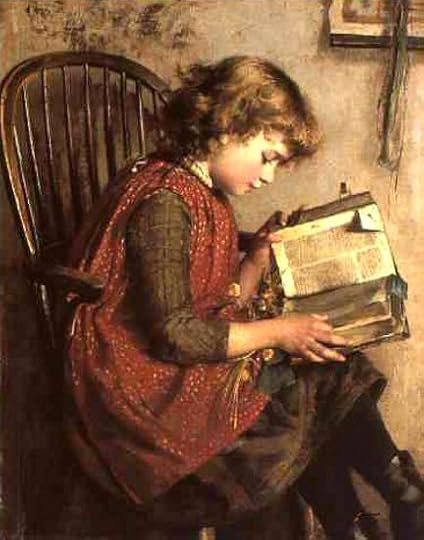
I reread the novel in my old hardback that is long since out of print. I did go to a store, however, to consult this Barnes & Noble edition that I am ostensibly reviewing here. It has a simply gorgeous (and apt) picture on the cover. But it largely fails where I hoped it would be helpful, in providing notes on the numerous unfamiliar words and concepts. While there are indeed some notes, they are lamentably few, even for someone like me who has some experience in historical reading. [And of course, not having the actual volume, I have not read the additional stories it contains.]
Profile Image for Allison.
27 reviews
April 14, 2022
really torn between 3 and 4 stars. i liked it but i’m not dying to reread it anytime soon, so 3 it is.
250 reviews27 followers
May 25, 2019
Why tf do people seem to hate George Eliot? I really enjoyed Silas Marner, The Lifted Veil, and to a lesser degree because it was so short, BRother Jacob.

I think what I appreciated most is that these stories are dense yet still light, entertaining while still exploring the psychology of character, and most of all, they have satisfying conclusions that feel good to read. And i mean that in a different way than if I said the endings were good - because some of the writing at the end felt oddly abrupt, but it's the plot, with all the ends tied together prior to the stylistic conclusion of the book, that felt just...right. I think half of it to me is people getting their due. This is idealistic writing, and so deeply satisfying as a result.

For Silas Marner in particular I found myself rooting for almost all of the characters, at its heart this was a story about a lonely man, and there was something that just will always tug at my heartstrings about that storyline. The Lifted Veil was completely different, an odd sort of magical realism that felt like a study of human character and I ate it up as well. It had some wonderful musings on life and how we as humans treat each other and made me think.

Here's the thing about Eliot - it's not easy text to read. There were paragraphs where I had to read a few times to glean the information, and I don't think it's Eliot's fault per se, just a change in language over time and the need for more philosphoical points to be thought over and considered. I found value in this, but I feel like this is the part of her writing that stops people in their tracks. It takes work and effort, it is not a casual read. It's like watchiong a foreign show with subtitles where you have to pay attention vs. the easy tv browsing many of us do today while half an eye is on tumblr or our own thoughts. I sound like a crotchety old get off my lawn person but I do feel there is a time and a place for both easy consumption AND works that require slower consideration, that's all I'm saying, and that's what this book reminded me of. I'm so glad I started reading classics a few years ago after never touching them prior, and I find myself looking forward to the next!
Profile Image for Tyler.
147 reviews12 followers
October 25, 2023
Haunting and lovely, a beautiful book for the month of October. George Eliot is one of our wisest writers; the four stars instead of five here is only because this book is a sapling, not a tree, and I can only imagine how good it would be if she had written it later in on her life
Profile Image for tortoise dreams.
1,231 reviews59 followers
July 29, 2021
An excellent collection of George Eliot's short fiction. Her other novels start at five hundred pages and grow from there. Here we have Silas Marner (1861), which can be called a novella and is her only major work that can be taught comfortably in school. Accordingly, it's well known (how many short works are especially famous for that very reason) and oft read with only Eliot's skill keeping it from being overly sentimental. The other two pieces are lengthy short stories, "The Lifted Veil" (1859) and "Brother Jacob" (1864). Her only short stories, both are different from Eliot's other work and reveal hidden facets. The first is Gothic, supernatural, and uniquely narrated in the first person, male no less. Thematically it's contrary to her other works. The second story is humorous and satiric, acidic. As a moral allegory it's more suited to her more famous works, but the relentless comic aspects are distinct. Both shorter pieces seem ripe for discussion in comparison and contrast to Eliot's more established novels.
Profile Image for Sara Anne Taylor.
250 reviews34 followers
July 3, 2025
This was my brother‘s choice for our sibling book club and I was so excited because it was already on my shelf waiting to be read for much longer than I care to admit. 🤣

I am happy to say, this book was worth the wait! Both beautifully written and deeply moving, it explored themes of redemption, love, and the importance of community. The story of a reclusive weaver whose life is transformed by the unexpected arrival of a child was both heartwarming and profound. With Eliot’s rich prose and insight into human nature, it’s understandable why this is considered a timeless classic. A truly rewarding read that will stay with me!

Recommend!
⭐️⭐️⭐️⭐️
Profile Image for Todd Price.
213 reviews1 follower
May 30, 2024
Like a classic tragedy, the tale of Silas Marner unfolds during the course of his unfortunate, though mostly uneventful life. Only a small number of misfortunes interrupt the daily monotony of his work as a country weaver, but those unfortunate incidents determine the course of his life for years. Eliot unfolds a touchingly human story of a man’s losses, closing him off from connection with others, but which is fated to be upended in a surprisingly redemptive manner.

Eliot’s style reminds one of works from other well known writers of the 19th Century, including Charles Dickens, Jane Austen, and Washington Irving. Silas Marner is reminiscent of Dickens’ “Great Expectations”, Jane Austen’s contemporary heroines of countryside England, and Irving’s “Sketchbook” observations of English countryside hamlets and villages.

The short stories “The Lifted Veil” and “Brother Jacob” bear remarkable resemblance to works by Edgar Allen Poe. Very engaging storylines and excellent writing.
Profile Image for Sandi.
402 reviews4 followers
March 19, 2022
This book was gifted to me several years ago, and I just read Silas Marner, not the other two short stories. I'm glad I read Middlemarch first, because had I read Silas Marner first, I doubt whether I would have attempted Middlemarch.

I did not care for the story line. Marner is unjustly accused in his early life and spends the rest of his life in despair practically living like a hermit. About 3/4ths of the way in, the story picks up, but not enough for me to get any further engaged. It was tough sledding all the way through!

Obviously there is much there to be appreciated from a literary standpoint, but it was lost on me.
Profile Image for Amanda.
105 reviews
Read
February 13, 2014
I had to write a paper about this for my lit class, so it is my review.


Profile Image for Leah Fischer.
131 reviews1 follower
March 11, 2022
3.5. My first George Eliot! She knows humans on an innate level and writes about them in long sentences, planning on reading Middlemarch
Profile Image for Jeni Enjaian.
3,444 reviews52 followers
March 1, 2015
It took me a little while to get into the title story. At first I found the narrative to be wordy and vague. I kept being distracted by the incredibly long paragraphs. Once I could devote a larger section of time to reading the book, it felt like the narrative had found its footing and moved forward at a steady, understandable pace. I still have a problem with the length of the paragraphs but such is the style of the time in which Eliot wrote. After reading the depressing Ethan Frome and selected short stories, I must admit that I expected an equally depressing tone and ending for Silas Marner. Thankfully, Eliot chose a more wholesome, uplifting ending. I cannot say the same for the second short story included in this work, "The Lifted Veil." It's because of this short story that I rated this particular edition with three stars instead of four. I found nothing redeemable about that story. I was also not fond of the third story "Brother Jacob" but did not object to it as much as "The Lifted Veil." Although the plot of "Brother Jacob" got lost somewhere in the middle, it found its footing in the end in which each character received a suitable comeuppance.
For those interested in reading the classics, I recommend this book. I care neither one way or the other in terms of recommendation for anyone else.
Profile Image for Anna.
378 reviews
April 9, 2010
I am glad to say I have read a novel by George Eliot. I have tried unsuccessfully to read Middlemarch many times, so I am glad I was able to read Silas Marner. But she just gives me way too many details about village life that I just cant get into and too much information about characters who are not involve dint he story at all. George Eliot is my favorite professor's favorite author, but I just cant get into her!
Profile Image for Becca.
237 reviews39 followers
December 27, 2012
So, this is the book I decided to read for AP Lit. And I liked it. For a school book, I really liked it. Especially after Eppie showed up. The ending was really good, and the plot was interesting. I liked Silas and Eppie, althought there were some characters I really didn't like. The biggest problem was all the fluff. Some parts just took FOREVER to read because of all the fluff or just being slow. Overall, I like the book a lot, but I probably wouldn't read it again.
Profile Image for Lauren.
424 reviews23 followers
March 27, 2019
"Unlike the gold, which needed nothing, and must be worshiped in close-locked solitude--which was hidden away from the daylight, was deaf to the song of birds, and started no human tones --Eppie was a creature of endless claims, and ever-growing desires, seeking and loving sunshine, and living sounds, and living movements, making trial of everything , with trust in new joy, and stirring the human kindness in eyes that looked on her."

Silas Marner and Two Short Stories by George Eliot is a compilation of three works of fiction by Mary Anne Evans. Including one novella (Silas Marner), and two short stories ("The Painted Veil" and "Brother Jacob"), Silas Marner offers the reader a great deal of variety regarding genre. Eliot was capable of both gloomy and dark Gothic fantasy in "The Paint Veil" and satirical comedy in Brother Jacob. "The Painted Veil" follows a young man with clairvoyant glimpses of the future, who, though he knows how terrible and bleak a future will be with a charming, mysterious young woman, can't help but feel compelled to marry her anyway. "Brother Jacob" follows a young man named David who steals from his family in order to finance a trip to the Indies that could change his fortunes. He changes everything about himself in the hope of starting a new life with better prospects. However, what he can't anticipate is that his "idiot" Brother Jacob will follow him to the ends of the earth, and David's new identity therefore won't be lasting long.

The real star of the show, however, is Silas Marner. I absolutely adored this little novella. Silas Marner follows a old weaver who has become disillusioned with the world and hoards and admires his gold night after night. One day though the gold is stolen from Marner's cottage. Marner is devastated. A day later a little girl with golden hair wanders into his cottage from the cold to sit by his fire. Convinced this is a sign, Marner adopts the girl and raises her from a toddler. He names her Eppie and together they grow into a loving, supportive, father-daughter team. What Marner can't anticipate, however, is that in the wings is Eppie's biological father who decides he wants to claim her after fifteen years. How will Eppie react? What will Marner do? Will they still be a family?

Silas Marner really was the cutest story. I loved the lesson on the importance of family and being a part of a community. Marner and Eppie's relationship was just adorable and reading this story was so comforting--like a bowl of chicken soup. It's a testament to Eliot's strength as a writer that her stories are really that timeless. I enjoyed also "The Painted Veil" and "Brother Jacob" for other reasons. "The Painted Veil" was intriguing, mysterious, and morbid in the perfect manner for a Gothic fantasy. "Brother Jacob" was silly and comical, especially making me giggle towards the end of the story. Overall I would give Silas Marner and Two Short Stories four out of five stars. I truly enjoyed picking up another classic, and book by George Eliot and can't wait to do it again.
Profile Image for Jonathan Koan.
858 reviews793 followers
February 25, 2019

I'm so glad I re-read this book. I originally read it in Mrs. Brock's 10th Grade English Class. I remember having strong feelings about it, but I didn't really value it as much as I do now.

The story of Silas Marner actually seems to be one of the most powerful classics emotionally for me. I think that one reason that this book stands the test of time is the story of redemption. It's interesting reading in the notes(of the Barnes and Noble edition) that this was written during the time when George Eliot(Mary Anne Evans) had left Christianity and eventually come back to it. The story of Silas Marner follows a strange pattern to Evans personal life.

I think that this story has influenced several of my favorite recent stories. The concept of a lonely recluse who watches over a child and has limited interaction with others is a trope used heavily in JJ Miller's novel, "Kenobi" and the concept of the adopted child representing the main character's heart is used in James Mangold's film, "Logan".

The reason that I think that I value this book is that I value this book is that in some ways I used to identify with Marner. I've moved to new places before and not known anyone there and felt lonely before. However, like Marner, I've learned to make use of the friendships available to me...sorry, I seem to have gotten carried away there...

Anyway, this gets the highest I've ever given a classic novel. It would get 7.1 out of 10, but since it's a classic, it gets the bonus point and gets a 8.1 out of 10! Highly Reccomended.
Profile Image for Sarah.
241 reviews
September 11, 2023
Silas Marner surprised me. when i first read the book in high school, i rolled my eyes and declared it the "most boring book i've ever read." throughout college, also, i beat down silas because "who ever wanted to read about a stupid weaver"? very very harsh of me, i know, but i mention that to say this: the repeating arc in the story of Silas's "inward metamorphosis" holds so much redemption for me. if you're familiar with the story, you know it begins with silas being framed and consequently losing his faith in not only humanity but also God. silas moves to a different town, becomes a miser, and worships his treasure trove of coins, hidden in the floorboards of his house. those coins are taken from him, but soon replaced by a darling little girl he names Eppie. i found the redemption in his own "metamorphosis" to be so sweet: once so isolated and lonely, silas now has a child to pour all the unused love he'd held inside the past decade or so. if that isn't redemption, what is?

The Lifted Veil was a dark and brooding story of visions and fantasy that i very much enjoyed. reminiscent of edgar allen poe, it kept me on the edge of my seat.

Brother Jacob was an interesting story about a conniving confectioner who was ashamed of his brother. it calls to mind that old saying: "oh what a tangled web we weave when first we practice to deceive."
Profile Image for Teresa Osgood.
Author 3 books4 followers
January 7, 2021
Silas Marner was mentioned, in some other book I read recently, as a sort of gateway classic. I have no problem with the classics, but I realized I'd never read anything by George Eliot, and decided to give it a go. It's pretty good, with interesting characterizations, delightfully rustic dialogue, and musings on the consequences of people's various choices. And now I can see that The Storied Life of A.J. Fikry is totally a modern riff on Silas Marner.

The first of the Two Short Stories began too drearily for me to go on, but "Brother Jacob" is an insightful study of a very selfish young man, and the truth he can't escape.
Profile Image for George.
109 reviews
November 10, 2017
Wonderful novel! I read "Silas Marner" many years ago (maybe in high school). I very much enjoyed reading it again. I also rented the movie version, staring Ben Kingsley as Marner. It was very good, but I liked the book more. The movie DVD came with an hour-long biopic of George Eliot (Mary Anne Evans), which was excellent!! I would rent the DVD again just to see the George Eliot life story a second time.
Profile Image for Jim.
475 reviews11 followers
January 8, 2018
A quaint little fairy tale of a novella. Not particularly exciting but a nifty little moralistic tale about provincial early 19th century England. At least I can now claim that I’ve read a George Eliot novel. As for the two included short stories, I couldn't make it past the 10th page of either one. For aficionados only, I suppose. How could anyone subject high school students to this as required reading?
27 reviews1 follower
February 4, 2022
Great book! I am a Highschool freshman and I read this for my English class. It exceeded my expectations. It is incredibly wordy (just an issue with reading older novels) and I was worried that it would be unenjoyable, but it turned out pretty good! The plot moves along at a good rate, and it has plenty of foreshadowing and plot twists. If you can get over the lengthy/wordy paragraphs and focus on the plot and themes, it’s an excellent book.
Profile Image for Molly.
98 reviews37 followers
January 27, 2018
THIS IS NOW MY FAVORITE CLASSIC!! I loved this story so much. George Eliot’s writing was so deep and powerful. I could reread this book a thousand times and get new lessons from it each time. Please do read this book. It’s heartwarming and the characters are complex and such a great edition to her writing. (If you didn’t know, George Eliot is a pen name. The author is actually a woman!) I love this story to pieces.
Yes this book was for high school, but if you go into it with a positive mindset, you will notice how hilarious the banter between the characters are and the wonderful symbols that play a huge part in this novel. I’m so glad I read this for school!
Profile Image for Jeremiah Cobra.
Author 7 books31 followers
August 6, 2020
This is a beautiful, poetic, and light-hearted story with a tremendous insight into the nature of human beings and the importance of human connections. At times the story relies on happenstance to further the plot (which is a minor pet-peeve of mine), but overall I found it hard not to be delighted by Sila’s quest for love and friendship.
Profile Image for Amanda Himes.
271 reviews16 followers
July 26, 2024
Silas Marner is a solid 5 stars. A happy ending from George Eliot--yay!!
-and-
The Lifted Veil -- 3.5; weird protagonist.
Brother Jacob -- 2 stars. The "idiot brother" was treated as less of idiot than the thieving protagonist, but still. Not all that funny.
Profile Image for soleil.
136 reviews14 followers
October 11, 2017
This book was pleasant and had some very good quotes. Enjoyable.
(Also, I really love this edition. The cover is gorgeous.)
Profile Image for Cooper Renner.
Author 24 books57 followers
July 3, 2018
Silas Marner is very fine indeed. The two stories good but not quite Marner ‘s equal. Brother Jacob is more entertaining than Lifted Veil.
Profile Image for Grace Steele.
22 reviews1 follower
June 17, 2020
How I adore George Eliot. This was the first book I read of hers, and it got me hooked on her. How I love Silas and Eppie.
Displaying 1 - 30 of 51 reviews

Can't find what you're looking for?

Get help and learn more about the design.