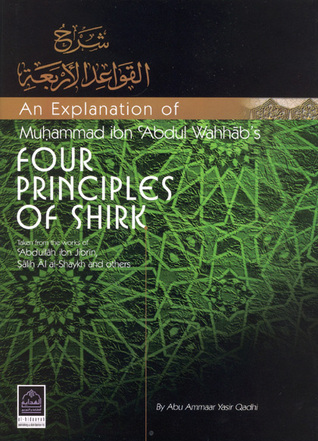
An Explanation of Muhammad ibn Abdul Wahhab's Four Principles of Shirk By Tr Abu Ammar Yasir Qadhi In this book, the author explains the dangerous concept of shrik through four simple principles. The sin of shirk - or associating partners with Allah - is the most reprehensible act that a person can do. It is for this reason that this sin is the one sin that Allah has promised He will never forgive. Unfortunately, many Muslims who are unaware of the reality of shirk fall into it out of ignorance. This short treatise is an ideal work for the Muslim in order to understand the essence of shirk, and thus essential reading for the one who wishes to avoid falling into the greatest trap of Shaytan. The explanation of the work of Muhammad ibn `Abd al-Wahhab has been taken from the works of Ibn Jibrin, Salih Al al-Shaykh, and other major scholars
Dr. Yasir Qadhi is a prolific author and Islamic teacher who has written several books about Islam. He is a popular speaker in many Muslim circles in the United States, Canada, England and Australia. His lectures at different locations can be found on YouTube. He is one of the few people who has combined an Islamic seminary training (from Islamic University of Madinah) with Western education (from universities of Houston and Yale).
Dr. Qadhi was born in Houston, Texas, to Pakistani parents, in 1975, went to high school in Jeddah, Saudi Arabia, graduating valedictorian of his class, and completed a Bachelor of Science in Chemical Engineering from the University of Houston. After working for Dow Chemical for a short stint, he decided to pursue an education in Islamic studies, and left for the Islamic University of Madinah. There, he completed a second bachelor's degree, specializing in hadith studies, and then went on to complete an M.A. in Theology. Presently, he is in the final stages of completing his Ph.D in Religious Studies from Yale University in New Haven, Connecticut.
He is the Dean of Academic Affairs and an Instructor in the AlMaghrib Institute. He appears on a number of Islamic satellite channels (Islam Channel in England; Al-Huda Channel in Egypt; Al-Fajr Channel in Egypt; and Peace TV in India, U.K and U.S), where he teaches theology, Seerah, Tajweed, and other topics. He gives regular sermons and lectures. He also blogs at MuslimMatters.org, where he is the group-blog's lead specialist.
The summary of this book is all about two things: 1: To know the Religion that our Prophet Muhammad PBUH came with. 2: To know the situation of the pagans and the polytheists in which The Messenger PBUH was sent to.
I was quite disappointed. While the topic itself is of immense importance in ‘aqīdah, this book adds very little depth beyond what one would already know from basic defination of "shirk".
The content feels unnecessarily extended — the pages are thick, the Arabic text large, and many quotations/paragraphs are repeated throughout. The author himself admits that the “four principles” could fit on a single page, and that seems accurate. Instead of elaborating with fresh insights, examples, or scholarly analysis, the explanations often circle back to the same statements in different words covering 60 pages total.
The language used is simple but lacks the precision or weight expected of a treatise on tawḥīd and shirk. What should have been presented as concise, clarifying principles instead reads as repetitive commentary. In essence, this work might have been more effective as a short talk, pamphlet, or podcast episode rather than a full hardcover publication.Therefore, it's literature component could have improved and simplified to 5 pages with solid facts- or a smaller book.
While I do not wish to discredit anyone’s effort in teaching about shirk, this book unfortunately does not deliver meaningful expansion of knowledge. Its presentation and depth do not justify its length, cost, or place on a serious student’s bookshelf.