

What do you think?

After the Ice: Life, Death, and Geopolitics in the New Arctic
New from Smithsonian Books, After the Ice is an eye-opening look at the winners and losers in the high-stakes story of Arctic transformation, from nations to native peoples to animals and the very landscape itself. Author Alun Anderson explores the effects of global warming amid new geopolitical rivalries, combining science, business, politics, and adventure to provide a fascinating narrative portrait of this rapidly changing land of unparalleled global significance.
304 pages, Hardcover
First published November 12, 2009
Ratings & Reviews
Friends & Following
Create a free account to discover what your friends think of this book!
Community Reviews
Displaying 1 - 25 of 25 reviews

May 20, 2010
This is a must read for anyone who is interested in international affairs, ecological threats or climate issues. The changes that are taking place in the Arctic will have great impact on the rest of the world. Alun Anderson offers a look at various aspects of that change with an eye to the potential dangers and benefits.
Anderson looks first at the people who inhabit the north, the Inuit, whether in Canada, Greenland, the USA or Russia, reports on the issues faced by local residents, their hopes for the future and the challenges they face.
Next he writes about the alarming decline in arctic ice coverage, looking at several of the factors that contribute to the change. The obvious decreases in area covered by ice does not take account of the decrease in ice depth or age. New ice is shallower, more susceptible to melting and, being lighter, is more easily pushed to warmer seas by arctic winds.
How will Arctic territorial claims by the several nations with Arctic borders be resolved? How much of the Arctic is national territory and how much is international waters? Who will have a say in how conflicting claims are resolved?
Oil drilling in the Arctic. Is it possible? If so, how will it be done, how much, by whom, with what benefits and what risks.
So much information here, and so many questions. There are opportunities to adapt, but the potential dangers are, well, chilling.
UPDATES
10/18/11 - NY Times article - Warming Revives Dream of Sea Route in Russian Arctic
05/06/12 - The scientists at Germany’s Max Planck Institute for Meteorology have come up with yet more confirmation for global warming being the cause of Arctic de-icing.
5/23/2012 - Obama OKs Arctic Drilling
7/2/2012 - What to expect with spills in the Arctic - Shell Clarifies: It can 'Encounter' 95 Percent of an Arctic Oil Spill, Not Collect It
8/28/2012 - NY Times article - Satellites Show Sea Ice in Arctic Is at a Record Low
6/22/14 - The name Hank Paulson might ring a bell from the economic collapse of the late Bush administration. He is now counseling the world to not ignore the signs of impending climate disaster the way he did the signs of impending economic meltdown when he was in office. In this small NY Times article, he sees an opportunity for the USA and China to work together to make a difference. The piece is titled, The Coming Climate Crash, and I am certain Paulson is sincere, but in the absence of any gray matter in today's nihilistic, scorched-earth Republican Party, no common sense recommendations have a prayer when they have to compete with what he calls short-termism. Of course Paulson engages in the sort of self-serving, narrow-view interpretation of the past that one can expect from Republicans who have been bounced out of the public sphere (see recent pronouncements from professional liar Dick Cheney, griping about ISIS miseries in Iraq), somehow ignoring true details of their involvement in creating the messes they would have the rest of us pay to clean up now. He ignores the corruption that was inherent in causing the economic crash at his peril. All that said, it is encouraging whenever one of the dark-side sorts sees the light on any policy matter of substance. And while there is certainly room for debate on whether the carbon tax is the best approach to reducing emissions, it is encouraging that he is one Republican who seems ready to set aside the politics of blame-the-black-guy to seek actual solutions. Take it all with a grain of salt. Paulson will not be facing voters, ever, so can say things that politicians faced with the Deliverance demographic and the desire for Koch Brothers support would never admit to. Science is real. It is getting corrupt legislators to vote in the actual interests of their voter-constituents and not merely serve the demands of their funder-constituents that is the real challenge. And all the research in the world, and intelligent policy planning will not move that mountain. Still, it is a net positive to hear from a Republican that reality exists and should be addressed. It is a rare thing and should be cherished.
October 9, 2015 - This LA Times article, What Exxon knew about the Earth's melting Arctic, By SARA JERVING, KATIE JENNINGS, MASAKO MELISSA HIRSCH AND SUSANNE RUST lets us know what Exxon knew and when they knew it as regards global warming. Yet another sociopathic corporation lying to the public with a straight face. Strong stuff.
November 2015 - The latest National Geographic focuses on global warming. It includes this story about How Melting Ice Changes One Country’s Way of Life
Although the book here is about the Arctic, there is plenty going on in Antarctica as well. You mighr want to check out Countries Rush for Upper Hand in Antarctica, a NY Times Magazine piece By Simon Romero, with photographs by Daniel Berehulan, about the international competition going on right now for for resources real and potential at the bottom of the world.
The March 2016 issue of National Geographic magazine has an amazing article about the challenges and dangers of resource extraction in the Arctic - In the Arctic’s Cold Rush, There Are No Easy Profits - By Joel K. Bourne, Jr. - Photographs by Evgenia Arbugaeva - check it out
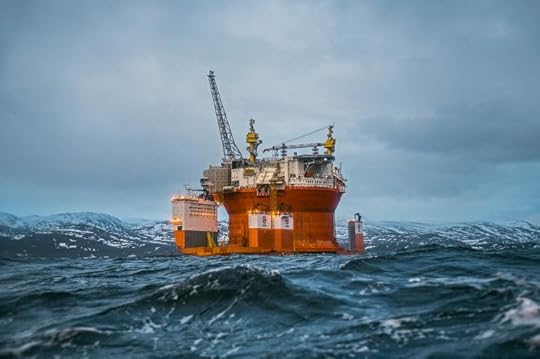
The new Goliat platform awaits commissioning in a fjord near Hammerfest, Norway, last April. Now moored in the Barents Sea at 71° north, it’s the world’s northernmost offshore oil platform. -= from the NatGeo article
September 19, 2016 - Arctic Ice Shrinks to Second Lowest Level on Record by The Associated Press - in the New York Times
March 22, 2017 - Washington Post - The Arctic just set a grim new record for low levels of sea ice - by Chris Mooney
April 26, 2017 - National Geographic - An interesting piece on the vulnerability of once-frozen archaeological relics to thawing and increasingly destructive erosion by a tumultuous Bering Sea -
Alaska’s Thaw Reveals—and Threatens—a Culture’s Artifacts - by A. R. Williams -- Photographs by Erika Larsen
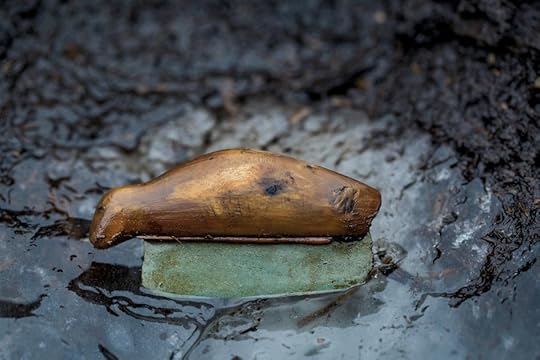
This centuries-old ulu, or cutting tool, was plucked from the thawing ground at Nunalleq. Embodying the native Yupik belief that everything is constantly in transition, the handle can be seen as either a seal or a whale.
October 2017 - National Geographic Magazine - They Migrate 800 Miles a Year. Now It’s Getting Tougher, By Gleb Raygorodetsky - on the Nenets, reindeer herders of the Russian Arctic, and how their lives are being impacted by global warming and development
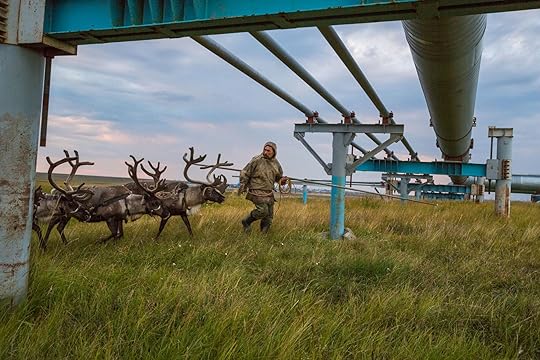
A Nenet herder leading his charges past a Russian gas pipeline - from the above article - photo by Evgenia Arbugaeva
November 25, 2017 - NY Times - Why Lost Ice Means Lost Hope for an Inuit Village - by Livia Albeck-Ripka
January 2018 - National Geographic Magazine - Last Ice - The Arctic’s perennial sea ice cover—the ice that survives the summer melt season—has shrunk dramatically - by Tim Folger
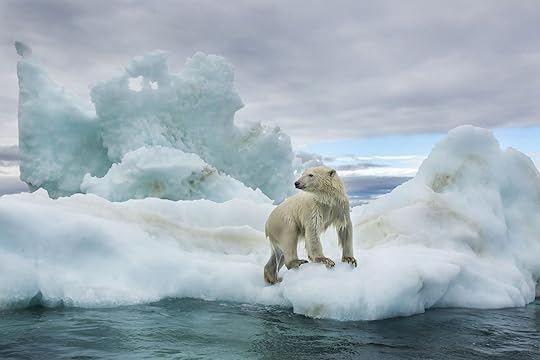
Dripping wet, a polar bear climbs onto an ice floe in northernmost Hudson Bay. Polar bears perch on sea ice to ambush seals—the source of 90 percent of their calories—when the seals surface. National Geographic Explorer-in-Residence Enric Sala is leading an effort to preserve some of the bears’ dwindling habitat. “In Russia we found bears stuck on islands eating grass and seabirds,” he says.
(text from NatGeo - photo by Paul Souders) - from the above article
February 22, 2018 - Washington Post - Arctic temperatures soar 45 degrees above normal, flooded by extremely mild air on all sides - by Jason Samenow
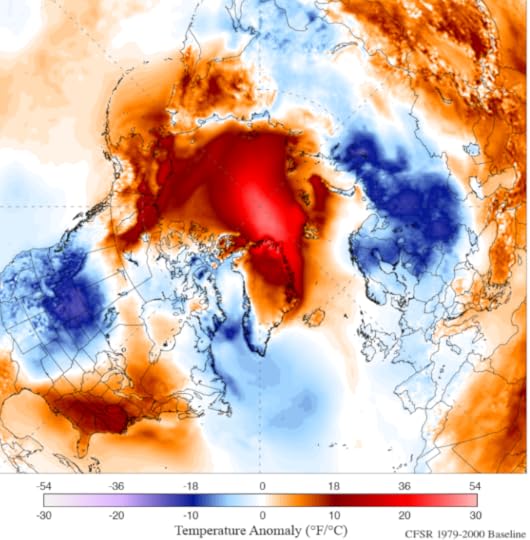
The temperature difference from normal over the Arctic averaged over the next five days in the GFS model forecast. (University of Maine Climate Reanalyzer)
March 23, 2018 - National Geographic - Arctic Sea Ice Is Second-Lowest on Record - by Craig Welch
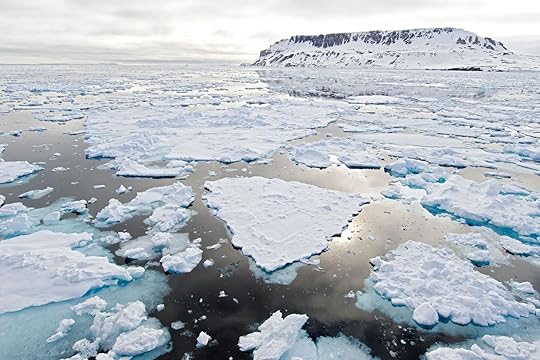
Arctic ice is getting thinner as the planet warms - Photograph by Rich Reid, National Geographic Creative - from above article
January 21, 2019 - NY Times - Greenland’s Melting Ice Nears a ‘Tipping Point,’ Scientists Say - by John Schwartz
Anderson looks first at the people who inhabit the north, the Inuit, whether in Canada, Greenland, the USA or Russia, reports on the issues faced by local residents, their hopes for the future and the challenges they face.
Next he writes about the alarming decline in arctic ice coverage, looking at several of the factors that contribute to the change. The obvious decreases in area covered by ice does not take account of the decrease in ice depth or age. New ice is shallower, more susceptible to melting and, being lighter, is more easily pushed to warmer seas by arctic winds.
How will Arctic territorial claims by the several nations with Arctic borders be resolved? How much of the Arctic is national territory and how much is international waters? Who will have a say in how conflicting claims are resolved?
Oil drilling in the Arctic. Is it possible? If so, how will it be done, how much, by whom, with what benefits and what risks.
So much information here, and so many questions. There are opportunities to adapt, but the potential dangers are, well, chilling.
UPDATES
10/18/11 - NY Times article - Warming Revives Dream of Sea Route in Russian Arctic
05/06/12 - The scientists at Germany’s Max Planck Institute for Meteorology have come up with yet more confirmation for global warming being the cause of Arctic de-icing.
5/23/2012 - Obama OKs Arctic Drilling
7/2/2012 - What to expect with spills in the Arctic - Shell Clarifies: It can 'Encounter' 95 Percent of an Arctic Oil Spill, Not Collect It
8/28/2012 - NY Times article - Satellites Show Sea Ice in Arctic Is at a Record Low
6/22/14 - The name Hank Paulson might ring a bell from the economic collapse of the late Bush administration. He is now counseling the world to not ignore the signs of impending climate disaster the way he did the signs of impending economic meltdown when he was in office. In this small NY Times article, he sees an opportunity for the USA and China to work together to make a difference. The piece is titled, The Coming Climate Crash, and I am certain Paulson is sincere, but in the absence of any gray matter in today's nihilistic, scorched-earth Republican Party, no common sense recommendations have a prayer when they have to compete with what he calls short-termism. Of course Paulson engages in the sort of self-serving, narrow-view interpretation of the past that one can expect from Republicans who have been bounced out of the public sphere (see recent pronouncements from professional liar Dick Cheney, griping about ISIS miseries in Iraq), somehow ignoring true details of their involvement in creating the messes they would have the rest of us pay to clean up now. He ignores the corruption that was inherent in causing the economic crash at his peril. All that said, it is encouraging whenever one of the dark-side sorts sees the light on any policy matter of substance. And while there is certainly room for debate on whether the carbon tax is the best approach to reducing emissions, it is encouraging that he is one Republican who seems ready to set aside the politics of blame-the-black-guy to seek actual solutions. Take it all with a grain of salt. Paulson will not be facing voters, ever, so can say things that politicians faced with the Deliverance demographic and the desire for Koch Brothers support would never admit to. Science is real. It is getting corrupt legislators to vote in the actual interests of their voter-constituents and not merely serve the demands of their funder-constituents that is the real challenge. And all the research in the world, and intelligent policy planning will not move that mountain. Still, it is a net positive to hear from a Republican that reality exists and should be addressed. It is a rare thing and should be cherished.
October 9, 2015 - This LA Times article, What Exxon knew about the Earth's melting Arctic, By SARA JERVING, KATIE JENNINGS, MASAKO MELISSA HIRSCH AND SUSANNE RUST lets us know what Exxon knew and when they knew it as regards global warming. Yet another sociopathic corporation lying to the public with a straight face. Strong stuff.
November 2015 - The latest National Geographic focuses on global warming. It includes this story about How Melting Ice Changes One Country’s Way of Life
Although the book here is about the Arctic, there is plenty going on in Antarctica as well. You mighr want to check out Countries Rush for Upper Hand in Antarctica, a NY Times Magazine piece By Simon Romero, with photographs by Daniel Berehulan, about the international competition going on right now for for resources real and potential at the bottom of the world.
The March 2016 issue of National Geographic magazine has an amazing article about the challenges and dangers of resource extraction in the Arctic - In the Arctic’s Cold Rush, There Are No Easy Profits - By Joel K. Bourne, Jr. - Photographs by Evgenia Arbugaeva - check it out
The new Goliat platform awaits commissioning in a fjord near Hammerfest, Norway, last April. Now moored in the Barents Sea at 71° north, it’s the world’s northernmost offshore oil platform. -= from the NatGeo article
September 19, 2016 - Arctic Ice Shrinks to Second Lowest Level on Record by The Associated Press - in the New York Times
March 22, 2017 - Washington Post - The Arctic just set a grim new record for low levels of sea ice - by Chris Mooney
April 26, 2017 - National Geographic - An interesting piece on the vulnerability of once-frozen archaeological relics to thawing and increasingly destructive erosion by a tumultuous Bering Sea -
Alaska’s Thaw Reveals—and Threatens—a Culture’s Artifacts - by A. R. Williams -- Photographs by Erika Larsen
This centuries-old ulu, or cutting tool, was plucked from the thawing ground at Nunalleq. Embodying the native Yupik belief that everything is constantly in transition, the handle can be seen as either a seal or a whale.
October 2017 - National Geographic Magazine - They Migrate 800 Miles a Year. Now It’s Getting Tougher, By Gleb Raygorodetsky - on the Nenets, reindeer herders of the Russian Arctic, and how their lives are being impacted by global warming and development
A Nenet herder leading his charges past a Russian gas pipeline - from the above article - photo by Evgenia Arbugaeva
November 25, 2017 - NY Times - Why Lost Ice Means Lost Hope for an Inuit Village - by Livia Albeck-Ripka
January 2018 - National Geographic Magazine - Last Ice - The Arctic’s perennial sea ice cover—the ice that survives the summer melt season—has shrunk dramatically - by Tim Folger
Dripping wet, a polar bear climbs onto an ice floe in northernmost Hudson Bay. Polar bears perch on sea ice to ambush seals—the source of 90 percent of their calories—when the seals surface. National Geographic Explorer-in-Residence Enric Sala is leading an effort to preserve some of the bears’ dwindling habitat. “In Russia we found bears stuck on islands eating grass and seabirds,” he says.
(text from NatGeo - photo by Paul Souders) - from the above article
February 22, 2018 - Washington Post - Arctic temperatures soar 45 degrees above normal, flooded by extremely mild air on all sides - by Jason Samenow
The temperature difference from normal over the Arctic averaged over the next five days in the GFS model forecast. (University of Maine Climate Reanalyzer)
March 23, 2018 - National Geographic - Arctic Sea Ice Is Second-Lowest on Record - by Craig Welch
Arctic ice is getting thinner as the planet warms - Photograph by Rich Reid, National Geographic Creative - from above article
January 21, 2019 - NY Times - Greenland’s Melting Ice Nears a ‘Tipping Point,’ Scientists Say - by John Schwartz

May 10, 2022
Many books about the Arctic leave the impression that this only involves Russia, Canada and the USA. Anderson gives significant time to Greenland, Svalbard and Norway.
This book deals, at length, with the facts and the treaties that frame actions taken (and to be taken) in this region.
There is a lot to learn about ice: from type to vulnerability. [This book is a decade old, and what is astounding is how far off the predictions about an “ice free” Arctic summer were.]
Still relevant and worth reading but you WILL want to update some issues including recent developments in geopolitics. 3.5*
This book deals, at length, with the facts and the treaties that frame actions taken (and to be taken) in this region.
There is a lot to learn about ice: from type to vulnerability. [This book is a decade old, and what is astounding is how far off the predictions about an “ice free” Arctic summer were.]
Still relevant and worth reading but you WILL want to update some issues including recent developments in geopolitics. 3.5*

October 13, 2016
While many of our politicians find it in their interest to deny climate change, residents, scientists, oilmen, shippers and even tour guides in the Arctic Circle are living with it. Biologist and science/nature writer and editor, Alun Anderson, covers the issues related to warming in the Arctic Circle. While the book is 6 years old, it was an eye opener for me regarding the history, the ecology and the economics of the region.
I was totally unaware of the 1953 relocation of Canada’s Inuit (so Canada could maintain its Arctic claims) or Svalbard’s history of whales and international competition, or how the Yamal Nenet reindeer herders in Russia fared under communism and back to capitalism, nor of the many abandoned mining towns.
The plight of the polar bear is well publicized but, the warm water pouring into the Arctic is bringing in new predators. The changing the waters of the Atlantic and Pacific have wide implications such as abundant fish off the coast of Greenland and the difficulty of restoring cod fishing in the Canadian Maritimes.
The dawn of “ice free” summers brings more shipping, the possibility of more oil exploration and has led to the development of $1.2 billion combination tankers and ice cutters.
Development is moving faster than an institutional infrastructure. As of the writing of the book, and according to Wikipedia, which I checked today, the territorial claims of the 5 nations (Canada, Denmark/Greenland, Finland, Russia and the US) have not been resolved, putting rights to shipping, oil exploration and a host of other governance questions in limbo.
This is a very informative book. It will be of interest to anyone interested in this region and the impact of climate change.
... added later...
Among the many things I learned.. (perhaps most people know this, but I didn't) a caribou is a reindeer. I was watching one of the Alaska reality shows where the men were desperate to hunt a caribou before winter set in. Interesting that the Alaskans have not developed herding like the Nenet. In today's world, the Nenet don't just take reindeer north for summer grazing... there are a meat packers there (along with the oil industry) so while they take some of the herd back south, the migration has some of the features of a cattle drive.

January 3, 2016
The main reason I didn't give this 5 stars is that it is already out of date, written in 2009, and things have proceeded at a terrifying pace toward its conclusion.And it is still one of the most comprehensive looks at the situation. He is trying to be clear, honest and calm to the extent he can. And sort of "fair and balanced" to the extent he can, which is to say he is trying to look for any hopeful signs he can.
This is the best review on Goodreads of it, with a few recent updates on related issues, from Will Byrnes: https://www.goodreads.com/review/show...
Anderson talks to everyone for this book, and visits everywhere relevant. He takes a layperson's position, though he is a science writer, to try to consolidate some of the science for those of us who need to know how to vote and how to be activists. He doesn't help us with many practical solutions, but he underscores the 2015 U. N. Climate Change summit resolution in Paris, one tiny step in the right direction all scientists already knew was necessary, that we have only one chance to save the planet, and even it is not a guarantee: To reduce carbon emissions drastically, and now. Now. But we have known this for fifty years. And now, we start to act on it.
Ten years ago, few knew it was possible that the Arctic ice would be gone in a hundred years. Almost no one could have predicted it would be gone in a quarter of that time, and almost no one still knows for sure what all the effects will be of the ice being gone, but we already know an incredibly complex ecosystem is being destroyed. And without questions sea levels are already rising as the global temperature is rising, and also as the ice goes, massive amounts of methane gas are released, there's an acceleration of the massive species die-off we are experiencing today, and so on.
Anderson tries to look for hope in places like a reviving tundra grasses project in Siberia, but this seems so far-fetched as to be sad. He also is bit annoying in talking about what the increase in oil production in the New Arctic might mean for the economic "progress" of the region. Maybe that's the most annoying thing in the book.
His stories of dying animals and ways of life are more vivid than any hopeful fantasy, which is not to say that the thousands of scientists working on the myriad problems are without all hope. He's a fine writer and researcher. The best book I ever read on the Arctic won a National Book Award, Arctic Dreams, by Barry Lopez, and in some ways even back then he foresaw some of what created the conditions for the end of the ice. I recommend both of these books, even if you feel you know what it will say already.
This is the best review on Goodreads of it, with a few recent updates on related issues, from Will Byrnes: https://www.goodreads.com/review/show...
Anderson talks to everyone for this book, and visits everywhere relevant. He takes a layperson's position, though he is a science writer, to try to consolidate some of the science for those of us who need to know how to vote and how to be activists. He doesn't help us with many practical solutions, but he underscores the 2015 U. N. Climate Change summit resolution in Paris, one tiny step in the right direction all scientists already knew was necessary, that we have only one chance to save the planet, and even it is not a guarantee: To reduce carbon emissions drastically, and now. Now. But we have known this for fifty years. And now, we start to act on it.
Ten years ago, few knew it was possible that the Arctic ice would be gone in a hundred years. Almost no one could have predicted it would be gone in a quarter of that time, and almost no one still knows for sure what all the effects will be of the ice being gone, but we already know an incredibly complex ecosystem is being destroyed. And without questions sea levels are already rising as the global temperature is rising, and also as the ice goes, massive amounts of methane gas are released, there's an acceleration of the massive species die-off we are experiencing today, and so on.
Anderson tries to look for hope in places like a reviving tundra grasses project in Siberia, but this seems so far-fetched as to be sad. He also is bit annoying in talking about what the increase in oil production in the New Arctic might mean for the economic "progress" of the region. Maybe that's the most annoying thing in the book.
His stories of dying animals and ways of life are more vivid than any hopeful fantasy, which is not to say that the thousands of scientists working on the myriad problems are without all hope. He's a fine writer and researcher. The best book I ever read on the Arctic won a National Book Award, Arctic Dreams, by Barry Lopez, and in some ways even back then he foresaw some of what created the conditions for the end of the ice. I recommend both of these books, even if you feel you know what it will say already.

September 17, 2012
Quotes that represent content from After the Ice by Alun Anderson
“ … until just a couple of years ago, we had no real idea that as the Arctic warmed, methane would begin fizzing out of its innards and into the atmosphere. Methane is a powerful greenhouse gas …Now we know that methane is bubbling out of ponds in the tundra and out of the Arctic’s shallow warming seas in places where it had never been seen before.
“The surface cover of ice trapped all the gases … It’s transparent so I could walk across the ice and see all these hot spots of methane bubbling . I knew how many there were and how strong they were …”
“The amount of methane proved far greater than anyone expected—and once again it hadn’t been included in any of the climate models. Plus, the lakes don’t stand still. The lake just grows … The Russian word for it is “eats the permafrost.” If you look along the edges of these lakes ... They are rough, as if someone is taking bites out of a cookie. The lake water is warmer and it migrates across the surface by eating the permfrost, digesting the materials and burping out the methane.”
“The methane is created when permafrost—the frozen ground just beneath the surface—melts, allowing microorganisms to break down its rich store of organic materials. ‘More methane increases global atmospheric temperature and causes more permafrost to thaw,’ say Walter.
“With any discovery like this, two questions immediately leap to mind: has anything similar happened before in Earth’s long history that might give up clues about what will happen next, and how big the impact might be? Walter looked back to the ‘scars of old lake basins’ that cover the Arctic … and found they corresponded with a surge in methane levels at a time when the earth was warming rapidly 14,000 year ago. Arctic lake methane might have been an important trigger in past climate change alongside methane from expanding wetlands. (14kya was the first of the three great floods)
“ … ocean cruises off the coast of Siberia … huge gas bubble clouds of methane in water columns in the Laptev Sea and the East Siberian Sea … Permafrost lies under 80 percent of the entire area … huge carbon pool is extremely vulnerable … These shallow seas have formed quite recently. Ancient permafrost, once part of the land, is now under the sea and may come into contact with water that can thaw it quickly. … the subsea permafrost is in a transition phase now … the permafrost is ‘failing to seal ancient carbon, which includes methane hydrates and natural gas.”
“Methane hydrates are Earth’s real climate bomb … Up in the Shetland Islands … Heading inland, you’ll find something very odd. There is a thin layer of what looks like sand … It was laid down when a tidal wave hit Shetland around eight thousand years ago … wave at least 100 feet deep … tsunami by underwater landslide off coast of Norway … One candidate for triggering that landslide is the warming of methane hydrates.”
“ … seabed methane hydrates … if they are warmed, they may be released in a sudden burst. And there are a lot of them …
BERENGIA : FROM “After the Ice” … “The Siberian tundra is particularly rich in carbon because it contains a special soil, yedoma. When much of the northern world was covered in glaciers, the lands of eastern Siberia remained free from ice and accumulated wind-blown loess that supported a rich, savanna-like grassland. In that era, these vast grasslands were home to mammoth, bison, horses, musk oxen, Siberian antelope, rhinoceroses, and Siberian tigers.
“The large mammals of Siberia did not just live in this grassland ecosystem, they also created and maintained it. Trampling hooves stop mosses from growing and encourage grass instead. Grass uses up a lot of water and dries out the soil. Herbivores eat the grass, digest it, and recycle nutrients to the soil quickly. That keeps the grass growing and develops a thick soil which is a rich sink for carbon. Without herbivores, the ecosystem shifts to a soggy tundra where mosses trap moisture in the ground. With the right number of herbivores the ecosystem moves toward grassland and stays there. … after humans wiped out large animals the steppe stopped being a rich sink for carbon, where grass and bones were building up a thick soil. Instead, that store of carbon froze up—and now it is waiting to be released back into the atmosphere.
“There are five hundred gigatons of carbon in the Siberian yedoma. It took thirty to forth thousand years to accumulate. We really don’t want to release it …
“ … until just a couple of years ago, we had no real idea that as the Arctic warmed, methane would begin fizzing out of its innards and into the atmosphere. Methane is a powerful greenhouse gas …Now we know that methane is bubbling out of ponds in the tundra and out of the Arctic’s shallow warming seas in places where it had never been seen before.
“The surface cover of ice trapped all the gases … It’s transparent so I could walk across the ice and see all these hot spots of methane bubbling . I knew how many there were and how strong they were …”
“The amount of methane proved far greater than anyone expected—and once again it hadn’t been included in any of the climate models. Plus, the lakes don’t stand still. The lake just grows … The Russian word for it is “eats the permafrost.” If you look along the edges of these lakes ... They are rough, as if someone is taking bites out of a cookie. The lake water is warmer and it migrates across the surface by eating the permfrost, digesting the materials and burping out the methane.”
“The methane is created when permafrost—the frozen ground just beneath the surface—melts, allowing microorganisms to break down its rich store of organic materials. ‘More methane increases global atmospheric temperature and causes more permafrost to thaw,’ say Walter.
“With any discovery like this, two questions immediately leap to mind: has anything similar happened before in Earth’s long history that might give up clues about what will happen next, and how big the impact might be? Walter looked back to the ‘scars of old lake basins’ that cover the Arctic … and found they corresponded with a surge in methane levels at a time when the earth was warming rapidly 14,000 year ago. Arctic lake methane might have been an important trigger in past climate change alongside methane from expanding wetlands. (14kya was the first of the three great floods)
“ … ocean cruises off the coast of Siberia … huge gas bubble clouds of methane in water columns in the Laptev Sea and the East Siberian Sea … Permafrost lies under 80 percent of the entire area … huge carbon pool is extremely vulnerable … These shallow seas have formed quite recently. Ancient permafrost, once part of the land, is now under the sea and may come into contact with water that can thaw it quickly. … the subsea permafrost is in a transition phase now … the permafrost is ‘failing to seal ancient carbon, which includes methane hydrates and natural gas.”
“Methane hydrates are Earth’s real climate bomb … Up in the Shetland Islands … Heading inland, you’ll find something very odd. There is a thin layer of what looks like sand … It was laid down when a tidal wave hit Shetland around eight thousand years ago … wave at least 100 feet deep … tsunami by underwater landslide off coast of Norway … One candidate for triggering that landslide is the warming of methane hydrates.”
“ … seabed methane hydrates … if they are warmed, they may be released in a sudden burst. And there are a lot of them …
BERENGIA : FROM “After the Ice” … “The Siberian tundra is particularly rich in carbon because it contains a special soil, yedoma. When much of the northern world was covered in glaciers, the lands of eastern Siberia remained free from ice and accumulated wind-blown loess that supported a rich, savanna-like grassland. In that era, these vast grasslands were home to mammoth, bison, horses, musk oxen, Siberian antelope, rhinoceroses, and Siberian tigers.
“The large mammals of Siberia did not just live in this grassland ecosystem, they also created and maintained it. Trampling hooves stop mosses from growing and encourage grass instead. Grass uses up a lot of water and dries out the soil. Herbivores eat the grass, digest it, and recycle nutrients to the soil quickly. That keeps the grass growing and develops a thick soil which is a rich sink for carbon. Without herbivores, the ecosystem shifts to a soggy tundra where mosses trap moisture in the ground. With the right number of herbivores the ecosystem moves toward grassland and stays there. … after humans wiped out large animals the steppe stopped being a rich sink for carbon, where grass and bones were building up a thick soil. Instead, that store of carbon froze up—and now it is waiting to be released back into the atmosphere.
“There are five hundred gigatons of carbon in the Siberian yedoma. It took thirty to forth thousand years to accumulate. We really don’t want to release it …

January 10, 2010
Did you guys watch the BBC series Planet Earth? If you didn’t, you totally should. It was amazing. My favorite episode was the one about the Arctic, although I positively sobbed at the part where they showed a hungry polar bear swimming in open water, miles from shore, in search of ice (where food – seals – would be). The narrator (I think it was Sigourney Weaver) explained that, due to global warming, the Arctic ice has been melting earlier and in larger quantities, which is making it more and more difficult for the polar bears to keep themselves fed.
Hearing this, it should come as no surprise that I have been intrigued by Alun Anderson’s new book After the Ice: Life, Death, and Geopolitics in the New Arctic. (Just check out the sad polar bear on the cover. It breaks my bleeding heart!) When my pals at HarperCollins included this book in the list of potential ones that I could review, I jumped at the chance.
Truth be told, I was worried that this would be a bit dry. After all, I don’t read a lot of non-fiction books, and usually when I do, they are biographies or memoirs. Instead, I couldn’t put it down, although that could be in large part because I find the effects of global warming terrifying. It is well-written, fascinating, and informative.
Anderson has compiled a virtual ton of information, yet somehow manages to make it easy for non-scientifically-minded folks like myself to process and understand. This book makes me want to go up to every single person who thinks global warming is not a threat and thump them on the head. It also makes me want to fight harder against my husband’s latest desire for an SUV.
My one complaint is that I wish Anderson had devoted a chapter to what individuals can or should do to help the situation, because it feels pretty bleak right now.
Hearing this, it should come as no surprise that I have been intrigued by Alun Anderson’s new book After the Ice: Life, Death, and Geopolitics in the New Arctic. (Just check out the sad polar bear on the cover. It breaks my bleeding heart!) When my pals at HarperCollins included this book in the list of potential ones that I could review, I jumped at the chance.
Truth be told, I was worried that this would be a bit dry. After all, I don’t read a lot of non-fiction books, and usually when I do, they are biographies or memoirs. Instead, I couldn’t put it down, although that could be in large part because I find the effects of global warming terrifying. It is well-written, fascinating, and informative.
Anderson has compiled a virtual ton of information, yet somehow manages to make it easy for non-scientifically-minded folks like myself to process and understand. This book makes me want to go up to every single person who thinks global warming is not a threat and thump them on the head. It also makes me want to fight harder against my husband’s latest desire for an SUV.
My one complaint is that I wish Anderson had devoted a chapter to what individuals can or should do to help the situation, because it feels pretty bleak right now.

February 17, 2019
This book was fascinating, well-organized, well-written, and painstakingly documented by Alun Anderson. The Arctic area has very complex factors: geography, ecology, political , cultural, economic, mining, and military. >>>>See OCT 2021 UPDATE AT END OF REVIEW.---->>>>
Since the book was published 10 years ago (2009), I frequently researched items for current 2019 information on the future of the Arctic. I was amazed at how much had been done over the years, how much more needs to be done, and how many countries are currently researching and taking positive steps. I didn’t know that the Arctic international borders have been defined and agreed upon, work is being done to reduce the short-term damage of carbon particle pollution, rules are in place to restrict unsafe vessels. The vessel activity in the area is being constantly monitored and emergency response plans are in place to help prevent predictable problems.
Recently I’ve been researching the development of nuclear power (and bombs) starting in the 1940’s. I’m particularly interested in learning how nuclear power is being used today and for what purposes. Arctic data collection was severely hampered because it took 40 years for some of the Top Secret information to be released. Countries have had a military presence in the Arctic from at least before WWII. Also, Russia exploded lots of nuclear bombs in the Arctic area.
Anderson had found “no experts on the Arctic and no grand source of knowledge” and wrote this book because “I needed to understand the new quarrels between nations over who owned the Arctic, where their borders should lie, and whether a boom in oil, gas, minerals, and shipping would transform the economy of the Arctic as the ice melted away.” He ended the book with some guarded optimism but reviewed the general complexities that are such challenge. He included sections on Sources and on Notes.
It was a concerted effort for me to read this e-book thoughtfully, but it was well worth it. I am a better citizen of the world now. Also, I see my local museum has a special exhibit right now of indigenous art from the Arctic and next month will feature Arctic photos.
A big thanks to Will Byrnes for recommending this book and writing such a thorough review.
OCTOBER 2021 UPDATEMy instructor in a Zoom class examining "TOPICS IN NATIONAL SECURITY" shared the newly released National Intelligence Council’s National Intelligence Estimate (NIE) on Climate Change and International Responses Increasing Challenges to US National Security Through 2040 (NIC-NIE-2021-10030-A). It’s about 22 pages of great information on the issues including details regarding the Arctic Ocean and you’ll get to see firsthand the type of intelligence document (NIE) that is used by the U.S. government (executive, congressional, and sometimes even judicial branches) to understand the issues and as a basis for making government policy. You’ll find the document at: https://www.dni.gov/files/ODNI/docume...

June 20, 2019
This is an excellent and well written book about the state of climate change, its consequences, and the future outlook for the Arctic. However, it was published in 2009. Things have moved rapidly since then and outstripped author Alun Anderson's optimistic point of view. Perhaps the biggest single negative fact since the book's publication was the election of Donald Trump in 2016 in the U.S. His decision to withdraw the U.S. from the Paris Agreement (on climate change) and the relaxing of pollution and emissions standards has distressingly set the U.S. and globe back. If I had one suggestion about "After the Ice" it would be for Alun Anderson or a collaborator to add an update to the book. Four stars from me instead of five that the book deserved in 2009.
Having said that, I learned a great deal from reading the book, much of it quite alarming. I am an Alaskan and over my lifetime I have seen confirmation of the alarm bells the scientists are raising about the future of our planet. I recommend the book.
Having said that, I learned a great deal from reading the book, much of it quite alarming. I am an Alaskan and over my lifetime I have seen confirmation of the alarm bells the scientists are raising about the future of our planet. I recommend the book.

April 19, 2011
2.5 stars
One thing this book immediately had going against it was the date it was published. 2009 may not seem that long ago but in the scientific world, especially in the realm of climate change, this actually makes the book dated. Another thing the book had going against it was that I have a lot of experience in the arena of climate change and the information contained within was not new to me (however I do have knowledge that the author never could considering the publishing date). Had I been new to the topic or not involved in science I may have reacted differently entirely. But I am well and wisely aware of the impacts of climate change. Although I sincerely hope the general population is ascertaining more info, perhaps with the help of books like this.
First of all, I did not feel as though there was enough science contained in the book. But I don't think the author was terribly comfortable with science, especially considering how often he was shocked (his term) by some of the findings. Granted they are often shocking (I'm a little immune at this point), but I think someone with more scientific knowledge would have been less inclined to be shocked but rather inclined to expand on the subjects further.
I did feel as though many of the chapter topics, while admittedly they do have an impact, were not as important to the topic of climate change as many other topics would be/are. Rather than entire (and rather dull) chapters on "Borders" or "People", Anderson should have included chapters on overall climate change, how other oceans are faring, methane and so forth.
Although Anderson's choices do bring up another issue, the narrow focus of the book in general added an element of naivete. Hopeful but naive comments such as the Arctic being a more productive ocean overall due to growing climate impacts were irritating. While this may be technically true it completely disregards the fact that our oceans overall are dying. The oceans are overrun with impacts of the human world: acidity, pollution, trash--especially plastic, overfishing, pharmaceuticals and I could go on and on. Yes, there will be more growth and "production" in the Arctic due to warming waters bringing in more beings of all varieties, but it completely misses the mark in terms of overall climate change.
A small gripe was the fact that many of the same graph and satellite imagery were used multiple times in the book when there were very few included period. I know there are MANY options out there in this area, many graphs and photos that could have elucidated the topic much better in fact.
Overall a dated book that was more for the novice when it comes to the impacts of warming in the Arctic. I do, however, recommend it to those new to climate change issues...but please expand from there, this is a very narrow scope.
One thing this book immediately had going against it was the date it was published. 2009 may not seem that long ago but in the scientific world, especially in the realm of climate change, this actually makes the book dated. Another thing the book had going against it was that I have a lot of experience in the arena of climate change and the information contained within was not new to me (however I do have knowledge that the author never could considering the publishing date). Had I been new to the topic or not involved in science I may have reacted differently entirely. But I am well and wisely aware of the impacts of climate change. Although I sincerely hope the general population is ascertaining more info, perhaps with the help of books like this.
First of all, I did not feel as though there was enough science contained in the book. But I don't think the author was terribly comfortable with science, especially considering how often he was shocked (his term) by some of the findings. Granted they are often shocking (I'm a little immune at this point), but I think someone with more scientific knowledge would have been less inclined to be shocked but rather inclined to expand on the subjects further.
I did feel as though many of the chapter topics, while admittedly they do have an impact, were not as important to the topic of climate change as many other topics would be/are. Rather than entire (and rather dull) chapters on "Borders" or "People", Anderson should have included chapters on overall climate change, how other oceans are faring, methane and so forth.
Although Anderson's choices do bring up another issue, the narrow focus of the book in general added an element of naivete. Hopeful but naive comments such as the Arctic being a more productive ocean overall due to growing climate impacts were irritating. While this may be technically true it completely disregards the fact that our oceans overall are dying. The oceans are overrun with impacts of the human world: acidity, pollution, trash--especially plastic, overfishing, pharmaceuticals and I could go on and on. Yes, there will be more growth and "production" in the Arctic due to warming waters bringing in more beings of all varieties, but it completely misses the mark in terms of overall climate change.
A small gripe was the fact that many of the same graph and satellite imagery were used multiple times in the book when there were very few included period. I know there are MANY options out there in this area, many graphs and photos that could have elucidated the topic much better in fact.
Overall a dated book that was more for the novice when it comes to the impacts of warming in the Arctic. I do, however, recommend it to those new to climate change issues...but please expand from there, this is a very narrow scope.
March 3, 2010
Nicole Guimarães Independent Reading Assignment
After The Ice by Alun Anderson
After the Ice is about the arctic. Throughout the book it talks about many topics. One of them is called “turn the world on its side” it’s about how the arctic started and what happened to it over the years. My book is not like the other books I have read. It tells me more about this guy’s adventure in the arctic and what he learnt. This book tells you the stories of the arctic. For example it tells you about the battle for oil and who owns it. Anderson wrote so many interesting facts that I never knew before.
In my book there isn’t really a main character, but in the introduction they do talk about one main animal and it is a baby polar bear. Alun the author of this book was on a boat that went into the arctic. This is where he saw a polar bear. He thought it was so amazing but then this man told him how that was a baby polar bear and it had lost its mother. Alun felt badly as the story went on. The man continued to tell him the story he said that the baby would soon die because she is not the size she is supposed to be and she is without food. Alun wondered why the man was telling him something that was so sad.
The climax of the story is when he started talking about people who made an impact on the arctic to accommodate some of our needs. For example we get lots of our oil from there. By drilling oil we were invading the spaces of the animal’s habitat. Then there was the problem of who “owns” the arctic or a certain part of it. The reason why I put quotations around it is because no one owns it. It belongs to the native people or animals that live there.
I think that Alun wanted me to know about the arctic and all of its beauty’s. The reason why I say that is because he tells us about the animals and life there and how it all happened. The book answers a lot of questions that I had. Even though some things were confusing to me I still saw what he was trying to say. I think he was trying to tell me that the arctic is not just a cold snowy piece of land but something much more.
I would recommend this book to anyone who is interested in learning about nature. This book would also be good for anyone who likes studying about the world or even traveling like me. I would also recommend this book to my older brother because this book would be a great level for him. This book could be read as early as 10 and older.
I would rate this book a 7.5 out of 10 because there were a lot of big words. Other than that one little issue I really enjoyed educating myself more about nature.
Nicole Guimarães Independent Reading Assignment
After The Ice by Alun Anderson
After the Ice is about the arctic. Throughout the book it talks about many topics. One of them is called “turn the world on its side” it’s about how the arctic started and what happened to it over the years. My book is not like the other books I have read. It tells me more about this guy’s adventure in the arctic and what he learnt. This book tells you the stories of the arctic. For example it tells you about the battle for oil and who owns it. Anderson wrote so many interesting facts that I never knew before.
In my book there isn’t really a main character, but in the introduction they do talk about one main animal and it is a baby polar bear. Alun the author of this book was on a boat that went into the arctic. This is where he saw a polar bear. He thought it was so amazing but then this man told him how that was a baby polar bear and it had lost its mother. Alun felt badly as the story went on. The man continued to tell him the story he said that the baby would soon die because she is not the size she is supposed to be and she is without food. Alun wondered why the man was telling him something that was so sad.
The climax of the story is when he started talking about people who made an impact on the arctic to accommodate some of our needs. For example we get lots of our oil from there. By drilling oil we were invading the spaces of the animal’s habitat. Then there was the problem of who “owns” the arctic or a certain part of it. The reason why I put quotations around it is because no one owns it. It belongs to the native people or animals that live there.
I think that Alun wanted me to know about the arctic and all of its beauty’s. The reason why I say that is because he tells us about the animals and life there and how it all happened. The book answers a lot of questions that I had. Even though some things were confusing to me I still saw what he was trying to say. I think he was trying to tell me that the arctic is not just a cold snowy piece of land but something much more.
I would recommend this book to anyone who is interested in learning about nature. This book would also be good for anyone who likes studying about the world or even traveling like me. I would also recommend this book to my older brother because this book would be a great level for him. This book could be read as early as 10 and older.
I would rate this book a 7.5 out of 10 because there were a lot of big words. Other than that one little issue I really enjoyed educating myself more about nature.
Nicole Guimarães Independent Reading Assignment
After The Ice by Alun Anderson
After the Ice is about the arctic. Throughout the book it talks about many topics. One of them is called “turn the world on its side” it’s about how the arctic started and what happened to it over the years. My book is not like the other books I have read. It tells me more about this guy’s adventure in the arctic and what he learnt. This book tells you the stories of the arctic. For example it tells you about the battle for oil and who owns it. Anderson wrote so many interesting facts that I never knew before.
In my book there isn’t really a main character, but in the introduction they do talk about one main animal and it is a baby polar bear. Alun the author of this book was on a boat that went into the arctic. This is where he saw a polar bear. He thought it was so amazing but then this man told him how that was a baby polar bear and it had lost its mother. Alun felt badly as the story went on. The man continued to tell him the story he said that the baby would soon die because she is not the size she is supposed to be and she is without food. Alun wondered why the man was telling him something that was so sad.
The climax of the story is when he started talking about people who made an impact on the arctic to accommodate some of our needs. For example we get lots of our oil from there. By drilling oil we were invading the spaces of the animal’s habitat. Then there was the problem of who “owns” the arctic or a certain part of it. The reason why I put quotations around it is because no one owns it. It belongs to the native people or animals that live there.
I think that Alun wanted me to know about the arctic and all of its beauty’s. The reason why I say that is because he tells us about the animals and life there and how it all happened. The book answers a lot of questions that I had. Even though some things were confusing to me I still saw what he was trying to say. I think he was trying to tell me that the arctic is not just a cold snowy piece of land but something much more.
I would recommend this book to anyone who is interested in learning about nature. This book would also be good for anyone who likes studying about the world or even traveling like me. I would also recommend this book to my older brother because this book would be a great level for him. This book could be read as early as 10 and older.
I would rate this book a 7.5 out of 10 because there were a lot of big words. Other than that one little issue I really enjoyed educating myself more about nature.
After The Ice by Alun Anderson
After the Ice is about the arctic. Throughout the book it talks about many topics. One of them is called “turn the world on its side” it’s about how the arctic started and what happened to it over the years. My book is not like the other books I have read. It tells me more about this guy’s adventure in the arctic and what he learnt. This book tells you the stories of the arctic. For example it tells you about the battle for oil and who owns it. Anderson wrote so many interesting facts that I never knew before.
In my book there isn’t really a main character, but in the introduction they do talk about one main animal and it is a baby polar bear. Alun the author of this book was on a boat that went into the arctic. This is where he saw a polar bear. He thought it was so amazing but then this man told him how that was a baby polar bear and it had lost its mother. Alun felt badly as the story went on. The man continued to tell him the story he said that the baby would soon die because she is not the size she is supposed to be and she is without food. Alun wondered why the man was telling him something that was so sad.
The climax of the story is when he started talking about people who made an impact on the arctic to accommodate some of our needs. For example we get lots of our oil from there. By drilling oil we were invading the spaces of the animal’s habitat. Then there was the problem of who “owns” the arctic or a certain part of it. The reason why I put quotations around it is because no one owns it. It belongs to the native people or animals that live there.
I think that Alun wanted me to know about the arctic and all of its beauty’s. The reason why I say that is because he tells us about the animals and life there and how it all happened. The book answers a lot of questions that I had. Even though some things were confusing to me I still saw what he was trying to say. I think he was trying to tell me that the arctic is not just a cold snowy piece of land but something much more.
I would recommend this book to anyone who is interested in learning about nature. This book would also be good for anyone who likes studying about the world or even traveling like me. I would also recommend this book to my older brother because this book would be a great level for him. This book could be read as early as 10 and older.
I would rate this book a 7.5 out of 10 because there were a lot of big words. Other than that one little issue I really enjoyed educating myself more about nature.
Nicole Guimarães Independent Reading Assignment
After The Ice by Alun Anderson
After the Ice is about the arctic. Throughout the book it talks about many topics. One of them is called “turn the world on its side” it’s about how the arctic started and what happened to it over the years. My book is not like the other books I have read. It tells me more about this guy’s adventure in the arctic and what he learnt. This book tells you the stories of the arctic. For example it tells you about the battle for oil and who owns it. Anderson wrote so many interesting facts that I never knew before.
In my book there isn’t really a main character, but in the introduction they do talk about one main animal and it is a baby polar bear. Alun the author of this book was on a boat that went into the arctic. This is where he saw a polar bear. He thought it was so amazing but then this man told him how that was a baby polar bear and it had lost its mother. Alun felt badly as the story went on. The man continued to tell him the story he said that the baby would soon die because she is not the size she is supposed to be and she is without food. Alun wondered why the man was telling him something that was so sad.
The climax of the story is when he started talking about people who made an impact on the arctic to accommodate some of our needs. For example we get lots of our oil from there. By drilling oil we were invading the spaces of the animal’s habitat. Then there was the problem of who “owns” the arctic or a certain part of it. The reason why I put quotations around it is because no one owns it. It belongs to the native people or animals that live there.
I think that Alun wanted me to know about the arctic and all of its beauty’s. The reason why I say that is because he tells us about the animals and life there and how it all happened. The book answers a lot of questions that I had. Even though some things were confusing to me I still saw what he was trying to say. I think he was trying to tell me that the arctic is not just a cold snowy piece of land but something much more.
I would recommend this book to anyone who is interested in learning about nature. This book would also be good for anyone who likes studying about the world or even traveling like me. I would also recommend this book to my older brother because this book would be a great level for him. This book could be read as early as 10 and older.
I would rate this book a 7.5 out of 10 because there were a lot of big words. Other than that one little issue I really enjoyed educating myself more about nature.
Nicole Guimarães Independent Reading Assignment
After The Ice by Alun Anderson
After the Ice is about the arctic. Throughout the book it talks about many topics. One of them is called “turn the world on its side” it’s about how the arctic started and what happened to it over the years. My book is not like the other books I have read. It tells me more about this guy’s adventure in the arctic and what he learnt. This book tells you the stories of the arctic. For example it tells you about the battle for oil and who owns it. Anderson wrote so many interesting facts that I never knew before.
In my book there isn’t really a main character, but in the introduction they do talk about one main animal and it is a baby polar bear. Alun the author of this book was on a boat that went into the arctic. This is where he saw a polar bear. He thought it was so amazing but then this man told him how that was a baby polar bear and it had lost its mother. Alun felt badly as the story went on. The man continued to tell him the story he said that the baby would soon die because she is not the size she is supposed to be and she is without food. Alun wondered why the man was telling him something that was so sad.
The climax of the story is when he started talking about people who made an impact on the arctic to accommodate some of our needs. For example we get lots of our oil from there. By drilling oil we were invading the spaces of the animal’s habitat. Then there was the problem of who “owns” the arctic or a certain part of it. The reason why I put quotations around it is because no one owns it. It belongs to the native people or animals that live there.
I think that Alun wanted me to know about the arctic and all of its beauty’s. The reason why I say that is because he tells us about the animals and life there and how it all happened. The book answers a lot of questions that I had. Even though some things were confusing to me I still saw what he was trying to say. I think he was trying to tell me that the arctic is not just a cold snowy piece of land but something much more.
I would recommend this book to anyone who is interested in learning about nature. This book would also be good for anyone who likes studying about the world or even traveling like me. I would also recommend this book to my older brother because this book would be a great level for him. This book could be read as early as 10 and older.
I would rate this book a 7.5 out of 10 because there were a lot of big words. Other than that one little issue I really enjoyed educating myself more about nature.

March 23, 2021
The last of my Christmas gift reads: a very generous Secret Santa gift from work.
I'm no scientist, so I found a lot of the time I was gong back and forth between pages to really understand what was going on. I even opted to use a pencil in the latter half so as to stimulate my concentration. There are a lot of scientific concepts in this book, but if you don't feel that way inclined don't be put off because Anderson has a lovely, accessible and completely unpretentious style of writing. He clearly felt the subject matter was important enough to write a book about, and to reach a wide audience. He is not wrong.
This is essential reading for anyone who wants to understand the rapid changes our planet is undergoing, and how this may affect us in the future. The Arctic is melting at a rate faster than the world's leading scientists thought a mere matter of 20 years ago. It could well be that by halfway through this century there will be no 'summer ice' left. There are various potential implications: political; economic; and of course geographical.
One thing is for certain, and that is man-made climate change is quickly eroding the once solid, multi-year build up of hard, old ice in the Arctic. Once it's gone it will not come back but in the form of rising sea levels and global temperatures. (The 'albedo effect', in which the white surface of the Arctic reflects heat from the sun's rays, will be eroded along with the ice). It is too late to stop it, only to slow it.
Scary and vital.
I'm no scientist, so I found a lot of the time I was gong back and forth between pages to really understand what was going on. I even opted to use a pencil in the latter half so as to stimulate my concentration. There are a lot of scientific concepts in this book, but if you don't feel that way inclined don't be put off because Anderson has a lovely, accessible and completely unpretentious style of writing. He clearly felt the subject matter was important enough to write a book about, and to reach a wide audience. He is not wrong.
This is essential reading for anyone who wants to understand the rapid changes our planet is undergoing, and how this may affect us in the future. The Arctic is melting at a rate faster than the world's leading scientists thought a mere matter of 20 years ago. It could well be that by halfway through this century there will be no 'summer ice' left. There are various potential implications: political; economic; and of course geographical.
One thing is for certain, and that is man-made climate change is quickly eroding the once solid, multi-year build up of hard, old ice in the Arctic. Once it's gone it will not come back but in the form of rising sea levels and global temperatures. (The 'albedo effect', in which the white surface of the Arctic reflects heat from the sun's rays, will be eroded along with the ice). It is too late to stop it, only to slow it.
Scary and vital.

October 16, 2025
Reading his prose is like listening to a symphony that transports you unyieldingly to a distant place and leaves you wishing you were there in person. While reading it is good to remember this is history and to view it with an eye to what is happening now. On very recent even in the news was about the Mendenhall Glacier lake outburst that happened August 2025. Some of us can look at glaciers we have privately, casually monitored over the years. For me this was the Snoqualmie Glacier on Mt Rainier which to me was shocking enough to make me wonder why people were questioning climate change when they could see all this occurring right before our eyes.
I'm ready for his sequel to fill in the years between then and now.
I'm ready for his sequel to fill in the years between then and now.

May 20, 2017
Good clear book on the Arctic, especially for someone who knows practically nothing.
Divided up in sections: the people, the ice, the borders, the politics.
The first third was a real education. This vague idea I have about "up there", versus what's happening. The complicated facts regarding the ice melting.
*I did not finish this book*– I did not get into the politics, (the whole battle for oil depresses me).
Very clearheaded description and thorough investigation of the Arctic, much of it based on the author's personal experience. No sense at all of an agenda.
Divided up in sections: the people, the ice, the borders, the politics.
The first third was a real education. This vague idea I have about "up there", versus what's happening. The complicated facts regarding the ice melting.
*I did not finish this book*– I did not get into the politics, (the whole battle for oil depresses me).
Very clearheaded description and thorough investigation of the Arctic, much of it based on the author's personal experience. No sense at all of an agenda.
March 27, 2021
Good book overall, it's a bit outdated but that's my fault for waiting until 2021 to read a book published in 2009. Good topic, covered very extensively, gave some hopeful looks forward. It was kind of fun to look up some of the "upcoming" projects from 2009 and see what has happened since then. Worth a read but be aware it is an issue that can paint a bleak picture of the future, depending on how humans act.
April 8, 2023
Awesome book! There was a little too much on the politics and not enough on the biology - BUT it was super important to learn! And although I easily get bored reading about politics, Alun was very concise, erudite, and clear in those parts and made reading it a little easier. 5/5, Anderson :)

May 31, 2017
Well-written and engaging, there were parts of this book I really liked and other parts I found dull. Overall an informative read on the state of the Arctic.
August 27, 2011
This takes the usual map of the world and turns it through 90 degrees, looking at the arctic as a single region. Its an interesting new way of seeing the world.
The book is a neutral account of what is happening in the Arctic, especially related to ice reduction, species change and petroleum exploration. The fact that the author succeeds in keeping his tone dispassionate doesn't make what he's talking about any less alarming. I knew at least some of what he was talking about already, but the scope of the change is startling.
Anderson doesn't attempt to offer realistic ways to slow down/halt the change as much as offer the thought that the future world will be different in some dramatically different way, both because of technological change and climate change.
The book is a neutral account of what is happening in the Arctic, especially related to ice reduction, species change and petroleum exploration. The fact that the author succeeds in keeping his tone dispassionate doesn't make what he's talking about any less alarming. I knew at least some of what he was talking about already, but the scope of the change is startling.
Anderson doesn't attempt to offer realistic ways to slow down/halt the change as much as offer the thought that the future world will be different in some dramatically different way, both because of technological change and climate change.
February 3, 2010
feb 10, 2010 lots of good reviews, just started reading, more later
I found this book very comprehensive and fulfilling to read, not to say there weren't some slow parts involving microorganisms that can survive in arctic sea ice but with his authoritative interviews with many experts and long discussions about the various regions surrounding the arctic he more than made up for any shortcomings.
I especially enjoyed discussions about the effects of shipping on the arctic as well as how changes in the arctic can be detrimental to all of humanity.
All in All a very good read.
I found this book very comprehensive and fulfilling to read, not to say there weren't some slow parts involving microorganisms that can survive in arctic sea ice but with his authoritative interviews with many experts and long discussions about the various regions surrounding the arctic he more than made up for any shortcomings.
I especially enjoyed discussions about the effects of shipping on the arctic as well as how changes in the arctic can be detrimental to all of humanity.
All in All a very good read.
Read
May 19, 2012Makes me want to visit the arctic. (In the summer.) That such a huge and important part of our planet has had so little research done is frightening. That various governments are involved in political tussles over a place that is so important to our planet, is scary.

March 4, 2013
Huge change is coming to the Arctic: the ice will go, creatures like the polar bear, walrus and narwhal will lose their historic habitat, and ice melt may change global geography and life. This superb book explains how and what we might be able to do to mitigate these momentous changes.

December 4, 2013
An interesting book with some scary predictions. In places a bit 'dense' so I skipped some bits. The prospect of an ice free arctic is not good for the world but probably can't be stopped.Worth a read.

January 29, 2016
Fascinating, and one of the more pragmatic books on climate change I've ever read. Some sections dragged, but overall was informative and added a few new topics to my list of things to learn more about. Read in Antarctica.

April 30, 2016
Considering how fast this field has been moving in the past few years (not to mention the huge downturn in oil prices so far), this book can come across as already a bit dated. But it has a nice holistic perspective of the interconnections of nature, geopolitics, and culture.

February 22, 2010
Awesome, but totally depressing. Makes me want to plan a trip to the Artic now before it's totally different.

May 13, 2012
Need of the hour!
Displaying 1 - 25 of 25 reviews