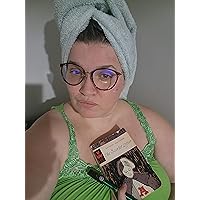
I've actually met Mr. Moraine in person at a book fair, and he seems like a cool guy. So its with a heavy heart that I'm about to criticize his work.
First things first. There definitely some strong points in this novel that Moraine should be proud of. I like most of the worldbuilding pillars. The main characters are a race of Amazonian beast/human hybrids with scales and fox ears. They use an interesting kind of magic, too: yarik, which I guess is life/world essence of some kind. Only, they don't do it by manipulating magic directly and casting spells the way a typical D&D wizard would. They imbue it into runic stones that store it like a battery, allowing them to create magic weapons and items sort of like an artificer. If I had to describe the aesthetic in a few words, I'd say something like "pastoral crystalpunk". Very refreshing and original.
Yet for each of these worldbuilding wins, there are also some setbacks. The biggest one I can think of is the Valkys. They're the faux antagonists of the novel, but by the end I wasn't even sure what they really are. They show up three times and each time they are characterized a totally different way. First as mindless wind-magic wielding buffalo things, again as weird bird things, and the third time as humanoid spellcasting lizard people that can be summoned by malicious magic users. Of the three, only the last incarnation shows any intelligence, but their motives still aren't explained. It kind of seems like they just like killing Manyari (whom they are related to via breeding with humans, which poses some disturbing lore implications) for...some reason. Honestly, it kind of felt like the author just needed some monsters the heroes could beat up for the action sequences, and that's about all the thought that went into them.
You could cut the Valkys out of the story entirely and it would actually improve the work. Not least because I don't think the action scenes are even that good. They're overly technical and confusing, mostly because the magic system, while interesting on the surface, isn't really explained in depth. So it was very hard to keep track of what was going on.
Actually, that goes for the first half of the book (about 100 pages) pretty much. Nothing really happens aside from some inconsistent character development told over random time skips. One character has this big failure towards the beginning that is supposed to define her entire arc going forward. She was supposed to be punished in some harsh but vague way for what was honestly kind of a BS reason, and its supposed to explain why she is so angry and eager to prove herself for the rest of the book. But in the next time skip, people talk about her as if that just didn't happen. She even has her old job and everything. Little moments of inconsistency like these (and there are plenty of them) had me scratching my head and gaslighting myself about what I'd just read.
The plot does finally start getting interesting somewhere past the halfway mark, in the lead up to the Bonding ceremony. I can't really talk about this without spoilers so consider yourself warned.
***SPOILERS***
Ok, so it turns out the entire purpose of the titular Son is to act as a sort of breeding slave for all the women of the tribe prior to a ritual that will kill him. The reasons why are not exactly clear, but if I had to guess: it seems like yarik actually originates from male manyari, and the tribe is scared of what they might do if they fully mature into their power. So they use special powder along with sex to somehow get the yarik out of males and into the females so they can use it. I guess the moral quandary is that they sort of NEED the yarik to create wards that protect themselves from the Valkys. But exactly why the Valkys want to kill the Manyari isn't explained, and neither is it explained why a male manyari can't just create and power wards himself. So maybe there was supposed to be some sort of moral ambiguity here, but as is, the female manyari end up looking cartoonishly evil. Like, they're just raping and stealing magical gifts from male children because it makes their lives slightly easier and cooler.
Predictable? Perhaps. Still very vague and unsatisfying? Absolutely. But I at least found something redeeming in this section, if only momentarily. The whole "breeding slave" thing isn't played for laughs. I know that's a low bar, but the trauma and hopelessness of the Son is taken seriously and explored in depth rather than dismissed just because "he's a man and men obviously like sex" as many authors would be tempted to do. There is a clear gender role reversal here where the Son is being treated how women all too often were (and still are) in real life history. That instantly made me want to root for him to escape the clutches of an evil society that wants to use and discard him like a mindless object.
I got major punk vibes from this setup and was voraciously reading to the end. I wanted to see The Son learn to harness his special gifts and transform into a badass, or at least reclaim some agency somehow.
That doesn't happen. Instead, his mommy comes and saves him. The story itself essentially treats him the same way as all the women of the tribe view him: as an object with no agency or power, even though he is literally the one with all the power. This immediately ruined all of the good will the Bonding Ceremony initially provoked in me. It would have been so cool to see him learn to use his gifts and lay the smackdown on these assholes. Sure, mommy or another benevolent female member of the tribe could have helped him, but he should have had some kind of agency. Instead he ends the book the same way as he started: a helpless object.
Considering the next book is called "The Mother" and she already overshadowed the protagonist in the first book that is named after him, I don't feel particularly compelled to read the second.
P.S. I wasn't really sure where to fit this in, but the book also has many spelling and grammatical errors. The most annoying one was that it sometimes switches tense not only between sentences, but also sometimes within the same sentence. This really could have used a lot more editing.