Jump to ratings and reviews
Rate this book

Illuminated Poems

Rate this book
Street-smart, hip urban graphics accompany a collection of some fifty poems that span the poet's creative evolution from 1948 to the present, including the complete text of "Howl," as well as four never-before-anthologized works. Simultaneous. IP.

144 pages, Paperback

First published June 27, 1996

8 people are currently reading
207 people want to read

About the author

Allen Ginsberg

490 books4,117 followers
Allen Ginsberg was a groundbreaking American poet and activist best known for his central role in the Beat Generation and for writing the landmark poem Howl. Born in 1926 in Newark, New Jersey, to Jewish parents, Ginsberg grew up in a household shaped by both intellectualism and psychological struggle. His father, Louis Ginsberg, was a published poet and a schoolteacher, while his mother, Naomi, suffered from severe mental illness, which deeply affected Ginsberg and later influenced his writing—most notably in his poem Kaddish.
As a young man, Ginsberg attended Columbia University, where he befriended other future Beat luminaries such as Jack Kerouac, William S. Burroughs, and Neal Cassady. These relationships formed the core of what became known as the Beat Generation—a loose-knit group of writers and artists who rejected mainstream American values in favor of personal liberation, spontaneity, spiritual exploration, and radical politics.
Ginsberg rose to national prominence in 1956 with the publication of Howl and Other Poems, released by City Lights Books in San Francisco. Howl, an emotionally charged and stylistically experimental poem, offered an unfiltered vision of America’s underbelly. It included candid references to homosexuality, drug use, and mental illness—subjects considered taboo at the time. The poem led to an obscenity trial, which ultimately concluded in Ginsberg’s favor, setting a precedent for freedom of speech in literature.
His work consistently challenged social norms and addressed themes of personal freedom, sexual identity, spirituality, and political dissent. Ginsberg was openly gay at a time when homosexuality was still criminalized in much of the United States, and he became a vocal advocate for LGBTQ+ rights throughout his life. His poetry often intertwined the personal with the political, blending confessional intimacy with a broader critique of American society.
Beyond his literary achievements, Ginsberg was also a dedicated activist. He protested against the Vietnam War, nuclear proliferation, and later, U.S. foreign policy in Latin America. He was present at many pivotal cultural and political moments of the 1960s and 1970s, including the 1968 Democratic National Convention and various countercultural gatherings. His spiritual journey led him to Buddhism, which deeply influenced his writing and worldview. He studied under Tibetan teacher Chögyam Trungpa and helped establish the Jack Kerouac School of Disembodied Poetics at Naropa University in Boulder, Colorado.
Ginsberg’s later years were marked by continued literary output and collaborations with musicians such as Bob Dylan and The Clash. His poetry collections, including Reality Sandwiches, Planet News, and The Fall of America, were widely read and respected. He received numerous honors for his work, including the National Book Award for Poetry in 1974.
He died of liver cancer in 1997 at the age of 70. Today, Allen Ginsberg is remembered not only as a pioneering poet, but also as a courageous voice for free expression, social justice, and spiritual inquiry. His influence on American literature and culture remains profound and enduring.

Ratings & Reviews

What do you think?
Rate this book

Friends & Following

Create a free account to discover what your friends think of this book!

Community Reviews

5 stars
132 (46%)
4 stars
85 (29%)
3 stars
49 (17%)
2 stars
11 (3%)
1 star
7 (2%)
Displaying 1 - 27 of 27 reviews
Profile Image for Steven Godin.
2,795 reviews3,462 followers
January 30, 2021

Confession Is Dream For the Soul
Woke to pee, I was in bed, bandaged,
I was sore, I'd confessed, been
amputated, mutilated, wrapped in gauze,
recovering in prison hospital, soul
emptied — nothing more to fear, secrets
revealed — for meat I'd murdered
for money stole parts of bodies,
razor'd open cattle and fish, eaten
and discarded bloody pulp entrails
Now I was revenged, now impotent,
prisoner, nothing more to hide, no
longer doomed. What was my sin?
What didn't I know? Was the ordeal over?
Profile Image for Dane Cobain.
Author 22 books322 followers
April 6, 2021
They called this one Illuminated Poems because I guess calling it Illustrated Poems would have been too obvious. That’s what it is though, and the illustrations come to us from Eric Drooker.

All of these poems have been published elsewhere and so there’s not much for me to say about that, and so I’ll focus on the illustrations instead. They were excellent, and they really brought Ginsberg’s words to life. They captured a lot of the darkness that he wrote about, but there was also some hope to them. And let’s be honest, I just liked the artist’s style. I’d happily have his work up on my walls.

Because it has Howl, it’s also a pretty accessible introduction to Ginsberg’s stuff. So yeah!
Profile Image for Therese L.  Broderick.
141 reviews9 followers
December 31, 2016
Because this monumental, ferocious book (published 1996) is "Dedicated to the prophets, visionaries ... and refugees of the 21st century", I can affirm its relevance for our civilization's post-2016 zeitgeist. And I warn any reader--including myself--who passively adopts the shallow slogans of extreme liberals or extreme conservatives or any other proponents of hostile ideologies, that the contents of this book spare no one from moral scrutiny.

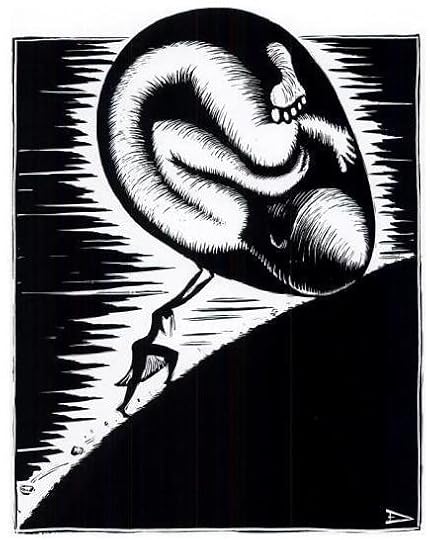
My favorite image from these masterful Drooker illustrations: "Sisyphus" re-cast as a marginal woman struggling mightily to roll an enormous egg (occupied by a giant human fetus) up the curved surface of an ink-black wedge (Earth, Moon, mountain, skull?).

My favorite passage from these Ginsberg poems: "Take the lump / in your throat / and sing out / yr holy note / of heart's delight / in living light / Day & Night" (from "Jumping the Gun on the Sun," page 124).


Profile Image for Samantha Lazar.
43 reviews3 followers
October 22, 2008
The pictures in this book are so bold and catching. The pictures represent each poem very well. The poems are also great, and I will probably use some of them next week when I start poetry with my students.
Profile Image for M.W.P.M..
1,679 reviews28 followers
January 21, 2022
I should dislike the artwork on principle, considering Eric Drooker is partially responsible for the unspeakably bad Ginsberg biopic HOWL. Fortunately, the artwork in Illuminated Poems isn't as objectionable as the animation in HOWL. I may even venture to say that some of the artwork is... good. But I can't say it adds much to Ginsberg's poems.

As Ginsberg explains in the introduction, the poems were selected by Drooker. They're not my favourite of Ginsberg's poems, but a decent selection regardless. The selection includes: "The Altering Eye Alters All”, “An Eastern Ballad”, “A Mad Gleam”, “In Death Cannot Reach What Is Most Near”, “Song”, “Lay Down Yr Mountain”, “Sunflower Sutra”, “Manhattan Thirties Flash”, “Morning”, “Howl”, “New York Blues”, “Native New York”, “On Neal’s Ashes”, “Punk Rock You’re my Big Crybaby”, “Get It?”, “Capitol Air”, “Pentagon Exorcism”, “Love Forgiven”, “War Profit Litany”, “When the Light Appears”, “Tears”, “The Lion for Real”, “I’m a Prisoner of Allen Ginsberg”, “Fighting Phantoms Fighting Phantoms”, “This Form of Life Needs Sex”, “Birdbrain!”, “America Again”, “New Stanzas for Amazing Grace”, “X-Ray Manhattan”, “Jumping the Gun On the Sun”, “Rock Song”, “Gospel Noble Truths”, “The Ballad of the Skeletons”, “Father Death Blues”, and “Confession Is Dream for the Soul"

From the Introduction:
Our collaboration volume began as byproduct of an illustration of my poem “The Lion For Real” for his St. Mark’s Poetry Project New Year’s Day 1933 Benefit poster. As I’d followed his work over a decade, I was flattered that so radical an artist of later generations found the body of my poetry still relevant, even inspiring. Our paths crossed often, we took part in various political rallies and poetical-musical entertainments, the idea of a sizable volume of illustrated poem-pictures rose. Eric Drooker himself did all the work choosing texts (thankfully including many odd lesser-known scribings) and labored several years to complete these Illuminated Poems.

Allen Ginsberg
Lower East Side
December 28, 1995


Prologue:
The Year was 1967 and I was an eight-year-old boy riding the crosstown bus with my mother. The bus stopped on Avenue A, and a man with black-rimmed glasses and a big black beard entered alone and sat down in front of us. My mother leaned over and whispered in my ear that the man in front of us was a famous poet. I didn’t know what to think. What did this mean? What did a famous poet do all day...write poems? As the bus slowly moved forward I sat quietly, looking at the back of his balding head and wondering what he was thinking as we rolled west on 14th Street.

Eric Drooker
Lower East Side
January 15, 1996


The poems & artwork...
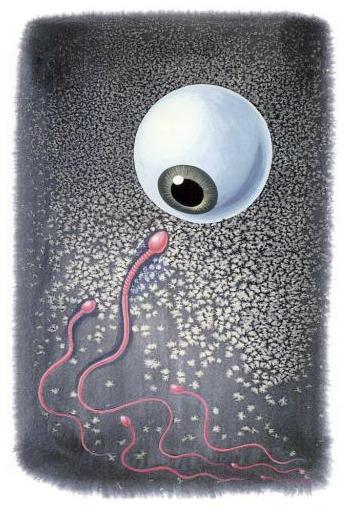
The Eye Altering Alters All

Many seek and never see,
anyone can tell them why.
O they weep and O they cry
and never take until they try
unless they try it in their sleep
and never some until the die.
I ask many, they ask me.
This is a great mystery.

East Harlem, June-July 1948
description
An Eastern Ballad

I speak of love that comes to mind:
The moon is faithful, although blind;
She moves in thought she cannot speak.
Perfect care has made her bleak.

I never dreamed the sea so deep,
The earth so dark; so long my sleep,
I have become another child.
I wake to see the world go wild.

1945-1949
description
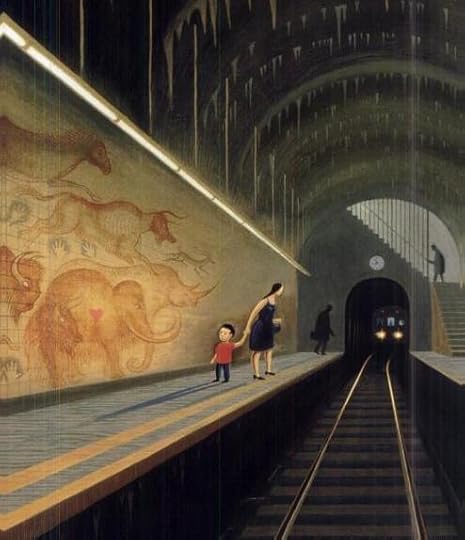
A Mad Gleam

Go back to Egypt and the Greeks,
Where the wizard understood
The spectre haunted where man seeks
And spoke to ghosts that stood in blood.

Go back, go back to the old legend;
The soul remembers, and is true:
What has been most and least imagined,
No other, there is nothing new.

The giant Phantom is ascending
Toward its coronation, gowned
With music unheard, yet unending:
Follow the flower to the ground.

New York, January 1949
description
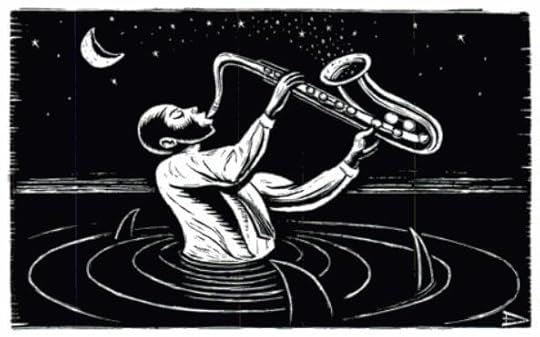
Lay Down Yr Mountain

Lay down Lay down your nation Lay your foot on the rock

Lay down yr whole creation Lay yr mind down
Lay down Lay down yr empire Lay your whole world down

Lay down your soul forever Lay your vision down
Lay down yr bright body Down your golden heavy crown

Lay down Lay down yr magic hey! Alchemist lay it down clear
Lay down your practice precisely Lay down yr wisdom dear

Lay down yr skillful camera Lay down yr image right
Lay down your brilliant image Lay down light

Lay down your ignorance Roll yr wheel once more
Lay down yr empty suffering Lay down yr Lion's Roar

October 31, 1975
description
Profile Image for James Holt.
84 reviews23 followers
July 14, 2018
I can see why people like Ginsberg. There's a lot of artistry here (especially from illustrator Eric Drooker). But, despite this artistry, nothing here touched me personally, and I took nothing from what I read.

Unfortunately, this has been my general experience with the works of the beat generation. I WANT to like them, but they just never land for me.
126 reviews
November 9, 2018
It was rather explicit, which is why I'm not rating it higher. I skipped a couple poems for its language. It had some very interesting ideas, though. I really liked "Song," "Sunflower Sutra," and "Jumping the Gun on the Sun." The artwork was amazingly powerful--sometimes even more powerful than the poetry.
Profile Image for Nickey.
94 reviews2 followers
March 2, 2025
Interesting, just okay. A reflection that as much as things change, they stay the same.
Profile Image for Robin.
1,023 reviews31 followers
April 5, 2015
Just because I don’t like reading many of Allen Ginsberg’s poems per se doesn’t mean that I don’t admire the man and his work. His ability to tell a nonlinear story, where phrases don’t make sense yet the meaning is clear, is incredible. Writing for the common man, he was adept at skewering such commonly-hated opponents as big business, corrupt politicians, poverty of body and soul, war, and racist governments. His uninhibited language leaves no part of the male body or psyche unexplored. His poems, with their characteristic rough edges, shocked the world when first published in the 1950s. For me, reading a whole volume of Ginsberg elicits too-strong emotions, a gut reaction of unsettled and hopeless feelings.

Eric Drooker’s artwork, however, caught my attention. His urban dreamscapes create a drama throughout the book that is often sad, alienated, and oppressed, but not without redemption. There’s compassion, self-acceptance, collaboration, fantasy, and even humor. One particularly funny illustration shows a diminutive Ginsberg, looking like a bearded, bald, bespectacled baby, exploring a glorious female odalisque, who is completely oblivious to his attentions. This illustrates the poem “This Form of Life Needs Sex,” about the gay man’s plight of only being able to procreate by having sex with a woman. A Zen-like page illustrates “Punk Rock Your my Big Crybaby” [sic], written at Mabuhay Gardens in the 70s. Drooker first depicts the starry sky, and in each subsequent panel moves his focus closer to the punk rock concert: cityscape, building exterior, doorway, back of club, front of club, onstage, punk singer, singer’s head, singer’s mouth, singer’s uvula…and then…starry skies as in the beginning.

And who else would dare to illustrate Ginsberg’s classic, “Howl”? Drooker takes us from homeless men around a fire in the snow to falling into the abyss to sexual intercourse to an indistinct nightmarish howling image, to connection among the oppressed, to a ghostly romp across the Brooklyn bridge. The image for “Pentagon Exorcism” shows “the people” dancing, drumming, and playing fantastically complicated Seuss-like horns. With these they drive back the military tank bearing various corporate symbols. My favorite illustration is for “In Death, Cannot Reach What is Most Near,” a short poem that ponders the meaning of life. An old—but remarkably fit—man transverses a small field between two dark doorways, eye turned up and back, noting a yellow butterfly, the only bit of color in the piece.

Given the age gap, it is remarkable that these men collaborated so well. They became acquainted in New York’s Lower East Side, where they both lived. Drooker’s mother pointed out Ginsberg on the bus when he was a child, causing him to wonder what a poet does all day long. Ginsberg first saw Drooker’s art in posters for homeless rights advocacy and other leftist causes. He began collecting Drooker’s work, which reminded him of 1930s political graphic novels. The men became friends, often meeting at political rallies and poetry-music events. For this book, Drooker chose the poems and created the art, yet lists Ginsberg as lead author.

Three stars on Goodreads represents “I liked it,” not that it’s average literature or art. Readers who enjoy Ginsberg’s poems, Beat literature, or modern urban art will want to check out this short and powerful read.
6 reviews1 follower
October 11, 2008
If you couldn't tell, Ginsburg is my favorite author of all time. His energy, imagry and rhythm seem to be in sync with my own. In this book he teams up with NYC artist Eric Drooker and although I feel that Ginsburg's imagry doesn't need any help by way of illustration, Drooker's own interpretations of Allen's imagry is extremely well done. Some highlights: a flaming phallus, a midget Allen on a large sprawling naked female, "dead" people doing things among the city i.e. going to McD's, many more.
Profile Image for SilentRebellions.
6 reviews
June 14, 2010
This is a beautiful and haunting collection of Ginsberg's greatest works. Drooker's art is perfectly matched to the poetry and it is obvious that both men have a deep respect and understanding of each others work. Even if you are not a fan of poetry, I can recommend this collection. Ginsberg is a master poet with a haunting spiritual vision that made him poetic the voice of an entire generation. His poetry is eternal, unglued from any time or place and Drooker's art is equally as haunting and raw.
Profile Image for Maureen.
147 reviews
October 22, 2012
Really more of a 3.5 for me, but I'll round up for my love of "Howl". Unfortunately, not every poem is as brilliant. To be honest, I find certain tendencies - such as his frequent use of anaphora - a bit tiresome. However, when he is good, he is damn good. The "illumination" of the poetry with Eric Drooker's art adds another level of interest to this collection and so I recommend it to Ginsberg fans (or fans of the Beats in general).
Profile Image for uh8myzen.
52 reviews26 followers
February 28, 2011
This is one of my favorite books, not because of the magical poetic genius of Allen Ginsberg or the wonderful and haunting images of Erik Drooker, but because the two fit so perfectly together. This is a wonderfully moving and mystical experience for anyone who loves art and poetry. These two were born to work together and they each seem to get one another in a deep and meaningful way.
Profile Image for Casey.
818 reviews57 followers
May 17, 2007
When I was thirteen, I thought this was the Best Thing Ever. I thought Ginsberg was some amazing Beat prophet, and Drooker's urban arts was just so damn cool. My enthusiasm for both has calmed down over the years, but this is still a pretty nifty book with a nice sampling of Ginsberg's poetry.
Profile Image for Sarah.
674 reviews67 followers
May 26, 2014
Some of the poems were interesting, and the artwork was really good, but I just couldn't relate. It happens. Sometimes I find poetry that just doesn't speak to me, and that's okay. It was all very well done, and Allen Ginsberg was truly talented.
Profile Image for HeavyReader.
2,246 reviews14 followers
June 23, 2007
Poetry by Allen Ginsburg and art by Eric Drooker. What could be more beautiful? (Answer: not much.) Highly recommended.
Profile Image for Cassandra.
24 reviews7 followers
January 2, 2008
i've been looking for an illustrated book of poetry for years!!! and what an incredible find. artwork is gorgeous and bold, with poetry to match.
Profile Image for Mia.
4 reviews3 followers
Want to read
September 4, 2009
As recommended by John Cusack!
Profile Image for Sherry.
467 reviews
July 25, 2011
A wonderful way to read/view Gisberg poems. A great collaboration!
Profile Image for Zee.
31 reviews1 follower
October 22, 2013
I really enjoyed his poems and how they challenged corporate militarism and economic injustice. I particularly liked the poem New Stanzas for Amazing Grace.
Profile Image for Penelope.
259 reviews
December 30, 2014
Good poems, amazing artwork. Altogether a great collaboration between Ginsberg and Drooker.
This entire review has been hidden because of spoilers.
Profile Image for hissi.
440 reviews13 followers
December 24, 2015
I'm not sure if these were stories or poems or tunes. they don't make sense :/
Displaying 1 - 27 of 27 reviews

Can't find what you're looking for?

Get help and learn more about the design.