

What do you think?
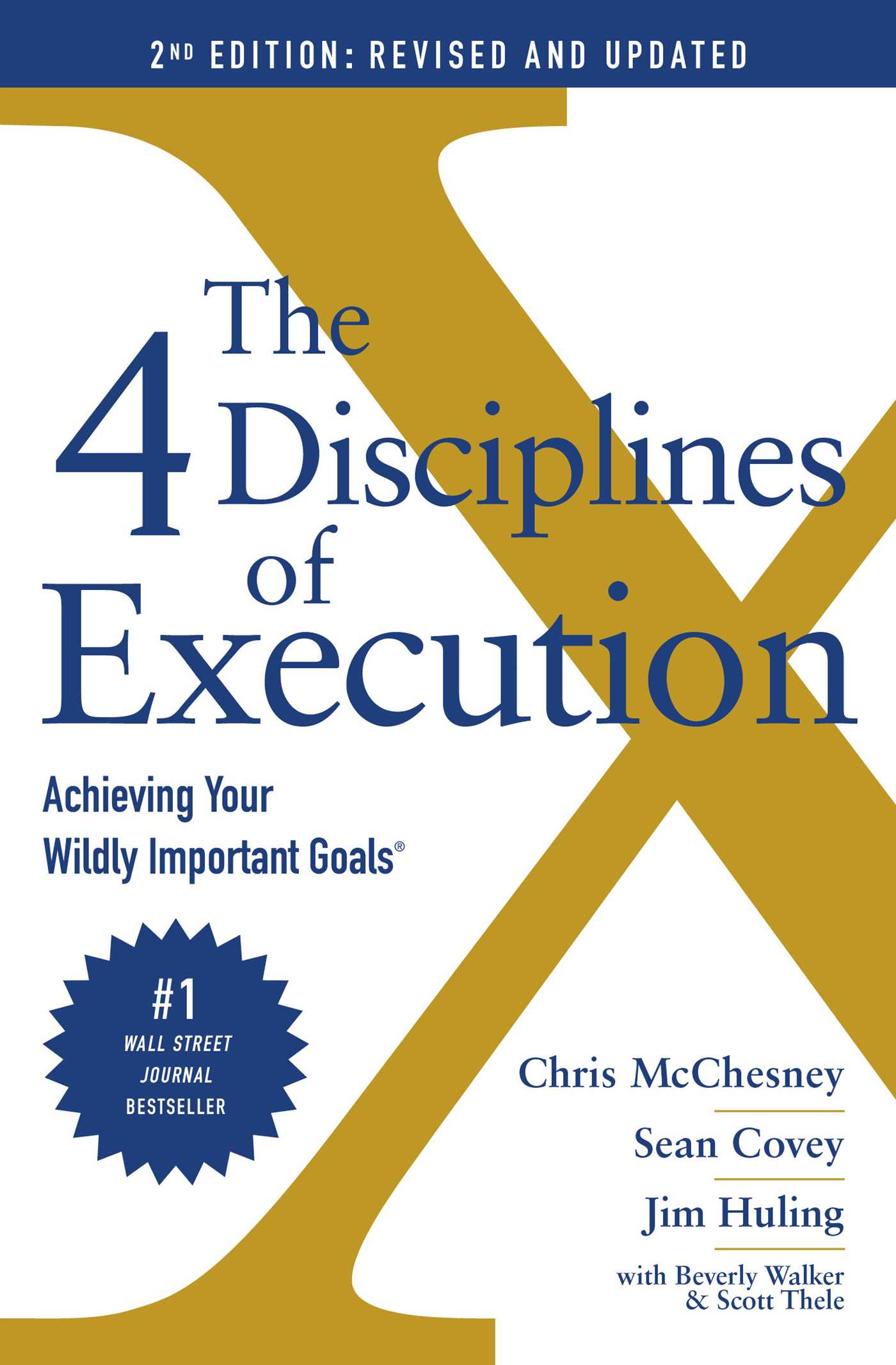
The 4 Disciplines of Execution: Revised and Updated
Fully revised and updated, the definitive guide for leaders on how to create lasting organisational change.
Do you remember the last major initiative you watched die in your organisation? Did it go down with a loud crash? Or was it slowly and quietly suffocated by other competing priorities? By the time it finally disappeared, it’s quite likely noone even noticed.
Almost every company struggles with making change happen. The 4 Disciplines of Revised and Updated is meant to help you reach the goals you’ve always dreamed of with a simple, repeatable, and proven formula. In this updated edition of the business bestseller, you’ll learn the 4 Disciplines of Execution and how to make them work for your organisation.
This proven set of practices have been tested and refined by hundreds of organisations and thousands of teams over many years. When a company or an individual adheres to these principles, they achieve superb results, regardless of the goal. These 4 Disciplines of Execution represent a new way to work and think that is essential to creating lasting organisational change and thriving in today’s competitive climate. It’s the one book that no leader can afford to miss.
Do you remember the last major initiative you watched die in your organisation? Did it go down with a loud crash? Or was it slowly and quietly suffocated by other competing priorities? By the time it finally disappeared, it’s quite likely noone even noticed.
Almost every company struggles with making change happen. The 4 Disciplines of Revised and Updated is meant to help you reach the goals you’ve always dreamed of with a simple, repeatable, and proven formula. In this updated edition of the business bestseller, you’ll learn the 4 Disciplines of Execution and how to make them work for your organisation.
This proven set of practices have been tested and refined by hundreds of organisations and thousands of teams over many years. When a company or an individual adheres to these principles, they achieve superb results, regardless of the goal. These 4 Disciplines of Execution represent a new way to work and think that is essential to creating lasting organisational change and thriving in today’s competitive climate. It’s the one book that no leader can afford to miss.
336 pages, Paperback
Published June 21, 2023
Ratings & Reviews
Friends & Following
Create a free account to discover what your friends think of this book!
Community Reviews
Displaying 1 - 12 of 12 reviews

April 11, 2026
I read this for work. I think it could have been half as long and made the same points.
January 30, 2025
Book Review: The 4 Disciplines of Execution: Revised and Updated
Authors: Chris McChesney, Sean Covey, and Jim Huling
Overview
The 4 Disciplines of Execution (4DX) is a practical and insightful guide to achieving strategic goals in business and life. In this revised and updated edition, the authors refine their methodology based on years of application across various industries. The book provides a clear framework for turning high-level objectives into tangible results by focusing on execution rather than just strategy.
Key Takeaways
The authors outline four core disciplines that organizations and individuals must follow to achieve “Wildly Important Goals” (WIGs):
1. Focus on the Wildly Important – Instead of spreading energy across multiple priorities, the book emphasizes the power of narrowing focus to just one or two crucial goals.
2. Act on Lead Measures – Rather than solely tracking lagging indicators (like revenue or customer satisfaction), 4DX stresses the importance of identifying and influencing lead measures—actions that drive those outcomes.
3. Keep a Compelling Scoreboard – Motivation and accountability improve when teams have visible, real-time scoreboards showing progress toward their goals.
4. Create a Cadence of Accountability – Regularly scheduled check-ins ensure team members stay committed to execution and make necessary adjustments.
Strengths
• Actionable Framework: The book is structured around real-world case studies and examples, making it easy to understand and apply.
• Focus on Execution: Many organizations struggle with execution despite having great strategies. This book bridges that gap effectively.
• Scalability: The principles apply to both small teams and large enterprises, making them useful for leaders at all levels.
Potential Drawbacks
• Repetitive at Times: Some sections reiterate the same points, which can slow the reading experience.
• Requires Strong Leadership Buy-In: While the methodology is sound, successful implementation often depends on leadership commitment and team engagement.
Final Verdict
The 4 Disciplines of Execution is a must-read for leaders, managers, and individuals who want to improve their ability to achieve high-impact goals. The updated edition refines the original framework with more insights and applications, making it even more relevant in today’s fast-paced business environment. If you struggle with turning strategy into results, this book provides a structured, proven path to success.
Rating: 4.5/5
Authors: Chris McChesney, Sean Covey, and Jim Huling
Overview
The 4 Disciplines of Execution (4DX) is a practical and insightful guide to achieving strategic goals in business and life. In this revised and updated edition, the authors refine their methodology based on years of application across various industries. The book provides a clear framework for turning high-level objectives into tangible results by focusing on execution rather than just strategy.
Key Takeaways
The authors outline four core disciplines that organizations and individuals must follow to achieve “Wildly Important Goals” (WIGs):
1. Focus on the Wildly Important – Instead of spreading energy across multiple priorities, the book emphasizes the power of narrowing focus to just one or two crucial goals.
2. Act on Lead Measures – Rather than solely tracking lagging indicators (like revenue or customer satisfaction), 4DX stresses the importance of identifying and influencing lead measures—actions that drive those outcomes.
3. Keep a Compelling Scoreboard – Motivation and accountability improve when teams have visible, real-time scoreboards showing progress toward their goals.
4. Create a Cadence of Accountability – Regularly scheduled check-ins ensure team members stay committed to execution and make necessary adjustments.
Strengths
• Actionable Framework: The book is structured around real-world case studies and examples, making it easy to understand and apply.
• Focus on Execution: Many organizations struggle with execution despite having great strategies. This book bridges that gap effectively.
• Scalability: The principles apply to both small teams and large enterprises, making them useful for leaders at all levels.
Potential Drawbacks
• Repetitive at Times: Some sections reiterate the same points, which can slow the reading experience.
• Requires Strong Leadership Buy-In: While the methodology is sound, successful implementation often depends on leadership commitment and team engagement.
Final Verdict
The 4 Disciplines of Execution is a must-read for leaders, managers, and individuals who want to improve their ability to achieve high-impact goals. The updated edition refines the original framework with more insights and applications, making it even more relevant in today’s fast-paced business environment. If you struggle with turning strategy into results, this book provides a structured, proven path to success.
Rating: 4.5/5

May 26, 2026
First of all: 4DX is super-useful as a technique (especially in combo with OKRs), but:
1. it (standalone) doesn't make this book great :)
2. it doesn't mean it's a topic for a whole book
3. it doesn't mean 4DX can be applied equally effectively everywhere
What do those three remarks really mean?
- the concept of 4DX is remarkably simple and can be fully covered in a blog post - a full book is an overkill as it's full of endless repetitions and clarifications "for dummies"
- the part for leaders of leaders (part 2) is pretty much a waste of time (it's the additional after the 1st edition)
- the authors acknowledge that it's challenging to apply 4DX in some conditions (e.g., project-oriented orgs), but they provide very limited REAL LIFE guidance here - I think that stick (quite comfortably) to relatively simple service/production organizations, completely disregarding knowledge/creative work
- I see zero "devil's advocate" approach - e.g., there should be a dedicated chapter on validating lead metrics (as it's one of the major things orgs struggle with)
Long story short - I like the framework, I think it provides a very simple and strikingly clear guidance, but ... as with other "easy to learn, hard to master" frameworks - devil is in the details and the authors didn't try to disarm all the inconvenient ones here :)
1. it (standalone) doesn't make this book great :)
2. it doesn't mean it's a topic for a whole book
3. it doesn't mean 4DX can be applied equally effectively everywhere
What do those three remarks really mean?
- the concept of 4DX is remarkably simple and can be fully covered in a blog post - a full book is an overkill as it's full of endless repetitions and clarifications "for dummies"
- the part for leaders of leaders (part 2) is pretty much a waste of time (it's the additional after the 1st edition)
- the authors acknowledge that it's challenging to apply 4DX in some conditions (e.g., project-oriented orgs), but they provide very limited REAL LIFE guidance here - I think that stick (quite comfortably) to relatively simple service/production organizations, completely disregarding knowledge/creative work
- I see zero "devil's advocate" approach - e.g., there should be a dedicated chapter on validating lead metrics (as it's one of the major things orgs struggle with)
Long story short - I like the framework, I think it provides a very simple and strikingly clear guidance, but ... as with other "easy to learn, hard to master" frameworks - devil is in the details and the authors didn't try to disarm all the inconvenient ones here :)

June 3, 2026
This book for me offers practical dealership strategies especially when dealing with teams. It made me understand why you need regular meetings tracking KPIs.
Even though it seems boring... you achieve so much through these meetings.
All these while staying humble and always improving. Key challenge for me is staying away from the distractions and staying focused on the goal.
Even though it seems boring... you achieve so much through these meetings.
All these while staying humble and always improving. Key challenge for me is staying away from the distractions and staying focused on the goal.

February 4, 2026
Solid reading and it has a real good insight on how to get things done especially as a team. I got a little bored towards the end as it felt a bit more redundant and less applicable to specifically me once I got the core theory / concept, but it was a good read nonetheless.

June 6, 2026
WIG - wildly important goal. This book goes in great detail about how to lead a team to achieve wildly important goals. There are lots of details. This is probably best gone through with a team over time when you clearly want to achieve change and improve.
July 26, 2026
4.5/5
There is a lot to love in this book. I appreciate the approach to execution, and regardless of how much one takes as far as specific action items and applies to their business, this is worth the read.
There is a lot to love in this book. I appreciate the approach to execution, and regardless of how much one takes as far as specific action items and applies to their business, this is worth the read.

October 14, 2025
work book!! Great for getting everyone rowing the boat in the same direction

October 29, 2025
3 Stars is my max personal rating for a business book.

February 2, 2026
A re-read & just as resourceful as it’s always been.
If you lead people, this is an excellent book on how to take your team from good to great!
If you lead people, this is an excellent book on how to take your team from good to great!

June 8, 2026
Well written. Was able to grasp and implement the concepts easily.

August 20, 2026
Not a bad concept, but it's not a new concept
This book could have been a one-pager and been just as impactful. Fifteen chapters was 14.999 chapters too long.
This book could have been a one-pager and been just as impactful. Fifteen chapters was 14.999 chapters too long.
Displaying 1 - 12 of 12 reviews