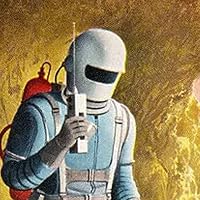
In Beyond Armageddon, the distinguished science fiction writer Walter M. Miller Jr. (1923–96) and the famed anthologist Martin H. Greenberg (1941-2011) have together collected stories that address one of the most challenging themes of imaginative fiction: the nature of life after nuclear war. These richly imagined stories offer glimpses into a future no reader will soon forget. Miller’s incisive introduction and a thought-provoking and irreverent commentary are included. All stories are preceded by intros, written by Miller, which comment on the story to come, and sometimes also the story preceeding the note.
Contents:
Introduction: Forewarning (Beyond Armageddon) (1985) • essay by Walter M. Miller, Jr. Salvador (1984) / short story by Lucius Shepard The Store of the Worlds (1959) / short story by Robert Sheckley The Big Flash (1969) / novelette by Norman Spinrad Lot [David Jimmon] (1953) / novelette by Ward Moore Day at the Beach (1959) / short story by Carol Emshwiller The Wheel (1952) / short story by John Wyndham Jody After the War (1972) / short story by Edward Bryant The Terminal Beach (1964) / novelette by J. G. Ballard Tomorrow's Children [Tomorrow's Children • 1] (1947) / novelette by Poul Anderson and F. N. Waldrop Heirs Apparent (1954) / novelette by Robert Abernathy A Master of Babylon (1966) / novelette by Edgar Pangborn (variant of The Music Master of Babylon 1954) Game Preserve (1957) / short story by Rog Phillips By the Waters of Babylon (1937) / short fiction by Stephen Vincent Benét (variant of The Place of the Gods) [as by Stephen V. Benet] There Will Come Soft Rains [The Martian Chronicles] (1950) / short story by Ray Bradbury To the Chicago Abyss (1963) / short story by Ray Bradbury Lucifer (1964) / short story by Roger Zelazny Eastward Ho! (1958) / short story by William Tenn The Feast of Saint Janis (1980) / novelette by Michael Swanwick "If I Forget Thee, Oh Earth ..." (1951) / short story by Arthur C. Clarke A Boy and His Dog [Vic and Blood • 2] (1969) / novella by Harlan Ellison My Life in the Jungle (1985) / short story by Jim Aikin
Also published as "Beyond Armageddon: Survivors of the Megawar"
Miller was born in New Smyrna Beach, Florida. Educated at the University of Tennessee and the University of Texas, he worked as an engineer. During World War II, he served in the Army Air Corps as a radioman and tail gunner, flying more than fifty bombing missions over Italy. He took part in the bombing of the Benedictine Abbey at Monte Cassino, which proved a traumatic experience for him. Joe Haldeman reported that Miller "had Post Traumatic Stress Disorder for 30 years before it had a name".
After the war, Miller converted to Catholicism. He married Anna Louise Becker in 1945, and they had four children. For several months in 1953 he lived with science-fiction writer Judith Merril, ex-wife of Frederik Pohl and a noted science-fiction author in her own right.
Between 1951 and 1957, Miller published over three dozen science fiction short stories, winning a Hugo Award in 1955 for the story "The Darfsteller". He also wrote scripts for the television show Captain Video in 1953. Late in the 1950s, Miller assembled a novel from three closely related novellas he had published in The Magazine of Fantasy and Science Fiction in 1955, 1956, and 1957. The novel, entitled A Canticle for Leibowitz, was published in 1959.
A Canticle for Leibowitz is a post-apocalyptic (post-holocaust) novel revolving around the canonisation of Saint Leibowitz and is considered a masterpiece of the genre. It won the 1961 Hugo Award for Best Novel. The novel is also a powerful meditation on the cycles of world history and Roman Catholicism as a force of stability during history's dark times.
After the success of A Canticle for Leibowitz, Miller never published another new novel or story in his lifetime, although several compilations of Miller's earlier stories were issued in the 1960s and 1970s.
In Miller's later years, he became a recluse, avoiding contact with nearly everyone, including family members; he never allowed his literary agent, Don Congdon, to meet him. According to science fiction writer Terry Bisson, Miller struggled with depression during his later years, but had managed to nearly complete a 600-page manuscript for the sequel to Canticle before taking his own life with a gun in January 1996, shortly after his wife's death. The sequel, titled Saint Leibowitz and the Wild Horse Woman, was completed by Bisson and published in 1997.
Classic Post-Apocalyptic Short Fiction Ranging from 1937-1985; with a few weak contemporary 80s New Wave SF stories thrown into the mix that are not really post-apocalyptic at all
BEYOND ARMAGEDDON RATED 79% POSITIVE. STORY SCORE 3.95 OF 5 21 STORIES : 8 GREAT / 6 GOOD / 5 AVERAGE / 2 POOR / 0 DNF
Walter Miller died by his own hand in 1996 after decades, and perhaps a lifetime, of depression … We began work on Beyond Armageddon in late 1983 and it was published in 1985. Walt took it very seriously, rejecting some stories and writing extensively for the book. In fact, his introduction constitute most of his published work after the seminal A Canticle for Leibowitz was released in 1959…
—Martin H Greenberg “Postscript to the Introduction”
This shocking bit of context comes after Miller’s wildly unhinged introduction. One can only nod solemnly. “Yeah, that makes sense.”
The ravings of an educated mad man whose mind swirls with Theophobia, word games, 1980s Cold War politics, and Science Fiction. It is sadly ironic that this is a book about how intelligent people kill themselves, and it is easy to imagine MegaWar as a kind of suicide.
The book is bipolar with a higher percentage of Great Stories and also a higher percentage of average to poor stories. Most anthologies stay comfortably in the middle. Beyond Armageddon isn’t comfortable.
It also isn’t full dystopia in the modern sense of that word. No tyrannical governments; they’ve already killed themselves. No plucky teenage heroes; the only YA-aged character is an amoral monster which his heart set on sexual assault.
Instead the stories lead us to think of what would be left behind. After the apocalypse. What would we be? How would we live? Would it be worth it? When all the stuff of civilization is stripped away, what will we become?
The Store of the Worlds • (1959) • short story by Robert Sheckley. A “Twilight Zone Style” story about a man who visits the Store of the Worlds. For the cost of all your possessions and 10 years of your life, you can experience a world that fulfills all your desires. But this man has to think about it first.
Lot • [David Jimmon] • (1953) • novelette by Ward Moore. The dark internal monologue of an awful father and husband as he tries to escape L.A. by car during a time of nuclear war. Captivating unlikeable protagonist and the interesting use of a biblical story as a framing device.
Day at the Beach • (1959) • short story by Carol Emshwiller. A quietly bleak tale of dystopia. It might be Saturday and in an attempt at normalcy, a family tries to spend a simple day at the beach. But nothing is normal about the state of this world. Flashes of horror amongst attempts at humanity.
The Terminal Beach • (1964) • novelette by J. G. Ballard. Vivid and surreal. A man has gone mad, tortured by the death of his family and his involvement in the creation of the atomic bomb. He spends his time on an island used for atomic testing. The wild character of the prose here is what will make you love it or bounce off hard. I loved it.
A Master of Babylon • (1954) • novelette by Edgar Pangborn. A story that feels incredibly modern and fresh. A concert pianist - who may be the last man in the world - lives in a flooded Museum of Human History.
There Will Come Soft Rains • (1950) • short story by Ray Bradbury. One of the true masterpieces of SF. A fully mechanized house continues the rhythms of the day even though its family are long gone. Beautiful prose, cadence, and sense of saudade.
The Feast of Saint Janis • (1980) • novelette by Michael Swanwick. A First World African travels to Third World America and falls in with a charismatic young woman who channels Janis Joplin each night. Swanwick has built a super world of an America that has mostly collapsed. Through the attitude and voice of our protagonist, we get a perspective on how we subconsciously judge the people in poor foreign lands. Riveting.
A Boy and His Dog • (1969) • novella by Harlan Ellison
Great. An ugly and depraved masterpiece. A violently horny young man and his telepathic dog hunt a young woman alone through the dangerous streets of a post apocalypse city. We can’t look at away from this man, even though we want to.
BEYOND ARMAGEDDON
21 STORIES : 8 GREAT / 6 GOOD / 5 AVERAGE / 2 POOR / 0 DNF
How do I arrive at a rating?
Salvador • (1984) • short story by Lucius Shepard
Good. A disturbed soldier in a Jungle War takes the war home with him. Well written with very minimal SF elements and little new to say in 2023.
The Store of the Worlds • (1959) • short story by Robert Sheckley
Great. A “Twilight Zone Style” story about a man who visits the Store of the Worlds. For the cost of all your possessions and 10 years of your life, you can experience a world that fulfills all your desires. But this man has to think about it first.
The Big Flash • (1969) • novelette by Norman Spinrad
Good. A band “The Four Horseman” give a performance to convince the population and military to accept the use of tactical nuclear weapons. Poetic language that works pretty well.
Lot • [David Jimmon] • (1953) • novelette by Ward Moore
Great. The dark internal monologue of an awful father and husband as he tries to escape L.A. by car during a time of nuclear war. Captivating unlikeable protagonist and the interesting use of a biblical story as a framing device.
Day at the Beach • (1959) • short story by Carol Emshwiller
Great. A quietly bleak tale of dystopia. It might be Saturday and in an attempt at normalcy, a family tries to spend a simple day at the beach. But nothing is normal about the state of this world. Flashes of horror amongst attempts at humanity.
The Wheel • (1952) • short story by John Wyndham
Average. A message story that is too on the nose as a future society is so suspicious of technology that they murder anyone who creates the wheel
Jody After the War • (1972) • short story by Edward Bryant
Average. A woman and man have a strained relationship because she is a “survivor” of the nuclear war and are suspicious of what kind of children she might produce.
The Terminal Beach • (1964) • novelette by J. G. Ballard
Great. Vivid and surreal. A man has gone mad, tortured by the death of his family and his involvement in the creation of the atomic bomb. He spends his time on an island used for atomic testing. The wild character of the prose here is what will make you love it or bounce off hard. I loved it.
Tomorrow's Children • [Tomorrow's Children • 1] • (1947) • novelette by Poul Anderson and F. N. Waldrop [as by Poul Anderson]
Good. A returning spy after a brutal war is sent to try to bring the surviving Americans together and finds mutated children.
Heirs Apparent • (1954) • novelette by Robert Abernathy
Average. After a global war, a communist and a capitalist meet in a town in Siberia. They argue and debate, but both of their ideologies won’t matter much in the new world.
A Master of Babylon • (1966) • novelette by Edgar Pangborn (variant of The Music Master of Babylon 1954)
Great. A story that feels incredibly modern and fresh. A concert pianist - who may be the last man in the world - lives in a flooded Museum of Human History.
Game Preserve • (1957) • short story by Rog Phillips
Average. Barely intelligent human live in a near state of nature after a MegaWar. One of the humans is more intelligent than the others.
By the Waters of Babylon • (1986) • short fiction by Stephen Vincent Benét? (variant of The Place of the Gods 1937) [as by Stephen V. Benet]
Good. A young man goes out on a form of vision quest and disobeys convention by traveling to the east and the City of the Gods. Beautiful and full of awe as the young man explores a city that he cannot understand, but that means a great deal to us.
There Will Come Soft Rains • [The Martian Chronicles] • (1950) • short story by Ray Bradbury
Great. One of the true masterpieces of SF. A fully mechanized house continues the rhythms of the day even though its family are long gone. Beautiful prose, cadence, and sense of saudade.
To the Chicago Abyss • (1963) • short story by Ray Bradbury
Average. A man will not stop reminding others of what abundance they once had. Even when it becomes dangerous to do so.
Lucifer • (1964) • short story by Roger Zelazny
Good. A man descends from the mountains to briefly return light to a city long dead.
Eastward Ho! • (1958) • short story by William Tenn
Poor. America has fallen apart and the Confederacy isn’t much better. The land is dominated by Native American tribes ascendant. Very on-the-nose. Lacking much of a story or characters.
The Feast of Saint Janis • (1980) • novelette by Michael Swanwick
Great. A First World African travels to Third World Boston and falls in with a charismatic young woman who channels Janis Joplin each night. Swanwick has built a super world of an America that has mostly collapsed. Through the attitude and voice of our protagonist, we get a perspective on how we subconsciously judge the people in poor foreign lands. Riveting.
"If I Forget Thee, Oh Earth ..." • (1951) • short story by Arthur C. Clarke
Good. A nice little mood piece about a son, living on a lunar colony, who is finally allowed to visit the surface of the planet and look into the sky to see what is left of Earth.
A Boy and His Dog • [Vic and Blood • 2] • (1969) • novella by Harlan Ellison
Great. An ugly and depraved masterpiece. A violently horny young man and his telepathic dog hunt a young woman alone through the dangerous streets of a post apocalypse city. We can’t look at away from this man, even though we want to.
My Life in the Jungle • (1985) • short story by Jim Aikin
Poor. A mathematician becomes a monkey one day and discusses in detail what he monkey-life is like.
This is one of the better anthologies I've read. Months later more than a few stories stories remain distinct in my mind. The opening story was especially good.
Without looking at the original publication date it's easy to see that many of the stories were written at the height of the Cold War. The political climate has changed but the stories remain powerful. Still, it would be interesting to see what these same authors would do with today's climate where terrorists groups, not nation states, are perceived as the threat that might bring Armageddon.
In reprinting Beyond Armageddon, a 1985 anthology of stories focusing on nuclear holocaust, Bison Books validates an enigma. Undoubtedly, things were different 20 years ago. But equally true is the diametric adage that the more things change the more they remain the same.[return][return]Although the 21 stories compiled by Hugo Award-winning author Walter M. Miller Jr. and master anthologist Martin H. Greenberg cover decades of writing, they also reflect the world at the time Beyond Armageddon was originally released. Ronald Reagan was sworn in for a second term and Mikhail Gorbachev assumed leadership in the Soviet Union. Only two years had passed since Reagan, discussing proposals for a nuclear weapons freeze, called the U.S.S.R. "an evil empire." The world was on its way to a record number of nuclear weapons and the doomsday clock was almost the closest it has ever been to a nuclear midnight.[return][return]Today, the number of nuclear weapons has diminished and the Cold War has ended. But in the same time we have seen the disintegration of controls over the Soviet stockpile, the efforts of North Korea and Iran to obtain such weapons, Pakistan joining its neighbor and foe India in the nuclear club and the increased threat of terrorism. As a result, while the hands of the nuclear clock have retreated, they today are they closest to midnight in more than a decade. Sadly, Beyond Armageddon is not an interesting historical artifact. It remains far too relevant today.[return][return]Balance of review at http://prairieprogressive.com/?p=750
P. 257 of "There Will Come Soft Rains," Ray Bradbury 4 🌟
There will come soft rains and the smell of the ground, And swallows circling with their shimmering sound;
And frogs in the pools singing at night, And wild plum-trees in tremulous white;
Robins will wear their feathery fire Whistling their whims on a low fence-wire;
And not one will know of the war, not one Will care at last when it is done.
Not one would mind, neither bird nor tree If mankind perished utterly;
And Spring herself, when she woke at dawn, Would scarcely know that we were gone.
Sara Teasdale, 1918
P. 278 Eastward Ho, William Tenn 5 🌟
Palefaces are treated the same way they treated Indians, by the Indian tribes that are now the rulers of the United States. Lol
P. 295 The Feast of Saint Janis, Michael Swanwyck, 4 🌟
The shithole 3rd-world country that the United States is, now, and in this story, needs an icon to get the rabble roused enough to make as many babies as possible, in the hopes that a few of them won't have mutations, and will make it out of the delivery room. Americans only live to ~42, so every year a new Janis Joplin Is engineered to rouse up the peasants.
P. 374 My Life in the Jungle, Jim Aiken, 4 🌟
A metaphor for human overpopulation and the destruction of our planet.
Finished the book today in Berlin, Germany. 21 stories. All remarkable for the time they were written. Really great authors, too. The editor comments about what time the stories were written, what the authors could have known at the time (about nuclear bombs, for example). Some stories hit harder than others, some made into films (and differ from the stories). This book is a keeper.
I'm only reviewing "The Feast of Saint Janis" by Swanwick from this collection.
Well now. I'm filled with a bit of awe, a queasy stomach, and no little spark of rage after reading this.
But not because I hated the story. Indeed, I thought it was a true fish-out-of-water, observing another's culture in its true self-destruct mode, reflecting it right back upon us, queasy.
In that respect, it did its job perfectly.
But to see such implants, personality or otherwise, used for such a means of suicide--well, I'm shivering. Not because it's unrealistic, but because I know people living today that would LOVE a chance to go out this way, with eyes wide open.
I mean, it sure beats the hell out of a quiet death pod, right? Um... right?
I feel a bit disturbed now.
Great story, though.
This book's synesthesia is a wild scream from a good friend, a torn mask in the middle of a ball.
Personal note: If anyone reading my reviews might be interested in reading my own SF, I'm going to be open to requests. Just direct message me in goodreads or email me on my site. I'd love to get some eyes on my novels.
Walter M. Miller, Jr. is most famous for writing A Canticle for Leibowitz, a classic science fiction novel about a post-apocalyptic world. He quit writing SF at the end of the 1950s and disappeared. But in 1985 he came out with this anthology that collects stories about nuclear war. He was inspired by the 1984 British film, Thread. Some of the stories are 5-star classics of this theme, and most of the other ones are almost as good.
You can read my review of the 21 individual stories on my blog:
Palefaces are treated the same way they treated Indians, by the Indian tribes that are now the rulers of the United States. Lol
The Feast of Saint Janis, Michael Swanwyck, 4 🌟
The shithole 3rd-world country that the United States is, now, and in this story, needs an icon to get the rabble roused enough to make as many babies as possible,
My Life in the Jungle, Jim Aiken, 4 🌟
A metaphor for human overpopulation and the destruction of our planet.
This entire review has been hidden because of spoilers.
A somewhat dated(mid 1980’s, yes I feel old now) compilation of short stories exploring possible scenarios of post apocalypse life, when nuclear annihilation seemed more likely near the end of the Cold War. The selections are well-written and thought-provoking and include several giants in speculative fiction. Worth a read for fans of the genre.
This is a really enjoyable collection of short stories relating to the theme of the apocalypse (as the name might suggest). Most of the stories do not feature the event itself, with the majority of them (but not all, despite the title) occurring a long time after a catastrophic event that has destroyed civilisation. I'll try to briefly summarise each story without giving away too many details. The book also includes (a rather waffling) introduction at the beginning of the book and a brief commentary before each story. I though almost all of the stories were good and relevant to anyone with an interest in the genre.
1) 'Salvador' by Lucius Shepherd - Not really anything to do with Armageddon, in my opinion. It's about a conflict in South America that draws parallels to the Vietnam War. The introduction states that it's the sort of event that could lead to a worldwide war, but I don't really see why it's relevant personally.
2) 'The Store of the Worlds' by Robert Sheckley - A man goes to a strange shop where people go to visit parallel universes where their wildest dreams are reality.
3) 'The Big Flash' by Norman Spinrad - A US rock band are manipulated into changing the public's perception of nuclear weapons so that the government have the option of using tactical nuclear weapons in a local conflict.
4) 'Lot' by Ward Moore - A man drives his family from LA in an attempt to avoid the chaos that follows a nuclear attack, but his family don't appreciate his efforts.
5) 'Day at the Beach' by Carol Emshwiller - A family decide to visit the beach despite the dangers involved.
6) 'The Wheel' by John Wyndham - A boy living in a superstitious society 'invents' the wheel, to their horror.
7) 'Jody after the War' by Edward Bryant - A couple talk about the problem involved in having children that could have genetic problems.
8) 'The Terminal Beach' by J G Ballard - A man goes slowly mad while wandering alone on an island previously used for nuclear testing. This is a weird one.
9) 'Tomorrow's Children' by Poul Anderson - The US military try to gather information on genetic abnormalities following a nuclear war. The story appears to have been extended and made into 'Twilight World'.
10) 'Heirs Apparent' by Robert Abernathy - A Russian communist encounters a settlement led by an American, who he thinks of as one of the enemy.
11) 'A Master of Babylon' by Edward Pangborn - A former concert pianist is the last man alive in Manhattan, living in a museum.
12) 'Game Preserve' by Rog Phillips - A member of a tribe realises that he is somehow different to the others, who have no memory or ability to formulate language.
13) 'By the Waters of Babylon' by Stephen V Benet - The son of a shaman takes a forbidden trip into some ruins to learn what they are. I've read this as a stand alone book.
14) 'There Will Come Soft Rains' by Ray Bradbury - A futuristic automated house continues to function even though its inhabitants have been killed in a nuclear explosion.
15) 'To the Chicago Abyss' by Ray Bradbury - A crazy old man gets into trouble by reminding people of things that existed before a disaster changed their way of life.
16) 'Lucifer' by Roger Zelazny - A man returns to a dead city to relive some memories.
17) 'Eastward Ho!' by William Tenn - A delegation from what's left of the Unites States of America visit a Native American chief, who leads one of the tribes that now dominate North America.
18) 'The Feast of Saint Janis' by Michael Swanwick - A Janis Joplin impersonator tours the US after it has been almost destroyed. She is joined by an African ambassador who represents the now dominant global power.
19) '"If I Forget Thee, Oh Earth..."' by Arthur C Clarke - A man takes his son on a trip to remind him of something important.
20) 'A Boy and His Dog' by Harlan Ellison - Made into the famous cult film (with a similar story to the film, but with a better ending). A young man uses his telepathic dog to look for women in a wasteland. Quite a horrific story, but one of the best in the book.
21) 'My Life in the Jungle' by Jim Aikin - A former mathematics professor appears to have become a chimpanzee. Another weird story that isn't much to do with Armageddon. I think it's not supposed to be taken literally, but that was all lost on me, sadly.
This is a collection of mostly post armageddon stories, most of which are obviously cold war era. I almost put the book down during the first story because it seemed more like the story of a bad acid trip than post apocalyptic story. After that one, things improved. The stories tend to be all over the place, which is good and bad. A couple don't really seem to fit the theme at all, most notably the first and last stories. I didn't find a LOT here that was particularly memorable but there was some imagery in a couple of the stories that sticks out in my mind. I'm a sucker for post-apocalypse/armageddon stories, so I enjoyed the read for that... but i doubt I'll ever read it again.
I'm a big fan of dystopian, apocalyptic, post-apocalyptic, etc types of stories & I really enjoy a good short story written about anything, but there weren't many in here that grabbed me and made me think and the ones that did were mostly ones that I'd already read in other anthologies. The others just seemed like filler or I just didn't enjoy whatever the author was trying to convey or maybe I just didn't understand... like "My Life in the Jungle."
Other reviewers have done a good job of briefly describing the 21 stories, so I'm not going to do so...
An absolutely amazing anthology of post-apocalyptic, dystopian, post-nuclear war stories! Walter M Miller Jr wrote one of the best post-apocalyptic books I have ever read (A Canticle For Leibowitz) and in this anthology, working with Martin Greenberg, he compiles an impressive list of stories that are of a similar topic. Anyone who is a fan of post-apocalyptic and dystopian fiction should read this book!
A great compilation of Apocalyptic literature, and edited by Walter Miller, author of A Canticle For Leibowitz, one of my faves. He starts each story and the collection with witty commentary, fun to read by itself. The collection includes A Boy and His Dog, fun to finally read it, I've seen the movie twice, and didn't know it was originally a story until getting my hands on this.
Some of these stories are a little boring, others quite entertaining. One story in particular (The Big Flash by Norman Spinrad) I found quite creepy, though I'm not entirely certain why. If you read this book, I recommend skipping the Forewarning. It is long and dull and adds little to the reading experience.
An anthology of tales of life before, during, or after doomsday. Among the more notable stories: Salvador, by Lucius Shepard Lot, by Ward Moore Day at the Beach, by Carol Emshwiller The Wheel, by John Wyndham Game Preserve, by Rog Phillips To the Chicago Abyss, by Ray Bradbury Eastward Ho!, by William Tenn A Boy and His Dog, by Harlan Ellison
Short stories of the end of the world by well-known scifi authors, Clarke, Ellison, Bradbury, Zelazny, et al. Some decent ones, but more a reference, if you can imagine needing one like this. It has the classics in the genre, but many seem pretty corny now.