

What do you think?

The Art of Avatar The Way of Water
Take an exclusive, behind-the-scenes look at the creative process of James Cameron’s Avatar: The Way of Water.
Packed with hundreds of stunning images and written in collaboration with the filmmakers themselves, uncover the incredible creative and technical skill that went into the making of Avatar: The Way of Water.
Featuring stunning concept art and intricate character, creature, and costume designs, uncover the details of Pandora in striking detail.
Art of Avatar: The Way of Water is produced in collaboration with James Cameron’s production company, Lightstorm Entertainment, and Twentieth Century Film.
With a foreword by filmmaker Robert Rodriguez.
© 2022 20th Century Studios.
Packed with hundreds of stunning images and written in collaboration with the filmmakers themselves, uncover the incredible creative and technical skill that went into the making of Avatar: The Way of Water.
Featuring stunning concept art and intricate character, creature, and costume designs, uncover the details of Pandora in striking detail.
Art of Avatar: The Way of Water is produced in collaboration with James Cameron’s production company, Lightstorm Entertainment, and Twentieth Century Film.
With a foreword by filmmaker Robert Rodriguez.
© 2022 20th Century Studios.
256 pages, Hardcover
First published December 16, 2022
About the author
Tara Bennett
29 books68 followersTara Bennett (formerly DiLullo) is the author or co-author of 30 official movie and TV companion books including The Story of Marvel Studios:
The Making of the Marvel Cinematic Universe, Sons of Anarchy: The Official Companion, The Official Making of Outlander Companions (Seasons 1 - 4), The Lost Encyclopedia, and September's Notebook: A Fringe Companion which was an Amazon Best Book of the Year.
She has also written nearly a thousand interviews and features for print and online publications such as: Total Film, Paste Magazine, IGN, SYFY WIRE, LOST: The Official Magazine, Alias Magazine, 24 Magazine, SCI FI Magazine, WSJSpeakeasy, Fandango/Movies.com, Fancast, Newsarama and VFXWorld.com. She is also the U.S. Editor for the world’s premiere sci-fi/fantasy publication, SFX Magazine.
Tara is also an adjunct professor at Rowan University in New Jersey, teaching Film and Television studies. As part of her curriculum, Bennett utilizes programs such as LOST and 24 to teach her students how to write for television.
The Making of the Marvel Cinematic Universe, Sons of Anarchy: The Official Companion, The Official Making of Outlander Companions (Seasons 1 - 4), The Lost Encyclopedia, and September's Notebook: A Fringe Companion which was an Amazon Best Book of the Year.
She has also written nearly a thousand interviews and features for print and online publications such as: Total Film, Paste Magazine, IGN, SYFY WIRE, LOST: The Official Magazine, Alias Magazine, 24 Magazine, SCI FI Magazine, WSJSpeakeasy, Fandango/Movies.com, Fancast, Newsarama and VFXWorld.com. She is also the U.S. Editor for the world’s premiere sci-fi/fantasy publication, SFX Magazine.
Tara is also an adjunct professor at Rowan University in New Jersey, teaching Film and Television studies. As part of her curriculum, Bennett utilizes programs such as LOST and 24 to teach her students how to write for television.
Ratings & Reviews
Friends & Following
Create a free account to discover what your friends think of this book!
Community Reviews
Displaying 1 - 28 of 28 reviews

January 13, 2023
﹙ four stars ﹚
avatar: the way of water was a stunning feat of a movie, and this book has so many beautifully rendered frames of it plus additional concept art. it’s such a treat to get a behind-the-scenes and detailed look at key locations, characters, and creatures.
i will say it does not reveal much more about the developmental process, and focuses more on exploring the chosen designs. i could have done with more sketches and less final products but if you enjoyed the movie and are interested in design and art in general, this will be a super fulfilling read.
avatar: the way of water was a stunning feat of a movie, and this book has so many beautifully rendered frames of it plus additional concept art. it’s such a treat to get a behind-the-scenes and detailed look at key locations, characters, and creatures.
i will say it does not reveal much more about the developmental process, and focuses more on exploring the chosen designs. i could have done with more sketches and less final products but if you enjoyed the movie and are interested in design and art in general, this will be a super fulfilling read.

February 6, 2023
Przecudowna książka. Tylko zwiększyła moją obsesję na punkcie Avatara♡♡♡

January 12, 2023
I’m a huge fan of Avatar, and I’m still bitter that I haven’t bought the first movie’s art book when I had the chance. ( I was 10, but still)
The artworks are beautiful in it, but I would have liked more process pictures and more explanations.
The artworks are beautiful in it, but I would have liked more process pictures and more explanations.

February 27, 2026
Gorgeous book woth tons of concept art and in depth details about the design and concpetion of the 2nd Avatar movie. Going over some of the items that took many many years to nail down. Very comprehensive. Nice book.

December 30, 2022
"The release of Avatar: The Way of Water is the realization of years of work by hundreds of artists, technicians, and craftspeople from around the globe, collaborating closely to bring James Cameron's vision for the ongoing stories of Pandora to life."
This - the idea that all films are essentially the result of collaboration between countless individuals and teams, who often remain nameless in comparison with big-name contributors, like directors and producers - is the thesis for all "The Art of [Media]" books, but The Art of Avatar: The Way of Water hammers that message home like no other. Individual contributors are named and given a voice, and while interviews with James Cameron are a prominent feature, other film, art, and design professionals are quoted just as often, shining a light on names I would otherwise never have heard, and on a process that is still too-often overlooked: pre-production.
The value of pre-production is highlighted enormously here, and much of the word count is devoted to exploring the many different factors which are taken into consideration in those early stages of making a film. It was fascinating to read about the interplay between aesthetics and functionality, "emotional impact, conceptual integrity, and the needs of each scene." There was also a strong undercurrent of conservationism and environmentalism; it was made clear at multiple points just how much Pandora is intended to be a 1:1 metaphor for Earth, and how the Na'vi and their relationship with Pandora should be aspirational (or at least thought-provoking) for human audiences.
Interestingly, much emphasis was put on the notion that, as alien or beautiful or interesting as an initial concept might have been, sometimes paring it down was essential in order to create the final sequence in a way that would be effective and emotionally resonant with audiences. Art books like this allow us to appreciate (in full detail, gorgeous colour, and alongside insightful commentary!) the initial creativity and love that went into each and every design behind Avatar: The Way of Water.
I loved this book. It has become a treasured addition to my modest "The Art of [Media]" collection, and I know I'll be revisiting these stunning images often. Also, unrelated and self-indulgent as this is, I'm honoured to be the first user to leave a review for this book, and glad it gets to be a positive one! So much work went into this film, and pared-back or not, it shows.
This - the idea that all films are essentially the result of collaboration between countless individuals and teams, who often remain nameless in comparison with big-name contributors, like directors and producers - is the thesis for all "The Art of [Media]" books, but The Art of Avatar: The Way of Water hammers that message home like no other. Individual contributors are named and given a voice, and while interviews with James Cameron are a prominent feature, other film, art, and design professionals are quoted just as often, shining a light on names I would otherwise never have heard, and on a process that is still too-often overlooked: pre-production.
The value of pre-production is highlighted enormously here, and much of the word count is devoted to exploring the many different factors which are taken into consideration in those early stages of making a film. It was fascinating to read about the interplay between aesthetics and functionality, "emotional impact, conceptual integrity, and the needs of each scene." There was also a strong undercurrent of conservationism and environmentalism; it was made clear at multiple points just how much Pandora is intended to be a 1:1 metaphor for Earth, and how the Na'vi and their relationship with Pandora should be aspirational (or at least thought-provoking) for human audiences.
Interestingly, much emphasis was put on the notion that, as alien or beautiful or interesting as an initial concept might have been, sometimes paring it down was essential in order to create the final sequence in a way that would be effective and emotionally resonant with audiences. Art books like this allow us to appreciate (in full detail, gorgeous colour, and alongside insightful commentary!) the initial creativity and love that went into each and every design behind Avatar: The Way of Water.
I loved this book. It has become a treasured addition to my modest "The Art of [Media]" collection, and I know I'll be revisiting these stunning images often. Also, unrelated and self-indulgent as this is, I'm honoured to be the first user to leave a review for this book, and glad it gets to be a positive one! So much work went into this film, and pared-back or not, it shows.

January 7, 2023
This art book is so incredibly beautiful, I want to cry. It takes you on a journey through the creative process behind the costumes, characters, places and the movie in general and offers beautiful concept art.

March 4, 2023
I’ve been reading a chapter a day since I got this to really appreciate the artistry on display here. James Cameron does not make subtle films - I mean, one of the spaceships in Avatar 2 is called Manifest Destiny, fer cry 🤣 - but no one can deny the effort he and his crew put into these movies.
One of the most interesting things I learned is that they actually built many of the props and crafted most of the costumes, so that the animators and digital artists had real references to emulate. Sometimes they would use real sea shells or stones, sometimes they would 3D print them and paint them. Putting in that extra effort really shows in the final film, which is even more photorealistic than the first one. They even built a full-size whaling boat you see in the movie. I guess when you’ve made 3 of the top-grossing movies of all time they let you do stuff like that.
The book is well-written and succinct, because Bennett is a seasoned hand at this, but the reason I only give it four stars is because, yet again, the layout design is garbage. These art books are supposed to feature the pretty pictures, yet designers insist on numerous double-page spreads. Those look fine in digital but in a real book they look like crap, and frequently here there seems to be interesting things lost in the valley. Book layout people, I beg you, STOP DOING THIS. It’s the printing equivalent of sound engineers making dialogue impossible to hear while action is so damn loud you have to turn the volume down. Stop it. It sucks. I would much rather have slightly smaller photos where I can see everything in the picture. The occasional low-information double page spread is fine.

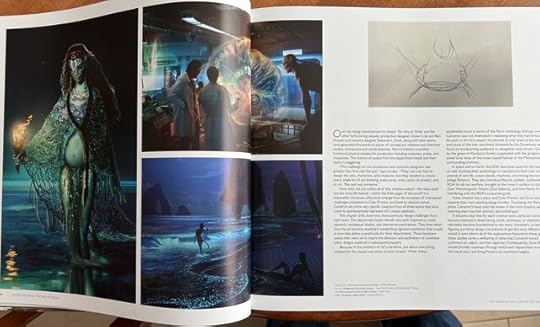
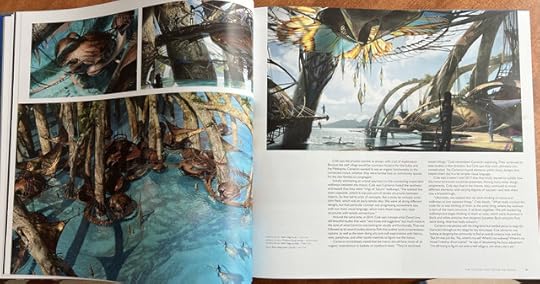
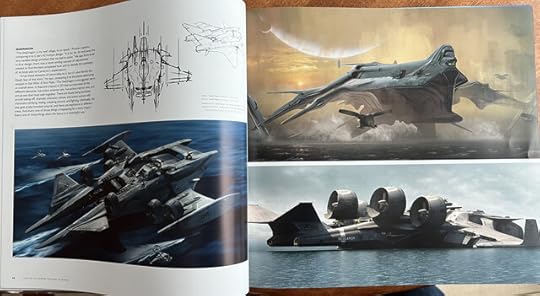

One of the most interesting things I learned is that they actually built many of the props and crafted most of the costumes, so that the animators and digital artists had real references to emulate. Sometimes they would use real sea shells or stones, sometimes they would 3D print them and paint them. Putting in that extra effort really shows in the final film, which is even more photorealistic than the first one. They even built a full-size whaling boat you see in the movie. I guess when you’ve made 3 of the top-grossing movies of all time they let you do stuff like that.
The book is well-written and succinct, because Bennett is a seasoned hand at this, but the reason I only give it four stars is because, yet again, the layout design is garbage. These art books are supposed to feature the pretty pictures, yet designers insist on numerous double-page spreads. Those look fine in digital but in a real book they look like crap, and frequently here there seems to be interesting things lost in the valley. Book layout people, I beg you, STOP DOING THIS. It’s the printing equivalent of sound engineers making dialogue impossible to hear while action is so damn loud you have to turn the volume down. Stop it. It sucks. I would much rather have slightly smaller photos where I can see everything in the picture. The occasional low-information double page spread is fine.

May 31, 2023
This artbook is very similar in appearance to the artbook for The Art and Soul of Dune, the difference is in the amount of text; The Art and Soul of Dune fully justifies its title as an artbook - the picture on the picture on the picture, and only brief comments here and there from the film team. The Art and Soul of Avatar The Way of Water, on the contrary, includes not so much pictures (although there are plenty of them, including the earliest concepts of Cameron himself), but text. It's no surprise that over the years, the Avatar team has a lot to say.
In short, describing this work, I would simply say that it is not only beautiful, but also interesting and informative, full-fledged reading, and not just admiring the pictures. There is a lot of new information here and things that are not shown in the film are presented. Anyone who wants to expand their Pandorapedia - welcome!
P.S. WHY DID THEY CUT THAT CUTE OTTER FROM THE MOVIE? I'M ANGRY.
In short, describing this work, I would simply say that it is not only beautiful, but also interesting and informative, full-fledged reading, and not just admiring the pictures. There is a lot of new information here and things that are not shown in the film are presented. Anyone who wants to expand their Pandorapedia - welcome!
P.S. WHY DID THEY CUT THAT CUTE OTTER FROM THE MOVIE? I'M ANGRY.

July 28, 2023
Despite having some of the best concept artists in the world, the volume is rather bland and unimaginative. The artwork is technically accomplished, however, the ideas in the digital paintings in the pages of the hardbound volume do not excite, they are commonplace, not unlike something out of a bad 1990s computer game.
The movie is essentially a science fiction take on the noble savage trope and where the natives defeat an evil technologically superior aggressor. The book details the concept art and digital assets created by the numerous teams of artists, basically, creation by committee and approved by the supremo, James Cameron. There are the designs of the native peoples, their costumes, their jewellery, the fauna, the flora and finally the evil humans and their machines in what is ultimately unimaginative work. What a waste.
The movie is essentially a science fiction take on the noble savage trope and where the natives defeat an evil technologically superior aggressor. The book details the concept art and digital assets created by the numerous teams of artists, basically, creation by committee and approved by the supremo, James Cameron. There are the designs of the native peoples, their costumes, their jewellery, the fauna, the flora and finally the evil humans and their machines in what is ultimately unimaginative work. What a waste.

March 21, 2024
I’ve been a fan of Avatar since the beginning, when I was 11, and now as an adult I still love this world and story so much. James Cameron will always be my favorite director in this world.
This was a great insight to how everything came to be in the sequel, the physics, the mechanics, the designs etc. The artwork was stunning throughout, as an artist and art lover i was left satisfied 🤌🏻.
It’s a beautiful book and so worth owning imo. I got mine from Amazon after a year or searching the stores but they were either always sold out or no longer sold the book. I’m so glad I have my copy so that I can put proudly on display 😊.
⭐️⭐️⭐️⭐️⭐️ 5 stars.
I see you 💙
This was a great insight to how everything came to be in the sequel, the physics, the mechanics, the designs etc. The artwork was stunning throughout, as an artist and art lover i was left satisfied 🤌🏻.
It’s a beautiful book and so worth owning imo. I got mine from Amazon after a year or searching the stores but they were either always sold out or no longer sold the book. I’m so glad I have my copy so that I can put proudly on display 😊.
⭐️⭐️⭐️⭐️⭐️ 5 stars.
I see you 💙

January 1, 2023
A detailed and thrilling look into the mesmerising world of Avatar.
It was fascinating to see the alternative concepts to the film's central components and to read about them first-hand from the artists that made the film possible. The art is stunning; seeing it reflected at you from the page truly showcases the talent of the individuals involved.
It was fascinating to see the alternative concepts to the film's central components and to read about them first-hand from the artists that made the film possible. The art is stunning; seeing it reflected at you from the page truly showcases the talent of the individuals involved.

July 10, 2023
Highly recommend this book if you’re a fan of Avatar. Gorgeous concept art and insight in to design and thought process of the creation of Pandora and its inhabitants. It’s crazy how much effort was put in to the film and I would have never known if I didn’t read this book.
March 20, 2025
I enjoyed the art. However, I wish it discussed the connections between the world of Avatar: The Way of Water and modern-day sociopolitical issues. I'm curious not only about the real objects that inspired the costuming and props but also the feelings and thoughts that drove the artists.

December 31, 2022
3.75/5

January 7, 2023
this book was a truly amazing look into what went into the making of avatar twow, i loved every page and the art was absolutely gorgeous

March 18, 2024
Oh to be a part of a project like Avatar.
June 21, 2024
Love the illustrations

July 26, 2024
i see you

August 29, 2025
Very similar to the original Avatar with lots of fighting with others and teen children.
October 4, 2025
One of the most beautiful art books I’ve seen, but felt like it was missing so much detail 💔 would’ve loved more character exploration or behind the scenes with the motion capture.
Read
October 30, 2025AMAZING!!!!!!!!!

December 18, 2025
Very informative and glad I finished right before I go see the third movie!!

January 15, 2026
Incredible (A)

May 8, 2026
First book of the year! Yay! This was written so well and the concept art was beautiful to look at. The art book for A3 is coming out in a few months, can't wait to read that as well 😛
February 28, 2023
nice book!

February 16, 2023
Bought at the same time as the previous book on Avatar 2, this one is very imposing and just as exciting. Alternating between explanatory texts and images on a double-page, we take full view and we learn especially a lot. While the Encyclopedia was more succinct, this large volume provides information about the post-production team, so 3D animators, illustrators, costume designers, special effects managers, every role is there. Not to mention discussions with directors and producers, including the great James Cameron.
Some recount the sometimes very long meetings, during which the teams dissect each element of the film, so that the script and the universe on the screen correspond to the overflowing imagination of the director. Between superficial modifs and total change of direction, the work provided has been, and is monstrous. The sequel is already filmed but remains to finish the production.
So for those who say that Avatar 2 is poor, I disagree. The abundant universe IS the story, watch Kiri or Lo'ak swim with a smile in these splendid waters, that’s the scenario! A life on a different planet from Earth, the Sully family leaves the jungle and has to adapt to survive. What more do you need? This film is of great depth, ask yourself: what did it do to you? What feeling(s)?
https://www.instagram.com/p/CoQMtI_ohB8/
Some recount the sometimes very long meetings, during which the teams dissect each element of the film, so that the script and the universe on the screen correspond to the overflowing imagination of the director. Between superficial modifs and total change of direction, the work provided has been, and is monstrous. The sequel is already filmed but remains to finish the production.
So for those who say that Avatar 2 is poor, I disagree. The abundant universe IS the story, watch Kiri or Lo'ak swim with a smile in these splendid waters, that’s the scenario! A life on a different planet from Earth, the Sully family leaves the jungle and has to adapt to survive. What more do you need? This film is of great depth, ask yourself: what did it do to you? What feeling(s)?
https://www.instagram.com/p/CoQMtI_ohB8/

May 18, 2023
Awesome book with really cool illustrations!

May 25, 2023
I got this from the library to read mostly as a picture book. I loved it. Very pretty, and the in-depth diagrams and explanations of wardrobes and tech that come with it were a happy plus.
Displaying 1 - 28 of 28 reviews