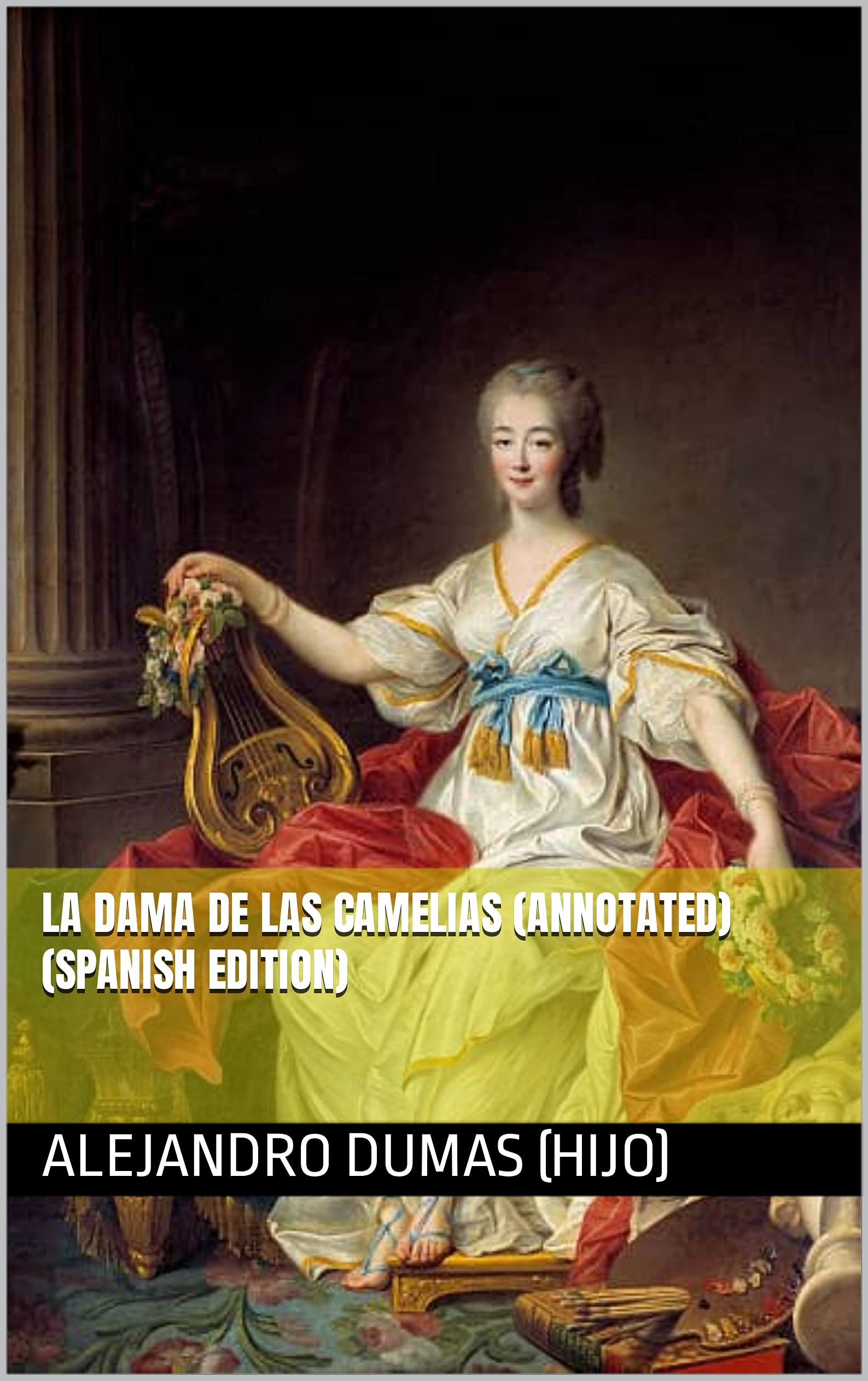
Este libro La dama de las camelias , fue publicado en el año de 1848, por el joven autor Alejandro Dumas (hijo), está basada en relatos de su propia vida, de un romance que tuvo con la joven cortesana Marie Duplessis en París, la cual sostuvo una gran cantidad de relaciones con personajes importantes de la sociedad de la época. Esta obra literaria La dama de las camelias forma parte del movimiento conocido como Realismo, siendo esta una de las primeras que pasaría a formar parte de una transformación hacia el romanticismo. La obra teatral La Traviata del compositor italiano Giuseppe Verdi, es la adaptación al teatro de esta novela inspirada en la imagen de Marie Duplessis. La mayoría de lo que sucede en la trama manifiesta algunos de los acontecimientos tal y como pasaron en la realidad.
Alexandre Dumas (fils) (son) was born in Paris, France, the illegitimate child of Marie-Laure-Catherine Labay (1794-1868), a dressmaker, and novelist Alexandre Dumas. During 1831 his father legally recognized him and ensured that the young Dumas received the best education possible at the Institution Goubaux and the Collège Bourbon. At that time, the law allowed the elder Dumas to take the child away from his mother. Her agony inspired Dumas fils to write about tragic female characters. In almost all of his writings, he emphasized the moral purpose of literature and in his play The Illegitimate Son (1858) he espoused the belief that if a man fathers an illegitimate child then he has an obligation to legitimize the child and marry the woman.
Dumas' paternal great-grandparents were a French nobleman and a Haitian woman. In boarding schools, Dumas fils was constantly taunted by his classmates. These issues all profoundly influenced his thoughts, behaviour, and writing.
During 1844 Dumas moved to Saint-Germain-en-Laye to live with his father. There, he met Marie Duplessis, a young courtesan who would be the inspiration for his romantic novel The Lady of the Camellias. Adapted into a play, it was titled in English (especially in the United States) as Camille and is the basis for Verdi's 1853 opera, La Traviata. Although he admitted that he had done the adaptation because he needed the money, he had a great success with the play. Thus began the career of Dumas fils as a dramatist, which was not only more renowned than that of his father during his lifetime but also dominated the serious French stage for most of the second half of the 19th century. After this, he virtually abandoned writing novels (though his semi-autobiographical L'Affaire Clemenceau (1867) achieved some success).
On 31 December 1864, in Moscow, Dumas married Nadjeschda von Knorring (1826 – April 1895), daughter of Johan Reinhold von Knorring and wife, and widow of Alexander, Prince Naryschkine. The couple had two daughters: Marie-Alexandrine-Henriette Dumas, born 20 November 1860, who married Maurice Lippmann and was the mother of Serge Napoléon Lippmann (1886–1975) and Auguste Alexandre Lippmann (1881–1960); and Jeanine Dumas (3 May 1867–), who married Ernest d' Hauterive (1864–1957), son of George Lecourt d' Hauterive and wife (married in 1861) Léontine de Leusse. After Naryschkine's death, he married in June 1895 Henriette Régnier de La Brière (1851–1934), without issue.
During 1874, he was admitted to the Académie française, and in 1894 he was awarded the Légion d'honneur.
Alexandre Dumas fils died at Marly-le-Roi, Yvelines, on November 27, 1895 and was interred in the Cimetière de Montmartre in Paris. His grave is, perhaps coincidentally, only some 100 metres away from that of Marie Duplessis.
Excelente versión dramatizada, disfruté de la músicalización, los efectos de sonido y la actuación del elenco de narradores, quienes logran darle vida a la trama y a los personajes de este melodrama clásico.
Me gustó que en la trama se abordan temas como la prostitución, la doble moral de la sociedad, los prejuicios, la obsesión, la pasión y los celos.
Tuve problema con el protagonista masculino. No me simpatizó. Era un hombre inmaduro, celoso, berrinchudo y abusivo con su "amada". Me desagradaban sus comentarios despectivos y machistas. No se merecía el amor y la devoción de Margarita.
Es una historia de amor intensa para la época en la cual fue escrita. Esperaba que existiera algún momento más duradero de felicidad pero es una historia bastante triste
Una hermosa historia de amor, un amor de época juzgado y tildado de prohibido por una sociedad de doble moral. Con un final desgarrador, pero sin una opción posible en un mundo como esté.