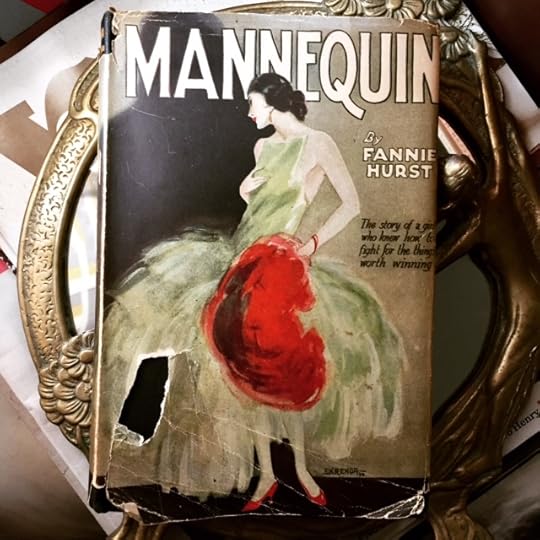
Melodramatic tale of a girl, kidnapped by her nursemaid and raised in a slum in early 1900's New York. At 18, she is working as a salesgirl, until her beauty is discovered and she is promoted to a model, or "mannequin," in the department store. Her story takes a sordid turn when she is accused of murder after her attacker dies while she is resisting a rape attempt. Later she is of course acquitted and reunited with her real family.
Fannie Hurst was born in Ohio, grew up in St. Louis and spent her adult life in New York City. She is the author of 17 novels and more than 250 short stories, as well as plays, screenplays, memoirs, essays and articles. Her best-remembered works are those turned into films, including: Imitation of Life, Back Street, Humoresque, The Younger Generation, and Young at Heart. She was active in a variety of progressive Jewish, social justice, labor, peace and women’s organizations. A lifelong philanthropist, Hurst willed her considerable estate to her alma mater Washington University and to Brandeis University.
I stumbled across this book at work (in a library) where it attracted me by its vintage cloth cover.
This began as a simple melodramatic tale of the progress of a young girl, raised in a slum in early 1900's New York, who begins to make a success of herself as a clothing model, or "mannequin." Her story takes a dramatic turn when she is accused of murder after a man dies while she is resisting a rape attempt.
I found this a very interesting, insightful treatment of the issues of violence against women, resentment of women by society in general, and the way the justice system and media treat female criminals. It reminded me of "Roxie Hart"/"Chicago," but from a different point of view, with a more sympathetic defendant, with more background story.
Reading this on the heels of "Virgin or Vamp" was an illumination of the same issues.
Here is a link to a review of the 1926 silent movie of the book, which is very critical and dismissive of the plot. Below are some more reviews.
I think what was maybe lost in the translation to screen, and probably would be lost on the reviewer in any case, is the brutal, disgusting description of the months and minutes leading up the the crime. It shows a very modern grasp of what motivates and precipitates sex crimes, i.e. that the man's actions are motivated by anger rather than lust, and that the woman really is functionally helpless to get out of the situation without violence.
Some things about this story were very un-feminist and condescending. There is an insulting implication that, because the girl was stolen from her rightful class and position, there was something special, different and better about her. It is implied that, if she really had been the daughter of the poor nursemaid who raised her, there would have been nothing wrong with the way her rapist treated her. It was only because she was really, secretly middle class, that she was naturally repulsed by the presumptuous behavior of this guy, but also too lady-like to snub him outright, until it was too late and he felt "led on."
There's also a lot of emphasis on the fact that the death was, in fact, an accident, because this innocent, precious, gentle girl would never have killed her rapist on purpose. In other words, the reason we want her to be found innocent is that she is actually innocent, which seems lazy. It would have been bolder and more to the point to portray her as innocent even though she killed the man, because it was self-defense.
Overall, I can't highly recommend this as a read, but I love the period (1926) and found this an interesting cultural artifact.
I found this book at an antique store. I had to have it for the gorgeous Art Deco dust jacket, though frail, was still attached. And since I love to read, of course I read it!
The writing I liked. Hurst has a tendency of introducing something, then repeating it with new information. Some people may find it tiresome, but I think it keeps the momentum up. Especially near the end, the writing became less formal and frantic, which worked with the tone of the story.
You feel so damn bad for the protagonist, Orchid Sargossa, who is a victim of fate. She gets assaulted by a creep, which is very hard to read and Lord, it nearly did me in! I don't know if I've ever read a passage quite so fast; I had trouble putting it down to go to sleep.
I also really liked her use of slang as in: "Ugh, he was losing no time with his tiresome parryings." Too, Hurst's favorite word is apparently "fastidious", which she uses all the damn time.