Jump to ratings and reviews
Rate this book

Tiepolo Pink

Rate this book
The eighteenth-century Venetian painter Giambattista Tiepolo spent his life executing commissions in churches, palaces, and villas, often covering vast ceilings like those at the Würzburg Residenz in Germany and the Royal Palace in Madrid with frescoes that are among the glories of Western art. The life of an epoch swirled around him—but though his contemporaries appreciated and admired him, they failed to understand him.

Few have even attempted to tackle Tiepolo’s series of thirty-three bizarre and haunting etchings, the Capricci and the Scherzi , but Roberto Calasso rises to the challenge, interpreting them as chapters in a dark narrative that contains the secret of Tiepolo’s art. Blooming ephebes, female Satyrs, Oriental sages, owls, we will find them all, as well as Punchinello and Death, within the pages of this book, along with Venus, Time, Moses, numerous angels, Cleopatra, and Beatrice of Burgundy—a motley company always on the go.

Calasso makes clear that Tiepolo was more than a dazzling intermezzo in the history of painting. Rather, he represented a particular way of meeting the challenge of endowed with a fluid, seemingly effortless style, Tiepolo was the last incarnation of that peculiar Italian virtue sprezzatura , the art of not seeming artful.

320 pages, Hardcover

First published October 1, 2006

29 people are currently reading
1026 people want to read

About the author

Roberto Calasso

66 books681 followers
Roberto Calasso (1941 – 2021) was an Italian writer and publisher.

Calasso was born in Florence in 1941, into a family of the Tuscan upper class, well connected with some of the great Italian intellectuals of their time.

Calasso worked for the publishing firm of Adelphi Edizioni since its founding by Roberto Bazlen in 1962 and became its Chairman in 1999. In 2015, he bought out the company to prevent it from being acquired by a larger publishing firm. His books have been translated into more than 20 languages.

He was the author of an unnamed ongoing work reflecting on the culture of modernity, which began with The Ruin of Kasch in 1983, a book admired by Italo Calvino. Dedicated to the French statesman Charles Maurice de Talleyrand-Périgord or, Talleyrand, it was followed in 1988 by The Marriage of Cadmus and Harmony, in which the tale of Cadmus and his wife Harmonia becomes a pretext for re-telling the great tales of Greek mythology and reflecting on the reception of Greek culture for a contemporary readership. Another world civilization is surveyed in Ka (1996, where the subject of the re-telling is Hindu mythology). K restricts the focus to a single author, Franz Kafka; this trend continues with Il rosa Tiepolo (Tiepolo Pink), inspired by an adjective used by Marcel Proust to describe a shade of pink used by Venetian artist Giambattista Tiepolo in his paintings. With La folie Baudelaire, Calasso once more broadens his scope from fresco to a whole civilisation, that of Paris in the latter half of the 19th century, reconsidering the lives and works of the post-romantic generation of writers and artists from Baudelaire to Valéry. In one of his more recent works, Ardore (2010), the author returns to India for an exhaustive analysis of the theory and practice of Vedic sacrifice and its significance for post-modern epistemology.

Along with his status as a major analyst specifically of the works of Kafka, Calasso was, more broadly, active in many essays in retrieving and re-invigorating the notion of a Central European literary culture. He also served as the president of the International Alexander Lernet-Holenia Society, which promotes the publication, translation and study of this multi-genre Austrian writer and his focus on the identity crisis of his characters at odds with postimperial Austria and Central Europe.

Ratings & Reviews

What do you think?
Rate this book

Friends & Following

Create a free account to discover what your friends think of this book!

Community Reviews

5 stars
92 (39%)
4 stars
99 (42%)
3 stars
33 (14%)
2 stars
8 (3%)
1 star
2 (<1%)
Displaying 1 - 30 of 37 reviews
Profile Image for Kalliope.
738 reviews22 followers
July 10, 2022


Calasso’s books seem to require some familiarity with their subject before letting oneself being led by his disquisitions. With Tiepolo this would require the paintings and murals, as well as the writing on them by writers. In particular Proust’s, as Calasso’s title is a quote of the latter. And, even if Calasso does not explicitly address Powell, Temporary Kings, volume eleven of the Dance will also come to the mind of the reader.

While visiting Tieopolo’s works in Ca’Rezzonico a friend and I talked briefly about this work. I had not read it yet. My friend did not find it particularly interesting; she said that it concentrated on his minor works – the Prints. This is true, but it is also not so.

There are three chapters and only the second deals with the Capricci and Scherzi. The other two are meditations on other works by Tiepolo and follow a mild chronological order.


From the very beginning Calasso explores the ‘theatrical’ character of Tiepolo’s art. Of course, he begins by acknowledging that to say that Tiepolo’s creations are theatrical is commonplace. What he does is then make us realise that Tiepolo had a troupe. His characters, the beautiful and young heroine, the elderly man, the Orientals, the dogs, owls, are met again and again. The actors change roles and settings, but they become familiar faces and bodies for the viewer who moves from work to work, or from ceiling to ceiling. The same beauty appears as: Angelica, St. Lucy, Beatrice of Burgundy, Iphigenia, Venus—not the Virgin, though. Even the settings and the costumes are reused or recycled: slanting trees, poles, masts, halberds mark space, or the stage. And sometimes the dresses are reused. Both Egyptians wear the same European dress: the daughter of Pharaoh when finding the infant Moses or Cleopatra.


And yet, the theatricals leave out the drama, and the suffering. There is no psychological turmoil, just “elegant placidity”. Calasso goes even as far as to say that the 18th Century did not understand the tragic; he must have meant it was rarely raised in the arts, since the century knew very well the tragic, particularly at its end.

Calasso certainly gives free rein to his interpretative abilities. And may be the fact that there is very little documentation on Tiepolo’s artistic ideas – only financial and contractual records have survived—justifies his license. But at times I felt somewhat frustrated (irritated?) by his descriptions or claims. May be this was because at the time I was reviewing his book I was also attending a Symposium in which I heard various curators discussing complex ideas on art without ever departing from their very solid basis.


Nonetheless, Calasso makes a very engaging proposal and now I come to my disagreement with my friend. In the second part of the book, in which he discusses Tiepolo’s sketches, Calasso presents an inviting interpretation of these works. The 10 Capricci and 23 Scherzi—the former horizontal and the latter vertical in format—have puzzled critics and historians. These were produced mostly during the 1740s with “a final coda” in the 1750s. Nobody understands what they are about. Enigmatic, mysterious, baffling, Calasso, after acting as an archaeologist of culture – digging and reviving the cultural use of various elements or themes, such as snakes, or witchcraft, comes up with a plausible verdict on these sketches. Relying on an important part of Tiepolo’s troupe, his Orientals, Calasso unveils their role as the “internal eye” of the scenes. As the observers of the scene “Their task is to insert the mind into that which appears”.


In the final section, Calasso addresses the large fresco cycles Tiepolo was commissioned: The Würzburg Residence (where I first got hooked on Tiepolo), and the ceilings in the Madrid Royal Palace. The Würzburg Treppenhaus Calasso appropriately identifies as the “phantasmagoria of history”, and he too easily dismisses the somewhat conflictive works in Madrid. Sadly, soon after the already elderly Tiepolo finished his commissions for Carlos III, the painter’s work abruptly passed out of fashion. The refrigerated Neo-Classicism arrived with an unsuitable great turmoil, and the rococo was defined in derision.


It ought to be Tiepolo, however, the most luminous master of light and open and freeing skies, who should be associated with the Enlightenment. His sprezzatura suited the rapidity with which liberating new ideas spread in the air of his century.

I do not know at what point Tiepolo began to be recuperated. Calasso criticizes Longhi’s negative judgement of the Venetian (we ought not to forget that Longhi had ‘discovered’ Caravaggio). May be similarly to the resurrection of El Greco by the Modernists, Tiepolo was also brought back by them. Proust’s tribute was powerful enough to prompt a full book based on his appellative. For a Calasso says, even though Proust makes copious references to explicit art works, with Tiepolo he gives the painter his most appropriate form. Proust transforms Tiepolo into a colour. And always in reference to a woman: Odette, la Duchesse and Albertine.

But which pink is it?… The pale tone or the vivacious cherry or fuchsia?

My vote is for that which Odette wore.


Profile Image for Greg.
562 reviews144 followers
September 7, 2020
For Proust, Tiepolo was first and foremost Odette’s robes. In the eyes of this very young and stubborn worshipper, none of the outfits with which Madame Swann appeared in society were remotely comparable to the “marvelous robe in crepe de Chine or silk, old rose, cherry, Tiepolo pink, white, mauve, green, red, yellow, plain or patterned, with which Madame Swann had eaten breakfast and was about to take off.”
Reading Tiepolo Pink conjures images of sitting in a comfortable, plush chair opposite of Roberto Calasso as we finish off a few bottles of exceptional wine. The whole time my transfixed awe of his monologue on Giambattista Tiepolo is probably much like that of Wallace Shawn in the movie My Dinner with Andre. Calasso goes off on seemingly wild tangents—ranging as wide as references to figures from antiquity and the Old Testament to Milan Kundera and Alfred Hitchcock—only to come back to with captivating, convincing, illuminating arguments about Tiepolo’s art. My only regret, considering the wonderful the language of the English translation, is that I’m not able to read it in the original Italian. His prose flows like a mesmerizing stream; much like a great rock song, you just want the jam going to keep on.

Tiepolo left behind no substantive traces about his life other than his art. Calasso weaves clues together, obvious and obscure, to leave a lasting impression of one of the most misunderstood artists in history. His gift was sprezzatura, which Baldesar Castiglione defined as “a certain nonchalance that may conceal art and demonstrate that what one does and says is done without effort and almost without thinking.” In other words, Tiepolo made it look too easy. His use of light to enhance his work was universally admired and acclaimed. Yet he was derided as an artistic mercenary of sorts, a “man who spent his life responding swiftly to religious and secular patrons, nobles and parvenus, monarchs and princes” and was “especially obsequious toward those powerful men who were also his patrons.” It was therefore easy for artists to dismiss him as an “intruder” as they failed to “grasp the peculiarity of the spell cast by his hand.”

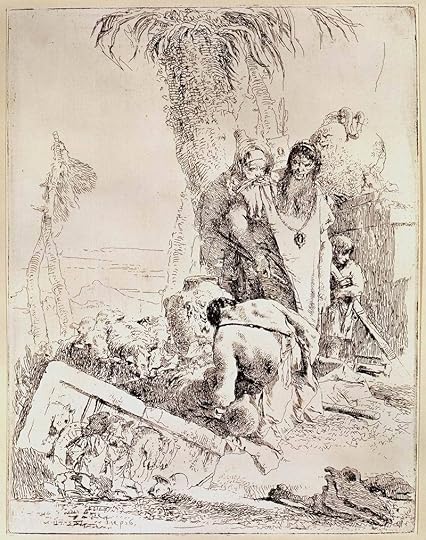
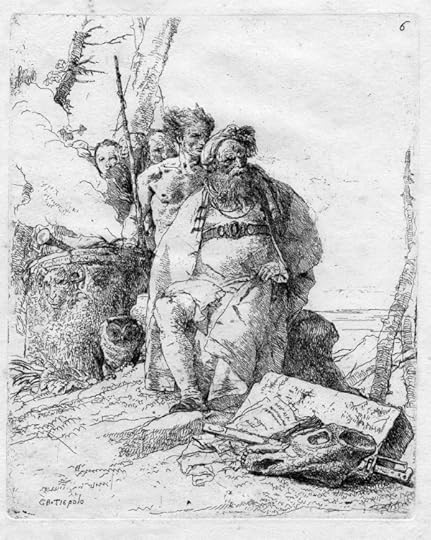
Calasso argues Tiepolo’s etchings known as the Capricci and the Scherzi are Rosetta Stones needed to understand the artist. They were personal artistic expressions, not meant for public consumption, and seen by only a handful of friends during his lifetime: “a body of work without a patron and without a buyer (or at least with extremely rare buyers), a body of work in which there reappear figures we have already encountered in paintings and frescoes, but that are now finally on their own, without any ceremonial function or apparatus.” Each of the 23 Scherzi is considered individually. These are not scenes normally associated with Tiepolo, mostly gatherings of characters and symbols that inhabited the fringes of his known work. They intermingle ideas and concepts of Christian and pagan worlds.

The common theme is theurgy, the expression of the supernatural in human actions, as Calasso describes it, “an inner zone of magic, the most secret, perhaps the highest.” Tiepolo lived at a time when it was widely believed that magic and mysticism intermingled in daily life. In the Scherzi, “Tiepolo chose to portray the moment in which the invisible is about to appear—or maybe it has just appeared or is taking shape,” or more precisely, the moment of theurgy. The scenes of the Scherzi mix visions of mythology, paganism and Christianity, often in ways that remain hidden without intense observation and attention to the minute details.
And what do the characters in Tiepolo’s Scherzi see? What are they pointing at? Not just what appears: the ashes, the snakes, the bones. But something else, which is not admitted, which has no name. In them there already resounds the baritone voice that Joseph de Maistre was to give to the senator of St. Petersburg as he says: “I have read millions of witticisms about the ignorance of the ancients who saw spirits everywhere: it seems to me that we who see them nowhere are much more foolish.”
“In the Scherzi,” writes Calasso, “Tiepolo wove the countermelody to the Enlightenment. No one else would have succeeded in calling that up.” He places the observers in his painting, the “Orientals,” in the center of events in the Scherzi. The repeated images of staffs with snakes coiled around them refer back to both pagan lore and the Old Testament. For example, the story of Moses’s rod changing to a serpent “is like a dialogue between a magician and an apprentice.” Many parts of the Scherzi found their way into his greatest work, the ceiling frescoes in the Würzburg Residenz.

In the Great Hall of the Residenz that was designed by Bathasar Neumann, Tieopolo had the greatest workspace of his life. His “Orientals” found their way back into their traditional roles of interested observers and the subject of Europe, America, Africa and Asia. The city also had historical experiences with the links between the occult, magic and reality that were implied in his Scherzi that likely influenced his painting in the Residenz.
Tatarottti mentioned in his book that “in Erbipoli [the Italian name for Würzburg]…in little more than two years, between 1627 and 1629, one hundred fifty witches and warlocks, including fourteen Curates, and five Canons, were decapitated and burned.” Nor were these solely stories from the past. Again in Würzburg, just one year before Tiepolo’s departure (and hence in 1749), one of the last witches in Europe was decapitated and burned. Her name was Marie Renata Singerin, and she had been “convinced since childhood of having had relations with the Devil and of having succeeded in concealing such wickedness until the age of seventy-three years.”
Tiepolo’s interpretations of America, Africa and Asia are among his most ambitious works. His view of Europe is more sedate, perhaps even a bit boring when contrasted with the other three continents, but one observer stands out.
The individual’s name is unimportant. Because he is the West, the only entity curious and foolhardy enough to get into trouble in such a faraway place—and always convinced that there are good business deals to be done. No one else saw this with Tiepolo’s prophetic irony. So prophetic indeed that it went unnoticed.
As Europeans went on to plunder those parts of the world to build their wealth, Calasso praises Tiepolo’s prescience as “the most reliable portrait of a civilization.”

I was fortunate to have spent most of my summers growing up in Würzburg. The Residenz and Tiepolo’s ceiling have always been a part of my life; the beauty and genius of the total experience was something I took for granted, but I was always aware of its greatness. Calasso shares a story that Edith “Wharton admired Tiepolo without moral reservations, with upper-class confidence. And in this she found an unexpected ally in Mark Twain, who had noted in his diary, back in 1878: ‘But Tiepolo is my artist.’” I realize now, thanks to Calasso’s brilliance, why Tiepolo is my artist as well.
Profile Image for Eric Byrd.
625 reviews1,184 followers
October 24, 2019
The ekphrastic installation of Tiepolo in the pantheon Calasso is building - another metaphysical dandy, a "semiclandestine" magus, a formalist of the unnameable. "Like all esoteric beings, Tiepolo said nothing about his secret. He merely displayed it."
Profile Image for Jonfaith.
2,154 reviews1,750 followers
February 7, 2017
Of all the greats of painting, Tiepolo was the last one who knew how to keep silent.

3.5 stars with an asterisk: political reality has never been this depressing. Calasso points to the sublime, the inherent mystery within. The task at hand is the Scherzi and the Capricci a pair of collections of etchings from the 18C painter Giambattista Tiepolo, an inscrutable iconography. Along the way of this largely orthodox art criticism we do encounter the Chaldean who sat with Plato during the philosopher's last days and the bronze serpent of the prophet Moses. Casting silent judgement over this constitutional is the ubiquitous Baudelaire.

This work deserved a better reading but I can't help but be poleaxed by each day's WH delirium. I almost hold my breath each morning before logging on to The Guardian.
Profile Image for Geoff.
444 reviews1,532 followers
Want to read
August 17, 2015
Dipping in and out of this one as it's being kept by the bedside. The writing is out-of-this-world good... So many names have already been paraded and again Baudelaire has become a presiding spirit. Things bode well for this book.
Profile Image for Krys.
144 reviews8 followers
Read
December 20, 2023
I found myself rather lost since I lack any steady footing in ancient and classical studies, which this book frequently veers into. But it's a comprehensive introduction to the Italian Renaissance painter Tiepolo, whom this book depicts as a sort of transitional figure far ahead of his time, and whose transformation of history and myth into a fantastical, theatrical language prefigured the art movements to come. The second chapter, which focused on Tiepolo's dark and gnomic etchings (titled the 'Scherzi'), was delightful to discover.

"A myth is the 'mesh' of a 'spider's web', and not a dictionary entry," Marcel Mauss once said. Tiepolo treated the stories his patrons asked him to translate into images in the same way. Christian or pagan—it was indifferent. Real or fictitious, at a certain point all events had to be transformed into the threads of the spider's web, hanging between the branches of a slanted tree trunk and swaying gently at every puff of wind. Never had it been possible to move around in the past with such agility, as if distances in tie and space were rhetorical arguments that facilitated contact rather than hindered it. The exotic, as such, no longer existed. All was exotic—or nothing.
Profile Image for Mattia Colombi.
27 reviews5 followers
June 3, 2021
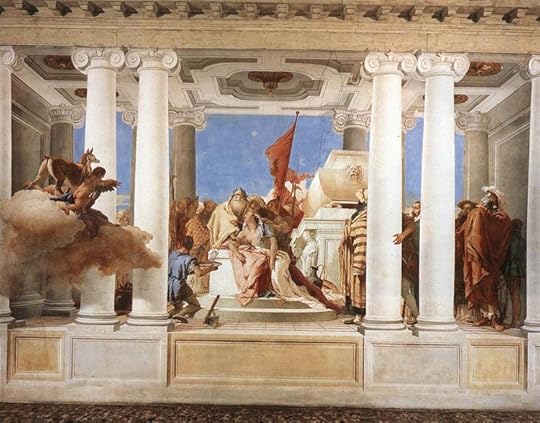
Secondo Roberto Calasso Giambattista Tiepolo è "l'ultimo soffio di felicità in Europa" e come poter non essere d'accordo con lui? Tiepolo (1696 - 1770) è il grande artista italiano, e anche l'ultimo, del XVIII secolo. Ha passato tutta la sua vita in modo riservato, lasciando parlare esclusivamente la sua arte, un'arte fatta di tinte pastello, di cieli trasognanti, di scene quasi arcadiche per il loro essere così fuori dal tempo. Non penso sia possibile non rimanere incantati ed estasiati guardando gli affreschi in Palazzo Labia a Venezia, con scene di Antonio e Cleopatra, i quali creano un effetto unico: i muri del palazzo sembrano venire abbattuti per poter portare lo spettatore in un altro luogo, un luogo contemporaneo ma estraneo al nostro mondo; ci troviamo di fronte (in quasi tutte le sue opere) ad una felicità fittizia ma che riesce ad accoglierci avvolgendoci con queste tinte quasi slavate che non possono che ricordarci le più delicate porcellane orientali.

Roberto Calasso non intende ricreare una biografia dell'artista ma cerca di capirlo esplorando la sua produzione, soprattutto quella più misteriosa ed oscura come i disegni presenti nel quaderni con gli Scherzi e Capricci dove appaiono figure talvolta mostruose e mitologiche. In questo capitolo, descrivendo le scene dei vari disegni si entra in un territorio che mai avrei immaginato di percorrere leggendo un libro su Tiepolo, si entra nel mondo della mitologia, della storia della magia, della necromanzia e dell'alchimia. E d'altronde "come ogni vera felicità, piena di lati oscuri, non destinati a scomparire, anzi a prendere il sopravvento".

Fatevi un favore: comprate questo libro, prendete un biglietto per Venezia, per Wurzburg, per Madrid e andate a farvi avvolgere dalle opere di Giambattista Tiepolo.
144 reviews1 follower
April 21, 2010
In 1983, I spent six weeks in Italy with my wife and daughter. During a three-day visit to Venice, we tracked down every Tiepolo ceiling we could find. Two of these were not in the guidebooks: they were painted in former palazzi that now housed the municipal waterworks and telephone office, respectively. I fell in love with Tiepolo's brilliant colors, dazzling light, billowing clouds, and infinite skies. So when a rave review of Calasso's book appeared in the New York Review, I ran out to buy it. Unfortunately the review was better than the text, which is by turns ponderous, petty, and pretentious. However, the book is beautifully made, with vivid color prints as well as reproductions of Tiepolo's eery etchings.
Profile Image for Lula Mae.
234 reviews66 followers
January 22, 2016
Una delicia para quien disfrute con el arte en general y con la pintura en particular y desde luego para mí, que estoy convencida que tienen que explicarme los cuadros para poder disfrutarlos plenamente. Porque aunque el arte moderno/contemporáneo requiera más esfuerzo que el de siglos anteriores, incluso los frescos de Tiepolo esconden guiños que alguien nos debe ayudar a descubrir.
Profile Image for brbb.
116 reviews
March 21, 2025
now THAT is how you defend your blorbo
Profile Image for Jose.
439 reviews18 followers
November 4, 2019
This is one of the most obtuse and pedantic books I've ever come across. I guess since Mr. Calasso is the owner of his own publishing house, he can impose this on the shelves. Roberto Calasso seems to the be the epitome of rarefied Italian intellectual with endless erudition on all things arcane, an erudition that he summons for whichever subject is at hand. Granted I read this book from a translation into English so may be I missed something among the clumsy phrasing and odd sentence turns.

The book has three chapters. The subject of the second one is Tiépolo's series of "Scherzi", jokes, capricious drawings this master of the late Venetian Baroque, early Enlightment made for his own amusement and whose meaning has eluded most experts. Calasso settles on the theory that their interchangeable cast of characters: The ephebes, nymphs, coiled snakes, imposing Orientals, owls, Punchinellos and the satyrs are symbolic of some sort of ritualistic cult. These characters are often depicted around altars where something burns and where instruction is imparted. They can be a bit dark if one looks really hard, a skull here, a recoiling snake there, nothing too ominous. Since Tiépolo never left much written about his personal life except for fawning letters praising his patrons to the point of groveling, it is hard to make much of these odd drawings which lack title and description. That doesn't stop Mr. Calasso from invoking all the weapons in his arsenal of expertise, Proust, Baudelaire, the Mahabarata, mythology, etc.. to find meaningful connections. So what could be a light twenty page tome becomes a plodding repetitive rambling with little evidence. Thankfully, the illustrations lighten the text and I encountered the best description -even if a disparaging one- for a Tiepolo ceiling fresco: it looks like a pile of laundry. Tiépolo himself doesn't come through in these pages. The author claims he was not innovative in the least and owed much to Veronese, Salvator Rosa and other Venetian masters. Tiepolo seems to have never made a painting that wasn't commissioned or paid for, which makes his "Scherzi" even more of a mystery. His repertoire of characters reappears again and again.

With all the erudition piled in this book like a traffic jam, there's no mention of technique. materials or any of the practical considerations that enliven any erudite essay about art. The first and last chapters deal with some other aspects of Tiépolo's ouvre without ever leaving the thick net of fee association. There's something about Tiépolo and his sons that really doesn't lend itself to obscure erudition however. His paintings are light, luminous, a bit predictable. His talent was sought after all over Europe, Venice, Würzburg, Madrid and more. It is unavoidable to compare Tiépolo's prints with those of Goya. Whatever the 'Scherzi' were, any comparison with Goya's fantastical prints pales in comparison. His art also finds echos in Boucher and Fragonard. The author thinks these French successors in the art of palatial decor didn't really probe the dramatics Tiépolo reached. Never mind that the art of ceiling monarchy apotheoses was already in retreat by the time Tiépolo himself was executing his masterpieces. As for the comments on Spain and its language, they are as misinformed as useless and dismissing the Palacio Real frescoes as a decline in the painter's work is arguably wrong. In conclusion, a difficult read on an interesting subject.
Profile Image for Margaryta.
Author 6 books50 followers
September 14, 2015
Roberto Calasso has taken a place in my list of favourite authors. “La Folie Baudelaire” was my introduction to his work and I fell in love with not only the language but the way in which he approaches the subject, the subtle twists and turns in his writing that make it enjoyable to read and easy to stay interested in the subject. “Tiepolo Pink” was no different.

It’s nice to finally be able to not only put a name but also a framework in terms of personality of the artist whose work I have seen several times before but knew practically nothing about. Tiepolo for me was a mystery when I picked up this book, although I saw his work before and developed a love for what is still labelled as the colour Tiepolo Pink. Once again Calasso didn’t just provide the basic biographical information about Tiepolo. There were other artists and critics who appeared in the essay along the way to strengthen his discussion of Tiepolo’s work, and it made the book read more like a factual story than an essay. It had the same plot hooks in place, the same character development that is characteristic of fiction. Quotations were strategically and perfectly placed without being overbearing and truly strengthened the writing without making it feel like the author was trying to be condescending and unloading everything they know onto the reader. Instead, it was a highly informative read that was at the same time entertaining.

In terms of “value” and what this book adds to the art history world, I would say section II, “Meridian Theurgy”, was the most fascinating and informative. Etching is often forgotten about when it comes to artists who create large paintings or frescoes. It was pleasant to see so much attention devoted to the etchings, and the balanced argument that Calasso built around the symbolism and meaning of the plates. The fact that he presented arguments from other art historians and pointed to why some of their theories wouldn’t work proved just how good a writer he is, as well as how eloquent a persuader. The only small downside I would point out, applicable not just to this section but to the book in general, is that at times it could get a little wordy or confusing. There were a few times when I had to go back and reread sentences because they didn’t sound grammatically correct in my head, leaving some lingering doubts after a couple of them still sounded funny after a couple more rereads. However this is a tiny trifle that doesn’t make a dent on the overall splendor of the book.

Not only have a learned a lot more about Tiepolo but I also now can’t wait to read more of Calasso’s books, both his earlier works and those that will be coming out translated in the future. It’s satisfying to read such an informative book that is able to make the task of reading it enjoyable, rather than making it feel like you’re forcing yourself to read in order to source the material later on for a paper. Calasso is a word master, world builder, and a persuasive expert with a pleasant sense of humour. “Tiepolo Pink” would make a wonderful addition to any art lover’s collection, or serve as a good opening into the world of painting, Italian artwork, or art history as a whole.
Profile Image for Fernando.
56 reviews37 followers
February 28, 2018
Calasso dice que la obra de Tiepolo fue el último respiro de la felicidad en Europa. Para descifrar qué quiere decir y por cuáles caminos se irá, hay que sumergirse en su análisis, empaparse de su erudición, dejarse llevar por los argumentos sembrados de sorpresas, giros inesperados y demostraciones de inteligencia impresionantes. Mucho de esto puede ser abrumador y hasta sofocante, pero si uno se desafía a perseguirlo, encuentra a Calasso como un guía cálido y emocionante. Es como el guía turístico que te llevaría al lado chismográfico de los monumentos pero para explicarlos mejor y revelarnos por qué siguen vivos y no son meras ruinas. Del lado más académico del asunto, por otra parte, Calasso puede ser muy (demasiado) aventurado, pero no por ello menos valioso. Es aventurado pero no impreciso, sino deseoso: quiere que encontremos la emoción vivísima que él siente ante el arte y uno agradece tal devoción.
Profile Image for Vivian.
81 reviews1 follower
September 2, 2012


Brilliantly, terribly esoteric. Calasso delves into an examination of Tiepolo's paintings that draws considerably on his knowledge of ancient religions and cultures. If you don't have a strong background in the classics or ancient studies, you may find yourself adrift at times (as I did). But the author's defense and discussion of Tiepolo's art is worth the effort.

Minor quibble: I wish the artwork in the book would have had been labeled, or at least been given better reference in the text (I.e., with plate or page numbers) so that it would have been easier to find and see the works that the author was discussing. There was an image list buried in the back matter of the book--irritating, because usually such a list is in the front matter and thus is more easily accessible/noticeable.
Profile Image for Astrid Virili.
60 reviews7 followers
June 16, 2012
Chi cerca un saggio esaustivo sulla pittura di Tiepolo farebbe bene a rivolgersi altrove, qui si indagano alcuni aspetti solo in apparenza secondari e piuttosto enigmatici della sua pittura. Il primo capitolo l'ho trovato un po' ostico, forse perché sono del tutto a digiuno di storia dell'arte, mentre con il secondo Calasso ci parla della più misteriosa fra le sue opere, la serie di incisioni raccolte negli Scherzi, il cui valore simbolico non è mai stato davvero chiarito. Affascinante la parte su Antonio e Cleopatra, mentre l'ultimo capitolo, incentrato su alcune piccole tavole dipinte dal pittore veneziano poco prima di morire, riesce a trasmettere l'emozione di trovarsi al confine tra la vita e l'arte di Tiepolo.
Profile Image for Wu Shih.
233 reviews29 followers
February 2, 2022
La bellezza della scrittura e l'acume di Calasso sono una certezza.

Non si tratta tanto di un'analisi iconografica e stilistica dell'opera, quanto di affrontare alcuni nodi principali (e non del tutto risolti) della sua opera. Come l'importanza storica della sua pittura, il carattere idefinibile legato all'assenza di dati biografici, la discontinuità data dalle incisioni rispetto ai grandi affreschi.
Profile Image for nerzola.
261 reviews44 followers
January 8, 2020
Con queste poche parole vengono offerti gli elementi indispensabili per avvicinarsi a Tiepolo: la luce, il teatro (la maschera, il travestimento). E soprattutto l'idolatria, la naturale reverenza verso l'immagine.
Profile Image for Andrea Giovanni Rossi.
161 reviews3 followers
March 23, 2025
Tiepolo è l’ultimo narratore di un mondo sospeso tra splendore e disincanto, capace di trasformare il mito in un soffio impalpabile
Profile Image for Intervalla Insaniae.
141 reviews39 followers
March 24, 2021
Primo libro di Calasso ad aver letto, “Il rosa Tiepolo” mi ha lasciato un po’ dubbioso.
La scrittura di Calasso è estremamente colta, ma cede all’autocompiacimento; è spesso ironica, talvolta però un po’ volgare; certamente non è un modo molto elegante di scrivere, quello qui messo in pratica, con brevi frasi lapidarie dove troppo spesso un punto divide due proposizioni, generando abominevoli “Che” iniziali da far accapponare la pelle.
 Inoltre, Calasso parla per iperboli che, in quanto tali, mi mettono sempre in allarme: le iperboli, nei saggi sull’arte, sono espressioni pericolose, e arroganti, da utilizzare.
Per quanto riguarda l’intenzione del testo, quella cioè di illuminare certi “misteri” della pittura di Tiepolo, devo dire che non ho mai creduto ai “misteri”, provo per essi il minimo interesse, senza contare che Calasso svela ben poco.
La parte centrale, la più corposa, quella che parla dei Capricci e degli Scherzi, poteva essere ridotta a poche pagine se Calasso avesse evitato tutte quelle ripetizioni.
Proprio in questa sezione egli pare arroccarsi nei suoi problemi interpretativi che, probabilmente, non sono nemmeno così importanti, elencando una profusione di osservazioni che il singolo, l’autore in questo caso, può ripetersi nella propria testa, affascinato o incuriosito, ma che non hanno poi un gran peso. Pare più un incaponirsi piuttosto che uno svelare.
Inoltre, nella prima parte, parlare di Tiepolo pare dare l’occasione a Calasso di dar contro a Longhi e al “suo” Caravaggio. Tiepolo diventa come un cavallo di Troia per parlare di ben altre faccende (ma, beninteso, sono pagine piuttosto gustose).
Certamente il libro è interessante, ma eccessivamente ridondante. Come testo unitario, forse, è poco significativo, poiché ha caratteristiche di dispersività: pare un susseguirsi di quarte di copertina innumerevoli che l’un l’altra si richiamano senza curarsi troppo di dire cose differenti, spesso limitandosi a ripeterle ma in altro modo (ho già usato la parola “arrogante”, vero? perché questo modo di scrivere mi pare lo sia).
Presi singolarmente, però, alcuni -se non molti- paragrafi sono notevoli.
Certo, avrei preferito che Calasso descrivesse un centinaio di volte in meno, e con profusione di aggettivi, gli orientali e che entrasse un po’ più nel merito di alcune sue osservazioni, che sanno più di sfoggio erudito che di analisi.
Profile Image for Philippe.
765 reviews728 followers
October 14, 2025
I found this volume in an antiquarian shop, exchanged for a five-euro note. It was my first encounter with Roberto Calasso, and I was captivated from the opening page. The book is spellbinding! Beautifully written and suffused with feeling. A prose fresco that mirrors the teeming, theatrical, weightless constellations conjured by its protagonist, Giovanni Battista ('Giambattista') Tiepolo.

The 18th century artist drifts through the narrative like a shadow, luminous yet with a dark center. If Calasso has anything like a central thesis, it lies in this observation:“Like few other painters, Tiepolo worked out a private, encoded iconology that he superimposed, just as much as was indispensable, over the official iconology required by his patrons.”

It is precisely that hidden, private iconology that Calasso reconstructs, with relish and vast erudition, in the sombre Scherzi and Capricci and in the translucent, transcendent canvases of the Madrid epilogue.

The book’s charm proved contagious: it carried us first to the Würzburg Residenz and then farther still, in search of the spirit of the Rococo. What began as a casual purchase has unfolded into a journey through the chiaroscuro of what the Germans call with an untranslatable word Endzeitlichkeit.

description
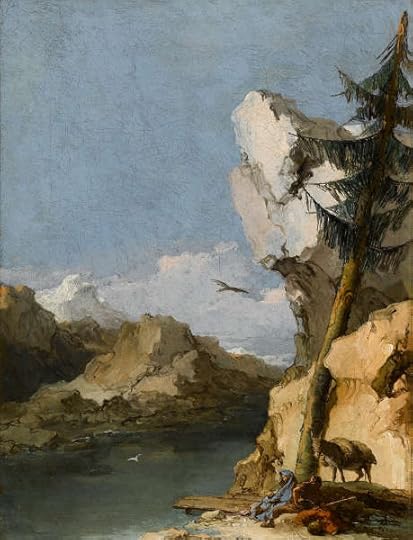
Giambattista Tiepolo, Break during the Flight from Egypt (Staatsgallerie Stuttgart). One of Tiepolo's very compact corpus of private, late works.
132 reviews
April 24, 2025
Dig deep and you'll find a fascinating analysis of many of Tiepolo's frescoes and his mysterious engravings but it's all a bit of a ramble perhaps due to poor translation and editing. The worst of it is that the pictures of the work, which are so essential to the author's explanations, are dropped haphazardly into the text with no captions – so that you're left scrambling around trying to link image to words. And sometimes even a picture is missing. Sloppy and unhelpful by the publisher, Penguin Modern Classics. (I thought that the Penguin Modern Classics series were all novels? Not sure how a book is judged to be a 'modern classic'?)
Profile Image for Remus Pop.
29 reviews2 followers
November 22, 2025
In the spirit of Calasso, it’s a virtuoso of a book, yet something fell short of my expectations. Although his treatment of Tiepolo’s singular world is undeniably masterful, the sense of novelty, enchantment, and curiosity I found in his earlier works was missing. I suspect the subject itself (very specific and narrow) offers less of the expansive topics he explores elsewhere. Overall, by no means a bad book, just one that didn’t quite resonate with me.
Profile Image for Maria Daniela Iftime.
3 reviews10 followers
March 9, 2019
An interesting book about one of the most underrated Italian painters. I read this before visiting the Wurzburg Residence, and I'm glad I did, because I could appreciate the wonderful affresco not only for the aesthetic, but also for the meaning behind it. The part about the "hidden" and mysterious drawing of Tiepolo, "Gli Scherzi", was especially intriguing
Profile Image for Stella B..
419 reviews
January 26, 2020
So far my favorite read this month - this was such a beautifully written book, full of interesting information and tidbits - from the works of Tiepolo, historical context (witches, courts, contemporaries!). Definitely interested in reading more of Calasso's works.

Definitely planning to re-read this, annotate and add other pictures of Tiepolo's works.
Profile Image for Davide Orsato.
124 reviews4 followers
August 2, 2018
E se il (relativamente) sottovalutato pittore Tiepolo fosse un esponente di una sette esoterica che dalla Grecia antica approdò nella Venezia settecentesca? Calasso coltissimo e gnostico come sempre, ma più accessibile del solito (con tanto di figure).
Profile Image for Thomas.
62 reviews1 follower
April 8, 2022
less convinced of any mysterism in Tiepolo in favour of an affective-ambivalent turn in the marketplace satire of humanism of a Rabelaisian baroque. I can't help but wonder if Calasso was, ages later, the victim of a spectacular joke.
Profile Image for Mass.
104 reviews2 followers
June 16, 2022
Difficile scrivere di Tiepolo senza incappare nei tranelli disseminati qui e lì nella sua pittura.
Calasso naturalmente ne esce sano e salvo, regalandoci una lettura acutissima e originale.
Profile Image for Alana.
368 reviews62 followers
July 17, 2022
this shit goes so hard in the mf paint. the paint colour is tiepolo pink of course.
Profile Image for David Pagnanelli.
265 reviews8 followers
December 29, 2022
Sono entrato nel mondo di Tiepolo grazie a questo libro. Calasso non sbaglia un colpo!
Displaying 1 - 30 of 37 reviews

Can't find what you're looking for?

Get help and learn more about the design.