

What do you think?

The Matter of Wonder: Abhinavagupta's Panentheism and the New Materialism
In the early 11th century, the Kashmiri philosopher Abhinavagupta proposed panentheism-seeing the divine as both immanent in the world and at the same time as transcendent--as a way to reclaim the material world as something real, something solid. His theology understood the world itself, with its manifold inhabitants--from gods to humans to insects down to the merest rock-as part of the unfolding of a single conscious reality, Siva . This conscious singularity-the word "god" here does not quite do it justice--with its capacity to choose and will, pervades all through, top to bottom; as Abhinavagupta writes, "even down to a worm -- when they do their own deeds, that which is to be done first stirs in the heart." His panentheism proposed an answer to a familiar conundrum, one we still grapple with Consciousness is so unlike matter. How does consciousness actually connect to the materiality of our world? To put this in more familar twenty-first-century terms, how does mind
connect to body?
These questions drive Loriliai Biernacki's The Matter of Abhinavagupta's Panentheism and New Materialism . Biernacki draws on Abhinavagupta's thought--and particularly his yet-untranslated, philosophical magnum opus, the Isvara Pratyabhijña Vivrti Vimarsini --to think through contemporary issues such as the looming prospect of machine AI, ideas about information, and our ecological crises. She argues that Abhinavagupta's panentheism can help us understand our current world and can contribute to a New Materialist re-envisioning of the relationship that humans have with matter.
connect to body?
These questions drive Loriliai Biernacki's The Matter of Abhinavagupta's Panentheism and New Materialism . Biernacki draws on Abhinavagupta's thought--and particularly his yet-untranslated, philosophical magnum opus, the Isvara Pratyabhijña Vivrti Vimarsini --to think through contemporary issues such as the looming prospect of machine AI, ideas about information, and our ecological crises. She argues that Abhinavagupta's panentheism can help us understand our current world and can contribute to a New Materialist re-envisioning of the relationship that humans have with matter.
- GenresPhilosophyReligion
264 pages, Hardcover
Published February 6, 2023
Ratings & Reviews
Friends & Following
Create a free account to discover what your friends think of this book!
Community Reviews
Displaying 1 - 1 of 1 review

October 18, 2025
I’m ill-equipped to review The Matter of Wonder on its own terms, contributing as it does to an academic discussion to which I am not privy. It is primarily concerned with articulating the relevance of Abhinavagupta, an eleventh-century polymathic genius and expositor of Kashmir Śaivism—a theistic, non-dualist philosophical and devotional Hindu tradition—for a contemporary intellectual movement called the New Materialism, which seeks to reclaim the reality and significance of our concrete, material world by finding subjectivity, life, consciousness, meaning, and all the qualitative richness of personal experience embedded in all that is: even in those “inanimate” objects—stones, jars, and the like—which appear to our ordinary perception as mere lifeless “things.” I was motivated to read this out of an interest in learning more about the general contours of Abhinavagupta’s philosophy, given the paucity of English-language sources on him. Even his magnum opus, the Īśvara Pratyabhijñā Vivṛti Vimarśinī, the Long Commentary on the Elucidation of Recognition of the Lord, a commentary on the writings of his predecessor Utpaladeva, from which Loriliai Biernacki draws most of her material, has yet to be translated into English. Having never heard of New Materialism, the focus of this book is for my purposes a bit niche, but I nonetheless found it useful for understanding Abhinava a little better.
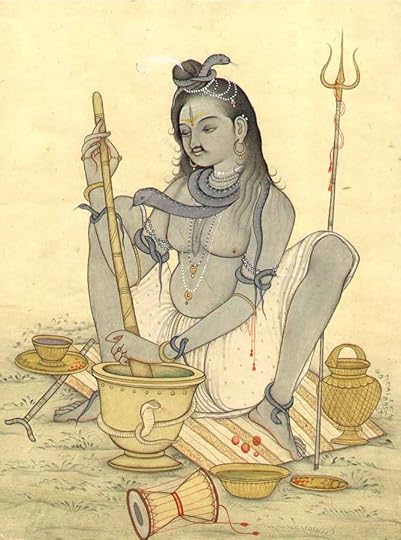
While most of the scholarly work on Abhinavagupta in the West has emphasized the transcendental and idealistic dimensions of his thought, Biernacki sets about her task by addressing how he distinguishes himself from both the dualisms of Sāṃkhya (an early school of Hindu philosophy) and post-Cartesian mechanistic modernity, as well as from the world-denying transcendentalisms of Advaita Vedanta (a nondualism which sustains itself by denying the ultimate reality of objective phenomena) and much modern transhumanist thought, by asserting the immanence of Śiva, the absolute reality which is consciousness itself, in and as every object of perception. According to this Kashmir Śaivite philosophy of recognition (Pratyabhijñā), union with the divine entails not an “up-and-out” evacuation from the material world—Biernacki points out that such a vision of transcendence is merely the adoption of a third-person perspective, a “view from nowhere”—but rather an enhanced sense of subjectivity as the world, as the deepest essence of all things. The limited subject does not realize its identity with Śiva by renouncing the world, but precisely by including it as one’s own Self, which is, at a deeper level, none other than the Divine Self, the primordial subject of all who, because of his ontological preeminence, is not other than objectivity. An enlarged subjectivity becomes the world, in turn revealing the world to be composed of consciousness—to be the body of God. As Biernacki evocatively puts it, “Subjectivity is what allows us to be secret sharers in the experience of all else that is.”
From the perspective of the limited subject (i.e. you and me), this discovery of the “I,” of the first-person perspective, in a cloud, an ant, a vista, or a pebble, elicits the absorptive experience of wonder (camatkāra). More fundamentally, wonder, because it is the very nonduality of subject and object in Śiva, is the very stuff of cosmic existence. Everything we see, taste, touch, or think is ultimately Śiva recognizing and delighting in himself. Wonder is all there is. The separativity and distinction associated with Māyā is not the incomprehensible falling away from an unsullied Puruṣa who merely witnesses material phenomena, but rather an active Puruṣa’s playful, dynamic exploration of all the possibilities and pathways of concrete existence; the infinitely various forms of being a woman, a star, a beetle, or a lump of coal. For the Kashmir Śaivite, the illusion is not that the world is real, but that it is just a thing. This is the positive, world-affirming, all-inclusive mysticism expressed in Walt Whitman’s magnificent “Song of Myself,” which some thinkers aligned with the New Materialism have apparently taken as their manifesto.
Rather than supposing, as modern cultures often do, a hierarchy of discrete beings with humans at the top, Abhinavagupta’s adapted version of the traditional tattva system of Sāṃkhya—a kind of elemental taxonomy of creation—instead describes a fluid hierarchy of subjectivity, of “this-ness” (idantā, connected to prakāśa: the light of consciousness by which all things exist) unfolding out of “I-ness” (ahantā, the experience of vimarśa: the “active awareness” or first-person perspective at the heart of consciousness); two aspects or modalities of the same conscious reality, which all beings, from humans to insects to rocks, have the capacity to shift between, with the telos of coming to rest in a pure subjectivity that is not opposed to the object, but which recognizes the life and sentience at its core. Through his primordial union with Śakti, who figures mythologically as his divine consort and more abstractly as his energy or power, that through which and in which he lives “beyond” himself as the creation, Śiva unfolds the world out of himself with increasing degrees of objective specificity. From our limited (Abhinava would say “Māyā-bound”) perspective, we are tempted to view this cosmogony as something distinct from the makeup of our supposedly discrete individual selves, but of course these are ultimately one and the same; our perception to the contrary is a byproduct of the fact that we ourselves are a mixture of subject and object, with the same capacity to shift between these two modalities as everything else, by virtue of the fact that for Abhinavagupta being and consciousness are synonymous.
Thus when I experience a clay jar as a lifeless, insentient object, I am also experiencing myself, to some degree, as a lifeless and insentient object. The subjectivity of both myself and the clay jar is inwardly withdrawn, hidden from view. Yet what appears to me to be two separate things—myself and the jar—withdrawing from one another is, more fundamentally, nothing other than the transcendent aspect of divinity, Sadāśiva: Śiva inwardly withdrawn rather than externally manifest—the hiddenness of God. Conversely, when I address the jar as “you” or “I,” when my own partial encasement in thingness moves me to compassion for that of the jar and I coax its inner life and awareness out of its hard shell, this is nothing other than Śiva himself becoming manifest in the jar—it is a theophany. At the inter-subjective level, we participate in the awakening and enlivening of the cosmos; in God’s becoming “all-in-all,” to borrow the locution of Saint Paul. By giving up the illusion of our psychosomatic autonomy and uniformity—for Abhinavagupta, the human body itself is inhabited by a host of gods with distinct intentionalities united only by one’s overarching sense of I-ness; a condition which functions as a vehicle for the recognition of the Self as God—we realize our essential immortality and freedom. One must become porous in order to expand.
I find that this vision connects well with certain fundaments of Christian theology, according to which all things are created through Christ, who is the Logos of God. Biernacki draws a parallel between Abhinavagupta’s understanding of the bivalency of consciousness and the dual function of information in some New Materialist thought, as something both quantifiable and transcendent, and thus a potential bridge between mind and matter. But I think the parallel can be extended to Christian logology, wherein the Logos is both the objective existence of all things and the personal subject of Christ. What is the Incarnation if not the Father’s wondrous recognition of his “I” in matter, which is phenomenally indistinct from Christ’s realization of his oneness with the Father, which he offers to all of us?
Like Abhinavagupta, Christianity therefore teaches—but many Christians often forget—that there is nothing in the universe which is not alive and personal in its deepest essence—a subjectivity which is ultimately one and the same for all of us—and that spiritual growth entails realizing that this is so and acting accordingly. Nothing is just a thing; everything is alive with one life: the dirt under your shoes; the chickens, pigs, and cattle on factory farms who spend their lives packed in cages to be mechanistically slaughtered; the human beings crowded in prisons and detention centers or buried under the rubble of bombed-out ghettoes, or who have otherwise been marginalized and dehumanized, branded as “other”; the whole planetary environment which human activity has so radically altered. Insofar as we have done it to the least of these, we have done it to ourselves—and to the Self of us all.
Man fulfills his appointed role as the priest of creation by recognizing that nothing is self-enclosed, but that everything participates in the same divine reality. To sacrifice something means to relinquish our limited, egoistic claims to ownership over it; a conceit we can only maintain by reducing it to a lifeless object. The sacrifice in acknowledging the inherence of all things in God is also the awareness of God’s sacrifice in becoming all things for us and as us: “Your own of Your own we offer to You, in all and for all.” And the crest jewel of sacrifice is love. To love is to live beyond oneself in another: as Śiva lives in Śakti, as Puruṣa lives in Prakṛti, as the love-smitten man lives in the woman, who becomes for him, by virtue of her distinctness from his limited self, the whole world; in whom he discovers that his life is not coterminous with his body.
As Biernacki suggests, this transfiguration of our relationship to the world is no pious sentimentality, but an imperative of existential significance.
While most of the scholarly work on Abhinavagupta in the West has emphasized the transcendental and idealistic dimensions of his thought, Biernacki sets about her task by addressing how he distinguishes himself from both the dualisms of Sāṃkhya (an early school of Hindu philosophy) and post-Cartesian mechanistic modernity, as well as from the world-denying transcendentalisms of Advaita Vedanta (a nondualism which sustains itself by denying the ultimate reality of objective phenomena) and much modern transhumanist thought, by asserting the immanence of Śiva, the absolute reality which is consciousness itself, in and as every object of perception. According to this Kashmir Śaivite philosophy of recognition (Pratyabhijñā), union with the divine entails not an “up-and-out” evacuation from the material world—Biernacki points out that such a vision of transcendence is merely the adoption of a third-person perspective, a “view from nowhere”—but rather an enhanced sense of subjectivity as the world, as the deepest essence of all things. The limited subject does not realize its identity with Śiva by renouncing the world, but precisely by including it as one’s own Self, which is, at a deeper level, none other than the Divine Self, the primordial subject of all who, because of his ontological preeminence, is not other than objectivity. An enlarged subjectivity becomes the world, in turn revealing the world to be composed of consciousness—to be the body of God. As Biernacki evocatively puts it, “Subjectivity is what allows us to be secret sharers in the experience of all else that is.”
From the perspective of the limited subject (i.e. you and me), this discovery of the “I,” of the first-person perspective, in a cloud, an ant, a vista, or a pebble, elicits the absorptive experience of wonder (camatkāra). More fundamentally, wonder, because it is the very nonduality of subject and object in Śiva, is the very stuff of cosmic existence. Everything we see, taste, touch, or think is ultimately Śiva recognizing and delighting in himself. Wonder is all there is. The separativity and distinction associated with Māyā is not the incomprehensible falling away from an unsullied Puruṣa who merely witnesses material phenomena, but rather an active Puruṣa’s playful, dynamic exploration of all the possibilities and pathways of concrete existence; the infinitely various forms of being a woman, a star, a beetle, or a lump of coal. For the Kashmir Śaivite, the illusion is not that the world is real, but that it is just a thing. This is the positive, world-affirming, all-inclusive mysticism expressed in Walt Whitman’s magnificent “Song of Myself,” which some thinkers aligned with the New Materialism have apparently taken as their manifesto.
Rather than supposing, as modern cultures often do, a hierarchy of discrete beings with humans at the top, Abhinavagupta’s adapted version of the traditional tattva system of Sāṃkhya—a kind of elemental taxonomy of creation—instead describes a fluid hierarchy of subjectivity, of “this-ness” (idantā, connected to prakāśa: the light of consciousness by which all things exist) unfolding out of “I-ness” (ahantā, the experience of vimarśa: the “active awareness” or first-person perspective at the heart of consciousness); two aspects or modalities of the same conscious reality, which all beings, from humans to insects to rocks, have the capacity to shift between, with the telos of coming to rest in a pure subjectivity that is not opposed to the object, but which recognizes the life and sentience at its core. Through his primordial union with Śakti, who figures mythologically as his divine consort and more abstractly as his energy or power, that through which and in which he lives “beyond” himself as the creation, Śiva unfolds the world out of himself with increasing degrees of objective specificity. From our limited (Abhinava would say “Māyā-bound”) perspective, we are tempted to view this cosmogony as something distinct from the makeup of our supposedly discrete individual selves, but of course these are ultimately one and the same; our perception to the contrary is a byproduct of the fact that we ourselves are a mixture of subject and object, with the same capacity to shift between these two modalities as everything else, by virtue of the fact that for Abhinavagupta being and consciousness are synonymous.
Thus when I experience a clay jar as a lifeless, insentient object, I am also experiencing myself, to some degree, as a lifeless and insentient object. The subjectivity of both myself and the clay jar is inwardly withdrawn, hidden from view. Yet what appears to me to be two separate things—myself and the jar—withdrawing from one another is, more fundamentally, nothing other than the transcendent aspect of divinity, Sadāśiva: Śiva inwardly withdrawn rather than externally manifest—the hiddenness of God. Conversely, when I address the jar as “you” or “I,” when my own partial encasement in thingness moves me to compassion for that of the jar and I coax its inner life and awareness out of its hard shell, this is nothing other than Śiva himself becoming manifest in the jar—it is a theophany. At the inter-subjective level, we participate in the awakening and enlivening of the cosmos; in God’s becoming “all-in-all,” to borrow the locution of Saint Paul. By giving up the illusion of our psychosomatic autonomy and uniformity—for Abhinavagupta, the human body itself is inhabited by a host of gods with distinct intentionalities united only by one’s overarching sense of I-ness; a condition which functions as a vehicle for the recognition of the Self as God—we realize our essential immortality and freedom. One must become porous in order to expand.
I find that this vision connects well with certain fundaments of Christian theology, according to which all things are created through Christ, who is the Logos of God. Biernacki draws a parallel between Abhinavagupta’s understanding of the bivalency of consciousness and the dual function of information in some New Materialist thought, as something both quantifiable and transcendent, and thus a potential bridge between mind and matter. But I think the parallel can be extended to Christian logology, wherein the Logos is both the objective existence of all things and the personal subject of Christ. What is the Incarnation if not the Father’s wondrous recognition of his “I” in matter, which is phenomenally indistinct from Christ’s realization of his oneness with the Father, which he offers to all of us?
Like Abhinavagupta, Christianity therefore teaches—but many Christians often forget—that there is nothing in the universe which is not alive and personal in its deepest essence—a subjectivity which is ultimately one and the same for all of us—and that spiritual growth entails realizing that this is so and acting accordingly. Nothing is just a thing; everything is alive with one life: the dirt under your shoes; the chickens, pigs, and cattle on factory farms who spend their lives packed in cages to be mechanistically slaughtered; the human beings crowded in prisons and detention centers or buried under the rubble of bombed-out ghettoes, or who have otherwise been marginalized and dehumanized, branded as “other”; the whole planetary environment which human activity has so radically altered. Insofar as we have done it to the least of these, we have done it to ourselves—and to the Self of us all.
Man fulfills his appointed role as the priest of creation by recognizing that nothing is self-enclosed, but that everything participates in the same divine reality. To sacrifice something means to relinquish our limited, egoistic claims to ownership over it; a conceit we can only maintain by reducing it to a lifeless object. The sacrifice in acknowledging the inherence of all things in God is also the awareness of God’s sacrifice in becoming all things for us and as us: “Your own of Your own we offer to You, in all and for all.” And the crest jewel of sacrifice is love. To love is to live beyond oneself in another: as Śiva lives in Śakti, as Puruṣa lives in Prakṛti, as the love-smitten man lives in the woman, who becomes for him, by virtue of her distinctness from his limited self, the whole world; in whom he discovers that his life is not coterminous with his body.
As Biernacki suggests, this transfiguration of our relationship to the world is no pious sentimentality, but an imperative of existential significance.
Displaying 1 - 1 of 1 review