

What do you think?
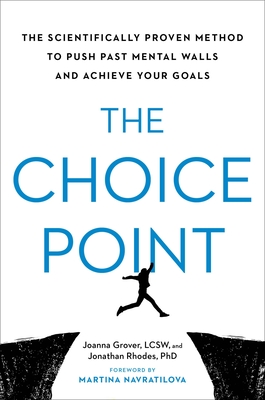
The Choice Point: The Scientifically Proven Method to Push Past Mental Walls and Achieve Your Goals
Discover a scientifically proven method to overcome obstacles and make choices that lead us closer to our goals—featuring a foreword by Martina Navratilova. When we choose to go to the gym at 6am, keep running that marathon, or stay up late to study, we are making conscious, value-based decisions that help us fulfill our goals. But even though we know that daily good choices add up to healthy routines and strong results, these days it’s just too easy to surrender to negative thoughts and old habits. How can we not?
Enter Functional Imagery Training (FIT). Grounded in science, FIT helps us lengthen our Choice Point : that moment when we say to ourselves, “Am I going to make the healthy decision, or am I going to choose to take an action that I know will undermine my success?” Merging mindfulness, motivational interviewing, and cognitive behavioral therapy into a user-friendly model—the first non-academic book of its kind— The Choice Point grants us control of the decisions that define us.
Jonathan Rhodes, a British psychologist, helped develop FIT, and Joanna Grover, an experienced therapist and coach, was the first person in the U.S. to be certified in FIT. Together, they work where science meets imagination to achieve peak performance, and their tools help us get to the root of our motivation. They’ve trained Olympians, C-Suite executives, and elite forces in the military to hack their autopilot systems and break records in their respective fields. The Choice Point is the roadmap they’ve built along the way, leading us from passengers to drivers of our own minds.
Enter Functional Imagery Training (FIT). Grounded in science, FIT helps us lengthen our Choice Point : that moment when we say to ourselves, “Am I going to make the healthy decision, or am I going to choose to take an action that I know will undermine my success?” Merging mindfulness, motivational interviewing, and cognitive behavioral therapy into a user-friendly model—the first non-academic book of its kind— The Choice Point grants us control of the decisions that define us.
Jonathan Rhodes, a British psychologist, helped develop FIT, and Joanna Grover, an experienced therapist and coach, was the first person in the U.S. to be certified in FIT. Together, they work where science meets imagination to achieve peak performance, and their tools help us get to the root of our motivation. They’ve trained Olympians, C-Suite executives, and elite forces in the military to hack their autopilot systems and break records in their respective fields. The Choice Point is the roadmap they’ve built along the way, leading us from passengers to drivers of our own minds.
272 pages, Hardcover
Published June 20, 2023
Ratings & Reviews
Friends & Following
Create a free account to discover what your friends think of this book!
Community Reviews
Displaying 1 - 24 of 24 reviews

October 11, 2023
There are hundreds of self-help books on the market that usually rehash over and over the same concepts. This is no different. If you have read a couple of good self-help books, this won't give you any new concept to reflect on. If you are new to this genre, this could be a good starter.

Read
June 3, 2023I received a complimentary copy of this book from NetGalley and the publisher. Opinions expressed in this review are completely my own.
This book brings together the disciplines of psychology, social work, and coaching to present a proven, science-based approach to behavior change. This approach, called Functional Imagery Training (FIT) uses the power of internal imagery to picture the outcome and the process of one's goals and dreams. How we envision that (both the goal itself and the steps to get there) influence the likelihood of achieving those goals. This is because the way in which we imagine the future affects our emotions, which drive our motivation and our actions, which--in turn--influence the process and outcome of our goals. The approach was originally developed and used to help overcome addictions by helping override pleasure-based decisions by training the mind how to stick with a goal. Now it is used by people from athletes to businesspeople to help reach higher and higher achievements by understanding and using "The Choice Point"--the moment when one shifts one's attention from an unwanted thought that may stop one from making a conscious decision in pursuit of a goal. Basically, "Do I stick with it or not?"
As both my education and my job are based in behavior change, I enjoyed reading an imagery-based strategy that I can use as an individual to fulfill my goals. I found the overall attitude of the book to be a bit binary for my taste (i.e. based in success or failure, black or white). But I do see how using that approach can help one change one's behavior in the instant it takes to make a decision, and I have seen through use of this approach and other behavioral change approaches that this can be used successfully. When I can learn that all it takes is a simple decision in a moment (rather than a long-drawn-out, agonizing effort to exert "willpower"), the process becomes second nature. And FIT can do that (and has done that) for me. I am excited about this approach and plan to buy the book for my loved ones and friends.
This book brings together the disciplines of psychology, social work, and coaching to present a proven, science-based approach to behavior change. This approach, called Functional Imagery Training (FIT) uses the power of internal imagery to picture the outcome and the process of one's goals and dreams. How we envision that (both the goal itself and the steps to get there) influence the likelihood of achieving those goals. This is because the way in which we imagine the future affects our emotions, which drive our motivation and our actions, which--in turn--influence the process and outcome of our goals. The approach was originally developed and used to help overcome addictions by helping override pleasure-based decisions by training the mind how to stick with a goal. Now it is used by people from athletes to businesspeople to help reach higher and higher achievements by understanding and using "The Choice Point"--the moment when one shifts one's attention from an unwanted thought that may stop one from making a conscious decision in pursuit of a goal. Basically, "Do I stick with it or not?"
As both my education and my job are based in behavior change, I enjoyed reading an imagery-based strategy that I can use as an individual to fulfill my goals. I found the overall attitude of the book to be a bit binary for my taste (i.e. based in success or failure, black or white). But I do see how using that approach can help one change one's behavior in the instant it takes to make a decision, and I have seen through use of this approach and other behavioral change approaches that this can be used successfully. When I can learn that all it takes is a simple decision in a moment (rather than a long-drawn-out, agonizing effort to exert "willpower"), the process becomes second nature. And FIT can do that (and has done that) for me. I am excited about this approach and plan to buy the book for my loved ones and friends.

March 19, 2025
Ideas from the Book:
* Choice points are the junctures where your future diverges, moments when your actions define your trajectory.
* The brain's plasticity enables you to rewire your responses to challenges.
* Embracing discomfort is essential for growth and transformation
* Choice points are the junctures where your future diverges, moments when your actions define your trajectory.
* The brain's plasticity enables you to rewire your responses to challenges.
* Embracing discomfort is essential for growth and transformation
December 9, 2023
Very confusing
My goodness sooo complicated and confusing. No clarity of steps and get lost in all the information in between! Start to put it together and then it's lost. Sorry wasted my money on this book and terribly disappointed. I could have used this technique because I can visualize and image well. So confused now, wouldn't even know where to go back and start again. Disappointing
My goodness sooo complicated and confusing. No clarity of steps and get lost in all the information in between! Start to put it together and then it's lost. Sorry wasted my money on this book and terribly disappointed. I could have used this technique because I can visualize and image well. So confused now, wouldn't even know where to go back and start again. Disappointing

December 6, 2023
Helpful mental models and frameworks but underwhelming and dry. Better to read in conjunction with a detailed journal for the exercises and regular pauses/reflections. The chapter for team building was interesting though. Overall, probs wouldn’t recommend given the textbook-esque delivery.
+++
- Functional Imagery Training (FIT)
- Motivational training: listening rather than being “the expert”, engage > focus > evoke > plan
- Asking open ended questions
- Affirmations
- Reflections
- Summaries
- History, story, core values
- By investing too much time and energy in a wide array of goals, you can lose your sense of personal meaning and purpose
- Detailed multi sensory imagery for anchored motivation > smaller challenging goals + mental contrasting > cues
- Hebban plasticity: similar synapses that are stimulated at a parallel tie build connections
- Vivid images, control thoughts, plan effectively, reflect regularly in detail
- LAP: locate, activate, persevere
- SLAPP: stop/slowdown, locate cue, activate imagery, park distracting thought, persevere with the plan
- Knowing when to quit eg. Injuries with running
- AIM: applied imagery for motivation
- Teams chapter: setting expectations, how you show up determines what others will expect from you, first impressions last a long time (filed in the imagery bank)
- Vulnerability loop to develop deep relationships and openness ==> trust ==> more likely to ask for help
- 3Ps: perceive external threats, plan the best route of progress and be present with tasks
- Common team problems and solutions chapter
- Empathy and autonomy create safety and belonging => imagination => innovation and solutions
+++
- Functional Imagery Training (FIT)
- Motivational training: listening rather than being “the expert”, engage > focus > evoke > plan
- Asking open ended questions
- Affirmations
- Reflections
- Summaries
- History, story, core values
- By investing too much time and energy in a wide array of goals, you can lose your sense of personal meaning and purpose
- Detailed multi sensory imagery for anchored motivation > smaller challenging goals + mental contrasting > cues
- Hebban plasticity: similar synapses that are stimulated at a parallel tie build connections
- Vivid images, control thoughts, plan effectively, reflect regularly in detail
- LAP: locate, activate, persevere
- SLAPP: stop/slowdown, locate cue, activate imagery, park distracting thought, persevere with the plan
- Knowing when to quit eg. Injuries with running
- AIM: applied imagery for motivation
- Teams chapter: setting expectations, how you show up determines what others will expect from you, first impressions last a long time (filed in the imagery bank)
- Vulnerability loop to develop deep relationships and openness ==> trust ==> more likely to ask for help
- 3Ps: perceive external threats, plan the best route of progress and be present with tasks
- Common team problems and solutions chapter
- Empathy and autonomy create safety and belonging => imagination => innovation and solutions

June 19, 2023
Multiple times per day individuals encounter The Choice Point, “the exact moment, you decide to shift your attention away from an unwanted thought that might stop you from making a conscious choice to persevere in pursuing a goal (or not). It’s that moment when you say to yourself, ‘to continue or not to continue?’”
Using Functional Imagery Training (FIT), the authors attempt to teach their readers how to imagine different scenarios to determine which choice best meets their own values. The book begins with a simple journal requirement and builds to using cues to persevere with the journal’s stated goals. The authors also include a plan to expand FIT to teams.
Overall, The Choice Point is an easy-to-understand method to make conscious decisions and achieve your underlying goals. Both are admiral aspirations. 4 stars!
Thanks to Hachette Books and NetGalley for a digital review copy of the book.
Using Functional Imagery Training (FIT), the authors attempt to teach their readers how to imagine different scenarios to determine which choice best meets their own values. The book begins with a simple journal requirement and builds to using cues to persevere with the journal’s stated goals. The authors also include a plan to expand FIT to teams.
Overall, The Choice Point is an easy-to-understand method to make conscious decisions and achieve your underlying goals. Both are admiral aspirations. 4 stars!
Thanks to Hachette Books and NetGalley for a digital review copy of the book.
May 17, 2024
Knew this book from the website imagerycoaching.com selling service from the authors.
Very amateur.
Clearly, the authors don't know how to speak without using names of people. 90% of the text are stories referring to certain people. All of them are trivial and unhelpful.
I have seen too many authors with so little in the brain while bing desperate to cash in, so they fill the books with fluff. No patience for a thorough read. There might be a good point or two, but absolutely unworthy of finding them through those rubbish. Definitely won't buy their service.
Very bad advertisement.
Very amateur.
Clearly, the authors don't know how to speak without using names of people. 90% of the text are stories referring to certain people. All of them are trivial and unhelpful.
I have seen too many authors with so little in the brain while bing desperate to cash in, so they fill the books with fluff. No patience for a thorough read. There might be a good point or two, but absolutely unworthy of finding them through those rubbish. Definitely won't buy their service.
Very bad advertisement.

Read
February 24, 2023The Choice Point: The Scientifically Proven Method to Push Past Mental Walls and Achieve Your Goals by Joanna Grover and Jonathan Rhodes is an inspiring read. The approaches and techniques outlined in the book are spot-on and, as the subtitle suggests, can be put into practice to yield tangible results. While this book may not be the definitive answer to goal achievement, it does provide a plethora of useful tools that can be applied to both individuals and teams alike, allowing them to reach their goals with greater ease and efficiency.

July 31, 2023
This is the book to read if you want to harness the envisioning, mental rehearsal, goal-setting, and motivational work that athletes and other Olympians of various kinds use to establish peak performance. It's all here, from starting with your purpose to setting little re-calibration moments when you get off track under pressure and need to re-engage your whole program. It's particularly good on what to do under pressure, during and after setbacks, and how to think about the inevitable failures along the way.

March 1, 2023
ARC review: I thank the authors for the copy! This book has some great takeaways and I’m intrigued by the Imagery Training and would love to receive some formal lessons. However, a few parts of the book feels repetitive. Some arguments seem too rushed without much elaboration. The examples used to prove the training’s effectiveness in the later chapters sound a bit vague and general for me to be convinced.

January 19, 2025
There is some very interesting material in here and the exercises can be fun, but overall, it's hard to recommend this as a self-help book. The methodology described in the book is probably best done with the help of a trained professional. It's not easy to understand exactly how I should apply some of the lessons that are conveyed in a practical day to day way, and what to be on the lookout for in terms of progress and success.

August 1, 2026
3.5 stars
One of my issues with the book is its part a personal self help book and part a team corporate help book. So you have to try and decide which parts you're goign to pay attention to. I understand the premise is the same, but it's written as both and not well.
It covers basically visualization and being aware of your choices. It provides similar information as other books but in different wording, so hopefully it will strike the right nerve for some people.
One of my issues with the book is its part a personal self help book and part a team corporate help book. So you have to try and decide which parts you're goign to pay attention to. I understand the premise is the same, but it's written as both and not well.
It covers basically visualization and being aware of your choices. It provides similar information as other books but in different wording, so hopefully it will strike the right nerve for some people.
January 5, 2023
Very good. I've read a ton of self help, and this is effective stuff. The approaches and techniques are spot on, and, as the sub-title suggests, work if put into practice. I wouldn't say this is THE answer to goal achievement, but there are good tools here. It's interesting that these tools can be applied to teams as well.
Thanks very much for the free ARC for review!!
Thanks very much for the free ARC for review!!

August 23, 2023
The Choice Point... an immersive book to keep the reader seeking the best choices in life while pushing away negative choices. A choose your own destiny style book, it reads with a casual yet authoritative tone. I enjoyed the visualization exercises, but I don't believe this style of making choices and visualizing results is for everyone.

January 16, 2024
Thanks to Netgalley and the publisher for this eARC.
This book gives you valuable skills you can readily put to use to accomplish goals in every facet of your life.
If you need help overcoming negative habits (and who doesn't) give the science-based tips in this book a try, you will be glad you did!
This book gives you valuable skills you can readily put to use to accomplish goals in every facet of your life.
If you need help overcoming negative habits (and who doesn't) give the science-based tips in this book a try, you will be glad you did!

August 13, 2023
The framework can be applied to improve oneself but the ability to
Improve using imagery needs a professional coach to pursue goals. The examples could be more detailed. The conclusion could have ended with actionable template.
Improve using imagery needs a professional coach to pursue goals. The examples could be more detailed. The conclusion could have ended with actionable template.
February 12, 2023
I got this book through Goodreads First Reads. I thought it was interesting. I wonder how practical this type of work is without a therapist to support it, but a good read nonetheless.

July 15, 2023
Wonderful book mainly highlighting manifesting. Visualization is key. Has an entire part on working for teams.

July 16, 2023
Should have been an article.

September 12, 2023
4 stars
Make good choices and this was a great start!
Make good choices and this was a great start!

March 8, 2024
Crowded market for this topic.
Solid information presented plainly.
I just visited a bookshop and flipped through two books on similar topics that I didn’t buy.
Solid information presented plainly.
I just visited a bookshop and flipped through two books on similar topics that I didn’t buy.

May 21, 2024
Painful to read. Word soup.
“Between stimulus and response there is a space. In that space is our power to choose our responses. In our response lies our growth and our freedom.” - Victor Frankl
“Between stimulus and response there is a space. In that space is our power to choose our responses. In our response lies our growth and our freedom.” - Victor Frankl

August 15, 2023
The book helps you identify your core values. Its then ask you a series of questions that related your core values and your goal. The emphasis is on the level of commitment you are going to put in because that determines your decision whenever a point choice is presented.

February 3, 2024
Ugh this one was hard to rate for me because the central concept of the book (functional imagery training and its use in achieving goals) is incredibly useful and the text is effective in teaching it. However, the book itself was a bit too tedious and tactical for me at times, especially in the back half of the text where it went into depth on how to apply the FIT tactics on a team. I feel like the team-focused lessons in the book could have been a shorter companion book meant for teams and managers, and the front half that focused on the technique itself could have contained a few more examples on application to make it all more digestible and less dense. That said, 4 stars for me primarily based on content quality with more of a 3 star rating for the overly academic presentation.
Displaying 1 - 24 of 24 reviews