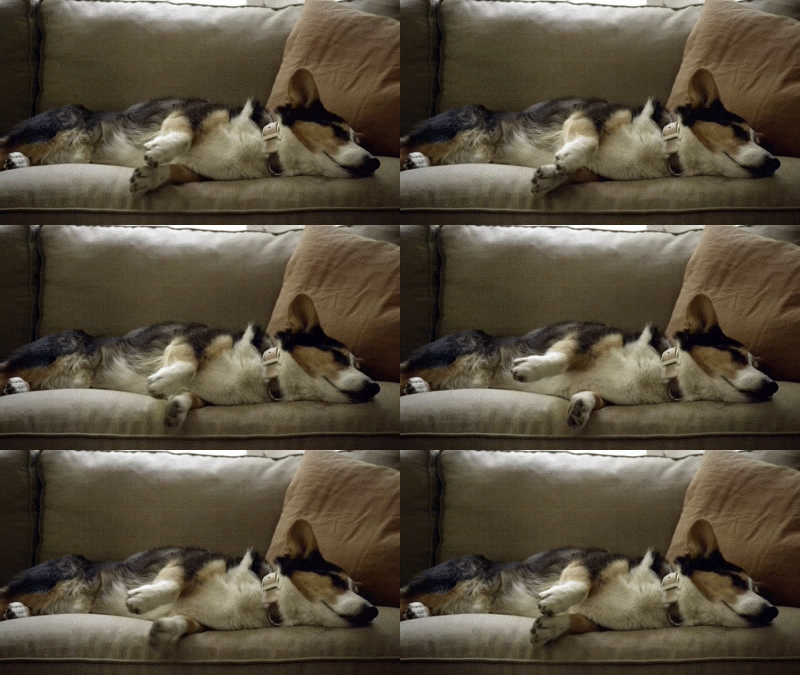
Zwar gibt es auch bei Menschen einen »siebten Sinn«, doch ist er offenbar weniger ausgeprägt und sensibel als bei Tieren. Tiere können z.B. bevorstehende Erdbeben und andere Naturkatastrophen wahrnehmen, lange bevor Menschen etwas davon spüren. Sheldrake hat dieses Phänomen untersucht und für sein Buch neben eigenen Experimenten Hunderte von Geschichten ausgewertet, die Tierbesitzer von überall her ihm berichtet haben. Ein aufregendes und unterhaltsames Buch, das uns zeigt, wie viele intuitive Fähigkeiten wir Menschen verloren haben und was wir von unseren Tiergefährten lernen können.
Rupert Sheldrake is a biologist and author of more than 80 scientific papers and ten books. A former Research Fellow of the Royal Society, he studied natural sciences at Cambridge University, where he was a Scholar of Clare College, took a double first class honours degree and was awarded the University Botany Prize. He then studied philosophy and history of science at Harvard University, where he was a Frank Knox Fellow, before returning to Cambridge, where he took a Ph.D. in biochemistry. He was a Fellow of Clare College, Cambridge, where he was Director of Studies in biochemistry and cell biology. As the Rosenheim Research Fellow of the Royal Society, he carried out research on the development of plants and the ageing of cells in the Department of Biochemistry at Cambridge University.
Recently, drawing on the work of French philosopher Henri Bergson, he developed the theory of morphic resonance, which makes use of the older notion of morphogenetic fields. He has researched and written on topics such as animal and plant development and behaviour, telepathy, perception and metaphysics.
Here's the thing about Sheldrake and his theories. When you're reading them, they make perfect sense. They're internally consistent (pretty much) and his rationale seems waterproof, while he's actually talking to you. It's only as you start thinking about what you've read that you realize something's up.
First of all, if his data is as rigorous as he claims why has none of it been published in a major peer-reviewed journal? His answer is that the "establishment" is against him. As someone familiar with the world of science, I can say that it is true many scientists don't like his theories, but it's not the reason his papers have not been published. If he could demonstrate consistent, repeatable, statistically-rigorous results from well-designed, double-blind experiments, he'd get published even if everyone else didn't want to believe him.
Science is about facts, not hunches. But because his experiments are based on anecdotal experiences (more about this in a minute) by self-selected audiences (people who already claim their dogs know when they're coming home) and because he doesn't decide what behavior a dog uses to indicate his or her owner is coming home until afterwards (Post hoc ergo propter hoc), his data is full of holes, and no one trusts it because no one can repeat it.
For the anecdotal bit, Sheldrake refutes this by saying that we accept anecdotes in medical journals where they become "case studies." That's true, but that doesn't mean we should allow all other anecdotes to become case studies. It means we need to be very careful about allowing case studies to dictate or define anything.
In fact, Sheldrake's defensiveness, and the fact that he has come up with a whole field of study dictated by his own terms and theories, was the biggest alarm bell for me. These are hallmarks of crank science. Also, he has no mechanisms. Cranks will say, Darwin came up with a new system and had no mechanism either, but there are far, far more cranks out there than there are Darwins.
It's always, of course, possible that Sheldrake is on to something here. And I'd be the first one to be interested if he showed statistically rigorous results. But he hasn't. It's true that traditional scientists (used to) tend to view animals as automatons, a la Descartes, and that is something that needs to change. However it ischanging. Slowly, sometimes too slowly for those of us that viewed it as barbaric in the first place, but science should change slowly, and take only steps completely merited by the data. That's the way science works, and the only way it can work for it to be a rational system of evidence, rather than a collection of beliefs.
I'm glad I read the book. It was very interesting, and it's always healthy to have your worldview challenged. However, it's not a relaxing book, as you have to be on your toes looking out for shoddy science and sloppy, wishful thinking, the whole time.
My old dog Sam travels to work with me every Friday. See that happy face?
That's Sam driving to work with me one Friday. I never say a word about it being Friday until I'm nearly walking out the door because he gets ridiculously excited and when he gets excited, he pees. Not just a dribble either. Let me tell ya, there's nothing like getting peed on when you're all dressed and running late for work. It took me a few years before I discovered that telling Sam ahead of time that "It's Friday Sam, we're going for a ride!" was a very bad idea. Now that he's getting up in years and prefers to sleep in on these frigid mornings, I usually have to nudge him awake and drag his furry butt out the door to do his business before leaving for work. Except for Fridays. Without fail, he is the first dog up with tail wagging, anxious to start the day. But only on Fridays. The rest of the week he feigns sleep so he can avoid the cold for just a few more minutes. It's bizarre but he always knows when Friday has arrived. I swear he counts the days . . . Which is my long winded-way of explaining why I picked up this book about dogs and the things they know. I'm hoping to get a little insight in Sam's behavior.
This was interesting to start. It's filled with lots of scientific information backed up by field research and testimonials. But I ended up losing interest in it because it wasn't what I was expecting. Just don't ask me what exactly it was that I was expecting because I don't really know. This is a scientific account of trials and recordings done on animals to test their psychic ability with small paragraphs of examples of various animals. I ended up getting bored, putting it aside and haven't had the urge to finish it.
This book explores the paranormal abilities of dogs, cats, horses, birds and other animals. Sheldrake attempts to explain how these animals can sense when their owners are returning home, as well as other abilities that remain unexplained. For example, how can a dog or cat alert its owner before they have an epileptic fit? Or before there is an earthquake or other natural disaster? Some animals show signs of agitation hours before an event like this, when no known sensory abilities would detect anything. Sheldrake is able to rule out smell, sight, behavioral cues and electrical field detection as senses that might show animals future events. The question then becomes, where does that leave us?
The first part of the book focuses on the scientific findings for commonplace animal abilities. As Sheldrake moves forward, however, the book becomes more interesting. Toward the end, Sheldrake comes to the conclusion that the animals must have the ability of either telepathy or precognition. To him, there can be no other explanation for their abilities. I have to say that I agree. It seems as if some information from the future can filter through to the present, and present to the past. There is no other way to explain how these animals have these abilities. His theory of morphic fields is sufficient to explain these phenomena. In a morphic field, animals are connected with places and people by what can be considered an invisible elastic band. This connection may even be subconscious. However, it helps animals find their way over hundreds of unexplored terrain to greet their former owners, as well as many other surprising abilities of animals.
What I found really interesting in the book was Sheldrake’s findings that many humans still have these abilities. However, those of us in the modern world seem to have lost them. It is mostly the shamans and hunting peoples of the old world that have a strong sense of direction or the ability to see into the future. For those of you who are skeptics, you may want to give one of Sheldrake’s books a read. I found this one to be a bit dry in the beginning, but toward the end it really picked up. Think of it as exponential reading. A lot of scientific research could still be done on the ideas that Sheldrake proposes, and so scientists should especially take note.
Either you get Rupert or you think he is a total whack job. I think I get him. I mean like, haven't *you* wondered if your pet knows stuff like is in the title of this book? You do, right? You won't admit it because you figure people will make fun of you (and they will! gleefully!), but you do. Well, good old Rupe doesn't give a rat's patootie what other people think. He just checks out stuff he finds interesting, and devises experiments to see what's really going on. This books is full of totally cool investigations, like can your pet help heal you or know if you've been in an accident while you were on vacation or can find its way home from a zillion miles away. One thing I wondered is if my dogs really knew when I was coming home or did they just wait by the gate all the time I was gone. Rupey told me to video them and find out. Oh! Of course. Duh. So I did, and...wait for it: They didn't hang around by the gate. They noodled around doing dog stuff until just about the time I started home. Then one went to the gate and settled down to wait, while the other kept doing doggy stuff until a minute or so before I arrived, then he went down to the gate. Whattaya think o' dat, huh? Read this book. It's totally kewel.
This book proved what pet owners have always known, that animals have an uncanny knack for communicating with their owners , hundreds of pet owners had obviously been asked to fill in a questionaire answering questions about their experience with pets , knowing when their owner had been ill, what time they were coming home even if they had a different routine every day, animals who knew when their owners had passed away, owners who had sensed their pets were ill, lost or in trouble, the stories were incredible and from all around the world. There is no scientific proof or explaination for this , although experiments have been carried out in the past to prove animals can communicate with each other and with humans. The author also cites the case of flocks of starlings and birds who swoop around the sky as one mass but never crash into each other and all go in the same direction, Homing pigeons who find their way home from strange places,the same with shoals of fish. You don't get a definite answer with this book because there is obviously not one, it is fascinating reading but may get a little repetative after a while and some chapters were definitely for the scientifically minded ! It is sad though to think that scientists know all this about animals but because they can not explain it they refuse to believe it and animals are still used in labs around the world for experiments
As with so many basically scientific books, it is very repetitive. But through the years, I am almost as repetitive as I retell the research and the findings. This isn't a dog story. This is a cosmic awareness moment as we learn that what connects us with our animals are morphic fields, that interconnectedness with other that can so easily stretch through space and distance.
I can't go vouching for the scientific validity of this action research, but seldom has investigation of animals seemed so entertaining and so emotionally satisfying. Sheldrake asks questions few scientists would risk investigating, designs innovative experiments, and compiles fascinating evidence for anyone to test.
I'm reminded of this book today due to my dog doing something very smart. Nevertheless I still believe this book is complete drivel. Despite my dog being smart, she can't figure out on which days I'm going to take her for a morning walk - if my wife is home, we don't go. So she's definitely not psychic.
The problem with this book is that there's just no standards in the evidence. Sheldrake recounts many anecdotes in which "at the exact same moment, on the other side of town" something happens. Of course has no evidence that the moment was exactly the same, the circumstances of the anecdote proscribe gathering of such evidence. These cases are assumed to be "at the exact same time" long after everything has happened. Sheldrake never mentions any attempt to actually scientifically observe the timing of such anecdotes. I end up not believing a word he says.
After the anecdotes, he magically leaps to the assumption that animals are psychic. You know what - if you're going to claim such a thing you'd better present some damned good evidence for it. There is none, and not even any suggestion that there is. I've read science fiction novels which are better researched than this load of tosh.
Next time I want an opinion on dogs' abilities, I will just go ask my dog. She might look stupidly at me and not cooperate until she gets a doggy treat, but her standards of evidence are much higher than Mr Sheldrake's and I have more trust in everything she says.
This was a fascinating read. Rupert Sheldrake documents numerous cases of what can best be described as animal Telepathy: knowing in advance (anywhere from 10 minutes to a couple of days) from distances of ten miles to thousands of miles, seemingly instantaneous of the person deciding to head home. It is reminiscent of Robert Heinlein's 1956 science fiction classic "Time for the Stars" where one twin goes into space while the other stays on Earth and they provide instantaneous telepathetic communication.
Sheldrake does experiments to verify the phenomena and attributes it to emotional attachment to usually one human, sometime two and occasionally three. Through surveys it is revealed close to half of dogs and around a third of cats demonstrate this ability. It is not partial to gender or breed but there does seem to be more responsiveness with pets in America than Britain (the two areas the author has case study data).
The book also provides anecdotal evidence of other pets, mostly parrots but also horses, and some reptiles. I checked with the director of the Belize Zoo and she reports similar behaviour from their harpy eagle when she has been away and is not quite yet on site.
The book doesn't stop with telepathy but goes on to chapters about animals recognizing being close to destinations without normal visual or smelling clues and tracking long distance such as exhibited by monarch butterflies, tortoises, salmon and pigeons but demostrated by other animals. Most unusual are cases of dogs finding where their deceased owners are buried, in that there should be no telepathic link.
There are two chapters on premonition where animals (without training) forewarn of epilepsy, diabetic shock, cancer and even death. Other cases provide precognition of earthquakes, tsunamis, avalanches, storms and other disasters. Records going back centuries of animals acting up prior to an earthquake don't seem to make an impact on the potential for forecasting shocks but China had some success in the 90's with volunteer observers working in a network, preventing deaths through timely evacuations, when many buildings where destroyed.
Sheldrake doesn't just provide details of incidents but endeavours to find explanantions and known scientific ones don't seem adequate.
There is an overwhelming wealth of data on paranormal like incidents that could have been divided into two books.
I am reminded of Henry Beston's quote: "...the animal shall not be measured by man. In a world older and more complete than ours, they move finished and complete, gifted with the extension of the senses we have lost or never attained, living by voices we shall never hear."
My dog can tell when I'm coming home even though I arrive at varying times and on a bicycle and so it's hard to explain by timing or hearing or smelling something from far away. I would like to understand how dogs can do this. It is a legitimate scientific question.
The book has numerous interesting examples of this sort of thing, but instead of going deep and answering the question, Sheldrake goes broad and shallow with lots of anecdotes about remarkable behaviors by lots of different animals (homing pigeons, seizure alert dogs, etc.). The author explains all of these with a sort of animal ESP, but doesn't provide proof for that. It seems like a specific type of brain activity triggered by the owner leaving work could be tested by doing EEGs or functional brain imaging in the dogs. Without some kind of proof for his theory, all the author has done is to validate that these behaviors exist. He hasn't established a solid new explanation. I'm assuming the author isn't lying when he says there is no valid explanation now.
I think the topic has plenty of merit and commend Sheldrake for persisting in the face of opposition. Perhaps some of his ideas or methods are dubious but it does seem like he is treated rather unfairly if he is indeed accurately portraying the interactions in the "Controversies" section, which describes some terrible behavior by a few of his critics. I didn't enjoy the book mainly because it felt long and rote. I feel the 337 pages could have been thinned to around 100. It felt very repetitive through most of it, though the beginning and conclusion were interesting. I have my doubts but, right or wrong, I still think it's very good that he is trying to investigate and open up inquiry to the unconventional regardless of what others think or say.
This was a “did not finish” for me. I really tried, folks. I really had a big issue with the author’s writing style... it was very redundant/tedious. I completely believe there are connections between people and animals and that this can even be proven scientifically, but this book wasn’t doing it for me. Due to its repetitiveness it is a much longer book than it should be. At my book club all but one person did not finish this book, so I was in good company. The one person who did finish was the one who recommended the book. Per her suggestion I will look for the video about Jaytee the dog... maybe that will redeem this study a little bit for me.
Definitely enjoyed the anecdotes and I agree it's well worth beginning the documentation process of such anecdotes. I feel like he's making a huge leap to his hypothesis of morphic fields, but I love that he's trying to think of something new and breaking out of the current paradigm. His hypothesis is not impossible, I just don't think he has enough evidence to support it. But documenting all of these cases and doing more experiments like the ones with Jaytee is a good start to discovering more about animal intuition.
This is one of those books that has an interesting premise and some interesting data that might support it, but the proposed theory of what the data means is complete an utter drivel. Morphic fields? Please. Let's just admit that we don't KNOW why some animals display an uncanny knack for knowing when their owners are coming home, be impressed that there are a fair number of cases of it, and be done with it.
kind of disappointing to be honest. The topic is compelling enough but at times I found the exaggerated amount of cases and situations repetitive. 150 pages would have been enough
I pulled this out of the wildlife section at the Oxfam bookshop,as I guess they where confused as to which section to display it in,and after reading it I'm still not in a position to advise them on this matter. The book is to a larger degree constructed of testimonies and data that verify the authors theories on Morphic Fields,which is only referred to in passing, and as such it presupposes the readers familiarity with his previous works on this subject.If you are coming to this book without this prior knowledge then it can seem just like an extended series of independently correlated reports that are capped off at the end of each chapter with an explanation of how the phenomena in question could have manifested itself.As such this method provides a large amount of evidence at the expense of advancing understanding. I think its highly probable that the authors' theories on Morphic fields will be verified at some point in the distant future,as most normal people experience some higher order of interconnection phenomena in their everyday lives ,but the inability to rationalise it in current scientific terms leaves a large gap for the doubting Thomas to stick the boot in, whilst having a resonance with more curious but less scientifically rigorous minds to provide Mr Sheldrake with a readership.
Cute and thought-provoking when it first came out but has been mostly proven to be a pile of crap now. I have two dogs -- they NEVER know when I'm coming home, dammit!
I like the idea of animals having supernatural powers. Or at least being smarter than humans. I admit that. But since this book was first published there have been much more sensible explanations for the supposedly psychic power of animals like dogs, homing pigeons and cats rather than morphic fields or whatever else Sheldrake was banging on about.
This is one of those books that I'll probably never read again but I'm too embarrassed to give it away just in case I'm seen in public with it.
Still, if you've been kidnapped by a murderous psychopath and this is the only book he/she/it will let you read, you may like it. There are worse books out there to be forced to read.
I think I picked this up in a charity box at the Kesteven RDA dog show a couple of years back, as the title looked interesting. We have three cats and when the other half works from home, he always says he knows when I’m coming home because they start emerging from wherever they’ve been sleeping. To be fair it’s a similar time most days so I’m not hugely surprised by this.
The book starts well with some of the examples given making interesting reading. And it’s not just dogs, he covers cats, horses and birds to name a few of the other animals he talks about. By the time I got to the section about homing, I was finding the book quite repetitive, and found that some of the examples could of done with a bit more exploring. We know animals are quite remarkable and can sense lots of things that we can’t, but I didn’t feel that this book answered any questions. I mean I would love to know why my brothers dog when he ran off once, homed to the pub! Maybe that says more about my brothers than his dog though 😂
The author takes a quite scientific approach to a very unscientific subject in this book, offering evidence and examples of animal telepathy and precognition. Obviously, the examples and case studies are the most interesting parts of the book and the science behind the theory is easily broken down to make this an entertaining non-fiction book. I do wonder if in the nine years between this book's publication and my discovery of it, if the outlined experiments for further study took place. And what the results were... maybe a follow-up or an updated version will be published at some point.
Either way, I heartily enjoyed this book (though I don't think my dog is terribly psychic) and would most definitely recommend it to anyone at all interested in this fascinating subject matter.
I was enlightened to learn of the powers of animals to sense things using faculties other than sight, sound and smell. The author attempts to define what the faculties are with theories that are difficut to prove but gives many different examples and encourages readers to test and note the behaviour of their pets as a way of gaining understanding. It is a fascinating subject and has made me aware of a level of communication with animals, both domestic and wild, that doesn't have to be verbal.
Une lecture assez pénible du fait des listes d'exemples et d'un style assez pompeux. L'auteur commence par une saillie à l'encontre des sceptiques mais ne convainc pas forcément dans la suite de l'œuvre.
Held onto the book for a "slow read" (i.e., squeezed between other books). It has a really great title and really interesting questions. It's just that it is unutterably boring. Plus the dogs I know don't have the same vibe.
Sheldrakella on teoria morfisista kentistä, jotka yhdistävät eläimiä, ihmisiä ja paikkoja, ja se tulee kirjan lukijalle kyllä hyvin selväksi. Minua jäi kiinnostamaan se, mikä on se aisti tai kyky, jolla nämä morfiset kentät tunnistetaan ja hyödynnetään.
Kirjan parasta antia ovat esimerkkikertomukset eläinten ennustavista taidoista sekä kuvaukset tutkimuksista, joilla kirjan kirjoittaja on tapauksia tutkinut.
Tämän luettuaan alkaa katsella eläinkuntaa entistäkin uteliaammalla ja kunnioittavalla silmällä.
Éste libro recoge multitud de testimonios de dueños/ as y otros que han observado cómo sus mascotas ( especialmente perros y gatos) que han predicho muertes,ataques o catástrofes de seres queridos u otros animales, cambios climáticos, llegada de sus amos a más con más de dos horas de antelación, que han vuelto a su hogar después de muchísimos kilómetros y tiempo, por decir algunas de las situaciones que se explican. Muy curioso y en más de una ocasión los dueños de mascotas nos veremos reflejados.
This is a great book that proves that there is a lot more going on with animals awareness than science currently understands. The author provides numerous examples of animals acting as if they are pre-cognitive and supports his case very well. Dogs, cats, birds and horses included. The way he approached it leaves no doubt in my mind that he has identified something that clearly exists but that science has yet to explain.
I'm going to show my age and just say it; it felt like I was reading for class and I have no idea what the prof wants me to get out of it. The original thesis is clear, the organization is solid, but the bulk of this book is anecdotal. And I'm not sure what to draw from that. Yes, there are some studies, but there are far more 'reports' and statistical compilations of said reports. Maybe Sheldrake is on to something, but I don't think he's there yet.
This is another book that I probably would have enjoyed more as a long article than a book. I can see that it's very popular but I found it quite repetitive. I'm not used to reading quite so much information about the mechanics of doing studies such as were performed here so that could be part of the problem I had.
I skimmed this book to try and find out how dogs (and other pets but I only cared about dogs) know when their owners are en route to them and unless I missed it no one knows exactly how, they just do. My dog is often looking out the front window when I get home but I assume he spends a lot of time looking out the window.
A scientist who writes well, Sheldrake has amazing stories to tell about dogs and other animals in this book, and some of them are so well documented that it would be hard for anyone to reject them out of hand, strange though they are.
Highly recommended for dog lovers and for anyone with an interest considering the possibility that what we normally consider to be real may not be all there is.