Jump to ratings and reviews
Rate this book

The Eumenides

Rate this book
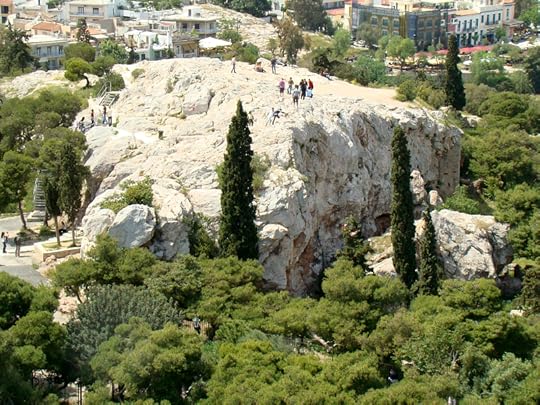
The final play of the Oresteia, called The Eumenides (Εὐμενίδες, Eumenídes), illustrates how the sequence of events in the trilogy ends up in the development of social order or a proper judicial system in Athenian society. In this play, Orestes is hunted down and tormented by the Furies, a trio of goddesses known to be the instruments of justice, who are also referred to as the "Gracious Ones" (Eumenides). They relentlessly pursue Orestes for the killing of his mother. However, through the intervention of Apollo, Orestes is able to escape them for a brief moment while they are asleep and head to Athens under the protection of Hermes. Seeing the Furies asleep, Clytemnestra's ghost comes to wake them up to obtain justice on her son Orestes for killing her.After waking up, the Furies hunt down Orestes again and when they find him, Orestes pleads to the goddess Athena for help and she responds by setting up a trial for him in Athens on the Areopagus. This trial is made up of a group of twelve Athenian citizens and is supervised by none other than Athena herself. Here Orestes is used as a trial dummy by Athena to set-up the first courtroom trial. He is also the object of central focus between the Furies, Apollo, and Athena. After the trial comes to an end, the votes are tied. Athena casts the deciding vote and determines that Orestes will not be killed. This ultimately does not sit well with the Furies, but Athena eventually persuades them to accept the decision and, instead of violently retaliating against wrongdoers, become a constructive force of vigilance in Athens. She then changes their names from the Furies to "the Eumenides" which means "the Gracious Ones". Athena then ultimately rules that all trials must henceforth be settled in court rather than being carried out personally.

75 pages, Kindle Edition

Published August 25, 2021

2 people are currently reading
10 people want to read

About the author

Aeschylus

1,831 books1,110 followers
Greek Αισχύλος , Esquilo in Spanish, Eschyle in French, Èsquil in Catalan, Eschilo in Italian, Эсхил in Russian.

Aeschylus (c. 525/524 BC – c. 456 BC) was an ancient Greek tragedian often described as the father of tragedy. Academic knowledge of the genre begins with his work, and understanding of earlier Greek tragedy is largely based on inferences made from reading his surviving plays. According to Aristotle, he expanded the number of characters in the theatre and allowed conflict among them. Formerly, characters interacted only with the chorus.
Only seven of Aeschylus's estimated 70 to 90 plays have survived. There is a long-standing debate regarding the authorship of one of them, Prometheus Bound, with some scholars arguing that it may be the work of his son Euphorion. Fragments from other plays have survived in quotations, and more continue to be discovered on Egyptian papyri. These fragments often give further insights into Aeschylus' work. He was likely the first dramatist to present plays as a trilogy. His Oresteia is the only extant ancient example. At least one of his plays was influenced by the Persians' second invasion of Greece (480–479 BC). This work, The Persians, is one of very few classical Greek tragedies concerned with contemporary events, and the only one extant. The significance of the war with Persia was so great to Aeschylus and the Greeks that his epitaph commemorates his participation in the Greek victory at Marathon while making no mention of his success as a playwright.

Ratings & Reviews

What do you think?
Rate this book

Friends & Following

Create a free account to discover what your friends think of this book!

Community Reviews

5 stars
6 (25%)
4 stars
8 (33%)
3 stars
7 (29%)
2 stars
3 (12%)
1 star
0 (0%)
Displaying 1 - 6 of 6 reviews
Profile Image for Patrick S..
484 reviews29 followers
May 28, 2025
When I first started The Oresteia trilogy, I wasn't sure if I was going to understand it enough or even enjoy it. Agamemnon was ok, but I really enjoyed The Libation Bearers; and with The Eumenides, I enjoyed this as well and saw the complete arc that Aeschylus was doing. So far, this year, I started with Homer's two epics, working my way to Plato and Aeschylus was the next stop on that road.

The journey that Aeschylus is taking the Greek people from a young civilization that carries out family revenge through a blood avenger as a means of proto-justice and here, the next movement into a justice through trials and courts is seen starting here with Orestes being caught between Apollo and The Harpies and a trial led by impartial Athena on the Areopagus. The stilted and awkward trial is beautifully done on purpose and highlighted with a line that promises that not everyone will be happy with the outcome, but that this means stops the never-ending blood avenging that was asked about in the previous installment of the story. I was quite pleased with reading this, and in the arc coming to an end. I see the stepping stone of why this is on the path to Plato and the building up of the Western world. Final Grade - A
Profile Image for Georgie.
142 reviews8 followers
Read
August 4, 2025
this is going to be a longgggg term
Profile Image for kotie.
19 reviews
November 16, 2025
No way Apollo argued that it was okay for Orestes to kill his mother because THE MOTHER ONLY INCUBATES THE BABY AND DOES NOT SHARE BLOOD…. AND WON.
This entire review has been hidden because of spoilers.
Displaying 1 - 6 of 6 reviews

Can't find what you're looking for?

Get help and learn more about the design.