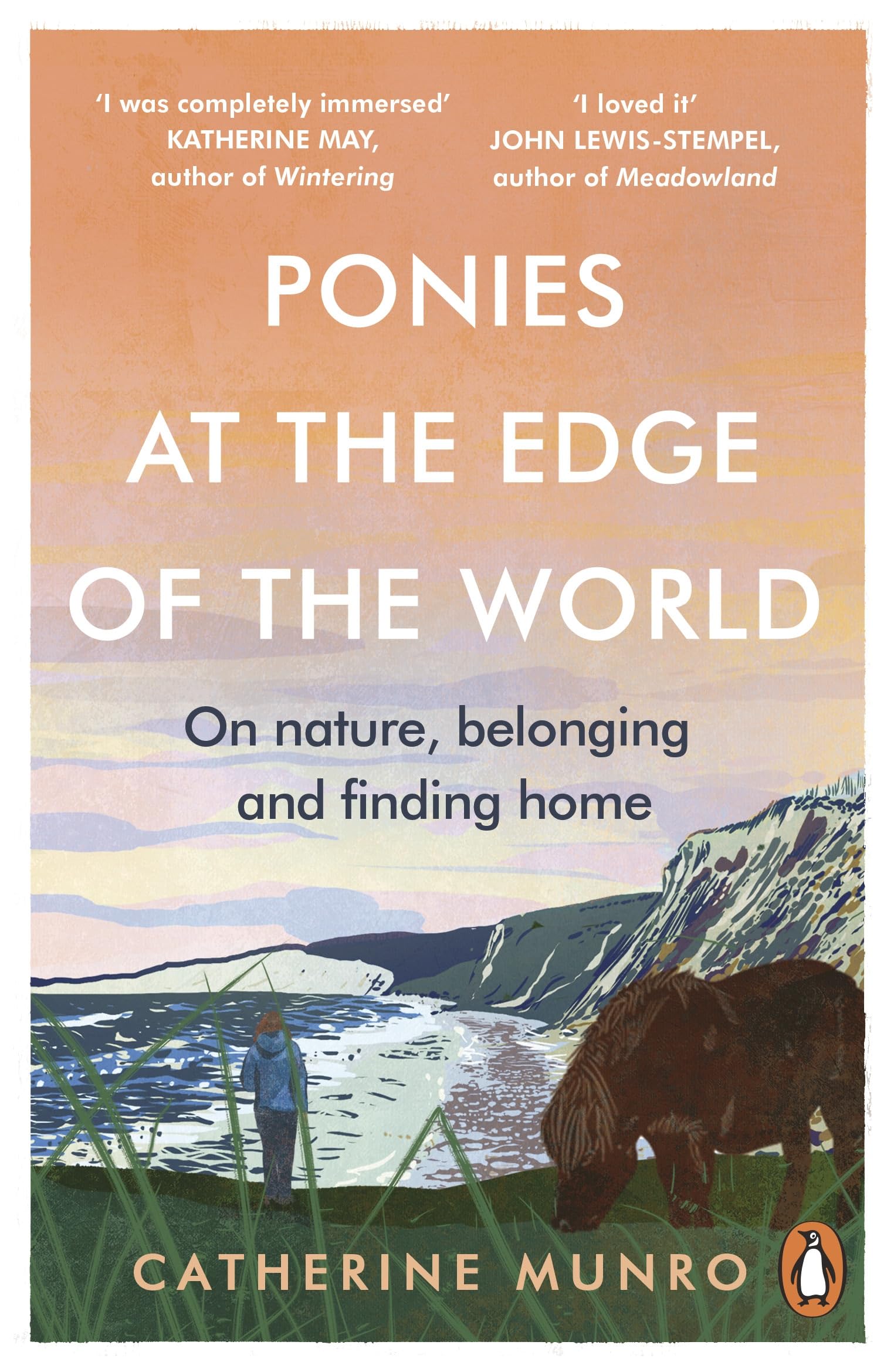
'A meditation on connection between humans and animals, and the homes we make in wild places. I was completely immersed' Katherine May
Catherine Munro transforms her life when she moves to Shetland to study the hardy ponies who call this archipelago home. Over the course of her first year, she is welcomed into the rhythms and routines that characterise life at the edge of the world.
When faced with personal loss, Catherine finds comfort and connection in the shared lives of the people, animals and wild landscapes of Shetland. The Ponies at the Edge of the World is a heartfelt love letter to the beauty and resilience of these magical ponies and their native land. This is a stunning book on community, hope and finding home.
Catherine Munro moved to Shetland to complete her PhD on Shetland’s iconic ponies.
“There’s a lot us humans can learn from animals if we just take the time to watch.”
Her book immediately felt relaxing, poetic and meditative. It made me feel like I was there too, with the wind blowing in my face and the skylark calls in the air. So many beautiful descriptions of nature. It’s as much about finding our place in the world, a place that feels like home, as it is Shetland ponies.
“Shetlanders describe the islands as being a part of them, as being in their blood, and that wherever they go in the world they will always call the islands home.”
It will get you thinking about your own encounters with animals and where your place is, the one that most represents ‘home’ and your own sense of belonging. It’s impossible not to reflect on this, such is the thought-provoking exploration of these themes by Catherine. It also got me thinking of my grandfather and his close bonds to farm animals and nature’s signs.
Her writing displayed an endearing vulnerability, especially when depicting pregnancy loss and her personal journey to find home. It was powerful, emotive stuff. The Ponies at the Edge of the World was best when portraying life in the small community and her assimilation into it. Her interactions with various animals were also touching and I smiled whenever puffins and otters were mentioned.
Catherine included many interesting facts. I had no idea the King of Denmark pawned Orkney and Shetland to Scotland. I also learnt of the distaste for which many Shetlanders view symbols of Scottishness! My favourite chapter was on Foula, an island off Shetland with thirty residents. It combined all the best parts of the book - remote island communities, poetic scenery and beautiful animals. I thoroughly enjoyed my glimpse into this amazing world.
I didn't enjoy the domestication of animals, breeding techniques and farmers' relationship with the land quite as much. They often repeated and felt like extracts from her thesis. Catherine also emphasised that she shouldn’t grow attached to a particular animal she cared for, while simultaneously ensuring the reader did. It served as a kick-in-the-guts when she made a certain decision regarding this animal in the final pages. When combined with other sad passages (like pony sales), it detracted from the otherwise wholesome, comforting feel of the book.
“I suddenly remembered the foals at the sale, the ones nobody had wanted, sold for less than the price of a takeaway coffee. What had become of them?”
Despite vivid descriptions, I found myself Googling areas to gain better understanding of the landscape and locations. Some photos, maps or a few sketches would’ve really helped.
I have newfound appreciation for Shetland’s remarkable animals after reading this. I also have greater awareness of my own connection to nature and the world around me. The Ponies at the Edge of the World is equal parts magic, moving, and pretentious, but overall, I enjoyed my time there and look forward to visiting this remarkable part of the world someday.
“As he listened patiently, our worlds merged, and I felt him understand. As surely as if he had spoken aloud, he told me to be still, that difficult times would pass and things would once again be all right.”
4.5 stars The author spends a year on one of the small islands of Shetland - Whalsay - to finish her PhD on Shetland ponies and how they connect with humans. The scenery of the island is so beautifully described that I'm there with her and can feel the wind on my face. Although I'm not much of a horse or pony person I loved her descriptions of how they were handled with respect for their character. It's a lonely place, but she and her husband are accepted and welcomed by the islanders.
We are almost half way through the year and this has definitely been one of the stand out reads for me so far in 2022. ‘The Ponies at the Edge of the World’ is an ethnography on Shetland’s Shetland Ponies. The book explores themes of belonging, roots and community, tradition, our relationship to the land (and sea) as well as our relationship to animals and their relationship to us.
I was really keen to read this as I like books about islands (probably because I live on an island). At the very beginning I was a bit sceptical as Munro talked about telling islanders that people on the mainland lock their doors (they would know this already I suspect) and there were plenty of cliches and touristy buzz words to do with islands that were all very chocolate boxy and romantic and not exactly real life. However, this very quickly changed and it was clear Munro’s attitude changed too as she left the mainland behind. We learn along with her about the ponies (also a few sheep and other animals), about their place and space on Shetland, the rhythms of life and as she discovers more it becomes apparent how much there is to learn rather than teach.
Her overall descriptions of the land, sea and wildlife were fantastic and really set an image in the readers eye. Her honesty about the situations she found herself also shone through well. What I particularly loved was how she managed to get the very difficult balance of combining her own personal story, anthropology theory and her research in this book and create something that was extremely readable and enjoyable. Her combining of these different elements is really what makes the book it is and paints the overall idea that everything is a lot more connected and in tune with each other than we might think if we only stop to observe this.
On a final anthropology point Munro brings out the islands themselves as an active participant in her research. This worked amazingly well and made me think a lot about how I view place and how so often we don’t take into account one of the biggest actors in our everyday lives. I also thought she drew some very interesting theories about balancing domesticity of animals and their wildness and the dangers of too much one way or another. The importance as well of animal and human reciprocity was really well argued. It reminded me in many ways of Robin Wall Kimmerer’s work.
This is such a wonderful book and I will definitely be reading it again to see what I missed first time round.
Thank you to NetGalley and the publisher for sending me an ARC in exchange for an honest review.
Catherine moves to Shetland as part of her research for her PhD, studying the relationships between animals and humans. This is a beautiful account of her time among the islanders, both human and animal.
The nature writing is exquisite, particularly the descriptions of the weather and sky. She introduces the reader to a range of Shetland wildlife and domestic animals; puffins, otters, seals, sheep, and of course Shetland ponies. We learn of the connections between the land and the people who live there and their relationships with their animals.
The Ponies at the Edge of the World is a celebration of the symbiotic relationship between animals and humans. The healing and restorative power of surrounding yourself in the natural world is a common thread throughout the book. I thoroughly enjoyed this read, although I hadn't realised before reading that the loss mentioned would be a miscarriage. As this is a sensitive topic for me, I skipped these pages - but this did not detract at all from my overall delight in the book.
My thanks to NetGalley and the publishers for the eARC.
Thank's to Netgalley I got to read a copy of this wonderful book!
It was fantastic to follow the author on her journey to build a new home in Shetland, where she'd decided to lead her thesis on the island's beloved ponies. She truly emphasises the importance of a back and forth relationship with our beautiful nature that gives us so much. Every page resonated with love and care, history and tradition. From the relationship she's built with the native islanders, with the ponies, the sheep, to the landscape and weather. Her approach to domestication is one that is gentle and understanding rather than violent and using strength. Catherine Munro highlights that it is possible and even preferable to raise animals in a place that is already theirs, where their instincts will be stronger (thanks to past generations who will pass down their knowledge to their little ones) all the while keeping in mind their deeper needs, only teaching them what is necessary and with profound respect.
I was glad to gain knowledge on a part of the world I knew next to nothing about but really wound up mesmerized by the loving exchanges between the different species bringing a true sense of symbiosis between man and nature. The author shares a beautiful journey to try and understand the island and all the living creatures that compose it. Highly recommend it to anyone who enjoyed "Names for the Sea: Strangers in Iceland" by Sarah Moss. This is also not quite a travelogue, not quite a memoir but a pleasant and insightful mix of both!
I was drawn to read this book due to the title and the description. I have always been fascinated by the lives of the people that live in The Shetland Islands and the other Scottish highlands, as well as having a lifelong love of horses and ponies. I find with non- fiction that I prefer to read a hard copy as you get more of an experience that can be savoured with a pristine hard back copy, and I feel that this would have been the case with this book, as I read it on kindle as an advance review copy. It would make an excellent gift for others or yourself! It can be described as part memoir, part nature book with vivid descriptions of the beautiful landscape and its inhabitants, bird life, sheep and of course, the Shetland Ponies. Additionally, the author shares how cathartic nature, animals, and friendship in the unlikeliest places can be when facing loss and sadness. Thank you to Netgalley, the publisher and the author for the opportunity to review this advance e copy.
A beautifully written book about the author's time in Shetland while writing a thesis on the island's ponies. From her first hesitant moments in her new home to learning all about the island, its inhabitants (both human and animal), and culture, it's a interesting insight to another place and world.
Her descriptions of the connection between the people, animals and nature are fascinating, showing how generations of sheep and ponies have learned how to survive the harsh conditions. Together with her sadness of losing a baby, there are some poignant moments.
Thank you to NetGalley, the publisher and the author for the chance to read this incredible story. Highly recommend.
Mesmeric, Soulful Account of Community: People, Other Animals, Landscape
Catherine Munro’s wondrous book is in a particular genre I adore, when it is done well. And this is. The genre is factual, often about history, the natural world, the arts – but what is special is that the author, however well researched and informative they are, observe their own involvement and engagement with the subject being written about,
This appears to me to be a particularly female approach (though there are of course also wonderful male writers who also engage in this way. Andrew Grieg and Robert MacFarlane spring immediately to mind.
Munro, in my mind, joins with Olivia Laing and Helen Macdonald, in her ability to write precisely and beautifully about place, inform and educate, but in a very dynamic and engaged manner. She herself is changed and expanded by her subject matter, and her readers become similarly engaged and present in relationship with the subject
Munro is an anthropologist by training. She has an affinity and connection with the Shetland Isles, and a fascination with its native animals, particularly Shetland ponies. Her PhD was specifically about the relationship between the islanders who breed and maintain the integrity of the ponies, and the animals they are fostering. For her research, she spent more than a year living on one of the islands, and visiting others to spend time with the pony communities – both the people and the equines. This is an account of all that, and of intense changes, both of loss, and of personal growth, which she found.
I particularly loved the section about healing horses – that is, horses healing humans. They are extraordinary animals, and, as pack animals, and prey animal, have evolved to be extremely sensitive to their surroundings and those within their community, whether other equines, or the people whom they connect with.
This is such a warm book, authentic and practical, and, wonderfully free from the merely sentimental.
This book is a lovely, relaxing account of a year and more in the author's life, while she moved to Shetland to work on her PhD. She chose to study the island's ponies and how they fitted into the lives of islanders and nature of the island.
The early pages give us interesting facts - the Danish king pawned the Shetland and Orkney islands in 1496 to pay for his daughter's wedding dowry, and never managed to redeem them, which is why the islanders have a distinct heritage from the rest of Scotland. We also see some of the paperwork and frills of academia, grant applications, conditions to be met. And after all that, the author and her partner are on their own to move to a new community with a fluctuating power supply and occasional lack of transport to the mainland for weeks.
The personal domestic dramas may have been hard to write, but add to the authentic inner experience. As the author goes from being the awkward, welcomed stranger, to a member of the community trusted to rear a 'caddy' lamb and care for two ponies, she learns about the Shetland breed, the bloodlines of distinct types, the hardiness of the little survivors. A reader will quickly gain respect for these clever ponies. Equally, for the sheep which still form a livelihood for many islanders. Native breeds are being revitalised thanks to one or two careful breeders.
As much, we see the shores, the gannets and other wild birds, the wild sky, the constant struggle to grow potatoes, carrots and other homestead crops in cold, wet, salty ground. The Shetland black potato, the Shetland chicken and more, all adapted over many generations to thrive. We learn some local words and gain a glimpse of the archaeology. With the turning of the seasons the book reveals more details, packed with energy. Enjoy.
I read an e-ARC from Net Galley. This is an unbiased review.
I absolutely love, love, love this book. Yes, I romanticized Shetland hard during the pandemic --a safe, wild, beautiful place away. I followed Munro on Twitter and all the Shetland accounts. I also have a love for Shetland ponies, Shetland sheep, and Shetland sheepdogs (I raised one as a child and have rescued several). I read books of Shetland lore. I love Shetland wildlife, the birds, and the orca sightings.
The author, an anthropologist, transports you to Shetland with her descriptions of the landscape in beautiful language.
Then, she sticks the landing in a book that is ultimately about the animal-human bond posing some thoughtful questions about our relationship with animals and the land. Just lovely and profound! I will certainly reread those final passages.
The author is not vegan and the book ties our past to our present more than our future --so the ethical questions fall short for our modern ruination. The passage about Yoda, the lamb's future, strikes this vegan reader as violent, harsh, and sad --although the author's decision between her available choices for him makes sense. And, at least, he will be allowed some years alive.
Oh, my goodness, I wish Shetland and this author and her family well. Many blessings upon them! I hope to visit some day although I know I will never have the full experience.
Interesting and thought-provoking. I’ve never read anything like this before. I learnt so much about Shetland and Shetland ponies and animals and their interaction with humans. The writing was beautiful. Really enjoyable and very peaceful.
La última parte del libro me la he pasado jugando al un, dos, tres, pollito inglés con una araña, comprobando cada cinco párrafos si se había movido de su rincón. Después de las reflexiones sobre las sinergias entre humanos y animales me parece un poco feo sucumbir a la aracnofobia y recurrir al zapatillazo de mi padre. Este libro ha tenido ese impacto, que así expuesto es tremendamente cutre, de intentar entender cuál es mi lugar en los entorno que habito y qué relaciones quiero en ellos, así que voy a romantizar mi vida sacando a la patas por la ventana de vuelta a la urbe. Es un libro lleno de imágenes preciosas de paisajes, de animales respetados aún sirviendo a un fin y de vecinos de los que parece que jamás podrán decir “siempre saludaba, no nos lo esperábamos” porque la comunidad allí sí existe. Dan ganas de mudarse. En fin, que me ha parecido un libro mu bonico pero además interesante, me ha enseñado cosas que espero haber aprendido, y las reflexiones vitales de la antropóloga en este momento de tanto yoísmo me han gustado mucho porque me ha sido muy fácil identificarme. Pensaba que iba a ser café para cafeteros por ir sobre ponis, pero qué va, cualquier persona con un mínimo interés por la vida y al que le gusten los animales podría disfrutarlo.
Not to go all horse girl on here but man. This was heartwarming. Also would moving to Shetland and taking in an orphaned lamb fix all my issues? Probably not. But. What if it did. Only one way to find out.
I so enjoyed this beautifully wise reflection on how the lives and existences of humans and animals are inextricably linked. Set on the wild, wind-blown hills of Shetland, this is a wonderful journey of exploration into the lives of Shetland ponies and the people that love them, care for them and breed them. It is such a celebration of man and nature existing together, her descriptions of the natural world so precise and vivid, it made me long to visit these remote and wild islands at the edge of the world.
Catherine Munro is living in Aberdeen, lurching from temporary job to temporary job, the stress of not knowing if she can pay the bills gradually eroding her spirit and soul. Eventually, her application to study for a doctorate is successful and she travels to the Shetland Island to study the eponymous ponies of the archipelago.
Her research into the ponies, into their heritage and lineage, into the ways they are known, respected and loved by the Shetlanders that breed and care for them, illuminates the sheer strength of character and personality of both the humans and animals that inhabit the rugged landscape.
Against Munro’s journey to understand the ponies is set her own desire to have a family. When tragedy hits it is the natural world and the animals that inhabit it that provide the comfort and hope she needs to move forward.
This work is written with such gentle humility, and yet expresses a mature wisdom that is both heartening and heartfelt. After reading it, I wanted to do nothing more than visit the islands, throw away my phone and immerse myself in the wild beauty of this magical place.
I very much enjoyed this book. I was tempted by the cover and the blurb and when you read that a book has been written by a PhD student, you are pretty much assured of good writing. I wasn't disappointed.
I'm not a horse person particularly, but I live close to an area where ponies roam freely so they are commonplace in the environment around me. I hoped that this book would not be exclusively based on the ponies but would be more a memoir style account of the experience living in the Shetland Isles - it is exactly that. There is an enormous sense of place, of the community that welcomed the writer and the nature and landscape around her. I loved the observations of wildlife - otters, seals and birdlife and also the story of the adopted lamb or caddy.
This is a great book to read. If you love the outdoors, it will make you want to immediately pack your bags and head off to a remote Scottish island. Highly recommended.
Thank you to NetGalley for an early copy of this book in exchange for an honest review.
This book tells the story of Munro and her husband moving to Shetland as part of her PhD fieldwork, and alternated between two things for me - the stories about day to day life, the animals and people, were easy to read, down to earth and made me really feel like I was there (I certainly wanted to be). But then before long, a section of academic text would come along, pulling me out of the flow as she went into “lots of words to not really be clear” mode. Often when talking about relationships, place, belonging… so the accessible and interesting parts I liked, but the bits that felt like academese, were harder to follow for me personally.
I received a free ARC copy of this via NetGalley and the publishers in return for an unbiased review. Apologies for the delay in providing this.
I had this on my wishlist and then when I did buy it I wondered whether I would take to it. In the event I found it a thought provoking and enjoyable read.
I spend some time each year on Shetland, particularly on Foula which features as a whole chapter of this book, and Out Skerries which is often accessed via Whalsay where most of the other chapters are based. I found the observations about Shetland as a whole and specific islands to be perceptive. Any reader of the book taking to the description of Foula is recommended to visit, it really is as unique as it comes across.
The central themes of the book about relationships between people and their 'domestic' animals are absorbing, though I did think they got a little repetitive towards the end. As a birder I noticed some of the ornithological comments were incorrect and would have benefited from sub-editing. I'm not best placed to comment on the experience of miscarriage but that part of the narrative gave me some insight into that and recovering from it.
A random find at the public library that I ended up liking a lot. I love travel writing, memoirs, and nature writing, and this was a beautiful combination of all three.
With a DIY adventurous spirit, the author moves to the Shetland islands to study local peoples' relationships with the native animals and their connection to the land, specifically Shetland ponies. I learned a lot from this book, not just about Shetland ponies being anything but the equivalent of teacup puppies for horses, but also about the landscape and deep community of the Shetland islands.
I liked the author's writing style, but wished for a little more of a coherent structure. This author is also a very anxious and insecure person, and she is self-aware of this in her writing, but I did find it wore on my nerves a bit by the end although it doesn't take away much from the overall book.
Overall would recommend if you like memoirs, animals, or reading about life in remote places.
Will definitely be one of my top books of the year. I love nature writing, especially when the language is poetic and I’ve just been hiking through Scotland, so this book was sure to speak to me. But it was so much more - a book that is well written, insightful and with new perspectives- I learned a lot! So much to take with me into my own life. Lovely.
A gentle book describing beautiful people, animals and land. I have been lucky enough to visit Shetland and would go back in a heartbeat. The author did a wonderful job of capturing how special these isles are to those who inhabit them.
This book came into my life at the perfect moment. It talks about how landscapes and animals are part of your life and form your identity. I particularly connected with the parts about how strong nature can have an effect on your life. With a busy life it is easy to rush through days and live on autopilot. But by noticing the nature around you, your day can really change.
This book gave me perspective on what I want for my future. It shows that nature time can really be a necessity and that is valid.
Catherine Munro transforms her life when she moves to Shetland to study the hardy ponies who call this archipelago home. Over the course of her first year, she is welcomed into the rhythms and routines that characterise life at the edge of the world.
When faced with personal loss, Catherine finds comfort and connection in the shared lives of the people, animals and wild landscapes of Shetland. The Ponies at the Edge of the World is a heartfelt love letter to the beauty and resilience of these magical ponies and their native land. This is a stunning book on community, hope and finding home.

This is a sweet book that I picked up because I had a book coupon lying around and I liked the part of the title where it said "at the end of the world", but I'm not really into ponies or horses. Regardless, I'm actually happy my curiosity won and I went ahead and chose the book. I learned some interesting facts, got some time to dream about the Shetland islands, and I have yet another place on my to-visit bucket list. The one question that remains for me is whether the ponies are as happy with us as we seem to be with them?
I enjoyed this book for multiple reasons. First, I enjoyed its deep look at the way humans and non-humans coexist and create entangled lives. While much of what I've been reading about this has been theoretical, this book was deeply personal. Because of this the ideas were much easier to understand and I feel I gained a greater understanding of the reciprocal nature of domestication. The second reason I enjoyed this book was Dr. Munro's writing style - I really felt as if I could smell the wind coming off the sea and feel the mist upon my cheeks. There's something magical about outermost islands, something I've always been drawn to, and this book captures both the isolation and the community ties that being in remote islands engenders.
A fascinating account of Catherine's work with Shetland ponies and her life on the remote, northernmost outpost of the British Isles. This is about much more than horses, encompassing as it does a sense of place, the concept of home and belonging and the importance of community in harsh environments.
You can listen to an interview with Catherine and excerpts from the book in this podcast from Alternative Stories
This is a book written from the heart. The author moved to Shetland discovering a rugged landscape, windswept through dark winters, but home to ponies, sheep, birds and the humans who had learned to share an ancient land with them. There are some very poignant moments. She teaches a tiny lamb, Yoda, how to become a sheep and adopts Yukon, a Shetland pony, and her mother, Sugar. It is these animals who help her to cope with personal tragedy and understand the meaning of 'home'. The Islanders are welcoming and social able and the book records an unique way of life in a beautiful setting.
an interesting book, exploring our connections with land, people and animals, a true account of island life, another book which brings back memories and refreshes my look at nature in all its forms