2033 год. Разрушительная война, превратившая мир в радиоактивную пустыню, вынудила москвичей искать убежища в метро. За прошедшие годы его станции стали настоящими государствами, которые торгуют или воюют друг с другом. На поверхности по руинам мегаполиса бродят чудовища-мутанты, а внизу, в туннелях, происходят страшные вещи. Артему, жителю ВДНХ, предстоит пройти опасный путь к Полису, чтобы спасти от мутантов свою станцию, а может быть, и все метро.
2033 год. После разрушительной ядерной войны, превратившей поверхность планеты в выжженную радиоактивную поверхность, немногочисленные уцелевшие перебрались под Землю. За прошедшие с момента катастрофы годы тоннели и станции московского метро превратились в целый мир, полный самостоятельных станций-государств, которые то воюют, то торгуют между собой. Юный Артём живёт на ВДНХ, на самом краю обжитых людьми туннелей. После того как он становится свидетелем жутких событий, лидеры станции отправляют его в полный опасностей поход в просвещённый Полис. От успеха его миссии зависит выживание не только станции, но и всего метро…
Dmitry Glukhovsky (Russian: Дмитрий Глуховский) is a professional Russian author and journalist. Glukhovsky started in 2002 by publishing his first novel, Metro 2033, on his own website to be viewed for free. The novel has later become an interactive experiment, drawing in many readers, and has since been made into a video game for the Xbox 360 console and PC. Glukhovsky is known in Russia for his novels Metro 2033 and "It's Getting Darker". He is also an author of a series of satirical "Stories of Motherland" criticizing today's Russia. As a journalist, Dmitry Glukhovsky has worked for EuroNews TV in France, Deutsche Welle, and RT. In 2008-2009 he worked as a radio host of a Mayak Radio Station. He writes columns for Harper’s Bazaar, l’Officiel and Playboy. He has lived in Israel, Germany and France and speaks English, French, German, Hebrew and Spanish as well as his native Russian.
I've been meaning to read more Russian this year and when this popped up on my radar, I was immediately intrigued: a comic adaptation of the dystopian Metro 2033 sounded like a potentially atmospheric read and just generally a good idea.
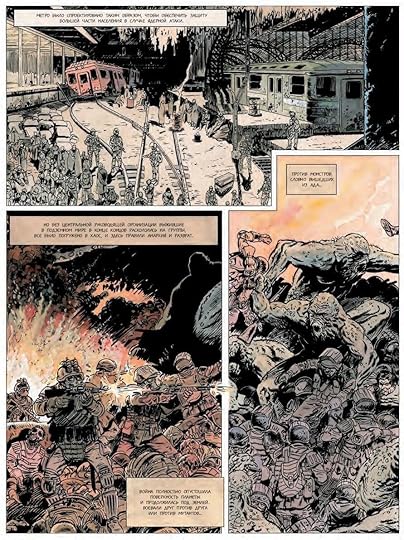
So Метро 2033 is a Russian novel, but the graphic novel was originally published in German – it adapts the novel and divides it into four parts, two of which this edition holds. For those who aren't familiar with the story: it's set in an apocalyptic world in which a nuclear war has made most of Russia uninhabitable, with the few survivors retreating into the underground metro system in search for refuge. As the settlements grow, factions begin to develop: there are independent peacekeepers, but also neo-nazis calling themselves Fourth Reich. Our 24-year old protagonist Artyom obviously ends up finding himself amidst these raging power battles.
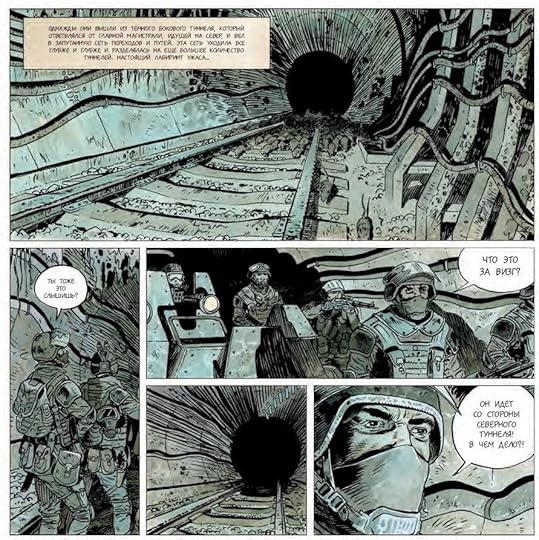
The vibe translates well. I generally enjoyed the art – it's just as dark and gritty as I pictured the world when encountering this world for the first time through the novel. It did kind of lack in variety, but then that might be due to the consistent settings of events. After all, everything is playing out underground, so there are only so many ways you can portray tunnels.
The story was reduced to plot. I'll really have to read the novel again soon in order to confirm this, but as far as I remember the philosophical components and the societal analysis were sharper in the novel. The graphic novel zooms in on Artyom and we closely follow his whereabouts, but generally learn less about the structures of life in the metro and how the fractions came to exist. That was fine by me – if you want more, more is out there for you to read after all, but in direct comparison this does feel like a diet version of the real thing.
Nonetheless, I've got the second volume right next to me as we speak and will definitely dive into that one soon as well.