

What do you think?
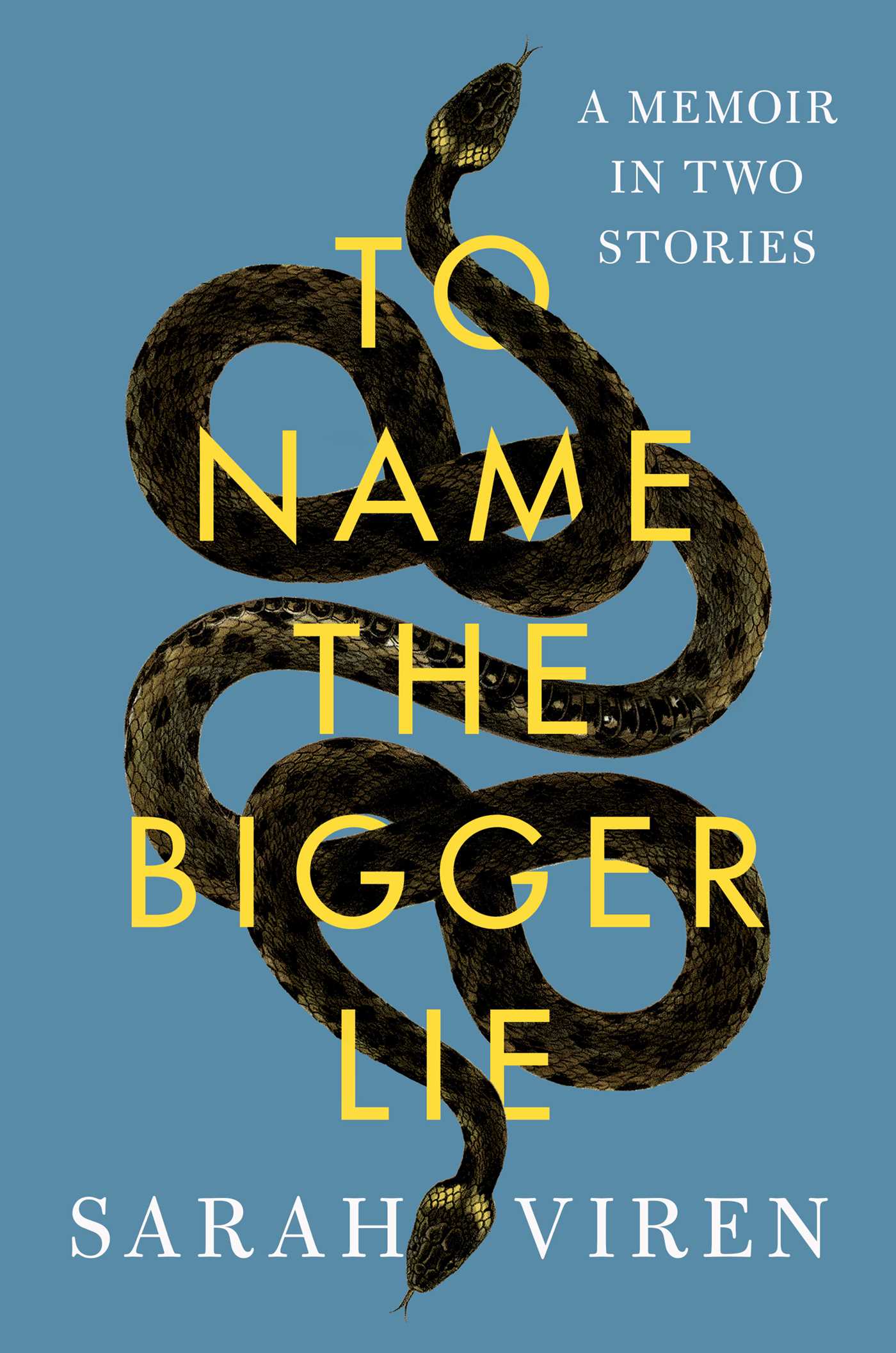
To Name the Bigger Lie: A Memoir in Two Stories
“Has the page-turning quality of a thriller.” —NPR
“Strange and wonderful…A book for our times.” —The New York Times Book Review
“Propulsive…mesmerizing…breathtaking.” —Publishers Weekly (starred review)
This unforgettable memoir traces the ramifications of a series of lies that threaten to derail the author’s life—exploring the line between fact and fiction, reality and conspiracy.
In To Name the Bigger Lie, Sarah Viren “has pulled off a magic trick of fantastic proportion” (The Washington Post), telling the story of an all-too-real investigation into her personal and professional life that she expands into a profound exploration of the nature of truth. The memoir begins as Viren is researching what she believes will be a book about her high school philosophy teacher, a charismatic instructor who taught her and her classmates to question everything—eventually, even the reality of historical atrocities. As she digs into the effects of his teachings, her life takes a turn into the fantastical when her wife, Marta, is notified that she’s being investigated for sexual misconduct at the university where they both teach.
To Name the Bigger Lie follows the investigation as it challenges everything Sarah thought she knew about truth, testimony, and the difference between the two. She knows the claims made against Marta must be lies, and as she attempts to uncover the identity of the person behind them and prove her wife’s innocence, she’s drawn back into the questions that her teacher inspired all those years ago: about the nature of truth, the value of skepticism, and the stakes we all have in getting the story right.
An incisive journey into honesty and betrayal, this memoir explores the powerful pull of dangerous conspiracy theories and the pliability of personal narratives in a world dominated by hoaxes and fakes. An “ouroboros of a book” (The New York Times) and a “bold new approach to the genre of memoir” (The Millions), To Name the Bigger Lie also reads like the best of psychological thrillers—made all the more riveting because it’s true.
A compelling, incisive journey into honesty and betrayal, this memoir explores the powerful pull of dangerous conspiracy theories and the pliability of personal narratives in a world dominated by hoaxes and fakes. To Name the Bigger Lie reads like the best of psychological thrillers—made all the more riveting because it’s true.
“Strange and wonderful…A book for our times.” —The New York Times Book Review
“Propulsive…mesmerizing…breathtaking.” —Publishers Weekly (starred review)
This unforgettable memoir traces the ramifications of a series of lies that threaten to derail the author’s life—exploring the line between fact and fiction, reality and conspiracy.
In To Name the Bigger Lie, Sarah Viren “has pulled off a magic trick of fantastic proportion” (The Washington Post), telling the story of an all-too-real investigation into her personal and professional life that she expands into a profound exploration of the nature of truth. The memoir begins as Viren is researching what she believes will be a book about her high school philosophy teacher, a charismatic instructor who taught her and her classmates to question everything—eventually, even the reality of historical atrocities. As she digs into the effects of his teachings, her life takes a turn into the fantastical when her wife, Marta, is notified that she’s being investigated for sexual misconduct at the university where they both teach.
To Name the Bigger Lie follows the investigation as it challenges everything Sarah thought she knew about truth, testimony, and the difference between the two. She knows the claims made against Marta must be lies, and as she attempts to uncover the identity of the person behind them and prove her wife’s innocence, she’s drawn back into the questions that her teacher inspired all those years ago: about the nature of truth, the value of skepticism, and the stakes we all have in getting the story right.
An incisive journey into honesty and betrayal, this memoir explores the powerful pull of dangerous conspiracy theories and the pliability of personal narratives in a world dominated by hoaxes and fakes. An “ouroboros of a book” (The New York Times) and a “bold new approach to the genre of memoir” (The Millions), To Name the Bigger Lie also reads like the best of psychological thrillers—made all the more riveting because it’s true.
A compelling, incisive journey into honesty and betrayal, this memoir explores the powerful pull of dangerous conspiracy theories and the pliability of personal narratives in a world dominated by hoaxes and fakes. To Name the Bigger Lie reads like the best of psychological thrillers—made all the more riveting because it’s true.
304 pages, Hardcover
First published June 13, 2023
About the author
Sarah Viren
10 books73 followersSarah Viren is a contributing writer for the New York Times Magazine and author of two books of narrative nonfiction. Her essay collection Mine won the River Teeth Nonfiction Book Prize and the Great Lakes College Association New Writers Award, was a silver winner for essays in Foreword INDIES Book of the Year Awards, was longlisted for the Pen Diamonstein-Spielvogel Award for the Art of the Essay and was a finalist for a Lambda Literary Award (as well as being named one of LitHub’s favorite books of 2018). Her second book, To Name the Bigger Lie: A Memoir in Two Stories, is out on June 13 from Scribner. Sarah is a finalist for a National Magazine Award in Feature Writing and the recipient of a National Endowment for the Arts Fellowship and a Fulbright Student Grant to Colombia. In her work as a literary translator, Sarah has translated stories by the Latin American authors Pilar Quintana and Federico Falco along with Falco’s novella, Cordoba Skies. She teaches in the creative writing program at Arizona State University and lives in Tempe with her partner, two kids, and rescue dog Oki.
Ratings & Reviews
Friends & Following
Create a free account to discover what your friends think of this book!
Community Reviews
Displaying 1 - 30 of 285 reviews

June 15, 2023
In my day job I'm an academic at a university, and so is my husband. We and everyone we know who works in higher ed heard about the sinister true-life tale Sarah Viren recounts in this book, whereby she and her wife became victims of a stealth campaign to derail their prospects to secure positions at the University of Michigan. The whole affair was so eerie and bizarre that it had the making of a great Lifetime movie, but it was also scary and enraging. To think that someone would be sick enough to manufacture false claims of sexual harassment just to get a job is almost beyond belief, except for the fact that this happens in real life, and our zeitgeist has become inundated with false narratives, deep fakes, and conspiracy theories to the point that one must be vigilant in pursing the truth.
This is the overarching thesis of To Name the Bigger Lie, Viren's attempt to gain control of the narrative of that rending event and also to examine the reasons people buy into conspiracy theories and promote them. Two stories are being told here: in addition to Viren recounting her and her wife's ordeal with "Jay," the scuzzy academic--also queer--who embarked on a course of action to torpedo their professional and personal lives, she also chronicles her high school years spent in a philosophy class taught by "Dr. Wiles," a man who may or may not have bought into conspiracy theories, chiefly Holocaust denialism, and tried to foist these pernicious delusions onto impressionable students.
I like the work Viren does in this book but the structure works against it. Meticulous scholar that she is, she goes to great pains to memorialize events and conversations, even enlisting the aid of fact checkers. To Name the Bigger Lie asks readers to connect lots of dots, and it brings to the surface contemporary debates about what curriculum is being taught in schools, the dissemination of harmful beliefs, and the widespread lies that threaten to topple our society. Using the 2016 presidential election as a point of origin for this project, Viren's twin stories prompt readers to ask themselves how they confront and debunk lies and what they would do were they in her place. Though Dr. Wiles's use of Holocaust denialism and other conspiracy theories as teaching tools--quite foolish and pompous, if you ask me--has long-term consequences, Jay's actions could have completely destroyed Viren and her family, and like many readers I want him to pay.
But the book tacitly critiques the various systems which enabled Jay's behavior. Not to absolve or excuse his actions, but Jay is a gay man who, at the time, was living in a very conservative and, I gather, hostile small town in an isolated area. One of the big drawbacks of pursuing a career as a college or university instructor is that jobs are scarce, and the job market is competitive beyond belief. Jay was obviously desperate to get out of his circumstances and, like Viren and her wife Marta, relocate to a place that was more welcoming to queer people and had more to offer. Yet this by no means absolves him of the damage he caused, and though Viren reports that Jay has since been suffering his own punishment, it's hard not to want him to pay in other ways.
To Name the Bigger Lie is compelling up until the final quarter of the book. Once readers reach the Dear Reader section, Viren shifts into imagined dialogues--the one between Socrates and Dr. Wiles at the bar was dumb and embarrassing--and tarnishes all the good writing that came before. She transitions into philosophical musings and dialogues that I had no interest in whatsoever. That section really doesn't offer anything readers need, so I recommend you skip it all together. She reaches out to Dr. Wiles, they exchange several professional emails, and that's it. Other than the eye-rolling final section, please read this book and consider the ways we, both collectively and individually, can uphold truth in a world that values it less and less.
This is the overarching thesis of To Name the Bigger Lie, Viren's attempt to gain control of the narrative of that rending event and also to examine the reasons people buy into conspiracy theories and promote them. Two stories are being told here: in addition to Viren recounting her and her wife's ordeal with "Jay," the scuzzy academic--also queer--who embarked on a course of action to torpedo their professional and personal lives, she also chronicles her high school years spent in a philosophy class taught by "Dr. Wiles," a man who may or may not have bought into conspiracy theories, chiefly Holocaust denialism, and tried to foist these pernicious delusions onto impressionable students.
I like the work Viren does in this book but the structure works against it. Meticulous scholar that she is, she goes to great pains to memorialize events and conversations, even enlisting the aid of fact checkers. To Name the Bigger Lie asks readers to connect lots of dots, and it brings to the surface contemporary debates about what curriculum is being taught in schools, the dissemination of harmful beliefs, and the widespread lies that threaten to topple our society. Using the 2016 presidential election as a point of origin for this project, Viren's twin stories prompt readers to ask themselves how they confront and debunk lies and what they would do were they in her place. Though Dr. Wiles's use of Holocaust denialism and other conspiracy theories as teaching tools--quite foolish and pompous, if you ask me--has long-term consequences, Jay's actions could have completely destroyed Viren and her family, and like many readers I want him to pay.
But the book tacitly critiques the various systems which enabled Jay's behavior. Not to absolve or excuse his actions, but Jay is a gay man who, at the time, was living in a very conservative and, I gather, hostile small town in an isolated area. One of the big drawbacks of pursuing a career as a college or university instructor is that jobs are scarce, and the job market is competitive beyond belief. Jay was obviously desperate to get out of his circumstances and, like Viren and her wife Marta, relocate to a place that was more welcoming to queer people and had more to offer. Yet this by no means absolves him of the damage he caused, and though Viren reports that Jay has since been suffering his own punishment, it's hard not to want him to pay in other ways.
To Name the Bigger Lie is compelling up until the final quarter of the book. Once readers reach the Dear Reader section, Viren shifts into imagined dialogues--the one between Socrates and Dr. Wiles at the bar was dumb and embarrassing--and tarnishes all the good writing that came before. She transitions into philosophical musings and dialogues that I had no interest in whatsoever. That section really doesn't offer anything readers need, so I recommend you skip it all together. She reaches out to Dr. Wiles, they exchange several professional emails, and that's it. Other than the eye-rolling final section, please read this book and consider the ways we, both collectively and individually, can uphold truth in a world that values it less and less.

May 4, 2023
Thanks to Scribner for the ARC.
I expected so much more from this book like scandal, intrigue, and relatable insights. Instead this book reads exactly like what it is, a essay that the author pulled and stretched into a full-length book. There’s not much juice in the high school/coming of age half of the book. The other half is a bit better, but also does not warrant more than an article.
Additionally, the book is full of brags from getting into an exclusive high school program to winning awards and mentioning that she was so tired after having her second kid that she could not remember how to pronounce “mimesis”. All the self-aggrandizing detracted from the book as a whole and really turned me off of Viren as an author.
Viren apparently teaches “creative non-fiction.” If this is an example of her version of that genre, count me out.
I expected so much more from this book like scandal, intrigue, and relatable insights. Instead this book reads exactly like what it is, a essay that the author pulled and stretched into a full-length book. There’s not much juice in the high school/coming of age half of the book. The other half is a bit better, but also does not warrant more than an article.
Additionally, the book is full of brags from getting into an exclusive high school program to winning awards and mentioning that she was so tired after having her second kid that she could not remember how to pronounce “mimesis”. All the self-aggrandizing detracted from the book as a whole and really turned me off of Viren as an author.
Viren apparently teaches “creative non-fiction.” If this is an example of her version of that genre, count me out.

January 7, 2024
I mostly kept reading this book to figure out what the two lies/stories were, but there was little to no pay off for me. This book would've been better as an essay. I think the author tried to do to much and also not enough at the same time. It felt very much like a good idea without great execution or even a strong reason to exist. The writing is fine but it can't carry the book.

October 22, 2023
If it weren't for the last section of this book, I probably would have given it four stars. Before then I was absolutely along for the ride with Viren in what initially appeared to be a novel form of memoir.
Viren was writing a work of personal nonfiction about her high school philosophy teacher, who she calls Mr. Wiles. It is a troubling story, of a teacher who is challenging the way his students think, but whose methods move into difficult areas, including the use of conspiracy theories and misinformation. Viren finds her experience as a teenager meaningful given the increase in conspiracy theories in 2016 and embarks on interviews and research for the project.
While she is doing this work, allegations are made against her wife, and she suspects those allegations are coming from an academic peer, who she calls "Jay." (You may have seen this story, it ran in a major magazine and was much passed around in her shorter essay on it.) While Viren is working on this story about truth, she finds herself in a situation where the truth is again malleable and where she feels as if she is under attack.
These stories individually are strong enough to stand on their own, the kind of thing where you regularly find your jaw drop. But what Viren has done putting them together, I'm not so sure about.
Ultimately it felt like there was so much Viren could have done and didn't do. What was the story she was going to write about Mr. Wiles? How did the experience with Jay impact the writing of it or the way she looked at it? This seems to be the center of Viren's story, from the way she presents it to us, and yet the stories remain mostly disjointed. All we really get about Viren's writing is the final section, which appears to be written entirely at a writer's retreat, and which rambles and rambles through imaginary confrontations with these men (and, somehow, Plato?) without connecting it all together.
I understand the urge to have some kind of connective tissue between the stories, when they both happen to you the way they did, it surely feels like they are variations on a theme. But it is also a very different thing for a reader to read about it than it is to experience it and whatever Viren sees as the connection here, it never fully gelled for me.
Viren was writing a work of personal nonfiction about her high school philosophy teacher, who she calls Mr. Wiles. It is a troubling story, of a teacher who is challenging the way his students think, but whose methods move into difficult areas, including the use of conspiracy theories and misinformation. Viren finds her experience as a teenager meaningful given the increase in conspiracy theories in 2016 and embarks on interviews and research for the project.
While she is doing this work, allegations are made against her wife, and she suspects those allegations are coming from an academic peer, who she calls "Jay." (You may have seen this story, it ran in a major magazine and was much passed around in her shorter essay on it.) While Viren is working on this story about truth, she finds herself in a situation where the truth is again malleable and where she feels as if she is under attack.
These stories individually are strong enough to stand on their own, the kind of thing where you regularly find your jaw drop. But what Viren has done putting them together, I'm not so sure about.
Ultimately it felt like there was so much Viren could have done and didn't do. What was the story she was going to write about Mr. Wiles? How did the experience with Jay impact the writing of it or the way she looked at it? This seems to be the center of Viren's story, from the way she presents it to us, and yet the stories remain mostly disjointed. All we really get about Viren's writing is the final section, which appears to be written entirely at a writer's retreat, and which rambles and rambles through imaginary confrontations with these men (and, somehow, Plato?) without connecting it all together.
I understand the urge to have some kind of connective tissue between the stories, when they both happen to you the way they did, it surely feels like they are variations on a theme. But it is also a very different thing for a reader to read about it than it is to experience it and whatever Viren sees as the connection here, it never fully gelled for me.

July 29, 2023
What is true? And how do you know? (p. 144)
When I was in high school, I was full of questions like these. I wondered whether you and I saw the same color as red. I wondered whether what was true for me was also true for you. The adults I knew didn't know what to make of such questions and mostly dismissed them. What would it have been like to have a teacher, like Sarah Viren's Dr. Whiles, who took those questions seriously and helped students develop the skills to question the nature of reality and the stories people tell about them.
As Viren observed, while this questioning is a useful and important skill to develop, it can also be a dangerous teaching strategy if not handled well (e.g., the difference between the philosophical freshman year Dr. Whiles and the conspiracy-filled junior year version).
Against this backdrop, Viren described the story of her partner – and eventually Viren, herself – being (falsely) accused of sexual harassment by several anonymous students. How does one believe – and we encourage people to believe victims – and fight back? How does one go through this without it damaging one's career, family, and friendships? Viren's story is about truth and survival, but it's about more:
Would I have been able to distinguish truth from fears from propaganda? Would I have sided with Socrates? Or those standing beside and among me who wanted to put him to death? The question of justice inherent to those calculations no longer seemed all that abstract. Neither Dr. Whiles nor Jay was a figure like Socrates—I knew that—but I still felt myself, both audience member and author of this much smaller drama, wanting not only to know what was true but also what was just. (p. 158).
Dr. Whiles' story alone would make a thrilling book, but it becomes a thought-provoking one when seen against both the political times in the US, which she only briefly talked about, and her history as Dr. Whiles' student. Aren't we always looking at our world through a glass distorted by what happened earlier? Viren clearly recognized this duality, what Virginia Woolf called the "I now" and the "I then," and that each influences the other. I am my history, my history is seen through my present eyes.
I wouldn't have read The Bigger Lie if it had been a novel, as most thrillers feel far-fetched. The Bigger Lie is far-fetched, but sometimes far-fetched is true. I felt paranoid along with Viren, worried about how students (or professional enemies) might spread rumors that would hurt me and my family. Not far-fetched in these times.
One narrative that analysts tell about conspiracies is that those subscribing to conspiracy theories are less well-educated and less intellectually-gifted. One of the interesting things is that Dr. Whiles was clearly thoughtful and well-read, yet fell down a conspiracy rabbit hole, taking a number of his students with him. Subscribing to conspiracy theories is about more than poor critical thinking skills.
Viren originally published this story in the New York Times . The original story is compelling, the intertwined stories are so much more.
When I was in high school, I was full of questions like these. I wondered whether you and I saw the same color as red. I wondered whether what was true for me was also true for you. The adults I knew didn't know what to make of such questions and mostly dismissed them. What would it have been like to have a teacher, like Sarah Viren's Dr. Whiles, who took those questions seriously and helped students develop the skills to question the nature of reality and the stories people tell about them.
As Viren observed, while this questioning is a useful and important skill to develop, it can also be a dangerous teaching strategy if not handled well (e.g., the difference between the philosophical freshman year Dr. Whiles and the conspiracy-filled junior year version).
Against this backdrop, Viren described the story of her partner – and eventually Viren, herself – being (falsely) accused of sexual harassment by several anonymous students. How does one believe – and we encourage people to believe victims – and fight back? How does one go through this without it damaging one's career, family, and friendships? Viren's story is about truth and survival, but it's about more:
Would I have been able to distinguish truth from fears from propaganda? Would I have sided with Socrates? Or those standing beside and among me who wanted to put him to death? The question of justice inherent to those calculations no longer seemed all that abstract. Neither Dr. Whiles nor Jay was a figure like Socrates—I knew that—but I still felt myself, both audience member and author of this much smaller drama, wanting not only to know what was true but also what was just. (p. 158).
Dr. Whiles' story alone would make a thrilling book, but it becomes a thought-provoking one when seen against both the political times in the US, which she only briefly talked about, and her history as Dr. Whiles' student. Aren't we always looking at our world through a glass distorted by what happened earlier? Viren clearly recognized this duality, what Virginia Woolf called the "I now" and the "I then," and that each influences the other. I am my history, my history is seen through my present eyes.
I wouldn't have read The Bigger Lie if it had been a novel, as most thrillers feel far-fetched. The Bigger Lie is far-fetched, but sometimes far-fetched is true. I felt paranoid along with Viren, worried about how students (or professional enemies) might spread rumors that would hurt me and my family. Not far-fetched in these times.
One narrative that analysts tell about conspiracies is that those subscribing to conspiracy theories are less well-educated and less intellectually-gifted. One of the interesting things is that Dr. Whiles was clearly thoughtful and well-read, yet fell down a conspiracy rabbit hole, taking a number of his students with him. Subscribing to conspiracy theories is about more than poor critical thinking skills.
Viren originally published this story in the New York Times . The original story is compelling, the intertwined stories are so much more.

July 24, 2023
2 ⭐️. “Thriller” as a descriptor is inaccurate and overly generous. Nothing about this memoir seemed particularly attention-keeping. It took 25 chapters for the mystery to start and only 3 for the resolve. I would have preferred the authors essay about the incident over the novel.
September 4, 2023
DNF'd at page 105. The underlying story is fascinating, and I recommend you read the piece Viren wrote about it in the New York Times (I cannot link but the title is “The Accusations Were Lies. But Could We Prove It?”) Viren sort of weights down the central story in which her wife is falsely accused of sexual misconduct, and a second story about abuses by a charismatic high school teacher, with bland interviews and insights not as weighty as the author thinks. This was technically well-written, but I was honestly bored to tears and life is too short.
July 20, 2023
I can see how most writers (particularly memoirists) would need to possess a certain degree of “main character syndrome” in their own lives in order to feel confident enough to write. However, Viren’s writing made it feel as if she feels she is the main character in other peoples’ lives as well.
(Also—this could have been much shorter and more focused on fewer directions!)
(Also—this could have been much shorter and more focused on fewer directions!)

July 25, 2023
2.5 stars rounded down to 2.
This is a very hard memoir to review. In my opinion, memoirs are intended to focus on pivotal events in people's lives and how the writers interpreted (and crucially, reinterpreted with hindsight and maturity) and grew from challenging events in their lives.
The first titular story of this memoir (and the narrative thread Viren keeps perseverating on) is her odd fixation on a high school philosophy teacher who simultaneously challenged her to question her views on reality but also seemed to espouse conspiracy theories. Viren doesn't mention this explicitly, but from all her indirect hints, she was part of the International Baccalaureate (IB) diploma program in high school. As a fellow IB diploma grad from 15-20 years ago, I too was required to take two years of a class called Theory of Knowledge (TOK) taught by a similarly odd duck instructor who I hadn't thought about in 15-20 years until I read Viren's book. My TOK class read Sophie's World, watched Waking Life, talked about the cave dilemma, and spent hours debating what a chair was (yes, really, and I spent most of the hours inwardly rolling my eyes and feeling stressed at all the homework from my other classes I couldn't do while being forced to sit in this required class). I went to a private religious high school, so instead of religious elements being illicitly present in TOK like in Viren's class (at a public high school), religious overtones were explicit in my TOK class and in the years of religion courses that every student at my high school was required to take, regardless of our own beliefs (I did not share the religious beliefs of my high school). I can't say I can really relate to Viren's mindset and why her TOK instructor became so fixated in her thoughts decades later. I found it very odd that Viren proceeded to track her instructor down and send him a series of very odd emails asking him to justify his teaching style and clarify things that had been bothering her for over 20 years. It's pretty demonstrative of a lack of personal growth and maturity, in my opinion.
The second titular story of this memoir is far more compelling, and far more awful (in my opinion), recounting how Viren and her wife were falsely accused of sexual misconduct by another member of the LGBTQ+ community (someone who had been on same job interview circuit as Viren and reacted very poorly to her getting an offer that he wanted). This individual instigated an online smear campaign falsely disguising himself as fictitious female students, and the repercussions of this false accusation unfortunately negatively impacted both Viren and her wife's academic careers and caused them incredible stress and financial hardship. Though the accusation was thankfully found to be not credible and the perpetrator is unlikely to ever get the academic job he was after, there really are no winners in that situation.
In balance, I wish that Viren had developed this memoir more around the second story and omitted the first story altogether.
This is a very hard memoir to review. In my opinion, memoirs are intended to focus on pivotal events in people's lives and how the writers interpreted (and crucially, reinterpreted with hindsight and maturity) and grew from challenging events in their lives.
The first titular story of this memoir (and the narrative thread Viren keeps perseverating on) is her odd fixation on a high school philosophy teacher who simultaneously challenged her to question her views on reality but also seemed to espouse conspiracy theories. Viren doesn't mention this explicitly, but from all her indirect hints, she was part of the International Baccalaureate (IB) diploma program in high school. As a fellow IB diploma grad from 15-20 years ago, I too was required to take two years of a class called Theory of Knowledge (TOK) taught by a similarly odd duck instructor who I hadn't thought about in 15-20 years until I read Viren's book. My TOK class read Sophie's World, watched Waking Life, talked about the cave dilemma, and spent hours debating what a chair was (yes, really, and I spent most of the hours inwardly rolling my eyes and feeling stressed at all the homework from my other classes I couldn't do while being forced to sit in this required class). I went to a private religious high school, so instead of religious elements being illicitly present in TOK like in Viren's class (at a public high school), religious overtones were explicit in my TOK class and in the years of religion courses that every student at my high school was required to take, regardless of our own beliefs (I did not share the religious beliefs of my high school). I can't say I can really relate to Viren's mindset and why her TOK instructor became so fixated in her thoughts decades later. I found it very odd that Viren proceeded to track her instructor down and send him a series of very odd emails asking him to justify his teaching style and clarify things that had been bothering her for over 20 years. It's pretty demonstrative of a lack of personal growth and maturity, in my opinion.
The second titular story of this memoir is far more compelling, and far more awful (in my opinion), recounting how Viren and her wife were falsely accused of sexual misconduct by another member of the LGBTQ+ community (someone who had been on same job interview circuit as Viren and reacted very poorly to her getting an offer that he wanted). This individual instigated an online smear campaign falsely disguising himself as fictitious female students, and the repercussions of this false accusation unfortunately negatively impacted both Viren and her wife's academic careers and caused them incredible stress and financial hardship. Though the accusation was thankfully found to be not credible and the perpetrator is unlikely to ever get the academic job he was after, there really are no winners in that situation.
In balance, I wish that Viren had developed this memoir more around the second story and omitted the first story altogether.
April 5, 2025
Many readers of The New York Times will probably recall Sarah Viren's gripping feature article, at once a bizarre tale of academic jealousy and sabotage and a shocking exposé of Title IX's murky procedures. After receiving a job offer from the University of Michigan, Sarah was hoping that her wife, a professor of Spanish language and literature, would also be given a job. Spousal hires are notoriously difficult but she was given reason for optimism. However, week after week, with little communication from the department chair or dean, she nervously waited for further details and an official letter. As the delays dragged on and the radio-silence continued, she remembered her own mother's experience as an academic, a prestigious position in Boston offered and then arbitrarily rescinded by the provost. What could be the hold-up? Abruptly one night, Sarah's wife received an email informing her that she was the subject of a Title IX investigation for sexual harassment. What ensues is an unbelievable story—garishly fabricated accusations of topless parties, sexual extortion and coercive abuse of power, a litany of Reddit posts all purportedly made by former students, a skeptical administration obligated to follow the preponderance of evidence even when no actual accuser has stepped forward, a desperate colleague and deranged fantasist with an ulterior motive. It has the set-up of a Patricia Highsmith novel.
This story is only one part of Viren's memoir. Bookending this campus thriller of academic subterfuge is a more poignant story of high school. Growing up in Tampa, Florida, Sarah was lucky enough to attend a magnet school with a progressive curriculum. In grade 9, she took a philosophy class under a charismatic teacher who posed deep questions that shocked them out of complacency and forced them to think critically. She was enamored. However, when she returned to his class in grade 12, she found a very different man: a fervid convert to Catholicism, a Holocaust-denying conspiracist, a homophobic propagandist, a happy-slave apologist for the confederacy. In his grade 9 class, he told kids to kill their TVs and he compared television shows to the shadows of Plato's cave, the simulacra of reality that man must be liberated from; in grade 12, he made those same students watch right-wing media and never offer them the mainstream view or the counter evidence ("Look into it," he would just say, or "interesting stuff.") He sounds a lot like Muriel Spark's Miss Jean Brodie. Was he trying to indoctrinate them with his conspiracy thinking? Or was he trying to push them to rebel against the material? Was he an unchecked paranoiac or a mastermind provocateur? His own PhD dissertation had concerned the potential harms of teaching philosophy—was his idiosyncratic curriculum, one that both challenged and tortured her, part of some intentional pedagogical theory? Or was he an out-of-control crackpot?
Sarah Viren began working on this during Trump's first presidency. Her memoir was originally animated by a desire to understand conspiratorial thinking, to examine how and why people fall for false realities. She cites Foucault on how truth, and claims to truth, are often embedded in systems of power. She quotes Hannah Arendt's discussions of Plato's Republic and the "tyranny of truth," the idea that a just world may require falsehoods and lies because the higher truth cannot be communicated and shared by all. But none of these philosophers really speaks to her personal experiences and, as she surveys her high-school classmates, she sees no clear pattern about why some were duped while others resisted. Her memoir in the end is less about conspiracies and theories of knowledge but rather about truth-telling and story-telling. With postmodern sensibilities, Sarah Viren acknowledges the difficulties of turning memory into narrative; she sees the pot-holes in her mind's recollection; she recognizes the limits of personal perspectives. But, nonetheless, she reiterates the power of witnessing: of speaking out against false narratives and fabrications.
I found this to be a compelling memoir and I liked the way it braided together the two stories of her conspiracist teacher and fabulist colleague. I liked the thesis-less quality to its meditations. I thought the Plato-like dream dialogues at the end lagged a little (although I guess on a conceptual level I understand what they are meant to do). Overall, a great read.
This story is only one part of Viren's memoir. Bookending this campus thriller of academic subterfuge is a more poignant story of high school. Growing up in Tampa, Florida, Sarah was lucky enough to attend a magnet school with a progressive curriculum. In grade 9, she took a philosophy class under a charismatic teacher who posed deep questions that shocked them out of complacency and forced them to think critically. She was enamored. However, when she returned to his class in grade 12, she found a very different man: a fervid convert to Catholicism, a Holocaust-denying conspiracist, a homophobic propagandist, a happy-slave apologist for the confederacy. In his grade 9 class, he told kids to kill their TVs and he compared television shows to the shadows of Plato's cave, the simulacra of reality that man must be liberated from; in grade 12, he made those same students watch right-wing media and never offer them the mainstream view or the counter evidence ("Look into it," he would just say, or "interesting stuff.") He sounds a lot like Muriel Spark's Miss Jean Brodie. Was he trying to indoctrinate them with his conspiracy thinking? Or was he trying to push them to rebel against the material? Was he an unchecked paranoiac or a mastermind provocateur? His own PhD dissertation had concerned the potential harms of teaching philosophy—was his idiosyncratic curriculum, one that both challenged and tortured her, part of some intentional pedagogical theory? Or was he an out-of-control crackpot?
Sarah Viren began working on this during Trump's first presidency. Her memoir was originally animated by a desire to understand conspiratorial thinking, to examine how and why people fall for false realities. She cites Foucault on how truth, and claims to truth, are often embedded in systems of power. She quotes Hannah Arendt's discussions of Plato's Republic and the "tyranny of truth," the idea that a just world may require falsehoods and lies because the higher truth cannot be communicated and shared by all. But none of these philosophers really speaks to her personal experiences and, as she surveys her high-school classmates, she sees no clear pattern about why some were duped while others resisted. Her memoir in the end is less about conspiracies and theories of knowledge but rather about truth-telling and story-telling. With postmodern sensibilities, Sarah Viren acknowledges the difficulties of turning memory into narrative; she sees the pot-holes in her mind's recollection; she recognizes the limits of personal perspectives. But, nonetheless, she reiterates the power of witnessing: of speaking out against false narratives and fabrications.
I found this to be a compelling memoir and I liked the way it braided together the two stories of her conspiracist teacher and fabulist colleague. I liked the thesis-less quality to its meditations. I thought the Plato-like dream dialogues at the end lagged a little (although I guess on a conceptual level I understand what they are meant to do). Overall, a great read.

January 6, 2023
Thank you to Scribner and Net Galley for the eARC. This book is set to publish in June of 2023.
I had to sit a moment and think about the review for this text. While it can certainly be categorized as a memoir, there is a fair bit of philosophical discussion that dominates the text in a way that I believe detracts slightly from the story of Viren's life. The memoir is composed in two parts: first discussing her memory of her experience in Dr. While's class and the second about the sexual harassment allegations made against her spouse and eventually, herself. I had read the New York Times Magazine article that Viren composed in anticipation of this full-length memoir and some of the writing style that I loved in the shorter article did not translate to the longer piece.
Since I teach a memoir class, I loved Viren's discussions about the nature of truth, especially in connection to nonfiction. In the wake of "fake news" and #MeToo, the nature of what constitutes truth and for whom is something I repeatedly bring up in my classes. As much as this book is a book about truth, it is also very much about teaching. Viren examines her own educational experience as well as her teaching philosophy.
While I don't think this is necessarily appropriate for my high school classroom, I would love to see this book in collegiate-level courses, especially for writers of memoir. On the whole, I liked it, but I didn't love it as I expected to after the initial article read.
I had to sit a moment and think about the review for this text. While it can certainly be categorized as a memoir, there is a fair bit of philosophical discussion that dominates the text in a way that I believe detracts slightly from the story of Viren's life. The memoir is composed in two parts: first discussing her memory of her experience in Dr. While's class and the second about the sexual harassment allegations made against her spouse and eventually, herself. I had read the New York Times Magazine article that Viren composed in anticipation of this full-length memoir and some of the writing style that I loved in the shorter article did not translate to the longer piece.
Since I teach a memoir class, I loved Viren's discussions about the nature of truth, especially in connection to nonfiction. In the wake of "fake news" and #MeToo, the nature of what constitutes truth and for whom is something I repeatedly bring up in my classes. As much as this book is a book about truth, it is also very much about teaching. Viren examines her own educational experience as well as her teaching philosophy.
While I don't think this is necessarily appropriate for my high school classroom, I would love to see this book in collegiate-level courses, especially for writers of memoir. On the whole, I liked it, but I didn't love it as I expected to after the initial article read.
April 3, 2025
[spring ‘25 - transformational narratives]
the author is lucky i had to read this book for class bcuz ain’t no way i would’ve finished it otherwise.
the good news: when this book was actually about what it said it would be about, it was a real page turner. even if for the sole fact that i love me some drama. (not to diminish the situation, as it was obviously very bad.) i liked the nuance with which the author tackled it.
the problem is it doesn’t actually even get to that point until the second section, and even then, what’s described in the summary comprises maybe 1/3 of the book. the rest is just the author reminiscing on her past and the influence of this specific teacher (the second of the titular ‘two narratives’). her attempts to link this with the other ‘narrative’ about her & her wife feels tenuous at best (her reasoning, as she says toward the very end, is that this book is about ‘men who lie’, and i get where she was going with that, but i don’t totally buy it) and makes the whole thing come across as self-serving and a total bait-and-switch.
in class we’ve talked about how when you’re a writer you’re kinda entering a ‘contract’ with your reader. you create tension by playing with their expectations—by “manipulating” them—but ultimately, you have to ‘fulfill’ your end of the contract in some way. not like you have to force a satisfying ending, but you have to make it feel like the reader got SOMETHING out of the deal. and i just don’t. it feels like the contract was bad from the beginning. the author promised me one thing, and delivered another.
and i probably could forgive all of that, because basically it boils down to me feeling betrayed by the book summary which, yeah, not that big a deal in the grand scheme of things. there was even a point about midway through—the author mentioned something about this book initially being about one thing, and this other narrative turning it into something else; which was a cool thing to consider, and i would’ve loved for the story to dig into that angle more (it, of course, did not)—where i became more appreciative of and more willing to forgive whatever qualms i had.
but oh my god. you can totally tell the author is an academic and i don’t mean that in a positive way. the tone of the book, ESPECIALLY toward the end, is sooo pretentious. when the last section is just you imagining hypothetical conversations between you and plato or you and a tortoise for 50 odd pages, you’ve lost me. and her emails to her old teacher at the end are just so—sorry for using this word in a book review—extra, that i actually found myself feeling bad for her crazy-ass, conspiracy-theory-spouting teacher there.
jeez. well i’ve always said it’s better for a book to make me feel something than for it to be boring, so…guess she succeeded?
the author is lucky i had to read this book for class bcuz ain’t no way i would’ve finished it otherwise.
the good news: when this book was actually about what it said it would be about, it was a real page turner. even if for the sole fact that i love me some drama. (not to diminish the situation, as it was obviously very bad.) i liked the nuance with which the author tackled it.
the problem is it doesn’t actually even get to that point until the second section, and even then, what’s described in the summary comprises maybe 1/3 of the book. the rest is just the author reminiscing on her past and the influence of this specific teacher (the second of the titular ‘two narratives’). her attempts to link this with the other ‘narrative’ about her & her wife feels tenuous at best (her reasoning, as she says toward the very end, is that this book is about ‘men who lie’, and i get where she was going with that, but i don’t totally buy it) and makes the whole thing come across as self-serving and a total bait-and-switch.
in class we’ve talked about how when you’re a writer you’re kinda entering a ‘contract’ with your reader. you create tension by playing with their expectations—by “manipulating” them—but ultimately, you have to ‘fulfill’ your end of the contract in some way. not like you have to force a satisfying ending, but you have to make it feel like the reader got SOMETHING out of the deal. and i just don’t. it feels like the contract was bad from the beginning. the author promised me one thing, and delivered another.
and i probably could forgive all of that, because basically it boils down to me feeling betrayed by the book summary which, yeah, not that big a deal in the grand scheme of things. there was even a point about midway through—the author mentioned something about this book initially being about one thing, and this other narrative turning it into something else; which was a cool thing to consider, and i would’ve loved for the story to dig into that angle more (it, of course, did not)—where i became more appreciative of and more willing to forgive whatever qualms i had.
but oh my god. you can totally tell the author is an academic and i don’t mean that in a positive way. the tone of the book, ESPECIALLY toward the end, is sooo pretentious. when the last section is just you imagining hypothetical conversations between you and plato or you and a tortoise for 50 odd pages, you’ve lost me. and her emails to her old teacher at the end are just so—sorry for using this word in a book review—extra, that i actually found myself feeling bad for her crazy-ass, conspiracy-theory-spouting teacher there.
jeez. well i’ve always said it’s better for a book to make me feel something than for it to be boring, so…guess she succeeded?

February 4, 2024
As an academic who has to deal with title IX and with students processing conspiracy theories, this was a fascinating narrative. I’m a historian so I’m less convinced by thinking about metaphor and “deeper” truths because I have to deal with things that “really” happened. I found the back and forth in time confusing and but that’s perhaps part of the point. We want straightforward narrative and that might not be totally truthful. I’m going to be thinking about the discussion of how teachers can help students think critically for a long time.

July 22, 2024
though i very much appreciated the structure-thesis-concept of commitment to breaking down the barriers of memoir and emphasizing the reality of "I now," in practice these sections of the book (namely the concluding chapters) were exceptionally underwhelming and ultimately pointless? also there's the basically familiar problem atp of the lack of any real voice or character(ization).
really really loved much of the philosophical core of this book, though, from the literal philosophy classes to the shadowing of the cave allegory. all this reasoning and re-reasoning was successful as structure (structure was really strong!), allusion, motivation, and conflict all in one. basically disappointed me though by failing to meaningfully wrap things up--and daring instead to slap such a bland, metaphorical, empty, and totally toothless bow onto the end instead.
so idk. this review sounds mean. maybe a 3.5 for me.
really really loved much of the philosophical core of this book, though, from the literal philosophy classes to the shadowing of the cave allegory. all this reasoning and re-reasoning was successful as structure (structure was really strong!), allusion, motivation, and conflict all in one. basically disappointed me though by failing to meaningfully wrap things up--and daring instead to slap such a bland, metaphorical, empty, and totally toothless bow onto the end instead.
so idk. this review sounds mean. maybe a 3.5 for me.
July 24, 2023
I really appreciated the topic of this book. I thought a lot about “lies” and how they shape our individual lives. And just how often we encounter others lying to us in todays world. It’s way more than I had ever understood.
Personally, the storytelling side of this book lost me. I started the book ready to learn the details of the real life legal case, but it took several other stories to get to that part of the book. And by the time I was there, I was exhausted by the amount of detail it took to get through one experience and it’s flashbacks.
So for me, I think would’ve loved the essay version of this book with links for other research on the topic of lies :)
Personally, the storytelling side of this book lost me. I started the book ready to learn the details of the real life legal case, but it took several other stories to get to that part of the book. And by the time I was there, I was exhausted by the amount of detail it took to get through one experience and it’s flashbacks.
So for me, I think would’ve loved the essay version of this book with links for other research on the topic of lies :)

June 22, 2023
It’s closer to a one, but I’m giving benefit of the doubt that the narrator of the audio version was too precious. This book should have remained an excellent NYTimes magazine article. It’s unfortunately way too detailed about the narrator’s high school love life (really?), and far too pretentious and navel-gazing. (Does she really have a “deep” discovery-inducing conversation with a tortoise?!…Yes, she does, and we are all the less for it.)

September 2, 2023
It’s hard for me to be objective here, because I had Sarah Viren as a professor my spring semester of my first year of graduate school, but I thought this book was incredible ❤️ So raw, real, and authentic, and really reflective about what is truth and what is a lie. Thank you for writing this Sarah!! You’re amazing!!
January 20, 2024
This book was pretty good considering I knocked off almost an entire star for the fact the her “conversation with a tortoise” was not edited out

October 15, 2024
I didn’t know much about this going in but I read it quickly and enjoyed it. Truly was nervous during the situation with her wife and wish that we could’ve gotten a full confession/wrap up with it but unfortunately this is real life and that doesn’t always happen. I’m surprised more people didn’t talk to the administration about dr wiles but also I know that when things like that get reported a lot of times nothing happens :( honestly wish there had been a bit more of a tie between the two main stories and like her life today but I suppose that’s just the structure and it’s supposed to be segmented like this
February 19, 2025
This really did not work for me. The two stories did not connect or complement each other imo, one was kinda philosophical and the other seemed like an airing of grievances (fair I guess!) about a recent traumatic event that the author is still processing. I didn’t come away with any new thoughts or even food for thought about truth or deception

March 14, 2024
This girl needs to get over her past.
January 31, 2025
I liked it until the last section, and then I just felt stupid for never having had a dialogue with a tortoise.

Read
September 25, 2023Interesting concept and infuriating behavior from both men involved. That said, the book felt way too long, especially since there really wasn't a solid resolution.

January 10, 2024
Viren is making sense of what is, in many ways, a messy, tangled couple of stories, both dealing with truth, responsibility, education and deception. Memory and perception loom large here, too, along with the nature of memoir, justice and reality.
The stories sit with dissonance together, proving to have less in common than the first appear. In the first/earliest thread, Viren interrogates her experiences with a charismatic, manipulative high school teacher who introduced his class to holocaust denialism, pro-slavery arguments and various alt-right conspiracy theories. In interviewing a vast array of her schoolmates and teachers, Viren explores the different ways they experienced and remembered him, as well as the various ways the teachers and students responded. She acknwledges space for different understandings of his beliefs, and varied influences. In the second, she details the horrendously stressful experience she underwent in writing the book, when a jealous colleague faked sexual harrassment allegations against her spouse in an attempt to steal a job offer from her. Here, there is a little ambiguity: the fakery is ludicrously amatuer and there is zero room for doubt about villians and events.
This disjuncture weakens the attempt to draw the story into a mediation on the nature of truth. While ambiguity abounds in the first thread and the number of questions piles up, (from the difference between facts and truth, to the moral responsibilities of teachers, to whether we need to acknolowledge collectively agreed truths or buck them) the the second thread's tension comes from a cat and mouse chase. The clarity of facts and truth in the second thread grinds discordantly against the questions of reality and truth. This may be intentional, but more often it feels forced together.
For me, there were also really troubling issues raised about the inaction of educators in the first thread - where space is given to differing views on what was justified - while the temper in the second half is frustration with the robust process, which comes to a clear conclusion, but still leaves consequences for the victims. The perpetrator escapes consequence here, but that descends like the furies once Vires decides to publish - also raising uncomfortable questions about justice, shame and space to atone. All this highlights how the perspective in the first thread moves around, while the second is clearly Viren's story.
All the discordance becomes acute in the last third of the book, in which Viren uses a forshadowed second person to cover the crucial interactions now-her has with the teacher. This section simply doesn't work, feeling more avoidant than enlightening, and jarring rather than evolving in style.
The book is highly succesful, however, in raising real questions. Viren's intrusion of her "now self" complicates the story of her "past self", providing an intriguing commentary on the nature of memoir (which includes some great Woolf quotes). Wrestling with flawed memories raises real issues about the role of evidence over conclusion, a theme I wished had been more drawn out in regard to the teacher (a cursory look at Theory of Knowledge course today indicates that the issue of how to assess evidence looms larger than the nature of reality). (some fantastic Arendt quotes here).
I liked the mess in the end. I think I would have liked the book more if it had leaned into the inherent chaos, and less into trying to weave a coherent narrative about modern America.
The stories sit with dissonance together, proving to have less in common than the first appear. In the first/earliest thread, Viren interrogates her experiences with a charismatic, manipulative high school teacher who introduced his class to holocaust denialism, pro-slavery arguments and various alt-right conspiracy theories. In interviewing a vast array of her schoolmates and teachers, Viren explores the different ways they experienced and remembered him, as well as the various ways the teachers and students responded. She acknwledges space for different understandings of his beliefs, and varied influences. In the second, she details the horrendously stressful experience she underwent in writing the book, when a jealous colleague faked sexual harrassment allegations against her spouse in an attempt to steal a job offer from her. Here, there is a little ambiguity: the fakery is ludicrously amatuer and there is zero room for doubt about villians and events.
This disjuncture weakens the attempt to draw the story into a mediation on the nature of truth. While ambiguity abounds in the first thread and the number of questions piles up, (from the difference between facts and truth, to the moral responsibilities of teachers, to whether we need to acknolowledge collectively agreed truths or buck them) the the second thread's tension comes from a cat and mouse chase. The clarity of facts and truth in the second thread grinds discordantly against the questions of reality and truth. This may be intentional, but more often it feels forced together.
For me, there were also really troubling issues raised about the inaction of educators in the first thread - where space is given to differing views on what was justified - while the temper in the second half is frustration with the robust process, which comes to a clear conclusion, but still leaves consequences for the victims. The perpetrator escapes consequence here, but that descends like the furies once Vires decides to publish - also raising uncomfortable questions about justice, shame and space to atone. All this highlights how the perspective in the first thread moves around, while the second is clearly Viren's story.
All the discordance becomes acute in the last third of the book, in which Viren uses a forshadowed second person to cover the crucial interactions now-her has with the teacher. This section simply doesn't work, feeling more avoidant than enlightening, and jarring rather than evolving in style.
The book is highly succesful, however, in raising real questions. Viren's intrusion of her "now self" complicates the story of her "past self", providing an intriguing commentary on the nature of memoir (which includes some great Woolf quotes). Wrestling with flawed memories raises real issues about the role of evidence over conclusion, a theme I wished had been more drawn out in regard to the teacher (a cursory look at Theory of Knowledge course today indicates that the issue of how to assess evidence looms larger than the nature of reality). (some fantastic Arendt quotes here).
I liked the mess in the end. I think I would have liked the book more if it had leaned into the inherent chaos, and less into trying to weave a coherent narrative about modern America.

August 18, 2024
this was a fantastic book. seriously so well written and thought out, and a fascinating story. i was genuinely shocked by how engaged i was, given that i never read non fiction. sarah viren should be more popular as a writer, she is so talented!! i would honestly recommend this book to anyone.

September 8, 2024
I picked this up because I've liked some of the author's articles--I still think her article on Andrea Smith is one of the better pieces of writing on the phenomenon of white women in academia pretending they aren't white.
This book tells the story of her wife being falsely accused of sexually harassing students and of her experiences with a high school teacher who, among other things, promoted Holocaust denial to her and other students. The portion about the false accusations differs very little from the New York Times Magazine article from a few years ago--if you've read it, you're not going to find much that's new here. The portion about the teacher is interesting but feels underbaked/incomplete--we get much more about her interior world during high school, which is interesting but which doesn't really match up to the promised exploration of the teacher.
Overall, the book felt padded out/like it should have been two separate essays rather than a book. There's also a recurring theme of trying to tie both stories to current politics, which feels forced and never quite comes together. The final section, with multiple imagined dialogues between historical figures and people from both stories, was frankly kind of embarrassing. It felt tacked on and just didn't work.
This book tells the story of her wife being falsely accused of sexually harassing students and of her experiences with a high school teacher who, among other things, promoted Holocaust denial to her and other students. The portion about the false accusations differs very little from the New York Times Magazine article from a few years ago--if you've read it, you're not going to find much that's new here. The portion about the teacher is interesting but feels underbaked/incomplete--we get much more about her interior world during high school, which is interesting but which doesn't really match up to the promised exploration of the teacher.
Overall, the book felt padded out/like it should have been two separate essays rather than a book. There's also a recurring theme of trying to tie both stories to current politics, which feels forced and never quite comes together. The final section, with multiple imagined dialogues between historical figures and people from both stories, was frankly kind of embarrassing. It felt tacked on and just didn't work.

August 22, 2023
This was a solid 4- or 5- star read for me until the imagined conversations between the author and past versions of people she knows (and some animals?) which I VERY DEEPLY DID NOT NEED, but. The rest of it? Is wildly fascinating. A horrible thing happened but she grapples with it in a brilliant way, and tells it masterfully. I do recommend this, but just tap tap tap through the imaginary conversations if you hate them too. You can fully enjoy this book and her points and her line of thinking without that, I promise.
October 25, 2023
Listened to the audiobook.
Before I start talking about the book, I wanna say hello from a fellow IB victim! My TOK teacher was also an absolute basket case. I'm starting to think that being clinically insane is a requirement in the job listing.
Anyway, about the book. This was so stupid. Like actually so dumb. Sarah, I'm so sorry for what you and your family went through with J, but I just had so much trouble seeing how J and Dr. Wiles go together. This entire book felt so messy. I also got extremely bored by the last 20%.
Before I start talking about the book, I wanna say hello from a fellow IB victim! My TOK teacher was also an absolute basket case. I'm starting to think that being clinically insane is a requirement in the job listing.
Anyway, about the book. This was so stupid. Like actually so dumb. Sarah, I'm so sorry for what you and your family went through with J, but I just had so much trouble seeing how J and Dr. Wiles go together. This entire book felt so messy. I also got extremely bored by the last 20%.
December 30, 2022
Unique mysterious a memoir told in two parts. I was immediately drawn in to the author’s life relationships.I will be recommending it a big to good to miss.#netgalley #scribner.
Displaying 1 - 30 of 285 reviews