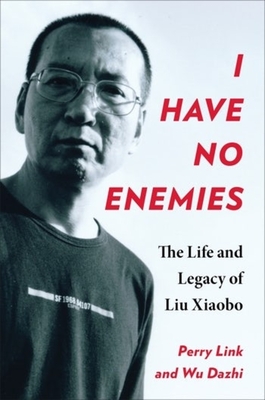
Late one night in December 2008, police arrived at the home of Liu Xiaobo―China’s leading dissident, a key figure in the prodemocracy manifesto Charter 08―and took him away. When Liu won the 2010 Nobel Peace Prize as a political prisoner, the award was bestowed on an empty chair. Inside China, the regime sought to erase every trace of his existence. Liu died of liver cancer in 2017 without ever having been allowed to return home.
I Have No Enemies is the definitive biography of Liu Xiaobo, offering a meticulously researched account of the twists and turns of a remarkable life. Perry Link and Wu Dazhi explore Liu’s upbringing, immersion in classical Chinese poetry and philosophy, bold challenges to literary conformity, and involvement in democratic movements. They trace the lifelong evolution of his thinking and chronicle his persecution, incarceration, and death.
I Have No Enemies emphasizes Liu’s principled commitment to dissent and the significance of the example he set in China and around the world. Liu was a farsighted strategist whose ultimate goal was “to change a regime by changing a society.” In Tiananmen Square, he showed others how to face down armed soldiers; in daily life, he looked for ways to build a more democratic culture. A powerful record of Liu’s life and times, this book also tells the story of a generation of Chinese intellectuals who sought a better way forward.
A near perfect biography. It is honest about Liu Xiaobo's virtues and vices, calling attention to his most remarkable trait: a willingness to change. And throughout his life, even in the race of severe opression, he moved in the direction of kindness, gentleness, and non-violence.
I Have No Enemies is a moving and well researched biography of the late Chinese literary critic, human rights activist and Nobel Prize winner Liu Xiaobo. Perry Link, professor emeritus of East Asian studies at Princeton University, and Wu Dazhi, long-time friend of Liu, chronicle how Liu's personal experiences shaped his thinking and examine the decisions that led to his imprisonment. For readers unfamiliar with contemporary Chinese history, particularly those related to domestic issues, the authors deftly weave in the wider cultural and historical contexts.
The biography begins with a brief introduction centring on the manifesto Charter 08 and Liu's his final disappearance and arrest. It then returns to his youth as a mischievous boy in a family of intellectuals who remained loyal to the Communist Party. The family is impacted by the Down to the Countryside Movement and thus relocated to Inner Mongolia before Liu is then sent to the countryside himself elsewhere as part of the "sent-down youth " program. It is during this time that he forms his impressions of those experiencing poverty, ethnic minorities and other people outside his family's typical sphere. This will give him a natural sympathy for the underdog later in life. These people include ousted officials, environmental activists, dissidents, activists and members of the Tiananmen Mothers. Additionally, he provided commentary in times of national public outrage, particularly after the 2008 Sichuan Earthquake.
We then read about his first marriage and how he advanced through academia to become an 'intellectual star.' I especially enjoyed the sections which described university life and how the living arrangements functioned on campus. I expected this book to be mainly about imprisonment and surveillance, but there are so many fascinating details about daily life during this period of opening up. For example, it describes how the massive backlog of would-be college students from between 1966 and 1976 led to a paper shortage when they all registered for the restored college entrance exams in 1977. It was also amusing to read about the cultural shock he experienced when visiting the Europe for the first time, since "Before he arrived, his impressions of the West were ideal images that had come from books."
This biography touches on so many topics related to literary criticism, such as modern fiction, poetry, personal ethics, metaphysics and aesthetic pursuits. This book is a awash in references to Chinese classical poems, ancient texts and philosophy. Many of the dissidents communicated with each other and their families through poetry. For those with absolutely no interest in Chinese philosophy or long reflections on thinking about thinking, these chapters might be a struggle for you. However, reading through these sections do provide an understanding for how Liu responded and interpreted the events in his life. I especially enjoyed reading a fresh perspective on the mindset of some of the student groups involved in the Tiananmen protest. Being "raised on the wolf's milk" of Maoist thinking, they sometimes went a bit mad for power inside their own little organisations and seemed to think that 'democracy' meant do whatever you want. I had not read about these issues in other books which covered the 1989 Tiananmen Protest.
Much of his remarkable life story revolves around his involvement in Tiananmen Square and his attempts to atone for his behaviour in Qincheng Prison in 1990. He was arrested numerous times and lived under constant surveillance. One of Liu's strong points was his willingness to work with people inside the system and to see the humanity in the police officers and 'Guobao' (state protection) surveillance teams he would become very familiar with over the years. It was very interesting to read about the "casual, even cordial relationships with the people they watch." As you might expect, Liu experienced allegations of being a 'black hand' behind student protests and of being insufficiently radical by the same young students. With so many different interpretations of controversial events in modern Chinese history, the authors naturally draw upon the large amount of writing available from Liu Xiaobo, but they wisely did their own research and interviews to check facts and provide a more balanced interpretation of events. It can occasionally be overwhelming to have so much information about the many of the individuals who came in and out of Liu's life, but the authors helpfully signal about what moments or individuals will be relevant in the future. These mini-biographies of his friends and acquaintances do not detract significantly from the flow of the book.
I have to agree with Australian Sinologist Linda Jaivin that "Though I enjoyed the style with which Xiaobo blasted nearly all of Chinese culture’s sacred cows, and admired his essays, I thought him intolerably full of himself." One key theme of this book is how one's ideas and perspectives can change with age and experience. Liu does become less arrogant with age, but throughout the book I felt my blood pressure rising over the treatment of his partners and son. There appeared to be times where he put his love of status over taking paid work which could have better supported his son, and there were multiple situations where both his first and second wives had to be financially supported by their own family or mutual friends. His first wife and mother of his son had her book on Lady Murasaki "blocked from publication because of her status as the wife of a black hand criminal." In the meanwhile, he had a roving eye for the young women in his activist circles. He recognised his guilt and her suffering when he reflected on Tao Li's life with him: "What did she get? Anything besides pain, shock, worry, and anxiety? Anything but the torment of illness and burdens of raising a child alone? She lay in bed battling a disease for two years and got nothing. I never thought of her once when I was out there listening to cheers from crowds of protesters. When I faced reporters, their flashbulbs popping, feeling very good about myself, Tao Li’s suffering never crossed my mind. Still less did I ever think about her suffering spirit and bleeding heart as I flirted with other women, right there on the square dissolute by nature and infatuated with personal fame." Similarly, his second wife Liu Xia suffered terrible family troubles, financial issues and social isolation during his imprisonment. To be fair, sometimes he was unaware of the extent his partners and their families were being persecuted while he was imprisoned. It is a credit to the authors that they have written such a likeable book about such an unlikeable person. Somehow even his frequent apologies read as self-serving, as if he was luxuriating in the attention that giving an apology provides. He acknowledged this issue himself when he observed that, “Many of China’s elite intellectuals — want to be seen as suffering Jesus Christs, as momentous moral heroes. But they also don’t want to be nailed to the cross forever. They want to spend a bit of time there and then be helped down, to a sea of plaudits from admiring crowds. You might call this “crucifixion with Chinese characteristics.”
This book meticulously covers an incredible amount of extremely sensitive topics which range from corrupt officials, discrimination against various groups and heavy matters related to human trafficking and police brutality. The authors did an excellent job providing background information for those unfamiliar with contemporary Chinese history or with how things work in China. This book would be of interest to media studies and journalism students, particularly in the sections which shared how Chinese outrage was sparked by a mistranslation. I strongly recommend it to my fellow criminologists who have an interest in East Asian Studies, and those more generally interested in social psychology, grassroots activism, and human rights. This biography is not overawed by his position as a Nobel Peace Prize winner and fully recognises his human failings. I Have No Enemies reveals how these weaknesses developed Liu Xiaobo's sense of shared humanity and emergence as a prominent intellectual internationally recognised “for his long and non-violent struggle for fundamental human rights in China."
This book was provided by Columbia University Press for review.
Having recently completed the biography of Detrich Bonhoeffer by Ferdinand Schlingensiepen, it speaks volumes to be able to say how impressed I was at reading Liu Xiaobo’s life journey. A life journey which was fueled by his prodigious reading assisted by a photo-graphic memory. Professor Link was able to skillfully quote from Liu Xiaobo’s readings and subsequent prodigious output -- readings, articles and books frequently complex in their reflection of a mind which was constantly questioning and criticizing itself. After one of his books were ready for print, Liu Xiaobo, having reflected further, wrote an epilogue to the book refuting the very premise of his work.
Perhaps the most impressive was Liu Xiaobo’s evolution. From flamboyant, philandering anti-establishment activist to humble, non-violent dissident, working from the bottom up, willing to listen to people’s case-by-case issues. And, of course, his change from failed husband and father in his first marriage to deeply loving, committed husband to his second wife, Liu Xia. Something else impressed me about Liu Xiaobo which might not play to popular fashion: Liu Xiaobo’s insistence that right cause does not make one faultless. His criticism of the fatal error of “self-righteousness” among activists struck me as heroic – a label shunned by Liu Xiaoba -- in its independence. Most activists I have known through the decades – both as a social worker and obscure protester -- never got past the self-righteous stage.
Throughout the book, the author renders Xiaobo’s complex evolution in clear, simple terms whether referring to his prison readings of Aquinas’s, City of God, Bonhoeffer’s resistance, imprisonment, execution, or Gandhi and King’s philosophy of non-violence (see MLK’s Letters from a Birmingham Jail). Professor Link is frank about Liu Xiaobo’s faults. He writes frankly on Xiaobo’s infidelity during events leading to Tiananmen Square. Most painful to Liu Xiaobo was his cooptation by authorities after his first arrest when he confessed that he never actually witnessed killings during Tiananmen. It allowed the authorities to publish his “confession” to support the official government version that no shootings and deaths had ever occurred. Liu Xiaobo felt guilty until his death at the deaths of June fourth. Even more guilty at what he considered his own hypocrisy and cowardice. He compensated by becoming engaged in the most dangerous activism of all the dissidents. A role recognized by the Nobel committee when they bestowed the Nobel Prize for Peace upon Liu Xiaobo in 2010.
Liu Xiaobo not only believed in non-violence. He advocated No Blame of those who enforced the Chinese regime’s persecution of him. Thus, the title: “I Have No Enemies.” In this way, Xiaobo was tragically like Bonhoeffer who engaged and befriended his guards. In one tragi-humorous incident, the author relates how one of Liu Xiaobo’s security personnel assigned to monitor him approached Xiaobo to ask if the latter would promise not to leave his house so the policeman could go home to watch a soccer game. Liu Xiaobo – a soccer fan himself – agreed and kept his promise.
After reading Professor Link’s book of 400 pages, with 100 pages of notes, I came away feeling not only an intense respect and admiration for Liu Xiaobo – blemishes along with evolution to martyr of non-violence – but a kind of love you might feel for an individual you sought to emulate and follow. Let us hope that the lessons from Liu Xiaoba’s life – especially the dangers of falling into the hubris of faultless self-righteousness – as detailed so well in this book are read and put into practice by contemporary and future activists.
I can only wish that AMERICAN readers will take hold of this book and read every page with deep appreciation of our now struggling democracy. What this amazing man endured--as so richly told by its biographer--is something every American should take note of and weigh in his/her very soul with the highest regard to the very sacredness of what our almost 250-year old Declaration of Independence holds.
This man, this heroic, Nobel Peace Prize winner was imprisoned repeatedly and therein died for an idea. An idea that America was built on. And now more than ever, at a time when half our electorate is throwing away this sacred idea of freedom that's the bedrock of democracy is frightening and makes this read the top of the list for 'necessary' ones, the world over, and most importantly, our privileged world here at home.
Should be required reading for every college student in the Humanities. Not only is this read worth every word and page for its rich information on how Chinese rule works to this very day, it's riveting reading all the way through. Superb. One of the best of its kind I've read to date.
A fantastic biography that also provided a great look at Chinese history over the past 50-100 years. The perspective on the cultural revolution, 6/4/89, and many other aspects of China was fantastic. This was a dense read but well worth the effort.
My conversation with Perry Link. On enemy rhetoric, male chauvinism, Charter 08, and amnesiac China
“The only fundamental solution to China’s quest for modernity [is] to have the CCP regime go away. When it does, the door will be open to rehabilitating people’s reputations and Liu Xiaobo will certainly be on the list of ones to be looked at again.”