Jump to ratings and reviews
Rate this book
Rate this book
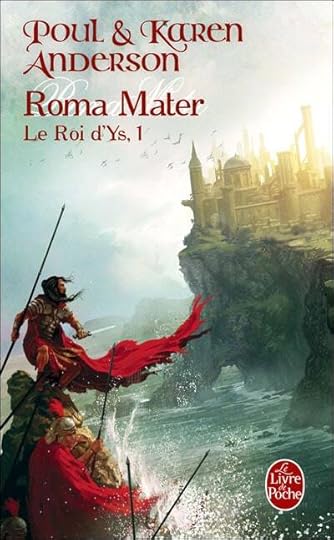
In the waning days of the Roman Empire, Magnus Maximus sends his prefect Gratillonius to western Gaul and the faraway land of Ys, a place shrouded in legend and ruled by a cruel and tyrannical king. When the sovereign challenges Gratillonius to a duel, the envoy from Rome emerges victorious and claims the throne as the new king of Ys, inheriting a land whose religion, culture, and history are entirely foreign. He also gains the former king’s nine wives, the Gallicenae, a powerful group of women to whom he must appear equally devoted despite his growing feelings for one in particular. As he adjusts to his new role as ruler of Ys, Gratillonius must fight to keep his strange new country on its feet while the rest of the Roman Empire begins to crumble around him.

461 pages, Mass Market Paperback

First published January 1, 1986

Loading...
Loading...

About the author

Poul Anderson

1,621 books1,123 followers
Pseudonym A. A. Craig, Michael Karageorge, Winston P. Sanders, P. A. Kingsley.

Poul William Anderson was an American science fiction author who began his career during one of the Golden Ages of the genre and continued to write and remain popular into the 21st century. Anderson also authored several works of fantasy, historical novels, and a prodigious number of short stories. He received numerous awards for his writing, including seven Hugo Awards and three Nebula Awards.

Anderson received a degree in physics from the University of Minnesota in 1948. He married Karen Kruse in 1953. They had one daughter, Astrid, who is married to science fiction author Greg Bear. Anderson was the sixth President of Science Fiction and Fantasy Writers of America, taking office in 1972. He was a member of the Swordsmen and Sorcerers' Guild of America, a loose-knit group of Heroic Fantasy authors founded in the 1960s, some of whose works were anthologized in Lin Carter's Flashing Swords! anthologies. He was a founding member of the Society for Creative Anachronism. Robert A. Heinlein dedicated his 1985 novel The Cat Who Walks Through Walls to Anderson and eight of the other members of the Citizens' Advisory Council on National Space Policy.[2][3]

Poul Anderson died of cancer on July 31, 2001, after a month in the hospital. Several of his novels were published posthumously.


Series:
* Time Patrol
* Psychotechnic League
* Trygve Yamamura
* Harvest of Stars
* King of Ys
* Last Viking
* Hoka
* Future history of the Polesotechnic League
* Flandry

Ratings & Reviews

What do you think?
Rate this book

Friends & Following

Create a free account to discover what your friends think of this book!

Community Reviews

5 stars
43 (21%)
4 stars
64 (31%)
3 stars
66 (32%)
2 stars
22 (10%)
1 star
8 (3%)
Displaying 1 - 13 of 13 reviews
Profile Image for Lyn.
2,021 reviews17.8k followers
July 10, 2023
As a long time Paul Anderson fan, I have learned to read his novels slower than I am accustomed with other writers, I want to make sure not to miss a thing. I do this also with Gene Wolfe, there is a lot going on between the lines and both writers pack a great deal into their narratives.

Anderson is much more accessible than Wolfe, though, and this flowed nicely.

This is a story about the legendary city of Ys, on the extreme western edge of Brittany, set in the 400-500 AD timeframe, as Rome struggles to remain in power and the world is a very different place.

I could not help comparing this to Jack Vance’s intriguing series of Lyonese as the settings and themes are similar. But Anderson plays this one close to the vest and keeps the magic and fantasy downplayed, this is historic fantasy, emphasis on the historic.

Anderson, writing with his wife Karen, first published this work in 1986 and this would begin his King of Ys series of four books. The great accomplishment here is that, besides the Ys world building, this paints a portrait of this time and place and Anderson, ever the socio-economic commentator, fills his narrative with details, sights and sounds, that make this time come alive for us. We learn the kind of food they ate, the clothes they wear, the fashions and influences from far east and we get a glimpse into how this world operates.

One aspect of this that I liked very much was the Atlantic Ocean was called simply “Ocean” as for these folks, they were quite literally at the western edge of their experience.

Not perfect, and maybe a touch too long, this was still fascinating. I concede that I am a big fan of Anderson’s writing and so I probably gave him lots of grace and forgave more than I otherwise would, and I would even go so far as to say this is probably not the best representative of his work and this would not be the best introduction of his work to new readers. However, fans will enjoy this and readers who enjoy historic fiction may like this as well.

description
Profile Image for Kat  Hooper.
1,590 reviews439 followers
April 16, 2009
ORIGINALLY POSTED AT Fantasy Literature.
This review is for all four books in this series:

The King of Ys is a historical fantasy -- it is set in our world just before the fall of the Roman Empire and it mixes in the legend of the mythical city of Ys which was built below sea level on the coast of Brittany. Many of the characters in The King of Ys (Roman emperors, Christian saints, etc) are based on legendary and real historical figures and Poul and Karen Anderson include plenty of footnotes which explain the legend of Ys and the culture and religion of the 5th century.

In Roma Mater, we meet Gaius Valerius Gratillonius, a Roman centurion stationed at Hadrian's Wall. Because of his loyalty to would-be-emperor Magnus Clemens Maximus, the commander of the Roman troops in Britannia, Maximus assigns him to be Rome's prefect in Ys so that Gratillonius can keep it loyal while Maximus goes for the purple. Ys, though part of the Roman empire, has been left to itself for years because it's spooky. According to rumors, Ys is ruled by nine witches who, among other things, control the weather to keep Ys safe from enemies intending to invade by sea. These nine "witches" are the God-chosen wives of the King of Ys who is a nasty tyrant. His nine wives use their powers to ask the Gods to bring them a deliverer -- someone to challenge the king.

And so Gratillonius and his small troop arrive in Ys and soon he finds himself king. Along with inheriting the crown, Gratillonius gets the nine witch queens, too. As he sets out to reform Ys, which has suffered under the former rule, he has a lot of unfamiliar stuff to deal with: the responsibilities of a king, the different culture, a strange land and people, clashes in religious beliefs (he covertly worships Mithras who has been denounced by the newly Christian Roman Empire, and the Ysans worship three pagan gods), and satisfying nine wives who vary greatly in age, beauty, intelligence, and appreciation for men.

At first, Gratillonius balances all of this mostly successfully, and he begins to restore the prosperity of Ys. He is well-intentioned, but he can't help but occasionally go wrong as his own beliefs conflict with his people's and their gods'. One problem is that the Ysan's believe that their gods will destroy Ys by flood if they are not obeyed. So, there is a conflict between the Ysans' expectations of Gratillonius's duties at their religious rites, his desire to keep alive the worship of Mithras, and his admiration for the Christian leaders he knows. The other big problem is that when one of his wives dies, the gods choose the replacement from the priestesses who are all descendants of the previous kings and queens and the gods don't seem to care too much about age, mental ability, or consanguinity. So, not only are there nine wives, but their family tree looks more like an M.C. Escher drawing than a tree, and this kind of behavior isn't congruent with the worship of either Mithras or Christ. (But it does make for some interesting reading.)

The first two books, Roma Mater and Gallicenae, progress rather slowly and there's not much action -- and this is really my only complaint about The King of Ys. But, by the end of Gallicenae, we've seen the ways Gratillonius has had to struggle to obey the Ysan gods, and we can be rather certain about what they're going to throw at him next ... and we know he's going to defy them this time. And, we've seen some plot threads being developed (warriors preparing overseas) that are presumably being carefully set up for use in the next novel.

In the third novel, Dahut, things really come to a head, and the fallout is spectacular. The reader then realizes and appeciates how carefully the Andersons have planned and crafted this work from page one. Well done! The fourth book, Dog and Wolf, deals with the after-effects of the events in book three, develops the characters further as their lives have drastically changed, and comes to a satisfactory conclusion.

Besides being a fascinating and original tale with real historical feel, The King of Ys is beautifully written:
The armies met south of the River Ruirthech. That was a day when clouds blew like smoke, low above the valley, underneath a sky the hue of lead. Rainshowers rushed out of them, drenched men, washed their wounds and their dead, passed away on the keening wind. All colors were dulled except those of blood and gold. Shouts, horn calls, hoofbeats, footfalls, clamorous wheels, clash and rattle of weapons, were somehow muffled. But blows fell as heavy and sharp as always.


My favorite parts were Gratillonious's internal thoughts about his wives:
He gazed back. Over the years she had added flesh to flesh, though her frame was quite large enough that as yet she did not appear quite gross. Her features remained good in their heavy fashion and her hair was still a burnished red-brown. It was untidily piled on her head, like the raiment on her body. He had grown used to that....Well, she had her rights, and she was by no means a bad person, and a man ought to shoulder his burdens without whining about them.


And there is poetry -- even whole chapters of poetry!
Would you know the dog from the wolf? You may look at his paw,
Comparing the claw and the pad; you may measure his stride;
You may handle his coat and his ears; you may study his jaw;
And yet what you seek is not found in his bones or his hide,
For between the Dog and the Wolf there is only the Law.


Near the end of the story, Gratillonious meets a young soldier who is in nearly the same situation he was in when he left Britain 25 years before. Shocked, he looks back and realizes that he's not the same man he was then -- he would make different choices now. Through love and loss, we learn what's important -- that's a good story.

Read this review in context at Fantasy Literature's Poul Anderson page
Profile Image for Steve R.
1,055 reviews70 followers
May 10, 2023
One of the best examples I can think of to show the vibrancy of what had become one of my favorite genres: historical fantasy. To blend both a historical time with an imaginative place and peoples with strange powers seems to me to get the best of both worlds: a realistic form for imagination to work or a fanciful spin of the actual past. Guy Gavriel Kay is my favourite author within this genre, but the four volumes of these series rival if not exceeding the delight Kay's works continually provide for me.

In this book Anderson and his wife (as co-author) take a military leader sent out by Rome in the waning days of its Empire. He is sent to western Gaul, and to the mythical city of Ys, a settlement on the coast of Brittany which legend has it was swallowed by the ocean. Gratillonius, the Roman leader, has to contend with the tyrannical rule of this city, his nine wives and the strikingly different culture and customs of the people.

Not well remembered, except for the almost breathless anticipation with which I devoured the additional three books in this series.

Highly recommended, and a work I'll definitely re-read should I ever manage to find the time.
Profile Image for Ron.
Author 2 books175 followers
July 6, 2017
“God’s hand touches a man and that man turns into one whom others will follow though it be past the gates of Hell.”

Excellent old-fashioned historical fiction/fantasy. Well-researched fourth century setting. Draws the reader into many aspects life. Invented a religion out of whole cloth, but used it to compare and contrast with existing ones.

“Despair was for afterwards. He still had work to do.”

Punctuation irregularities and errors, perhaps optical scanning glitches.

“Magic is ever a two-edged sword, oft times wounding the wielder.”

Why there’s a Spartan on the cover of the ebook edition is anyone’s guess.

“Had he wandered so far, into such foreignness? Had the God of his fathers no longer heard him?”

Broke oft abruptly. Cost them a star. Won’t try the follow-on volumes.

“Wisdom lies in nobody’s gift. We must each forge it for ourselves, alone. As best we can.”
Profile Image for Ruth.
21 reviews9 followers
August 2, 2007
What a great beginning to a great fantasy/historical series. A Roman centurion, Gratillonius, is dispatched to make an alliance with the fabled city of Ys in Western Gaul, and ends up becoming its ruelr in the dying days of the Western Empire. This series is set in the era of Arthurian myths, but from a Continental (Breton) perspecitve. Religions (Christianity, Mithraism, Celtic and Roman polytheism) clash, empires tumble and are relaced by kingdoms. There are fantastic elements but they are really well balanced--this is a believably historical setting, and Gratillonius is a very believable inhabitant of the late-Roman world.
Profile Image for Dave.
42 reviews3 followers
February 19, 2024
I've seen countless sci-fi novels by Poul Anderson lining the shelves of every used bookstore I've been in, but in all my years reading genre fiction I haven't actually read one of his books. Until now. And it was not sci-fi.

Co-authored with his wife Karen, Roma Mater is unquestionably historical fantasy but with the "historical" both bolded and underlined and the "fantasy" in light italics. The concept is very interesting - a Roman centurion of Britannic birth/upbringing dispatched to ensure the neutrality of a mystical Breton-ish kingdom (wholly invented by the authors) as a true-to-history struggle for empire begins. The Andersons' c. AD 380 world is rich in historical detail, with everything from hobnailed shoes to salted meats being colorfully described. Daily life in the kingdom of Ys (pronounced "eess", according to the authors) is equally well detailed, though information about the polytheistic mysticism which is at the core of Ys' existence is offered up in tiny morsels. In effect, we learn at the same pace that our centurion main character learns.

And for me, that was Roma Mater's greatest flaw. For three quarters or more of its length, this novel crawls. The moments of action are sparse and widely separated, the intrigue is rudimentary and hardly gripping, and the plot... well, is there one? Also, a pretty significant (it turns out) subplot was introduced early but then does not reappear for 160-or-so pages, only to later disappear without (it seems) being resolved. This book proves that superb writing skill does not equal superb storytelling ability. However - bolded and underlined - the final score or so pages did fly by as the denouement unfolded. Up until that point I was certain that I would not be moving on the the next volume in the series, but now... I'm not so sure.

Ultimately, I may be willing to give the series a second chance at some point down the road. A previous reviewer mentioned that Roma Mater was not the book for new readers of Anderson to begin with, and I can certainly understand why. If I was unaware of his stature in the sci-fi community I would certainly be tempted to dismiss all of his writing based on what is, to me, a cumbersome read.
Profile Image for RubyLogan.
94 reviews3 followers
October 29, 2020
Я понимаю за что книга нравится людям, но увы для меня она прошла мимо. Да, у авторов хороший слог, неплохая идея, живые персонажи, но книга не моя. Может проблема в том, что я ожидала увлекательного фэнтези, а получила исторический роман с вкраплениями мистики, а исторические романы я в принципе не люблю.

В центре истории у нас цинтурион которого направляют для налаживания отношений с Исом, таинственным городом, о котором больше сказок, чем реальных фактов. Что ждёт героя в этом городе? Кто такие девять загадочных королев? И как вообще этому небольшому городу удаётся то что не в силах самому Риму, а именно противостоять варварам? Все это предстоит вам выяснить на страницах книги.

Это довольно неплохое приключение с интересным сетингом и не картонными героями, у каждого своя судьба, своя история. Но лично меня книга не покорила. Да, мне было интересно читать, но узнать, что же там дальше произошло с героями нет вообще никакого желания.
Profile Image for Marsha Valance.
3,840 reviews60 followers
October 6, 2020
An impeccably researched, beautifully written epic historical fantasy about the fate of the Breton Kingdom of Ys. Volume 1, ROMA MATER, tells how Gratillonius, a Romano-British centurion, becomes King of Ys by defeating its previous ruler in combat and wedding its 9 mage-queens.
347 reviews2 followers
March 20, 2020
Fully enjoyed this, and am eager for more.
Profile Image for Shana McCarl.
38 reviews
August 13, 2021
Good world building, but teeters on the edge of being a soap opera due to its lack of plot.
Displaying 1 - 13 of 13 reviews