

What do you think?
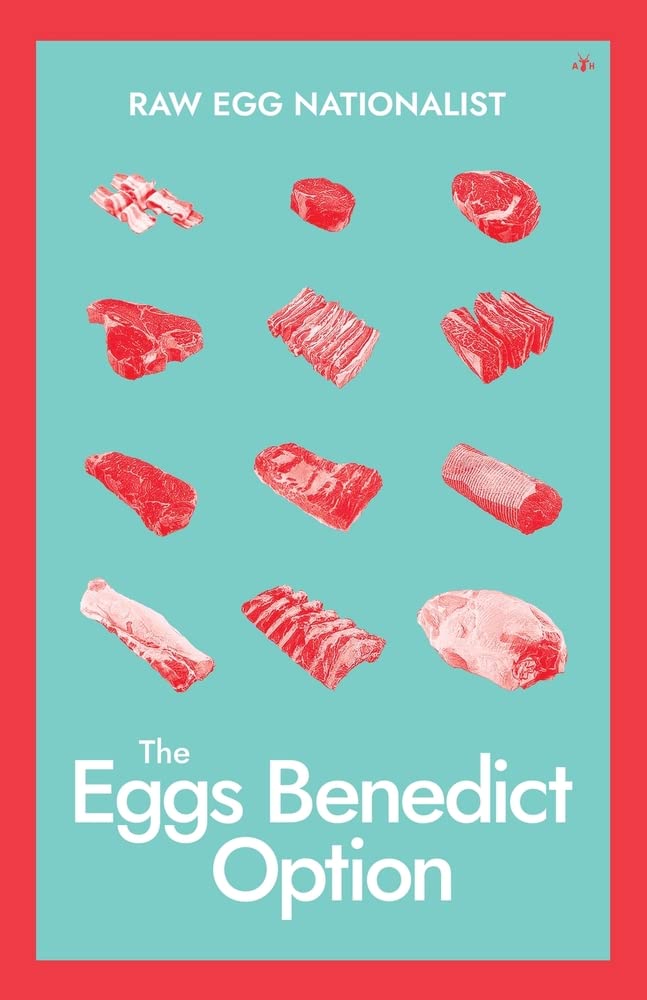
The Eggs Benedict Option
Welcome to 2030. You'll own nothing, have no privacy, and you'll be happy. . . .
For the past two years, since the beginning of the coronavirus pandemic, we have been told that our old way of life is dead and gone. There can be no return to how things were before. Instead we must embrace a "new normal" in which every aspect of our lives is transformed-the way we live, eat, and work, and the way we are governed, not just by the state, but also by corporations. This is the Great Reset. And the foundation of this plan is a revolution in food.
In this groundbreaking book, RAW EGG NATIONALIST lays out the globalist plan for food in detail, for the first time. Using the globalists' own published materials, he reveals the preparations for a new worldwide diet-"The Planetary Health Diet"-that will be almost entirely plant-based. By eliminating animal agriculture, and placing total reliance on genetically modified crops and new alternative forms of protein, the globalists will tighten corporate control of the food supply-and of us. In a startling comparison with the effects of the Neolithic Revolution in agriculture-which he calls "the original Great Reset"-RAW EGG NATIONALIST reveals just how much we have to lose if the globalists should succeed.
But this book is no council of despair. RAW EGG NATIONALIST proposes his own alternative vision of fundamental change. Taking his inspiration from Russian household gardening and the new movement for regenerative agriculture, he argues that the future of food, and the key to human flourishing, is actually the past. Instead of allowing ourselves to be alienated yet further from the natural world, we must return to it and to the foods and ways of producing them that made our ancestors strong.
For the past two years, since the beginning of the coronavirus pandemic, we have been told that our old way of life is dead and gone. There can be no return to how things were before. Instead we must embrace a "new normal" in which every aspect of our lives is transformed-the way we live, eat, and work, and the way we are governed, not just by the state, but also by corporations. This is the Great Reset. And the foundation of this plan is a revolution in food.
In this groundbreaking book, RAW EGG NATIONALIST lays out the globalist plan for food in detail, for the first time. Using the globalists' own published materials, he reveals the preparations for a new worldwide diet-"The Planetary Health Diet"-that will be almost entirely plant-based. By eliminating animal agriculture, and placing total reliance on genetically modified crops and new alternative forms of protein, the globalists will tighten corporate control of the food supply-and of us. In a startling comparison with the effects of the Neolithic Revolution in agriculture-which he calls "the original Great Reset"-RAW EGG NATIONALIST reveals just how much we have to lose if the globalists should succeed.
But this book is no council of despair. RAW EGG NATIONALIST proposes his own alternative vision of fundamental change. Taking his inspiration from Russian household gardening and the new movement for regenerative agriculture, he argues that the future of food, and the key to human flourishing, is actually the past. Instead of allowing ourselves to be alienated yet further from the natural world, we must return to it and to the foods and ways of producing them that made our ancestors strong.
252 pages, Paperback
Published July 31, 2022
Ratings & Reviews
Friends & Following
Create a free account to discover what your friends think of this book!
Community Reviews
Displaying 1 - 11 of 11 reviews

November 25, 2024
Excuse me while I overhaul my entire pantry…
I was already red-pilled, so to speak, on the travesty of the modern food industry. But this book is an unending, science-based attack on the globalist vision for our food. It also dismantles much of what we’ve been taught about what exactly a healthy diet looks like. It’s surprisingly well-researched without being dry.
The weak point is his solution, the Eggs Benedict Option. While I love the idea of every American having their own subsistence garden, I’m just not enough of an optimist to think that a majority would ever do that.
I was already red-pilled, so to speak, on the travesty of the modern food industry. But this book is an unending, science-based attack on the globalist vision for our food. It also dismantles much of what we’ve been taught about what exactly a healthy diet looks like. It’s surprisingly well-researched without being dry.
The weak point is his solution, the Eggs Benedict Option. While I love the idea of every American having their own subsistence garden, I’m just not enough of an optimist to think that a majority would ever do that.

December 30, 2024
Dieta Djokovic

November 24, 2022
Often those who complain about the world in which we live offer neither a clear vision of how things might be different, nor a path to achieve that vision. Refreshingly, in The Eggs Benedict Option the pseudonymous writer Raw Egg Nationalist offers both vision and path, centered around food, in all its aspects, as the core of human flourishing. His essential insight is that, now as ever, he who controls the food controls the people. We must pick the controller—either our globalist ruling classes, or each of us for himself. The former is and will be a disaster for the nation. But for the latter, hard work and discipline are required.
As you can tell from his pen name, REN is very focused on the health benefits of eggs, especially of raw eggs. (He earlier wrote a cookbook manifesto, titled simply Raw Egg Nationalism.) Eggs are, however, merely the condensed symbol of his worldview; he does not exhort us to live only on eggs, but rather to eat a full range of pre-industrial, largely animal-derived, foods. The Nationalist part of his moniker conveys his resistance to the globalist plan of universal imposition of an unhealthy and enervating plant-based, industrially produced-and-processed diet. That plan deliberately diminishes each of us, and “The nation is only as strong as the individuals who make it up.” REN has spread his message widely. For example, he was recently featured in the Tucker Carlson documentary The End of Men, which analyzed in detail the severe physical and mental debilities of today’s men (no doubt Carlson invited him in part because REN edits and publishes a notable men’s magazine, called simply Man’s World, in which yours truly has published an article).
The title of this book, in case it’s not obvious, is a play on Rod Dreher’s famous Benedict Option. However, Dreher does not appear here, other than for REN to make in passing the same point I have made repeatedly, that the Benedict Option is inadequate because it makes no provision for defense against attacks that are inevitable if it gets any traction whatsoever—which, let’s be honest, it’s not getting. The option REN offers is wholly compatible with Dreher’s ideas, but is much more defensible, as well as practical, because it is largely personal, involving no larger organization, formal or informal, that can be attacked.
The Eggs Benedict Option does offer specific nutrition advice, but most of all it is a book about politics—how we are governed, or more precisely, in our times of decay, how we are controlled. REN identifies the massive global push to force mankind into a wholly plant-based diet as a chimerical utopian impulse. Why is this program bad? It sickens us and enslaves us. What is the solution? Small-scale and household agriculture, which will make us healthy and contribute mightily to destroying our noxious overlords.
We begin with standard boogeymen of the Right—Klaus Schwab (whom REN calls a “thrift-store Palpatine”), the World Economic Forum, the Great Reset, “you will own nothing and you will be happy,” and so forth. As REN points out, none of what is planned for us, which he generically lumps together as the Great Reset, is a “conspiracy theory” (anyway now a meaningless term, or rather one that means the opposite of its original meaning), because our globalist overlords are entirely open about their plans for us. They aim to perfect, as it were, mankind through our simultaneous total atomization and total subordination to their control. REN (with reference to Alexander Dugin, who has done much legwork on this topic), traces this desire back to the nominalism of William of Occam. That may be a stretch (though he is not the first to make the connection, and nominalism is at least in part the root of our modern discontents), but certainly the idea of earthly human perfection is an ancient belief central to the Left.
To this end, they have a great many plans for us, all nasty. We will focus, however, on their plans for our diet. Their main plan is a global shift, for most people (the ruling class will, as always in history, eat the very finest and desirable foods whenever they want), to an exclusively plant-based diet, heavy on highly-processed products, derived ultimately from grains. The diet we will have thus imposed on us is some variation on the so-called Planetary Health Diet, originally proposed by an NGO that is one of the innumerable tentacles of the Regime (in this case, an NGO funded by a Swedish billionaire and his wife). The stated aims of the PHD are three: to feed ten billion people by 2050; to reduce deaths caused by poor diet; and “to be environmentally sustainable so as to prevent the collapse of the natural world.” To achieve these ends, the PHD demands the masses eat a diet of primarily grains, along with industrially-produced seed oils (i.e., oils that require intense chemical processing to extract food from otherwise-inedible seeds), some fruits and vegetables, very little dairy and eggs (1/4 of an egg per day), and essentially zero meat (fourteen grams per day). This is not a diet meant to meet people’s desires—would you choose to eat it?—but quite obviously a diet meant to make them easy to control. Controlling diet is not a new ruling class tool; REN points out that Plato suggested feeding the masses a vegetarian diet to keep them compliant, and nothing has changed in the past 2,500 years.
The globalists don’t admit they just want control, no surprise. But their aim is very poorly hidden. The PHD’s last stated goal, sustainability, is pretty clearly the most important aim of the PHD, with “collapse” being code for “global warming,” and the PHD explicitly taking laughable farces such as the Paris Agreement as divine commands written on stone, much more important than any mere human desire. The globalists talk, for example, about “the globe’s carbon budget” as a limitation on food, as if there were such a thing. We don’t have to guess at the actual practice and results of this insane approach. Early examples can be seen already in recent instances such as the Dutch government’s attempt to destroy farmers using military force in order to meet “climate goals,” and the Sri Lankan government’s deliberate collapse of the country’s agricultural system in order to toady to their globalist overlords. Whether the first two PHD goals, of feeding people and reducing deaths, are real and merely secondary, or, as seems likely, just lies covering the Regime’s well-documented desire to make the masses weak and compliant, and preferably much smaller in numbers, is not totally clear. It probably depends on which appendage of the Regime is being discussed.
Regardless, the PHD is to be implemented both by government compulsion and by handing over the food production and distribution process to giant corporate entities intertwined with the government. As REN notes, this latter process is already largely complete (hidden by that the vast majority of food companies which appear independent competitors are divisions of a handful of truly enormous companies). The PHD merely aims to finish it, and then in practice forbid eating anything not pre-approved and distributed through limited, official channels. To aid control, much work is being done on new foods, supposedly “sustainable” but actually demanding huge amounts of inputs, such as lab-grown meat, fake meat, and insect proteins. The real benefit of these “foods” is that they can be patented and then manufactured centrally, increasing government and corporate control.
Leaving aside its inevitable use by the government to crush political opposition unconnected to food, were such a system to be implemented (Justin Trudeau would love to starve his enemies), REN emphasizes that the PHD, and all variations of it, is simply not healthy. (The sickly-looking Sam Bankman-Fried, fraudster head of the collapsed crypto exchange FTX, proudly followed the PHD, which is pretty much all the evidence you need.) Men are the most, but not the only ones, affected, because the PHD lowers testosterone and raises estrogen—a feature, not a bug, in the eyes of the planners, who fear masculinity most of all. It is a lie that seed oils are healthier than animal fats; it is a lie that cholesterol is bad for you. Grains are not healthy in quantity and plant protein is not the equivalent of animal protein. Moreover, the giant corporate farms needed to grow these grains use enormous amounts of pesticides, destroy irreplaceable topsoil, and are antithetical to ordered freedom.
I certainly oppose the PHD’s program, for the same reasons as REN, but my perspective is a little different than REN’s. I don’t think their more aspirational plans, requiring new technology, are going to happen, because we have passed technological apogee and are moving backward. Thus, although no doubt the globalists can cause a lot of damage, even horror, by simple, tried-and-true methods such as dictating who may eat what, or may eat anything; destroying farmers through confiscation; and taxing healthy foods while subsidizing revolting foods, we’re never going to be eating lab-grown meat or drinking cockroach milk, because those things are not technologically possible at scale, at least with the social-technological stack we have today. Moreover, I just don’t think the vast majority of Americans will put up with being told to adopt the PHD. Let’s not forget, the company Beyond Meat, after a decade of having been pumped up with billions of dollars, is failing rapidly and will soon likely disappear. (If you’ve ever tried their products, you know why.)
REN does find a few points of agreement with the PHD. He concurs that reducing food waste is a sensible goal. Nor should we have factory farming of animals. And it may be that Africans can benefit from the PHD, because a bad diet is better than no diet, and the incompetent governance and worthless cultures found in Africa often result in the latter. But the West is not Africa (even if we are letting Africa invade us), and there is no need for us to eat like Africans, because we’re not Africans, and we owe the Africans nothing. In any case, all these legitimate goals can be met without adopting any element of the PHD—to which end REN offers the Eggs Benedict Option.
So what would REN have us do? Unlike Neolithic people (REN discusses James C. Scott’s excellent Against the Grain, which points out that sedentary agriculture was a health catastrophe for mankind, but enabled extraction by a new ruling class), we can’t run away from our rulers, so we will have to fight in place. On the individual level, we should raise as much of our own food as possible, using regenerative farming techniques, and we should eat primarily eggs, meat, dairy, and animal fats, while limiting grain. (REN’s plan is not dissimilar to William Wheelwright’s “ice cream nationalism”; both ideas spring from the same ferment on the Right.) This is not just a pipe dream—as REN shows in detail, it’s been done in Russia over the past few decades, where two-thirds of Russian households operate small garden plots, which collectively produce more than fifty percent of Russia’s agricultural output (and this does not include extensive foraging, hunting, or fishing). This is not done, or not anymore done, primarily for subsistence or due to hardship; it is more a cultural phenomenon. (REN does not say, but it is true, that this system gives Russia enormous resilience completely lacking in most of America, and moreover also shows that Russia’s relative GDP is underestimated, because such production is not included in GDP.) On the group level, we should have what Dugin called the Great Awakening, a spontaneous uprising to defeat the globalists, to oppose and to defeat the Great Reset. REN explicitly offers his ideas as part, though only part, of that Great Awakening. While I have read no Dugin, this certainly fits with my belief that not only is our Regime fragile, but it can be overthrown by a counter-elite that rises in the hour of need.
An obvious question is who in this scenario is going to feed the urban apartment-block dwellers. In Russia, and in Central Europe in my personal experience, it is common for city dwellers to have plots in the country close to the city. Are American urban dwellers, or for that matter suburbanites, going to do this? Well, probably not, not now at least. They’re too busy watching Netflix (REN observes that the average American watches thirty-two hours of television every week) and getting handouts, either from the government or from those who employ them at their parasitical jobs. But they could. As REN points out, Russian gardens are about nineteen million acres; America has twenty-eight million acres of lawns (though looking online, some estimates are forty million acres). Moreover, America has a much more favorable growing climate than Russia. Yes, making a change in America to something resembling the Russian system would require a cultural (and legal) earthquake, but much stranger things have happened, and if there were a need because supply chains had collapsed along with handouts, it might get the necessary stimulus very quickly.
We should also recognize that raising our own food has many benefits beyond healthy eating. Most importantly, it is a skilled practice rooted firmly in reality. (I butchered a rooster this afternoon; that was very real, and very instructive to my children.) In the words of Matthew B. Crawford, adopting such practices creates a “situated” man (or woman), one who understands that he is not autonomous or able to escape reality, making him a more rounded individual with far more strength that the desiccated, massified individuals who make up our population today. Or, put another way, a strong nation will result from REN’s plan in ways much beyond the merely physical. In addition, as I discussed in connection with Jean-Michael Fortier’s The Market Gardener, that localism in agriculture increases social trust very significantly.
I’m not a hundred percent sold on everything REN says. I don’t think it’s true, for example, that in the Middle Ages “nobles towered over much of the peasantry.” While conditions in Europe over a thousand years varied widely, it is generally true that prior to the Industrial Revolution peasants in the West were usually very healthy—not surprising, given they had plenty of good food and plenty of exercise, along with half their days as holidays. It was Enlightenment propagandists who manufactured the lie that the Middle Ages were times of oppression, starvation, and unhappiness. (In fact, most likely the higher nobility was less healthy than the peasantry; gout, for example, was famously an upper-class disease caused by eating excessive amounts of rich foods, and they were crowded together more than the peasantry.) More relevantly, I think it’s possible that REN overstates the benefits of his proposed diet. For example, he recommends (although emphasizing that self-experimentation is key) entirely eliminating grains. It seems to me fairly obvious that humans in their natural state are generally omnivores who eat quite a few, but not exclusively, animal products, and do not eat products that are highly processed or contain additives, whether synthetic sweeteners, fillers, or what have you. Therefore, any diet of that sort is likely to be relatively extremely healthy, and perhaps REN’s diet skews too far in one direction. But the beauty of his approach is that whatever works for you, you can adopt.
Over the past two decades, I have myself gradually changed my views not only on diet, but on related matters such as organic food (especially that which avoids pesticide use) and plastics. If you had asked me in 2000, I would likely have suggested, channeling all the slick propaganda of the corporate/government complex (much of it since revealed to be the opposite of the truth, such as that eggs and butter are bad for you, and you should eat margarine and soybean oil), that there was no problem with any of those things. And having just started dating, and then marrying, a vegetarian (well, pescetarian, meaning eating fish), I was cutting the amount of meat I ate. But years of seeing increasing diet-connected problems in the West, from obesity to low testosterone and sperm counts, have largely convinced me (and my wife) there is a very big problem with the food we eat, and the obvious response is to eat more simply. Should we completely eliminate seed oils, for example, something that has gotten attention in Right circles recently? I’m not sure, but the arguments seem plausible enough that my family has sharply reduced their consumption. We are also introducing quality meats into our family’s diet, though it is early days on that yet, and encouraging yet more consumption of butter and eggs. We raise chickens and bees, I extensively foraged for black walnuts this fall, and will, hopefully soon, have at least a full acre under intensive cultivation. It takes time, but not massive amounts, and the direct benefits are many, including the psychological boost that comes from working outside, rather than sitting for endless hours in front of a glowing screen.
One possible objection to REN’s plan that my own experience shows is that eating more simply is more expensive (if you are already preparing your own meals). It’s easy for the wealthy to buy organic food and meat that’s not factory farmed, and to eat twelve eggs a day. It’s less easy for most people, and becoming harder as inflation increases. True, household gardening, along with barter, alleviates some of these challenges. Practices such as raising chickens are within the reach of most people, as is vegetable gardening. But there is a learning curve, and you need quite a few chickens to get twelve eggs a day, or to get any significant amount of meat.
This is where we run into the simple fact that . . . [review continues as first comment]
As you can tell from his pen name, REN is very focused on the health benefits of eggs, especially of raw eggs. (He earlier wrote a cookbook manifesto, titled simply Raw Egg Nationalism.) Eggs are, however, merely the condensed symbol of his worldview; he does not exhort us to live only on eggs, but rather to eat a full range of pre-industrial, largely animal-derived, foods. The Nationalist part of his moniker conveys his resistance to the globalist plan of universal imposition of an unhealthy and enervating plant-based, industrially produced-and-processed diet. That plan deliberately diminishes each of us, and “The nation is only as strong as the individuals who make it up.” REN has spread his message widely. For example, he was recently featured in the Tucker Carlson documentary The End of Men, which analyzed in detail the severe physical and mental debilities of today’s men (no doubt Carlson invited him in part because REN edits and publishes a notable men’s magazine, called simply Man’s World, in which yours truly has published an article).
The title of this book, in case it’s not obvious, is a play on Rod Dreher’s famous Benedict Option. However, Dreher does not appear here, other than for REN to make in passing the same point I have made repeatedly, that the Benedict Option is inadequate because it makes no provision for defense against attacks that are inevitable if it gets any traction whatsoever—which, let’s be honest, it’s not getting. The option REN offers is wholly compatible with Dreher’s ideas, but is much more defensible, as well as practical, because it is largely personal, involving no larger organization, formal or informal, that can be attacked.
The Eggs Benedict Option does offer specific nutrition advice, but most of all it is a book about politics—how we are governed, or more precisely, in our times of decay, how we are controlled. REN identifies the massive global push to force mankind into a wholly plant-based diet as a chimerical utopian impulse. Why is this program bad? It sickens us and enslaves us. What is the solution? Small-scale and household agriculture, which will make us healthy and contribute mightily to destroying our noxious overlords.
We begin with standard boogeymen of the Right—Klaus Schwab (whom REN calls a “thrift-store Palpatine”), the World Economic Forum, the Great Reset, “you will own nothing and you will be happy,” and so forth. As REN points out, none of what is planned for us, which he generically lumps together as the Great Reset, is a “conspiracy theory” (anyway now a meaningless term, or rather one that means the opposite of its original meaning), because our globalist overlords are entirely open about their plans for us. They aim to perfect, as it were, mankind through our simultaneous total atomization and total subordination to their control. REN (with reference to Alexander Dugin, who has done much legwork on this topic), traces this desire back to the nominalism of William of Occam. That may be a stretch (though he is not the first to make the connection, and nominalism is at least in part the root of our modern discontents), but certainly the idea of earthly human perfection is an ancient belief central to the Left.
To this end, they have a great many plans for us, all nasty. We will focus, however, on their plans for our diet. Their main plan is a global shift, for most people (the ruling class will, as always in history, eat the very finest and desirable foods whenever they want), to an exclusively plant-based diet, heavy on highly-processed products, derived ultimately from grains. The diet we will have thus imposed on us is some variation on the so-called Planetary Health Diet, originally proposed by an NGO that is one of the innumerable tentacles of the Regime (in this case, an NGO funded by a Swedish billionaire and his wife). The stated aims of the PHD are three: to feed ten billion people by 2050; to reduce deaths caused by poor diet; and “to be environmentally sustainable so as to prevent the collapse of the natural world.” To achieve these ends, the PHD demands the masses eat a diet of primarily grains, along with industrially-produced seed oils (i.e., oils that require intense chemical processing to extract food from otherwise-inedible seeds), some fruits and vegetables, very little dairy and eggs (1/4 of an egg per day), and essentially zero meat (fourteen grams per day). This is not a diet meant to meet people’s desires—would you choose to eat it?—but quite obviously a diet meant to make them easy to control. Controlling diet is not a new ruling class tool; REN points out that Plato suggested feeding the masses a vegetarian diet to keep them compliant, and nothing has changed in the past 2,500 years.
The globalists don’t admit they just want control, no surprise. But their aim is very poorly hidden. The PHD’s last stated goal, sustainability, is pretty clearly the most important aim of the PHD, with “collapse” being code for “global warming,” and the PHD explicitly taking laughable farces such as the Paris Agreement as divine commands written on stone, much more important than any mere human desire. The globalists talk, for example, about “the globe’s carbon budget” as a limitation on food, as if there were such a thing. We don’t have to guess at the actual practice and results of this insane approach. Early examples can be seen already in recent instances such as the Dutch government’s attempt to destroy farmers using military force in order to meet “climate goals,” and the Sri Lankan government’s deliberate collapse of the country’s agricultural system in order to toady to their globalist overlords. Whether the first two PHD goals, of feeding people and reducing deaths, are real and merely secondary, or, as seems likely, just lies covering the Regime’s well-documented desire to make the masses weak and compliant, and preferably much smaller in numbers, is not totally clear. It probably depends on which appendage of the Regime is being discussed.
Regardless, the PHD is to be implemented both by government compulsion and by handing over the food production and distribution process to giant corporate entities intertwined with the government. As REN notes, this latter process is already largely complete (hidden by that the vast majority of food companies which appear independent competitors are divisions of a handful of truly enormous companies). The PHD merely aims to finish it, and then in practice forbid eating anything not pre-approved and distributed through limited, official channels. To aid control, much work is being done on new foods, supposedly “sustainable” but actually demanding huge amounts of inputs, such as lab-grown meat, fake meat, and insect proteins. The real benefit of these “foods” is that they can be patented and then manufactured centrally, increasing government and corporate control.
Leaving aside its inevitable use by the government to crush political opposition unconnected to food, were such a system to be implemented (Justin Trudeau would love to starve his enemies), REN emphasizes that the PHD, and all variations of it, is simply not healthy. (The sickly-looking Sam Bankman-Fried, fraudster head of the collapsed crypto exchange FTX, proudly followed the PHD, which is pretty much all the evidence you need.) Men are the most, but not the only ones, affected, because the PHD lowers testosterone and raises estrogen—a feature, not a bug, in the eyes of the planners, who fear masculinity most of all. It is a lie that seed oils are healthier than animal fats; it is a lie that cholesterol is bad for you. Grains are not healthy in quantity and plant protein is not the equivalent of animal protein. Moreover, the giant corporate farms needed to grow these grains use enormous amounts of pesticides, destroy irreplaceable topsoil, and are antithetical to ordered freedom.
I certainly oppose the PHD’s program, for the same reasons as REN, but my perspective is a little different than REN’s. I don’t think their more aspirational plans, requiring new technology, are going to happen, because we have passed technological apogee and are moving backward. Thus, although no doubt the globalists can cause a lot of damage, even horror, by simple, tried-and-true methods such as dictating who may eat what, or may eat anything; destroying farmers through confiscation; and taxing healthy foods while subsidizing revolting foods, we’re never going to be eating lab-grown meat or drinking cockroach milk, because those things are not technologically possible at scale, at least with the social-technological stack we have today. Moreover, I just don’t think the vast majority of Americans will put up with being told to adopt the PHD. Let’s not forget, the company Beyond Meat, after a decade of having been pumped up with billions of dollars, is failing rapidly and will soon likely disappear. (If you’ve ever tried their products, you know why.)
REN does find a few points of agreement with the PHD. He concurs that reducing food waste is a sensible goal. Nor should we have factory farming of animals. And it may be that Africans can benefit from the PHD, because a bad diet is better than no diet, and the incompetent governance and worthless cultures found in Africa often result in the latter. But the West is not Africa (even if we are letting Africa invade us), and there is no need for us to eat like Africans, because we’re not Africans, and we owe the Africans nothing. In any case, all these legitimate goals can be met without adopting any element of the PHD—to which end REN offers the Eggs Benedict Option.
So what would REN have us do? Unlike Neolithic people (REN discusses James C. Scott’s excellent Against the Grain, which points out that sedentary agriculture was a health catastrophe for mankind, but enabled extraction by a new ruling class), we can’t run away from our rulers, so we will have to fight in place. On the individual level, we should raise as much of our own food as possible, using regenerative farming techniques, and we should eat primarily eggs, meat, dairy, and animal fats, while limiting grain. (REN’s plan is not dissimilar to William Wheelwright’s “ice cream nationalism”; both ideas spring from the same ferment on the Right.) This is not just a pipe dream—as REN shows in detail, it’s been done in Russia over the past few decades, where two-thirds of Russian households operate small garden plots, which collectively produce more than fifty percent of Russia’s agricultural output (and this does not include extensive foraging, hunting, or fishing). This is not done, or not anymore done, primarily for subsistence or due to hardship; it is more a cultural phenomenon. (REN does not say, but it is true, that this system gives Russia enormous resilience completely lacking in most of America, and moreover also shows that Russia’s relative GDP is underestimated, because such production is not included in GDP.) On the group level, we should have what Dugin called the Great Awakening, a spontaneous uprising to defeat the globalists, to oppose and to defeat the Great Reset. REN explicitly offers his ideas as part, though only part, of that Great Awakening. While I have read no Dugin, this certainly fits with my belief that not only is our Regime fragile, but it can be overthrown by a counter-elite that rises in the hour of need.
An obvious question is who in this scenario is going to feed the urban apartment-block dwellers. In Russia, and in Central Europe in my personal experience, it is common for city dwellers to have plots in the country close to the city. Are American urban dwellers, or for that matter suburbanites, going to do this? Well, probably not, not now at least. They’re too busy watching Netflix (REN observes that the average American watches thirty-two hours of television every week) and getting handouts, either from the government or from those who employ them at their parasitical jobs. But they could. As REN points out, Russian gardens are about nineteen million acres; America has twenty-eight million acres of lawns (though looking online, some estimates are forty million acres). Moreover, America has a much more favorable growing climate than Russia. Yes, making a change in America to something resembling the Russian system would require a cultural (and legal) earthquake, but much stranger things have happened, and if there were a need because supply chains had collapsed along with handouts, it might get the necessary stimulus very quickly.
We should also recognize that raising our own food has many benefits beyond healthy eating. Most importantly, it is a skilled practice rooted firmly in reality. (I butchered a rooster this afternoon; that was very real, and very instructive to my children.) In the words of Matthew B. Crawford, adopting such practices creates a “situated” man (or woman), one who understands that he is not autonomous or able to escape reality, making him a more rounded individual with far more strength that the desiccated, massified individuals who make up our population today. Or, put another way, a strong nation will result from REN’s plan in ways much beyond the merely physical. In addition, as I discussed in connection with Jean-Michael Fortier’s The Market Gardener, that localism in agriculture increases social trust very significantly.
I’m not a hundred percent sold on everything REN says. I don’t think it’s true, for example, that in the Middle Ages “nobles towered over much of the peasantry.” While conditions in Europe over a thousand years varied widely, it is generally true that prior to the Industrial Revolution peasants in the West were usually very healthy—not surprising, given they had plenty of good food and plenty of exercise, along with half their days as holidays. It was Enlightenment propagandists who manufactured the lie that the Middle Ages were times of oppression, starvation, and unhappiness. (In fact, most likely the higher nobility was less healthy than the peasantry; gout, for example, was famously an upper-class disease caused by eating excessive amounts of rich foods, and they were crowded together more than the peasantry.) More relevantly, I think it’s possible that REN overstates the benefits of his proposed diet. For example, he recommends (although emphasizing that self-experimentation is key) entirely eliminating grains. It seems to me fairly obvious that humans in their natural state are generally omnivores who eat quite a few, but not exclusively, animal products, and do not eat products that are highly processed or contain additives, whether synthetic sweeteners, fillers, or what have you. Therefore, any diet of that sort is likely to be relatively extremely healthy, and perhaps REN’s diet skews too far in one direction. But the beauty of his approach is that whatever works for you, you can adopt.
Over the past two decades, I have myself gradually changed my views not only on diet, but on related matters such as organic food (especially that which avoids pesticide use) and plastics. If you had asked me in 2000, I would likely have suggested, channeling all the slick propaganda of the corporate/government complex (much of it since revealed to be the opposite of the truth, such as that eggs and butter are bad for you, and you should eat margarine and soybean oil), that there was no problem with any of those things. And having just started dating, and then marrying, a vegetarian (well, pescetarian, meaning eating fish), I was cutting the amount of meat I ate. But years of seeing increasing diet-connected problems in the West, from obesity to low testosterone and sperm counts, have largely convinced me (and my wife) there is a very big problem with the food we eat, and the obvious response is to eat more simply. Should we completely eliminate seed oils, for example, something that has gotten attention in Right circles recently? I’m not sure, but the arguments seem plausible enough that my family has sharply reduced their consumption. We are also introducing quality meats into our family’s diet, though it is early days on that yet, and encouraging yet more consumption of butter and eggs. We raise chickens and bees, I extensively foraged for black walnuts this fall, and will, hopefully soon, have at least a full acre under intensive cultivation. It takes time, but not massive amounts, and the direct benefits are many, including the psychological boost that comes from working outside, rather than sitting for endless hours in front of a glowing screen.
One possible objection to REN’s plan that my own experience shows is that eating more simply is more expensive (if you are already preparing your own meals). It’s easy for the wealthy to buy organic food and meat that’s not factory farmed, and to eat twelve eggs a day. It’s less easy for most people, and becoming harder as inflation increases. True, household gardening, along with barter, alleviates some of these challenges. Practices such as raising chickens are within the reach of most people, as is vegetable gardening. But there is a learning curve, and you need quite a few chickens to get twelve eggs a day, or to get any significant amount of meat.
This is where we run into the simple fact that . . . [review continues as first comment]

October 8, 2024
Apart from a clear message of avoiding grains, it gives a self-sufficiency solution to the food problem. If were more independent from the state, we will be able to associate freely with whom we want. Not depent on food, we will be able to gather with our own.

January 20, 2023
Which way, western man? Don’t read this unless you are prepared to be red-pilled.

March 10, 2023
Written from a pagan worldview, but the information on the World Economic Forum and what they’re up to is critical.
October 28, 2023
One of the better ecology books I've read. The editing is subpar with some clearly misplaced sections and "Twitter speak" does look through heavily. As a post-soviet country member, the praise for Russia seems too "rose-tinted" for my taste. Despite that, the proposed solution/plan seems sound. If you don't need convincing about the issue of the current food industry, you can skip to the last part.
May 27, 2023
Some typos, etc., but great info. Definitely a recommend.
August 3, 2023
Should have more substance in it. Easy weeklong read that held pieces of information that I find useful, but could do better with wrapping the entire idea together.


June 2, 2024
An interesting perspective of how the diet of a society, and the processes around it to support it, can have a much further reaching effect on every aspect of life than one may suspect.
If one is expecting an Alex Jones level of schizoposting in this book they may be sorely disappointed. Most of the talking points discussed are grounded in reality with points on historical presidents, scientific studies, and common sense.
You don't have to be full-ball on what is seen as the more 'extreme' viewpoints on health science, like sneed oils, to appreciate the message being conveyed.
If one is expecting an Alex Jones level of schizoposting in this book they may be sorely disappointed. Most of the talking points discussed are grounded in reality with points on historical presidents, scientific studies, and common sense.
You don't have to be full-ball on what is seen as the more 'extreme' viewpoints on health science, like sneed oils, to appreciate the message being conveyed.
Displaying 1 - 11 of 11 reviews