A vital consideration here is that this is the first history of the late 10th and early 11th centuries written by a Scandinavian historian and translated into English. This is more important than usual because very little was written in Scandinavia during this transitional period. While there are peripheral writings in England, Normandy, northern Germany and even Muslim Spain, for Scandinavia, it's necessary to rely on heroic poetry composed by contemporary "skalds", which were written down later in languages that have changed considerably by today. That makes this the first book to, in English, really perform a detailed treatment of the first part of the North Sea wars using all the available sources.
This transitional period saw Scandinavia changing from the pagan to the Christian religion as well as from the viking model to that of kingdoms similar to those of the rest of Europe. It's a very dynamic story with great attempts to grab power and sudden reversals. The author wisely ties it closely to some of the famous names of the era such as Kings Harald Bluetooth, Æthelred ("the Unready"), Sweyn Forkbeard, Olaf Tryggvason, Cnut the Great and the one this Norwegian author clearly finds the most interesting, King and later Saint Olaf of Norway (though it's clear there was little that was saintly about his behavior). The joker in this deck is Eadric Streona of England, a sort of empathy-free manipulator and wheeler-dealer – a Loki – who would betray anyone at anytime so long as it provided him an advantage. By the way, it turns out Æthelred and Eadric were Tolkien's model for King Theoden and Wormtongue.
So it's a constantly intriguing story as they plot and wage war against one another. But there's also a healthy amount of social history that discusses daily life, religious observances, court life, and so on. One senses that the author is not as interested in these matters as the poliitco-military history, however, and they are less engrossing. It's not just that the famous people are the ones we prefer to read about. I have read histories of, say, the Anglo-Saxons, that tease out many more interesting facts about medieval life than are apparent here.
While I'm complaining a bit, there should have been more maps and more labels so that the reader knows where the referred-to places are.
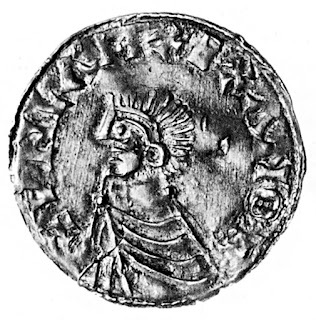
One big fail is that there is a (black-and-white) photo at the start of each chapter, but to get the caption for it you must annoyingly go to the list of illustrations at the back of the book.
There is no index, which is unpardonable for a book published in 2022, though there is an ending chronology that helps.
At times the book repeats points, making it seem less like a complete book and more like a series of articles. This might help explain the lack of an index, if this is just an edited collection. But maybe the author just forgot what he mentioned earlier.
There are occasional statements that seem dubious, such as the claim that there were no nuclear families in Scandinavia.
Occasionally the reader feels talked down to, such as when it explains that a man whose nickname was "Wobbly Belly" means that he was probably fat.
The book could have been a bit broader in approach as well. Several times are mentioned developments such as the use of religion to bolster royal power, the use non-noble ministers for the same reason, the collection of a very loyal band around the king and so on. The book does not seem to always realize that these developments were a general trend with all European kingdoms, indeed with all Indo-European kingdoms.
The book seems to need a sequel to cover the events in England between the death of Cnut and the coronation of Edward the Confessor as they seem part of the same cloth. Well, maybe we'll see it one day.