Kappa is a profound and unsettling work that serves as both a biting satire of human society and a personal reflection on the author’s struggles with mental illness and existential despair. As my first encounter with Akutagawa’s writing, I was struck by the complexity and darkness of the narrative, which is far from a straightforward fantasy. Instead, it is a layered exploration of societal contradictions, human nature, and the author’s disillusionment with the world. Written in the final months of Akutagawa’s life, Kappa carries the weight of his impending suicide, making it a haunting and introspective read.
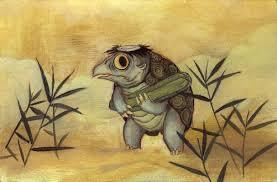
The story is narrated by “Patient No. 23,” a man confined to a psychiatric hospital, who recounts his accidental journey into the land of the Kappa—a mythical creature from Japanese folklore. In this strange world, the Kappa have their own culture, values, and logic, often inverting or exaggerating human societal norms. Through the protagonist’s experiences in Kappa Land, Akutagawa critiques the absurdities and contradictions of modern society, from labor exploitation to gender dynamics and moral hypocrisy. The Kappa’s world, while seemingly utopian, is far from perfect, mirroring the flaws and suffering inherent in human civilization.
What makes Kappa particularly compelling is its dual nature as both a societal critique and a self-deprecating of Akutagawa’s own psyche. The protagonist’s inability to reintegrate into human society after Kappa Land symbolizes the isolation and alienation felt by those who cannot conform to societal norms. This theme resonates deeply with Akutagawa’s own struggles, as he grappled with mental illness and a profound sense of disconnection from the changing world around him. The story’s ending, where the protagonist remains trapped in his delusions, underscores the tragic reality that those who deviate from societal expectations are often marginalized and misunderstood.
As a late work, this book is imbued with a sense of melancholy and impending doom. Akutagawa’s mental instability and preoccupation with death are palpable, especially in his contrast of the beauty of nature with the ugliness of human existence. The story’s dark humor and surreal imagery heighten its emotional impact, leaving the reader with a lingering sense of unease. For me, reading Kappa felt like peering into the mind of a man who had already made peace with his decision to end his life. The work is not just a critique of society but a meditation on the fragility of human sanity and the inevitability of death.
While Kappa is undeniably a heavy and challenging read, it is also a masterpiece of modern literature. Akutagawa’s ability to blend satire, fantasy, and psychological introspection is unparalleled, and his prose is both beautiful and haunting. However, as a first-time reader of his work, I found Kappa to be an intense and emotionally draining experience. It is not a book for the faint of heart; but for those willing to confront its dark themes, it offers a thought-provoking journey into the mind of one of Japan’s greatest literary figures.
In the end, Kappa is more than just a story about mythical creature as it is a mirror held up to society and a window into the soul of its author. Akutagawa’s forlornness is palpable on every page, making this work a deeply moving and unforgettable read.