‘This book is a revelation; an ambitious, poetic, sweeping account of the Black Summer fires … a natural catastrophe on a ferocious scale beyond the realm of anything previously experienced, or for that matter, imagined … a sterling primer for survival in the age of climate chaos which deserves very wide readership. This is a must-read book for the climate crisis era we are now living in.’ —Peter Garrett AM, noted environmentalist, former Australian Federal Minister, and Midnight Oil frontman
***
FIRE is a love letter to a small community who has a message for the world. The time for hollow words and targets and plans is over. Communities need to take back their control and consciously adapt to living in a world with more apocalyptic wildfires, killer heat domes, catastrophic rain bombs, lethal floods and mudslides, deadly droughts, and violent sandstorms.
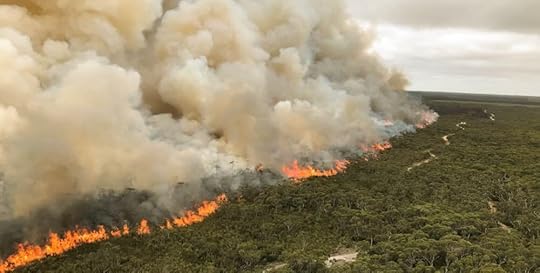
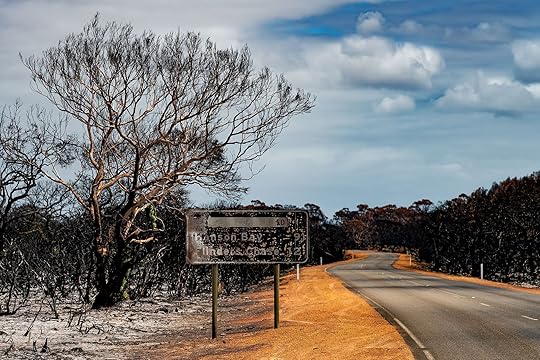
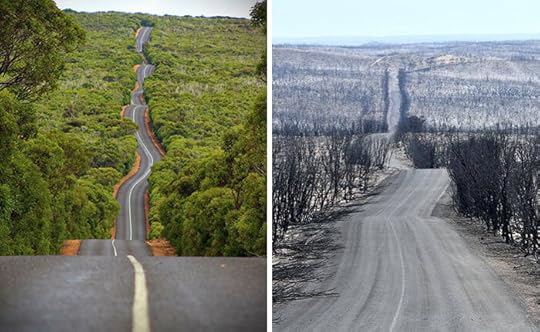
In 2019 and 2020 fires ripped across Kangaroo Island’s iconic landscape in the catastrophic continent-wide climate-event known as Black Summer. In that fatal season, wildfire destroyed a globally unprecedented percentage of Australia’s forest biome. Across the country 190,000 square kilometres were decimated, the lives of 33 people tragically lost, over 3,000 houses destroyed, and more than 100,000 farm animals and three billion native animals wiped out. Confronted by a hellfire that burned too hot to contain, even the oldest souls within Kangaroo Island’s small community gravely whispered, ‘never before.’
FIRE is essential reading for anyone interested not just in humanity’s future but our present.
Margi Prideaux has written about wildlife, international politics, and law almost every day for the past thirty years as an international negotiator and independent academic. She has four books and numerous articles and essays in circulation.
Having lived and lost in Australia’s 2020 Black Summer fires, she has joined the Planet Politics Institute and begun writing with a radically new direction. FIRE is her first book in this new theme.
I feel like the world in general is still putting profit and convenience over really getting on the real road to sustainable living. When I exclaim about Climate Change I always make a point of saying "Australia was on fire in 2020, and there's still so many Climate Change deniers, that's ridiculous.!" Margi Prideaux reached out to me and kindly sent me a copy of this book in exchange for a fair review. The worse thing about this message from the edge of Climate Catastrophe is how it doesn't surprise me, the amount of (human) bad decisions that led to this huge disaster. Each chapter begins with stories of the community's traumatic time on Kangaroo Island during the savage onslaught. Despite being written by an academic the book is really accessible as Margi provides historical, scientific, conservation and/or political background and basic core information before introducing a topic, and in a free flowing organic way. Now, this book is accessible, well balanced, informative, and very much eye-opening, but most of all there's no filter to lessen what happened. This a deeply researched and insightful real-time horror story showing what it was like for a community during an extreme climate event. A very firm Four Star, 9 out of 12 read. 2023 read
A thought-provoking book that should be on everyone's to-read pile and bookcase. We have heard what the media had to say about disasters around Australia and the effect this had on communities.
Well, here is a review of a trusted source, an insider recollection of the true events unfolding in a dramatic fashion within a community left to itself to survive. Get an insight into what it was like for residents on Australia's third-largest island on the most tragic day for their tight-knit community.
Margi Prideaux is an author, international negotiator and independent academic passionate about our planet and the creatures living on it. Your words ring true about the consequences of our own doing, mirrored in the events unfolding year by year around the country and world. This is her very personal perspective as a directly affected resident who proclaims her love for an island standing together, but fighting alone.
FIRE is a sobering analysis of the world’s government strategies to face climate change weaved with unique stories of bravery, community and loss during and after the Black Summer fires. An authentic recollection of disaster recovery everyone needs to read in order to create change together for a safer future.
The epiphany has been a journey of crests and waves, bare hilltop and burnt valleys.
It’s a rare epiphany, as few with Margi Prideaux's more than thirty years of rigorous intellectual examination and contribution and total commitment to, and belief in, conservation, policy, processes, and negotiation, call themselves out by openly admitting that although they had been steadily climbing the right ladder, it had been leaning against the wrong wall the whole time.
Fire is hopium, dissected.
Fire’s revelations makes me think of America as a teenager; immature, reactive, narcissistic, and self-involved. Well, it seems that America is not alone, the whole world is suffering an adolescence of sorts and it’s accompanied by utter bullet-proof self-belief and aided by bureaucratic blindness.
In a sense Fire is about discovery and reflection, a very personal journey as Margi manages to clearly pinpoint and identify various bureaucratic inconsistencies and global half efforts. She pit-marks the climate chaos timeline for us and we, the great misled, find out how truly dire the situation is and yet, magically, she manages to open our eyes without making us either angry nor despondent. How she does this is remarkable because, while she is guiding us to new possibilities, her impressive credentials entangle her as now she stands slightly a part from her former powerful conservation tribe. They take no prisoners by the way and she knows her tribe.
In Fire, she exposes herself publicly clearly willing to take the backlash. It may sound like she is pussy-footing at times but really there is so much love in her message and fire beneath her feet. Conservation efforts, she declares, are valiant and useless, too slow, too laborious, too distracted.
Fire establishes a milestone moment in climate history, essentially a change in direction, a solid argument for communities to take control. It is a call to action; local action. And while Margi tells us, quite a few times, that there is no time, she also says there’s still an opportunity to survive if we decide to stop living as we do. We must change how we live. We must adapt to survive.
Adaptation requires skills, local knowledge and long term planning, actually there is a bit of a list and it’s there waiting in Fire’s generous message. We have made changes to the landscape in order to protect our assets for thousands of years, always for our comfort, benefit and use. Are we willing to revise how we live?
Margi Prideaux has a somber message for the world and it’s probably not the one you think it is. It’s not even the one she thought it was going to be. Regardless, it is a message drawn up after earning a PhD in Wildlife Policy and Law, and decades of experience working as an international negotiator and conservationist. In a nutshell, Prideaux has the credentials that merit us listening to what she has to say. And if her career and academic achievements weren’t already enough, Prideaux lived on the edge of climate catastrophe, surviving the horrific Black Summer fires on Kangaroo Island in 2020. This lived experience changed her deeply held views on conservation and made it clear to her that the world needs to view climate chaos differently than it has been.
This book was hard to read. I definitely needed to put my big girls pants for this one. Not because of difficult language or concepts, but because you come face to face with what communities steeped in climate chaos have gone through, are going through, and will continue to go through. This book challenged me, making me analyze my approach to climate change, and made me re-evaluate my opinions of people who I’ve considered as on the wrong side of the conservation debate. I cried, I underlined, I Googled,…while I was reading this book I was living it. The facts, science, and anecdotal records all flowed nicely, keeping me IN IT. I credit Prideaux’s writing skills for that.
However unexpected her message was for me or the author, it’s important, it’s critical. I gave this book 5 stars because it gripped me, taught me, and helped me see what we have to do. I will think of its content often and keep the book in my bookcase as a great resource…and reminder.
This is a difficult and painful read, but a necessary one. It's not Margi's prose that makes it difficult to read - that flows nicely - but the heartfelt anguish of her traumatic experiences that pour out of the book. I fear that we will see more such personal accounts in the near future. In fact, some of them are unfolding as I write this review.
3 "Billion" "native animals" killed? How exactly do you arrive at a figure like that? Unless you're including insects, I call bullshit. And if you're counting insects I'd like to see the peer reviewed study on that, and also, it's bullshit.