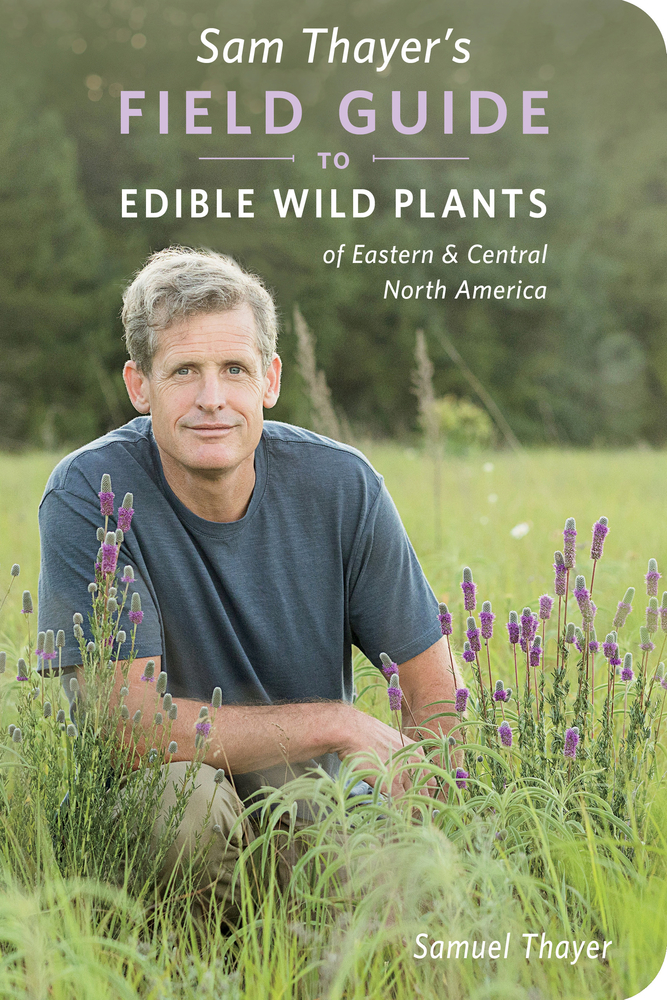
Eastern North America is one of the richest foraging landscapes in the world, with a wild abundance of fruits, berries, nuts, roots, tubers, shoots, flowers, seeds, and leafy greens. This guide is the key to unlocking the nutritional and culinary secrets of the natural bounty around us. As the most comprehensive regional guide ever written, it contains detailed descriptions, range maps, and sharp color photos of 700 edible species as well as some of our most troublesome toxic plants. Sam Thayer’s Field Guide pioneers a novel identification system using everyday language accessible to beginning and advanced foragers alike, designed to stand alone or work with phone-based identification apps to confirm positive ID before a plant is eaten. Readers will also learn about the plant’s habitat, conservation, edible parts, seasons of harvest, and methods of preparation. Destined to become the new standard in foraging field guides.
Please let me know if there are any changes you'd like to make to the above description and we can resend this description out in our data feed this week.
This book is incredible. Not only must I have it (I checked this out from my local library), but I'm also have to make a cute book holster to strap it to my leg. I don't want to venture into the woods with out this book ever again. It's the most through field guide for edible plants I've ever seen in my life. It has maps, it has biological descriptions, it has pictures of every plant, it has suggestions on how to eat the plants and where it fall in conservation efforts. It's like the field guide of your dreams. Every library and household in the Midwest should have this book.
Great photos, a ton of plants, and easy to understand. Think it’ll be great during the apocalypse, both to forage food and also it’s so heavy I could use it to fight off attackers.
I wanted to find a comprehensive book on wild foraging that was accurate, clear, and had enough information that I could be confident in my identifications without needing an app to help me out. I wanted lots of clear full color photos. I also wanted the book to be region specific and to contain more than just a few plants (and by "more than just a few plants," I mean ALL of the plants). So, before ordering this book, I did a lot of research.
Initially, I was torn between this book and the Peterson one. However, after several hours spent reading through blog posts, discussions on forums, and reviews on Amazon, I ultimately chose this one. I'm very happy with my decision.
Some things I love about this book:
- This is the largest collection of wild edible plants I've found in a book, which is exactly what I wanted. It is THICK! There truly are over 500 wild edibles in this book and each one has a lot of information about it.
- The identification keys are clear and easy to understand. Even though it might look daunting at first, you'll get used to it the more you use the book, I promise.
- I like that there's an "identification difficulty rating" for each plant (1 easy, 2 moderate, 3 difficult).
- There are multiple indexes in the back, including the author's "The Best" lists; a list of plants that are edible according to lore but that the author hasn't been able to verify or try for himself; habitat & seasons tables; "Important Plant Families For Gatherers" lists; and more.
- There's a glossary with clear, understandable diagrams and cross sections of labeled plant parts that are used to identify plants.
- There's a poisonous plants section containing plants that are often confused for non poisonous ones.
- Every plant has at least one clear, full color photo and many plants have more than one. There are a few that I wish had more, but there's only so much you can put in one concise book and this thing is thick and heavy as it is.
- Between the photos, the id keys, the descriptions, and the glossaries, I am confident that I can correctly identify most of the plants in this book, especially the ID Difficulty 1 plants.
- There's even a bit a humor, which is always welcome!
What this book isn't:
- There are no mushrooms or other fungi in this book. That is a whole other category and it requires a lot of information to positivly identify and safely eat mushrooms gathered from the wild. It's really easy to misidentify them and the consequences can be fatal or, at the least, extremely unpleasant. So, if you're interested in that aspect of foraging, you'll need to look elsewhere.
- You won't find much information about medicinal uses of any of the plants in this book and you won't find any plants or herbs that are only gathered for that purpose. For example, things like usnea (which is technically a fungus anyway so maybe not the best example, but whatever!) are not in here, nor are the medicinal properties of edible plants such as Japanese knotweed root mentioned. Again, that's a whole other topic that requires a lot of information, which was outside the scope of this book.
- This also doesn't contain the more involved preparation instructions for any plant uses that require more than a paragraph to explain. For instance, cattail flour is mentioned, but the one sentence preparation instructions leave out a few steps that would make the process easier. Still, there is enough information to get the job done with a little bit of trail and error.
- As you can imagine, there are no recipes beyond the basic information you need in order to prepare the plants in this book. Again, I can't imagine how to fit that in along with everything else.
- This book only covers Eastern and Central North America. For other parts of the country or world you'll need to look elsewhere.
None of these things is a negative as far as I'm concerned. Still, I wanted to let others know in case they're expecting this information.
Bottom line: I'm very happy with this book. I'd recommend it to anyone looking for an easy to follow, comprehensive tome of wild edible plants that doesn't require electricity or the Internet to access. As long as you aren't expecting fungi or herbalism, I'm sure that you'll be happy with this book, too.
I actually just got this book after seeing a lot of foragers give effusive recommendations for it. It is heftier than what I was expecting. The description of each plant is clear and broken down to the most distinctive salient points, with excellent colored photos to clarify any additional points.
And the thing about the format is, the author only optionally adds sections that would be helpful, and excludes them if not, which strikes me as being a truly personal field guide. I love the comments, warnings, and anecdotes included with the plants. As an example, some time ago, I was excited to find out that day lilies were edible, and that I had in fact eaten them before, in traditional home-cooked hot-and-sour soups as a child. But the information I found online gave me pause with advisories about explosive diarrhea and gastrointestinal discomfort. Better not pick the ones growing by my front door, I thought. In the field guide, the author explains that, first of all, "There are other species and hybrids of day lily, the safety of which are questionable (even more than this one.)" Additionally, "I no longer allow people to eat it in my foraging class. Eat at your own risk." But also, "petals are traditionally stored by drying and then reconstituted for cooking," which is exactly how it was prepared for the soups when I was a kid. Having that extra context served to answer a lot of my flabbergasted questions.
This book really is a great companion to my PictureThis plant identification app, which my florist friends say provides questionable plant identifications. I've learned a lot so far by using the app as a starting point and looking up its findings later. The book provides a lot more context and breadth to each plant I find. And knowing that the author survived the advice he's dished out in the book gives me a lot more peace of mind when exploring the interesting diversity growing in my backyard.
If you’re only going to buy one foraging guide, THIS is the one you want. If you already have a shelf full of foraging guides, you *also* want this. I've never found a foraging guide with more information jammed into its pages. I wish I could give it more than 5 stars.
I was given an advance copy to review and spent many happy hours perusing its pages. Thayer has invested an immense amount of energy designing a guide with thorough and careful information about 700 plant species as well as helpful explanations and a novel system for identifying plant types.
I have turned to his former books over and over again through the years, but this one will keep me busy for the rest of my life. Plus if you don’t find straight up plant information enough entertainment, Thayer’s irrepressible humor shines through often. You will especially enjoy "The Best Index," different from the *Regular Old Boring Index* (his words) which includes helpful categories about which are the best greens to fry versus eat in a salad, which make the best survival foods, and my favorites, the best things to feed a first date and the best things to avoid feeding a first date. You get the idea.
On top of hundreds of pages of plant descriptions and pointers, Thayer has added a super-useful foraging calendar that he has separated out by habitat, so you can pick the habitat you find yourself in and scan through things to keep an eye out for during the different seasons. Really genius.
Not perfect, but certainly the best foraging field guide to have been written thus far. Appreciate mightily that he actually worked to eat every likely edible part of each plant in the book, challenges conventional wisdom and the issue of copying and pasting from older, perhaps mistaken sources, and lengthy physical descriptions of each plant that make identification foolproof. Comments on the practicality of consumption, identification difficulty and similar plants, and notes about conservation were particularly nice inclusions.
Some of the pictures were not really enough. Small in size, taken from weird angles often (sometimes deliberately to show identifying features) and often not having pictures of the plant as a whole and at its most identifiable or edible stage was a little annoying. I understand the need for space and that this is a tome already, but the pictures are the most important part for me! I can find more online I guess but I’m suspicious of those I don’t trust. I think I would still take more included plants over more and larger pictures though if that was the compromise.
Overall still highly recommended. Sam should try making more pesto (or at least recommending it more often) as some of the species in here are great pesto options considering flavor and local abundance — chickweed, garlic mustard, mint etc.
Side note: this is the only guide I’ve read to list Heracleum mantegazzianum as not only not “highly poisonous” but at least partially edible — and very casually! Surprising to me. I will still not be eating it.
This isn't a book you check out at the library; this is one you have to keep with you always. It doesn't just have pictures of plants and how to eat them; it also teaches you botany lingo in case you go to other sources, has a whole section on similar-looking poisonous plants, and has a second "best of" index for when you want recommendations. Pretty much all the information you could want is here in one book.
I'm still getting used to how to actually find a plant in the book after I've spotted it in the wild; I'm using this book in conjunction with iNaturalist and Google for now, but someday I hope to not need those crutches. I'm not even using the book to forage at this point, but to identify plants (the first step in foraging), and it's still incredibly useful.
We wanted something to take hiking in the forest in the Colorado Rockies when I recover from double foot surgery. What we found in this is something so much more. Our daughter's are finding edible plants in our backyard, next to their bus stop, our local park and the path to school! This book, combined with his other books, show our children how our ancestors survived on other food besides meat as described in school books, and it can taste delicious, especially when cooked right. It's so expertly organized so even our 8 year old can find things quickly. Now they are planning their own edible wild garden!
Pretty good. I'm not thrilled with the organization. Coming from a scientific systematics background, it can be a bit harder to navigate if you already know the species you are looking for. It is designed for foragers, and it does seem more useful if trying to identify an unknown plant. It focuses on edible plants, specifically ones also found across the US, not just in the region of focus; however, except for the most toxic look-alikes to be wary of, it won't cover all other species in the region that you might encounter. I think it would be good in addition to a more taxonomic field guide or compendium, but I wouldn't rely on this as my only wild plant identification guide.
Absurdly, insanely well-researched, profoundly easy to use with clear iconography, stuffed to the brim with dozens of useful notations, this is single-handedly the best foraging field guide I have (and possibly will ever) read. I am fortunate enough to live in the Midwest and this is probably the only resource I will ever need to, as the author notes, tentatively identify plants. There is no other book like this that I know of on the market.
Thorough. I am slightly paranoid when it comes to eating plants out of the backyard, not having been raised with plant identification skills from a young age like some. But the amount of detail included in this guide is educational and extremely specific to aid proper identification. You can tell a lot of time and experience went into the making of this. I admire Thayer for the quality put into this assembly of information.
this book was lent to me, but it was so good i had to get a copy for myself so i could finish it. this isn't really a book you read, but it's worth a thorough flip-through to familiarize yourself with it. that way you'll be able to better use it as an identification tool in the field. plus you'll be surprised by how many plants you recognize and just never knew the name for, and/or never knew had edible uses! a very rewarding read.
This book is the only guide you will need for foraging edible wild plants! This detailed guide contains decades' worth of acquired information for each plant with colorful pictures throughout the book.
The amount of information in this book is astounding. The photos for identifications are great. This is another author that is an automatic purchase for me.
I need to purchase this one! Great field resource. Very extensive. Not light to carry around in your pack, but very informative with pictorals and useful info!
Brilliant, thorough, and highly accessible. Thayer's voice permeates his field guide with a refreshingly personal touch that doesn't sacrifice an ounce of credibility.
I had the pleasure of taking a foraging class with Sam this past summer and he is so knowledgeable and passionate about foraging. This book is like a bible to me!
Heavy and difficult to carry into the field without damage. Has everything you need to know about edible plants and adds a huge element of reward and discovery to trail walks and hikes. Great at first glance and better as I have used it more.
This is probably the most comprehensive and utilitarian guide to wild plants out there today. He leans into a common characteristic based taxonomy to group his plants, while color coding each grouping to give an additional visual aid when jumping through the book. There's also a flowchart type diagram in the beginning of the book to help you jump to whatever group the plant you're trying to identify likely belongs to. Once you find the page for the group, there's another flow chart to find the most likely plant.
Sam greatly improved the usefulness of his harvesting calendar iterated over in previous books by splitting it out by biome and simplifying the chart itself. He uses graphics to aid in communicating which parts of the plants are edible both on the pages dedicated to each plant and on the calendar.
Due to the sheer number of plants included in this book, Sam had to cut down on some of the flavored writing and individual detail which is understandable.
Overall this is probably his most visually compelling and practical book. I don't know exactly how many plants are included but it may be more than all of his other books combined. Nobody has done more for the modern forager and it shows. I imagine this must have been a labor of love.
I really enjoy this book - it is jam packed with info, and I really appreciate that Thayer has thoroughly tested/eaten his recommendations. I also like some of the features that I haven't seen in other books, such as his "The Best Index" which has short lists of his top recommendations for teas, jams, etc. It is a very dense book and heavy, so I like to use it in collaboration with a couple other books to go even deeper on certain plants.
Sam Thayer reports in the intro that he spent 17,000 hours working on this book. While that may be the amount of time spent directly working towards the book’s completion, it would be just as accurate to say that there is a lifetime of preparation and study that has gone into this field guide. Sam Thayer started foraging at a very young age and has remained passionate about the topic since that time. His unmatched foraging knowledge shines through in this field guide very clearly. I cannot recommend this book enough.