Jump to ratings and reviews
Rate this book

Poets for the Millennium

Una luz que perdura

Rate this book
Intensamente lírica y permeada de una sofisticada comprensión universal, la poesía de Kenji Miyazawa es un canto de amor a la humanidad y a la naturaleza.

Pocos poetas tienen la capacidad de lograr que todo un pueblo se sienta identificado y reconocido en sus poemas. Kenji Miyazawa hace palpitar el corazón japonés con la delicada brillantez de sus versos: versos sinceros, puros y tiernos que atrapan la realidad en un parpadeo, un «momento puntual y fugaz», en el que plasmar la deslumbrante belleza del mundo, la espiritualidad más profunda o el intenso dolor de la pérdida del ser amado.

Intensamente lírica y permeada de una sofisticada comprensión universal, la poesía de Kenji Miyazawa es un canto de amor a la humanidad y a la naturaleza. "Cuando camino por las zonas más oscuras del bosque,/ los pantalones y los codos se me llenan de labios/ que tienen la forma de la luna creciente".

224 pages, Hardcover

First published January 1, 2007

13 people are currently reading
468 people want to read

About the author

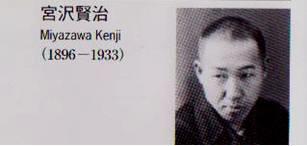
Kenji Miyazawa

989 books339 followers
His name is written as 宮沢賢治 in Japanese, and translated as 宮澤賢治 in Traditional Chinese.

Kenji Miyazawa (1896-1933) was born in Iwate, one of the northernmost prefectures in Japan. In high school, he studied Zen Buddhism and developed a lifelong devotion to the Lotus Sutra, a major influence on his writing. After graduating from an agricultural college, he moved to Tokyo to begin his writing career but had to return home to care for a sick sister. He remained in his home in Iwate for the rest of his life. One of his best-known works is the novel Night on the Galactic Railroad, which was adapted into anime in the late twentieth century, as were many of his short stories. Much of his poetry is still popular in Japan today.

Ratings & Reviews

What do you think?
Rate this book

Friends & Following

Create a free account to discover what your friends think of this book!

Community Reviews

5 stars
60 (40%)
4 stars
57 (38%)
3 stars
28 (18%)
2 stars
3 (2%)
1 star
0 (0%)
Displaying 1 - 25 of 25 reviews
Profile Image for Flo.
649 reviews2,245 followers
January 10, 2018
I said, “The evening sun the color of ancient gold,”
and your eyes reproach me:
Why seize on despicable gold
to compare to this solemn evening sun?

The family of Kenji Miyazawa (1896-1933) practiced Pure Land Buddhism, a prominent branch of Mahayana Buddhism. In 1915, the poet shook the foundations of their relative’s faith when he decided to convert to Nichiren Buddhism, another branch. Such conversion was prompted by the Lotus Sūtra – a deep influence on his poetry, which brims with Buddhist terms without actually delving into essential notions. I had to return to some texts since I had forgotten some concepts.

My rating is based on my inability to relate to most of Miyazawa’s poems. Perhaps their complexity exceeded my understanding and a clear image turned into labyrinthine symbolism. But I did find some enjoyment. Some of his poems are imbued with the serene expressions of nature, with the sense of a challenging yet reachable enlightenment. With the verifiable elements of science, the volatile human nature, and religion trying to build bridges between them.

description

Other poems are infused with the monochromatic presence of death. Miyazawa's verse was deeply affected by the demise of his younger sister, Toshi, on November 27, 1922. That same day, he wrote three poems. With that loneliness you must make music. Always.

This collection of somewhat disjointed thoughts started with an excerpt of a poem called "Mr. Pamirs the Scholar Takes a Walk." I marveled at the juxtaposition of simple yet sophisticated visuals which express an ideal version of ourselves. A faithful portrait of the chasm between a sublime sight and a worldly kingdom, transient by definition. Someone subscribing to such values is a rare treasure. The rest is just noise.


April 13, 17
* Also on my blog.
** Photo credit: Kuon-ji, temple founded by Nichiren, a Japanese Buddhist priest, in 1281. / via Panoramio
Profile Image for Susan Budd.
Author 6 books298 followers
March 15, 2020
Kenji’s saintliness, his devotion to the Lotus Sutra, and his love of all living beings radiate from his poetry.

His way reminds me of Saint Therese’s “Little Way.” For Kenji, religion was simple. It was love. And science was simple, for it too was love. Agriculture and astronomy, physics and chemistry, biology and geology, like religion, exist solely to help people. But it begins with religion, with the vow to help all beings ~ the bodhisattva vow.

Kenji’s poems are Buddhist philosophy expressed in the language and imagery of the sciences. He establishes his poetic voice and spiritual vision in the preface to his self-published first collection of poetry ~ the only collection of poetry published in his lifetime.

The phenomenon called ‘I’
is a blue illumination
of the hypothesized, organic alternating current lamp
” (63).

However, the poems that most touch my heart are the ones about his sister Toshiko.


The Blue Woods

Toshiko died of tuberculosis on November 27, 1922. She was twenty-four years old. What more of love did Kenji learn when he lost the one he loved most?

Why do you try to grasp firmly in the human
what you can get only in religion
” (99)?

In a poem written on the day she died, Kenji describes the last hours of her life. Burning with fever, she asks him for snow, bids him fill two chipped ceramic bowls with snow. The siblings grew up with these bowls and now Toshiko will eat from them for the last time.

I pray from my heart:
may this turn into the food of Tushita Heaven
and soon bring to you and all others
sacred nourishment.
That is my wish, and for that I will give all my happiness
” (84).

In an earlier draft of the poem he wrote: “May this become heavenly ice cream” (84).

In another poem written on the day she died he brings her a pine branch and she presses it to her cheek, so deeply does she yearn for the woods.

Like a bird, like a squirrel,
you longed for the woods
”(86).

A year later, he is still composing elegies. In one he describes a journey by train ~ a device that will reappear in Milky Way Railroad.

He imagines himself riding the train. It squeaks and he sleeps. Toshiko burns with fever, thinking of birds and the woods.

Toshiko opens her eyes gently
and in a transparent rosy fever
thinks about the blue woods
” (96).

Again there is the image of birds and squirrels.

Like a bird, like a squirrel,
she longed for the fresh woods so
” (96).

At the end of his journey, he wonders where she is.

In the coal-black cloud
Toshiko may be hidden
” (97).

This feeling that Toshiko is hidden somewhere just out of reach is a theme in Kenji’s writing.

I can’t help thinking of her, hidden somewhere” (97).

It also appears in Milky Way Railroad. When the Milky Way train comes into view of the coal-sack, Campanella reaches his heavenly destination.

In fact, throughout this selection of poems there are numerous images that reappear in Milky Way Railroad.


Colorless Peacocks Filled the Blue Sky

The story of two boys riding a train through the Milky Way Galaxy may have begun with that poem he wrote on the day Toshiko died.

There, he rides the train sleepily thinking about Toshiko. Toshiko is both there and not there. In Milky Way Railroad, Giovanni’s friend Campanella is also both there and not there. This is the paradox of death: The deceased is both ever-present and gone forever.

In a later poem, Kenji describes a train journey on the Iwate Light Railway ~ the railway built by his maternal grandfather. But the ordinary journey becomes a phantasmagoria as Kenji imagines it heading to the North Pole.

Elsewhere in Kenji’s poetry are other images that he will use in Milky Way Railroad:

Tonight’s the festival of the Galaxy and woods” (77).

Giovanni’s journey occurs during the Tanabata festival.

All these propositions are asserted
in the four-dimensional extension
as the attributes of imagination and time
” (65).

The Milky Way train Giovanni rides is described as “this imperfect, fantasy Fourth Dimension Milky Way Railroad” (Sigrist and Stroud 80).

a green epistle, modestly folded,
gets into my pocket
” (102).

When the train conductor comes to see tickets, Giovanni reaches into his pocket and discovers there “a piece of green paper ... folded in four” (Sigrist and Stroud 79). It is Giovanni’s round-trip ticket to the heavens and back.

fresh bachelors of arts may excavate
wonderful fossils somewhere from the glittering frozen nitrogen
” (65).

Fossils are an important image in Milky Way Railroad. As evidence of the past, they make present that which is gone. At one rest stop, Giovanni and Campanella meet a paleontologist excavating fossils from the Pliocene epoch.

Then there are peacocks ...

colorless peacocks filled the blue sky” (65)

... and dolphins ...

Dancing and jumping up like a dolphin” (147)

... which the children see from the windows of the train.

There are apples ...

(addressing his sister)

your cheeks are like a child’s, like apples.
May you be reborn in heaven
with such beautiful cheeks
” (88).

... that perfect food that the children eat on board the train.

And there are birds and squirrels ~ especially squirrels. They both represent Toshiko.

In Milky Way Railroad, as the train approaches heaven, the children see “electric squirrels with gold halos peeping out of the mist” (Sigrist and Stroud 124).

The poetry prefigures the novel and in both Toshiko peeps out of the mist. Perhaps she resides in the vastness of the galaxy, far away in heaven, hidden somewhere mysterious beyond Kenji’s reach.


How Blue is the Anger

The conclusion to Milky Way Railroad is the same conclusion Kenji comes to in his poetry. He said it on the day Toshiko died when he wished “sacred nourishment” for her and for everyone.

That is my wish, and for that I will give all my happiness” (84).

He said it again and again throughout his oeuvre. And he did not just say it. He lived it. He lived it with the humility of a saint, calling himself an asura. (An asura is an angry demon.)

how bitter, how blue is the anger” (68)!

He describes himself as adrift “in the dark field of poisonous grass and luminous fungi” (87) and he announces “I am Asura incarnate” (68).

Did not Saint Francis call himself “the greatest of sinners”?

Kenji devoted his life to helping others, both in prayer and in work. Not just his own loved ones ...

(writing about his sick three year old niece he says)

may her illness, her pain,
be transferred to me
” (216).

... but all beings.

In his poetry, he offers himself up for every man, woman, and child, every horse and pig and cow, the crows and the pine trees, even the guy at work who always gives him the stink eye. Everyone. Everywhere.

He would sacrifice himself for all beings, be “crucified” (102) for them. He would give up his own happiness for theirs, like Giovanni would for the Bird-Catcher in Milky Way Railroad, or be burned up like the fabled scorpion to light their way.

He was voluntarily austere. Though his family had money and Kenji possessed luxuries, he chose to live and work among the poor farmers, devoting himself to improving their lives, even when they laughed at him

Everything Kenji did was for others. Nothing for himself.

in everything
not taking oneself
into account
” (219)

This was his ideal and it seems to me that he lived up it to as much as any saint or sinner could.


A Transient Blue Dream

Kenji died of pneumonia at the age of thirty-seven. In the poems he wrote while ill, he expresses the Buddhist concept of Sunyata ~ the true nature of reality ~ in the language of science.

the atom is in the end a form of vacuum,
and so is the external world
” (213).

Existence is an illusion. The self is an illusion.

But in addition to philosophizing, he also describes his own subjective experience of dying, of becoming more and more illusory to himself.

And it must be that I will die soon
but what on earth is what is called I
I thought rethought it a number of times read and read
heard it was this was taught it was that
but in the end it isn’t clear yet
what is called I ...
” (212).

Perhaps Kenji was a bodhisattva, suffering in the world for the sake of all beings. I think he was.

At the very end of the blue sky,
above the atmospheric strata where even hydrogen is too thin,
there lives a group of eternal, transparent living things
who’d find it too cloying
to think even such thoughts as:
‘I am the entirety of this world.
The world is the shadow of a transient, blue dream’
” (173).
Profile Image for Praj.
314 reviews900 followers
June 17, 2015


Beneath the solitary Saddle Mountain terrain,
Soil in dampness laid, memories of rain erase,
Crimson sun teasing the amorphous clouds
Witness the birthing of a maiden rice grain,
From the new railroad, tumbles steamy mesh,
Dances to the mist, a worm in its silken nest,
Smiling at the chopsticks, await two bare bowls,
As blissful serving of brown rice and miso grace,
Against the black lacquer, the Lotus Sutra sings,
A crow in a hundred postures, Miyazawa dreams,
Above the fragrant cypresses, wild cranes stretch,
In the realms of Buddha, an Asura incarnate sleeps,
Is this a cosmos melancholy of a peasant or a poet?
Ask, free-verse galaxy to the bodhi tree, as I silently read.

If reading prose pushes you to edge of your vulnerabilities; poetry snatches the throne on which your brooding vulnerabilities reign. Resembling a drop of water, that with the slightest touch of sunlight becomes a chimerical glass - a mirror, through which the world shines brighter than the spectral extravaganza of a rainbow; poetry in its concise form is a collection of these glassy droplets from which one can view the vivid colours of the life and death, each droplet being carefully harvested into a river of emotions making the worldly spectrum lucid to its colour blind observer.

Nature awakens to the first call of Spring. Trees birth their first tender leaves to the melodious songs of young birds. The mist on the ground breathes life to the very Earth, on which it resides. The fiery sun crackling through the cerulean aerial carpet, the first pink sakura sprinkling, the pitter-patter of tadpoles taking their first swimming lessons, the newly found giggles of children that were lost in wintery gloominess and the enthusiastic soil waiting for a prosperous harvest. Life begins in spring. Art begins. Life is art and living is the masterstroke of the artist. Miyazawa Kenji’s poems are works of such sophisticated art that encompasses a world view attaching human life to nitty-gritty of nature, as all living beings come under one mammoth umbrella of the wholesome existence of universe. Through nature one derives acts of compassion and enlightenment. The Lotus Sutra of the Wonderful Law seeps through every stanza of Kenji’s poems encompassing a “world view” as opposed to the tapered “human life”, transforming nature into labour of art through Kenji’s eyes.

The phenomenon called “I”
Is a blue illumination
Of the hypothesized, organic alternating current lamp
a blue illumination
of the karmic alternating current lamp
which flickers busily, busily
with landscapes, with everyone
yet remains lit with such assuredness...(Proem)


Born on Aug’27, 1896 in Hanamaki, Iwate Prefecture in Tohoku, Kenji the son of an affluent pawnbroker, had converted to Nichiren sect of Buddhism, in his adolescent years, being a staunch follower of the teachings of Lotus Sutra. Kenji perceived the world as one which connected all living organisms through a common thread of universal enlightenment. In a world where suffering has to be endured, Kenji’s poems emotes intense emotion as a vehicle that travels through conscious surroundings of practicality constructing a bond between the mind and the nakedness of radical elements of conflict. Kenji’s struggle between inner and the outer world, seeking refuge in realms of Buddhism, became the ultimate building block of his future works. Justly, placing under the contradicting title of ‘Spring& Asura’, Kenji displays the blaring discrepancies of the universe.

How bitter, how blue is the anger!
At the bottom of the light in April’s atmospheric strata,
Spitting, gnashing, pacing back and forth,
I am Asura incarnate.....(Spring& Asura)


The above verse identifies the fundamental quandary that eclipsed most of Kenji’s life. Approximating to an Asura ( evil deities or spirits fond of fighting and quarrels who are constantly at war with various heavenly beings...), Kenji was forever at war with himself and the superficial environmental exterior as he tried to find poise with his internal modernist outlook and the external conservative rudiments. Adhering to the basic principles of Buddhism of renouncing anger to gain bodhisattva (enlightenment), Kenji described his innate anger as a stubborn malevolence that compels him to “smash the desk with his whole body” and its luxuriant red colour that later feels like water turns him into a “madman”. Kenji defines himself as “an Asura in the world of humans becoming a Buddha”.

Kenji’s works are diversified branching into various short plays, children’s stories; all trying to create a bridge between the fundamental intuition and practicality with a certain dose of satire. Among his numerous poems, few of my favourites are the ‘The Railroad’ [where all the living beings, be it animals, insects or humans suddenly take a break from their usual chores to give a grand welcome to the new train that passes in its steamy reverie] ; ‘The Doctor’, ‘ The Crow with Hundred Postures’ , “The Politician’, ‘Refractive Index’, ‘Haratai Sword- Dancing Troupe’ and many more that bring out the brilliance of a man who interlaced the world in a single consciousness of life, as it is said.

Desolate grass ears, the haze of light
the verdigris extends serenely to the horizon
and from the seam of clouds, a variegated structure
a slice of heaven’s blue.
My chest retains the strong stab.
Those two kinds of blue
Are both the properties that Toshiko had.....(Okhotsk Elegy)


Kenji was most affected by the loss of his younger sister Toshiko who died on Nov’27, 1922 after a long illness. A bulk of his poems from Vol. I & II are dedicated to Toshiko and the anguish he endured from the death of his beloved sister. ‘Love & Fear’ was the first poem where Kenji expressed his concerns over her illness and his heartache further deepened as he penned numerous poems:- ‘The Voiceless Grief’, ‘The Morning of the Last Farewell’, ‘Pine Needles’, ‘Volcano Bay: A Nocturne’, ‘White Birds’..... as he eulogised Toshiko.

Two large white birds fly
Calling to each other sharply, sorrowfully
In the moist morning sunlight,
They are my sister,
My dead sister
Because her brother has come, they call so sorrowfully..(White Birds)


Geoffrey O’Brien who has written an preliminary chapter in this book, rightfully calls Kenji as “a modernist in the mountain”. Miyazawa, much to his father’s angst decided to be a peasant and lived a humble life away from the riches that he was accustomed too. A teacher of Agrarian art, Kenji wrote poems in meteorology, sericulture, crop rotations, botany, geology and mineralogy. Was then Kenji a poet who became a farmer OR a farmer who became a poet? Miyazawa Kenji brought each element of nature amalgamating into humanity, his words breathe life into inert objects; nature and Kenji became one and thus is becomes difficult to take away the farmer from the poet and vice-versa. As the philosopher, Umehara Takeshi puts it:-“Kenji saw in Buddhism a grand view of the world that is consistent with the finding of modern science”.

I do not want pleasure
I do not want fame
Now I just wish to offer
This useless body
To the Lotus Sutra.......( October 28)


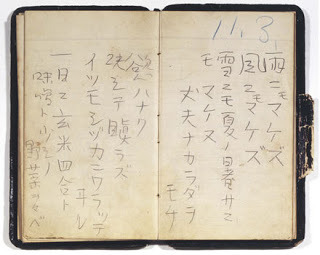
During his last years, Kenji scribbled his poems with a titular date registering the day on which he wrote the respected poems. Similar to his teachings which were liberated from the conventions of mandatory textbooks, Kenji truly believed that a poem should be written spontaneously with the very first impression one gets as a onlooker. Thus, it is not surprising that the poem that gifted Miyazawa Kenji the reflection of a saint was the one that he had scribbled before his death and had not amended. ‘November 3rd or Ame ni mo makezu( Be not defeated by the Rain) acquired an iconic status that became a cultural treasure in Japan, a country that once failed to recognize the genius of this reclusive , modest farmer. The poem is compared to another brilliant poetic verse of Joyce Kilmer’s “Trees”.

November 3rd.


Hiroaki Sato, does a marvellous job by bringing absolute gems from Miyazawa’s poetic treasure that encompasses rural life into the art of poetry, unearthing the invisible footprints of man that were misplaced in the fleeting cosmos of ignorance and prejudices while imparting the vibrant sensibilities to a colour-blind spectator like myself. Comprehend this book, cherish the words while you listen to the chuckles of your children, the chirping of birds, the loveable wagging of your dog’s tail, the rhythmic flow of water, the swaying of leaves or the crystalline spectacle of snow tapping your window and under the open sky when the fiery sun hides behind those wispy clouds, think about a man whose words transformed all these elements into one whole entity and ponder on how cloistered verses found a voice that is listened delightfully through decades.


Profile Image for Steven Godin.
2,782 reviews3,374 followers
July 10, 2020

Today my forehead dark,
I can't even look straight at the crows.
My sister, just about now
in a cold gloomy bronze-hued ward,
begins to be burnt by transparent rosy fire.
Truly, though, sister,
today I too feel weighed down, terrible,
so I won't pick up willow flowers and come.

— — —

The rolling snow
gets bright peach juice poured into it,
the moon left unmelted in the blue sky
purring gently to heaven
drinks once again the diffused light.

— — —

You who go through rice paddies in the rain,
you who hurry toward leviathan woods,
you who walk into the gloom of clouds and mountains,
fasten up your raincoat, damn it.

— — —

Night dew and wind mingle desolately,
pine and willow go black,
the sky fills with dark petals of karma.
I have recorded the names of gods,
and shiver violently, cold.

— — —

My sin has turned to illness,
I am helpless
sleeping in the valley sky.

At least at least
onto this body fever
this year's blue spear blades, take root.
Out of this humid air,
rain, be born
and moisten the drought earth.

— — —

I do not want
pleasure
I do not want
fame
now I just wish to offer
offer
this base useless body
to the Lotus Sutra
to light
a speck of dust
and if forgiven
become
servant to father and mother
to return their billions
of favors
ill and faced with death
I have no other
wish
Profile Image for Mir.
4,974 reviews5,331 followers
Read
October 9, 2018
It looks like you can read this on Google books.

He has some very amusing titles, such as "Ambiguous Argument About a Spring Cloud" and "Prefectural Engineer's Statement Regarding Clouds" (just coincidence that they both mention clouds) and some quiet funny poems.

Others are extremely sad, although I did not find this translation as moving as the one I read previously, where some of the poems literally had me in tears. His grief for sister and his struggle to accept his own premature death are very moving.

Here is the last tanka, written on the day he died:
Within these square miles: is this in Hinuki alone?
The rice ripe and for three festival days
the whole sky clear

Because of illness, crumbling
this life --
if I could give it for the dharma
how glad I would be
Profile Image for Akemi G..
Author 9 books149 followers
September 11, 2016
Old-fashioned as they are, few Japanese skip reading Kenji's stories and poems. I read them in the original Japanese language, and I don't know how good this translation is or which stories this book contains, but I can wholeheartedly recommend his writing. There is something so genuine, almost unashamedly genuine and graceful, about it that is hard to find elsewhere.
Profile Image for Alex Pler.
Author 8 books274 followers
October 21, 2022
"No dejarse vencer por la lluvia,
no dejarse vencer por el viento, ni por la nieve
ni por los calores de verano".

Las antologías de autores que murieron jóvenes, cuando se ordenan por orden cronológico como esta de Kenji Miyazawa, nos recuerdan la injusticia del talento truncado demasiado pronto.
Profile Image for Dane Bell.
12 reviews33 followers
December 10, 2015
Kenji artfully stitches together wrought, introspective emotion (notably his grief over his sister's premature death) with natural observation in a way that is sensually evocative while at the same time wholly cohesive, if not always 100% coherent.
Profile Image for J.
180 reviews
June 23, 2020

REST

In the upper stratum of that resplendent space
bloom kinpoge
(these are superior buttercups
but they are not so much butter as sulfur and honey)
and below there are pearlworts and parsley.
Toy dragonflies made of tin are flying,
and the rain crackles
(an oriole calls calls
besides there’s even a silverberry)
I throw myself out in the grass,
and the clouds have both white spots and black spots,
everything glittering boiling.
I take my hat and throw it down and there a black mushroom top
hat.
I draw myself up and my head goes to the other side of the mound.
I yawn,
and in the sky too a devil appears and shines.
These dead grasses are soft,
now this, an ultimate cushion.
The clouds have all been plucked,
and the blue has turned into a giant net.
That’s the gleaming mineral plate.
The oriole does his thing incessantly,
and a skylark falls toward me, crackling

5/14/1922


ANNELID DANCER (ANNELIDA TÄ NZERIN)

(Yes, it’s water sol,
it’s opaque agar liquid)
Sun’s a golden rose.
A red, tiny wormy worm,
draping itself with water and light,
is dancing a solitary dance
(Yes, 8 γ e 6 α
in particular, arabesque ornate letters)
the corpse of a winged insect
a dead yew leaf
pearly bubbles and
a torn rachis of moss
(Red, tiny princess dear
now above the bottom in the deep
dances, yes she dances all alone
only with a yellow fluff;
no, but soon, it’ll be soon,
up she’ll come in no time at all)
The red annelid dancer
with two pointed ears,
each metamere, phosphorescent, coral,
correctly adorned with a pearly button,
turns round and round, pirouetting
(yes, 8 γ e 6 α
in particular, arabesque ornate letters)
With her back glistening
pirouette she does with all her might,
but her pearls, in truth, are all fake,
not even glass, but gassy beads
(no, but even so,
eight gamma E six alpha
in particular, arabesque ornate letters)
With her back glistening
dance she does with all her might, or so I say.
But if, in truth, you leap about, tortured by bubbles clinging, all that
isn’t easy for you.
Besides, the sun has set behind the clouds;
I got pins and needles, sitting on a stone;
the black wood chip at the bottom of water looks, I say, like a
caterpillar or a sea cucumber.
Besides, Worst of all, I can’t see your shape.
Have you really melted away, I wonder.
Or, was all this an opaque blue dream
from the start, I wonder
(No, she’s there, she’s there,
princess dear, she’s there
8 γ e 6 α
in particular, arabesque ornate letters)
Humph, water’s opaque,
light’s at a loss,
worm’s eight gamma E six alpha
in particular, arabesque ornate letters, you say,
oh you make me ticklish
(yes, I’m quite certain about that, sir
eight gamma E six alpha
in particular, arabesque ornate letters)

5/20/1922


PAST DESIRE

Pale-blue sap oozes from the severed root.
I smell fresh humus
and work in the glittering air after the rain,
an immigrant puritan.
The clouds run, rocking dizzily.
Each of the pear leaves has precise veins.
On a branch with fruit-bearing blossoms a raindrop becomes a lens
accommodating the sky, the trees, the entire scene.
I hope the drop will not fall,
until I finish digging a circle here.
For, as soon as I remove this small acacia
I will politely bend down and touch my lips to it.
The way I look furtively in its direction,
in a collared shirt and tattered jacket,
shoulders squared as if I had a secret intent,
I may look like a terrible rascal,
but I think I’ll be forgiven.
In the world of these phenomena
where everything is unreliable,
where you cannot count on anything,
the unreliable attributes
help form such a beautiful raindrop
and dye a warped spindle tree
like a gorgeous fabric
from rouge to the color of moonlight.
Now I have dug out the acacia,
I am content to lay down the hoe
and go under the tree, smiling generously
as if meeting my lover who’s been waiting.
It is a form of desire.
Already it has become a water-blue past.

10/15/1923
Profile Image for Borja Buzón.
149 reviews2 followers
January 20, 2024
Lo único malo que puedo decir del poemario es que te deja con ganas de más. La edición es preciosa y la traducción y la selección de poemas también. Sé que lo releeré varias veces.
Profile Image for Diana Trăncău.
330 reviews8 followers
June 5, 2022
“madly in love
with fragments of the bright words
innocently spoken
by the people with beautiful cheeks
who burn the red flowers of Oriental poppies
and pluck black plums,
through the rows of coal-black pines
endlessly I’ve come”
Profile Image for Edgar Trevizo.
Author 24 books72 followers
February 17, 2025
Algunos de los poemas me resultaron muy raros, muy ajenos, debe ser, a nuestra cultura y experiencia occidental. Pero los grandes poemas a la muerte de su hermana, las fabulosas descripciones creativas de la naturaleza, su cualidad de cántico, fueron una delicia. Kenji es sin duda un gran poeta.
Profile Image for Albus Elown.
275 reviews14 followers
March 8, 2025
UNA LUZ QUE PERDUEA
AUTOR: MIYAZAWA KENJI
EDITORIAL: @satoriediciones
PAGINAS: 220
TRADUCCION DE: @hoshiyumi15 y DAVID CARRION

🇯🇵 En estos días que he comenzado el #marzoasiatico tome la decisión de leer poesía japonesa en la cual, he encontrado autores contrastantes y maravillosos. Para este caso Kenji Miyazawa es una locura en una especie de poesía experimental o como el lo llama Mental Sketch, del cual son pensamientos que plasma el autor en su momento y que nos muestra parte de lo que el aprecia en la vida y a sus más cercanos.

⛩️ Su estilo es bastante interesante, es un autor que combina lenguaje científico dentro de la misma poesía y nos presenta varias de sus pasiones y amores a lo largo de su vida. Este poemario está cargado de tristeza y amor por su hermana Toshi (con la cual se llevaba más) y también su pensamiento budista reflejado en varios de sus poemas.

📚 Para mí, es descubrir a un autor completo que ha realizado novelas, poesía y otros trabajos que pese a su condición social marcada, el escritor ha Sido de los más relevantes de Japón. Más que comentar aspectos técnicos de sus poemas, me queda claro que Miyazawa tiene una sensibilidad poco explorada que al momento de leerlo, se desnuda su alma.

🎎 No es una lectura para todo público, pero si es para aquellos que amamos a un autor que con su simpleza en la ficción y su amor por la naturaleza en su profesión como profesor y agricultor, lo hace un autor totalmente maravilloso. En cada uno de sus poemas como Primavera y Azura (compendio de estos) hay una carga melancólica , amorosa y de diferentes facetas de la vida del mismo escritor .

#reseña
#kenjimiyazawa
#unaluzqueperdura
#poemario
#satori
#japaneseauthor
#japanesebooks
#books
#bookstagram
#literaturajaponesa
#japon
#japan
#yoleoasia
#marzoasiatico2025
#literatura
#poesia
Profile Image for The Little Match Girl.
5 reviews58 followers
Read
April 18, 2025
Lines from book I liked:
-"If you cast aside what you're in love with,
soon you'll be in love with love"
-"In the spring, oh in the spring, wasn't that-bright-love itself"
-"Since it's her duty,
spring comes, blue, uncomplaining."
-"Unless the entire world becomes happy, there can be no happiness for individuals."
-"Toward the end of this past September again
I fell ill in Tokyo.
I had
expected to die there,
but when again my parents' compassion
helped me to return,
she welcomed me, smiling by the gate,
and then from the staircase
shouted at the top of her voice,
You've been gone a long time!"
-"neither yielding to rain
nor yielding to wind
yielding neither to
snow nor to summer heat
with a stout body
like that
without greed"
-"sleepy
sleepy sleepy
if you fall asleep because it's sleepy you will die exactly stir up your effort absolutely eyes! eyes!! eyes!!! open e , yessir"
This entire review has been hidden because of spoilers.
11 reviews
April 18, 2023
Miyazawa Kenji is a famous Japanese novelist and poet whose works are beloved in Japanese literature. Miyazawa Kenji: Selections is a book that compiles many of Miyazawa’s translated poems into one place. In reading Miyazawa’s poems, I noticed that his style of poetry consisted of vivid descriptions and imagery that are incredibly creative. In the poem “Past Desire” for example, Miyazawa writes: “On a branch with fruit-bearing blossoms a raindrop becomes a lens / accommodating the sky, the trees, the entire scene”. Miyazawa’s poems always include either a vivid description of a color or some mention of the beauty of nature and the countryside. I’m not usually a huge fan of poetry, but I’d recommend this book to anyone who likes poems because Miyazawa’s poems are really beautiful.
Profile Image for Azin.
378 reviews12 followers
August 23, 2024
کنجی میازاوا یکی دیگه از نویسنده و شعرایی بود که تو انیمه ی سگ های ولگرد بونگو باهاش آشنا شدم!
کنجی ای که تو این انیمه به تصویر کشیده شده یه پسر جوون روستاییه با لباسهای ساده و کلاه حصیری،
و جالبه که بدونید در واقعیت هم این نویسنده اهل روستا بوده و بعدها هم کشاورزی میخونه و تا آخر عمر کوتاهش، به کار کشاورزی و زندگی در روستا، ادامه میده...
توی تمامی شعرهاش هم عشق به طبیعت و حس و حال زندگی روستایی کاملا به چشم میخوره..
15 reviews
April 28, 2025
I enjoyed many of the nature centric poems, but I don't have the life experience required to relate to the poems about death and illness. My favorite poems were Annelid Dancer, Ambiguous Argument About A Spring Cloud, and The Politicians.

This addition starts with a biography of Miyazawa to give context for his poems. While it was helpful, it was over 50 pages long and rambled a lot. It was frankly the least engaging part of this book.
Profile Image for Isabel Somoza.
62 reviews5 followers
February 15, 2023
Este año me prometí leer más poesía, queriendo adentrarme en su propia naturaleza.
Muy bueno ✨y sobre todo, sé que en unos años que lo vuelva a leer, será como volverlo hacer por primera vez.
Sobre todo … No dejarse vencer por la lluvia.
[…] así es como quiero ser yo.

« La naturaleza como núcleo esencial de la existencia y fuente de lo absoluto »
Profile Image for Beth.
1,081 reviews14 followers
March 25, 2011
I've been fascinated by Miyazawa (the book's title follows the Japanese tradition of listing the surname first) since my first exposure to a short anime video based on his life.

The substantial (nearly 50 pages) "Introduction" by editor Hiroaki Sato is a well-rounded biography of Miyazawa not only as a poet and writer but as a agricultural scholar, teacher, idealist, and Buddhist--all of which have a profound effect on his poetry. His fascination with science and nature, passionate but often unsuccessful efforts to improve the lives of peasants while living somewhat like one, and endearing (though annoying to many) idiosyncracies drew me in further.

The poetry itself is much like the man: rich with specific terms from geology and physics, nature imagery from rice paddies to the stars, strong emotion, and a devout love of science, beauty, and the worth of all creation. I'm sure some of Miyazawa's style and meaning is lost in translation despite the translator's knowledge of languages and the poet himself but so much shines through as strong and bright as summer sunlight.
Profile Image for Freyja.
260 reviews10 followers
February 28, 2025
WHAT A COWARD I am.
Because the rain at daybreak
beat down the rice stalks around here,
I work like mad,
I try to distract myself from the fear.
But look, again in the west
the black death floats up.
In the spring, in the spring,
was that not bright love itself?
Profile Image for Larry.
32 reviews
March 31, 2009
Hard to believe these poems were written in the 20's. One nice feature is the same poem by two different translators back to back. Shows how much the translator's voice comes through.
Profile Image for Brendan .
780 reviews37 followers
December 13, 2011
Just read the ( good ) introduction, biographical parts. Has a good glossary
Displaying 1 - 25 of 25 reviews

Can't find what you're looking for?

Get help and learn more about the design.