

What do you think?

The Year of the Cat: A Love Story
I looked around at my flat, at the woodchip wallpaper and scuffed furniture, and realised that I did have a life after all. What it didn't have in it was a cat.
When Rhiannon fell in love with, and eventually married her flatmate, she imagined they might one day move on. But this is London in the age of generation rent, and so they share their home with a succession of friends and strangers while saving for a life less makeshift.
The desire for a baby is never far from the surface, but can she be sure that she will ever be free of the anxiety she has experienced since an attack in the street one night? And after a childhood spent caring for her autistic brother, does she really want to devote herself to motherhood?
Moving through the seasons over the course of lockdown, The Year of the Cat nimbly charts the way a kitten called Mackerel walked into Rhiannon's home and heart, and taught her to face down her fears and appreciate quite how much love she had to offer.
When Rhiannon fell in love with, and eventually married her flatmate, she imagined they might one day move on. But this is London in the age of generation rent, and so they share their home with a succession of friends and strangers while saving for a life less makeshift.
The desire for a baby is never far from the surface, but can she be sure that she will ever be free of the anxiety she has experienced since an attack in the street one night? And after a childhood spent caring for her autistic brother, does she really want to devote herself to motherhood?
Moving through the seasons over the course of lockdown, The Year of the Cat nimbly charts the way a kitten called Mackerel walked into Rhiannon's home and heart, and taught her to face down her fears and appreciate quite how much love she had to offer.
320 pages, Hardcover
Published January 19, 2023
About the author
Rhiannon Lucy Cosslett
6 books45 followersRhiannon Lucy Cosslett is a columnist, feature writer and editor for The Guardian newspaper. She is the author of two novels, one memoir, and a collection of her parenthood writing.
She was born in Islington, grew up in Wales, spent time living in France and Italy, and has now returned to her birthplace, where she lives with her husband, son, and Mackerel, her cat.
She was born in Islington, grew up in Wales, spent time living in France and Italy, and has now returned to her birthplace, where she lives with her husband, son, and Mackerel, her cat.
Ratings & Reviews
Friends & Following
Create a free account to discover what your friends think of this book!
Community Reviews
Displaying 1 - 30 of 66 reviews

February 9, 2023
When life gives us lemons, we are supposed to make lemonade. Some of us even sell it. To attract more attention, it is advisable to decorate the lemonade’s label with something whimsical. How about an adorable kitten? This is what happens in The Year of the Cat (2023), a memoir with essayistic flair about a new pet, the pandemic, personal traumas, family troubles, an autistic brother and more.
After I had read the review of this book in The Guardian, I felt very tempted to buy it and impatiently counted the days to the premiere. Was it worth the wait? To be frank, I had a love-hate relationship with this book. Some passages were scintillating with brilliance and moved me truly. Some tested my patience and resilience. For example, I felt exasperated by the author’s obsessive, often recurring divagations on the pros and cons of having children. Apropos, I found it surprising that her husband did not participate in these considerations - it looked as if the whole responsibility was Rhiannon Lucy Cosslett's and he would just have to adjust obediently. I am aware these repetitions might be the result of the author’s anxiety problems but I wish she and the editors had been a bit more critical. Another complaint is the extensive length of this book.
With all respect due to Rhiannon Lucy Cosslett and her problems, it is Mackerel the cat who immediately steals the show. I loved her from the moment she entered and wish she would have been in the limelight more often. I also immensely enjoyed the author’s musing on cats in general, the feline quotes, all the interesting examples from literature and art. It was a sheer delight! I wish I could enthuse about the parts in which Rhiannon Lucy Cosslett reveals and unravels in detail her personal traumas. Unfortunately, I did not enjoy these passages although I do feel very sorry for the author and all the 'lemons' she has been gifted generously.
After reading The Year of the Cat I imagine Rhiannon as a sensitive, subtle, fragile, reserved person and I wonder what the emotional cost of revealing to a crowd of complete strangers such personal things was. I guess writing this book might have been a cathartic experience for the author but I hope the publication did not ricochet. Sometimes reading this memoir felt like eavesdropping on Rhiannon Lucy Cosslett's monologues at a therapist.
My lack of total ardour for The Year of the Cat may be rooted in my pet peeve: very personal confessions of people I know absolutely nothing about make me feel awkward and frustrated that there is not much I can do to help. I did not enjoy the forced intimacy between Rhiannon Lucy Cosslett and me either but I appreciated the author's honesty and candid reflections on her life and cats. Especially cats.
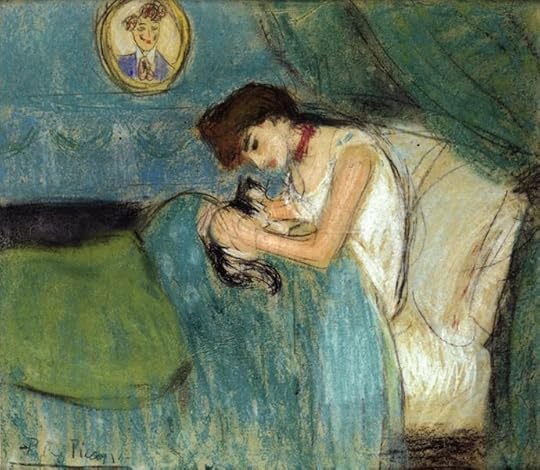
Woman with Cat, Pablo Picasso.
After I had read the review of this book in The Guardian, I felt very tempted to buy it and impatiently counted the days to the premiere. Was it worth the wait? To be frank, I had a love-hate relationship with this book. Some passages were scintillating with brilliance and moved me truly. Some tested my patience and resilience. For example, I felt exasperated by the author’s obsessive, often recurring divagations on the pros and cons of having children. Apropos, I found it surprising that her husband did not participate in these considerations - it looked as if the whole responsibility was Rhiannon Lucy Cosslett's and he would just have to adjust obediently. I am aware these repetitions might be the result of the author’s anxiety problems but I wish she and the editors had been a bit more critical. Another complaint is the extensive length of this book.
With all respect due to Rhiannon Lucy Cosslett and her problems, it is Mackerel the cat who immediately steals the show. I loved her from the moment she entered and wish she would have been in the limelight more often. I also immensely enjoyed the author’s musing on cats in general, the feline quotes, all the interesting examples from literature and art. It was a sheer delight! I wish I could enthuse about the parts in which Rhiannon Lucy Cosslett reveals and unravels in detail her personal traumas. Unfortunately, I did not enjoy these passages although I do feel very sorry for the author and all the 'lemons' she has been gifted generously.
After reading The Year of the Cat I imagine Rhiannon as a sensitive, subtle, fragile, reserved person and I wonder what the emotional cost of revealing to a crowd of complete strangers such personal things was. I guess writing this book might have been a cathartic experience for the author but I hope the publication did not ricochet. Sometimes reading this memoir felt like eavesdropping on Rhiannon Lucy Cosslett's monologues at a therapist.
My lack of total ardour for The Year of the Cat may be rooted in my pet peeve: very personal confessions of people I know absolutely nothing about make me feel awkward and frustrated that there is not much I can do to help. I did not enjoy the forced intimacy between Rhiannon Lucy Cosslett and me either but I appreciated the author's honesty and candid reflections on her life and cats. Especially cats.
Woman with Cat, Pablo Picasso.
January 13, 2023
I had no idea what to expect going in to this and it turned out to be everything I didn’t know I needed.
The breadth of topics covered in this book are astounding and yet I couldn’t get enough. It truly had everything. Discussions on motherhood, fertility, lockdown, health anxiety, disability, violence at the hands of men, ptsd, Parisian living, care work, womanhood, societal pressures, feline friendship and even witchcraft! This book literally has it all and yet not once did it feel overwhelming, it just felt right. Like these thoughts were coming from inside my own head. I think so many people are going to relate to many aspects of this book and I think that’s so special.
Not to mention the writing is incredible. Everything flows so easily, and I could of listened to Rhiannon’s voice all day long.
I can’t wait to see what this writer does next!!
(Big thanks to Netgallery for giving me access to this audiobook 🙏🏼)
The breadth of topics covered in this book are astounding and yet I couldn’t get enough. It truly had everything. Discussions on motherhood, fertility, lockdown, health anxiety, disability, violence at the hands of men, ptsd, Parisian living, care work, womanhood, societal pressures, feline friendship and even witchcraft! This book literally has it all and yet not once did it feel overwhelming, it just felt right. Like these thoughts were coming from inside my own head. I think so many people are going to relate to many aspects of this book and I think that’s so special.
Not to mention the writing is incredible. Everything flows so easily, and I could of listened to Rhiannon’s voice all day long.
I can’t wait to see what this writer does next!!
(Big thanks to Netgallery for giving me access to this audiobook 🙏🏼)

April 17, 2023
Paperback release = June 22nd
January 5, 2023
What a beautiful book. This is a book about motherhood, about trauma, feminism and cats. Rhiannon opens the doors to her life for us with grace and vulnerability, admitting fears and traumas but most of all her own personal journey with these elements.
There were moments when I was happy with her for her healing or sweet memories, her kitten and her life with her husband and then at other moments i found myself angry with her, at those moments of trauma she had to live and that will follow her forever even if they don’t haunt her anymore.
Definitely one that I will revisit when I’m a bit older, I think I’ll find myself relating to different sections depending on my stage in life.
Thank you so much to the publisher and NetGalley for providing me with an e-ARC!
There were moments when I was happy with her for her healing or sweet memories, her kitten and her life with her husband and then at other moments i found myself angry with her, at those moments of trauma she had to live and that will follow her forever even if they don’t haunt her anymore.
Definitely one that I will revisit when I’m a bit older, I think I’ll find myself relating to different sections depending on my stage in life.
Thank you so much to the publisher and NetGalley for providing me with an e-ARC!
March 19, 2023
Disappointed
I was really looking forward to reading this book, but unfortunately found it quite long and boring. The cat history was interesting and the stories of Mackerel were cute but it was so disjointed I found it quite irritating as if I was just reading someone’s journal and random thoughts through lockdown.
I was really looking forward to reading this book, but unfortunately found it quite long and boring. The cat history was interesting and the stories of Mackerel were cute but it was so disjointed I found it quite irritating as if I was just reading someone’s journal and random thoughts through lockdown.

September 3, 2024
Time spent with a cat is never wasted.
Unfortunately, I can't say the same for my time spent with this book, which is more about the author, her fears, and the effect the cat has on her feelings and her ability to love than about the cat itself.
The cat is called Mackerel, a good name for a cat.
Unfortunately, I can't say the same for my time spent with this book, which is more about the author, her fears, and the effect the cat has on her feelings and her ability to love than about the cat itself.
The cat is called Mackerel, a good name for a cat.

January 5, 2024
Neočekivan užitak. Priča o usvojenom mačetu u vreme pandemije zapravo služi da pripremi teren za mnoge druge priče, isprepletane među sobom, veoma interesantne i poučne, ali nekad toliko intimne da sam se sa vremena na vreme osećala kao da prisluškujem razgovor među prijateljima ili čitam nečiji dnevnik. Misleći da je u pitanju dnevnik pandemije, čitalac će se iznenaditi temama koje autorka pokreće.
January 22, 2023
Amazing
I chose this book because of its title, I am a cat lover.
But, this book is so much more, it has totally engrossed me.
There are so many similarities to my life, and I am sure many people's lives.
The book has prompted and helped me to look at life, and particularly my life in a totally different way.
Really enjoyed it.I
Loved the cat intersections and pieces from artists and authors.
Thank you Rhiannon
I chose this book because of its title, I am a cat lover.
But, this book is so much more, it has totally engrossed me.
There are so many similarities to my life, and I am sure many people's lives.
The book has prompted and helped me to look at life, and particularly my life in a totally different way.
Really enjoyed it.I
Loved the cat intersections and pieces from artists and authors.
Thank you Rhiannon
September 2, 2024
3.5 🌟
The content of this book made me feel really, really sad, which is sometimes a good thing but this one was probably wrong book, wrong time.
The style and tone ended up boring me and I had to force myself to finish it. Lots of repetition which I’m sure was intentional but could have done with a tighter edit; kind of all over the place in terms of tone and style - it felt a bit like reading the notes to a book before it became one.
I’d probably have loved it a few lifetimes ago.
The content of this book made me feel really, really sad, which is sometimes a good thing but this one was probably wrong book, wrong time.
The style and tone ended up boring me and I had to force myself to finish it. Lots of repetition which I’m sure was intentional but could have done with a tighter edit; kind of all over the place in terms of tone and style - it felt a bit like reading the notes to a book before it became one.
I’d probably have loved it a few lifetimes ago.

April 23, 2023
"You should have a baby because you are a woman, and women have babies. Otherwise, what are you supposed to do? You have been told that you should have a baby because there is a whole dimension of human experience that you are missing out on. When people tell you this, you want to point out that there are infinite dimensions of human experience, and to experience them all would be impossible. You have never been in a tsunami, for example, or had a tapeworm."
This was a really engaging, often funny, story about a woman debating whether or not she should have children. She gets a kitten, and the capacity for love that caring for the cat reveals,contributes to her belief that she could raise and nurture a child. Whereas caring for my two cats for 14 years has had quite the opposite effect on me. This far and no further! But also, Rhiannon desperately longs for a baby, so her arguments are never that convincing.
The book was a love story about her own mother, her brother, and partially her husband. I thoroughly enjoyed it, despite feeling it was never going to be a particularly useful argument against having children- which may have been part of its intention.
This was a really engaging, often funny, story about a woman debating whether or not she should have children. She gets a kitten, and the capacity for love that caring for the cat reveals,contributes to her belief that she could raise and nurture a child. Whereas caring for my two cats for 14 years has had quite the opposite effect on me. This far and no further! But also, Rhiannon desperately longs for a baby, so her arguments are never that convincing.
The book was a love story about her own mother, her brother, and partially her husband. I thoroughly enjoyed it, despite feeling it was never going to be a particularly useful argument against having children- which may have been part of its intention.
August 8, 2023
If only Cosslet had heeded the advice she received when she was a student “This is a writers’ group, not a therapy session”.
Omg. The self-indulgent navel-gazing. The presumption that she’s interesting enough to warrant a ‘memoir’.
There needed to be much more about cats. Not a potted history of feminism as it relates to cats. . . Not a never-ending series of men-hating anecdotes that always seem to end up with a “Did I mention I was in Paris at the time of the terrorist attacks?” Yes, you did. A LOT. So were about 2 million other people. That doesn’t get to be your ‘thing’. More your thing: a Sarah Everard-type near miss in a park. Fair enough.
Constantly describes herself as ‘mad’. The only people who ever do this are completely normal bores, PTSD notwithstanding, so at least this is quite fitting.
I had zero interest in whether she decided to have a child or not and was at a bit of a loss as to why Cosslett thought any reader would be interested. One for other narcissistic millennials I think.
Omg. The self-indulgent navel-gazing. The presumption that she’s interesting enough to warrant a ‘memoir’.
There needed to be much more about cats. Not a potted history of feminism as it relates to cats. . . Not a never-ending series of men-hating anecdotes that always seem to end up with a “Did I mention I was in Paris at the time of the terrorist attacks?” Yes, you did. A LOT. So were about 2 million other people. That doesn’t get to be your ‘thing’. More your thing: a Sarah Everard-type near miss in a park. Fair enough.
Constantly describes herself as ‘mad’. The only people who ever do this are completely normal bores, PTSD notwithstanding, so at least this is quite fitting.
I had zero interest in whether she decided to have a child or not and was at a bit of a loss as to why Cosslett thought any reader would be interested. One for other narcissistic millennials I think.

January 4, 2025
A personal, open memoir, with Rhiannon's cat Mackerel symbolising her struggles and teaching us all something. There is a lot going on here: the pandemic, relationship, fertility, travel, abuse, family, future... there are probably three or four books compressed into one. I would love to hear more about her autistic brother (and from him).
Ironically for something that laid emotions so bare, I felt weirdly alienated and cold. I expect this mirrors Rhiannon's dissociation and numbness after experiencing trauma. However it was difficult to be disconnected from her in this way.
This is a stream of consciousness and as such lacks editing and focus. For me, it is more successful conceptually than in execution.
Ironically for something that laid emotions so bare, I felt weirdly alienated and cold. I expect this mirrors Rhiannon's dissociation and numbness after experiencing trauma. However it was difficult to be disconnected from her in this way.
This is a stream of consciousness and as such lacks editing and focus. For me, it is more successful conceptually than in execution.
March 11, 2024
Incred, articulated so many of my own thoughts about the having children/ not having children debate and all the shite women have to put up with. Also - as it says on the tin, cat heavy throughout. Chefs kiss

August 31, 2023
I’ve always enjoyed the author’s journalism so I wasn’t surprised to really enjoy this book too. I found it interesting, funny, moving, and relatable. My cunning plan of giving it to my cat-loving sister for her birthday so that I could eventually read it has paid off.
March 11, 2024
my god this is incredible.
April 3, 2025
Within the first 50 pages, I knew this was going to be one for the 5 ⭐️ club. A tender, candour story featuring a cat and the exploration of whether to have a child. I love reading about women's lives!!!

March 6, 2024
I was disappointed in this book. I really looked forward to read this, saw the reviews and it was very promising but I found it to be a long read.

April 19, 2023
A book that explores the pull towards motherhood in your 20s-30s while facing your past and also the unknown of the longevity of your future.
December 2, 2023
I just want a lil boy like mackerel !

January 5, 2023
This book made me feel whole and warm and powerful, and I hope it makes you feel that way too.
Ease of Reading: 5✨
Writing: 5✨
Substantiality: 4✨
Impactfulness: 5✨
Accessibility: 5✨
Enjoyment: 5✨
Overall: 4.83✨
The vibe: memoir, feminist, cats, self-growth, London, city living, motherhood, millennial, witchy
I listened to the audio version of this book gifted via Netgalley, and I already want to reread a physical copy to highlight a million lines within it and feel the feels again.
I would call this a memoir maybe? And is read by the author herself. It follows Rhiannon through the purchase of a kitty in lockdown, and how she relates this experience to the decision of motherhood (which I feel privileged for me is also a decision).
Being in my late twenties with many friends of similar ages, the talk of motherhood is one which is always being discussed. The way The Year of the Cat approaches this topic is very respectful but also insightful and adds a different lens to the discussion.
The book interweaves lil cat facts throughout its pages and I love how it visits goddesses and witches amongst them.
I would say there are a spattering of trigger warnings to be wary of, main ones being PTSD, anxiety and violence. But overall this book is modern and magical, a perfect millennial memoir that I really recommend.
Ease of Reading: 5✨
Writing: 5✨
Substantiality: 4✨
Impactfulness: 5✨
Accessibility: 5✨
Enjoyment: 5✨
Overall: 4.83✨
The vibe: memoir, feminist, cats, self-growth, London, city living, motherhood, millennial, witchy
I listened to the audio version of this book gifted via Netgalley, and I already want to reread a physical copy to highlight a million lines within it and feel the feels again.
I would call this a memoir maybe? And is read by the author herself. It follows Rhiannon through the purchase of a kitty in lockdown, and how she relates this experience to the decision of motherhood (which I feel privileged for me is also a decision).
Being in my late twenties with many friends of similar ages, the talk of motherhood is one which is always being discussed. The way The Year of the Cat approaches this topic is very respectful but also insightful and adds a different lens to the discussion.
The book interweaves lil cat facts throughout its pages and I love how it visits goddesses and witches amongst them.
I would say there are a spattering of trigger warnings to be wary of, main ones being PTSD, anxiety and violence. But overall this book is modern and magical, a perfect millennial memoir that I really recommend.

December 21, 2022
This is an utterly gorgeous book/audiobook!
Admittedly, I just saw "Cat" in the title and thought "Yup, getting that." I didn't realise that the focus of the memoir is the author's dilemma as to whether to have a baby or not, against the backdrop of Covid lockdowns in London. As a childfree woman who feels no desire to have children, I found her writing incredibly moving (and comforting, in a way - I feel absolutely nothing of the longing she describes, which makes me more certain about my own feelings).
I was originally going to give the book 4 stars, because one thing that I struggled with (more at the beginning) was the abrupt switching that happens between different memories and moments in Cosslett's life. And there were so many family cats flying around I couldn't keep track! I got a little more used to it as time went on.
Without going into detail, there are some exceptionally dark moments in this book, which may be triggering for women who have suffered from male violence. Some readers may also be put off by the fact that the book is partly about lockdown, but I would urge them to give it a try - I have avoided lockdown books in the past but I never found this one tiresome or tough to read.
Cosslett writes about her life with great skill, and I wanted to give her a huge hug by the end. I was sad to finish!
(With thanks to Headline Audio and NetGalley for this audiobook in exchange for an honest review)
Admittedly, I just saw "Cat" in the title and thought "Yup, getting that." I didn't realise that the focus of the memoir is the author's dilemma as to whether to have a baby or not, against the backdrop of Covid lockdowns in London. As a childfree woman who feels no desire to have children, I found her writing incredibly moving (and comforting, in a way - I feel absolutely nothing of the longing she describes, which makes me more certain about my own feelings).
I was originally going to give the book 4 stars, because one thing that I struggled with (more at the beginning) was the abrupt switching that happens between different memories and moments in Cosslett's life. And there were so many family cats flying around I couldn't keep track! I got a little more used to it as time went on.
Without going into detail, there are some exceptionally dark moments in this book, which may be triggering for women who have suffered from male violence. Some readers may also be put off by the fact that the book is partly about lockdown, but I would urge them to give it a try - I have avoided lockdown books in the past but I never found this one tiresome or tough to read.
Cosslett writes about her life with great skill, and I wanted to give her a huge hug by the end. I was sad to finish!
(With thanks to Headline Audio and NetGalley for this audiobook in exchange for an honest review)

February 19, 2023
I read this memoir at a particular point in my life and it really spoke to me. It’s one of only books which have brought tears to my eyes.
I am OBSESSED with cats and loved the vignettes of the charm and idiosyncrasies of cats as a metaphor and the ‘crazy cat lady’ stereotype.
I am OBSESSED with cats and loved the vignettes of the charm and idiosyncrasies of cats as a metaphor and the ‘crazy cat lady’ stereotype.
August 11, 2023
3.5 stars. I enjoyed reading this, although it wasn't what I expected from the title or blurb. It's about the author getting a cat during lockdown, but actually it's about her traumatic past and her decision whether or not to have a baby. I found my mind wandering quite a bit as two thirds in it all became a bit samey, and this coincided with a decrease in cat anecdotes which are a significant part of the charm of the book. But overall I enjoyed it, it just maybe could have been a bit shorter.
November 8, 2023
I started off reading the physical copy of this book but was struggling with it. BBC Sounds have an abridged version of it so I switched to that. I am wondering if the abridged version drastically changes the story.
Rhiannon Lucy Cosslett writes in a diary like way, which I appreciated but the content didn't grab me. She had a lot of worries and anxieties which intensified during the lock down period. She decided to channel her desire to be a mother into caring for a kitten. I don't think it's the same thing but whatever floats your boat.
I did like some of the topics she touched upon such as pregnancy scares as a teen versus the desire to be pregnant as an adult, how women are expected to be grateful carers and not speak about about the burden of caring. Shitty male therapists. She spoke about the time a man strangled her on the street and how everyone else walked by. It was terrifying, and the lack of care the police showed. She spoke about Sarah Everard's murder without naming her. I think A Year of the Cat is so firmly placed in the Covid years, once you read it outside of that, the impact is lost even though the themes are applicable to all time periods.
When you don't enjoy reading/listening, you start to pick up on all the minor things that irritate you such as the editing of the abridged audio version. Usually in audiobooks, you don't hear the narrator breathe before they begin a sentence, even though everyone takes a breath before they speak. It bugged me a lot. I also didn't appreciate the austen-esque piano music to highlight the breaks in narrative. I also couldn't get over, how bored the author sounded, reading aloud her own book.
A friend read A Year of the Cat at the same time, and they loved it. They really appreciated how the narrative would jump across time periods because that's a natural form of speaking. Nobody discusses events in strict chronological order, they intersperse it with anecdotes, analyses, thoughts etc
Something they picked up on (which I didn't even think about) is the allocation of burden. Although Rhiannon and her husband agreed to get the cat, Rhiannon did most of the work. We had both read Invisble Women recently so this remains a hot topic. I felt that Rhiannon nagged her husband into getting a cat, and as the cat was mostly for her benefit, it made sense that she cared for it the most.
Honestly, I wouldn't recommend A Year of the Cat, but I can see from other reviews, people reacted to it very strongly. Mostly, I found it forgettable.
Rhiannon Lucy Cosslett writes in a diary like way, which I appreciated but the content didn't grab me. She had a lot of worries and anxieties which intensified during the lock down period. She decided to channel her desire to be a mother into caring for a kitten. I don't think it's the same thing but whatever floats your boat.
I did like some of the topics she touched upon such as pregnancy scares as a teen versus the desire to be pregnant as an adult, how women are expected to be grateful carers and not speak about about the burden of caring. Shitty male therapists. She spoke about the time a man strangled her on the street and how everyone else walked by. It was terrifying, and the lack of care the police showed. She spoke about Sarah Everard's murder without naming her. I think A Year of the Cat is so firmly placed in the Covid years, once you read it outside of that, the impact is lost even though the themes are applicable to all time periods.
When you don't enjoy reading/listening, you start to pick up on all the minor things that irritate you such as the editing of the abridged audio version. Usually in audiobooks, you don't hear the narrator breathe before they begin a sentence, even though everyone takes a breath before they speak. It bugged me a lot. I also didn't appreciate the austen-esque piano music to highlight the breaks in narrative. I also couldn't get over, how bored the author sounded, reading aloud her own book.
A friend read A Year of the Cat at the same time, and they loved it. They really appreciated how the narrative would jump across time periods because that's a natural form of speaking. Nobody discusses events in strict chronological order, they intersperse it with anecdotes, analyses, thoughts etc
Something they picked up on (which I didn't even think about) is the allocation of burden. Although Rhiannon and her husband agreed to get the cat, Rhiannon did most of the work. We had both read Invisble Women recently so this remains a hot topic. I felt that Rhiannon nagged her husband into getting a cat, and as the cat was mostly for her benefit, it made sense that she cared for it the most.
Honestly, I wouldn't recommend A Year of the Cat, but I can see from other reviews, people reacted to it very strongly. Mostly, I found it forgettable.
This entire review has been hidden because of spoilers.

May 19, 2024
Having read "The Panic Years" by Nell Frizzell about two years ago I wasn't sure whether there could be much more for someone to add to the collection of narratives about having children or not, however I think that the way Cosslett has told her story makes it very personal and relatable to the reader and I didn't feel that she is necessarily repeating anything that I had heard before.
This is a well-balanced memoir and narrative around Cosslett's decision about whether to become a parent. Cosslett cleverly plays out the thoughts of all the pros and cons through the stories of her kitten, Mackerel, who she and her husband adopt during lockdown. The book is like an extended essay, with little segues into different areas of Cosslett's past and how these events have shaped her life and the decisions she finds herself facing. Cosslett doesn't hide the fact that she is the survivor of a horrific and deeply traumatic attack as she references it throughout along with the therapy she has undergone to come to terms with the PTSD (and I just want to say I think this is incredible and I'm so pleased that she is doing ok now). There are plenty of stories about Mackerel and other cats Cosslett has had in her life (don't we all have a cat story?!), but this isn't "just" a book about a woman and her cat. It is in turns funny, moving and insightful.
This is a well-balanced memoir and narrative around Cosslett's decision about whether to become a parent. Cosslett cleverly plays out the thoughts of all the pros and cons through the stories of her kitten, Mackerel, who she and her husband adopt during lockdown. The book is like an extended essay, with little segues into different areas of Cosslett's past and how these events have shaped her life and the decisions she finds herself facing. Cosslett doesn't hide the fact that she is the survivor of a horrific and deeply traumatic attack as she references it throughout along with the therapy she has undergone to come to terms with the PTSD (and I just want to say I think this is incredible and I'm so pleased that she is doing ok now). There are plenty of stories about Mackerel and other cats Cosslett has had in her life (don't we all have a cat story?!), but this isn't "just" a book about a woman and her cat. It is in turns funny, moving and insightful.

August 7, 2023
This book raised some interesting points about motherhood in the 21st century, about living a nurturing and fulfilling life and what that looks like to different people. I enjoyed the historical break-down of the ‘crazy cat lady’, the spinster or the witch and how decades of artists have tried to defy the stereotype and failed (why is that?)
I kind of liked the memoir in the way that there are some similarities between myself and the author but there were parts that bugged me…
1) She clearly wants a child from page 1, so the tooing and froing didn’t feel very balanced from the off, the answer to ‘what’s your purpose?’ Seems to be ‘having a fleshy baby, but if you don’t want to that’s ok too’ - which feels a tad condescending
2) When Mackerel is sick, “sobbing into my face mask, I have become the essence of crazy cat lady. It is a complete overreaction, but I can’t seem to stop. It’s as though the cat is that last thing standing between me and a total breakdown. It is only now that I realise the extent to which she has kept me sane” - THERE IS NOTHING EMBARRASSING ABOUT CARING FOR A SENTIENT BEING
I kind of liked the memoir in the way that there are some similarities between myself and the author but there were parts that bugged me…
1) She clearly wants a child from page 1, so the tooing and froing didn’t feel very balanced from the off, the answer to ‘what’s your purpose?’ Seems to be ‘having a fleshy baby, but if you don’t want to that’s ok too’ - which feels a tad condescending
2) When Mackerel is sick, “sobbing into my face mask, I have become the essence of crazy cat lady. It is a complete overreaction, but I can’t seem to stop. It’s as though the cat is that last thing standing between me and a total breakdown. It is only now that I realise the extent to which she has kept me sane” - THERE IS NOTHING EMBARRASSING ABOUT CARING FOR A SENTIENT BEING
This entire review has been hidden because of spoilers.

September 22, 2025
A friend recommended this to me a few years back so I was intrigued to read it especially as a cat owner myself. This covers the first year of owning a kitten, which I found incredibly relatable as we only got a kitten last year. The story is interspersed with other things that are either ongoing in her life or have happened in her life. The range of topics is wide, fertility, family (in particular her autistic brother, PTSD from an attack on her, anxiety, living in Paris and more. She’s obviously had quite a life and not all of it good. I didn’t mind the diversions on the way but the star of the show is Mackerel the kitten. I’m pleased I read it read it now and not earlier as I could relate to all the anxiety of bringing the kitten home, and all the firsts, the hiding places when you think they have gone missing, although we had the added stress of introducing it to our two older cats too.
July 17, 2024
Having not had any expectations of this book before reading it, I have been left feeling I loved some aspects and hated others. It is a memoir type book based around a year in lockdown and getting a cat. It refers to previous trauma and difficulties faced by the author (all wrote beautifully and interspersed between stories of cats). Then there is the constant back and forth as to whether to have children, which frankly was very annoying and repetitive (probably as it was for the author in real life). But overall that just spoilt this book for me and I would have loved to have read a version with about a quarter of the references to the dilemma of parenthood, personally I believe this would have been a truly great book
August 22, 2023
This book wasn’t about the cat much at all it was mainly about her and her husbands life though out lockdown which really annoyed me as the books is called the year of the cat. You get bits and pieces of the cat though out the book but no much at all. There is also a lot about her childhood and her parents and there cats which I didn’t really enjoy at all. I found this book to be boring and lacking anything interesting I got board whilst reading this book and when I finally finished it I was so glad. The bits we did get about the cat were interesting and intriguing to read about and I enjoyed some of them parts of the books but overall this book was a massive let down xxx
March 5, 2024
I had high hopes for this book, I truly did.
Initially, the premise seemed promising, and I appreciated the author's exploration of topics that resonate deeply with me. Using anecdotes about cats to delve into themes such as motherhood, fertility, PTSD, anxiety, and family was an intriguing approach. However, I found the transitions between these themes to be awkward and forced. While I understood the author's intention, the execution felt disjointed. At one point, I almost DNF the book, but then I skimmed through the final third. Given the book's strong starting point and concept, I suppose my rating is fair, but it falls short of my initial expectations.
Initially, the premise seemed promising, and I appreciated the author's exploration of topics that resonate deeply with me. Using anecdotes about cats to delve into themes such as motherhood, fertility, PTSD, anxiety, and family was an intriguing approach. However, I found the transitions between these themes to be awkward and forced. While I understood the author's intention, the execution felt disjointed. At one point, I almost DNF the book, but then I skimmed through the final third. Given the book's strong starting point and concept, I suppose my rating is fair, but it falls short of my initial expectations.
Displaying 1 - 30 of 66 reviews