Jump to ratings and reviews
Rate this book

California Natural History Guides #76

Introduction to Water in California

Rate this book
The food each of us consumes per day represents an investment of 4,500 gallons of water, according to the California Farm Bureau. In this densely populated state where it rains only six months out of the year, where does all that water come from? This thoroughly engaging, concise book tells the story of California's most precious resource, tracing the journey of water in the state from the atmosphere to the snowpack to our faucets and foods. Along the way, we learn much about California itself as the book describes its rivers, lakes, wetlands, dams, and aqueducts and discusses the role of water in agriculture, the environment, and politics. Essential reading in a state facing the future with an already overextended water supply, this fascinating book shows that, for all Californians, every drop counts. A new preface on recent water issues brings the book up to the minute. * Features 130 color photographs and 26 color maps * Includes a table, "Where Does Your Water Come From?,"

262 pages, Paperback

First published April 26, 2004

26 people are currently reading
85 people want to read

About the author

David Carle

24 books2 followers

Ratings & Reviews

What do you think?
Rate this book

Friends & Following

Create a free account to discover what your friends think of this book!

Community Reviews

5 stars
32 (30%)
4 stars
44 (41%)
3 stars
20 (19%)
2 stars
9 (8%)
1 star
0 (0%)
Displaying 1 - 18 of 18 reviews
Profile Image for Richard.
1,187 reviews1,145 followers
July 6, 2021
Update, 28 June 2021 —

The New York Times just published an article, It’s Some of America’s Richest Farmland. But What Is It Without Water?
❝A California farmer decides it makes better business sense to sell his water than to grow rice. An almond farmer considers uprooting his trees to put up solar panels. Drought is transforming the state, with broad consequences for the food supply.❞
A major gripe with Carle’s book is that it is seriously out of date. This article screams out that fact: so little water is available that agriculture at the southern end of the San Joaquin — some of the most valuable farmland in all of the United States — is being shut down due to the lack of water. Given how little the U.S. and the world are doing about climate change, this story doesn’t have a happy ending.
Back to the previously filed review…

The University of California Press provides an incredible resource in their California Natural History Guides. I've got several of them, although scrolling through the list of titles in the publisher's catalog makes me want more.

This book isn't listed there, though. That's probably because it is from 2004, and a lot has happened since then. There were two droughts, after all — the short one in 2007–2009, and then the really bad one in 2011–2017. Now (2021) we seem to be starting an even worse one, so the book would really need to be updated. I wouldn't be surprised if they were working on one, but that it is too tough to keep up with the climate changes to get it out the door.

But this is still excellent in many ways, especially the natural history portions.

As a backpacker, I was especially pleased by the second chapter, "California Water Landscape", specifically when the author went through each of the major hydrologic regions. I'm a little embarrassed to admit that I learned something a few new things.

I've been backpacking in California for decades, so I thought I knew this well. For example, I live in San Francisco, so my drinking water is captured in Yosemite where the O'Shaughnessy Dam holds back the waters of the Tuolumne River at the Hetch Hetchy* Reservoir. I knew the remnants of the Tuolumne would join the Merced in the San Joaquin, which headed up the southern half of the Central Valley to join the Sacramento River and head west to the sea.

What I didn't know was that the water from those two rivers at one point never really got to the ocean via San Francisco. Agriculture sucked it dry. Only the treated sewage of cities further downstream recreated the "river", many miles later. That changed in 2009, well after this book was published, although reconnecting the San Joaquin to the ocean is a long, multi-step process that doesn't seem to be done yet.

I also thought that the Kings River, which drains Kings Canyon (the National Park south of Yosemite, and in some ways more beautiful to my tastes as a backpacker) eventually joined the San Joaquin. Not at all, and not ever! The Kings terminated in the long-gone Tulare Lake — once the largest freshwater lake west of the Mississippi River, now emptied and filled for agriculture. Tulare County is now the third most agriculturally productive county in the United States, after Fresno and Kern Counties, neighbors in the southern San Joaquin Valley. Those farms, that's where the Kings River ends up (along with that of the Kern, and others from the southern Sierra Nevada).

The next chapter was about how California rearranged the natural distribution of water. Nothing surprising there to a native. That Los Angeles, and southern California more generally, are the main villains is old history. “Forget it, Jake. It's Chinatown.” I did learn a bit about the extent, though. Did you know the entire hydroelectric power output of the California State Water Project (6.5 terawatt-hours, including the 2.2 terawatt-hours of the Oroville Dam, tallest in the U.S.) isn't enough by a long shot to power the pumps that haul water over the Tehachapi Mountains and down to Los Angeles, et al? Water is heavy, and moving it takes a vast amount of electricity. In 2020, California's dams produced 21.4 terawatt-hours, total, and in some years the SWP takes almost half of that to move water.

It does make sense, though. Los Angeles County was once the most productive place in the country to grow food, but the near-endless sunshine was also attractive to humans, who moved there in droves. According to our author, the region's water could naturally support three million people, but some twenty million want to live there. And the sunshine is hot, so they want their swimming pools, and nice green lawns and golf courses. And all together, they've got the money to get those things, even if it means warping nature in horrifying ways, and destroying less powerful communities.

They don't really want to stop that, but climate change and other powerful interests are slowly forcing changes. I doubt those changes will be satisfactory, but so it goes.


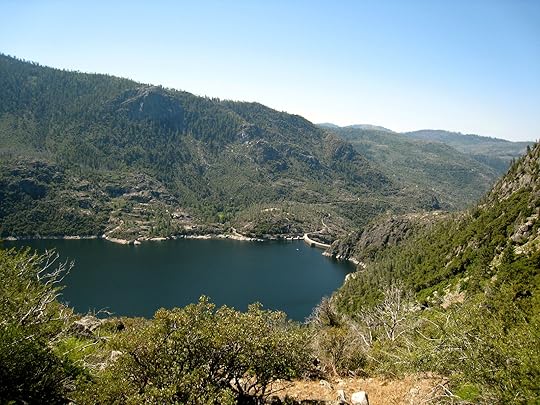
*Aside: I wasn't surprised when this book discussed the idea of tearing down that dam to return the Hetch Hetchy Valley — the sibling of the majestic Yosemite Valley — to nature, somewhat decrying its creation. What I think is underappreciated is how pristine Hetch Hetchy is, compared to Yosemite. Yosemite Valley has many acres of parking lots, massive traffic jams, sewer systems, and millions of people. The views are stunning, but there really isn't much that's purely natural. If Hetch Hetchy Valley hadn't become San Francisco's watershed and thus very, very highly protected, I'm fairly confident it would have shared Yosmite Valley's fate. Would I support tearing down the dam, now? Only if we had a U.S. Congress that wouldn't try to monetize it. Instead, I suspect the Walt Disney Company (or someone else) would bid for the rights to "manage" it into an exciting new tourist destination. That would not be better than the protected watershed it remains today. This is what it look like now (well, actually, when I last backpacked there in 2008):

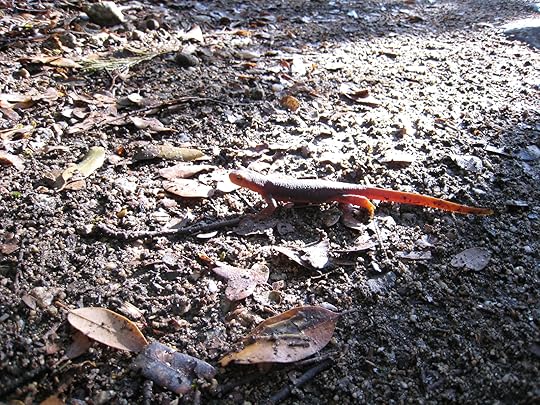
I saw almost no other soul while on my 3-day backpacking trip, although I did have to watch my step to avoid little fellows like the below. I've never seen a salamander on the hard-trodden trails of Yosemite Valley.
49 reviews2 followers
August 23, 2017
The definitive book on water in the west is Cadillac Desert, which is a true masterpiece and one of the best pieces of nonfiction writing and research I have ever read. This book has more modest ambitions, part almanac and part atlas, but after reading it I think I grasp the fundamentals of California's water situation better than I did after reading Cadillac. Recommended.
Profile Image for Asi Traore.
1 review
Read
July 17, 2025
As someone who usually reads classic literature and stuff, this was (besides for school) my first real foray into reading a nonfiction science type book. It was recommended to me by a waterologist (shout out Curt), as I have recently become more aware and thus curious about water in the good god sent state in which I live. I will admit i did not find it a thrilling read, but I read it to learn so I guess I got what I wanted. I feel like a fair amount (most if not all) of it went over my head, as I am unfamiliar with hydrology, but it was a good introduction. I imagine with perhaps a reread and maybe more books on water I might be able to better wrap my head around this stuff, but alas I am wimping out of nonfiction immediately after my first foray. The classics call my name again.
Profile Image for Jon.
376 reviews9 followers
August 12, 2012
Similar in concept to Water in Texas: An Introduction, this book runs through the basics of the California water system. While I largely preferred the Texas book's organization (though there was at least one clunky chapter that I'd have pulled to the back as an appendix), Carle had a knack with words that the Texas water book's author did not, making the California book in some ways a better read. Its charts are also particularly fascinating, with for example one given over to sizing rivers by how much water is taken from them for each major metropolitan area of the state.

Because California seems to be the epicenter for water issues and because I grew up in the state, I was much more aware of many of the items recounted in this book than I was in the Texas book. This is also, of course, the fourth book on water I've read in a row, so likewise, there's been some redundancy in terms of things I hadn't known until now.

Like most of the water books, this one starts with a general introduction about water itself (its various unique properties) and about the water cycle (how it goes from land to sea to sky). Added to this section in Carle's book is information about how California's landscape is one of extreme wet and extreme dry, depending on the year (and even during the course of the year, since virtually all of the state's precipitation arrives between December and February). Hence, there is no true average, and water planners have to adjust accordingly. This is one reason that in many ways California's is perhaps one of the most human-manipulated water supplies in the country.

How manipulated it is is made plain in the third section of the book, where Carle discusses the state's water distribution system. Subsections are devoted to each delivery system, each aqueduct.

This isn't to say that natural watersheds are ignored. Those are discussed in the second section of the book, with again subsections given over to each hydrologic region. What is made plain is how water comes mostly from the north and the mountains and is transferred to the south and the shore. This obviously has huge environmental impacts, which are picked up on in the fourth and fifth sections of the book, on the challenges the California water system presents.

As in Texas, overdrafting of groundwater is a problem because once again it is largely unregulated. Whoever owns the land above can use the water below. I certainly would want the rights to dig a well on my own property. But this can lead to problems, since groundwater isn't unconnected to surface water, and if one landowner draws out a huge share, then others who use the same aquifer will suffer. One solution in California has been to recharge groundwater with waste water and other reserves, which has some benefits (as well as costs). It was interesting to learn that Glendale, close to my birth home, had its groundwater despoiled, so that unlike Pasadena, where I grew up, it can no longer get part of its water from beneath the ground.

There has been some negative reaction against the reuse of waste water, but as the author notes, residents often aren't aware that "pristine" water from surface sources often is waste water from cities further up in the watershed. In fact, often, treated waste water is cleaner than water coming into a particular area for just this reason. Such pollution has also led to concerns about Giardia, a waterborne parasite that makes some worry about the safety of backcountry water. Indeed, fecal contamination is somewhat widespread, leading some backpackers to pack bottled water. But as the author notes, this concern is a bit overhyped--most tap water, which is treated, is likely to contain a higher concentration of Giardia cysts, and bottled water (often pulled from said streams or from tap water itself) but without the safety testing is likely to be even worse. The better thing to do is to use common sense--when hiking, pull water upstream and away from camps and trails where there is plenty of flow where it's likely to be cleaner.

In the final challenges section, the author also tackles the need for conservation, showing the ways that cities like Los Angeles have managed to cut back on water use even as the population has increased--through reuse and better use. As with virtually every state, almost every good potential dam site has been dammed, so achieving more efficiencies by storing more isn't really an option. Beyond that, such dams create environmental concerns that the state is now paying closer attention to. The filling in (via sediment buildup) and upcoming destruction or renovation of dams offers opportunities for California to reassess some of its water management strategies.
301 reviews9 followers
January 8, 2008
I am not a hydrologist, or a 'professional' environmentalist; I'm just a layperson who likes to know how the world works.

This book has roughly 3 parts, outlining the physical hydrology of California (where water would go if we left it alone), the engineered hydrology (where water goes now because we move it), and the challenges of California water management in the 21st century.

The first two parts are very descriptive and very interesting, partially because they just describe the world as it is (or was). The third part is the weakest part of the book, partially because it describes ongoing history (the narrative cuts off in late 2002, and there were a lot of issues that were left hanging), and partially because it has a bit of a feel of a harangue -- focusing on ways that individual consumers can save a gallon or two (which, keep in mind, means millions of gallons in the aggregate) while ignoring many ways that non-urban users can save water (agriculture isn't the most efficient user of water, partially because it is so cheap, and agriculture is one of the biggest water users in the state). A big omission that I was hoping for (on a detailed note) is that the author implies that salination of the ground due to irrigation -- the downfall of many historic civilizations in the Middle East, and a growing problem in California -- can be dealt with but he never says why.

But the first two parts are great.
Profile Image for Julie Mickens.
209 reviews30 followers
December 27, 2018
Well-told and valuable introduction to California's hybrid or even cyborg water system -- half nature, half machine. My copy was a first edition from the library, so published in 2004 and written in 2002. A lot has changed since then, although the core of the CA water system remains those essential bones laid down during the post-war era, the New Deal era, and the early 20th century. An updated 2nd edition would probably get 5 stars.
31 reviews
December 20, 2025
Useful introduction to the intricacies of the California systems that gather and distribute water. Introduces the various watersheds, hydrologic zones, and relevant local, state and federal agencies. Discusses general issues, such as water rights, the over-committing of available water, competing interests, conservation efforts, desalinizaton, and the effects of climate change. Gives a broad rather than detailed view.
Profile Image for Samuelthunder.
194 reviews
July 20, 2024
A bit more of a reference, and fairly dated (definitely in need of a newer version), but makes for fascinating reading all the same. Should be required knowledge for Californians: where our water comes from, how it's distributed, competing uses, environmental concerns and controversies, etc. The book is concise, but still quite comprehensive, and quite readable. Essential stuff, water.
Profile Image for A.
1,231 reviews
June 17, 2011
This is one of the books that everyone who lives in California should read. It should make you re-think how you use water since most of it travels many miles to get to your tap. It is a comprehensive view of water, its sources, uses, politics, how to conserve it, and how it is being recycled.

While driving Interstate 5 between southern and northern California, there are plenty of signs on corporate farm land saying "Congress Created Dustbowl." Pure politics. Interstate 5 through the Central Valley is full of acres of farmland. It seems to be on the increase. And then there's all of the KB Homes developments that used to be farmland...
Profile Image for Veronica.
28 reviews4 followers
September 24, 2012
The photographs, maps, figures and facts with cited sources make this an excellent "go to" book for getting away from history and science textbooks and into a primary source for integrating water facts into geography, biology, chemistry, political science, etc.
Profile Image for Katharine.
110 reviews
May 3, 2016
Everyone who lives in California should read this to understand where our water comes from and what it costs, economically and environmentally speaking, and to be a more informed participant in very important California water policy debates. Maybe William Shatner should read it first.
Profile Image for Virginia.
115 reviews
September 8, 2012
Fantastic eyeopening reference on all our water sources in California.
1 review13 followers
February 17, 2014
Required reading for anyone who uses water in California.
7 reviews
April 21, 2014
This book has changed my outlook.
Displaying 1 - 18 of 18 reviews

Can't find what you're looking for?

Get help and learn more about the design.