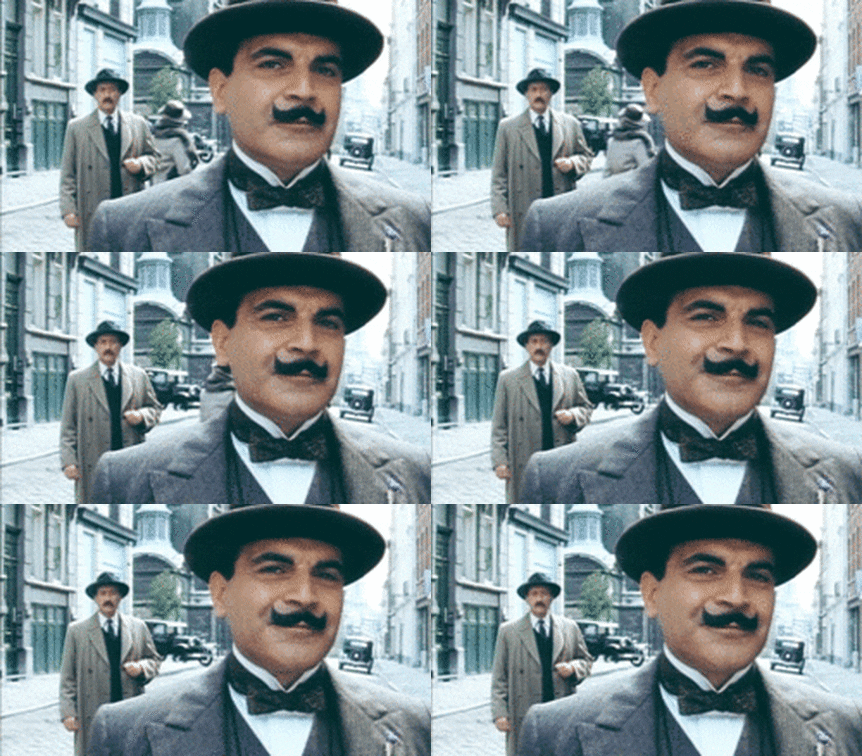
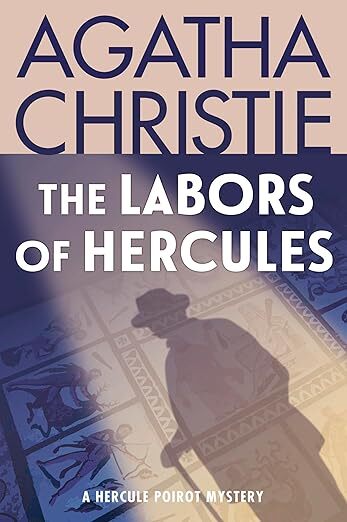
The first story, The Nemean Lion illustrates Poirot's humanity and acute perception. We also learn that Miss Lemon can type "with the speed and precision of a quick firing tank." The story includes a pekinese dog and there is a delicious twist in the tale.
Quotes I appreciated from the second story, The Lernaean Hydra:
"Coloring up to his eyebrows," and "a mare's nest."
The Arcadian Deer deals with hope and despair, life, and death, and art. "When he saw her lying there with hollow cheeks in each of which was a vivid red stain and long thin emaciated hands stretched out on the coverlet a memory stirred in him. He had not remembered her name but he had seen her dance, had been carried away and fascinated by the supreme art that can make you forget art."
The Erymanthian Boar takes place in Switzerland and includes a funicular railway. I loved the description of the passengers. Poirot and the American piece together who is who. I enjoyed the different definitions of boar versus bore.
The Augean Stables. I loved that a well-worn raincoat stands as "a symbol of the English climate, of the prudent forethought of the English race, of their attachment to old possessions." Then, there is the description of one of the characters, "in his bluff British way John Hammett was an orator. His speeches, quietly and earnestly delivered contained those simple sentimental cliches which are so deeply rooted in the English heart."
The Stymphalean Birds story teaches us that appearances can be deceiving. "Two grim women" described as "blood-sucking harpies" are not quite what they seem.
In The Cretan Bull, Hugh Chandler believes himself to be a monster. Poirot sets out to help him discover the truth. According to Poirot, "It is much easier to catch a murderer than it is to prevent a murder."
The Horses of Diomedes is about illegal drugs and how they can destroy lives. "The person who deliberately profits from the degradation and misery of other people is a vampire preying on flesh and blood."
The Girdle of Hippolyta is about a stolen Rubens.
The Flock of Geryon is the story of a charismatic religious leader with a diabolically clever plan to enrich his ministry.
The Apples of Hesperides is about a treasure known as the Borgia goblet. The setting is the west of Ireland, which is described as having a "melancholy haunted beauty."
Furthermore, I was intrigued to read that, "Here in the west of Ireland the Romans had never marched [...] had never fortified a camp, had never built a well ordered sensible, useful road. It was a land where common sense and an orderly way of life were unknown."
The Capture of Cerberus begins on with Poirot travelingon the underground and lamenting the crush of people. Too many people. Interesting, perhaps even intriguing quote: "What was this passion that attacked women for knitting under the most unpropitious conditions. A woman didn't look her best knitting, the absorption, the glassy eyes, the restless busy fingers. One needed the agility of a wild cat and the willpower of a Napoleon to manage to knit in a crowded tube. But women managed it."