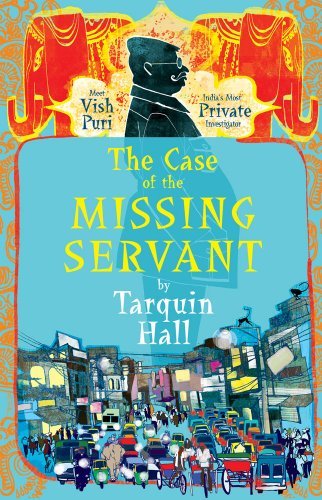
Meet Vish Puri, India's most private investigator. Portly, persistent, and unmistakably Punjabi, he cuts a determined swath through modern India's swindlers, cheats, and murderers.
In hot and dusty Delhi, where call centers and malls are changing the ancient fabric of Indian life, Puri's main work comes from screening prospective marriage partners, a job once the preserve of aunties and family priests.
But when an honest public litigator is accused of murdering his maidservant, it takes all of Puri's resources to investigate. How will he trace the fate of the girl, known only as Mary, in a population of more than one billion? Who is taking potshots at him and his prize chili plants? And why is his widowed "Mummy-ji" attempting to play sleuth when everyone knows mummies are not detectives?
With his team of undercover operatives -- Tubelight, Flush, and Facecream -- Puri ingeniously combines modern techniques with principles of detection established in India more than two thousand years ago -- long before "that Johnny-come-lately" Sherlock Holmes donned his deerstalker.
The search for Mary takes him to the desert oasis of Jaipur and the remote mines of Jharkhand. From Puri's well-heeled Gymkhana Club to the slums where the servant classes live, his adventures reveal modern India in all its seething complexity.
Tarquin Hall is a British author and journalist who has lived and worked throughout South Asia, the Middle East and Africa. He is the author of The Case of the Missing Servant, dozens of articles, and three works of non-fiction, including the highly acclaimed Salaam Brick Lane, an account of a year spent above a Bangladeshi sweat shop in London’s notorious East End. He is married to Indian-born journalist, Anu Anand. They have a young son and divide their time between London and Delhi.
Fun read! An Indian murder mystery, taking place in and around Delhi, relaxed and entertaining, just what I needed now. Meet Vish Puri, India's most private investigator. Portly, persistent and unmistakably Punjabi, including a magnificent waxed moustache, he cuts a determined swathe through modern India's criminal classes...... More to follow. Say 3.8. Enjoyed it!
“Watch out Alexander McCall Smith!” claims the blurb. Watch out indeed, because Hall is not doing the genre any favors. Though I picked this up due to a favorable GR review, and found myself further intrigued by comparisons to the Inspector Singh series, I’d say Hall needs further practice before he’s ready for the big time.
I originally passed it to my mom, hoping to tease her into another series and perhaps, you know, broaden her horizons just a touch. She complained it was hard to get into to and that there were “a lot of words to look up.” She tends to be more of a stickler with wanting to understand things, so I figured that I’d give it a shot as a genre reader.
Right away, I empathized with her experience. In the first paragraph, Vish Puri is “devouring a dozen green chili pakoras* from a greasy takeout box.” That asterisk refers the reader to a glossary with over one-hundred-fifty words. Still, I tried my sci-fi skills. Not terrible. Hall usually has one vocabulary word or two per paragraph. But still, the one I tried made no sense: ‘press-wallah,’ defined as a ‘journalist.’ The sentence it is used in? “The family also relied on a part-time dishwasher, a sweeper, a gardener and the local press-wallah who had a stand under the neem tree down the street where he applied a heavy iron filled with hot charcoal to a dizzying assortment of garments, including silk saris, cotton salwars and denim jeans.”
So is Hall having us on?
Well, aside from that. Given the glossary is over 150 words, you can easily assume this isn’t your average mystery. And in fact, it is not. It is a slice of life tale that is told in a very meandering, wandering fashion. Thus, in the middle of a stakeout in the first chapter, Mr. Puri is recalling his latest letter to The Times of India, decrying the youth of today. I get it; Hall is trying for a chatty, accessible tone, except it isn’t accessible at all. Any forward momentum in the story is derailed with backstory. We can’t just refer to someone by nickname; no, Mr. Puri needs to think about all the other nicknames his crew has, his own nickname, and the reasons they all came about, and what his doctor’s thoughts were on his chubbiness at his latest visit. Again, this might be charming if you wanted a travelogue through semi-modern India. In a mystery? Not so much. Add in his penchant for dressing well (or at least, very Seville Row) and chubbiness, coupled with an outdated cultural view, and I wonder if we are supposed to be laughing at Mr. Puri.
I’ll note a couple of things. One, as I was recently reminded when reading a blog post from James Corey, if you wink too much at your protagonist, you risk not taking them seriously. Two, you want to write a mystery, you need some dramatic tension. Expecting your readers to frequently stop and look up words in a glossary is not how you maintain that tension.
All it took was that chapter and I concurred with the Mom. I also concurred with Richard’s last paragraph of his review where he notes “but for a mystery reader, it would be a horrible experience, and for a snootybootsy four-hankies-and-a-pistol reader it would be a horrible experience, and for the general what’s-new-this-week reader it would be a disorganized mess. If you’re in the mood for a curry, though, could do nicely. Just don’t go in with expectations too high.”
I’m no expert when it comes to detective novels but when I read a good one I’m really happy about it and I just have to tell you guys about it. The Case of the Missing Servant ignited some kind of desire to read more detective novels, especially of its kind. What kind you may ask? Those that contain larger than life characters placed in the modern-day back drop of hustling and bustling India. All the elements for a captivating intrigue are present; starting with Vish Puri.... Go to http://didibooksenglish.wordpress.com... to read more.
Any fan of the Ladies No 1 Detective Agency (A McCall Smith) will find a new pleasure here. My mother recommended this author/series to me recently after reading The Case of the Deadly Butter Chicken, which is book 3. I like to try and read these in order if I can, so Missing Servant starts it off. Not only is there an interesting mystery to be solved by Vish Puri, private investigator; you will learn so much without being hit over the head with it about Punjabi (and Indian) life. In the way that Mma Ramotswe of No 1 ladies gives you a glimpse into a world utterly dissimilar to your own in Botswana, and the everyday details and features that make it different to Western life yet universally relevant and comforting; Tarquin Hall delivers the same gentle education. Compelling, lovable, imperfect characters and exotic location meld in a charming and unique way. If you have an interest or affinity for southeast Asian desi culture there is enough real idiomatic language and authentic detail to teach you at least what you like to eat when you have Indian food; and a little of the intricacies of the Indian caste system. From meddling aunties to interfering mothers; Vish Puri takes on standard investigations into potential brides or grooms all the way to murder! Highly recommended. Book equivalent of a mug of hot tea & a back rub; entertaining and suspenseful yet loving, sweet, and informative. Thanks Mom.
3.5 A more than decent cozy mystery with an Indian detective as the lead. I had encountered Vish Puri, his girth, his lovable wife concerned about his health and his underlings in book No. 3, the Case of the deadly butter chicken, and hence was acquainted with him much before reading this first book of the series, which introduces him and his retinue. Vish Puri is a 50 something private detective, who earns his bread and butter with matrimony cases, but once in a while is embroiled in a much more interesting murder mystery.. as with this one. While investigating prospective grooms for a couple of clients, he is called by a Lawyer whose female servant has run away and is suspected to have been molested and murdered by him. So Vish is embroiled in a couple of parallel cases, and finally comes out with a solution to all.
What I loved about this book:
The cute Indian English lingo, which I often overhear is used to perfection Random facts about history and geography of India The circumstances of the seemingly silly murders/mysteries Homelife of Puri with slightly dominating wife and mother
What I dont like that much:
The oddities and drawbacks of India are mentioned in every other page Sometimes the solutions are very unorthodox or unbelievable
Overall, a series which I will pursue, especially when I need a quick stopgap in between serious/depressing reads.
Having heard so much about the book, I was eager to read the book. However, I was rather disappointed. To be fair, let us just say, it was nothing out of ordinary for me.
Vish Puri (pun on Hindi phrase for your wish comes true)is 51-year old Punjabi, pot-bellied private detective. (He is being India's Poirot.) But the book more reminded me of Mma Ramotswe for its sheer draggy quality.
However, don't get me wrong, my perspective is biased, since Delhi is home - this stereotyped peculiarity that Punjabis display is no longer exotic. I am used to their amusing manner of speaking and conservative line of thought. Vish Puri (and his clan) is guilty of both.
The book is full of instance when English language is so innocently butchered by Punjabis. Even the notices on Gynkhana club seem to be written incorrectly and sometimes they are outright hilarious. Sample a few of these snatches of conversations: "I am not having the foggiest." (I have no idea.) "He’s knowing Bunty Bannerjee." "Everyone's doing gossip."
Then there is a sequence that emulates Holmes' deduction methods. Mr. Hall, I am sure, had fun writing that. Btw, Vish Puri, is never flattered by the reference 'Sherlock Homes of India' since in his mind Chanakya devised those deduction tricks and tactics centuries ago and Holmes just copied those without crediting him.
I would have been happier if the mystery story in the book was shorter and crisper, however, I have to admit that the author has interesting writing style that is full of amusing observations about city that is Delhi and people who are Indians. Sample:
"Her (secretary) job required her to keep her Boss’s diary, answer the phones, manage the files, and make sure Door Stop, the office peon didn’t steal milk and sugar."
While describing vehicles on road "..cars and occasional unworthy hybrid vehicle that defied description".
I will read second book if I have time to spare (from other books, of course). :P
The Case Of The Missing Servant is the first book in the Vish Puri, Most Private Investigator series by British journalist and author, Tarquin Hall. The usual fare of Most Private Investigators Ltd. in Delhi is marriage: vetting prospective spouses. Vish Puri and his talented employees are good at what they do, and he takes pride in his inevitable successes.
The request from a Jaipur lawyer who believes himself under threat of prosecution is a surprise, but Ajay Kasliwal is an acquaintance of a friend, so Vish accepts the case. The Jaipur police want Kasliwal to produce Mary, the maid who disappeared in August, four months earlier, or face a charge of rape and murder. Kasliwal maintains his innocence: yes, he might not be completely faithful to his wife of twenty-nine years, but no, never with the staff.
Kasliwal is known for trying to clean up corruption in his city, and is convinced those he targets are trying to ruin his reputation. The badly beaten body of a young woman was found at the time Mary disappeared, but Vish finds it telling that police are only now pursuing her employer. The Inspector in charge of the case, though, believes he has found the killer and determined to make an example of Kasliwal.
Vish conducts interviews with the household but also arranged surveillance and infiltration to find out what really happened. Distracting him from the Jaipur case, Brigadier Bagga Kapoor who has taken against his granddaughter’s fiancé, unfairly, Vish believes: the young man may not have served India in war, but he is hardworking, teetotal, doesn’t use drugs or visit prostitutes. Does the Brigadier have a case?
Also, someone has emptied a six-shooter in Vish’s direction one morning while he attends to his roof-top garden. The police aren’t really interested, beyond saying the Puri houseboy is their main suspect, but Vish has examined the shooter’s likely position, and he has people on the case. He’s not at all happy that Mummy has decided to investigate. It’s true that she had occasionally assisted his late policeman father, but he really wishes she would keep out of this: he has it in hand.
Hall gives the reader plots with plenty of intrigue and a generous helping of humour; and a clever and likeable protagonist in this portly, persistent, Punjabi PI, with his quirkily-nicknamed team: Tubelight, Flush, Facecream and Handbrake.
Hall really has the measure of his setting: “Outside Jaipur’s District and Sessions Court, rows of male typists sat at small wooden desks bashing away at manual typewriters. The tapping of tiny hammers on paper punctuated by the pings of carriage bells was constant – the very sound of the great, self-perpetuating industry of Indian red tape” and the dialogue is authentic and entertaining. More of this cast is most welcome and, luckily there are at least another five novels in the series to be enjoyed.
What a fun book to start off 2014! As someone with Indian relatives I could recognize so many details and mannerisms which really made this story particularly enjoyable. Vish Puri, the esteemed detective, must be one of the most memorable characters I have come across in some time. All of the characters, in fact-especially Mummi-have something quite real about them, though they seem so much like caricatures at the start. The plot, for me, was not even that important, still it was interesting enough. This is really a book you read for the characters, for laughs, and even to learn a fair bit about Delhi life. Much of what Hall writes about Delhi, the Indian culture and its people has a tongue-in-cheek sort of flavor, but there is also some not-too-subtle social criticism. To blend all of these attributes and create a flowing, engaging story is no easy feat and I hope Tarquin Hall keeps at it as I am currently reading the third in the series and look forward to many more to come!
This is the first book in the Vish Puri series, and it's the only one that I had not read. It's also the only book that I listened to rather than read. Unfortunately, it was not one of my favorites. I was hoping for more charm in the narration, but the reading was too slow paced for me and I didn't care for some of the female voices.
As usual there were several storylines running concurrently but none of them really grabbed me, and some of them had abrupt, unsatisfying conclusions. However, I did like the picture of life in contemporary India.
I found this an entertaining listen and I expect hearing the accent made it better. I enjoyed the characters, especially Mummy-ji and the detective with all of his nicknames for his employees. The setting also made it interesting. India is a place I don’t really know much about overall and probably would feel rather uncomfortable trying to understand all the nuances in the culture. But that is what makes reading so fascinating. A very safe way to go exploring. Not that I am terrified of new things or traveling. I just got back from a trip to Croatia and Slovenia and I loved every bit of it!!
A detective agency set in Delhi, a crime wrapped in the Indian masala alongside matrimony investigations and the pot bellied pakora crunching Indian Hercule Poirot in Vish Puri. The detective has a team of agents with nicknames such as Tubelight and Facecream. The detective skills, for all the monologue on history of detective skills, is not so spectacular and lot of hardwork. The book is a simple read and seems so normal to read. So much like watching TV detectives on candid camera.
Vish Puri is a character written for a series. The 'Indianness' in the book is overwhelming including bad English, caste elitism and caring mummyji. If you had any doubt, there is 5% of the Kindle edition dedicated to a glossory of Indian terms including 'cousin-sister [a colloquiialism emphasising that in India a first cousin is like a sibling]' , 'Dosa [a South Indian crepe made from rice and lentils]' to more hard hitting ones like 'dalits [untouchables, low caste; means 'suppressed']'. Tough to believe it is written by a foreigner (and maybe a tad worrying too)
One thing I did before writing the review was re-read my reveiw of Mccall Smith's No 1 Ladies Detective Agency. And I realised I took whatever I read to be a painting of Africa. Now I know, how so many people are going to assume this is India. Maybe not really as long as we acknowledge the humor.
Very highly recommended if you like Alexander McCall Smith and/or Agatha Christie.
This is a gem of a detective story based in Delhi. A thoroughly enjoyable read. This is the first book I have read of this author. I couldn't believe that he is not Indian. Except for perhaps one or two scenes, I felt that he has gotten India and Indians very well.
It's funny how things find a strange way of lining themselves up. A few months ago, I came across an ARC copy of this novel at a local library sale. I flipped through it, read the back cover, and thought it sounded interesting. Once I got home, I stacked it up on my bookshelf with the other books I purchased that day, and there it sat... Until I met Lucinda, who with the authors literary agent, in NYC during the BEA.
She offered to have me host the author, Tarquin Hall, on TNBBC to discuss the novel (which is taking place all this week) and offered up 5 copies of the novel to get the discussion going!
So, of course, in order to participate in the Author Q&A, and drive some discussion, I pulled the book off of the bookshelf and began to read it.
The Case of the Missing Servant is - at it's heart - a true murder mystery. Taking place in Dehli, we met Vish Puri: India's Most Private Investigator. A portly, proud, and persistent undercover detective who will stop at nothing to uncover the truth of the disappearance of Mary, a maid servant who seemingly vanished in the middle of the night.
Using ancient espionage methods, Vish Puri enlists the help of spies like FaceCream, Tubelight, and Handbrake to investigate the situation. Little by little, the pieces of the puzzle begin to fit together for our hero - leading the reader on what first appears to be a twisting, turning, seemingly endless wild goose chase.
Tarquin Hall has created a wonderfully humorous, light-hearted tale starring a very charismatic, if not slightly full of himself, lead character who certainly has earned the recognition and prestige that is showered upon him. Boasting about his numerous awards, his photo appearing on the cover of a popular magazine, and the many cases he has already solved, Vish Puri is quick to refuse help from his Mummy - who manages to perform some of her own undercover investigations throughout the novel as well.
Hall also does a fantastic job of pulling the reader into the storyline, of allowing us to get lost in the plot, and giving us just enough information to keep us guessing the whole way through.
What really made the book for me, in the end, was the authentic way in which Tarquin's characters spoke English. In conversation, it is quite common to hear the characters saying "The driver was doing reckless driving..." or "Don't do the sleeping." or "You want I should send someone with you?"
A real gem of a novel, a true taste of India, and a dynamic cast of characters. This books is worth the read, and I hope if you enjoyed it, that you will check out the second novel of the series, which just released this past week, "The Case of the Man Who Died Laughing".
I found this first in a series book absolutely wonderful-Vish Puri is the Punjabi equivalent of Agatha Christie's Hercule Poirot. The local color and varied characters are spot on. I have not read a great deal of books set in India but I was so engrossed in this detective story that I must read further into Vish Puri's The Case of..... And kudos for the glossary in the back - that is a great help and so interesting!
Author: Tarquin Hall Publisher: Random House Price: Rs. 430/- Let me make myself very clear at the outset. I have never been a fan of who-dun-it novels by Indian Authors. The only one that I have liked in recent times was Krishnna’s Konfession & that too I attribute to the fact that it was chick-lit cum mystery novel. My last attempt at Indian thriller (though I must accept it wasmore of a love story) was “My Friend Sancho” by Amit Verma. The book though listed Man Booker Prize in 2007 (!!!) was just about average. So when I heard about “The Case of the Missing Servant” I wasn’t very excited but two facts made me pick up the book
- It has got rave reviews - It was listed in the ‘HT Page Turners to pickup in 2009’ & the list is yet to fail me.
The cover & the catch line “Meet Vish Puri India’s Most Private Investigator” reminded me of “The Ladies No. 1 Detective Agency” but that’s where the similarity ends.
Vish Puri, a pot bellied 51 year old man is the MD of India’s Most Private Investigator Ltd. From screening grooms for matrimonial alliances to murder mysteries Mr. Puri has done it all and is considered to be the BEST in the business.
He has a team of undercover operatives with cutest nick names in town; Tubelight (because the man is slow), Facecream (because the girl is fair), Flush (his was the first house in the village to have a flush). Mr. Puri’s lands with one of the most complicated cases in recent times when a Public prosecutor is accused of murdering his maidservant Mary.
He faces the indomitable task of finding Mary who was just another face in the crowd & has now vanished in thin air. Even before he can seriously start his search the police claim to have found her body and arrests Mr. Kasliwal.
Can Mr. Puri solve the case? Can he prove the innocence of his client???
Well that’s not the only worry that he has in his mind. While watering plants at his home Mr. Puri miraculously escapes an attempt on his life and it is then that the detective instincts of his mother raises its head and nothing he says can discourage her from the case of shooting on his son. Needless to say the situation gets quite a many chuckles out of us.
The book is
- A Page Turner - Racy - Cute - Funny - Adorable
Sample this, Mr. Puri a hot shot detective leaves for Jaipur for an overnight trip but no one at home has any clue about the trip and this is how he explains things to his zapped driver
“I have packed my overnight things in the cardboard box. It was not possible to explain all this to you at home. Everyone is doing gossip”.
A detective who can not keep secrets in his home :D
The writing is taut and the description of India very colorful & real. The driver of Mr. Puri, Handbrake loves his job but hates the fact that his boss asks him to follow traffic rules & speed limit. The later meant giving way to traffic & this humiliated him to no ends. Isn’t that the mentality of every 2nd Indian?
But the best part is that the author is not Indian and that makes the accurate description more marvelous & special.
The best part about the book is that no where does it go overboard in description. The mystery when solved leaves some loose ends but I felt the humor & the writing make up for every small flaw.
I won’t spend much time in shredding or appreciating the book & all I will say is.
A who-dun-it with Indian Tadka can not get better than this. Not at all over the top, has lovable characters & the taut writing makes the book an immensely entertaining read. I am now waiting for a series of cases to follow. So go grab your copy NOW!!!
There was a popular song during my youth by a band called 10cc. The chorus of this song was, "I'm not in love/so don't forget it/it's just a silly phase I'm goin' through...." India, books Indian in setting and theme, Indian food *dripdrool*, Hindu theology, henna tattoos, all objects of fascination for me and much of the American culture just now. Fairly soon, I understand we're to get our first Tatas on these shores. (Go Google "Tata.")
So what's a weentsy-teentsy little shoestring publishing house like Simon and Schuster supposed to do, try to buck the trend? Heavens to Betsy! Perish forbid! Must needs we leap aboard the wagon, fringe on the top gaily floofledy in the breeze of our passage on to the NEXT trend! And then where will Tarquin Hall be?
Tarquin who?
Vish Puri, our sleuth for this inaugural outing of the "Most Private Investigations Ltd" series, will be rattling around in iUniverse, his loyalists ordering a few copies here and there, and perchance Tarquin Hall coming up with the odd (a very advised use of the term) new entry but probably not.
The investigations here are not in the least bit the point of the book. The point is India, Indians, and the astonishing amount we here in the West don't know about any and all of those things. As such, I enjoyed the book quite a lot. I'm on record in several previous reviews as saying we'd best get used to Indian influences in our literature, because their influence is finally catching up with their numbers. I for one welcome this, because I find India completely fascinating, and I really really enjoy chances to add to my store of knowledge of the place.
Hall makes a very good guide, since he's as white a white boy as my blue eyes have ever seen. This means that things which would not need saying, like the fact that servants must fill washing machines by buckets, get said and our spoiled, spoiled eyes get big at the very *notion* of not simply twisting a tap for instant, clean water of whatever temperature we desire. (PLEASE GOD, plagues wars famines whatever, DON'T MAKE ME GIVE UP HOT SHOWERS!)
Oh! The story! Well, least said soonest mended, and let's move on to the important part: Should you read the book?
Nah. Fun, for me; pleasantly charmingly amusing, for me; but for a mystery reader, it would be a horrible experience, and for a snootybootsy four-hankies-and-a-pistol reader it would be a horrible experience, and for the general what's-new-this-week reader it would be a disorganized mess. If you're in the mood for a curry, though, could do nicely. Just don't go in with expectations too high.
This is the debut appearance of the Punjabi detective, Vish Puri, founder of Delhi's Most Private Investigators, Inc.
A maidservant has gone missing, and a crusading layer has been accused of killing her. Puri sets out to prove the attorney's innocence. (Other more minor cases are also investigated.)
Puri is called the Punjabi Sherlock Holmes and, although he shares similarities with a number of fictional detectives, he has a charm all his own. He is clever and resourceful but with enough eccentricities and flaws (vanity, boastfulness) to make him both memorable and likeable. He is assisted by a motley crew of investigators, although they are not developed to any great extent.
The author excels at local colour. He describes the sights, sounds and smells of India; the food descriptions alone leave the reader craving Indian food. The author also touches on the country's contemporary problems (e.g. rapid urbanization, outsourcing, caste prejudices, the gap between rich and poor, rampant corruption).
The book is sufficiently suspenseful while also evoking pathos and laughter at times. It is definitely a promising introduction to a literary detective.
Polisiye yönü biraz zayıftı. Daha çok hint gelenek görenek, yiyecekleri vs. bilgi yönünden daha dolu bir kitaptı. Seriye devam edip bitireceğim. Vish Puri'de biraz Poirot amca havası var o yüzden sevdim :)
First Sentence: Vish Puri, founder and managing director of Most Private Investigators Ltd., sat alone in a room in a guesthouse in Defense Colony, south elhi, devouring a dozen green chili pakoras* from a greasy takeout box.
Private Investigator Vish Puri has his hands full. An honest and respected public litigator has been accused of murdering his maidservant. The police say they have witnesses of him dumping the body. Puri must prove the man’s innocence and find the real killer. A second case has Puri investigating a potential bridegroom. The bride’s father is certain there is something his daughter’s fiancée is hiding. And who attempted to kill Puri while he was on his own rooftop?
Puri is often compared by others to Sherlock Holmes but he also reminds me of Hercule Poiroit, albeit with a larger spirit. He also made me think, a bit, of Louise Penny’s Gamache because of his four rules of detection. All together, he is a very likable, appealing character. He’s not perfect, fortunately, as he has an intense fear of flying.
Puri is supported by a fascinating team of operatives, each with their own background. Best of all is Mummy, his mother, who conducts her own investigation and has the experience for so doing. No amateurs here.
It is fascinating to look at an entirely different culture. One forgets how old a civilization is India yet it a culture in transition. There is a bit of a moral and/or cautionary tale for Westerners here. The gap between the wealthy and the poor is huge. The old jobs for the individual and the poor are disappearing. The Indian court and justice system is a shamble. Bribery is the way in which much gets done. ”How can India reach superpower status with all the corruption around.” Yet Puri also observes that Krishna stated “The discharge of one’s moral duty supersedes all other pursuits, whether spiritual or material.”.
The three mysteries within the story are very well done. There is nothing obvious about them and the investigation is done through following the clues and investigative procedure. I like that. The writing is first rate; not a portent or cliff hanger in sight.
This was a very enjoyable book and one I probably would not have picked up had it not been a selection of my mystery readers’ group. I would read more in the series and would definitely recommend “The Case of the Missing Servant.”
I loved this book and hope there are many more to come - Vish Puri is a great hero! "Chubby" to his loving wife Rumpi, "Mummy-ji" and wonderfully mixed bag of friends and associates, he calls himself India's Most Private Investigator and his ego (rightfully) equals Poirot himself. Puri carefully records all of his cases at completion, as he is sure future generations will want to study his methods and even has the title picked out for his future memoirs: "Confidentiality Is My Watchword".
Puri is hilarious and wise, following the investigative methods laid down by his two gurus: the philosopher-statesman Chanakya, "who lived three hundred years before Christ and founded the arts of espionage and investigation", and his own father, a deceased Delhi police detective. The "New India" of 24-hour call centers, hyper-development and booming high-tech industry has created a lot of growth, opportunity, and new money, but also a lot of crime, and Puri is busier than ever. Here he is working on two investigations - one checking into the background and suitability of a potential bride groom, and in the other case he must discover the fate of the missing servant girl of the title to save a client accused of killing her. It's a glorious ride following Puri as he marshalls his many, sometimes dubious resources to get to the bottom of these two challenging cases, and his supporting cast of characters, including his staff, his patient wife and his wise Mummy-ji (a natural investigator in her own right, despite Chubby's misgivings!) are wonderful - I hope to read more about them in future books.
Delightful, even if Vish Puri is a pompous, sexist ass sometimes. Set in contemporary Delhi, Puri is hired to find out what happened to a missing servant girl whom his client is accused of killing. One subplot has him investigating the prospective groom of his client's daughter, and the other has his mother investigating who is responsible for shooting at him. All the plots were satisfying, the characterization deft, and there was plenty of dry humor, too. Bonus points for the extensive glossary and for the descriptions of all the tasty food. There are several reviews comparing this to Alexander McCall Smith's Precious Ramotswe novels. To the extent that they both are outsiders writing about former British colonies, the comparison has merit. However, McCall Smith's works really are love letters to the country and the people of Botswana. They are gentle musings on human nature. Hall vividly depicts modern Indian culture, but I wouldn't characterize the book as particularly affectionate or gentle. It's also a better mystery than most of McCall Smith's books.
A rollicking good read. I'd call him the "Sherlock Holmes of India" but Mr. Puri would be insulted by that comparison. So I'll just say, the setting is well drawn, the dialog is well rendered, and I've already ordered the next book in the series.