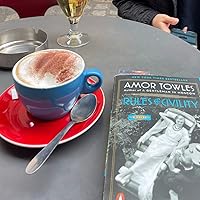
This was book 6 of my Rumpus poetry bookclub subscription. I'm a lil behind in my Rumpus poetry reading (I read 1-5, then I read 8, so 6-7 were here but waitin' on me.)
(I did not actually read this book for three entire months. I started and restarted it a few different times during that time period and finally really read the whole thing in March.)
This book was intense and challenging and really really worth the read. Also deeply deeply sad and upsetting. Dear America, oh my god, you have sucked for such a long time, and yet somehow you just continue to deeply deeply suck.
Things that are amazing about this book:
--a fierce reckoning with the effects of white supremacy / privilege on Black lives.
--an honoring of Latasha Hawkins, a 15 year old shot in LA in 1991 by a Korean grocery store shopkeeper.
--an examination specifically of relations/relationships between Blacks and Asians and how despite both facing in some cases very similar types of racism, it is more common to see schism there than connection.
--the examination of what has helped us avoid certain fates and what yet makes certain fates still inevitable.
--this poet's ability to zoom in (microcosm) and zoom out (macrocosm); her ability to make Latasha's life, or her own life, both personal and specific, as well as being an example of so many of the young Black girl lives out there being lived.
--this poet's ability to tie together recent events with deep histories, some of which I had never read about before (in both areas).
Things that made this book a challenging read:
--One of the things that gave me trouble getting started is the book is not really broken into individual poems. It has seven sections, but each section just sort of flows all the way through. A lot of this is written more as, I would say, prose snippets, rather than what your expectation of "a poem" might be.
--The poet experiments with a huge range of ways to present her ideas: there are photos, mixed-media collage pieces, store reviews, conversations, lyrics, timelines, etc. Some of these I found more effective than others; some I just found easier to parse than others. I actually really really loved the juxtaposition timelines although the one on pg 55 that intermixes white text and gray text was a real challenge to read (visually). This reminded me of Krista Franklin's book "Too Much Midnight" where you are reading poems interspersed with mixed media collage art, and essays.
--It's often not clear who's talking or whose view is being presented. Not all quotes/conversations are attributed. Sometimes it feels like the author presenting herself personally as "I", sometimes it seems like it's her but separated, almost as "reporter" or "outside," sometimes it seems clear that it's someone else, but who? Sometimes it's just not really clear. I think that's part of the point, but it IS a challenge. With the store reviews, for example, I was left wondering: Did she write these? Are they "fiction"? Did she write these after going to these places? Are these written by other people and she found them online? Are they an amalgamation of types of reviews she's seen?
Here is a quote I can't let go of. A little background first: After Latasha's murder, some people tried to set fire to the store where it happened. But Black residents living in a motel nearby, spent all night putting out the fire, with garbage bags of water, because if they hadn't, it would have also burned down their home.
"To save their own lives, they had to save this monument of brutality. Our survive, inextricable from the structures that threaten it."