‘I want to tell a story. A long but simple story. A tale of long recovery. A tale of love. A tale of lost and found.’
In his remarkable new novel, award-winning Australian author Michael Meehan sensitively explores the links between generational conflict, family, and the creative act.
At its heart, An Ungrateful Instrument is a novel that portrays a son’s struggle to be more than a mere instrument of the father’s ambition. Antoine Forqueray and later his son Jean-Baptiste, were each brought up as child prodigies to the court of Louis XIV. Together, they were said to be the only musicians in France who could play the father’s brilliant, eccentric music for the viola da gamba.
In an imaginative masterstroke the story is told by Jean-Baptiste’s highly attuned mute sister, Charlotte-Elisabeth. Threaded throughout, deep in a forest an old man creates the gift of a special viol for the boy, Jean Baptiste.
This is a novel that can almost be heard like music, as it soars in language, theme, and a wisdom that both embodies and transcends its period setting.
Michael Meehan’s novels –The Salt of Broken Tears, Deception, Below the Styx and Stormy Weather – have been shortlisted for and won many awards and have also been published internationally. He is an Emeritus Professor at Deakin University and was for many years the chair of Adelaide Writers Week. He currently lives in Adelaide, South Australia
As readers know by now, I 'rediscovered' the novels of South Australian Michael Meehan late last year. In anticipation of his new novel An Ungrateful Instrument, (Transit Lounge, 2023) I resurrected from my reading journal a review of his first novel, The Salt of Broken Tears, (1999), and his second: Stormy Weather (2000), and a week after that, I'd retrieved from the TBR and reviewed Below the Styx (2010). I was smitten!
And now, An Ungrateful Instrument. I shall try not to gush, but seriously, this is one of the most exquisite books I've read in a long time.
This is a novel of fathers and sons; death and immortality; and the tension between originality and wanting to preserve things of beauty unchanged. It's about the glorious voice of a musical instrument — ephemeral until the advent of sound recording — and the silent but powerful voice of the writer. And it's about a world of privilege and power and the conditions in which creativity might flourish.
Antoine Forqueray (1672-1745) (Wikipedia)
An Ungrateful Instrument begins with the melancholy voice of Charlotte-Elizabeth, an elective mute. She tells us of her brother Jean-Baptiste Forqueray who is beaten and brutalised by his father into being the musical prodigy he was himself as a boy. Antoine Forqueray performed before Louis XIV at the age of ten and was appointed as a court musician when still a teenager. In contrast with the elegance of courtly music, Antoine Forqueray's style is wild, energetic and fiendishly difficult. (A listener at YouTube describes him as 'a beast'. You can see why here.)
Brilliant, inventive, demonic' Antoine wants immortality, as so many men do, and he wants his son to be a reproduction of himself, following exactly the same path so that his own glory can transcend death and live on through his son and grandsons.
His self-belief in his own genius, fostered by the admiration of the king at Versailles, is such that he will not tolerate having his music written down, to be copied by his inferiors. Only he and his son can play it, and he beats the boy into perfect fidelity to what he hears his father play.
He beat Charlotte-Elizabeth viciously too, because he wanted her to be a prodigy as well, as evidence that his genius can even extend to siring a female prodigy. But she could not — or would not — play, and at eight she retreats into silence, a shadow always hovering on the edge of things, invisible and silent as women mostly are in the historical record.
This was interesting and not at all what I expected. I’m honestly not sure what I expected actually but this was a unique story, told to the reader in a unique way.
It is set in the early 1700s in France around the very real composer and viol virtuoso Antoine Forqueray and his son, Jean-Baptiste but it’s told through the eyes of Forqueray’s daughter Charlotte-Elisabeth. Forqueray is an accomplished musician, a favourite of the King even, whom he first played for at age 10 and the King was so impressed that he arranged for Forqueray to have lessons at the King’s own expense. Forqueray is determined to pass his great legacy onto his children and he tends to do this with a rigorous amount of beatings, one of which was so damaging that it rendered Charlotte-Elisabeth mute. Now his attentions are focused on Jean-Baptiste, with the ultimate goal of making him a prodigy that will play for the King just as Forqueray himself did, become a favourite, with the King a valued patron.
Not only does Charlotte-Elisabeth describe the vicious beatings, but also the unhappy situation of her parent’s marriage, which is punctuated with fights and mired in complete misery. Her mother wafts around their borrowed apartments dressed in threadbare clothes, grief punctuating her every moment and her father and his moods dominate their lives. He is obsessed with passing on his legacy and creating this dynasty but not in a way that glorifies his son – in a way that glorifies only himself. How marvellous he is, how talented, how incredible that he is able to mould and shape his son in his image, what a credit his son and his son’s playing abilities are to him.
Forqueray never writes his music down, instead he teaches Jean-Baptiste by having Jean-Baptiste watch him and learn that way which means only the father and son are ever able to play the father’s music. Only them. It is a brutal teaching method and bear in mind, I think Jean-Baptiste is very young, a small child at the beginning of the novel. It moves through their adolescence, addresses the separation of their parents and the fact that Forqueray had his son imprisoned and then later exiled using his powerful connections, via a lettres de cachet (a letter signed by the King of France, whose judgements could not be appealed). Even after this he continues to manipulate Jean-Baptiste’s life, alternately promising things should Jean-Baptise do as he wishes and removing them if he does not.
After Forqueray’s death, Jean-Baptiste published some of his music, so you can hear his compositions if you go to YouTube or google it. I don’t know anything about music in terms of classical composition (I had to google what a viol was, I’d never heard of it before), only what I like or don’t like. However I did find it interesting to go and listen to several pieces to get a vague idea of what it might’ve been like to learn such music by listening, watching and for Jean-Baptise, looking only into his father’s eyes and apparently ‘seeing’ it that way.
I haven’t read Michael Meehan before but the writing in this was beautiful. Choosing a mute character who observes, to provide the voice of the story, was an incredibly interesting one and it winds the two siblings together in the most intimate of bonds. They themselves both know the other’s experience, they are tied together because of it and they both seek and find solace in the other, sharing quiet times hidden together, presumably escaping their father’s wrath. Interspersed throughout Charlotte-Elisabath’s narratives are chapters that detail the crafting and making of a special instrument and this chapters have such stunning writing. I know even less about the crafting of such instruments than I do of the composing with/for them but these were described in such a way that every step was so vivid. The instrument truly came alive during the course of the novel.
This is very focused historical fiction, with clear indications of large amounts of research and incredible writing. I definitely need to read more books by Michael Meehan – he has several others already published and I’ll be keeping a lookout for his future releases as well.
***A copy of this book was provided by the publisher/Quikmark Media for the purpose of an honest review***
Set in the time of Louis XIV, An ungrateful instrument tells the story of Antoine Forqueray, a musician playing for the highest in the land, and his prodigiously gifted son, Jean-Baptiste; the music that binds and repels them both. Very early Jean-Baptiste is proficient enough to play with his father at formal occasions, always dutifully following the way his father directs. Soon, Jean-Baptiste begins to “riff” on his father’s music, unbeknownst to anyone but his father and sister, the mute Charlotte-Elisabeth. Enraged by what he sees as his son’s insubordination, Antoine engineers his son’s exile from France, Jean-Baptiste eventually arriving in Venice. Here he hears the sublime playing of the organ in an empty church by a young girl, barely into puberty. He is entranced. Permitted by his father to return to France, on one condition: that he marry Jeanne Nolson; Jeanne is well connected, from a family rich in music, a family eager to be associated with the Forquerays. Strangely it is through the silent workings of Jeanne Nolson that the girl from Venice, now a young woman is re-introduced to Jean-Baptiste. Audaciously, Meehan tells his story through this girl-woman who hasn’t spoken since she was seven. Yet as a corporeal character Charlotte-Elisabeth is almost invisible; she dresses as a servant and hides behind tapestries and other shields. It is through the intimacy of touch and whispered murmurings that Jean-Baptiste, Jeanne Nolson, and later Marie-Rose, the woman from Venice express their feelings to this silent cipher. Beginning to read the novel I found the writing style quite dense at times, almost to the point of opacity, and truthfully I’m not sure whether I became accustomed to the cadences, or the writing “loosened” up. Whatever the explanation you won’t read another novel like it.
The book’s central premise is that art answers to the universe while legacy answers to ego. Good v evil.
It’s a book about what we don’t know. The spiritual side of existence. The stuff between the cracks of our knowledge and science. Between wisdom and ego. Where beauty lies. The battle between the father and the old man for the heart of the son was a battle between ego and art.
The narrator, a self-imposed mute sister of the main character, presents more as ghost than human, which enables the writing to be ethereal, other-worldly and insightful.
But it is so esoteric I did not find it an enjoyable read and I finished it more as a duty to honour Meehan’s seemingly tortured commitment to his muse.
But there was also a lot of repetition. It was as though Meehan was as determined to get his words right as the old man was to perfect his instrument.
So a lot of the thousands of layers of lacquering on the pearwood bridge may not have been needed. But which ones? I think that was his problem.
In the end I’m more curious about why Meehan would choose to write this book than about what he was writing. It felt like accessibility had been trampled by ambition.
I found this book difficult to read, perhaps because the beauty of the musical genius of Antoine Fourqueray was not evident in the story. The story tells us that his son was being groomed to take the legacy into the future through brutality and coercion, and the actual act of making music had become twisted by an insane wish to mould the future. The father then became unreasonable, ruining his relationship with his son, but also his wife and his daughter, who became electively mute yet a constant observer of the tension in the house. The parallel story of the old man creating a Viol for the son, Jean-Baptiste, is a loving alternative reality, about making music for the love of the instrument and the quality of the sound. This is a sweeter, gentler tale, quite delightful, which kept me reading with its magical quality, where the brutality of the home was quite overwhelming at times. An unusual tale that I didn't really enjoy but found intriguing, partly because it is based on the true story of the elder Fourqueray playing at the French court of Louis IV. Probably for the musical historian.
I'm not that musical a person and I especially do not know my classic music so I did not know that these characters are based on real historical figures! I have had to search for them on Google after I read the author's notes at the end of the book. Perhaps if you know your music and specifically these personages, Antoine Forqueray and Jean-Baptiste Forqueray, you may find the novel more of an interest. But for ignorant me, it was just ok.
Actually the story itself is mostly sad as it involves quite a bit of violence (towards children) and because we read them through the children's perspectives, a really unhappy childhood. The bulk of the tale was told by the sister, actually, who from her own traumatic incident chose to lose her voice. And yet, that does not mean that she's lost her voice completely though it does mean that others find her to be a convenient confessor. Fascinating perspective but this would not have been a book I'd picked up on my own
My thanks to Transit Lounge Publishing for gifting me a copy of this book. Thoughts are mine own.
I wanted to like this book, I really did, but it just lacked something. I struggled to the end and it took me a month to finish. The basic story is there, and a unique perspective to tell it from but I didn’t really find any of the characters particularly likable, and the story jumped oddly about. I enjoyed the descriptions of the instruments’ construction. Sadly, I feel that the cover illustration was the highlight of the book.
Written stylishly, from the perspective of a mute girl which has its challenges but overall the author pulls it off well. Characterization was strong, the plot moves a bit erratically which certainly catches the attention. Not in love with the ending. A good read regardless about family, art, and destiny.
This is a beautifully written story of two child prodigies at the court of Louis XIV. However the father is a thug and abuses his family unmercifully. His son and daughter must fine a way to survive. There are detailed descriptions of how to make a viol, should you be so inclined.




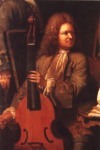 Antoine Forqueray (1672-1745) (Wikipedia)


