

What do you think?

Diamond Hill
‘Do you know what it was like here? You wouldn’t believe the glamour. We had our own film studio, redbrick houses for the stars, even Jackie Chan. Now look at us – the Hollywood of the Orient will soon be gone altogether.’
1987, Hong Kong. Trying to outrun his demons, a young man who calls himself Buddha returns to the bustling place of his birth. He moves into a small Buddhist nunnery in the crumbling neighbourhood of Diamond Hill, where planes landing at the nearby airport fly so close overhead that travellers can see into the rooms of those below.
As Buddha begins to care for the nuns and their neighbours, this pocket of the old city is vanishing. Even the fiery Iron Nun cannot prevent the frequent landslides that threaten the nunnery she fights for, and in the nearby shanty town, a faded film actress who calls herself Audrey Hepburn is hiding a deep secret and trying to survive with her teenage daughter who has a bigger fish to fry.
But no one arrives in Diamond Hill by accident, and Buddha's ties to this place run deeper than he is willing to admit. Can he make peace with his past and survive in this disappearing city?
1987, Hong Kong. Trying to outrun his demons, a young man who calls himself Buddha returns to the bustling place of his birth. He moves into a small Buddhist nunnery in the crumbling neighbourhood of Diamond Hill, where planes landing at the nearby airport fly so close overhead that travellers can see into the rooms of those below.
As Buddha begins to care for the nuns and their neighbours, this pocket of the old city is vanishing. Even the fiery Iron Nun cannot prevent the frequent landslides that threaten the nunnery she fights for, and in the nearby shanty town, a faded film actress who calls herself Audrey Hepburn is hiding a deep secret and trying to survive with her teenage daughter who has a bigger fish to fry.
But no one arrives in Diamond Hill by accident, and Buddha's ties to this place run deeper than he is willing to admit. Can he make peace with his past and survive in this disappearing city?
352 pages, Paperback
Published May 12, 2022
About the author
Kit Fan
9 books26 followersKit Fan is a novelist, poet and critic. His first novel Diamond Hill (2021) was published with critical acclaim. Goodbye Chinatown (2026) is his second novel. His third poetry collection, The Ink Cloud Reader (2023), was shortlisted for the T. S. Eliot Prize and Forward Prize. He was shortlisted twice for the Guardian 4th Estate BAME Short Story Prize, and was a winner of the Hong Kong University International Poetry Prize, Northern Writers Awards for Poetry and Fiction, Times/Stephen Spender Poetry Translation Prize and POETRY’s Editors Prize for Reviewing. He has written for the Guardian, Times Literary Supplement and Telegraph. He is a Fellow of the Royal Society of Literature, Vice-Chair of Authors’ Licensing and Collecting Society (ALCS), Co-Chair of the Copyright Licensing Agency (CLA), and a Trustee of New Writing North. He was born and educated in Hong Kong and now lives in the UK.
Ratings & Reviews
Friends & Following
Create a free account to discover what your friends think of this book!
Community Reviews
Displaying 1 - 30 of 48 reviews

October 17, 2021
I had a lovely time interviewing the author of this propulsive, kinetic read: It can be found here.
https://www.youtube.com/watch?v=uUD2Q...
https://www.youtube.com/watch?v=uUD2Q...

June 19, 2021
I really really wanted to like this book…actually, not just like it, but love it. I mean, how often do I come across a book written in English that is set in my birth city of Hong Kong and is actually about HK people, places, culture, history, etc. After reading the premise, my expectation was that this would be a story that was truly HK-focused, with an authentic portrayal of the city that wasn’t written from a primarily Western point of view. Going into this, I was excited and kept thinking to myself — finally, a book about the old HK that will satisfy the nostalgia I’ve been feeling lately about a city I’ve always loved, but had become increasingly foreign to me in recent years. I went into this with high hopes and also preparing to rate it highly. Unfortunately, this book turned out to be nothing like what I expected (in a bad way) and after reading it, instead of feeling nostalgic, I actually ended up feeling frustrated and disappointed.
The biggest issue I had with this book was that the writing was very disjointed and uneven, which wouldn’t have been as bad of a problem except that the story overall was also poorly executed — both of these things, along with several other issues I found, made this an extremely frustrating read for me. In fact, I had actually wanted to DNF this book several times (which is not a good sign, as I’m a stickler for finishing every book I read), but I pressed on, reminding myself every couple pages of all the things I had mentioned above about why I had been so excited to read this. I ultimately finished, but not without resorting to skimming the last 50 pages or so (because by that point, I was already at my wit’s end).
The main thing about the writing and execution that frustrated me was the constant switching back and forth between style and tone — one minute, the writing would be eloquent, descriptive, even philosophical, but then the next minute, the writing would descend into profanity-laced vulgarities that seemed to come out of nowhere. If this happened only once or twice, then it wouldn’t be a problem, but the writing actually alternated between these two extremes for the entire story. As if that weren’t enough, there was also a lot of switching back and forth between English and either formal Chinese or Cantonese slang (with English translation in parentheses next to it) — normally, I would be happy to see a book written in English about Chinese culture / experience utilize Chinese characters as needed to enhance the story, but in this case, the switching was done haphazardly, in a random way that made absolutely no sense to me — for instance, randomly inserting Chinese (with English translation) in the middle of characters’ dialogues or having some side character who only shows up for like a minute blurt out a bunch of profanities in Cantonese as a main character passes by. Again, I would be fine with it if incorporating these phrases served a purpose in the story, advanced the plot, or were necessary to characterization— but none of it did…the phrases that the author chose to write in Chinese didn’t seem to have any rhyme or reason to them. From a character perspective, it didn’t make sense for some of the characters to speak a hybrid of English / Cantonese to the extent that these characters did (yes, some Hong Kongers do mix some English in their speech, but most ordinary folks don’t constantly switch back and forth between the two languages like that unless they’re bicultural or they were educated overseas or in an international school where everything is taught in English). It almost seemed like the author couldn’t decide whether he wanted to write in English or Chinese and so decided to do a hodgepodge of both.
In addition, I also found the prolific and gratuitous use of Cantonese slang words and profanities throughout the story not only unnecessary, but also annoying. In the Author’s Note at the end of the book, Kit Fan explains that he included the Cantonese slang and profanities in both Chinese and English throughout the book in order to “give a culturally distinctive inflection to a language that is under threat, not unlike the shanty town in the novel” – while I agree with the sentiment that Cantonese is a language that has increasingly come under threat over the years, I disagree with the method of sprinkling ‘random Cantonese profanities + their English translations’ throughout the story as a means of preserving the “vitality of the language.” Even if the author wanted to show the distinctive cultural flavor of Cantonese slang (or the language as a whole), incorporating a few phrases here and there would’ve been enough — but inundating the story with it, especially when majority of the slang and profanities were irrelevant to the story, that’s going overboard in my opinion. In terms of the translations in parentheses— perhaps because I am both a Cantonese and English speaker myself (as well as a translator for the Chinese/English language pairing), this method especially frustrated me, as my brain is wired to automatically compare the Chinese and English to see if it was translated correctly (quite a bit of it actually wasn’t), so each time it switched to Chinese, I got jarred out of the story – basically, rather than enhancing the story or helping me appreciate it more, the Chinese words and phrases with its translations ended up being a distraction that made it difficult to concentrate on the story itself.
Speaking of the story – well, this was another aspect that I found problematic. First of all, there wasn’t really a plot to speak of – there were a lot of detailed descriptions of places and characters’ surroundings, but little to no substance in terms of what actually happens. If I had to summarize this book, I would say that it is essentially an “information dump about HK” – there is an abundance of name-dropping of various HK people, places, things, historical events, cultural aspects, etc., almost all of which would be recognizable to anyone decently familiar with the city, but none of it advanced the plot and very little (if any) was actually relevant to the story. Even the characters had no depth to them -- it seemed like the main purpose of the characters was to either 1) describe their surroundings, or 2) regurgitate heaps of (oftentimes unnecessary and irrelevant) information about HK to anyone who would listen, or 3) insult others with some type of profanity / vulgarity and/or drop a random Chinese idiom in the middle of a lengthy, rambling discourse about things may or may not have been important, but I had already stopped caring by that point.
What bothered me most about this book though was the stereotypical way in which all the female characters were portrayed in the story. Of course, I wasn’t expecting a male author to write complex female characters completely accurately, but I was disappointed (and more than a bit miffed) that the author seemed to go the route of portraying all the women as sexual stereotypes who essentially fell into three categories: the uptight, sex-deprived nun; the promiscuous, ‘gangster wannabe’ tomboy; and the sex-crazy, possibly a little unhinged prostitute. Though I understand that these portrayals probably weren’t intentional on the author’s part, as a woman, I found such depictions offensive and worrisome, especially since we’ve seen over the past year how harmful perpetuating such stereotypes can be.
With all that said, I do believe in giving credit where it’s due and so I have to say that the author did a pretty good job giving readers unfamiliar with HK a better understanding of what life in Diamond Hill was like back in the day. The feelings of despair and uncertainty that were pretty widespread throughout HK in the years after the signing of the Joint Declaration were also well-depicted — feelings that were exacerbated tenfold after what happened in Tiananmen in 1989 (and sparked fears about the fate of Hong Kongers after the handover).
Even though this book absolutely didn’t work for me, I am clearly the exception here given all the 4 and 5 star reviews I’ve seen for this one. So I would say check out the other reviews so you can make an informed decision on whether you’d be interested in reading this one.
Received ARC from World Editions via Edelweiss.
The biggest issue I had with this book was that the writing was very disjointed and uneven, which wouldn’t have been as bad of a problem except that the story overall was also poorly executed — both of these things, along with several other issues I found, made this an extremely frustrating read for me. In fact, I had actually wanted to DNF this book several times (which is not a good sign, as I’m a stickler for finishing every book I read), but I pressed on, reminding myself every couple pages of all the things I had mentioned above about why I had been so excited to read this. I ultimately finished, but not without resorting to skimming the last 50 pages or so (because by that point, I was already at my wit’s end).
The main thing about the writing and execution that frustrated me was the constant switching back and forth between style and tone — one minute, the writing would be eloquent, descriptive, even philosophical, but then the next minute, the writing would descend into profanity-laced vulgarities that seemed to come out of nowhere. If this happened only once or twice, then it wouldn’t be a problem, but the writing actually alternated between these two extremes for the entire story. As if that weren’t enough, there was also a lot of switching back and forth between English and either formal Chinese or Cantonese slang (with English translation in parentheses next to it) — normally, I would be happy to see a book written in English about Chinese culture / experience utilize Chinese characters as needed to enhance the story, but in this case, the switching was done haphazardly, in a random way that made absolutely no sense to me — for instance, randomly inserting Chinese (with English translation) in the middle of characters’ dialogues or having some side character who only shows up for like a minute blurt out a bunch of profanities in Cantonese as a main character passes by. Again, I would be fine with it if incorporating these phrases served a purpose in the story, advanced the plot, or were necessary to characterization— but none of it did…the phrases that the author chose to write in Chinese didn’t seem to have any rhyme or reason to them. From a character perspective, it didn’t make sense for some of the characters to speak a hybrid of English / Cantonese to the extent that these characters did (yes, some Hong Kongers do mix some English in their speech, but most ordinary folks don’t constantly switch back and forth between the two languages like that unless they’re bicultural or they were educated overseas or in an international school where everything is taught in English). It almost seemed like the author couldn’t decide whether he wanted to write in English or Chinese and so decided to do a hodgepodge of both.
In addition, I also found the prolific and gratuitous use of Cantonese slang words and profanities throughout the story not only unnecessary, but also annoying. In the Author’s Note at the end of the book, Kit Fan explains that he included the Cantonese slang and profanities in both Chinese and English throughout the book in order to “give a culturally distinctive inflection to a language that is under threat, not unlike the shanty town in the novel” – while I agree with the sentiment that Cantonese is a language that has increasingly come under threat over the years, I disagree with the method of sprinkling ‘random Cantonese profanities + their English translations’ throughout the story as a means of preserving the “vitality of the language.” Even if the author wanted to show the distinctive cultural flavor of Cantonese slang (or the language as a whole), incorporating a few phrases here and there would’ve been enough — but inundating the story with it, especially when majority of the slang and profanities were irrelevant to the story, that’s going overboard in my opinion. In terms of the translations in parentheses— perhaps because I am both a Cantonese and English speaker myself (as well as a translator for the Chinese/English language pairing), this method especially frustrated me, as my brain is wired to automatically compare the Chinese and English to see if it was translated correctly (quite a bit of it actually wasn’t), so each time it switched to Chinese, I got jarred out of the story – basically, rather than enhancing the story or helping me appreciate it more, the Chinese words and phrases with its translations ended up being a distraction that made it difficult to concentrate on the story itself.
Speaking of the story – well, this was another aspect that I found problematic. First of all, there wasn’t really a plot to speak of – there were a lot of detailed descriptions of places and characters’ surroundings, but little to no substance in terms of what actually happens. If I had to summarize this book, I would say that it is essentially an “information dump about HK” – there is an abundance of name-dropping of various HK people, places, things, historical events, cultural aspects, etc., almost all of which would be recognizable to anyone decently familiar with the city, but none of it advanced the plot and very little (if any) was actually relevant to the story. Even the characters had no depth to them -- it seemed like the main purpose of the characters was to either 1) describe their surroundings, or 2) regurgitate heaps of (oftentimes unnecessary and irrelevant) information about HK to anyone who would listen, or 3) insult others with some type of profanity / vulgarity and/or drop a random Chinese idiom in the middle of a lengthy, rambling discourse about things may or may not have been important, but I had already stopped caring by that point.
What bothered me most about this book though was the stereotypical way in which all the female characters were portrayed in the story. Of course, I wasn’t expecting a male author to write complex female characters completely accurately, but I was disappointed (and more than a bit miffed) that the author seemed to go the route of portraying all the women as sexual stereotypes who essentially fell into three categories: the uptight, sex-deprived nun; the promiscuous, ‘gangster wannabe’ tomboy; and the sex-crazy, possibly a little unhinged prostitute. Though I understand that these portrayals probably weren’t intentional on the author’s part, as a woman, I found such depictions offensive and worrisome, especially since we’ve seen over the past year how harmful perpetuating such stereotypes can be.
With all that said, I do believe in giving credit where it’s due and so I have to say that the author did a pretty good job giving readers unfamiliar with HK a better understanding of what life in Diamond Hill was like back in the day. The feelings of despair and uncertainty that were pretty widespread throughout HK in the years after the signing of the Joint Declaration were also well-depicted — feelings that were exacerbated tenfold after what happened in Tiananmen in 1989 (and sparked fears about the fate of Hong Kongers after the handover).
Even though this book absolutely didn’t work for me, I am clearly the exception here given all the 4 and 5 star reviews I’ve seen for this one. So I would say check out the other reviews so you can make an informed decision on whether you’d be interested in reading this one.
Received ARC from World Editions via Edelweiss.

May 8, 2021
Diamond Hill is a captivating and culturally rich piece of autofiction in which award-winning Hong-Kong-born poet and writer Kit Fan tells the story of the place in which he spent his childhood years and uses it as the foundation on which to build the fictional plot. It is 1987 and three years since Britain signed the Sino-British Joint Declaration agreeing to hand over its last colony, Hong Kong, to China in 1997. With that declaration, signed by Chinese Premier Zhao Ziyang and UK Prime Minister Margaret Thatcher, comes the promise that the city will remain unchanged for fifty years. Under the "one country, two systems" it was agreed that Hong Kong would not practise the communist system present in mainland China, and Hong Kong's existing capitalist system and way of life would be unchanged for 50 years until 2047. But upheaval is already happening in Diamond Hill, in the east of Kowloon. Once the ‘Hollywood of the Orient,’ a prosperous and glamorous locale in the 50s and 60s, it was once home to some of Hong Kong's most famous film studios where Bruce Lee movies were once made. It is now a ramshackle shantytown and an eyesore right in the middle of a glitzy financial hub and it soon became the last shantytown in the region.
Buddha is a recovering heroin addict who is travelling home to Hong Kong, from Bangkok, at the insistence of Daishi, a dying Thai monk who previously assisted him in getting clean and who had saved him from death many times. He returns home to find the shabby neighbourhood being bulldozed to make room for gleaming towers. Parts of the settlement continued to be demolished over the years and the final sections were demolished in 2001, the same year 21-year-old Fan moved to the UK. Daishi instructs Buddha to stay at a small Buddhist monastery; the dilapidated convent in the heart of Diamond Hill is managed by a woman known as The Iron Nun. There he sleeps in a damp, dark, uncomfortable shed where he meets and befriends a female teenage gang leader called Boss, who was employed by the Triad to oversee heroin distribution in the local area and sleeps with a prostitute, Boss’s mother, a faded movie extra who is stuck in the past and who calls herself Audrey Hepburn. Diamond Hill is an exhilarating, memorable and evocative read from beginning to denouement and it's immediately clear that Fan has placed as much heart and soul as he possibly can into his portrayal of the place he still calls home.
The author’s love, sadness and nostalgia for the now-extinct neighbourhood are striking as well as moving and his perfectly poetic prose, rich descriptions and acute observations had me feeling sorrowful over a place I have never had the pleasure to visit. It illustrates adeptly the intense locality of Hong Kong and you very much feel the east meets west fusion of cultures that comes from the amalgamation of British and Chinese influences. The novel begins in 1987 and shows Hong Kong in transition; it's 10 years before the British hands the Island over to China but Buddhist nuns, drug gangs, property developers, the government and foreign powers each have itchy palms, and all want a piece of Diamond Hill. Corruption and redevelopment are rife and year after year the lights on the Hill thin exponentially as parties clamour to bulldoze the makeshift dwellings. When Buddha discovers that The Iron Nun plans to allow the neighbourhood he loves to be bulldozed and destroyed, he begins to question everything and everyone around him. A thoroughly enjoyable, powerful and majestic reading experience and one I highly recommend.
Buddha is a recovering heroin addict who is travelling home to Hong Kong, from Bangkok, at the insistence of Daishi, a dying Thai monk who previously assisted him in getting clean and who had saved him from death many times. He returns home to find the shabby neighbourhood being bulldozed to make room for gleaming towers. Parts of the settlement continued to be demolished over the years and the final sections were demolished in 2001, the same year 21-year-old Fan moved to the UK. Daishi instructs Buddha to stay at a small Buddhist monastery; the dilapidated convent in the heart of Diamond Hill is managed by a woman known as The Iron Nun. There he sleeps in a damp, dark, uncomfortable shed where he meets and befriends a female teenage gang leader called Boss, who was employed by the Triad to oversee heroin distribution in the local area and sleeps with a prostitute, Boss’s mother, a faded movie extra who is stuck in the past and who calls herself Audrey Hepburn. Diamond Hill is an exhilarating, memorable and evocative read from beginning to denouement and it's immediately clear that Fan has placed as much heart and soul as he possibly can into his portrayal of the place he still calls home.
The author’s love, sadness and nostalgia for the now-extinct neighbourhood are striking as well as moving and his perfectly poetic prose, rich descriptions and acute observations had me feeling sorrowful over a place I have never had the pleasure to visit. It illustrates adeptly the intense locality of Hong Kong and you very much feel the east meets west fusion of cultures that comes from the amalgamation of British and Chinese influences. The novel begins in 1987 and shows Hong Kong in transition; it's 10 years before the British hands the Island over to China but Buddhist nuns, drug gangs, property developers, the government and foreign powers each have itchy palms, and all want a piece of Diamond Hill. Corruption and redevelopment are rife and year after year the lights on the Hill thin exponentially as parties clamour to bulldoze the makeshift dwellings. When Buddha discovers that The Iron Nun plans to allow the neighbourhood he loves to be bulldozed and destroyed, he begins to question everything and everyone around him. A thoroughly enjoyable, powerful and majestic reading experience and one I highly recommend.

August 2, 2021
I wanted to love this one but it was an absolute miss. I kept waiting and waiting. I went back to this book at least four times but.... Beautiful cover though.

May 9, 2021
“𝚃𝚑𝚎 𝚌𝚒𝚝𝚢 𝚑𝚊𝚍 𝚌𝚑𝚊𝚗𝚐𝚎𝚍 𝚜𝚘 𝚖𝚞𝚌𝚑, 𝚜𝚘 𝚏𝚊𝚜𝚝”
As I enter the twilight of my time in this fine city, I’m determined to try & read a few books set right here in Hong Kong.
This project begins with a brand new release, the most expensive novel I’ve ever bought (I won’t miss HK’s book prices 😓), one that poignantly evokes a city on the cusp of change, acting as both a requiem for the city’s faded past & a timely reflection of its conflicted present.
As a great philosopher once sang, “you don’t know what you got till it’s gone”, a statement which may well be true of my own relationship with HK, but certainly isn’t for poet and debut novelist Kit Fan’s characters, who are fully cognisant of the impending loss of Diamond Hill’s identity. But the area, home of the famous Chi Lin nunnery which, though unnamed in the novel, plays a crucial part in the story, is no paradise to be paved over, but a shanty town full of the iniquity of poverty. Once nicknamed the “Hollywood of the Orient”, Diamond Hill was formerly a glamorous backdrop for Bruce Lee movies, but is now a nihilistic hovel of heroin addiction, prostitution & Triad criminality.
However, it’s scheduled for demolition: the Bentley-driving developers waiting in the wings to roll in the cranes & whack up the high rises. Diamond Hill is thus both setting & also a microcosm for Hong Kong in general: a city caught in a David & Goliath struggle, where the disempowered fight to retain their identity against the unrelenting onslaught of national & colonial greed.
Set ten years before the 1997 Handover (and in my birth year!) the book is full of wistful reflections on a city on the precipice, stuck half way between China & Britain, neither one or the other, or, indeed, either. Fan powerfully evokes HK’s character: the ubiquity of construction, the stench of humid proximity and the jostling syllables and colourfully hurled invectives of Cantonese.
The novel also felt timely on a personal level, with the protagonist making a journey from Bangkok to HK, an inversion of my future movements. ‘Buddha’ as he is known (no characters are given real names; ‘identity conflict’ being a central theme), is a recovering heroin addict, sent by a dying monk to the ‘Iron Nun’ the fierce head nun of the neighbouring nunnery for reasons that gradually become clear. He also meets Boss, an enterprising teenage drug-dealer, her ‘mother’ Audrey Hepburn, who may or may not have once slept with Bruce Lee, and Quartz, a trainee nun with a dark and forgotten past. As their paths collide, personal and civil conflicts overlap and intersect.
In real life, Chi Lin nunnery is the world’s largest handmade wooden building, built with no nails, all the parts intricately interlocking. Like this location, the novel’s parts connect and align in complex ways, coming together to form a rather fascinating, and moving, whole.
As I enter the twilight of my time in this fine city, I’m determined to try & read a few books set right here in Hong Kong.
This project begins with a brand new release, the most expensive novel I’ve ever bought (I won’t miss HK’s book prices 😓), one that poignantly evokes a city on the cusp of change, acting as both a requiem for the city’s faded past & a timely reflection of its conflicted present.
As a great philosopher once sang, “you don’t know what you got till it’s gone”, a statement which may well be true of my own relationship with HK, but certainly isn’t for poet and debut novelist Kit Fan’s characters, who are fully cognisant of the impending loss of Diamond Hill’s identity. But the area, home of the famous Chi Lin nunnery which, though unnamed in the novel, plays a crucial part in the story, is no paradise to be paved over, but a shanty town full of the iniquity of poverty. Once nicknamed the “Hollywood of the Orient”, Diamond Hill was formerly a glamorous backdrop for Bruce Lee movies, but is now a nihilistic hovel of heroin addiction, prostitution & Triad criminality.
However, it’s scheduled for demolition: the Bentley-driving developers waiting in the wings to roll in the cranes & whack up the high rises. Diamond Hill is thus both setting & also a microcosm for Hong Kong in general: a city caught in a David & Goliath struggle, where the disempowered fight to retain their identity against the unrelenting onslaught of national & colonial greed.
Set ten years before the 1997 Handover (and in my birth year!) the book is full of wistful reflections on a city on the precipice, stuck half way between China & Britain, neither one or the other, or, indeed, either. Fan powerfully evokes HK’s character: the ubiquity of construction, the stench of humid proximity and the jostling syllables and colourfully hurled invectives of Cantonese.
The novel also felt timely on a personal level, with the protagonist making a journey from Bangkok to HK, an inversion of my future movements. ‘Buddha’ as he is known (no characters are given real names; ‘identity conflict’ being a central theme), is a recovering heroin addict, sent by a dying monk to the ‘Iron Nun’ the fierce head nun of the neighbouring nunnery for reasons that gradually become clear. He also meets Boss, an enterprising teenage drug-dealer, her ‘mother’ Audrey Hepburn, who may or may not have once slept with Bruce Lee, and Quartz, a trainee nun with a dark and forgotten past. As their paths collide, personal and civil conflicts overlap and intersect.
In real life, Chi Lin nunnery is the world’s largest handmade wooden building, built with no nails, all the parts intricately interlocking. Like this location, the novel’s parts connect and align in complex ways, coming together to form a rather fascinating, and moving, whole.

April 29, 2021
The run-up to the handover of Hong Kong from British to Chinese rule was a period of craziness, uncertainty, and a kind of 'fin de siecle transition that's perhaps being lived out again today as the Chinese move from a more 'hands-off' approach to a 'hands-on and hands in handcuffs' approach to governing the famous territory. Kit Fan's book 'Diamond Hill' captures a lot of that sense of transition and I couldn't help but play 'compare and contrast' with the changes being forced on Hong Kong today. It's always been a place that you feel could ignite in an instant and in 1987's Diamond Hill, there's plenty of tension and plenty of change.
An ex-heroin addict - I don't think he's ever named, people just call him Buddha - is sent back to Hong Kong by his Buddhist leader, the man who saved him by detoxing him and teaching him the Buddhist ways in a temple in Bangkok. We gradually learn the circumstances of his departure as the book unfurls. He arrives at a Buddhist nunnery in the once-glamorous district of Diamond Hill, to be hosted by a woman called the Iron Nun, another follower of his guru (forgive me, I'm not entirely sure if Buddhists have gurus or if I'm using the term incorrectly). Diamond Hill is about to change. The old decrepit buildings will be torn down and new high rises built in their place. Amongst the inhabitants of the district, Buddha finds a young girl, Boss and her mother Audrey Hepburn. Boss works with the Triads and is a successful young businesswoman. Her mother is a faded beauty who once slept with Bruce Lee - or so she claims.
The book gives us these great characters and then throws in a few more. A fragile nun called Quartz, an old man with a historic orchid collection, a strange beggar who throws out odd lucid phrases. The people are all multi-dimensional, fascinating, and every bit as colourful as their surroundings.
The writing is exceptional. You can feel the heat, the damp, the non=stop rain dripping through Buddha's hut, the mud sliding down the hillside, smell the bats in the cave, taste the forbidden chicken broths and congee. It's a great book. I'm slightly underwhelmed by the ending and not 100% sure I completely understood it, but I'd definitely be the first in line with my hand up when another Kit Fan book comes along.
With thanks to Netgalley and the Publishers. I hope this book will be a great success.
An ex-heroin addict - I don't think he's ever named, people just call him Buddha - is sent back to Hong Kong by his Buddhist leader, the man who saved him by detoxing him and teaching him the Buddhist ways in a temple in Bangkok. We gradually learn the circumstances of his departure as the book unfurls. He arrives at a Buddhist nunnery in the once-glamorous district of Diamond Hill, to be hosted by a woman called the Iron Nun, another follower of his guru (forgive me, I'm not entirely sure if Buddhists have gurus or if I'm using the term incorrectly). Diamond Hill is about to change. The old decrepit buildings will be torn down and new high rises built in their place. Amongst the inhabitants of the district, Buddha finds a young girl, Boss and her mother Audrey Hepburn. Boss works with the Triads and is a successful young businesswoman. Her mother is a faded beauty who once slept with Bruce Lee - or so she claims.
The book gives us these great characters and then throws in a few more. A fragile nun called Quartz, an old man with a historic orchid collection, a strange beggar who throws out odd lucid phrases. The people are all multi-dimensional, fascinating, and every bit as colourful as their surroundings.
The writing is exceptional. You can feel the heat, the damp, the non=stop rain dripping through Buddha's hut, the mud sliding down the hillside, smell the bats in the cave, taste the forbidden chicken broths and congee. It's a great book. I'm slightly underwhelmed by the ending and not 100% sure I completely understood it, but I'd definitely be the first in line with my hand up when another Kit Fan book comes along.
With thanks to Netgalley and the Publishers. I hope this book will be a great success.
May 21, 2021
Update: I'm downgrading my review to 1 star. I really wanted to like the book, but the more I think about it, the more I find it to be problematic.
The biggest issue is the story telling. The author painstakingly build each character with details in the room they live in, but their stories come out in gossips ("did you know XYZ happened to so-and-so?"), or in interrogation ("what did you do?" "And then what happened?"). Fictions should "show, not tell", but this book does the opposite.
The second biggest issue is that the major female characters fall on the Madonna Or Whore dichotomy. This is a common issue when male authors don't know how to write complex female characters, so then their sexuality (or lack thereof) takes center stage. For a book that's aiming to capture an era and the feeling of uncertainty of the future, centering people's deep dark secrets on this aspect does a disservice for the story's theme.
----
3 stars because the Chinese really bothered me. I'm afraid I'd sound terribly elitist for saying this, but this books needs a Chinese editor.
It's fun to see the characters codeswitch between English and Cantonese. Some people might see it as a sign of a person not having fluency in either language, and some language learners make it a point to only speak in one language at a time. But in reality, bicultural Hong Kongers codeswitch all the time. In an interview with Toronto Public Library, the author said he hears the characters speak in Cantonese, and he's just faithfully translating their words into English. I believe him, I would even believe that those characters switch between English and Chinese within the same sentence too. HK-ers do that in real life all the time.
The thing that bothers me is that the author's own translation of those expressions often fall flat. And sometimes the Chinese writing uses the wrong word. I suppose one can't be a poet AND a writer AND a translator. And Cantonese has so many colorful idioms and wordplays that sound so vivid, and it's hard to find an English equivalent. But I wish there was a bilingual editor to clean up the text.
The biggest issue is the story telling. The author painstakingly build each character with details in the room they live in, but their stories come out in gossips ("did you know XYZ happened to so-and-so?"), or in interrogation ("what did you do?" "And then what happened?"). Fictions should "show, not tell", but this book does the opposite.
The second biggest issue is that the major female characters fall on the Madonna Or Whore dichotomy. This is a common issue when male authors don't know how to write complex female characters, so then their sexuality (or lack thereof) takes center stage. For a book that's aiming to capture an era and the feeling of uncertainty of the future, centering people's deep dark secrets on this aspect does a disservice for the story's theme.
----
3 stars because the Chinese really bothered me. I'm afraid I'd sound terribly elitist for saying this, but this books needs a Chinese editor.
It's fun to see the characters codeswitch between English and Cantonese. Some people might see it as a sign of a person not having fluency in either language, and some language learners make it a point to only speak in one language at a time. But in reality, bicultural Hong Kongers codeswitch all the time. In an interview with Toronto Public Library, the author said he hears the characters speak in Cantonese, and he's just faithfully translating their words into English. I believe him, I would even believe that those characters switch between English and Chinese within the same sentence too. HK-ers do that in real life all the time.
The thing that bothers me is that the author's own translation of those expressions often fall flat. And sometimes the Chinese writing uses the wrong word. I suppose one can't be a poet AND a writer AND a translator. And Cantonese has so many colorful idioms and wordplays that sound so vivid, and it's hard to find an English equivalent. But I wish there was a bilingual editor to clean up the text.

March 11, 2021
Diamond Hill is a fascinating novel about a place disappearing and a city changing, set in Hong Kong in the late 1980s. Diamond Hill is a run down shanty town with a Buddhist nunnery, drug addiction, and a faded memory of being a place for making films. When a man, nicknamed Buddha and a recovering heroin addict, takes refuge in the nunnery when he returns to his home of Hong Kong from Bangkok, he meets a strange selection of people, like the severe Iron Nun, Quartz who has forgotten her past, and Boss, a teenage gang leader who dreams of her escape. All the while, Diamond Hill is under threat from the various people and power across it, and looming redevelopment.
Kit Fan really draws you into the world of the novel, Hong Kong with looming knowledge of the handover from Britain to China coming in 1997, and into the issues of colonialism, displacement, and self that run through the characters' lives. The characters in general are heavily tied to language and place—Cantonese and English, Hong Kong and England and Thailand, Diamond Hill and elsewhere—and this gives a sense of some of the kinds of tension at play. Power is crucial: who has it and who doesn't, but also how it can be a presence in different ways. Buddha, as a protagonist drawn into others' lives to avoid thinking about his own, is an interesting viewpoint into the narrative, suggesting how hard it is to ignore both the past and the future.
Both a look at distinctive characters dealing with their past and what they might do next, and a wider commentary on Hong Kong at this particular moment, Diamond Hill is an eye-opening novel that I found gripping and atmospheric. I enjoyed the chance to find out more about Hong Kong's recent history too.
Kit Fan really draws you into the world of the novel, Hong Kong with looming knowledge of the handover from Britain to China coming in 1997, and into the issues of colonialism, displacement, and self that run through the characters' lives. The characters in general are heavily tied to language and place—Cantonese and English, Hong Kong and England and Thailand, Diamond Hill and elsewhere—and this gives a sense of some of the kinds of tension at play. Power is crucial: who has it and who doesn't, but also how it can be a presence in different ways. Buddha, as a protagonist drawn into others' lives to avoid thinking about his own, is an interesting viewpoint into the narrative, suggesting how hard it is to ignore both the past and the future.
Both a look at distinctive characters dealing with their past and what they might do next, and a wider commentary on Hong Kong at this particular moment, Diamond Hill is an eye-opening novel that I found gripping and atmospheric. I enjoyed the chance to find out more about Hong Kong's recent history too.

April 21, 2021
Buddha is a recovering heroin addict who, upon his return to Diamond Hill, a drug-filled shanty town in Hong Kong, discovers that it is being cleared away so bigger, better buildings and homes can take it place. During his time living in a nunnery, run by the aptly named Iron Nun, Buddha meets and finds his life entangled with many interesting individuals, including a nun attempting to flee from her past name Quartz, a washed-up actress calling herself Audrey Hepburn, and teen gang leader known as Boss. As Buddha attempts to navigate his new life, he discovers that, amid the upcoming handover of Hong Kong to China from the British, he discovers that many people are not who they seem, and that their ulterior motives are their true driving forces.
Diamond Hill is simply an outstanding debut novel by Kit Fan. There are so many powerful messages and themes all throughout the pages, such as the utter devastation caused by drugs and addiction, the power of blame and forgiveness, the beauty of growth and rebirth, and the power of the past on the present. Fan’s descriptive language really paints a wonderful picture for the reader, allowing them to travel to Diamond Hill through the pages. The ending is, simply put, a real WOW moment that I never saw coming. Diamond Hill is a brilliant page-turner and I cannot wait to see what Kit Fan has instore next.
I highly recommend Diamond Hill, available May 4th; it is a riveting and captivating novel. Thank you to World Editions for gifting me a copy of Diamond Hill by Kit Fan in exchange for an honest review; all opinions are my own.
Diamond Hill is simply an outstanding debut novel by Kit Fan. There are so many powerful messages and themes all throughout the pages, such as the utter devastation caused by drugs and addiction, the power of blame and forgiveness, the beauty of growth and rebirth, and the power of the past on the present. Fan’s descriptive language really paints a wonderful picture for the reader, allowing them to travel to Diamond Hill through the pages. The ending is, simply put, a real WOW moment that I never saw coming. Diamond Hill is a brilliant page-turner and I cannot wait to see what Kit Fan has instore next.
I highly recommend Diamond Hill, available May 4th; it is a riveting and captivating novel. Thank you to World Editions for gifting me a copy of Diamond Hill by Kit Fan in exchange for an honest review; all opinions are my own.

March 12, 2021
"...a testament of love to a changing city while exploring a compelling narrative of identity and the inability to escape our past."4/5 stars
ARC ebook, 221 pages.
Read from March 9, 2021 to March 12, 2021.
Review at The Pluviophile Writer: https://bit.ly/3mE7rwL
I discovered this book from the social media page of a local English bookstore I follow in Hong Kong called Bleak House Books. It’s the best English bookstore in Hong Kong, in my opinion, as they promote and support local authors and have a wide range of carefully curated literature, comics, and more, both in-store and online. If you’re in Hong Kong, I highly recommend that you check them out. A big thanks to Netgalley for having an ARC copy of this book that I was able to get my eager hands on.
Diamond Hill is an area on the Kowloon side of Hong Kong and contrary to its name, Diamond Hill has never contained any diamonds. In Cantonese, the word “diamond” (鑽石) has the same pronunciation as “to drill rocks” as Diamond Hill used to be a stone quarry. Diamond Hill has a long history and is an area in Hong Kong that was settled long before the British arrived, as early as the 18th century. Diamond Hill was once considered the “Hollywood of the Orient” but it turned into an ungoverned slum of squatters and shanty homes. Hong Kong’s lack of public housing created slums all over Hong Kong from the 1950s to the late 1980s. During this time the Kai Tak airport was located nearby. Planes landing at Kai Tak had to brush past both the Diamond Hill slums and the infamous Walled City slums nearby making it one of the most dangerous places to land a plane back in the day. Today, most slums have been demolished, with both Diamond Hill and the Walled City having been refurbished into a stunning park and garden. The Nan Lian Garden has replaced the shacks and the Chi Lin Nunnery, which is likely the one referenced in the book as it was built in the 1930s as a Buddhist nun retreat, was rebuilt in 1998 in Tang Dynasty style. The infamous Walled City slum relics and the park is only a quick MTR stop away from Diamond Hill. These areas are some of my all-time favourite places in Hong Kong for their beauty and their history.
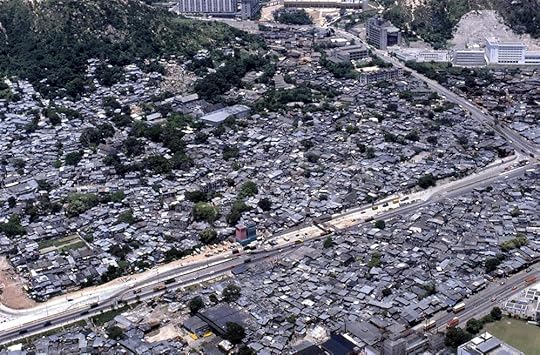
Diamond Hill, 1983. Image from Zolima City Magazine
Diamond Hill takes place in the late 80s, just as demolition is starting to take place in squatter slums all over Hong Kong, all the while the current British government is working on handing Hong Kong back over to China. Diamond Hill is run by triad gangsters and drug dealers and is enveloped with poverty, yet there is a feeling of community within its shanty homes. The narrator, nicknamed Buddha, is a former heroin addict that has found himself back at his former home after recovering from his addiction under the guidance of a monk he befriended while in Thailand. While not a full monk himself, Buddha appears as one. As he arrives in Diamond Hill, he runs into an eccentric woman, Aubrey Hepburn, who insists she dated Bruce Lee and is aggressively cutting a teenage girl’s hair. Having prior experience as a hairdresser, Buddha assists in cutting the girl’s hair. Buddha then makes his way to the temple where the head nun, the Iron Nun, is in a fight to keep the temple in place with the looming threat of demolition while a new nun, Quartz, aims to rid herself of her past. Buddha learns that the teenage girl he assisted, Boss, runs a drug scheme under the Triad gang and that Aubrey Hepburn is her adoptive mother who has ideations of a former time of ritz and glamour. Each character is attempting to escape their past while mourning for the change that is occurring and the fear that is brewing with the city’s handover.
The book simultaneously explores colonialism, displacement, loss, and how the past always tangles with the future. It’s a testament of love to a changing city while exploring a compelling narrative of identity and the inability to escape our past. The story is a mirror of misfit characters in a misfit city that’s not been able to claim its own identity with others that are constantly meddling in its future. While its ending is ambivalent, each character has finally made choices for themselves and are moving towards a future that they will control, leaving the reader wondering about the outcome of each of the characters and the city that gets left behind. Kit Fan’s writing style has beautiful similarities to Murakami in terms of tone and unique character work but he brings them together in his own unique and poetic style. Kit Fan’s writing is visceral and raw, with its writing appropriately paired and complemented with Cantonese characters and translations, emphasising just how robust and expressive Cantonese is, deepening the story’s meaning and effect on the reader while giving off an undeniable Hong Kong feel.
This novel has been one of my favourite reads of 2021 thus far. I was enthralled with the plot, its characters, and the narrative style. I would highly recommend this book to anyone who has spent any time in Hong Kong or is interested in its robust history. I also think that those who are bilingual in both written Cantonese and English will especially enjoy this novel. Even for those who have never had the pleasure of visiting Hong Kong, this book holds a riveting tale with a historical premise that will be appealing to most.

Read
November 27, 2024deeply frustrating because there is so much potential and can definitely operate as a Hong Kong Studies book but so many problems with it on many many fronts. working class representations from what feels like a distinctly non working class pov (drugs and depraved behaviour and isolation); kind of soulless narrator and characters; someone said that all of the most exciting parts of this text are off screen and i agree; prose that just wasn’t for me and with an awkward use of canto/translations.
i think diamond hill was made to be literary fiction and may very well be in the future but for me the writing couldn’t live up to the (excellent) premise of sketchy nunnery triad shenanigans on diamond hill and the wider ideas about colonial nostalgia, belonging and land development in hk during the handover that are fundamental to the book.
something that does this concept/aesthetic imo is what’s up connection (dir. masashi yamamoto) which is an incredibly hectic film about evil property developers going after a village in hk… it seems tangential but i think both works are gesturing towards something similar
i think diamond hill was made to be literary fiction and may very well be in the future but for me the writing couldn’t live up to the (excellent) premise of sketchy nunnery triad shenanigans on diamond hill and the wider ideas about colonial nostalgia, belonging and land development in hk during the handover that are fundamental to the book.
something that does this concept/aesthetic imo is what’s up connection (dir. masashi yamamoto) which is an incredibly hectic film about evil property developers going after a village in hk… it seems tangential but i think both works are gesturing towards something similar

February 28, 2021
Diamond Hill, Kit Fan’s debut novel, is that rarest of things in fiction: both a timely and compelling narrative in its own right and a love letter to a disappearing city that becomes an enduring metaphor for individual identity, power and transformation.
Set in Hong Kong in 1987, four years after the signing of the Joint Declaration, it follows the ironically named Buddha, a recovering heroin addict, sent back to Hong Kong by his dying mentor in Bangkok to live in a dilapidated nunnery in the eponymous Diamond Hill. Once known as the Hollywood of the Orient - mainly due to its associations with the actor Bruce Lee - the area has since become the last shanty town in Hong Kong, epitomised by its nihilistic descent into poverty but kept financially afloat - in a knowing nod to the historic Opium Wars - by its outflow of drugs, controlled by the charismatic teenage girl known simply as Boss.
Diamond Hill’s real value, however, lies in its status as a piece of prime real estate for the encroaching developers and the novel’s outward plot, at least, centres on this David and Goliath struggle as the disempowered but enterprising residents battle to protect their homes against the relentless onslaught of colonial and national greed.Amidst this larger battle, however, civil conflicts and betrayals are rife as personal interests come to bear on the characters, setting the stage for a complex, poignant descent into the war for individual recognition.
The exploration of disempowerment is nothing new in fiction, of course, but Fan’s focus on Hong Kong at this particular point in history, and specifically the fate of Diamond Hill, gives perfect voice to the complexity of a theme which continues to resonate today in the city. Many of those in Hong Kong see themselves as children of the UK, albeit adopted ones, and the fear of change and transformation as 1997 approaches is reflected in the microcosm of the novel’s plot and its characters alike. Both Boss and her mother - the wonderful Audrey Hepburn - identify themselves as British, although their outdated and stereotypical allusions to the culture (the heavy gold jewellery; the Laura Ashley faux Victoriana of Boss’s slum bedroom) are rudely revealed as merely a pastiche when set against the white colonial property developers in their very real Bentleys.
Both the willing and unwilling suppression of memories is an ongoing theme in the novel and plays out at both a personal and wider level, most notably through Buddha himself and the fascinating Quartz, a novice at the nunnery whose lack of memory before joining the order becomes central to the story. But it is important on a political level, too, most specifically regarding the question of agency through history. Here too, however, Fan offers a nuanced and convincing argument. It’s not that Hongkongers have forgotten the stick for the carrot, but that their identities have been shaped over generations into something unique and individual that is now under very palpable threat. I was reminded at times of Fruit Chan’s “Made in Hong Kong” which similarly deals with themes of disenfranchisement among the lower classes under the shadow of the Handover, and the way in which without power or money to secure their fate, characters are forced to find agency through the sheer will of human spirit and communal values. Though not as pessimistic in its outlook as Made in Hong Kong, there is something equally inevitable about the fate of the players in Diamond Hill and the note of uncertainty that the novel ends on which perfectly captures the mood of the moment.
Fan’s genesis as a poet and short story writer as well as his personal investment in the story is evidenced in his elegant prose which is by turns muscular and beautifully lyrical. His language skillfully achieves that sweet spot peculiar to Hong Kong in its mix of poetic, idiosyncratic metaphor and street slang, including its liberal use of inventive and frequently hilarious profanities.
Neither is the apparent smallness of Diamond Hill’s plot an accident, for this is a novel which strives and wholeheartedly achieves more than the sum of its parts. Structured around the lunisolar calendar, and set over the course of a year, the largest character in Diamond Hill is Diamond Hill itself, whose physical changes over the novel become both the crucible and the mirror of the events within it. In writing the novel, Fan has crafted both a fascinating story and a poignant memory of himself which will endure as a record of history. I can only hope it receives as wide a readership as possible both now and in the years to come. Highly recommended.
Set in Hong Kong in 1987, four years after the signing of the Joint Declaration, it follows the ironically named Buddha, a recovering heroin addict, sent back to Hong Kong by his dying mentor in Bangkok to live in a dilapidated nunnery in the eponymous Diamond Hill. Once known as the Hollywood of the Orient - mainly due to its associations with the actor Bruce Lee - the area has since become the last shanty town in Hong Kong, epitomised by its nihilistic descent into poverty but kept financially afloat - in a knowing nod to the historic Opium Wars - by its outflow of drugs, controlled by the charismatic teenage girl known simply as Boss.
Diamond Hill’s real value, however, lies in its status as a piece of prime real estate for the encroaching developers and the novel’s outward plot, at least, centres on this David and Goliath struggle as the disempowered but enterprising residents battle to protect their homes against the relentless onslaught of colonial and national greed.Amidst this larger battle, however, civil conflicts and betrayals are rife as personal interests come to bear on the characters, setting the stage for a complex, poignant descent into the war for individual recognition.
The exploration of disempowerment is nothing new in fiction, of course, but Fan’s focus on Hong Kong at this particular point in history, and specifically the fate of Diamond Hill, gives perfect voice to the complexity of a theme which continues to resonate today in the city. Many of those in Hong Kong see themselves as children of the UK, albeit adopted ones, and the fear of change and transformation as 1997 approaches is reflected in the microcosm of the novel’s plot and its characters alike. Both Boss and her mother - the wonderful Audrey Hepburn - identify themselves as British, although their outdated and stereotypical allusions to the culture (the heavy gold jewellery; the Laura Ashley faux Victoriana of Boss’s slum bedroom) are rudely revealed as merely a pastiche when set against the white colonial property developers in their very real Bentleys.
Both the willing and unwilling suppression of memories is an ongoing theme in the novel and plays out at both a personal and wider level, most notably through Buddha himself and the fascinating Quartz, a novice at the nunnery whose lack of memory before joining the order becomes central to the story. But it is important on a political level, too, most specifically regarding the question of agency through history. Here too, however, Fan offers a nuanced and convincing argument. It’s not that Hongkongers have forgotten the stick for the carrot, but that their identities have been shaped over generations into something unique and individual that is now under very palpable threat. I was reminded at times of Fruit Chan’s “Made in Hong Kong” which similarly deals with themes of disenfranchisement among the lower classes under the shadow of the Handover, and the way in which without power or money to secure their fate, characters are forced to find agency through the sheer will of human spirit and communal values. Though not as pessimistic in its outlook as Made in Hong Kong, there is something equally inevitable about the fate of the players in Diamond Hill and the note of uncertainty that the novel ends on which perfectly captures the mood of the moment.
Fan’s genesis as a poet and short story writer as well as his personal investment in the story is evidenced in his elegant prose which is by turns muscular and beautifully lyrical. His language skillfully achieves that sweet spot peculiar to Hong Kong in its mix of poetic, idiosyncratic metaphor and street slang, including its liberal use of inventive and frequently hilarious profanities.
Neither is the apparent smallness of Diamond Hill’s plot an accident, for this is a novel which strives and wholeheartedly achieves more than the sum of its parts. Structured around the lunisolar calendar, and set over the course of a year, the largest character in Diamond Hill is Diamond Hill itself, whose physical changes over the novel become both the crucible and the mirror of the events within it. In writing the novel, Fan has crafted both a fascinating story and a poignant memory of himself which will endure as a record of history. I can only hope it receives as wide a readership as possible both now and in the years to come. Highly recommended.

November 19, 2024
I enjoyed this more than I expected to, especially as it took me quite a long time to read it. I was interested to know how the plot would play out - I’m not sure I fully understand what did happen, but I liked thinking about possible meanings. I don’t know anything about HK or its history and I’ve gone away afterwards to find out more. I do think the characters felt somewhat in service of the story the writer wanted to tell - rather than feeling like real people with a set of beliefs and motivations. Sometimes the storytelling felt repetitive, but actually I feel that was in service of what the book was trying to do in its depiction of a changing city.

April 2, 2025
3.75 - a vivid tale set in the slums of pre-handover Hong Kong. Sometimes the characterisation felt a bit too on the nose and especially the end message about everyone wanting to forget, but I did like the plot twist in the final chapter.

January 18, 2025
“change, uncertainty, confusion” - toby

October 20, 2024
Quite a fast paced book that can be read for the immediate story, but that is not so fascinating as the backdrop in which it is placed. Hong Kong around 1987 when the handover was just announced, with several hard hitting stories and narration of the tough life that people led in the shanty town that was Diamond Hill. While the account is fictional, the account of the lives of people that were ruled by triads or drugs was quite searing. It was interesting to see Cantonese swear words together with their English translation, although the pace and the frequent switch between deeply thought wisdom and exchange of profanities was quite disconcerting and did not flow too well. It was not a tale very well told, nor did i find myself sympathising with any of the characters, but was glad to have read it particularly for its Hong Kong setting, and also because our literary group discussion came really alive as we delved deep into the book to understand its various aspects. Not a literary masterpiece in terms of word play, although some of the thoughts do seem quite special.
Whoever knew that the location around Diamond Hill was famous for movie production (Hollywood of the East), hence Hollywood Plaza, and that Hong Kong produced more movies than the US at one point in time! And the detailed description of life in the squatter towns - very educative given the difference between that era/location vs. what we are all used to today.
Overall a fast paced read but only for someone who is familiar with Hong Kong
Whoever knew that the location around Diamond Hill was famous for movie production (Hollywood of the East), hence Hollywood Plaza, and that Hong Kong produced more movies than the US at one point in time! And the detailed description of life in the squatter towns - very educative given the difference between that era/location vs. what we are all used to today.
Overall a fast paced read but only for someone who is familiar with Hong Kong
August 27, 2024
Not a fan of the descriptive style and narrative voice. maybe it has to do with the fact that I'm from Hong Kong myself, but I found the frequent culture references and cantonese text inserts a bit excessive ....... though I don't know how it would read for other readers. the tone felt a bit off and inconsistent but I do mostly agree with its ideas and arguments. sometimes it works, sometimes it felt a bit cringey. all the characters are very interesting, and so is the Odyssey-type story so that was entertaining and gripping throughout. I don't know much about Diamond Hill, coming from the less dense and more rural parts of Hong Kong, but I did enjoy the familiarity albeit being somewhat melancholic and upsetting. That's how it is I guess.
Won't write too much about political and social perspectives on the whole thing, let me save that for English Literature class! Good luck navigating through all that without crying in lesson hahahah ha a
Won't write too much about political and social perspectives on the whole thing, let me save that for English Literature class! Good luck navigating through all that without crying in lesson hahahah ha a

May 11, 2021
An enticing read and a fascinating look at Hong Kong ten years before the 1987 British handover. Lest you take it for some dry historical fiction, it is full of nuns, ghosts, drug addicts, murderers, agents of organized crime, and a shantytown ruled by a post-pubescent girl with plans to take over the world. The protagonist is at times variously translucent, opaque, admirable, despicable, and an anti-hero you won’t soon forget. This is one of the best first novels I’ve read in a long time. I look forward to more from this author.

February 9, 2023
Ugh. I only got through 35%. Flat, unrealistic characters, no discernible plot, MS boy descriptions of sex and writing style. I had hoped to learn more about the development in Hong Kong during the time period, but the bad writing got in the way. When will someone finally write a novel about HK worth reading?


May 30, 2021
'Diamond Hill' by Kit Fan was a captivating and culturally rich novel that encapsulated the nostalgia, love and sadness of his own home of Hong Kong through the fictitious storyline of Buddha, a recovering heroin addict who returns to Diamond Hill from Bangkok at the insistence of Daishi, a dying monk in Thailand who helped him get clean. Daishi instructs Buddha to stay in a dilapidated Buddhist monastery in the heart of Diamond Hill where he meets the Iron Nun who manages the nunnery. Through his lens, we see Diamond Hill, a shabby neighbourhood and shanty town gradually demolished and destroyed in order to make way for apartment blocks in the area. At the same time, he comes across a faded movie extra who calls herself Audrey Hepburn and Boss, the daughter of Audrey who is a gang leader working with the Triad to oversee heroin distribution in the area. Throughout his return to Hong Kong, we see Buddha trying to make sense of the place where he was born and grappling with everything and everyone around him.
The novel was an evocative, exhilarating and bittersweet read from the beginning to the end and it is evident that Fan has put so much of his heart and soul towards the portrayal of a place he calls home and doing so as true as he possibly can. His gorgeous poetic prose and rich descriptions had me yearning for the city of that serves as the foundation and lifeblood of my culture and my identity. In much the same way, Fan writes Buddha's story as a requiem for a lost city that will never be the same especially considering the events in Hong Kong that have transpired in the past two years. It is evident that the themes in the novel despite its plot-line set when the Sino British Joint Declaration was already a signal of the ticking time-bomb in relation to Hong Kong's status as a British colony; can be linked to Hong Kong in the present day as a disappearing city. It is haunting as the novel begins in 1987 and shows Hong Kong in transition - it is 10 years before the British hands the city over to China but the Buddhist nuns, drug gangs, property developers, the government and foreign powers are all itching to have a piece of Diamond Hill.
Fan illustrates the intense locality of Hong Kong which is evoked through the fusion of cultures that come from British and Cantonese influences. At the same time, Fan makes a beautiful move by inserting Cantonese slang and language in the novel, to reinforce the importance and mark it has on Hong Kong as a city and to resist the idea of its current status as a disappearing language. As a great philosopher once said, “you don’t know what you got till it’s gone”, a statement which may well be true of my own relationship with Hong Kong, but certainly isn’t for the characters in the novel, who are fully aware of the impending loss of Diamond Hill’s identity. It is poignant in the novel that Fan touches on the wistful reflections on a city in the precipice - halfway between China and Britain, neither one or the other, or either. In some ways, the novel felt timely on a personal level in relation to the disappearing image of Hong Kong as the Pearl of the Orient which rings true to the intense power of China over the region. Like Diamond Hill, the novel's plot-line and its characters intertwine and connect in ways that create a fascinating, moving and compelling read that makes it well worth the read. 4.5 stars for Kit Fan's 'Diamond Hill'. Absolutely beautiful.
The novel was an evocative, exhilarating and bittersweet read from the beginning to the end and it is evident that Fan has put so much of his heart and soul towards the portrayal of a place he calls home and doing so as true as he possibly can. His gorgeous poetic prose and rich descriptions had me yearning for the city of that serves as the foundation and lifeblood of my culture and my identity. In much the same way, Fan writes Buddha's story as a requiem for a lost city that will never be the same especially considering the events in Hong Kong that have transpired in the past two years. It is evident that the themes in the novel despite its plot-line set when the Sino British Joint Declaration was already a signal of the ticking time-bomb in relation to Hong Kong's status as a British colony; can be linked to Hong Kong in the present day as a disappearing city. It is haunting as the novel begins in 1987 and shows Hong Kong in transition - it is 10 years before the British hands the city over to China but the Buddhist nuns, drug gangs, property developers, the government and foreign powers are all itching to have a piece of Diamond Hill.
Fan illustrates the intense locality of Hong Kong which is evoked through the fusion of cultures that come from British and Cantonese influences. At the same time, Fan makes a beautiful move by inserting Cantonese slang and language in the novel, to reinforce the importance and mark it has on Hong Kong as a city and to resist the idea of its current status as a disappearing language. As a great philosopher once said, “you don’t know what you got till it’s gone”, a statement which may well be true of my own relationship with Hong Kong, but certainly isn’t for the characters in the novel, who are fully aware of the impending loss of Diamond Hill’s identity. It is poignant in the novel that Fan touches on the wistful reflections on a city in the precipice - halfway between China and Britain, neither one or the other, or either. In some ways, the novel felt timely on a personal level in relation to the disappearing image of Hong Kong as the Pearl of the Orient which rings true to the intense power of China over the region. Like Diamond Hill, the novel's plot-line and its characters intertwine and connect in ways that create a fascinating, moving and compelling read that makes it well worth the read. 4.5 stars for Kit Fan's 'Diamond Hill'. Absolutely beautiful.

February 15, 2023
Buddha is back in Hong Kong.
Diamond Hill, once known as the 'Hollywood of the Orient' for its myriad film studios, has slid into disrepair and squalor. Now squatting in the shadow of highrises and ear-splitting jets, the shantytown harbors all sorts of characters. Buddha meets a motley crew, from Audrey Hepburn, a woman who saw herself destined for the silver screen (but really only had the chops to be an extra at best) and Boss, an enthusiastic teenage drug lord who sees nothing but dollar signs and a ticket out in the drugs she pilfers, to Iron Nun and Quartz, two nuns at the nearby monastery, where he stays at the directive of his old teacher.
It's the 80s, a decade before the handover (1997, when the sovereignty of Hong Kong is handed over from the UK to China), but the massive implications and identity politics of that moment already loom large. Are we British? Chinese? Hongkongese? And what do any of these mean when you're trolling a dirty back alley looking for a fix?
Now shopkeepers, drug lords, venture capitalists, religious denizens, and high-rise developers are all vying to assert their claim on this prime real estate. Ultimately, this is a book about power(lessness), hope(lessness), colonialism, displacement, and all that is lost (and found) in the face of immense, earth-moving change.
Fan's use of language is deft and lyrical, and it has cinematic quality to it. It reads a bit like a movie treatment, with sweeping landscape descriptions followed by closeup of intimate dialogue and character work. I also adore the intertwining of English and Cantonese in the dialogues, which root the story in place. This is rendered in Chinese and English with translation in the text, which I love. Cantonese is laced with profanity, and as the author points out in his endnote is apparently a dying art. You can tell by this note alone that Fan loves language and words; I also found out after reading that Fan is an award-winning poet so now it all makes sense.
I know so little about Hong Kong, but this book leaves me wanting to know more.
For an interesting conversation around power, religion, and capitalism in a post-British colonial city, pair with Katherine Boo's non-fiction 'Beyond the Beautiful Forevers,' about Annawadi, a shantytown in Mumbai.
Diamond Hill, once known as the 'Hollywood of the Orient' for its myriad film studios, has slid into disrepair and squalor. Now squatting in the shadow of highrises and ear-splitting jets, the shantytown harbors all sorts of characters. Buddha meets a motley crew, from Audrey Hepburn, a woman who saw herself destined for the silver screen (but really only had the chops to be an extra at best) and Boss, an enthusiastic teenage drug lord who sees nothing but dollar signs and a ticket out in the drugs she pilfers, to Iron Nun and Quartz, two nuns at the nearby monastery, where he stays at the directive of his old teacher.
It's the 80s, a decade before the handover (1997, when the sovereignty of Hong Kong is handed over from the UK to China), but the massive implications and identity politics of that moment already loom large. Are we British? Chinese? Hongkongese? And what do any of these mean when you're trolling a dirty back alley looking for a fix?
Now shopkeepers, drug lords, venture capitalists, religious denizens, and high-rise developers are all vying to assert their claim on this prime real estate. Ultimately, this is a book about power(lessness), hope(lessness), colonialism, displacement, and all that is lost (and found) in the face of immense, earth-moving change.
Fan's use of language is deft and lyrical, and it has cinematic quality to it. It reads a bit like a movie treatment, with sweeping landscape descriptions followed by closeup of intimate dialogue and character work. I also adore the intertwining of English and Cantonese in the dialogues, which root the story in place. This is rendered in Chinese and English with translation in the text, which I love. Cantonese is laced with profanity, and as the author points out in his endnote is apparently a dying art. You can tell by this note alone that Fan loves language and words; I also found out after reading that Fan is an award-winning poet so now it all makes sense.
I know so little about Hong Kong, but this book leaves me wanting to know more.
For an interesting conversation around power, religion, and capitalism in a post-British colonial city, pair with Katherine Boo's non-fiction 'Beyond the Beautiful Forevers,' about Annawadi, a shantytown in Mumbai.
February 28, 2025
Surprisingly I found this book in the wrong section in a local library, labelled under H (for Hill) instead of F (for Fan)... but understandable from a librarian's perspective, hahah.
I can't give this a definite 5 star, but it's a defo 4.5 star in my eyes... and adding to my Favourites folder. >_<"
I get the storyline from beginning to end. I actually visualised this as it was a Hong Kong movie starring Tony Leung or Andy Lau as Buddha and Faye Wong as Audrey Hepburn. Can't really think who would play the other characters, but it would sound awesome as a movie with some special effects of the old location of the airport, with flying airplanes above Diamond Hill and all the triad style stuff that happened back in old Hong Kong. Too bad the shanty town and Kai Tak Airport has been demolished!
It's around 10 years before Hong Kong is handed back to China. People are trying to get away from Diamond Hill or trying to stay where they are. There's hostility on redevelopment of the area - it's like where will they go for cheap rent and finding a local job. Even the local nunnery is trying to survive the redevelopment!
The main character Buddha is a known drug addict trying to stay clean, and came back to HK following a decision from the Daishi in Thailand to overcome his troubles from the past.
Audrey Hepburn, a mother and a whore who tries to live in her own dream world as an actress.
Boss, the adopted daughter of Audrey Hepburn, who lives as Triad and dreams to leave HK for the UK.
The Iron Nun is Audrey's elder sister who escaped a previous life of vanity and lies.
And Quartz who was abused as a child, and tried to leave the world when she was at her worst.
Read the book as if you're watching a HK style film. What are the Hong Kongers trying to escape from is the question....
The book reminds me of Sour Sweet by Timothy Mo - on how to survive in a world full of Triads, reform, betrayals and lies.
I can't give this a definite 5 star, but it's a defo 4.5 star in my eyes... and adding to my Favourites folder. >_<"
I get the storyline from beginning to end. I actually visualised this as it was a Hong Kong movie starring Tony Leung or Andy Lau as Buddha and Faye Wong as Audrey Hepburn. Can't really think who would play the other characters, but it would sound awesome as a movie with some special effects of the old location of the airport, with flying airplanes above Diamond Hill and all the triad style stuff that happened back in old Hong Kong. Too bad the shanty town and Kai Tak Airport has been demolished!
It's around 10 years before Hong Kong is handed back to China. People are trying to get away from Diamond Hill or trying to stay where they are. There's hostility on redevelopment of the area - it's like where will they go for cheap rent and finding a local job. Even the local nunnery is trying to survive the redevelopment!
The main character Buddha is a known drug addict trying to stay clean, and came back to HK following a decision from the Daishi in Thailand to overcome his troubles from the past.
Audrey Hepburn, a mother and a whore who tries to live in her own dream world as an actress.
Boss, the adopted daughter of Audrey Hepburn, who lives as Triad and dreams to leave HK for the UK.
The Iron Nun is Audrey's elder sister who escaped a previous life of vanity and lies.
And Quartz who was abused as a child, and tried to leave the world when she was at her worst.
Read the book as if you're watching a HK style film. What are the Hong Kongers trying to escape from is the question....
The book reminds me of Sour Sweet by Timothy Mo - on how to survive in a world full of Triads, reform, betrayals and lies.

April 29, 2021
-ARC provided by publisher in exchange for honest review-
The year is 1987. But in the rundown shanty town of Diamond Hill, once consider the Hollywood of the Orient, everyone is obsessed with one single date: July 1st 1997, the date of the Hong Kong Handover from Britain to China. The day that Hong Kong will be moving from one regime to another.
Buddha, the protagonist and narrator, is a heroin addict that came back to HK after spending some time in Bangkok, in a buddhist monastery.
In HK, he meets the most diverse cast of characters. Some dialogues and situations are so bizarre that everything feels like a fever dream. An actress that calls herself Audrey Hepburn and is obsessed with her past romance with Bruce Lee. A teenage gang leader named Boss that is escaping a death threat. A group of disturbing nuns with weird names like Quartz and Iron. A nameless property lawyer that has been attacked by bats. Everyone seems to be hiding their real identités behind made up names.
As the cast of characters tells Buddha the stories of their lives, the reader has the sensation that they seem to be living many lives in one. They are at the same time one and many (maybe that is the reason why they don't have proper names?) They are also a metaphor of a community that has to adopt a new identity and of the city that has to become a mass grave in order to leave room to progress
Buddha's lack of incentive takes him from one place to another, from one bizarre situation to the next one.
This book is the narration of a traumatic transition from a collective and an individual perspective. The language and the descriptions are beautiful in an unpretentious way that makes this slow paced book an honest and compelling piece of work.
Highly enjoyable. Not a fan of the cover
The year is 1987. But in the rundown shanty town of Diamond Hill, once consider the Hollywood of the Orient, everyone is obsessed with one single date: July 1st 1997, the date of the Hong Kong Handover from Britain to China. The day that Hong Kong will be moving from one regime to another.
Buddha, the protagonist and narrator, is a heroin addict that came back to HK after spending some time in Bangkok, in a buddhist monastery.
In HK, he meets the most diverse cast of characters. Some dialogues and situations are so bizarre that everything feels like a fever dream. An actress that calls herself Audrey Hepburn and is obsessed with her past romance with Bruce Lee. A teenage gang leader named Boss that is escaping a death threat. A group of disturbing nuns with weird names like Quartz and Iron. A nameless property lawyer that has been attacked by bats. Everyone seems to be hiding their real identités behind made up names.
As the cast of characters tells Buddha the stories of their lives, the reader has the sensation that they seem to be living many lives in one. They are at the same time one and many (maybe that is the reason why they don't have proper names?) They are also a metaphor of a community that has to adopt a new identity and of the city that has to become a mass grave in order to leave room to progress
Buddha's lack of incentive takes him from one place to another, from one bizarre situation to the next one.
This book is the narration of a traumatic transition from a collective and an individual perspective. The language and the descriptions are beautiful in an unpretentious way that makes this slow paced book an honest and compelling piece of work.
Highly enjoyable. Not a fan of the cover

November 20, 2022
I'm very confused about this one you see...
On the one hand, I completely recognise its faults. The pacing is all over the place. Because of that, the writing feels janky. The dialogue can be a bit odd. The characters feel a bit one-dimensional. You're constantly wondering where the story is going or why this and that are happening. At one point, I felt the story veer very close towards pro-life territory, which, coupled with the way women were portrayed in this, made me feel really iffy and icky. It feels very unexceptional, but in an exceptional way? It reads like a fever dream set in Hong Kong, which makes me think is entirely the point.
I should provide the caveat that I'm reading this for my undergrad dissertation on Anglophone fiction set in Hong Kong. Does it bring Hong Kong to life? Considering I was born here in '01, I cannot really say for sure. The storytelling definitely felt claustrophobic, so there's that. I think what I appreciated from this the most was the thematic explorations. Hong Kong has a rough time with identity, which is code for a rough time with coming to terms with its own past. The book does a lot of interesting things to interrogate this, be it in the use of language, or through the way time is non-present and hardly felt in the novel. From a reader's perspective, it sucks ass the story is so confusing. From a student's or learner's/overthinker's perspective, it's fun to unpack the implications of what could be interpreted as artistic liberties.
I guess this is to say: as a reader, it's a 3. It genuinely is pretty confusing and mediocre at best. Even the portrayal of physical Hong Kong, which I was most excited for, kind of confused me. As a student though, it is more of a 4.5 to me. Hence, my rating.
On the one hand, I completely recognise its faults. The pacing is all over the place. Because of that, the writing feels janky. The dialogue can be a bit odd. The characters feel a bit one-dimensional. You're constantly wondering where the story is going or why this and that are happening. At one point, I felt the story veer very close towards pro-life territory, which, coupled with the way women were portrayed in this, made me feel really iffy and icky. It feels very unexceptional, but in an exceptional way? It reads like a fever dream set in Hong Kong, which makes me think is entirely the point.
I should provide the caveat that I'm reading this for my undergrad dissertation on Anglophone fiction set in Hong Kong. Does it bring Hong Kong to life? Considering I was born here in '01, I cannot really say for sure. The storytelling definitely felt claustrophobic, so there's that. I think what I appreciated from this the most was the thematic explorations. Hong Kong has a rough time with identity, which is code for a rough time with coming to terms with its own past. The book does a lot of interesting things to interrogate this, be it in the use of language, or through the way time is non-present and hardly felt in the novel. From a reader's perspective, it sucks ass the story is so confusing. From a student's or learner's/overthinker's perspective, it's fun to unpack the implications of what could be interpreted as artistic liberties.
I guess this is to say: as a reader, it's a 3. It genuinely is pretty confusing and mediocre at best. Even the portrayal of physical Hong Kong, which I was most excited for, kind of confused me. As a student though, it is more of a 4.5 to me. Hence, my rating.

June 22, 2021
This story shows us a side of Hong Kong we don’t often hear about - it’s raw and visceral, and treads this kind of crazy line between compulsive and repulsive!
We don’t know much about ‘Buddha’ to begin with - only that he’s a recovering heroin addict who’s been sent to Diamond Hill where he stays at the nunnery. He seems compassionate and sorrowful about the demise of Diamond Hill, the old ‘Hollywood of the Orient’, which is being demolished to make way for new and expensive properties. With the Triad and rich developers, and even the lead Nun involved in the redevelopment, it seems that this destruction of Diamond Hill is crossing the political, criminal and religious. Buddha just doesn’t want to see the people he cares about destroyed…
Whilst beautifully written and full of rich detail, this story is generally pretty brutal - Diamond Hill is a place of squalor, drug addiction, prostitution and crime, and these facts aren’t glossed over at all. Even the nunnery isn’t safe from the corruption outside of its walls, and some of the people living there are escaping traumatic pasts themselves.
Buddha is kind of an enigma - even after finishing the novel, I still feel like there’s so much I don’t know about him. But I loved his interactions with ‘Boss’, a young woman working for the Triad who develops a strange attachment to him. There’s something almost comic in their conversations at times which is so at odds with the gruesome world around them.
This was definitely a really unique and unexpected novel - and it was fascinating to learn of Hong Kong in the run up to the handover from Britain to China, where so many people’s successes were dependent on the suffering of others. Not a comfortable read, but a powerful and eye-opening one.
We don’t know much about ‘Buddha’ to begin with - only that he’s a recovering heroin addict who’s been sent to Diamond Hill where he stays at the nunnery. He seems compassionate and sorrowful about the demise of Diamond Hill, the old ‘Hollywood of the Orient’, which is being demolished to make way for new and expensive properties. With the Triad and rich developers, and even the lead Nun involved in the redevelopment, it seems that this destruction of Diamond Hill is crossing the political, criminal and religious. Buddha just doesn’t want to see the people he cares about destroyed…
Whilst beautifully written and full of rich detail, this story is generally pretty brutal - Diamond Hill is a place of squalor, drug addiction, prostitution and crime, and these facts aren’t glossed over at all. Even the nunnery isn’t safe from the corruption outside of its walls, and some of the people living there are escaping traumatic pasts themselves.
Buddha is kind of an enigma - even after finishing the novel, I still feel like there’s so much I don’t know about him. But I loved his interactions with ‘Boss’, a young woman working for the Triad who develops a strange attachment to him. There’s something almost comic in their conversations at times which is so at odds with the gruesome world around them.
This was definitely a really unique and unexpected novel - and it was fascinating to learn of Hong Kong in the run up to the handover from Britain to China, where so many people’s successes were dependent on the suffering of others. Not a comfortable read, but a powerful and eye-opening one.

July 14, 2022
I was really looking forward to this. I love Hong Kong and Diamond Hill had a glowing review in the Guardian, but when I picked it up I found a raw, first attempt at a novel by a writer that doesn't have the skill to pull it off. Another reviewer mentioned that Diamond Hill breaks the golden rule of 'show don't tell,' that's correct. There's always a character signposting the plot or explaining out loud what's happening or about to happen. The writing is disjointed and clumsy -the narrator describes each scene or character before dialogue. There was a girl with short hair wearing plastic sunglasses, a fly buzzed around in the window behind her ...
I read that Charles Burkowski's philosophy was "don't try," meaning that as soon as the reader becomes aware of the writer then the illusion is broken. Boy, is Kit Fan trying in Diamond Hill. Everything feels contrived from the descriptions to the dialogue. He's trying so hard that it becomes annoying after a while. For example, at one point the narrator mentions that the "side room" of the place where he's staying "lives up to its name," as it is at the side of the main building.
In the end I put this down as it clearly wasn't going to get any better and within about 30 pages I knew exactly what was going to happen.
I read that Charles Burkowski's philosophy was "don't try," meaning that as soon as the reader becomes aware of the writer then the illusion is broken. Boy, is Kit Fan trying in Diamond Hill. Everything feels contrived from the descriptions to the dialogue. He's trying so hard that it becomes annoying after a while. For example, at one point the narrator mentions that the "side room" of the place where he's staying "lives up to its name," as it is at the side of the main building.
In the end I put this down as it clearly wasn't going to get any better and within about 30 pages I knew exactly what was going to happen.

April 13, 2021
When his mentor disappears, Buddha is forced to leave the monastery in Bangkok and return home. Kicking off with his wandering through Diamond Hill as he arrives at his new home, the local nunnery, the cast of characters introduced as the story unravels are anything but ordinary. From a woman called Audrey Hepburn to Boss and Quartz, there is no shortage of entertaining personalities. However, as the story unfolds Buddha’s attachment to those he meets, and the future of Diamond Hill begin to intertwine.
Bringing readers an introspective story of a disappearing city and its lost souls, author Kit Fan explores the command of drugs, powerlessness, religion and choices. Readers will ignite in the tale of Buddha as he wades through his new reality based on his past choices as he interacts with his new but disappearing city and the forces at play.
*Disclaimer: a review copy was provided by the publisher; all opinions are my own.
Bringing readers an introspective story of a disappearing city and its lost souls, author Kit Fan explores the command of drugs, powerlessness, religion and choices. Readers will ignite in the tale of Buddha as he wades through his new reality based on his past choices as he interacts with his new but disappearing city and the forces at play.
*Disclaimer: a review copy was provided by the publisher; all opinions are my own.
June 16, 2021
I think for sentimental reasons, I really loved this book. As described in the synopsis, it was truly a "requiem for a disappearing city", the city being Hong Kong, which continues to fade more and more everyday. Set in 1987, I learned lot of fascinating Hong Kong history, like Diamond Hill being a shanty town and the complicated political atmosphere after Britain and China had signed the Join Declaration/Basic Law 3 years prior. You could feel the characters' sense of hopelessness that was due to Hong Kong's rapid changes/identity crisis. One con though was that I didn't understand Buddha's choices at the end but the setting was highly immersive and the story was captivating and unique, so it was still highly enjoyable and definitely an important read.
July 8, 2022
2 stars. Harsh? Definitely maybe. I would certainly have given it a 2.5 had it been an option.
I was excited at the prospect of this book. Writers using fiction to record important aspects of history is usually a top pick of mine. Even on starting the book, I was impressed by some fantastic descriptive writing, making me picture the area of Diamond Hill, hear its daily rhythms and smell the aromas within it.
But that's where the excitement ended for me. I am a huge fan of many books where language or common terms are recorded for preservation. However, I found the constant (and often needless) proverbs and translations really rather exhausting. I struggled to bond with the characters and felt that a great deal of the dialogue was forced and unnatural.
The idea was good. The description excellent in places. But the style was simply not for me.
I was excited at the prospect of this book. Writers using fiction to record important aspects of history is usually a top pick of mine. Even on starting the book, I was impressed by some fantastic descriptive writing, making me picture the area of Diamond Hill, hear its daily rhythms and smell the aromas within it.
But that's where the excitement ended for me. I am a huge fan of many books where language or common terms are recorded for preservation. However, I found the constant (and often needless) proverbs and translations really rather exhausting. I struggled to bond with the characters and felt that a great deal of the dialogue was forced and unnatural.
The idea was good. The description excellent in places. But the style was simply not for me.
Displaying 1 - 30 of 48 reviews