

What do you think?

Il Re del Grano e la Regina della Primavera
Nel regno immaginario di Marob, sulla costa del Mar Nero, una giovane maga di nome Erif Der è costretta a sposare il potente rivale politico del padre, Tarrik, il Re del Grano e Capo di Marob, diventando così la Regina della Primavera. Il suo compito sarà proteggere l’avvicendarsi delle stagioni e la fertilità della terra. Erif, suo malgrado una pedina al centro dei giochi di potere tra il padre e il marito, dovrebbe condizionare il consorte attraverso la magia; i suoi poteri, però, non sortiscono gli effetti sperati perché il Re del Grano, dopo aver salvato da un naufragio un filosofo greco di nome Sfero, che inizia a condividere con lui il suo sapere, diventa immune agli incantesimi e decide di recarsi in Grecia di persona per approfondire le sue conoscenze di filosofia e politica. Anche Erif, dal canto suo, si dovrà imbarcare in un lungo viaggio per mare, che la porterà nella battagliera Sparta, dove il re Cleomene III vuole provare a cambiare le cose, e poi nell’Egitto opulento e pieno di piaceri: un’avventura complessa che la aiuterà a comprendere più a fondo il suo ruolo di Regina della Primavera, ampliare i suoi orizzonti e sfidare le norme precostituite.
Straordinaria avventura di una donna che si libera della veste che le è stata assegnata per sperimentare la vita in tutti i suoi aspetti, Il Re del Grano e la Regina della Primavera, capolavoro di Naomi Mitchison tradotto per la prima volta in italiano, è un poderoso mix di magia, epica, mito e storia.
Straordinaria avventura di una donna che si libera della veste che le è stata assegnata per sperimentare la vita in tutti i suoi aspetti, Il Re del Grano e la Regina della Primavera, capolavoro di Naomi Mitchison tradotto per la prima volta in italiano, è un poderoso mix di magia, epica, mito e storia.
790 pages, Kindle Edition
First published January 1, 1931
About the author
Naomi Mitchison
160 books164 followersNaomi Mitchison, author of over 70 books, died in 1999 at the age of 101. She was born in and lived in Scotland and traveled widely throughout the world. In the 1960s she was adopted as adviser and mother of the Bakgatla tribe in Botswana. Her books include historical fiction, science fiction, poetry, autobiography, and nonfiction, the most popular of which are The Corn King and the Spring Queen, The Conquered, and Memoirs of a Spacewoman.
From 1937, Mitchison lived at Carradale in Kintyre and was an active small farmer. She served on Argyll County Council and was a member of the Highlands and Islands Advisory Panel from 1947 to 1965, and the Highlands and Islands Advisory Consultative Council from 1966 to 1974.
Her first book, The Conquered, was published in 1923: her best known Scottish novel was The Bull Calves.
Praise for Naomi Mitchison:
"No one knows better how to spin a fairy tale than Naomi Mitchison."
-- The Observer
"Mitchison breathes life into such perennial themes as courage, forgiveness, the search for meaning, and self-sacrifice."
-- Publishers Weekly
"She writes enviably, with the kind of casual precision which ... comes by grace."
-- Times Literary Supplement
"One of the great subversive thinkers and peaceable transgressors of the twentieth century.... We are just catching up to this wise, complex, lucid mind that has for ninety-seven years been a generation or two ahead of her time."
-- Ursula K. Le Guin, author of Gifts
"Her descriptions of ritual and magic are superb; no less lovely are her accounts of simple, natural things -- water-crowfoot flowers, marigolds, and bright-spotted fish. To read her is like looking down into deep warm water, through which the smallest pebble and the most radiant weed shine and are seen most clearly; for her writing is very intimate, almost as a diary, or an autobiography is intimate, and yet it is free from all pose, all straining after effect; she is telling a story so that all may understand, yet it has the still profundity of a nursery rhyme.
-- Hugh Gordon Proteus, New Statesman and Nation
From 1937, Mitchison lived at Carradale in Kintyre and was an active small farmer. She served on Argyll County Council and was a member of the Highlands and Islands Advisory Panel from 1947 to 1965, and the Highlands and Islands Advisory Consultative Council from 1966 to 1974.
Her first book, The Conquered, was published in 1923: her best known Scottish novel was The Bull Calves.
Praise for Naomi Mitchison:
"No one knows better how to spin a fairy tale than Naomi Mitchison."
-- The Observer
"Mitchison breathes life into such perennial themes as courage, forgiveness, the search for meaning, and self-sacrifice."
-- Publishers Weekly
"She writes enviably, with the kind of casual precision which ... comes by grace."
-- Times Literary Supplement
"One of the great subversive thinkers and peaceable transgressors of the twentieth century.... We are just catching up to this wise, complex, lucid mind that has for ninety-seven years been a generation or two ahead of her time."
-- Ursula K. Le Guin, author of Gifts
"Her descriptions of ritual and magic are superb; no less lovely are her accounts of simple, natural things -- water-crowfoot flowers, marigolds, and bright-spotted fish. To read her is like looking down into deep warm water, through which the smallest pebble and the most radiant weed shine and are seen most clearly; for her writing is very intimate, almost as a diary, or an autobiography is intimate, and yet it is free from all pose, all straining after effect; she is telling a story so that all may understand, yet it has the still profundity of a nursery rhyme.
-- Hugh Gordon Proteus, New Statesman and Nation
Ratings & Reviews
Friends & Following
Create a free account to discover what your friends think of this book!
Community Reviews
Displaying 1 - 30 of 64 reviews

July 20, 2007
The best epic novel. I'm not even going to exclude Homer, and not because the novel wasn't an invented form yet, either. Includes rape, machinations, travel, metalsmithing, people as gods in various cultures, war, power, magic, power, politics, power, Greek orgies, exile, ships, power, suicide, execution, and return.
The last chapter ruins the book. Skip it.
The last chapter ruins the book. Skip it.

March 11, 2019
This is marvelous. The characters and their distinctive psychologies are very well-realized and their entwining stories fascinating and suspenseful. Mitchison somehow manages to convey the violence and tragedy of some events without indulging in any sort of sickening violence-porn. The cultures: Scythian, Spartan, Ptolemy's Egypt, are all philosophically different and interesting. The dialogue is simple, not stilted yet not too anachronistic. I love a good historical novel, but they are rare; this one fits in that rare category.

July 3, 2014
This story is set in a savage community called Marob, set around 1000 BC which takes us from this apparently simple, rural and ritualistic beginning to Sparta, and then on to Egypt before finally returning home. An epic, sometimes compelling, sometimes very dry, the Middle 200 pages are fairly turgid at times, but it comes good in the end. It is weighty with very serious themes, as an academic I don't necessarily want to read theses in my spare time, and this is hard work at times. Still a very impressive work and quite unlike anything else I've read.
A few examples of the themes that run through the book;
Gender, patriarchy, female power and submission
Relations of people to nature, through ritual and magic
The inner and outer self
The specialness and contented isolation of Marob, and the playing of this against the ambivalent expansionism of Sparta, and the overblown and paranoid Alexandria
In Marob, only Tarrik, the corn king feels a similar ambivalence: The god and the chief - the id and ego, emotional and rational, the impulsive and the stoic. His personal quest dominates the first half of the book, but it turns out to be the spring queen's story, she gets to take the king of soul searching journey into the unknown ordinarily reserved for the men in such stories.
A few examples of the themes that run through the book;
Gender, patriarchy, female power and submission
Relations of people to nature, through ritual and magic
The inner and outer self
The specialness and contented isolation of Marob, and the playing of this against the ambivalent expansionism of Sparta, and the overblown and paranoid Alexandria
In Marob, only Tarrik, the corn king feels a similar ambivalence: The god and the chief - the id and ego, emotional and rational, the impulsive and the stoic. His personal quest dominates the first half of the book, but it turns out to be the spring queen's story, she gets to take the king of soul searching journey into the unknown ordinarily reserved for the men in such stories.

December 15, 2015
Phew! What a long book. And quite entertaining, with its focus on the alienness of the Ancient world, its trials and rituals and vast journeys. The epilogue is the only real scuff mark on this. I might have given it a little higher other than that - still, it's an achievement of a novel, worth it if that world appeals to you (it does to me as a classics student back in the day).

July 9, 2011
I must confess, I couldn't force myself through the entire book, which is rare for me. It was entirely too long and drawn out, and every time I'd start to form a bond with a character they'd do something atrocious and horrify me all over again. In my opinion, the characters were just too barbaric (but you could say that's true to the setting.) However, amazing amazing historical detail, and loved the way different Greek philosophy views were woven through. It's actually helping me with my World Civ class a bit due to the extreme historical detail.

February 19, 2023
Il nuovo romanzo di Naomi Mitchison narra le avventure di una donna che decide di sperimentare la vita in tutti i suoi aspetti, togliendosi di dosso le vesti che le erano state imposte.
Un romanzo imponente che cerca di coniugare la fantasia di un mondo antico ed epico con la realtà storica di città come Atene e Sparta, il potere del mito e della magia.
Tarrik ed Erif sono il re e la regina di un mondo a stretto contatto con la natura e costellato di riti, superstizioni e magie che ne regolano la quotidianità.
Il viaggio verso nuove terre e soprattutto verso Sparta cambieranno per sempre la loro visione dei ruoli e della vita.
Mi sono piaciuti i messaggi inoltrati come il coraggio, il perdono, lo spirito di sacrificio ma il testo è veramente troppo prolisso e carico di nomi e storie che si intrecciano all'infinito.
Sui fantasy ho, purtroppo, sempre questo tipo di difficoltà, nonostante abbia apprezzato la competenza storica, per me è stata una lettura complicata.
"Erif Der, seduta sui ciottoli, lanciava sassi tra le onde del Mar Nero.. A cosa stava pensando? Un po' alla magia...."
Un romanzo imponente che cerca di coniugare la fantasia di un mondo antico ed epico con la realtà storica di città come Atene e Sparta, il potere del mito e della magia.
Tarrik ed Erif sono il re e la regina di un mondo a stretto contatto con la natura e costellato di riti, superstizioni e magie che ne regolano la quotidianità.
Il viaggio verso nuove terre e soprattutto verso Sparta cambieranno per sempre la loro visione dei ruoli e della vita.
Mi sono piaciuti i messaggi inoltrati come il coraggio, il perdono, lo spirito di sacrificio ma il testo è veramente troppo prolisso e carico di nomi e storie che si intrecciano all'infinito.
Sui fantasy ho, purtroppo, sempre questo tipo di difficoltà, nonostante abbia apprezzato la competenza storica, per me è stata una lettura complicata.
"Erif Der, seduta sui ciottoli, lanciava sassi tra le onde del Mar Nero.. A cosa stava pensando? Un po' alla magia...."

February 15, 2015
Every time I see or hear 'Rites of Spring' I think of the world of the Corn King and the Spring Queen. Though the rites are different, they come out of similar cultural and religious beliefs about cycles of growth and decline, life and death and what's needed to ensure a good harvest.
Mitchison is a great storyteller and this was a terrific read.
Mitchison is a great storyteller and this was a terrific read.

August 14, 2019
Fantastic read!

January 10, 2008
Unfortunately, I struggled through much of this book. The characters were flat, the dialogue was awkward, and the thing was just too darn long. What kept me going was the setting of ancient Greece and the mythological intertwinings that joined the characters to their communities. What I will remember of this is only vignettes, rather than a long coherent story: Berris’ love for Philylla; the spring ceremony of the King and Queen; the killing of Erif’s first son; and her banishment to Egypt.
FAVOURITE QUOTE: “…thoughts and words should be the same thing, only one was transparent, the other opaque; the thought comes forth and crystallizes into the word; dialectic guides it.” [p. 284]
FAVOURITE QUOTE: “…thoughts and words should be the same thing, only one was transparent, the other opaque; the thought comes forth and crystallizes into the word; dialectic guides it.” [p. 284]

May 14, 2024
"After that the King began to wake, coming quietly out of the drowning, dim awareness of some shapeless disaster, over the threshold of dreams into full and sharp consciousness of everything. For half an hour he would face it with no physical stirring, no tears. he could not, perhaps, have spoken. Then, as his body overcame his mind, the thing he saw would waver and blur and rock out into blackness again, and for another space of time he was unconscious and gathering strength against the next awakening."
...................
I Really Liked This Book
I recently finished 'The Corn King and the Spring Queen' by Naomi Mitchison, a longish book which took me a long time, and boy, was it pretty great. Five star book for sure. And an actual five stars, not just a relative to experience five stars that I give out for some reads.
Like a lot of very long, very deep, rich books, it ends up being about everything, a mirror to the world and psyche of the writer as well as of its imagined events.
The two books this reminded me of were 'Black Lamb, Grey Falcon', by Rebecca West, and 'A Tale of Bali' by Vicki Baum. All of these books are about the ancient and reawakened borders of one kind of morality interacting with another. But I will go into troubling depth about this in the final part of the essay.
...................
"There was much that Panteus was in a way too happy to understand fully; he was country bred and he had not the scepticism about appearances that comes more naturally to someone who had been brought up in a complicated place with pictures and literature. All the same, if ever the thing should happen which would wake him fully to life and show him that everything could not possibly be done either simply of happily, then he might be able to think."
...................
What Happens in the Book?
The story is set towards the latter end of the Hellenistic Age, just before the rise of Rome, (the first Punic War takes place in the storied afterword). It opens in the town of Marob; a fictional settlement on the shores of the Black Sea with a culture imagined, or interpolated by Maomi Mitcheson based on general record and archaeology of the area, circa 1930 (she roamed across the Mediterranean, Black Sea and Russia for five years during the writing of the book, but more on that later).
Marob is a recreated Scythian-'type' society with some strong Hellenic inflections. Its culture is considered 'barbaric' by Hellenes but discoveries over the course of the story suggest a deeper older commonality
It’s important to talk about culture because the book is partly about cultures. Where they come from, what they mean and how and why they are maintained. If we think of this essay as a tool to affect the mind, and of an epic tale to be a tool to affect the heart, then one aspect of 'Corn King' is about human social cultures being tools to interface with the soul; both managing and expressing the deep unseen engines of that buried thing.
Marob is what I will call a 'Sacrifice' Culture. They have a deep sequence of largely organic rituals, yearlong, which tend to be more bottom-up than top-down. Marob is built around the growing of Corn and its faith/ritual cycle is all built into the seasons, weather, harvest and growth. But it is also an expression of the unstated moods, tensions, desires, factions, hungers and fears of the community. Everyone 'of Marob' takes part in these festivals, dances, sacrifices and acts of worship. They are so built into the psyche and spirit of the place that its inhabitants would not really recognise these things as 'culture' or a thing they do separately. To those of Marob rituals are the substance of their lives not objects in it.
Marob has a Corn King. The Corn King is chosen, or made, when the old Corn King is sacrificed. They eat part of the old King and become the new King. The new King is given near-total license over the community to fulfil whatever desire they wish. (Though in truth this is constrained in a way through ritual, social expectation and other forms of unstated power*). The Corn King rules until they are no longer virile and powerful, then they are sacrificed and fed to the new Corn King.
(*It’s also possible for a Corn King to 'fail' at being the Corn King, to get the rituals wrong, to fail to intuit, manage and reflect the psyche of the community, to make political mistakes or piss everyone off too much, and to be deposed, in which case it is decided they were no longer a right king, and a new one is made.)
While the Corn King usually rules till their sacrificial death, there is also a Spring Queen; the female part of the ritual and religious dyad, who performs a complimentary role and has similar powers, but who can be replaced more easily and less lethally from year to year and who does not need to be sacrificed.
Erif Der is a teenage witch and daughter of Harn Der, a powerful man in Marob. Tarrik is the current Corn King. Erif is recruited by her father to seduce Tarrik into becoming the Spring Queen, and then to “magic” and trick him into failing as Corn King, so he can be replaced by one of Harn Ders choosing, making him the effective ruler of the tribe and town.
Erif Der begins this process but during it, starts to actually fall in love with Tarrik. Tarrik is broadly aware of the conspiracy but goes along with it, also falling for Erif.
Both Erif and Tarik are highly perceptive and intelligent people, and Tarrik in particular is brave, subtle, cunning but also deeply chaotic, impulsive, charismatic, tricky and perhaps disordered. He is aware Erif is 'magiking' him but is broadly along for the ride, either because he is very far sighted or because he just likes to roll the dice like that, (probably both).
Both Erif and Tarrik are struggling psychologically, spiritually and morally with their place in the society and faith of Marob, and in Erifs’ case, also with her impossible dual role of daughter of a conspirator and of Spring Queen.
We actually come in half way through this dynastic conspiracy story, because another completely different story is going to smash into it in the night, in the form of a ship crashing into a sandbar outside Marobs harbour; Tarrik and his young men dash off to bravely rescue those onboard the ship, (later some will be ransomed, some distaff-enslaved, some probably-brutally enslaved and others just let go). The last person off the ship is a Greek Philosopher; Sphaeros.
Sphaeros brings two extremely dangerous things to Marob; the Philosophy of Stoicism and the story of a brave Spartan King trying to rescue his culture from decadence, inequality and failure, and to enact a kind of social revolution, returning Sparta to its old roots and purging wealth, ownership, decadence and foreign influence. (This is the historical Cleomenes III, who did in fact attempt just this.)
These are both extremely attractive to Tarrik, even more so after Sphaeros saves his life from a curse or spell made by Erif during the annual bull-running. Tarrik escapes from the problem of his beloved wife/possible assassin, by announcing that he will be haring off on an adventure to Sparta to meet with this revolutionary King and presumably do heroic deeds over there for a while.
From this point on the story is about two places and things; the spiritual challenge of Marob, and the fate of the revolution of Cleomenes. Erif and Tarrik follow and rescue each other, seperate and re-unite, change and grow, face physical, moral, magical and intellectual challenges and the whole thing ends in the extremely cool and decadent Alexandria of Ptolemy Philopater, another God-King, this time way more of the Epstein’s Island type.
And if you want to know how it ends you can look up the story of Cleomenes III.
The afterword cuts a generation ahead to the children of Tarrik and Erif Der as they meet with and free a Spartan Slave of the galleys who gives them a brief potted history of the rise of Rome and the fate of the ideas of the revolution in general.
...................
"They had come to a kind of peace and understanding, based on not saying or being aware of a great deal about one another, a pattern of exclusions which made for great courteousness, tenderness even, and which went easily with the life they must both lead at this time of year when there was so much to do. Yet it was essentially temporary, a breathing space in which they could just continue to live without facing one another, until the child was born."
...................
Naomi Mitcheson
I had no idea why I was reading this book, then I looked up Naomi Mitcheson and realised; she’s the sister of JBS Haldane! I must have read about here while looking into JBS and then ordered the book and then forgotten I had.
JBS Haldane some of you may remember as the extremely clever Geneticist, subject of his own somewhat wild experiments, rare Chemical Weapons enthusiast, science populace, low key eugenicist and communist traitor.
Born of the same womb, one good way to describe Naomi Mitcheson is 'What if JBS Haldane had a soul'. She combines Haldanes ferocious intelligence and deep grasp of history with a subtle and perceptual emotional sense and generally not being a semi-autistic half-soul. The range of people who are both extremely brilliant and are also skilled at living life is small and she is in it.
Over the years of writing 'Corn King' she had a marriage, a lover, two children, lost one, and wandered around the Mediterranean and black sea collecting evidence and information for her sorcerous generation of a past epoch.
The depth of the scholarship shows, but a merely clever writer could do that. The resurrection and recreation of a lost world would require a merely brilliant writer. The depth, perception, accuracy, wit, subtlety and the very deep awareness and understanding of a human life as it is lived, and of the thoughts and feelings of all the people involved in living it, requires more. There are probably many perceptive writers but generally they are boring while Mitcheson is not. Added to this the epic range, the historic spread with all its battles, dramas, plots, decadent courts, magic, strange rituals and so on.
For the simple range of things she could do and ability to do them Mitcheson might be amongst the most skilled writers I have read.
Flauberts 'Sallambo' is as good in terms of its prose, invention vividness, savagery and excitement, but its characters are (appropriately) inner savages as well, living in an alien mode, abstracted from their own emotions as we would see it. Mitchesons characters have all the strange otherness of those who have grown under a foreign system of belief, but manage to bridge the gap between us and them, they live and breathe and give us strange windows into their half-alien souls , and her characters manage to live the whole of life in equal vividness. Especially the women and especially Erif Der who, by the end is the main character and probably also a Mitcheson self-insert. Like Mitcheson Erif Der has a child but loses one and it’s difficult to believe the events of Mitchesons life didn't affect the character.
Mitcheson lived a lot of lives. In her castigated story/memoir of life on the borderlands of communism in the 1920’s and 1930’s ‘We Have Been Warned’ its said she had to create two self-insert characters to fit in all the varied stuff she did. Born a child of peers and nobles she lived through the entirety of the 20th Century and died just after its end. She was an advisor to a South African tribe? A proof reader for Lord of the Rings? Helped start the Eugenics society but left if over political differences? Was on Orwells watch-these-commies list? How to find Mitcheson in the intellectual life of 20th Century Britian? Throw a rock in the bushes apparently, you will probably hit her. Woman was a real-life Jennie Sparks.
It’s the range and the depth of real-life human experience that shines from her work. Most Philosophers are mildly disappointing people and learn little from their lives as-lived, being creatures of thought. Mitcheson is the opposite
...................
“The baby lay in front of the fire on a blanket: he was awake and staring, first at his own fist and then at the bright, steady flaming of the logs. His eyes were blotted and brimming with flames. His fat legs bent and unbent in a steady kicking; they thumped softly on the blanket; when they stayed still one of Tarrik’s hounds would stretch across and lick the toes. …….
Bye and by he began to give little panting, eager cries of desire for food and the warmth and tenderness that went with it. Erif’s breasts answered to the noise with a pleasant hardening, a faint ache waiting to be assuaged. Their tips turned upward and outward, and the centre of the nipple itself grew velvet soft and tender and prepared for the softness of the baby. She unpinned her dress and picked him up and snuggled down over him on to a heap of cushions. He moved his blind, silly mouth from side to side eagerly. For a moment she teased him, withholding herself; then, as she felt the milk in her springing towards him, she let him settle, thrusting her breast deep into the hollow of his mouth, that seized on her with a rhythmic throb of acceptance, deep sucking of lips and tongue and cheeks. Cheated, her other breast let its milk drip in a large bluish-white drops on to his legs, then softened and sagged and waited. For a time he was all mouth, then his free arm began to waver and clutch, sometimes her face, sometimes a finger, sometimes grabbing the breast with violent, untender little soft claws. She laughed and caught his eye, and the sucking lips began to curve upward in spite of themselves. He et go suddenly to laugh, and her breast, released, spirted milk over his face.”
...................
Magic
Magic in 'Corn King' occupies a psycho-spiritual space very close to that in Baums 'A Tale of Bali'. It is real in the minds of the characters and since the story is told through them, it is real enough. Yet magic does nothing necessarily supernatural or physically impossible from the readers point of view. (Though there are certainly a number of edge-cases and some very unusual, though not impossible, events.)
Erif Der and some other women in Marob believe themselves to be Witches and to have certain magical powers. Everyone else in Marob also believes this and so certain of the powers work. Tarrik is a half-Greek by descent and so both he and Erif believe that her magic can't really affect his Greek side.
"On the last day she came in sight of the house under the elms, and brisked up the pony. She rode down through shallows, knocking up clouds of sweet golden pollen; fat shining leaves were unfolding out of the mud. But between her and Yellow Bull's farm was a brown mile of floods. Westwards the sun dropped towards red reflections. She rode a few yards through the water, splashing, and suspected it was nowhere deep, but she grew nervous and the pony, feeling it through her, refused to go on. She felt shaken and sick. At last she did what she had not meant to do. She crouched in the brim of the flood among the muddied grass stems and stirred the water into ripples, talking to it all the time; the ripples went off towards the island with the elms. She sat in the saddle and waited. Before it was quite dark two of Essro's servants rowed over in a flat-bottomed boat. Erif stepped in and the tied the pony behind.'Essro sent you at once,' she said contentedly, glad to think of the fire and dry bed waiting for her. But the men frowned at one another. 'We saw you - didn't we?' said the elder of the two."
With the people of Marob Erif can interrogate, cause shallow wounds to stop bleeding, form magic circles others cannot cross, but even outside Marob, in the general Greek world, people are still magic-conscious enough that her powers can have some affect. At Delphi she and her brother save an annoying philosopher from a baying Mob;
"'They'll be back in no time! Oh Erif, can't you leave things alone!'
She said: 'I can make a circle, Berris, I know I can. Look at the knife!' There was blood on the tip of it, from someone - but the rest of Tarrik's knife was glowing as it had not since it was in Greece.
'Then that's all right,' said Berris. 'Make a line while I get the ban away behind it.' If she said she could she would be able.
She made it with the knife and the green shells and a few shaken blood drops. The first people who came back to finish off their atheist and whoever else there might be, found her ending it. She went along it again, to strengthen it. Then she invited them to come. But instead they all ran to fetch a priest and show him what was being done in Apollo's own ground."
The full depiction of the Oracle at Delphi is pleasingly touristy, with a mixture of deep Greek history (at that time), present at the site, but also the effects of being essentially a religious/tourist preferred location, with the logistics and accommodations of a tourist town in the ancient world, mixed with an active temple complex and a class of clever Priests set to facilitate the oracle, who we never see and who's prophecy at first seems like gimcrack fortune cookie stuff but which actually comes true in the books last part, perhaps guided by the deep psychologies of the character and maybe with a bit of actual magic.
Whether any of the magic represents what we would call actually supernatural events is open for argument. Blades and wooden charms 'glow' at times but these may be in the eyes of the beholder. There are a handful of rare and unusual events like premonitions of danger and snakes acting strangely, which suggest but don't confirm actual-magic.
Probably much more important is that there is no 'magic' as we would see it in the story. The world of the characters is impregnated with what we would call supernatural powers but to them are largely expressions of reality, be it the cycle of the seasons, the great engine of ritual, the moral exchange of sacrifice, the well-wishing or evil eye of practitioners or any of a flowing wash of things which easily cross the boundaries between what we would call real and unreal.
[RAN OUT OF ROOM, WILL POST THE FULL THING ON THE SUBSTACK AND BLOG LATER -PEACE!]

April 26, 2023
Un tuffo nella storia antica, con un pizzico di rituali alla Midsommar e un’immensa ricerca da parte dell’autrice.
A tratti leggermente dispersivo, non è sicuramente una lettura da fare a cuor leggero.
A tratti leggermente dispersivo, non è sicuramente una lettura da fare a cuor leggero.

February 10, 2026
The Emotionally Distant King and the Fiercely Loyal Queen

January 22, 2023
Oggi sono qui per parlarvi di un'altra bellissima opera arrivata nelle nostre librerie.
Come sapete sono una grande amante del genere, quindi potevo mai farmelo scappare?
Assolutamente no.
In Il Re del Grano e la Regina della Primavera di Naomi Mitchison ci porta a Marob.
Erif Der è una maga costretta a sposare il Capo di Marob, ovvero il Re del Grano. Diventa così la Regina della Primavera, usata sia da suo padre che da suo marito e proprio quella vita la porta a far bloccare i suoi poteri e solo quando partirà per un lungo viaggio da Sparta in Egitto capirà davvero cosa vuol dire essere Regina.
Allora, diciamo pure che questo è da considerarsi più uno storico con sfaccettature fantasy che un vero e proprio fantasy. Solo alla fine della lettura, per non essere offuscata da fattori esterni, mi sono informata e ho scoperto che il libro fu scritto per la prima volta nel 1931, pubblicato poi molti anni dopo. I suoi anni, quindi, si vedono tutti e non è assolutamente un male, però probabilmente il modo prolisso di descrivere tutto, non so, forse troppi personaggi a volte, troppe cose insieme, mi hanno rallentata e appesantito davvero molto. Forse mi aspettavo qualcosa di diverso, non so.
Nonostante ciò però ho adorato la storia e ho trovato tutto molto interessante. Forse semplicemente è un genere più adatto a chi mangia pane e Tolkien a colazione.
Come sapete sono una grande amante del genere, quindi potevo mai farmelo scappare?
Assolutamente no.
In Il Re del Grano e la Regina della Primavera di Naomi Mitchison ci porta a Marob.
Erif Der è una maga costretta a sposare il Capo di Marob, ovvero il Re del Grano. Diventa così la Regina della Primavera, usata sia da suo padre che da suo marito e proprio quella vita la porta a far bloccare i suoi poteri e solo quando partirà per un lungo viaggio da Sparta in Egitto capirà davvero cosa vuol dire essere Regina.
Allora, diciamo pure che questo è da considerarsi più uno storico con sfaccettature fantasy che un vero e proprio fantasy. Solo alla fine della lettura, per non essere offuscata da fattori esterni, mi sono informata e ho scoperto che il libro fu scritto per la prima volta nel 1931, pubblicato poi molti anni dopo. I suoi anni, quindi, si vedono tutti e non è assolutamente un male, però probabilmente il modo prolisso di descrivere tutto, non so, forse troppi personaggi a volte, troppe cose insieme, mi hanno rallentata e appesantito davvero molto. Forse mi aspettavo qualcosa di diverso, non so.
Nonostante ciò però ho adorato la storia e ho trovato tutto molto interessante. Forse semplicemente è un genere più adatto a chi mangia pane e Tolkien a colazione.

Want to Read
August 7, 2020A part of The Hera Series by Soho Press
August 31, 2018
This book has been described as “the best historical novel of the twentieth century.” Perhaps informed by James George Frazer’s The Golden Bough, as an attempt to inhabit the mindset pertaining to an ancient belief system it is certainly admirable. Yet while readable, and a must for Mitchison completists, it is, however, not without its flaws, which are indeed acknowledged by the author’s afterword to this edition, published more than fifty years after its original appearance.
We start in the Black Sea area in the settlement of Marob where the young Erif Der is a practitioner of magic (she calls herself a witch) but this is actually a relative commonplace in the community. Erif’s father, Harn Der, wants her to marry Marob’s Corn King, Tarrik (who is part Greek and also has the name Charmantides) in order to nullify Tarrik’s powers with her own and so allow Tarrik to be replaced. Tarrik has fallen under the influence of the Stoic Sphaeros, and her enchantments are not enough. The fertility rituals are depicted comprehensively (and later contrasted with those of Egypt) their importance to the community’s functioning emphasised. Eventually Erif falls in love with Tarrik, but under Sphaeros’s influence he decides to take a trip to Greece to where she accompanies him. This entails a change of viewpoint as in Section Two we engage with the inhabitants of Sparta before the arrival of the barbarians from Marob.
The first six sections alternate between Marob and Greece thereafter we remain following the fortunes of Spartan King Kleomenes, even into exile in Egypt, until the final epilogue chapter, set in Marob but still concerned with Kleomenes as it rounds off the tale of his legacy. The Greek and Egyptian sections make up well over half the book and so make the title a little misleading. The book at times reads as more of a history of Kleomenes than of the lives of Erif Der or Tarrik.
Mitchison’s characters display a matter of fact attitude to sex which might have been unusual in print ninety years ago, yet when Kleomenes refers to “nigger-boxers” - meaning black pugilists - the book’s origins in what are now distant times are apparent.
Phrases such as, “‘When things turn simple, women have to give up much more than men. Because they live in shadow, by mystery,’” show that feminism is by no means a late twentieth century invention. That the passage of time may provide a different perspective is illustrated by, “With time and questionings, rights became wrongs and wrongs rights.”
Notwithstanding the alien belief systems Mitchison’s characterisation is excellent, Erif’s brother Berris’s infatuation with the Greek girl Philylla a particular high point. These are recognisable human beings. It is the book’s structure that is off-kilter. There are in fact two stories here, though intertwined, Erif’s (Tarrik is off-stage for more than half the novel) and that of Kleomenes, who in his freeing of the helots comes across as a bit of a socialist before their time. Maybe they would have been better split into two separate volumes.
We start in the Black Sea area in the settlement of Marob where the young Erif Der is a practitioner of magic (she calls herself a witch) but this is actually a relative commonplace in the community. Erif’s father, Harn Der, wants her to marry Marob’s Corn King, Tarrik (who is part Greek and also has the name Charmantides) in order to nullify Tarrik’s powers with her own and so allow Tarrik to be replaced. Tarrik has fallen under the influence of the Stoic Sphaeros, and her enchantments are not enough. The fertility rituals are depicted comprehensively (and later contrasted with those of Egypt) their importance to the community’s functioning emphasised. Eventually Erif falls in love with Tarrik, but under Sphaeros’s influence he decides to take a trip to Greece to where she accompanies him. This entails a change of viewpoint as in Section Two we engage with the inhabitants of Sparta before the arrival of the barbarians from Marob.
The first six sections alternate between Marob and Greece thereafter we remain following the fortunes of Spartan King Kleomenes, even into exile in Egypt, until the final epilogue chapter, set in Marob but still concerned with Kleomenes as it rounds off the tale of his legacy. The Greek and Egyptian sections make up well over half the book and so make the title a little misleading. The book at times reads as more of a history of Kleomenes than of the lives of Erif Der or Tarrik.
Mitchison’s characters display a matter of fact attitude to sex which might have been unusual in print ninety years ago, yet when Kleomenes refers to “nigger-boxers” - meaning black pugilists - the book’s origins in what are now distant times are apparent.
Phrases such as, “‘When things turn simple, women have to give up much more than men. Because they live in shadow, by mystery,’” show that feminism is by no means a late twentieth century invention. That the passage of time may provide a different perspective is illustrated by, “With time and questionings, rights became wrongs and wrongs rights.”
Notwithstanding the alien belief systems Mitchison’s characterisation is excellent, Erif’s brother Berris’s infatuation with the Greek girl Philylla a particular high point. These are recognisable human beings. It is the book’s structure that is off-kilter. There are in fact two stories here, though intertwined, Erif’s (Tarrik is off-stage for more than half the novel) and that of Kleomenes, who in his freeing of the helots comes across as a bit of a socialist before their time. Maybe they would have been better split into two separate volumes.
February 20, 2019
Step back in time thousands of years and see the universe as our ancestors (men and women) did, and evaluate events in terms of your understanding of nature and the world ... forgetting everything we know and take for granted as modern people. It is a magical and mysterious life we enjoy, and this novel brings us back to that understanding. I loved this book.
May 20, 2023
This book is fascinating, but so long and complex in scope that I sometimes had trouble keeping track of what had happened. It's set in the Hellenistic world, beginning in a fictional country on the Black Sea (and hence inhabited by people the Greeks would have considered barbarians), then moving to Sparta and Egypt. It's a good imagining of what life might have been like in those days, and shows a lot of research, particularly with the historical details of the part in Sparta with Kleomenes, a king who instituted what I guess would now be called socialism. The main character, Erif Der, is the titular Spring Queen, who marries the Corn King Tarrik, the village chief. She's a witch, and it's a marriage based on ritual magic, with both of them required to play parts in the pageantry associated with the changing seasons. She is exiled after killing her father, which is how the two of them end up in Greece. The characters give their view on the syncretism between Greek and Egyptian religion, and even a brief look at their take on Jewish monotheism. Stoic philosophy also enters into the story through the character of Sphaeros, who was historically Kleomenes' tutor. Another theme is that of art, and one inspiration for the story was that the Scythians were known to be skillful in making bronze objects.

December 16, 2022
Un libro ricco di Storia, non saprei definirlo altrimenti.
Recensione: https://laspacciatricedilibri.blogspo...
Recensione: https://laspacciatricedilibri.blogspo...
May 1, 2026
I’m completely absorbed and blown away by this book. Which is interesting considering that when I read the first few chapters, I had doubts. My expectation was that I read historical fiction with a touch of fantasy (of pagan magic) that traversed the ancient world of the Scythians, Greeks, and the Egyptians but it turned out that the book is also a psychological allegory of society’s rites, ideals (in the book, Mitchison refer to this as the pattern of different nations) and individuals’ own need to flourish in a life that is free (and must be seek by themselves) from the cages of these society’s established rites. Published in 1931, it’s quite evident that the plot seems to reflect either the political or social condition in Europe at that time. A bit similar to Vladimir Bartol’s Alamut, Mitchison used the ancient world to lay out her philosophical thoughts and political ideology through this book. Thus, the revolution in Sparta sounds a bit like the communist revolution, Erif Der’s killing of Harn Der during their annual rites in Marob symbolises the breakaway of patriarchal society, and Philylla’s strong-willed loyalty to her Spartan ideals and towards the memory of Agiatis to the very end, in retrospect, looks so much like a feminist choice with all its sacrifice. It’s not a surprise, then, when Naomi Mitchison's name was found in George Orwell’s list of names. Because the philosophical and political leanings of Mitchison contrast with those of Orwell.
Erif Der (Red Fire if you read backwards) and Tarrik (also called Charmantides) are both the Spring Queen and the Corn King of Marob. It’s not just a rulership title but they’re also part of the culture and tradition of Marob. Both can be seen as useful tools or representative of established pagan magic rites that has something to do with the harvest of their grain crops (here in this book it is referred to as corn). Failure to be part of these rites or deviating from it can affect their harvest which in turn affect the quality of their life and the sustenance of the people of Marob. Let’s talk a little bit about history here.. while Mitchison draws inspiration from the Scythian culture, or rather, from their archaeological artefacts found abundantly in the Black Sea region.. Marob is nowhere like the greater Scythian world. It certainly must be difficult for Mitchison to re-create an imaginary society in her times when there was quite a dearth of Scythian studies. And so, although Marob was placed in the Black Sea region and was referred to as the Scythian in the book, Marob is largely Mitchison’s creation, perhaps, of a past society that depends heavily on fertility rites and truly believes in them. The Scythians were nomadic pastoralist whereas Marob here was a settled civilisation focused largely in agriculture and communal gathering.
On Marob’s tradition of sacrificing the Corn King when his time is due and the next Corn King must eat the flesh of his predecessor.. this pagan ritual seems to draw the most from James George Frazer’s The Golden Bough theory of the dying and reviving God that was tied to the fertility cults. In The Golden Bough there was a priest of the Goddess Diana called Rex Nemorensis (King of Nemi) who played a role as an incarnation of a dying and reviving God who underwent a kind of ritualistic marriage to the Earth goddess, died at the harvest and was reincarnated in the spring. Strabo called these unusual pagan rites ‘Scythian’ because the latter was always associated with barbarism. So it is quite clear that Mitchison based Marob and the Scythian to represent the ‘barbaric world’ to show the contrast between Marob and Sparta.
But she was not necessarily wrong to make Marob one of the trading cities among the greater ancient Greek world. Mitchison mentioned cities like Olbia and Panticapaeum as Marob’s neighbouring cities. So, I realised that Marob must have been closer to the Maeotians (and they did live near the nomadic Scythians). Erif and Tarrik largely were confined in their own world and their own problem until Sphaeros came to Marob (rescued from a shipwreck by Tarrik) and introduced a different kind of worldview, of philosophical mind distinct from Marob’s old belief; that is Stoicism and rational understanding (and somewhat similar to modern rationalism and atheism as well).
And here where Mitchison introduced us to the second important storyline in her book: Sparta and Kleomenes III’s radical reform. The Sparta of Leonidas was long gone and replaced by the ephors (wealthy magistrates) and inequality of wealth distribution among the Spartiates. Kleomenes III’s revolutionary ideas to break this stagnancy were to bring back the ‘New Times’ based on Lycurgus’ Law, the Sparta that singularly focused on transforming all their male citizens to become austere warriors. Kleomenes III is also set to abolish the ephors and distributes the wealth equally to the Spartiates’ citizens and freeing the helots (state slaves that works the land) and gave the latter a chance to be citizens of Sparta. Although this latter was clearly Mitchison’s invention since historically, in order for the Spartiates to become full-fledged warriors without the cares to tend their own farmland, it was to have these helots completely subjugated and working the land for Sparta. Mitchison seems to conflate Kleomenes III’s Spartan revival with the modern communist revolution.
The other protagonist—apart from Erif, Tarrik and Berris Der (Erif’s brother)—is Philylla. A young woman who truly believes in Kleomenes III’s ‘New Times’ and has completely tried to embody the Spartan ideals: of its stoicism, simple life and shared hardship. Erif and Berris’ adventure in Sparta shaped and influenced their old ways of thinking, albeit gradually and slowly. This book is massive, at almost 700 pages, Mitchison weaved Erif’s journey slowly and took us to get used to the way of life between Marob and Sparta.
Everything comes to a head point, the final culmination, in the last phase of the book: in Ptolemaic Egypt. Kleomenes III and his friends ended up in Egypt because they exiled themselves after losing the war with Macedonia and thus his attempted revivalism failed. Much opposite to the ritualistic Marob and Spartan’s stoicism, Egypt’s Ptolemy was decadent, luxurious and thoroughly complacent. Yet, it also shared the basic belief similar with Marob but perhaps can’t be accepted from the rationalist mind of the Spartiates. This is where I didn’t realise how ingenious Mitchison was.. when Philylla, the friend that both Erif and Berris holds very dear, lose all her Spartiates’ friends (historically, Kleomenes tried to incite a revolt in Egypt because he was kind of being taken of hostage instead of being supported, but the attempted revolt failed and they chose to die by suicides to evade capture and humiliation) and in turn: losing the life she was accustomed to (of Spartan’s revivalism). She chose death herself despite her own basic human emotion (embodying the Spartan ideals), I found myself as sad and shocked as Erif because a dear friend was lost and dead (and will never come back to life again). All along, I have considered Philylla as the other secondary character who was there, being put and written to be Erif and Berris’ comrade without guessing that her death was the transformation of Erif all along.
The ending was heart-wrenching but also transforming. Exactly what Mitchison intended, just like the cycle of the season and the rituals that Marob followed all along but also, of transformation because of meeting new life, new minds, and facing completely new experiences. After death sprung new life but not the way of the old life. The ending is bittersweet but also brings about relief.
This is an incredible and rewarding book for those who are not afraid to read it laboriously due to the scope itself and also, to learn the historicity behind the storyline and the philosophical ideas that Mitchison presented throughout the chapters. I don’t think, despite of my longer review, still able to cover all the aspects that Mitchison put in The Corn King and The Spring Queen. I’m glad that I truly took my time to read this one.
“Each man, after all, must do the thing that is right for himself, not the thing that other people say is right for him.” ~Part VI: Dream on, who can!
Erif Der (Red Fire if you read backwards) and Tarrik (also called Charmantides) are both the Spring Queen and the Corn King of Marob. It’s not just a rulership title but they’re also part of the culture and tradition of Marob. Both can be seen as useful tools or representative of established pagan magic rites that has something to do with the harvest of their grain crops (here in this book it is referred to as corn). Failure to be part of these rites or deviating from it can affect their harvest which in turn affect the quality of their life and the sustenance of the people of Marob. Let’s talk a little bit about history here.. while Mitchison draws inspiration from the Scythian culture, or rather, from their archaeological artefacts found abundantly in the Black Sea region.. Marob is nowhere like the greater Scythian world. It certainly must be difficult for Mitchison to re-create an imaginary society in her times when there was quite a dearth of Scythian studies. And so, although Marob was placed in the Black Sea region and was referred to as the Scythian in the book, Marob is largely Mitchison’s creation, perhaps, of a past society that depends heavily on fertility rites and truly believes in them. The Scythians were nomadic pastoralist whereas Marob here was a settled civilisation focused largely in agriculture and communal gathering.
On Marob’s tradition of sacrificing the Corn King when his time is due and the next Corn King must eat the flesh of his predecessor.. this pagan ritual seems to draw the most from James George Frazer’s The Golden Bough theory of the dying and reviving God that was tied to the fertility cults. In The Golden Bough there was a priest of the Goddess Diana called Rex Nemorensis (King of Nemi) who played a role as an incarnation of a dying and reviving God who underwent a kind of ritualistic marriage to the Earth goddess, died at the harvest and was reincarnated in the spring. Strabo called these unusual pagan rites ‘Scythian’ because the latter was always associated with barbarism. So it is quite clear that Mitchison based Marob and the Scythian to represent the ‘barbaric world’ to show the contrast between Marob and Sparta.
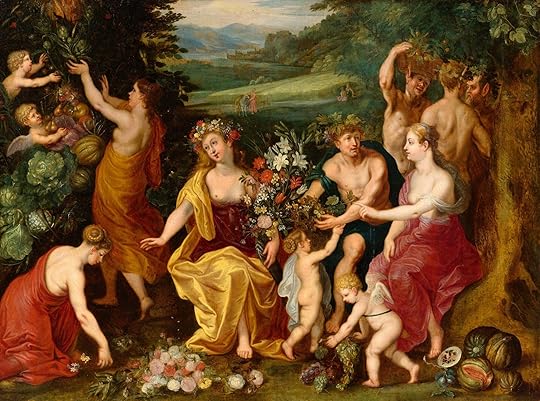
Homage of Flora, Allegory of Fertility painting by Jan Brueghel the Younger and Jan van Balen
But she was not necessarily wrong to make Marob one of the trading cities among the greater ancient Greek world. Mitchison mentioned cities like Olbia and Panticapaeum as Marob’s neighbouring cities. So, I realised that Marob must have been closer to the Maeotians (and they did live near the nomadic Scythians). Erif and Tarrik largely were confined in their own world and their own problem until Sphaeros came to Marob (rescued from a shipwreck by Tarrik) and introduced a different kind of worldview, of philosophical mind distinct from Marob’s old belief; that is Stoicism and rational understanding (and somewhat similar to modern rationalism and atheism as well).
“There is nothing wrong with me when I am god. I can feel the seed-corn sprouting now all over Marob. But that will come to an end, as it did with my father. I shall be killed, and parts of me will be eaten. They will perhaps be eaten by that queer little thing in your belly, Erif.’ He shivered and said: ‘Every year the corn springs again. It is cut down. The seed is stored. After the plowing it is thrown into the dark earth. The earth holds it, buried and forgotten. But it comes alive again. That is the game we play at harvest. But where does Tarrik come in? I am tired of playing the game for the corn, making it go on, the food of Marob, making Marob go on, but leaving myself out. And you. I leave you out. Women die. They die in childbirth, Erif. Often they die! Why must it always be the corn and never us? I want to play a different game.” ~Part III: What Advantageth it Me?
And here where Mitchison introduced us to the second important storyline in her book: Sparta and Kleomenes III’s radical reform. The Sparta of Leonidas was long gone and replaced by the ephors (wealthy magistrates) and inequality of wealth distribution among the Spartiates. Kleomenes III’s revolutionary ideas to break this stagnancy were to bring back the ‘New Times’ based on Lycurgus’ Law, the Sparta that singularly focused on transforming all their male citizens to become austere warriors. Kleomenes III is also set to abolish the ephors and distributes the wealth equally to the Spartiates’ citizens and freeing the helots (state slaves that works the land) and gave the latter a chance to be citizens of Sparta. Although this latter was clearly Mitchison’s invention since historically, in order for the Spartiates to become full-fledged warriors without the cares to tend their own farmland, it was to have these helots completely subjugated and working the land for Sparta. Mitchison seems to conflate Kleomenes III’s Spartan revival with the modern communist revolution.
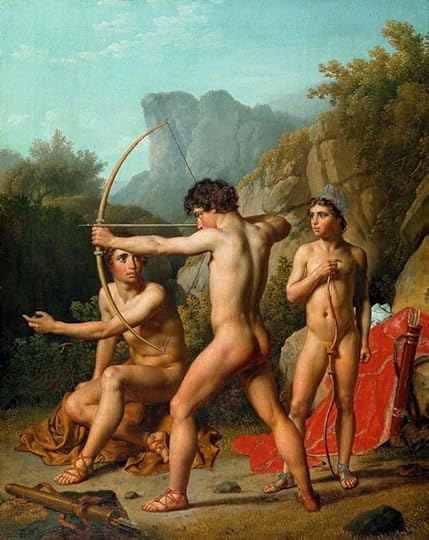
Three Spartan Boys Practising Archery painting by Christoffer Wilhelm Eckersberg
The other protagonist—apart from Erif, Tarrik and Berris Der (Erif’s brother)—is Philylla. A young woman who truly believes in Kleomenes III’s ‘New Times’ and has completely tried to embody the Spartan ideals: of its stoicism, simple life and shared hardship. Erif and Berris’ adventure in Sparta shaped and influenced their old ways of thinking, albeit gradually and slowly. This book is massive, at almost 700 pages, Mitchison weaved Erif’s journey slowly and took us to get used to the way of life between Marob and Sparta.
Everything comes to a head point, the final culmination, in the last phase of the book: in Ptolemaic Egypt. Kleomenes III and his friends ended up in Egypt because they exiled themselves after losing the war with Macedonia and thus his attempted revivalism failed. Much opposite to the ritualistic Marob and Spartan’s stoicism, Egypt’s Ptolemy was decadent, luxurious and thoroughly complacent. Yet, it also shared the basic belief similar with Marob but perhaps can’t be accepted from the rationalist mind of the Spartiates. This is where I didn’t realise how ingenious Mitchison was.. when Philylla, the friend that both Erif and Berris holds very dear, lose all her Spartiates’ friends (historically, Kleomenes tried to incite a revolt in Egypt because he was kind of being taken of hostage instead of being supported, but the attempted revolt failed and they chose to die by suicides to evade capture and humiliation) and in turn: losing the life she was accustomed to (of Spartan’s revivalism). She chose death herself despite her own basic human emotion (embodying the Spartan ideals), I found myself as sad and shocked as Erif because a dear friend was lost and dead (and will never come back to life again). All along, I have considered Philylla as the other secondary character who was there, being put and written to be Erif and Berris’ comrade without guessing that her death was the transformation of Erif all along.
“Yes, mother, they’re lovely. But even if something’s going perhaps to start again with me—and I don’t see how it possibly can—Philylla is dead and I loved her and she was younger than me and so beautiful. And my first baby is dead too. Both those things are real, not just in my mind. Each of them is—a kataleptike phantasia. And an utter waste.” ~Part VIII: Death and Philylla
The ending was heart-wrenching but also transforming. Exactly what Mitchison intended, just like the cycle of the season and the rituals that Marob followed all along but also, of transformation because of meeting new life, new minds, and facing completely new experiences. After death sprung new life but not the way of the old life. The ending is bittersweet but also brings about relief.
This is an incredible and rewarding book for those who are not afraid to read it laboriously due to the scope itself and also, to learn the historicity behind the storyline and the philosophical ideas that Mitchison presented throughout the chapters. I don’t think, despite of my longer review, still able to cover all the aspects that Mitchison put in The Corn King and The Spring Queen. I’m glad that I truly took my time to read this one.

January 8, 2020
It's been a long time since I read a book I found as absorbing as this! If you find Mitchison's narrating style a bit difficult in the beginning, like I did, I recommend you keep going. I got used to it, and the story she told was absolutely worth it.
I've read several books set in ancient Rome, quite a few set in ancient Egypt, some set in ancient Greece but, maybe not surprisingly, none set in ancient Scythia. As Mitchison writes in her introduction we don't know much about them, in my opinion this makes what she has made up even more impressive. That she manages to keep herself from explaining too much makes everything more believable. I enjoyed her description of the life in Marob immensely.
As someone interested in history an archaeology I am of course familiar with the Spartans (or Spatiates, as she calls them). Who hasn't heard about brave king Leonidas and the battle at Thermopylae? But brave king Kleomenes and his communist project was new to me, and deeply fascinating.
And, of course, the decadent Egyptian court is familiar territory.
I'm impressed by Mitchison's open mindedness and modern attitude when it comes to sexuality and gender equality. She must have been quite a marvellous person, writing this in the 1930's!
I've read several books set in ancient Rome, quite a few set in ancient Egypt, some set in ancient Greece but, maybe not surprisingly, none set in ancient Scythia. As Mitchison writes in her introduction we don't know much about them, in my opinion this makes what she has made up even more impressive. That she manages to keep herself from explaining too much makes everything more believable. I enjoyed her description of the life in Marob immensely.
As someone interested in history an archaeology I am of course familiar with the Spartans (or Spatiates, as she calls them). Who hasn't heard about brave king Leonidas and the battle at Thermopylae? But brave king Kleomenes and his communist project was new to me, and deeply fascinating.
And, of course, the decadent Egyptian court is familiar territory.
I'm impressed by Mitchison's open mindedness and modern attitude when it comes to sexuality and gender equality. She must have been quite a marvellous person, writing this in the 1930's!

November 10, 2019
A stunning work of historical fiction with mild fantasy elements. I don't understand the reviews that say that the last section ruins the book; the ending seems fine to me. Naomi Mitchison was a major author, and it's a pity that so few of her works are still in print.

September 17, 2008
Wonderful book about 3d century BC Greece, Egypt and Scythia. History, drama, romance, magic, violent death, this book has it all. Most highly recommended.

July 24, 2026
Tra Magia Barbara e Ragione Greca
Se cercate un romanzo che sia al contempo un’accurata ricostruzione storica e un’immersione profonda nel mito antropologico, "Il Re del Grano e la Regina della Primavera" di Naomi Mitchison è un’opera monumentale che non potete ignorare.
Scritto tra il 1925 e il 1930, il libro ci trasporta in un’epoca di transizione (228-187 a.C.), dove il mondo arcaico della magia si scontra con la nascente razionalità ellenistica.
Un ponte tra due mondi: Marob e Sparta
La narrazione si muove su un doppio binario geografico e spirituale. Da un lato abbiamo Marob, una città immaginaria sulle rive del Mar Nero, abitata dagli Sciti: una cultura "barbara" regolata dai cicli della terra e dai riti magici del Re del Grano (Tarrik) e della Regina della Primavera (Erif Der). Dall'altro c'è la Grecia, e in particolare la Sparta di re Cleomene III, impegnato in una rivoluzione radicale per restaurare le leggi di Licurgo, la cosiddetta "Nuova Era".
Il cuore del romanzo batte nel desiderio di Tarrik di trasformarsi da sovrano semidivino in un re filosofo. Spinto dagli insegnamenti dello stoico Sfero, Tarrik intraprende un viaggio verso la Grecia per incontrare Cleomene, sperando di trovare risposte che le tradizioni di Marob non sembrano più in grado di fornirgli.
Personaggi e legami indimenticabili
Il rapporto tra Berris Der (fratello di Erif e artista scita) e la spartana Fililla è uno dei più complessi della letteratura storica. Quella che inizia come una sfida culturale — Fililla disprezza il "barbaro" Berris finché lui non dimostra il suo valore uccidendo il generale Lidiade a Ladocea — evolve in un’intimità profonda segnata dall’arte (il "Ciclo di Agide" dipinto da Berris) e da un dolore condiviso. Tuttavia, il legame di Fililla con lo spartiata Panteo e l'ideale di Sparta rimarrà una barriera insuperabile, rendendo il loro amore una "scintilla" destinata a spegnersi nel crollo di un mondo.
Interessante è anche la sottile attrazione fisica tra Erif e Fililla, descritta attraverso momenti di quotidiana vicinanza ad Alessandria, che suggerisce un bisogno di conforto umano che va oltre le etichette sociali.
La Storia con la "S" maiuscola
Mitchison non fa sconti alla realtà storica. Dalla battaglia di Sellasia, descritta con minuzia strategica — con l'accerchiamento macedone del monte Euas e la morte di Euclida — fino al tragico esilio in Egitto, il romanzo segue fedelmente le cronache di Plutarco.
Incontriamo figure storiche come il ministro Sosibio, che trama nell'ombra, e il mercante Nicagora, il cui tradimento e false accuse porteranno Cleomene e i suoi seguaci agli arresti domiciliari ad Alessandria. La fine di Cleomene, il fallito tentativo di rivolta e il suicidio collettivo dei dodici spartani (incluso Panteo) sono momenti di una potenza drammatica devastante.
Riflessioni sul potere e il sacrificio
Il libro brilla per le sue riflessioni filosofiche. La conclusione della seconda parte, con il cupo presagio di Panteo verso una Fililla troppo felice («Stai attenta, Fililla... o tutto questo ti si ritorcerà contro!»), funge da perfetta anticipazione della Nemesis greca.
Particolarmente toccante è l'accettazione del sacrificio. Come dice Cleomene prima della rivolta finale: «La nostra morte almeno toglierà dalle loro spalle il peso intollerabile della regalità». Un tema che riecheggia nell'epilogo, dove il figlio di Tarrik ed Erif, Klint-Tisameno, ormai Re del Grano, accetta il suo destino consapevole che un vero sovrano deve essere pronto a morire per il suo popolo.
Conclusione: un Re che diventa Stagione
Cosa resta di Tarrik alla fine? Dopo una profonda crisi d'identità che lo porta persino a bruciare i libri di Sfero e ad affrontare l'impurità causata dall'uccisione del suocero Harn Der, Tarrik accetta infine la propria natura rituale. Nell'epilogo, scopriamo che si è "trasformato in un dio ed è diventato parte delle stagioni", svanendo come individuo per permettere alla vita di Marob di ricominciare.
"Il Re del Grano e la Regina della Primavera" è un'opera che sfida il tempo, ricordandoci che, sebbene le rivoluzioni politiche possano fallire e i re possano morire, il ciclo della natura e la bellezza dell'arte sono le uniche vere forme di immortalità.
Voto: 5/5 - Un classico imprescindibile per chi ama il romanzo storico venato di misticismo.
Se cercate un romanzo che sia al contempo un’accurata ricostruzione storica e un’immersione profonda nel mito antropologico, "Il Re del Grano e la Regina della Primavera" di Naomi Mitchison è un’opera monumentale che non potete ignorare.
Scritto tra il 1925 e il 1930, il libro ci trasporta in un’epoca di transizione (228-187 a.C.), dove il mondo arcaico della magia si scontra con la nascente razionalità ellenistica.
Un ponte tra due mondi: Marob e Sparta
La narrazione si muove su un doppio binario geografico e spirituale. Da un lato abbiamo Marob, una città immaginaria sulle rive del Mar Nero, abitata dagli Sciti: una cultura "barbara" regolata dai cicli della terra e dai riti magici del Re del Grano (Tarrik) e della Regina della Primavera (Erif Der). Dall'altro c'è la Grecia, e in particolare la Sparta di re Cleomene III, impegnato in una rivoluzione radicale per restaurare le leggi di Licurgo, la cosiddetta "Nuova Era".
Il cuore del romanzo batte nel desiderio di Tarrik di trasformarsi da sovrano semidivino in un re filosofo. Spinto dagli insegnamenti dello stoico Sfero, Tarrik intraprende un viaggio verso la Grecia per incontrare Cleomene, sperando di trovare risposte che le tradizioni di Marob non sembrano più in grado di fornirgli.
Personaggi e legami indimenticabili
Il rapporto tra Berris Der (fratello di Erif e artista scita) e la spartana Fililla è uno dei più complessi della letteratura storica. Quella che inizia come una sfida culturale — Fililla disprezza il "barbaro" Berris finché lui non dimostra il suo valore uccidendo il generale Lidiade a Ladocea — evolve in un’intimità profonda segnata dall’arte (il "Ciclo di Agide" dipinto da Berris) e da un dolore condiviso. Tuttavia, il legame di Fililla con lo spartiata Panteo e l'ideale di Sparta rimarrà una barriera insuperabile, rendendo il loro amore una "scintilla" destinata a spegnersi nel crollo di un mondo.
Interessante è anche la sottile attrazione fisica tra Erif e Fililla, descritta attraverso momenti di quotidiana vicinanza ad Alessandria, che suggerisce un bisogno di conforto umano che va oltre le etichette sociali.
La Storia con la "S" maiuscola
Mitchison non fa sconti alla realtà storica. Dalla battaglia di Sellasia, descritta con minuzia strategica — con l'accerchiamento macedone del monte Euas e la morte di Euclida — fino al tragico esilio in Egitto, il romanzo segue fedelmente le cronache di Plutarco.
Incontriamo figure storiche come il ministro Sosibio, che trama nell'ombra, e il mercante Nicagora, il cui tradimento e false accuse porteranno Cleomene e i suoi seguaci agli arresti domiciliari ad Alessandria. La fine di Cleomene, il fallito tentativo di rivolta e il suicidio collettivo dei dodici spartani (incluso Panteo) sono momenti di una potenza drammatica devastante.
Riflessioni sul potere e il sacrificio
Il libro brilla per le sue riflessioni filosofiche. La conclusione della seconda parte, con il cupo presagio di Panteo verso una Fililla troppo felice («Stai attenta, Fililla... o tutto questo ti si ritorcerà contro!»), funge da perfetta anticipazione della Nemesis greca.
Particolarmente toccante è l'accettazione del sacrificio. Come dice Cleomene prima della rivolta finale: «La nostra morte almeno toglierà dalle loro spalle il peso intollerabile della regalità». Un tema che riecheggia nell'epilogo, dove il figlio di Tarrik ed Erif, Klint-Tisameno, ormai Re del Grano, accetta il suo destino consapevole che un vero sovrano deve essere pronto a morire per il suo popolo.
Conclusione: un Re che diventa Stagione
Cosa resta di Tarrik alla fine? Dopo una profonda crisi d'identità che lo porta persino a bruciare i libri di Sfero e ad affrontare l'impurità causata dall'uccisione del suocero Harn Der, Tarrik accetta infine la propria natura rituale. Nell'epilogo, scopriamo che si è "trasformato in un dio ed è diventato parte delle stagioni", svanendo come individuo per permettere alla vita di Marob di ricominciare.
"Il Re del Grano e la Regina della Primavera" è un'opera che sfida il tempo, ricordandoci che, sebbene le rivoluzioni politiche possano fallire e i re possano morire, il ciclo della natura e la bellezza dell'arte sono le uniche vere forme di immortalità.
Voto: 5/5 - Un classico imprescindibile per chi ama il romanzo storico venato di misticismo.
This entire review has been hidden because of spoilers.

July 30, 2023
I took a bit of a chance on Naomi Mitchison, chancing upon her biography, finding she had an interesting body of work and getting as many as I could for as cheap as I could. I’ve been building to The Corn King and the Spring Queen, it being largely celebrated as her greatest work.
The blurb really doesn’t capture the book, simply describing the first few actions in the book. Tarrik is the Corn King and he is married to Erif Der, and she becomes the Spring Queen. Her father wants her to use her witch powers to ruin Tarrik’s kingship and take over. Then a Greek poet washes up in their land and they follow him to Sparta where a social revolution is taking place… and then more happens. It’s a long book with a complex plot mixing historical fiction, true events and fantasy.
If anything, the book is less about a plot but themes. A look at the notion of civilisation through the lens of a barbarian civilisation, a Greek civilisation going through an assessment of their values and the bloated, cruel civilisation of Ptolemaic Egypt. The book then looks at the place of magic, belief, ritual, tradition, art, luxury, martial purpose and many other elements and how they contribute and detract from their civilisations.
Mitchison performs impressive world building, imagining the reality in Sparta and Egypt, but more particularly with the creation of her created Scythian country of Marob. It’s a world away from the big power players of the Mediterranean, less important than that harrumphing wannabe, Rome. Women can have magic, a nebulous set of powers that use objects to create illusions and change behaviour - the book heavily implies that the magic is real, especially towards the end of the book. What’s more, the growing seasons in Marob are aided by the Corn King and Spring King, who, when playing these roles, are considered touched by divinity. A lot of thought has been put into the rituals, their links to the year, to standard mystical concepts, and life’s rites of passage. Quite a few end in orgies, something you don’t expect in a book written in the ‘30s. It’s all a bit Wicker Man.
There’s a lot of sex in the book and not all of it heterosexual. With some of the book happening in Sparta, there’s also description of boy-man love, as well as assault and gropey stuff in decadent Egypt. There’s a lot of violence in the book as well, some of it rather gruesome. These characters live in violent times but most of them have violence in them as well. There’s an arbitrary nature to much of the violence, and the actions of the characters.
Tarrik the Corn King is particularly inscrutable. He makes sudden and self-harming decisions, sometimes just for a laugh. Yet he also has a fondness for philosophy and a desire to be a good person. I think the splits within Tarrik are supposed to reflect the tensions within Marob society but it makes him difficult to understand. This is a problem with most of the characters to a certain extent. Mitchison does such a good job in creating an involved world but can’t fully bring the reader into it. I could understand why Tarrik did as he did but I couldn’t feel it. Intellectually, I could acknowledge that Tarrik was nervous about the forthcoming harvest dance and this was expressed in nervy bursts of energy and occasional murder, a murder which he feels justified by his Godhood - but it felt so incongruous with how he was presented the rest of the time that I couldn’t follow him.
The book also follows the story of Kleomenes, which I knew a little of the history of. Interestingly, his tragedy is built up with Christ parallels. He has twelve close advisors, they share a final meal, he is strung up on a cross - I knew it was a little early for Christianity, but I did feel it may pop in. Especially because Marob, Sparta and Egypt all had dead-God, rebirth moments. One horrific detail of being Corn King, is that when his time is up he is ritually killed and eaten. Tarrik had eaten some of his father, and his son would eat him. Maybe that explains his erratic nature.
The Corn King and the Spring Queen is a book I admire for it’s world building and the detailed imaginative investment it makes into the past and the more fantastical elements. I appreciated the core themes and saw how each character and event explored and reflected them. I just couldn’t really connect deeply with the characters and it didn’t ‘live’ for me quite as it could.
The blurb really doesn’t capture the book, simply describing the first few actions in the book. Tarrik is the Corn King and he is married to Erif Der, and she becomes the Spring Queen. Her father wants her to use her witch powers to ruin Tarrik’s kingship and take over. Then a Greek poet washes up in their land and they follow him to Sparta where a social revolution is taking place… and then more happens. It’s a long book with a complex plot mixing historical fiction, true events and fantasy.
If anything, the book is less about a plot but themes. A look at the notion of civilisation through the lens of a barbarian civilisation, a Greek civilisation going through an assessment of their values and the bloated, cruel civilisation of Ptolemaic Egypt. The book then looks at the place of magic, belief, ritual, tradition, art, luxury, martial purpose and many other elements and how they contribute and detract from their civilisations.
Mitchison performs impressive world building, imagining the reality in Sparta and Egypt, but more particularly with the creation of her created Scythian country of Marob. It’s a world away from the big power players of the Mediterranean, less important than that harrumphing wannabe, Rome. Women can have magic, a nebulous set of powers that use objects to create illusions and change behaviour - the book heavily implies that the magic is real, especially towards the end of the book. What’s more, the growing seasons in Marob are aided by the Corn King and Spring King, who, when playing these roles, are considered touched by divinity. A lot of thought has been put into the rituals, their links to the year, to standard mystical concepts, and life’s rites of passage. Quite a few end in orgies, something you don’t expect in a book written in the ‘30s. It’s all a bit Wicker Man.
There’s a lot of sex in the book and not all of it heterosexual. With some of the book happening in Sparta, there’s also description of boy-man love, as well as assault and gropey stuff in decadent Egypt. There’s a lot of violence in the book as well, some of it rather gruesome. These characters live in violent times but most of them have violence in them as well. There’s an arbitrary nature to much of the violence, and the actions of the characters.
Tarrik the Corn King is particularly inscrutable. He makes sudden and self-harming decisions, sometimes just for a laugh. Yet he also has a fondness for philosophy and a desire to be a good person. I think the splits within Tarrik are supposed to reflect the tensions within Marob society but it makes him difficult to understand. This is a problem with most of the characters to a certain extent. Mitchison does such a good job in creating an involved world but can’t fully bring the reader into it. I could understand why Tarrik did as he did but I couldn’t feel it. Intellectually, I could acknowledge that Tarrik was nervous about the forthcoming harvest dance and this was expressed in nervy bursts of energy and occasional murder, a murder which he feels justified by his Godhood - but it felt so incongruous with how he was presented the rest of the time that I couldn’t follow him.
The book also follows the story of Kleomenes, which I knew a little of the history of. Interestingly, his tragedy is built up with Christ parallels. He has twelve close advisors, they share a final meal, he is strung up on a cross - I knew it was a little early for Christianity, but I did feel it may pop in. Especially because Marob, Sparta and Egypt all had dead-God, rebirth moments. One horrific detail of being Corn King, is that when his time is up he is ritually killed and eaten. Tarrik had eaten some of his father, and his son would eat him. Maybe that explains his erratic nature.
The Corn King and the Spring Queen is a book I admire for it’s world building and the detailed imaginative investment it makes into the past and the more fantastical elements. I appreciated the core themes and saw how each character and event explored and reflected them. I just couldn’t really connect deeply with the characters and it didn’t ‘live’ for me quite as it could.

August 8, 2025
“Il Re del Grano e la Regina della Primavera” è un’opera difficile da recepire e recensire in questo 2025; oltre alla densità letteraria di un’opera scritta nel 1930, ciò che può rendere pesante la lettura consiste nell’attenzione, e forse nella ridondanza, con cui l’autrice trattò la vita quotidiana di alcune culture oggi scomparse. I protagonisti del romanzo sono la coppia di sposi composta da Erif Der e Tarrik, rispettivamente la Regina della Primavera e il Re del Grano del titolo. Costoro appartengono al misterioso popolo sciita e vivono sulle sponde del Mar Nero; Erif Der è una strega e viene data in sposa dal padre a Tarrik per indebolire i suoi poteri sacri, quelli che fanno crescere il grano e prosperare la natura attorno a lui. La fanciulla ubbidisce al padre, ma proprio quando sembra che il suo clan abbia la meglio, sulle coste del loro villaggio, Marob, naufraga un filosofo greco, Sfero. Tarrik lo soccorre e, facendosi insegnare la filosofia, sembra riprendere il controllo su sé stesso, tanto che desidera visitare la Sparta di Cleomene III, di cui Sfero parla come di un monarca illuminato. Tarrik parte alla scoperta della Grecia e in seguito sarà raggiunto da Erif. Cominciano così gli anni di viaggi e ritorni: dopo aver visto Sparta, Erif e Tarrik non saranno più gli stessi e anche dopo il loro ritorno a Marob, qualcosa cambierà e saranno costretti a ripartire. Queste sono solo le premesse, i due protagonisti sono solo la scusa dell’autrice per vedere con occhio nuovo e disincantato la decadenza della cultura greca, pochi anni prima della conquista romana. Nella cornice principale si incastrano innumerevoli sottotrame e personaggi secondari, ognuno con il proprio peso sulla narrazione e sullo sviluppo degli eventi, benché non rendano la scrittura scorrevole. Procedendo nella lettura ci si chiede sempre quale valenza possano avere alcune scene che occupano un capitolo intero, ma alla fine di tutto si deve ammettere che, come nella vita reale, anche esse sono servite a far sviluppare i caratteri dei personaggi. Il tema del viaggio è quello dominante: soprattutto nella seconda parte esso viene utilizzato come metafora di guarigione per far cambiare prospettiva ai personaggi e far capire loro le cause dei propri sbagli, nonché la caducità delle idee. L’elemento fantasy viene maneggiato con cura e parsimonia, Erif è in grado di creare illusioni e questo la rende la dea ex machina in alcune occasioni ma non la rinchiude nel personaggio della paladina-maga. Altro pregio della scrittura è quello di non lesinare critiche anche a comportamenti “davvero barbari” dei protagonisti, in questo la figura dei vari filosofi aiuta davvero. La religione è un elemento fondamentale ma reale della narrazione, il divino, nonostante i vari culti che si incontrano, non è mai ridicolizzato e soprattutto guida i personaggi a raggiungere una stabilità interiore. Lo stile di scrittura è limpido ma la trama non è decisamente avvincente; questo non è un difetto in realtà, perché accentua il realismo dell’opera, spesso e volentieri i personaggi evolvono semplicemente seguendo i fatti storici e quotidiani che capitano attorno a loro e, cosa importante, viene dato loro tempo per maturare nuove consapevolezze, fosse anche solo l’amore verso una persona che si conosce da tanto. Concludendo il discorso, è difficile ridurre questo romanzo solo a genere storico, è in realtà un’opera drammatica a tutto tondo che parla principalmente della fine della storia greca vista dagli occhi di due giovani “barbari” che devono a loro volta risolvere i propri drammi interiori; a fine lettura non ci si lamenta più delle parti che sembravano inutili e prolisse e ci si rende conto di aver avuto a che fare con un’opera unica.

December 4, 2022
This is a historical novel of ancient Greece and ta city on the coast of the Black Sea. 228 – 187 b. c. e. It starts with a young woman, Erif Der, enjoying a moment on the beach of the Blasck Sea outside her town of Marob.. I suppose this is a fictional city. These people of this city were superstitious, and believed in witches and Gods working magic. Erif is a witch and the Spring Queen. She became the Spring Queen somehow, but mostly by being the one to dance with the Corn King at Plowing Eve, a spring festival to give the crops the magic to grow and be plentiful. She is also the daughter of the wealthiest man in town.
The Corn King and chief is Tarrik. The Corn King is a God that ensures the crops get rain, sunshine, and are fruitful. I did not find out how he was chosen to have this honor, but because Erif's father wants to be chief, and is using her to that end, I suspect it is bestowed by the town elders, Being the Corn King is trickier. In the second part of the story Tarrik gives his Godhood to Erif's brother, Yellow Bull, because Tarrik is taking a trip to Sparta, so can not be there to perform the rites of the Corn King. While Tarrik is gone, Yelllow Bull dies, and the crops fail.
Tarrik has fallen in love with Erif, so he rapes her and forces her to marry him. He has no notion that she is in league to dispose him in favor of her father, but that does not happen because she begins to enjoy his company, and later falls in love with him.
Things happen, and it is pretty much a history of this era, but that is about it. After reading three hundred or so pages out of seven hundred nineteen, I decided it was not worthwhile, so I have put it aside.

December 7, 2023
Comprendi che la lettura non è nelle tue corde quando già prima della metà perdi qualsiasi interesse per le vicende narrate e per i destini dei personaggi. Non sono mai riuscito a farmi catturare dalla storia - ad eccezione dell'ultima parte, in Egitto, l'unica in grado di suscitare in me in minimo di curiosità, qualcosa di diverso dalla più sconfortante noia e delusione. Non ho mai provato alcuna emozione nei confronti dei personaggi, forse disprezzo e disgusto per Tarrik e Tolomeo, che comunque sarebbe in ogni caso naturale. Lo stile di scrittura l'ho percepito troppo pesante, un mattone. Faticavo a proseguire, necessitavo più volte di una pausa.
Avevo grandi aspettative, leggendo la trama in quarta di copertina. Aveva tutte le carte in regola per diventare uno dei miei romanzi preferiti, ma si è rivelato infine una cocente amarezza. Avrei assegnato una stella, ma ne ho aggiunta una giusto per l'impegno della Mitchison (e per i capitoli ambientanti in Egitto).
Tuttavia non comprendo ancora due cose: 1) dove sarebbe il fantasy? Giusto qualche sporadico e rarissimo accenno, raffazzonato e posticcio. Poteva benissimo non esserci, e risultare uno storico puro. 2) come fanno a vederci la Rowling in queste pagine? Ma seriamente?
Avevo grandi aspettative, leggendo la trama in quarta di copertina. Aveva tutte le carte in regola per diventare uno dei miei romanzi preferiti, ma si è rivelato infine una cocente amarezza. Avrei assegnato una stella, ma ne ho aggiunta una giusto per l'impegno della Mitchison (e per i capitoli ambientanti in Egitto).
Tuttavia non comprendo ancora due cose: 1) dove sarebbe il fantasy? Giusto qualche sporadico e rarissimo accenno, raffazzonato e posticcio. Poteva benissimo non esserci, e risultare uno storico puro. 2) come fanno a vederci la Rowling in queste pagine? Ma seriamente?
November 11, 2022
Questo romanzo è stato una sorpresa sotto molti punti di vista.
Mi aspettavo infatti una lettura simile a “Il viaggio di Halla”, che ho adorato, per stile di scrittura e narrazione. Ma, se in “Il viaggio di Halla” sembrava di leggere quasi una fiaba per bambini, quindi una narrazione molto semplice e scorrevole, con uno stile fiabesco, con questo libro siamo su un pianeta totalmente diverso.
Il worldbuilding è sicuramente più complesso, tanto che faticavo a stare al passo con le presentazioni dei diversi personaggi, genealogie ecc, ma è soprattutto la scrittura dell’autrice che non mi ha aiutato con la lettura. Una scrittura magnetica quanto prolissa in questo caso, tanto che non mi è difficile immaginare il motivo per cui Tolkien sia rimasto notevolmente influenzato da questa scrittrice, della quale era un caro amico.
I temi trattati, però, sono diversi e molto attuali: patriarcato, autoaffermazione femminile, sottomissione e genere sono i fili conduttori della storia. Sicuramente l’elemento più interessante del libro.
Se si riesce a superare lo scoglio iniziale, può essere una lettura fantasy davvero interessante e che vale la pena intraprendere.

June 3, 2023
Una delle letture più interessanti che mi sia capitata di leggere negli ultimi tempi.
Come ho potuto vivere finora senza aver mai sentito nominare Mitchison? Perché i suoi libri non sono in bella mostra sugli scaffali delle librerie? Perché i suoi titoli sono così rari nelle biblioteche? Perché è una donna? Perché negli anni 30 scriveva di virilissimi uomini spartani innamorati tra di loro? Perché non ha mai un occhio giudicante sulle culture diverse dalla sua? Che sia tutto questo insieme?
È un libro perfetto, questo? No. Si prende alcune libertà storiche? Sì, ma, santiddio, è la stessa autrice a mettere le mani avanti nella prefazione ("Le possibilità che il mio Cleomene corrisponda a quello realmente vissuto sono scarsissime, e credo che allo stato attuale delle conoscenze nessuno possa ricostruirlo in modo più verosimile del mio") e nell'introduzione scritta sessant'anni dopo la prima pubblicazione, con una punta di cinismo, ricorda che "I miei personaggi erano persone reali, diversissime da me e dalla lingua che uso per raccontarli, ma sono morti e non possono lamentarsi se ho sbagliato". Magari tutti i romanzi storici fossero così!
Come ho potuto vivere finora senza aver mai sentito nominare Mitchison? Perché i suoi libri non sono in bella mostra sugli scaffali delle librerie? Perché i suoi titoli sono così rari nelle biblioteche? Perché è una donna? Perché negli anni 30 scriveva di virilissimi uomini spartani innamorati tra di loro? Perché non ha mai un occhio giudicante sulle culture diverse dalla sua? Che sia tutto questo insieme?
È un libro perfetto, questo? No. Si prende alcune libertà storiche? Sì, ma, santiddio, è la stessa autrice a mettere le mani avanti nella prefazione ("Le possibilità che il mio Cleomene corrisponda a quello realmente vissuto sono scarsissime, e credo che allo stato attuale delle conoscenze nessuno possa ricostruirlo in modo più verosimile del mio") e nell'introduzione scritta sessant'anni dopo la prima pubblicazione, con una punta di cinismo, ricorda che "I miei personaggi erano persone reali, diversissime da me e dalla lingua che uso per raccontarli, ma sono morti e non possono lamentarsi se ho sbagliato". Magari tutti i romanzi storici fossero così!
February 21, 2026
DNF
Very original and historically dense book, but I could not get through all the "ploughing" and other barbarism. I kept trying to plough (no pun intended) through the book as it presented the work of a very intelligent writer that fully immersed herself in her work, but it simply gave me no joy to read it and otherwise made me not look forward to my usual habit of opening a book in the evening.
I don't believe that characters have to be morally good, relatable, or likable to hold my interest - in fact quite the opposite - but good lord, every other chapter the main heroin, Erif Der, or her "husband" Tarrik would go on a delirious murder or raping spree where even they would wonder why they're doing it and eventually they would be placated simply because some time passed or they're primitive little minds would come up with some absurd logic that temporarily soothed them until they started all over again. At about 150 pages into the book whatever charm they had was completely forgotten, and simply primitive animistic rituals remained.
In short, it's a well-written but awful story.
Very original and historically dense book, but I could not get through all the "ploughing" and other barbarism. I kept trying to plough (no pun intended) through the book as it presented the work of a very intelligent writer that fully immersed herself in her work, but it simply gave me no joy to read it and otherwise made me not look forward to my usual habit of opening a book in the evening.
I don't believe that characters have to be morally good, relatable, or likable to hold my interest - in fact quite the opposite - but good lord, every other chapter the main heroin, Erif Der, or her "husband" Tarrik would go on a delirious murder or raping spree where even they would wonder why they're doing it and eventually they would be placated simply because some time passed or they're primitive little minds would come up with some absurd logic that temporarily soothed them until they started all over again. At about 150 pages into the book whatever charm they had was completely forgotten, and simply primitive animistic rituals remained.
In short, it's a well-written but awful story.
Displaying 1 - 30 of 64 reviews