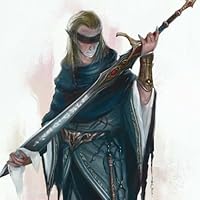
the first in a trilogy of tales, told by the minstrel orfeo, of the grim struggle against the Dark Powers of Chaos which threaten the Warhammer World. "The castle of Zaragoz was legendary- a citadel which could never be taken. But it was not so. An army came treacherously from below to seize the castle and depose the Duke. They killed the strongest, the bravest, the most virtuous, and sought to cow the rest."
This was an intriguing read and overdelivers for being a Warhammer novel. In fact, it barely reads like a Warhammer novel. I can't seem to figure out if this is the first published Warhammer novel or the second; it was published in 1989, the same year as Drachenfels (often considered the first Warhammer novel). In any case, this was one of the first ones, and one gets the sense that the rendering of the Warhammer "Old World" in fiction was still taking form when Brian Craig (a pseudonym for Brian Stableford) penned this. I am imagining that the editors told him to write a Gothic novel, and he delivered faithfully--very faithfully. This has all of the conventions of a traditional 1790s Gothic novel: a past transgression/sin coming to the surface, aristocratic skullduggery, an incarcerated innocent female victim, a mysterious priest (actually two of them), and several scenes that take place in shadowy and dangerous labyrinths. My one complaint isn't really a valid one:this doesn't feel like a Warhammer novel. There are barely any references--some might say there are zero references--to actual Warhammer fantasy lore. There are generic references to the Empire, the Dwarfs, the Elfs, Order, Chaos, and Bretonnia, but zero knowledge of the setting is needed to enjoy this. In fact, it is potentially a shame it is labeled as a Warhammer novel. Alas, it might make people pre-judge it as a literary gaming curio. Let me say, if you like traditional Gothic fiction, you'll like this. If Brian Stableford was able to publish this as a Gothic novel pastiche, situate Zaragoz in 17th-century Spain--instead of Estalia--it might just attract more readers. I am also wondering what Warhammer fans thought of it when it was published. Did they like it? Was the world even fleshed out in 1989? Anyway, I'm glad I read this. I loved the characters of Semjaza, Orfeo, and the vampiric seductress, Morella d'Arlette. I loved the rich and shadowy setting. I loved the atmosphere. I loved the prose style. I loved it. I loved it. I loved it.
Written back in the original run of Games Workshop fiction, this short novel is written in a far different tone than the modern ones. At turns both far more adult, darker, and creepier than the modern Black Library tales (this one had a definitive HP Lovecraft vibe to it), the pacing was also tremendously slower, and the writing was far more sophisticated than the majority of the modern novels which can, at times, be more than a tad juvenile. That said, due largely to the pacing, this wasn't one of my favorites. While it wasn't a bad read, it isn't one I think I will keep as a reread. Though if you are curious as to how the early versions of Warhammer fiction (fantasy in this case) stack up in comparison to the modern versions, and don't mind a creepy, psychological story that is a bit more intellectually dense than standard, modern, Black Library fare, give this one a shot.
I read this book as a child and it has always stayed with me. I don't read a lot of fantasy anymore, my tastes inclining more to literary fiction. As a writer, however, I am sensitive to the power that which I encountered as a child holds on my imagination, and I decided to reread this book for inspiration.
There are a number of things I might fault Zaragoz on - the ropey dialogue, inelegant prose and somewhat shallow characterisation for instance. But in spite of these it still has a grip on my imagination few other books I have read can equal. The great strength of the novel is its subtle Lovecraftian horror. Lovecraft himself was more of an ideas man than a technician and I honestly found this novel just as compelling as anything by the father of modern horror in its exploration of human angst at the immensity of the universe.
While the other characters in the novel (Orfeo included) felt fairly flat, the villains had a spark of life to them. But towering above all is Semjaza. Semjaza is fascinating - eloquent, sinister, either sickeningly amoral or actively evil, and yet strangely likeable, even compelling. While the writing throughout the rest of the novel is often so-so, the few passages devoted to Semjaza sizzle in the brain.
Despite clearly being aimed at a younger audience, this book is immensely dark in tone. The protagonist and his allies never seem more than bit-part players in a wider drama, one they have scant power to influence. This is a bold stroke of genius I have seldom seen in fiction, especially of this type. When the violent, horrifying climax comes, the unsettling mood of the novel is delivered upon brilliantly, and I loved the way the novel reached such a satisfying peak without ever making it feel like Orfeo and his companions were anything other than pawns.
Zaragoz is far from perfect but it wormed its way into the shadows behind my consciousness twenty years ago and has never left. It's a fascinating, flawed work of genius.
Oh, man, Warhammer Fantasy meets Robert Chambers, with a pinch of Lovecraft - what's not to love here? I'm not super fond of the idea of the framing device (Orfeo is telling this entire story to an Arab who has him as his slave in exchange for his freedom, though the fact there are two more books in the series should inform you how well that plan works out), and the postscript discussion about how the story should/shouldn't end there is ridiculously tiresome, but overall, this is an extremely fun reworking of The Yellow Sign into the WHF world. The first half is almost noirish in its manner of 'the man comes into town and keeps getting embroiled in everybody's business,' then the pieces are manipulated so everyone is at the masked ball, aaaaand the unmasking! Really great fun.
Well that was ehm peculiar? For starters the cover. I mean that cover is a lie. The main character is a minstrel flute player not some conan the barbarian. Why is he in some creepy forest and what is that old man above supposed to be? It is generic and in fact where it not for the big yellow letters one would never know this to be part of the warhammer franchise.
In fact the story itself has barely anything to do with warhammer. Yes a couple of names are dropped like Estalia, Wood elves, Solkan, a crag and chaos as a magical force but honestly? You could easily cut that out and nobody would ever know this was warhammer. That makes the book and story interesting to say the least. Published in 1989 this is part of the first wave of warhammer books/ black library publications. I can't help but be reminded of forgotten realms dnd books from the period. It feels as if they were still figuring this book stuff out and had not gotten their style down yet on how to translate their massive lore from the table top game into a shorter story, I can understand why dnd books were an inspiration.
The main character Orfeo is trained by woodelves and constantly hinted at having magical powers, well that is a DnD bard if I ever seen one. The same goes for magic as a whole, unlike later books where magic has gone through a serious review and is a complex affairs involving geometrical grids and winds of magic or gestalt force in case of the orcs and ogres. Here magic is all bundled up, good, chaotic, necromancy, demon pacts; again much more dnd then warhammer.
What does not help is the setting; Estalia is by far the least explored and most generic of all regions in warhammer. Tilea might have the dogs of war, Bretonnia it's knights and Araby the thousand and one arabians night vibe, all of which is cliché to a great extent but it had something and has been made into something of distinct warhammer flavor. Estalia is just kinda there in the lore and that makes the setting for this tale quite bland and not at all rooted in diverse crazy world that warhammer fantasy is.
Besides Orfeo we have a few characters more and honestly they all feel kinda bland. the evil duke, the twisted countess, the naive nobleman, the paranoid secret police captain, the out for revenge/justice priest and the power hungry sorcerer. Not much there to get excited about.
Plotwise, I was on board for the first half but I can't really grasp Orfeo motivations in the later half. At first he has this "I am off to see the world" vibe going, a charming rogue not bound to any place. That's why I was not at all convinced of why exactly he would be sticking his neck out the way he did for people he does not know and a cause not related to him. On top of that the evil plan, is kinda strange and weak while the twists at the end came out of nowhere.
I did not have high expectations and the first half was promising enough but what started out as a wrong time, wrong place story turned into something like a point and click adventure game plot. Why Is he stuck in this place? What is holding him here? It almost felt like I could feel the boundries of his world and the path he was supposed to take, not a great feeling to maintain the suspension of disbelieve or immersion in a story.
Set in the world of the Warhammer Fantasy miniature wargame, this is actually a pretty good dark fantasy novel. The central character is Orfeo, a bard (predictably, with that name), who is captured by pirates at the start of the novel. Warhammer fantasy has very clear parallels to real world cultures and these pirates are clearly analogue to Barbary Pirates, the Ottoman Corsairs operating around the mediterranean from medieval times to the 1800s. Orfeo himself has been brought up by elves but comes from an area similar to France or Northern Italy.
In a kind of variation of the Scheherazade story, he recognizes that his captain is from somewhere in the north and promises to give him news of Zaragoz, a land in which the captain seems particularly interested. We soon realise that the pirate setting is little more than a framing device for a story of courtly intrigue, magic and clashes between powerful families in Zaragoz. A place Orfeo arrives at as a travelling player.
You really need no previous knowledge of Warhammer or its universe to enjoy this. It's a pretty self-contained story and it has a pretty good sense of mood, with the scenes in Zaragoz being positively gothic in their medieval/renaissance back stabbings in thick-walled castles. Pretty fun little novel.
I've being delaying this book for some time. Now that I've read it I've got mix feelings. First of all let me say that I've got two versions of this book. First published by Baxtree books and another version by Brian Craig. The differences? There are some. I've read the Baxtree because of the paintings inside.. and fortunally I've done that because I also learn something that differs from the old books by Baxtree to this ones. I wonder all those books republished by Black Library and what did they took off. Why I Say this? Well there is a part in this novel that depicts the act of lovemaking. As I read that and after reading dozens of Black Library books I felt that something was different so I went to the Black Library book and read the same paragraphe... The ideia of lovemaking was there but they took out some parts. It's nothing that will change your impression of the novel but it's something. Of course I didn't checked everything so I wonder how much did they changed. Well I wonder all those books published by Baxtree and then republished.. how much did they lose? What information they took and didn't print on this new edition.
Now speaking of the novel itself. Well this book is different from other books. This book is a character based novel but also the plot is totally different what Black Library publish nowadays. Chaos is not Chaos in beasts or man. Evil is not defined. If this book was written outside black library it would fit and you would understand. There is no knowledge needed reading this book. This particular tale is narrated by Orfeo, a travelling player who tells of his tale in the little-known Estalian province of Zaragoz. Needless to say, he becomes entangled in a web of intrigue there. I must say that this part was a bit confusing with all the names, but nothing we couldn't understand in a long run. On the plus side a novel that depicts the life in Estalia is a rarity. Almost all novels with few exceptions have the Empire lands as the background. This was something that I observed and I am angered. I know the fundamental is the Empire. But why not a book with stories set in Estalia, Kislev or Tilea? Why not Albion or far Cathay? Or even far away to Nippon. Or even to the chaos dwarves land... There is so much yet to discover that I believe Black Library will only stop producing books if Games Workshop goes bankrupt... I don't play the miniatures games but I have all books because I like the world they created in Warhammer Fantasy and 40k Setting. They are far richer than other worlds like Forgotten Realms... Well I've talk so much not about the book... Sorry.
This was the first tale... Let us see if the second is better. I have plain confidence in Brian Craig.
This entire review has been hidden because of spoilers.
The Tales of Orfeo trilogy seems to be kind of forgotten by Warhammer Fantasy fans. I don’t think I’ve ever heard anyone talking about it before I dug it out of the depths of the fan wikis and decided to give it a read. And while I enjoyed reading it a fair bit, I ultimately understand why no one really talks about it, either.
Wandering storyteller and musician Orfeo has been captured by Arabian pirates, but their leader has offered him a deal: the man has a mysterious connection to the region of Zaragoz and if Orfeo can tell him the tale of what happened the last time the bard was there, then he will not be sold as a slave. So Orfeo sits with him and tells of a land where darkness hides around every corner and the coming of a mysterious priest awakens ancient magic baked into the stones of a young nobleman’s house.
The biggest problem with Zaragoz is that every emotional reaction in the story feels muted. Orfeo’s stoicism is probably intentional, to fit with his character as a man who has traveled a great deal and seen all kinds of things come to pass. But even still, one would think that after being condemned to a fate worse than death, for example, or finding out that a major power in the area is secretly a worshiper of the evil Chaos Gods, he would have stronger feelings about it than “well, this isn’t good”. I exaggerate for comedic effect, of course, but only slightly. It makes it harder to judge the stakes than it should be, and also more difficult to connect to the characters and to the story.
And the events of that story are pretty cool. As I was reading through it, I kept feeling a sense of familiarity that went beyond simply being set in a universe I was familiar with, and at some point, I realized it – Zaragoz very much feels like a tribute to the works of H.P. Lovecraft. The old location with something evil lurking in it (almost to the point of feeling like a character in itself), cultists around every corner, and a big bad that is something dark, mysterious and ultimately unknowable and uncontrollable. The focus on swarms of rats doesn’t hurt either, given that the first Lovecraft I ever read was “The Rats in the Walls”.
The story is pretty typical for a Warhammer Fantasy novel, but there were enough twists and turns to keep me on my toes, and at under 250 pages, a few slow-downs in the pacing weren’t enough to make it feel like a drag. The prose was good enough to ignore for the most part and Craig manages to pull together a chaotic finale that put a grin on my face.
While I fully understand how this one slipped through the cracks in discussions about Warhammer Fantasy, I did enjoy reading it and I feel like it deserves a bit more recognition. A great small bite of cosmic-horror inspired fantasy that doesn’t try to be more than what it is.
Warnings: Expect most of the typical content warnings for Warhammer Fantasy works - lots of violence, light body horror, a torture scene or two, and some references to slavery and various forms of in-universe bigotry. Also worth noting that country of Araby is pretty blatantly cobbled together from stereotypical views of the Middle East, which some readers might find offensive or distracting.
A very solid read and a very solid 3 stars. I wished for a bit more, but it just wasn't there. I do love Warhammer universe the more I delve into it, especially it's darker feel then other Fantasy Universes out there. It's grim, it's nasty, its a world full of demons of all kinds, and at any time all sorts of things can go wrong.
Characters: 3 An interesting set of characters I'd say. Kept me interested but I could not really get into it or immerse in fully. For some reason I had a hard time to really buy into the whole story. I think it was how the story was framed that turned me off from the beginning. Right in the first few pages you know that this is a story being told by a story teller to someone. Kinda like "1001 Nights". It's very hard to immerse if I know it's someone telling a story. (I know it sounds odd, since it's all stories in the end.)
Plot: 3 Solid plot as well. Some twists but overall story went by chapter by chapter. It was good, I liked it, but I could stop at any time without that urge of having to come back.
Setting: 3 Warhammer setting is great to me because of all the mystical elements and deities co existing together with the people. There was certainly a lot of that in the text which was why I liked it. It would be nice to have mythical beings take a more active part throughout the whole story but I suppose this is one of the first Warhammer novels written so the universe was still forming. Solid 3 again.
I'll definitely be reading the next book published in the Warhammer universe, that's for sure. There's something about it that draws me in. I hope for the world to get more and more fleshed out as it grows!
One of the best stories I've ever read. The plot twists, the expectations, the palacial intrigues, the role of magic and the supernatural, everything was just adequately measured. It's a book for a more mature reader I would say. Many Warhammer stories feel like they were written for teenagers or by teenagers, not *Zaragoz* though. Which is a good thing for me. The narrative is focused on the story itself instead of using the story to product-place Games Workshop's minis and games. One can perceive Warhammer(ness) in the story without feeling contrived and odd.
I really like the toned down fantasy aspect of this world. It aligns better with the grimdark aesthetic and clearly separates Warhammer from other fantasy worlds such as LOTR or Narnia. I think this was the original intent. Even the warhammer world map seems to reflect that intent, since it's basically planet Earth with some changes in its physical and human geography.
An excellent piece of dark fantasy, set in the Warhammer World and from a time when Games Workshop was still figuring out the target demographic of their gaming world, meaning this novel is notably more mature in parts than would be expected in modern Black Library publications, presenting a particularly impressive depiction of the corruption of those who follow the excess-and-lust chaos god Slaanesh, emphasising the disquieting horror rather than revelling in titilation. The medieval-ish setting of 'the Old World' is also presented with the eye of somone with a bit higher-than-renfaire level understanding of medieval societies, making the petty dukedeom Zaragoz come alive wonderfully.
I enjoyed this short novel. Although it takes place in the Warhammer fantasy universe, the usual references to demons and Chaos and other typically evil subjects is relatively muted instead of on full gory display, subtly presented in a story of political rivalry in a small kingdom. The main character, bard/adventurer Orfeo, often waxes philosophical and is probably a stand-in for the author's views. A spooky story that I finished reading, appropriately, on Halloween.
This story was clearly written in the days when Games Workshop were still evolving their now-distinct setting from a more generic fantasy one, but that’s no bad thing. Although it doesn’t feel like it has much to do with the Warhammer setting (with the few references to the world coming across as a lost an afterthought) it’s an enjoyable read, and far better than many of the "dungeon crawl"-style fantasy books which have come out over the years.
Craig struggles to develop the setting of this novel to the extent necessary to support the sort of political plot he seems to want to deliver. Full review: https://fakegeekboy.wordpress.com/201...
An interesting read with an eventful story and well developed prose. Leans into the warhammer universe without being dominated by it. Recommend for both character and stylistic enjoyment
Eye read about 2008 6.9/10 I might re-read this after I read name of the wind for the first time and see which is better. (both I think have a bloke in a pub tell a tale).
While competently written, Craig's storytelling fails to instill the fear and dread that a dark fantasy should, perhaps because the monsters (human or otherwise) in his narrative don't feel tangible enough to present a credible threat. Also, despite a cast of characters, he fails to invest you in what happens to any of them. I didn't even find myself rooting for Orfeo, the main protagonist! The story gradually raises the stakes, building to a suitable climax, but the final act lacks the impact it should, as does the conclusion. His philosophizing about the inevitably of human conflict is noteworthy, but his exploration of morality and the consequences of evil is shallow. It's a shame that such a well composed story makes for an unremarkable read. An enjoyable but forgettable tale, best reserved for fans of Warhammer Fantasy.
Not a bad trilogy of books. Picked them up from a charity shop a few years ago, and got round to reading them. Old school, Games Workshop, fantasy fiction from yesteryear that does a turn.
Very solid, very honest stuff, that was ten a penny back in the day.
I really enjoy the character of Orfeo. The story is enjoyable, but stay away from the sequels, Plague Demon and Storm Warriors - they have aged far more than Zaragoz, ironically.