Three days after I was expelled from the Marable School for Girls, our poor Simon arrived.
In the 1920s gothic comedy Uncommon Charm, bright young socialite Julia and shy Jewish magician Simon decide they aren't beholden to their families' unhappy history. Together they confront such horrors as murdered ghosts, alive children, magic philosophy, a milieu that slides far too easily into surrealist metaphor, and, worst of all, serious adult conversation.
A charming, delightful, very queer and very Victorian little magical book. Family histories and aristocratic lore, the fencing joker of a teenage girl main character, and a handsome Jewish protege of thee lady magician— an enjoyable read!
Effervescently witty and delicious with dark edges, like a Nancy Mitford story with more diversity and magic. The narrator, Julia, is 16 and finally starting to question the unspoken rules and shadowy history of her glittering 1920s community, just as her new best friend Simon is starting to question the rules and limits of his own magic by studying with Julia's ruthless magician mother. Some of the truths they find out are empowering, some are tragic, and they're all teased out so elegantly and elliptically that I think it might take a second read for me to be absolutely certain that I've got it all straight - but that's not a critique, because I know I'll enjoy that second read, where I put all the seemingly casual details from the opening together to prove which of my theories is right.
CW for the clear implication of abuse in a backstory (not the narrator's own story but one she's ferreting out and takes very seriously, as she should).
Really, really clever and fun, and I'd love to read more in this setting.
UNCOMMON CHARM is a really unique story. A queer, Jewish, gothic, historical fantasy, this novella features a subtle, slice-of-life style narrative set amidst 1920's London.
I really enjoyed all the elements of this book: ghostly seances, Jewish magical philosophy, mlm/wlw solidarity, family politics, and even a positive portrayal of protective mothers.
Though the edges of this tale at times struggled against the confines of its structure, its elements and themes sometimes fighting for dominance in a way that muddied the chronicling of timelines and train of thought. As I'm finding quite often nowadays, I think the folly of this story is perhaps its need for a stronger editorial hand.
But it did indeed contain an uncommon charm.
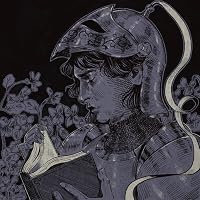
(A quick aside to scream about this gorgeous cover by Marlowe Lune, my favorite cover illustrator! This alone made this book's purchase more than worth it.)
Uncommon Charm is a short magical novella following two young people as they start becoming friends.
The universe of the story, with the magic system, along with the whole families and how everyone was connected with everyone, were all intriguing and interesting to read. However, they were presented as if the reader already knew everything about them, so it got tiring to try to figure out what was going on after a while.
Also, the main narrator was annoying. Sure, she is a teenager, but she also gets tiring after a while.
However, my main problem was with the main story, or the lack of it if I am to be exact. Halfway through the novella, it was clear that there was no story, no main plot, just long conversations that were getting confusing because I didn't have enough information to keep up.
As fitting a title as I’ve ever seen, this novella is uncommonly charming. Witty and funny, sweet, and with an unexpected theme on living through and breaking cycles of harm and wanting better for yourselves and your children, all alongside a delightfully philosophical exploration of magic.
very nicely written, interesting story and setting, but a short story that felt like a prequel to a story and not a full meal. i also didn't think that it would be this dark, wanted something light and fantasy and fun and so was surprised.
This is a quick little read of a novella, only 94 pages in my paperback, but I still found my attention wandering. Some of the magical scenes are charming, and some of the characterization stands out, but this landed as something I wanted to like more than I actually enjoyed.
Stylistically, this feels like a slice-of-life story, but it's more of a randomly selected slice than those stories often are. Julia has recently been expelled from boarding school, but she's not particularly reeling from that shock. Simon shows up at a new student for Julia's mother, but his characterization is somewhat muted and sidelined in favor of broader discussions of magic and family. Together they uncover some dark secrets about Julia's uncle, but the details are muddled and the stakes feel low. The threat to family ties could have been compelling, but Julia's friendship with her cousins is barely shown and there's no "let's get this out in the open" confrontation. It's something of a coming-of-age story for Julia, and it's fine on that character study front, but there's little in the way of a character arc or Simon or momentum for the story in general.
Many of the individual elements are great-- I particularly enjoyed how Simon, the secondary lead, allows his Judaism to inform his practice of magic, though I wanted to see more of his journey than the scraps we get from Julia's perspective. There are also some lovely scenes of magic transforming the environment, doing things like creating endless liminal spaces where Simon and Julia discuss things that are uncomfortable in the normal world. In a longer story with more room for Simon and Julia to commiserate about their lives as closeted queer people in the 1920s, I think that magic-as-other-space could have worked beautifully.
The ending also didn't quite land for me. Spoilers: And that's all somewhat down to reader preference, but it left me feeling unsatisfied.
Overall, this feels like a decent introduction to this world or a prequel story about Julia's teenage years once she's the adult protagonist of a longer series, but I'm not sure it holds up well on its own.
Content warnings: moderate; // Some lovely scenes, but I'm not sure they hang together in the most coherent way. RTC.
Other recommendations: -The closeted queer 1920s scene reminds me a bit of Siren Queen, which paints a haunting picture of silver-screen Hollywood.
"Uncommon Charm" has a fitting title, as it is odd and charming indeed. I liked reading a calmer fantasy, and the story uses its novella format very well—I love reading them, but a story feeling like an overexpanded short story or a crammed novel are my biggest literary pet peeves, and this didn't happen here at all.
I also really liked Julia, and I'm glad the story embraced her more as the protagonist towards the end (as much as I liked her relationship with Simon, I thought he didn't shine as much as her).
There was certainly charm to this, but the writing felt a bit vague to me at times - perhaps it was just me reading this during a heat wave, but I was often a bit confused as to the characters' motivations and what precisely was going on.
Charming n delightful !!!!!! But there are sooooooo many ideas and intrigues in this book and then it just kinda ends. I want more!!!!!! Functions best as a proof of concept imo
So sad to only be able to give Uncommon Charm 2 stars. I wanted to love this!
Uncommon Charm gives strong Jessica Mitford (and Mitford family in general) vibes, but it’s magical and queer! It’s channeling an older style of writing that fits the 1920s setting, and it features a distinct first person voice in Julia. She’s very flippant and funny, and I felt that was a definite strong point of this novella.
But while some parts made me chuckle, the charm wasn’t enough to save my reading experience. Uncommon Charm was seriously lacking in anything resembling a coherent plot. Even cozy books need some semblance of a plot, and characters with goals in order to keep readers interested, but this had almost none of that going for it. Also, there were far too many characters referenced to keep straight (referred to sometimes by nicknames, which didn’t help matters). And there was a lack of explanation for the magic system (a couple of sentences would have sufficed). Even the way that some of the sentences were constructed made them confusing to comprehend.
I kept reading thinking that it would get less confusing as I went along, but it didn’t. I’d love to read more books in this vein, but I need them to be edited better for clarity.
i really enjoyed this book! also the author was super sweet :) sometimes i got confused about who was related to who, but that probably was just my bad lol
This was a StoryGraph recommendation that I picked up because I loved the cover and I love Jewish main characters, and I’m so glad I did! Loved the atmosphere, the contrasting personalities and cultures of Simon and Julia, just wonderful!
I chose to read this book because I saw it on a list of novellas that might be nominated for the Hugo Award. Unfortunately, this poor little book was lacking a plot, character development, and world development. Everything about it was confusing. The main character/narrator is a 16-year-old extroverted girl who makes light of everything around her in Victorian Era (?) Russia (?) who has recently been kicked out of her boarding school because she failed all her classes (?) or was really annoying (?). A recently discovered cousin (?) who is a 21-year-old introverted man has come to stay in her household after a recent and short-lived attempt at staying in his father's household, after living his entire life with his Jewish mother who never told his father he existed. Why did she hide him? Why did he go to live with his father now? Why did his attempt to live there fail? Why is he moving in with our main character's household? A few of these are briefly touched on--a) he has magic and b) the main character's mom also has magic. Why, how, and what, we don't know. Now he's all shy so the main character decides to take him under her wing and poke her nose into all of his business. Then for some reason, they decide to start researching her mom's sordid past. They find out some stuff. The end. Oh, also he's hot and gay, but neither of those have any effect on the story at all. Bits of this were cute and had some potential, but overall, this felt very incomplete. It felt like a rough draft of the opening chapters of a novel, not a final product.
this book owes a TREMENDOUS debt to nancy mitford.
philosophically very (and explicitly) jewish; instead of wrestling with god, the characters wrestle with magic. makes for a nice change of pace from endless christianity. found julia refreshing as well; we don't often get girls of her stripe in fiction (england's two most accomplished magicians and their favorite clown).the cover is lovely. neon hemlock as a press seems like lots of fun too.
I echo other readers' critiques; while I was always able to determine what conclusions characters were coming to, the book really underexplains how they've gotten from point a to point c. I don't think everything needs to be spelled out precisely, and you can rely on your readers' good strong brains for inference, but if a to b is clear and b to c could be clear given a bit of evidence, perhaps better, I should think, to provide that bit of filler-in than to leave your readers squinting dubiously.
of linguistic interest: - the verb wot, as in to wit
I liked how this was written and the opacity of certain events and internal dialogues that might otherwise have been described more expansively. It ends abruptly and surprised me because I was never quite sure what the aim of the plot was, in that it felt like it began as a part of a much longer work.
I don't consider myself a dumb reader, but I can safely say that I had no clue of what was going on for a solid 55% of the book and that I'm just as clueless after finishing it 🥴
Subtle, oblique, atmospheric, and philosophical (so sometimes hard to have a firm grasp of the situation), but also very charming, sweet, and a poignant reflection on losing youthful naiveté.
A novella set in 1920s London narrated by a young aristocrat Julia and her aloof magician mother as a family friend’s Illegitimate son Simon comes to live with them to get magic instruction as it begins to manifest in unpredictable ways. Simon’s father is a former paramour of Julia’s mother and a member of Russian royalty who moved to England decades before, which adds a layer of intrigue of being a man whose power is largely symbolic post Russian revolution. Simon and Julia are navigating their strained relationship with their parents while also investigating a mystery spurred on by ghosts that linger around their parents that Simon can see. Being a novella actually feels like a weakness for this story however - in ways it feels like a character study. There are a lot of characters with rich backstories that it feels like more could have been explored. The conflict is at least resolved within the story but in a slightly rushed way. However I do have to give it 4 stars still as I am left wanting more of not only the characters within but also the cool magic system teased throughout.
I wasn't sure what to expect when I first picked this up. The summary didn't give much away other than the themes the reader would encounter but the cover made the book too pretty to pass up. Yes... I very much judge books by their covers.
The first couple of chapters were a bit unclear in the way they introduced the characters to the reader, but given how short the book is, it wasn't long before I had answers to some of my questions.
I was happily surprised by the revelation that our main characters were queer, a tidbit I had not come across in my very quick glance of this books Goodreads page so it was nice to be surprised by this fact.
This short novella wittingly explores serious themes and crafts a mystery that leaves you wanting more. I would LOVE to read a pages worth of these two families histories. Finishing this book, I was definitely left wanting more.
Overall, I do think I would recommend this to someone who is looking for a short, dark read with a comedic twist.
Uhm… this was weird but in a good way… I think? Certainly the narrator’s voice is the most distinctive I’ve read in a while. Julia is a bit annoying but, as I said, distinctive. Simon is an incredibly likeable character. I would love to read more of his story from his point of view. The story itself is more suggested than outright narrated and I quite liked that. Would be even better as a reread.
This was such a nice, short read. I'm amazed at the depth of the story and characters crafted into such few pages. There isn't much in the way of plot, this is definitely character-driven, which is in no way a critique – I actually really liked this aspect.
Julia is a quirky narrator and, surprisingly, I loved it. Everyone was such a treat to read about, so much personality bursting at the seams of every word. I came out of this realizing we ended up knowing more about Julia's mom and uncle Vladimir and their history than Julia and Simon, and that's okay. We still get an idea of where Julia is headed, but I would've liked a little more on Simon's future.
The writing style made me have to reread some sentences a couple times, but I quite liked the more flowery style. I like having to look up a couple words, but just something to keep in mind if you plan on picking this up and aren't super comfortable with the English language.
Part of me wishes this were longer, or there was a second novella; another part me recognises a lot of its charm (eheh) is in its brevity.