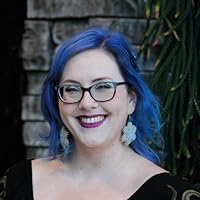
Tiffany Morris is an L’nu’skw (Mi’kmaw) writer from Nova Scotia. She is the author of the swampcore horror novella Green Fuse Burning (Stelliform Books, 2023) and the Elgin-nominated horror poetry collection Elegies of Rotting Stars (Nictitating Books, 2022). Her work has appeared in the Indigenous horror anthology Never Whistle At Night, as well as in Nightmare Magazine, Uncanny Magazine, and Apex Magazine, among others. She has an MA in English with a focus on Indigenous Futurisms and apocalyptic literature.
A stunning collection that engages with the environment, modernity, colonialism, and horror in inventive and enlightening ways. Loved the use of the Mi'kmaq language throughout and the author's note at the end on how it's meant to be read. Favourite poems included: Re-Wilding under those conditions, Ossuary Aria, If, Then, and Here, Have some Ghost Stories.
I loved this stunning collection to pieces. Tiffany Morris has such a powerful voice; I highly recommend picking up this beautiful, haunting, and thoughtful collection. It's a great addition to the world of poetry.
Tiffany Morris's "Elegies of Rotting Stars" is a devastating, luminous collection that welds cosmic horror to Indigenous grief with formal precision and righteous fury. At 61 pages, it carries the weight of prophecy, stars bleeding and flowers dripping like meat while the Mi'kmaq language pulses through every line like heartbeat. Morris writes the anthropocene as spiritual crisis, environmental collapse inseparable from cultural severance, yet refuses despair as final word. The Elgin Award recognition is earned; this is contemporary Indigenous poetry at its most urgent, where horror becomes witness and witness becomes song. Readers seeking lush, unflinching verse that navigates between devastation and hope will find a clear-eyed guide through the darkness. Essential reading for anyone who believes poetry can still matter in a world hurtling toward ruin.
i read tiffany morris's stunning short story "night in the chrysalis" in the anthology never whistle at night and deeply loved it. when i saw she had published this horror poetry collection i immediately went to read it. i really resonated with the poet's use of aesthetic imagery and at times the poetic voice gave me tingles like a spell being cast. i especially liked the lines "but these undrowned girls, / they sing— / they sing," references to mermaid songs, women crying, and tears glimmering. it was also so special to read the use of Mi'kmaq language and author's note in which morris shares how Mi'kmaq "engages with a world that is animate." i hope to read more from tiffany morris ! 🖤✨
I read “Never Whistle at Night” a couple months ago, and one of the stories was written by Tiffany Morris. Her bio mentioned horror poetry, and I immediately had to get it. This collection is absolute craft. The wordsmithing of this collection is both enrapturing and gruesome.
My favorite line from the poem “In This Necromancy of Cosmos”: “Formaldehyde reverie/spelled in withered shadow:/the sky blackened sulphuric/canticle in the ventricle in/fungal fugue.”
The language in these poems is both exquisite and horrific. Omens of a dying world already haunted by the terrible things we do. Partly post-apocalyptic, partly mid-catastrophe, partly confessional, Morris has a gift with words, twisting and weaving threads of the natural and man-made worlds together into a poison-tipped barbed wire. These poems draw blood and leave their venom behind.
Equally engaging in imagery and rhythm, these poems are densely packed with vivid, apocalyptic language, creating a sensation of different worlds (human and natural, real and potential) colliding.
This book of poetry I will re-read many times. Worlds of and beyond ours described in language that is a force. Words I never knew but when I looked them up, helped me better feel what was being created. The whole book seems to be located in a liminal space, and you can find yourself in there.
Visceral, snow-swept, defiant. Each poem has a captivating rhythm and sharp end, with beautiful use of language. My personal favorites are: “Here, Have Some Ghost Stories,” “This is Where There is Nothing,” and “Re-Wilding Under Those Conditions.”
That’s it, it finally happened, I gave a poetry book 5*. Usually I’m bothered by the fact that I don’t understand every metaphor and symbol perfectly without the context and that makes poetry more difficult to get into for me, but this was so beautiful I can’t give it any less. Amazing.
a gothically lush, dark collection of Horror poetry infused with the author's Mi’kmaq language. the way its used is powerful and beautiful. just an amazing collection, highly recommend!
I felt that it started out strong and fiddled out later on, I wanted to give it 3 stars, then headed into 2.5, yet the final part had me settling on 2 stars.
Elegies of Rotting Stars grabs you by the ear and heart and demands your attention. Morris combines bewitching language with warnings about the on-going dangers of colonialism to create a truly extraordinary collection.
We extracted a star from entrails,
stepped forward and threw
it all into the mouth of heaven:
love is not always a gift
blood is not always a sacrifice
~ “Dririmancy”
Morris unifies her collection with overarching themes including: ecological concerns, anti-colonialism, forgetting, and death. I love how she handles forgetting, positioning it as both a danger when we willfully don’t learn from the past and a way of wiping the slate clean. I also love how these poems engage with the death, dissolution, and decay of everything, including the reader and narrator. In some poems, such as “Possession”, all of these themes crash together in a beautiful wave, reminding us how small we are in the vastness of time and existence.
Morris demonstrates an absolute mastery of language and sound in her writing. Her imagery is vivid. I particularly enjoy her use of stars and burning, showing how fire is paradoxically both destructive and also a source of renewal. She revels in alliteration, sometimes sprinkling it in and other times weaving together long, elegant strings of alliterative phrases, such as in the remarkable, “If, Then”. I recommend reading these poems aloud to feel their full impact.
“If…
Every denouement is a devastation
of once-promised grace
Every equinox is an elegy
of rotting stars
Every flag is a framework
of surfeit collapse
Every gestation is a gesture
of appended horror…”
~ “If, Then”
Many poems in Elegies incorporate Mi’kmaq words alongside their italicized, English translations. In her afterword, Morris talks about this choice, saying: “this act emphasizes Mi’kmaq in the sentence and places it in the same terrain as the English text used predominantly in the poem. This decenters English as default and resists the impulse to objectify or ‘other’ the presence of Mi’kmaq” (60). If you’re interested in learning more about “apocalypse ecopoetics” (an apt description for many of the poems in Elegies) and intentionally decolonizing our thinking, check out Morris’s essay, Decolonizing the Apocalypse through Etuaptmumk in The Ex-Puritan. You can learn more about Mi’kmaq on Mi’kmaq Online.
I destroyed my fear of death
by obliterating the future, the
asynchronous sequencing of its fractal
gray, temtestoq, fragmented hours.
Yet pejipug, winter still arrives,
a blunt object resounding
on a soft surface.
~ “Possession”
I found that reading words in Mi’kmaq, a language unfamiliar to me, alongside my native English changed how I engaged with these poems. I read more slowly and paid more attention to the feeling of the words and syllables, especially in poems such as “We Are Born Devouring” and “Re-Wilding Under These Conditions” which are structured to be read multiple ways. I felt actively engaged in Morris’s process of reclaiming language and her warning for the future: if we can’t learn to perceive the world in new ways and from a multiplicity of viewpoints, we may not survive.
Elegies of Rotting Stars is a beautiful and vital collection. Morris will simultaneously break you open and pull the disparate parts of you together. I highly recommend Elegies to any fans of dark speculative poetry.