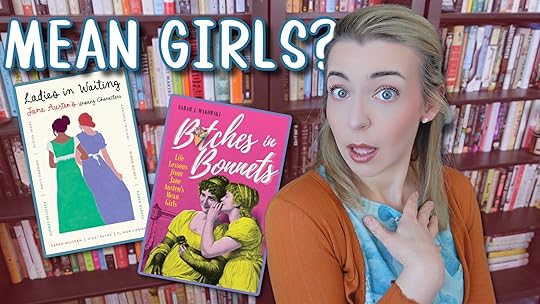
Have you ever recognized Mrs. Elton in an office colleague? Or caught a glimpse of Lady Catherine de Bourgh in the neighborhood crank? Have you spotted a young Emma Woodhouse in your teenage daughter's clique? Over two hundred years after their creation, Jane Austen's mean girls are still alive and kicking.
Bitches in Bonnets explores parallels between Austen's world and our own, showing how modern social and behavioral scientists are just beginning to document and quantify what the author knew instinctively. Interweaving modern research and sociological experiments, author and Austen scholar Sarah Makowski looks beyond Austen's texts for the sources of female aggression both during the Regency and today. Despite incredible advances in gender equality, women still face discrimination and bullying from creche to career. The cruelest assaults are those that are least expected – from other women. Hardly a woman alive has not experienced a false friend whose opinions and affection bring both positive and destructive consequences. The very ordinariness of Austen's stories leaves room for us to identify with her flawed heroines and make peace with their enemies.
Bitches in Bonnets examines how six novels of quiet English life, penned by a parochial Regency spinster, still provide insight on female relationships after all these years and how Austen’s writing – and our reading of it – offers solace to millions of fans worldwide.
Sarah was born in Michigan and now lives in Germany. Her first book, Bitches in Bonnets: Life Lessons from Jane Austen's Mean Girls, was inspired by her lifelong love for Jane Austen and a 20-year career in HR.
She is currently writing her second book, an intergenerational exploration of family secrets and identity, Four Fathers: A Nazi, A Métis, and Their Lost Sons.
This is an essay collection that contemplates the not-so-nice characters within Jane Austen novels, why their behavior reads so lifelike, and what we as modern readers can learn from them. The author freely admits that this book was motivated by a negative experience in the workplace that was rife with woman-on-woman misdeeds. I think that does occasionally overpower her points, but overall I thought this was really intriguing food for thought.
Click here to hear more of my thoughts on this book (and one other book on Jane Austen's side characters) over on my Booktube channel, abookolive!
‘Have you ever recognized Mrs. Elton in an office colleague? Or caught a glimpse of Lady Catherine de Bourgh in the neighborhood crank? Have you spotted a young Emma Woodhouse in your teenage daughter's clique? Over two hundred years after their creation, Jane Austen's mean girls are still alive and kicking.
Bitches in Bonnets explores parallels between Austen's world and our own, showing how modern social and behavioral scientists are just beginning to document and quantify what the author knew instinctively. Interweaving modern research and sociological experiments, author and Austen scholar Sarah Makowski looks beyond Austen's texts for the sources of female aggression both during the Regency and today. Despite incredible advances in gender equality, women still face discrimination and bullying from creche to career. The cruelest assaults are those that are least expected – from other women. Hardly a woman alive has not experienced a false friend whose opinions and affection bring both positive and destructive consequences. The very ordinariness of Austen's stories leaves room for us to identify with her flawed heroines and make peace with their enemies.
Bitches in Bonnets examines how six novels of quiet English life, penned by a parochial Regency spinster, still provide insight on female relationships after all these years and how Austen’s writing – and our reading of it – offers solace to millions of fans worldwide.’ ___________________
3.5 stars, rounded up to 4 stars.
Bitches in Bonnets: Life Lessons from Jane Austen's Mean Girls is a blend of humor and sociological analysis on the female relationships portrayed in Austen’s works and how they compare and/or remain in modern life.
I love Austen and I love sociology so I was intrigued to read this and possibly add another layer to consider during my next Austen read. I found much of it interesting and was intrigued by many of the comparisons that had not occurred to me before. There were several moments where I felt a sense of agree-to-disagree with the author in that I sometimes found her observations to be cynical and overly critical. I do note though that the author worked for two decades in HR, which I think has maybe painted her opinions to look upon certain behavior with a less tolerant lens. Also some characters featured more heavily and others less than I would have thought to see.
Overall, I enjoyed reading the authors insights, even if I did not agree on all points. I found several points to be thought provoking and I enjoyed considering how our interpretations on characters’ interactions and relationships affect those in our day-to-day lives and vice versa. _____
I would like to thank NetGalley and Rowman & Littlefield | Prometheus for sharing an eARC of Bitches in Bonnets: Life Lessons from Jane Austen's Mean Girls by Sarah J. Makowski with me. This is my honest review.
The conclusions were pretty basic and this didn’t really add much of a conversation to themes in Austen literature. I was hoping for a little more depth or new ideas.
Thank you to NetGalley, Rowman & Littlefield and Prometheus, and author Sarah J. Makowski for providing an arc in exchange for an honest review. Bitches in Bonnets comes out March 15, 2023!
This was a fun look in Jane Austen's mean girls. The author blends scholarly analysis and hilarious takes on Austen brilliantly. This is a must read for Austen lovers!
4/24/2023 Quite a scholarly read, and there were definitely bits where the author and I agreed to disagree, but overall a nice addition to the Austenverse. Full review tk at TheFrumiousConsortium.net.
4/26/2023 Okay, I know that no retrospective of Jane Austen's work is complete without Anne Elliott, but why on earth would she have her own chapter here when she is about as far from a Mean Girl as I can think of in this canon? Elizabeth Elliot, absolutely. Ending on Anne is just a weird thematic choice that I didn't love.
There was a lot to love otherwise, tho (and at least one other thing I was fairly lukewarm about) in this fun retrospective of all of Ms Austen's novels, including Lady Susan. Before I continue, I must say that while I've read all of Ms Austen's published works, I am terrible at keeping hold of minutiae. I literally had no recollection of Lucy Steele, despite having read Sense And Sensibility at least twice. The book I probably remember the most about is Emma, and that's only because I've seen the movie Clueless far too many times. My college debate partner even thought I was a total Cher Horowitz, which in fairness is a lot better than being a total Emma Woodhouse!
Emma, ofc, gets her own chapter here, as the queen of Ms Austen's Mean Girls. Sarah J Makowski does a terrific job of analyzing why Emma is so terrible yet why we're so ready to root for her, at least up to the point where she finally goes too far. And even then, we're happy to follow along as she sets out, more or less, to redeem herself. Ms Makowski not only analyzes Emma's thoughts and motives but sets them -- and similarly for the other Mean Girls in this book -- alongside sociological texts on female interpersonal relationships, bringing a fresh perspective to the characters' actions.
Even more intriguingly, Ms Makowski adds a touch of bibliomemoir to the proceedings, examining her own treatment at the hands of a Mrs Norris-type after re-entering the working world. The comparison is apt despite the seemingly wildly different circumstances. Mrs Norris takes Fanny Price into the Bertram household primarily to give herself a social inferior in Mansfield Park. Similarly did Ms Makowski's former manager hire her on, only to neglect and ostracize her in the workplace. These unusual parallels are insightful for being unexpected yet deeply logical.
The only bit I didn't super agree with -- and this is possibly just because I haven't reached that age yet -- is the chapter on Lady Catherine de Bourgh. After a quiet shock one day at realizing that I no longer commanded the attention of entire rooms merely by walking into them, I have embraced the invisibility of middle age. I hadn't even realized how oppressive the male gaze is until I was free of it! Ms Makowski posits that Lady Catherine is so overbearing because she's afraid of being ignored due to this invisibility, yet there is a great difference between needing to be included in everything vs needing to tell everyone around you how to live their lives.
Perhaps I will change my mind as I age and come around to Ms Makowski's point of view. Personally, I've always been one of those infuriating girls who doesn't particularly care about fitting in, a sort of cross between the Dashwood sisters and Jane Fairfax, despite my streak of Cher (which is likely what fuels my ability to not care.) Hardcore Janeites and readers plagued by Mean Girls will find much to love within these pages, given that even a dilettante like myself found it very enjoyable.
Bitches In Bonnets: Life Lessons From Jane Austen's Mean Girls by Sarah J. Makowski was published March 15 2023 by Prometheus Books and is available from all good booksellers, including Bookshop!
I would like to thank NetGalley and Prometheus Books for an uncorrected kindle proof of this book.
Synopsis: Integrating personal experience with psychological, sociological, and anthropological research Markowski examines Austen's mean girls and how their flaws highlight the very human nature of Austen's works. Each chapter focuses on a different mean girl and Makowski asks the reader to examine the women that they know who may have similar characteristics to these characters or how the reader themselves may have similarities to these "mean girls". By asking the reader to engage in this thought experiment Makowski explores how Austen's ability to capture human behaviour still draws readers in today.
Thoughts: I found the premise of the book fascinating. We spend much of our lives being told and learning not to formulate opinions of others without knowing them, but this is an action that we take about the characters we interact with in books. Makowski argues that understanding how readers engage with written characters may shed light on our understanding of our fellow humans and vice versa. Characters are written on the page or are only shaped by the information that the author chooses for us to have. As a result, readers form our opinions in such a way that we either love or hate them. The same is true of the people we meet in the world. We only have the information that we obtain and then we write our own narratives about a person around that. Makowski argues that by evaluating literature and our feelings about certain characters might be able to better comprehend our interactions with others and psychological phenomena. Specifically, by examining how behaviours such as females' aggression toward each other Makowski argues that part of Austen's enduring legacy is that her characters both heroine and "mean girl" are so captivating because they are so complex and because we can see ourselves in both roles. Rarely do you read a book that makes you think about how you are as a reader (or a person). There were several times when I had to stop and think about my own perceptions.
My biggest complaint about this book is that I wish there were a bit more of a discussion of the various characters in pride and prejudice. For instance, Lydia and Kitty are not really mentioned and I have always found them to be mean toward Mary. In the chapter on Lady Susan familial aggression is discussed in a mother-daughter dynamic, but it would have been nice to have seen sister-sister dynamics explored in more detail. Although these are more side characters I do think that there is something that might have added to Makowski's exploration as Mary is often maligned by her family as is Fredericka (in this case her mother), but no one comes to save her at the end of the story.
I really enjoyed this book. Makowski's conversational writing style and honest descriptions of her relationship with each of the women she discusses made this a book. I did not want to put it down. I was hooked by the title and book description, but I did not expect this book to make me so introspective. As a lover of Austen's work, I would recommend anyone else claiming the same. I do not think I will ever view Lady Catherine the same ever again.
Bitches in Bonnets is a non-fiction book that analyses interactions between women by comparing and contrasting between current day and Jane Austen's time based on how she wrote her characters. I appreciated the way that the analysis was broken into different sections and that she included information from research articles. The dissection of the interactions between the different 'mean girl' characters and the 'heroines' was fascinating to compare to common interactions between peers in the current day. Where this book lost me a bit was the author's insertion of bits and pieces from her life that didn't end up getting the same in-depth examination as the characters and examples from the research. This is especially prevalent in the section about Lady Catherine De Bourgh where the author attempts a comparison between herself and the character, but her example didn't feel fully fleshed out and came across a bit confusing to me. Most of the chapter is more focused on senior women in business and board rooms, but the reader isn't given enough background of the hierarchy of the author's workplace for the personal story to really connect. It just makes it sound like she is upset that one worker didn't want to talk to her? Is this person supposed to be reporting to her and isn't? We aren't told. So I just feel like it's a weird example of feeling invisible in the workplace. I wish there would have been a bit more analysis of maybe why she was feeling this way and maybe if there was some research to support those feelings. The conclusion to the personal example remains vague and it doesn't feel like the point was made in my opinion. The other thing that didn't really work for me was some of the choices of examples and the way some things were phrased. The author makes a point to attempt to be inclusive in a way. But some of the phrasing maybe could have been tweaked to make it more clear that some phrases were quotes from diverse media sources. There are also way too many Harry Potter references in this book. It's 2023. It's time to leave HP in the past with it's problematic author. No more HP references please. Overall, I think this was an interesting dissection of interactions between women and how some things never change despite the leaps in interpersonal relations and feminism that people have made over the years. It is fascinating to see an analysis of communication between Jane Austen's characters and how women are likely experiencing similar things in the current age. We all know the flaky friend, the girl who wants your partner but is overly friendly with you, the in law that bosses everyone around. These are still commonplace. Overall, I think people will find this book an engaging way to really think about interactions they have seen and experienced in their lives and maybe have that touchstone of relatability from their favorite (or not so favorite) characters.
**Thank you to Publishers Weekly, Edelweiss+, and Prometheus Books for the eARC in exchange fr review. All thoughts are my own.**
If you love Jane Austen and wondered about the relationships between all the women in her books, pick this up immediately.
I haven't been able to stop talking about this book. Makowski gives so much understanding to how women treat each other in Jane Austen's time and in current times. As an academic and a girl who spent half her life wanting to be a Jane Austen scholar, this is one of my favorite books I have read on the topic. For Austenites, we swoon over (most) Austen's heroines and their love interests, but Makowski steps back and has us look at those heroines from a different perspective. Not analyzing the love but all the other relationships that our heroines are a part of, why they make certain decisions, and what might Jane Austen have meant by having them make said decision.
While this is a nonfiction book and looks at feminism and has an academic sound to it, it was a very easy read. The language Makowski uses isn't overly academic, and it felt like talking with friends about our thoughts around it (while also bringing up other scholars who could help us better understand our thoughts).
This is probably one of the few 5 star nonfiction/academic-ish reads I have read and while this is in part because of my love for Jane Austen and the fact my academic career centers on Queer, Feminism, and Diversity/Inclusion in literature, it is also because of how easy it was to read. I didn't feel like I was forcing myself to read it and woke up excited to read it each morning.
For any Janenite wanting to take a short break from Austen retellings but remain in Austenland, this book is for you.
*I received this book from Edelweiss and Prometheus Books in exchange for an honest review. This has in no impacted my opinions.*
“Austen describes female experiences so deeply embedded in human social interactions that it’s doubtful that any woman comes to Austen without some sense of recognition. Linking Austen with evolutionary, psychological, anthropological, and sociological findings encourages self-reflection on the reality of women as individuals, each bound by unique hopes and fears.” - Sarah J. Makowski 💜💜💜💜 Bitches in Bonnets was a delightful read that allowed me to dive deeper into my own relationship amongst fellow woman, allowing me to reflect on the “queen bees” that have left unseen scars on my heart and thrive to be a better person in future interactions. Sarah J. Makowski had me looking at Jane’s characters in new lights. I absolutely adored the fun little lessons throughout, like “beautiful bonnets can’t hide horns” and appreciated the depth of research that went into the writing of this book. As a lover of psychology and the wiring of the brain, I was enthralled with the research, although at times I did wish it went a bit deeper. This was a unique way of looking at Austen and really made me realize how little life for women has changed over the past 200 years. I look forward to my book clubs discussion on this novel and if you’ve read it let me know your thoughts below.
At first glance, an absolutely unmissable title: a study of the female characters in Jane Austen’s novels who occupy opposite poles—the wicked and the depressive versus the boring and the overly virtuous. As an ardent fan of JA, I simply couldn't pass up this subject. Isolating a specific topic amidst such a vast literary universe is a wonderful opportunity. However, right from the very first chapter, it becomes clear that the author constantly prioritizes inserting her own political opinions. Yes, anyone not living in a cave has opinions, and politics plays a significant role in many of the decisions we have to make in our daily lives—especially regarding the economy (and everything revolves around money, doesn't it? Whether or not we can afford our children's education; whether or not we can take that trip, and so on). But in a scholarly study such as the one proposed in this book, I am not interested in knowing whether the author—a privileged, white, heterosexual, Western feminist—deems this or that acceptable in modern life. We are discussing female characters from the 17th and 18th centuries, not suffragettes who have already had the opportunity to burn their bras in public squares. The study promised so much... 2 stars
I must confess, I am not a Janeite. Though many of my friends have tried. So this is novel has been engaging in a way I did not expect. Being able to better understand why everyone around me has been able to see the characters of Austen’s work in their everyday life - and it has been eye opening. We join the narrator as we analyze a number of the women in Austen’s novels and see versions of them in our narrator’s life, and our own. It also showed me some of the reasoning behind others actions, and while I don’t know that I would have thought about their situation in that light, I do now understand a bit more about why others might see the same situations differently. While I don’t know that I will read more Austen as a result of this book, I do have a new understanding of those who do. 4/5
Thank you Netgalley and Rowman & Littlefield for sending the book for review consideration. All opinions are my own!
I would like to thank Prometheus Books for providing me with an ARC.
This book has a very interesting look at mean girls within Jane Austen's works and how those mean girls are still present within modern society, as they were during Austen's time period. Makowski makes use of a few areas of study to interpret the presence and behaviors of mean girls. There are some very interesting discussions on relationships between women. Makowski breaks down the mean girls within Austen's work and shows how these kinds of relationships between women are still very present today. I think the author did a very good job at describing the competitions that are present between women and how they are formed.
"Mothers misbehave particularly badly in Austen's work. Instead of providing comfort and affection, they are, at best, disinterested, and at worst, genuinely monstrous. There are no nurturing and selfless Marmies or Mrs. Weasleys in sight."
I really enjoyed this in-depth look at the mean girls in Jane Austen's novels. Not only did the author add historical context as to why characters like Caroline Bingley were so awful, the author also used modern-day studies to examine how women still attack women in today's world.
Thanks to Netgalley, the publisher, Rowman & Littlefield, and the author, Sarah J. Makowski, for providing me an electronic advanced review copy in exchange for an honest review.
I really wanted to love this book. The cover! The title! The modern analysis of the "mean girls" in classic novels by my favorite author--it really seemed as if this book was written with myself and my book club friends in mind, especially once I read that it's "wise and witty."
Unfortunately, the bulk of this text seems to be more summary than analysis. I've read and watched Sense and Sensibility enough times to know what Lucy Steele said and did and how that affected Elinore; what I need is the wise and witty analysis of lessons modern readers can learn from. What I want is more of the Mean Girl connections to characters I know so well, and less of the plot review.
Overall great concept, great cover art and title, but not what I was expecting.
Not sure how to rate a non fiction book as I don’t typically read non fiction like this. I usually read memoirs or biographies or autobiographies.
This book read like a research paper - and is it really non fiction with sources if you don’t question yourself at some point?
It’s not bad and it does bring to light how many women behave…but I’ve not really been one of those women. I was definitely called out in this book at one point - but I don’t care as I tend to avoid cliquey or manipulative women as best as possible. ((Hello Jane Fairfax))
If anything this book makes me want to read more Jane Austen so I can form more concrete opinions for myself on the characters.
In general, I prefer Jane Austen secondary characters to her primary ones, so I wasn’t surprised that enjoy this sassily titled treatise on Jane Austen’s mean girls. I didn’t always agree with Makowski’s analysis, nor all the analyses of the authorities she sites - a few of them actually made me go hmm? - but they were lots of fun to read.
Thanks to NetGalley for providing an ARC copy for my review.
It’s no secret that the works of Jane Austen have endured for centuries. Here, Makowski draws parallels between the mean girls of Austen’s novels and the mean girls we still see in real life, providing insight into at least one reason why her works endure. A very interesting analysis for any Jane Austen fan.
Jane Austen's characters are timeless and her mean girls behaviour can be found in contemporary women as well. It's an entertaing and thought provoking book about toxic women now and then. Highly recommended. Many thanks to the publisher for this arc, all opinions are mine
Fabulous reading! Love how Makowski has bought Austen's womenfolk to life again and how she relates them to real-life examples, backing this up with academic journals and/or books. Her humour is guaranteed to bring a chuckle to your lips and more than once I snorted out loud whilst reading. Essential reading for an Austen devotee like myself, and I enjoyed nothing more than reading about beloved (and not so beloved) characters in-depth and getting fresh perspectives on why Austen may have written them this way. Austen has humour peppered throughout her work, and Makowski also brings delightful humour to her work and I just loved it all.
Dr. Wakowski’s commentary is witty, hilarious, and very analytically critical. As a huge Janeite, this is now one of my favorite commentaries on Austen’s novels.
Heb alleen de essays gelezen die over p&p en s&s gaan. Vond het goed onderbouwd met onderzoek en eigen ervaringen, soms iets overreaching. Food for thought en zeker een oproep tot verbinding
This book is hilarious yet deep and dark at the same time - Jane Austen was a powerhouse writer who wrote scathing accounts of women who we love to hate: she died way too young!!
We all can recognize the women in question: maybe we are one of them as well. The book then goes to the dark side of feminism and how today's bullying of women at work and in one's personal life...by other women and men.... and why the bullying by a fellow woman hurts the most.
Miss Makowski is an Austen scholar and presents a book that you can identify with even if you have never read Austen and only seen the movies or semi-adaptations (Bridget Jones' DIary for one is a play on "Pride and Prejudice" and let's not forget the version of "Emma" in the movie "Clueless") of Austen's works.
I can only imagine how our heroines from the page (and older movies) could deal with the scathing ability of social media to make one an utter outcast or even suicidal...I barely survived high school as it was in the 1980s and social media would have literally led to my death. (Yes, I said LITERALLY which is the most over-used work of this time as it actually applies to the situation!)
I highly recommend this book to be read by individuals, movie buffs, book clubs and by teachers dealing with the scathing effects of the bitches not wearing bonnets in their classes. Moms dealing with both the bitches and their targets would enjoy this book as things have changed since we went to school...no more "mall hair" just what I call DEATH BY DIGITAL MEDIA.
Utterly unimpressed by the author’s undertone of hatred for the women of which she speaks. Despite the book’s intention (or, at least, I believe it to be the intention) being to bring nuance to Austen’s “mean girls,” the author’s understanding of that nuance is lost when she resorts to calling her subjects such derogatory terms as a “hussy,” or inviting the reader to resort to their own inner mean girl and berate the quality of Lucy Steele’s use of English.
Moreover, she the author misses the opportunity to humble herself and acknowledge her own shortfalls. We are all villains in someone’s stories, and we all have moments where we act in less than exemplary ways to survive and thrive. As the research in the book suggests, nearly all of us have gossiped or other some such thing. Instead, the author fills the spaces with unbearable, cliché millennialisms. “Adulting”? Really?
Bitches in Bonnets is an entertaining look at Austen's "mean girls" and heroines through the lens of female behavior and sociology. Makowski relates her own struggles with mean girl issues in the workplace with modern research on female relationship dynamics and Austen's portrayals of those same dynamics.
Using polls of her own as well as scholarly research by others, Makowksi provides an interesting take on one of the reasons why Austen's works are beloved.
I accessed a digital review copy of this book from the publisher. The book analyzes the women in Jane Austen's works and how they relate to real-life mean girls. The ideas are interesting and the author brings up good points.