Jump to ratings and reviews
Rate this book

Hadrian the VII

Rate this book
Hadrian VII (Wordsworth Classics) [paperback] Rolfe, Frederick William [Dec 07, 1993]

368 pages, Paperback

First published January 1, 1904

71 people are currently reading
2594 people want to read

About the author

Frederick Rolfe

60 books50 followers
English writer, novelist, artist, fantasist and eccentric. Rolfe is also known as Baron Corvo. His best known work is the novel Hadrian the Seventh.

Ratings & Reviews

What do you think?
Rate this book

Friends & Following

Create a free account to discover what your friends think of this book!

Community Reviews

5 stars
115 (19%)
4 stars
179 (30%)
3 stars
167 (28%)
2 stars
88 (15%)
1 star
29 (5%)
Displaying 1 - 30 of 107 reviews
Profile Image for Bill Kerwin.
Author 2 books84.3k followers
April 28, 2019

Hadrian VII is one of those books that sound more interesting than they are, at least for someone like me who delights in eccentrics, ornate writing, decadence, bitter old queens, and the pomp and politics of the Catholic Church. Yet Frederick Rolfe's book is so self-indulgent, and the personality it reveals so repellent, that the very act of completing it became a distasteful chore.

A brief biography can make Rolfe sound like a fascinating man. Born in London in 1860 of a prosperous Protestant family, he taught at the prestigious Grantham School (where allegedly Isaac Newton's youthful signature may still be seen, carved on the wall of the library). An unabashed homosexual and confirmed ephebephile, Rolfe apparently kept his hands off his pupils, contenting himself with young adult friends in England and—later—with the gondoliers of Venice.

Rolfe converted to Catholicism at twenty-six, convinced he was destined to become a priest, but was thrown out of two separate seminaries for his lack of concentration and his unpredictable behavior. He regretted the loss of the priesthood all his life, habitually referring to himself as “Fr Rolfe,” hoping the “Fr” for “Frederick” might be taken for “Father.”

Although he eked out a living as a writer, he was frequently compelled to rely on the kindness of patrons, most of whom he managed to alienate. One of these patrons was the Duchess Sforza Severini, who invited him to summer at her estate near Rome (where, having formed friendships with the local youths, he soon immersed himself in the local culture), and who subsequently granted him a monthly allowance to pursue his authorial ambitions. She soon withdrew her allowance, however, but not before—or at least so Rolfe claimed—she not only adopted him as her grandson but also granted him the privilege of referring to himself as “Baron Corvo,” a title he used as his principal nom de plume.” He died of a stroke in Venice, at the age of fifty-three.

Hadrian VII begins as a fictionalized and expanded version of Rolfe's journalistic account of the 1903 papal election, but it soon becomes a monument to his own ego and a shameless piece of wish-fulfillment. The protagonist George Arthur Rose--an impoverished middle-aged English writer living in a tiny London apartment with his little yellow cat--is contemplating what his life has become when three Catholic cardinals visit him unexpectedly. They apologize for the injustice perpetrated upon him years before when he was expelled from seminary, and ask him if he wishes to be ordained as soon as possible, become secretary to one of the three cardinals, and attend the papal conclave. Soon Father Rose is in Rome, where, the conclave having become deadlocked, he is elected pope.

Up to this point, the book has a certain charm. Rolfe shows self-knowledge in his initial portrait of Rose, and his account of the politics of the papal election is interesting. It soon becomes clear, however, that Rolphe knows himself so well only because he loves himself so much, and that he believes that every injury done to him was unmerited, that each of his virtues is extraordinary, that every idea he has ever had is original and useful, and that if he only had a decent platform—if, say, for example, he was the pope—he could solve not only the problems of the church but also fix the political mess in Central Europe. He also believes he could do so in such a manner that everyone—excluding only his natural enemies, the predatory female and the working-class socialist—would love him as a saint and venerate him as a martyr.

Nowhere in this fantasy can I discern any irony or saving perspective. If he is not admiring himself, then he is settling old scores. Baron Corvo is in love with himself, and he expects us to be too.

I was also disappointed in Rolfe's style. I expected faux fin-de-siecle, redolent of Ruskin, Pater, and Wilde, sonorous and colorful—a British version of Clark Ashton Smith; I received instead a dry-as-dust, unmusical prose, distinguished only by a bizarre latinate vocabulary.

Yes, Hadrian VII was a big disappointment. But I should know better by now. Once again, I made the same mistake I have been making in books and music--and friends--ever since I was a boy: if it is obscure and bizarre, it's gotta be good.
Profile Image for Jacob.
88 reviews551 followers
July 5, 2021
January 2011

THIS BOOK IS ABOUT
"Fencing. Fighting. Torture. Poison. True love. Hate. Revenge. Giants. Hunters. Bad men. Good men. Beautifulest ladies. Snakes. Spiders. Beasts of all natures and descriptions. Pain. Death. Brave men. Coward men. Strongest men. Chases. Escapes. Lies. Truths. Passion. Miracles."

Wait, sorry, my mistake. And now:


NYRB: A History of an Addiction (With Book Porn!)
July 2006
Half-Price Books, Madison, Wisconsin
Rolfe
Hello there, aren't you a pretty thing. But what are you doing on the $1.00 clearance shelf? You poor guy, you should come home with me...

September 2007
Avol's Books, Madison, WI
Doyle
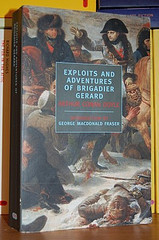
Hey, I couldn't help noticing you the last time I was here, Exploits and Adventures of Brigadier Gerard. That's funny, I didn't know Doyle wrote you too. You sound like a pretty cool book. Wanna come back to my place?

January 2008
Renaissance Book Shop, General Mitchell International Airport, Milwaukee, WI
Powers
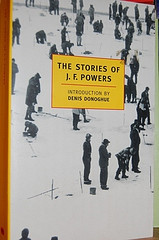
So, The Stories of J. F. Powers, I saw you on that bookshelf and thought "now there's a bold fellow in yellow." Heh. I don't usually go for Catholic writers, y'know, but I just came from my grandfather's funeral--drank himself to death four days before my 21st birthday, how's that for a cautionary tale?--and I'm feeling kinda melancholy. You feel like keeping me company?

You know, you look kinda familiar. Do you know a book called Hadrian the Seventh...?

September 2008
Reedsburg, WI
Williams
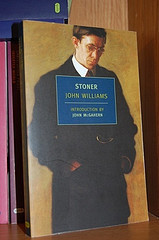
So, you're Stoner by John Williams. The Stories of J. F. Powers told me about you. You're all from the New York Review of Books, huh? Is that, like, some kind of sorority?

Got any friends?

December 2010
Loganville, WI
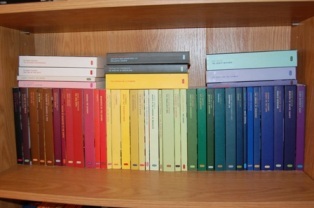
nyrb library
WHAT THE HELL?! I said you could invite a few friends to the party! A few friends! This is not a few friends! Shit, guys, the neighbors just called the cops, you gotta get out of he--wait, is that COCAINE? Are you doing cocaine?! Shit, guys! Oh, shit, my parents are gonna kill me!


Wait, I can explain...
New York Review Books (or NYRB) is a curious little publisher with an equally curious selection of titles, from obscure out-of-print books, somewhat-forgotten classics, long-dead cult hits, and works in translation, to travel writing, memoirs, history, and even cookbooks. Probably nine out of ten books they publish are by writers you (or, at least, I) have never heard of. In my case, actually, these are books I would never notice, much less pick up and read--were it not for the covers. THOSE GODDAMN COVERS.

Look, I'm not a book collector. I don't really care where my books come from, or who publishes them. I'm slightly shallow, of course: I do occasionally judge books by covers, but mostly, if it sounds good, I'll give it a try. But--and feel free to nod along, if you know what I'm talking about--NYRB books are something special. It's the covers, man. See above! Uniform editions, artistic cover design with the simple title box in the center, monochromatic spines, what more can I say? They look good, and they look even better arranged together on a shelf. See above! (And below!) In fact, check your own bookshelves: even if you're not a fan of NYRB (re: you've never heard of it before), you've probably, unconsciously, aquired one or two of their titles over the years. Look for a brightly colored spine. There! There it is! Now take it off the shelf--gently, now--and just hold it. Feel that? That's what intellectual liberalism feels like.

I know, I know. I'm such a nerd. A NYRB nerd, that is--perhaps even a NYRD? It’s like being a Gleek or a Belieber, but without the music and the screaming fangirls. But the fanaticism is still there. In droves. I mean, my interest in the NYRB series started out small. I was once like you! When I first realized I actually owned a few of their books, in 2008, I looked around, checked out the rest of their catalogue, bought a few here and there. Nothing major; it was all so innocent. Started out with three. By the end of 2009, I had a modest collection. Eleven NYRB titles.

Now? As of December 2010 January 2011, I have 46 49 52 53.

FIFTY-THREE

I may have gone slightly overboard last year. I might actually have a problem. It may even be time for an intervention of some sort.

But that's what an addict would say. Me? Pshaw, I can stop whenever I want.


Hadrian the Seventh
Hey. Hey, you. Yeah, you, the one with the cat.

Wanna be Pope?


And thus it was that George Arthur Rose became Pope.

A "hack writer and minor priest" (as opposed to the author, a minor writer and hack priest), Rose has spent the past twenty years laboring in obscurity, wronged and forgotten by all of his so-called friends, until--unexpectedly--the gridlocked papal conclave in Rome selects him as a safe and noncontroversial figure to replace Leo XIII. Or so they imagine. Although the rest of the world is somewhat astonished by this turn of events, Rose--under His new monicker Hadrian VII--adapts to His new role with ease (and no small amount of glee). And his papacy is far from noncontroversial. Hadrian's first major act is to renounce material possessions--His own, and those of the Church--because "My kingdom is not of this world." That alone is a bold pronouncement, enough to ruffle feathers both within and without, but Hadrian's other acts--denouncing socialism, selling off the Church's great wealth, dividing the world up among the great nations in an attempt to forge an everlasting peace--gains him more enemies in his one-year reign than the average pope would earn in a decade. Add to his problems a woman from his past and a socialist with an agenda, and--oh, dear, I suppose you'll have to read it.

As a novel, Hadrian the Seventh is cranky, longwinded, somewhat pedantic, and occasionally dull. As a wish fulfillment fantasy of its author (Frederick Rolfe, who called himself Baron Corvo and shortened his first name to Fr. to fool people into thinking he was a priest), however, it's charming, eccentric, and nothing short of entertaining. NYRB made a good choice when they republished it.


"...Beautifulest ladies. Snakes. Spiders. Beasts of all natures and descriptions..."
While reading this book, I kept thinking about another forgotten novel by another forgotten eccentric. Like Hadrian the Seventh, the great Florinese novel The Princess Bride also languished in near-obscurity for decades before its rediscovery and eventual reprinting. However, unlike Rolfe's novel, which received the glorious NYRB treatment, S. Morgenstern's Classic Tale of True Love and High Adventure fell into the hands of William Goldman, a shameless monster who butchered Morgenstern's original masterpiece by removing the "boring" bits; these days, the "Good Parts" version is probably the only one anyone has read.

What if Hadrian the Seventh had had the same fate? Imagine if Goldman's semi-literate father had read him Rolfe’s story of The Man Who Would Be Pope when Goldman was a boy, and he had grown up with his childhood fantasy of a book that, when he finally tracked down a copy of his own, didn’t resemble the real thing? Imagine reading a "Good Parts" version of Hadrian the Seventh! George Arthur Rose's embittered monologues--gone. The week-long, thirty-page papal conclave that resulted in Rose's surprising papacy--gone. The theological debates, the papal bulls and decrees, the bumbling socialist meetings--all gone, all lost.

A travesty! We would not accept such a crime with Hadrian the Seventh, not to mention any other book (except, perhaps, for War and Peace), so why do we continue to tolerate Goldman's literary maiming of The Princess Bride? It’s time we restored S. Morgenstern to his rightful place in the Florinese literary canon: it is time (past time, in fact--long overdue) for the New York Review of Books to reissue The Princess Bride--complete and unabridged, as god and Morgenstern intended.

William Goldman could even write the introduction. I expect to read a very long apology.


My name is Jacob, and I’m a NYRD
I hope, by sharing my story, that I can get other people to realize that they own NYRB titles too, and that it's ok to admit it. There is nothing wrong with you, because NYRB publishes beautiful books that look great on your bookshelf. In fact, you should add a few more, because it’s fun to rearrange them in colorful patterns…

Rainbow
Look! You can even do a rainbow!
Profile Image for Vit Babenco.
1,786 reviews5,796 followers
December 1, 2019
“And I say also unto thee, That thou art Peter, and upon this rock I will build my church; and the gates of hell shall not prevail against it.” Matthew 16:18
Hadrian the Seventh is a bizarre book written in the bizarre style. It is a literary oddment.
Pope is a vicegerent of Trinity in the vale of tears and this is a self-portrait of the new Christ’s deputy:
This world is infested by innumerable packs of half-licked cubs and quarter-cultivated mediocrities who seem to have nothing better to do than to buzz about harassing and interfering with their betters. Out of courtesy, out of kindness, he was used to give way; but all the same he tenaciously knew and clung to his original purpose. He knew that delay was his enemy: yet he invariably would stand aside and let himself be delayed. And now towards the end of his youth, he was poor, lonely, a misanthropic altruist.

But…
“And the Lord turned, and looked upon Peter. And Peter remembered the word of the Lord, how he had said unto him, Before the cock crow, thou shalt deny me thrice.” Luke 22:61
And the history of church is the history of betrayals…
“The key to all your difficulties, present and to come, is Love.” Hadrian was at His old self-analytical games again; and the aphorism, which He had gleaned in the most memorable confession of His lifetime, suddenly came back to Him. He went over a lot of things once more. He was convinced that, so far, He did not even know what Love was. People seemed to like Him. Up to a point there were certain people whom He liked. But, Love – He admitted to Himself that men mostly were quite unknown to Him. Perhaps that was His fault.

Naivety shall not inherit the earth… Idealists will not change the world.
Profile Image for Simon.
870 reviews142 followers
February 5, 2017
Not for everybody's taste, but if it is to yours, it will quickly become a book you reread. I just finished my umpty-umpth go-round with Frederick Rolfe's masterpiece, and as always, it did not disappoint. Set in 1903, Rolfe creates George Arthur Rose, a failed seminarian eking out a precarious living as a writer. He is hampered by a ferocious intellect, inflexible moral sense and the inability to refrain from criticism of the Roman Catholic hierarchy that has dismissed him from seminary. In short order, he is whisked off to Rome by a cardinal-elector, ordained, and then, in a brilliant plot-twist, elected Pope. Since the one and only English pope prior to this was (H)Adrian IV, Rose takes the name Hadrian the Seventh (the title is not meant to be spelled with Roman numerals). Hadrian begins an incredibly idiosyncratic reform of the Curia that climaxes when he creates two, count 'em two, new empires, around the German Kaiser and the King of Italy (those would be Wilhelm II and the teeny Vittorio Emanuele for those keeping score at home), and lets them begin the pacification of anyone who disagrees. Not counting the United Kingdom, naturally. Along the way he canonizes Mary Stuart and Henry VI, smokes, is fastidious about the whiteness of his garb and in the end, is assassinated by an Ulsterman. I mean, the demented is strong in this novel.

But, and this is an important but, it is also an unforgettable psychological portrait of a lonely man. Rose is modeled after Rolfe himself, so that when the time came to turn this into a play, they simply conflated the two, making the time spent as pontifex maximus a dream wrapped around the novel Rolfe is writing.

There is also the literary style. I can't describe it save to say it is peculiar to Rolfe. I went out after I first read this book and obtained all of his others. They did not disappoint, although none are as truly weird as Hadrian the Seventh.

Highly recommend, but don't say I didn't warn you.
Profile Image for Simon.
Author 5 books159 followers
read-enough-of
October 7, 2015
And while I'm giving up on books I hate (see this review), I'm going to give up on this one too. I'm sorry to. There's a lot to admire in it and it is occasionally breathtaking.

I'm especially loath to give up on it because I think that my father liked it, and told me about it when I was young. (I think, but I'm not sure. It's certainly the kind of learned but reactionary nonsense that would have appealed to him.) I've been meaning to read it almost my entire life, and now I'm giving up. It feels like a betrayal of my father. But I can't go on with it. There's something deeply terrible about its monomania.
Profile Image for DoctorM.
842 reviews2 followers
March 1, 2013
I'm writing this on an evening when the papal throne has just become vacant. Pope Benedict has retired and a new pope has yet to be chosen. What better time to read "Hadrian the Seventh"? It's a strange book, by a strange author who was one of the great literary scoundrels. Yet...for all the mad fancies and posturing arrogance of Fr. Rolfe ("Baron Corvo") the book is a small gem. It's one of those works that only a certain kind of English eccentric could've written--- someone from the lost world of pre-1914 eccentrics. It's a mad fantasy, of course--- Rolfe's literary alter ego is suddenly and inexplicably plucked from obscurity and translated from failed seminarian to Pope Hadrian VII, the first English pope in centuries, and proceeds to re-make the Church and the map of Europe. It's finely-written, mind you. And it's hilarious in some scenes and politically appalling in others. Tragic, too--- Hadrian achieves martyrdom after saving the Church and Europe. It's one of the great novels of papal politics, and you can certainly read it as miles and miles better than anything Morris West ever wrote. So...while we wait for the cardinals to gather in Rome, get a copy of "Hadrian the Seventh" and read along. It's a classic, and it's worth finding.
Profile Image for Peter.
737 reviews113 followers
March 31, 2023
Frederick Rolfe was born in London, the son of a piano-tuner, and left school at the age of 14. Rolfe converted to Roman Catholicism and this conversion became a strongly felt desire to join the priesthood himself. Rolfe went to college in Rome but was eventually thrown out because his inability to concentrate on his priestly studies and his erratic behaviour meaning that his desire to join the priesthood was constantly frustrated and never realised. Instead Rolfe became a free-lance writer relying on benefactors for support but he had a tendency to fall out with those who tried to help and support him. He eventually died in poverty in Venice. 'Hadrian the Seventh' is Rolfe's best known novel and many regard the titular character as the author's alter-ego.

'George Arthur Rose,' having originally been rejected for the priesthood and living in poverty as a free-lance writer, finds himself the object of a highly improbable change of mind on the part of the church hierarchy, who then elect him to the papacy. Rose takes the name Hadrian VII and embarks upon a programme of ecclesiastical and geopolitical reform. Dogged by petty jealousies and scurrilous accusations Hadrian's papacy is relatively short lived.

Rolfe was himself an avowed homosexual and Hadrian like his creator soon surrounds himself with young men and abhors the presence of women and children. Hadrian thus becomes an exercise in wish-fulfilment.

It seems highly unlikely that even back in the early 20th century that the Pope would have had the influence amongst politicians that Rolfe seems to imagine that Hadrian has but in todays world this seems ridiculous. This is a rather quirky novel that has almost been totally forgotten. This wasn't a particularly easy read, the prose is grandiose, there are elements of this book that I rather enjoyed, in particular his dealings with the Socialists who were laughable, but there were also some elements that I found rather tedious. It perhaps deserves to be more widely read but in truth I wouldn't necessarily recommend it to any of my friends.
Profile Image for James Lundy.
70 reviews21 followers
March 27, 2008
A.J.A. Symons's investigative biography "The Quest for Corvo" will make you think Corvo's "Hadrian VII" is an overlooked masterpiece. Well, when I finally got my hands on a copy, expecting to have my socks knocked off, and started reading it, let's just say I wondered what the devil Symons was smoking. This book is bizarre rant from a (more) bizarre man, thinly veiled in the guize of a story. How's this for bad: our hero is a down and out loafer living in a boarding house and about 5 pages later he is Pope Hadrian the 7th. Normally I would give the book one or even zero stars but I have to be amazed at the inventiveness of the author as he made up an amazing number of words for the book. Not names and places, mind you, but nouns and verbs. I found myself constantly grabbing the dictionary at first thinking it was odd to see a word I had never been exposed to and after a while I caught on that they weren't really words. Inventive, strange, eccentric, but ultimately boring. I've lost patience for people's rants.
Profile Image for David.
638 reviews130 followers
April 21, 2018
I thought this sounded like enormous fun. Another Ronald Firbank.

It opened very well, with the weirdo, the Bishop and the Cardinal. But after the election, it soon became rather dull.

Bits:
"All my life is a pose. Somehow or other I have taken the pose, or stolid stupids force me into the pose, of strange recondite haughty genius, very subtile, very learned, inaccessible, - everything that's foolish. God, You know what a sham I am: how silly this is: how little I know really. ... Therefore I pose. And, therefore also, I provide an image which they can worship, like, or loathe, as it pleases, or displeases, or strikes awe - and they generally loathe it. All the time, while they manifest their feelings, I look on like a child at Punch and Judy."

"He stretched out a hand and opened and shut it, as though claws protruded from velvet and retired."

"'That is where your Eminency and all the aboriginals err. Your opinion is formed upon the apprehensive sentimentality of pious old-ladies-of-both-sexes whose idea of Right is the Not-obviously Wrong. When a thing is unpleasant, they go up a turning: wipe their mouths, and mistake evasion for annihilation. They don't annihilate the evil: they avoid it."
Profile Image for George.
3,263 reviews
June 23, 2022
3.5 stars. An interesting, original, unusual historical fiction novel set in the late 1800s, set mainly in Italy. Unusual circumstances elevate George Arthur Rose from obscurity in England to becoming the Roman Catholic Pope in a matter of weeks. Rose had been living in poor conditions, having been rejected by the Roman Catholic hierarchy and also due to the deviousness of his one time friends.

As the Pope, Rose does a lot of good, cleaning up the Catholic Church and improving living conditions of the underprivileged, however he is thwarted by Jerry Sant, a political socialist activist. Sant hoped Rose would support Socialism. Rose snubs Sant leading to unexpected consequences.

This book was first published in 1904.
Profile Image for Paul Dembina.
694 reviews164 followers
June 12, 2022
What an odd little book by an odd man. Hadrian is apparently a thinly veiled version of the author. He's a man who's only recently been readmitted to the Catholic church and for some inexplicable reason is chosen to be the new Pope.
Rolfe uses the book to rail against Socialists, admire young boys, and get his own back on people he feels have wronged him. Mmmm.
Profile Image for Kyle C.
671 reviews103 followers
May 4, 2025
I read this years ago in college. It's a hilarious, magical parody and still uproariously funny (though to judge from the reviews on Goodreads, it's a polarizing book). George Rose is a fastidious oddball, an intractable misfit who always wanted to become a priest but was prevented, either by the malice or by error of his bishops, from being admitted to candidacy. He spends his days smoking cigarettes, stroking his cat, and scribbling out mediocre articles for small newspapers, living by commission, hoping that one day his vocation will be supported by the diocesan authorities. He is an elitist misanthrope, sickened by physical ugliness, lowbrow fiction and any vulgar breaches of fashion. One day he wakes up to find a cardinal and bishop at his doorstep who tell him that not only will he finally be ordained a priest but, by an impossible series of serendipities, he has been elected by the conclave of cardinals to become the next pope. He chooses the name of Hadrian VII.

Hadrian is a comically British pope: snooty but austere, sombre in tone yet ironical in outlook, rigid about rules but idiosyncratic in their interpretation. He is part saint, part madman. He repudiates wealth, celebrity and power. He proclaims humility as his chief virtue and, when he sees his name is the press, he is queasy about the attention. When he is ordained, he decidedly abjures lace ("leave that to the ladies"); when he is attired in the robes of pope, he rejects the emerald gem on the episcopal ring—the appropriate stone is amethyst. Following canon law, he refuses to be ordained until all his personal debts are paid; once pope, he papers over the lavish rococo walls of the Vatican palace with brown cardboard, eschews silk, sells its prized art, and renounces all temporal power. Yet at the same time, while he may reject materialism, this pope is constitutionally an aesthete and connoisseur. His private thoughts redound not on the interior soul but on interior decor: "Hadrian was mooning about in the Treasury one morning wondering why people will persist in using diamonds by themselves instead of as a setting for colored gems: grieving at the excess ugliness of most modern goldsmith's monstrous work". While political upheavals roil European peace, Pope Hadrian publicly negotiates treaties between emperors and kings but privately ruminates on the garish excesses of contemporary artisanship. The world is stunned by Pope Hadrian—a true individual who is consistently his own man and, for that very reason, is completely unpredictable. He is not just a sign of contradiction but a genuine paradox—outwardly pious but fiercely cynical, humble but prickly and rebarbative, sanctimonious and mercurial, simultaneously decadent and ascetic. He is certainly never prayerful. They call him an "anarchist academic".

When I first read this novel, I wasn't as attuned to its campiness and its homoerotic subtext. Like Firbank's Concerning the Eccentricities of Cardinal Pirelli, this novel is full of sartorial snobbery, ornamental exotica and swishy refinement, and it is festooned with uranian allusions: Hadrian has read John Addington Symonds; he has read the ephebophilic epigrams of Strato and Meleager; he discourses in ithyphallic verse and hendecasyllables (a meter associated with Sappho); his bishops exit the room to read Theocritean idylls dedicated to love. He commissions a masterpiece from an artist—a crucifix in which the body of Christ is modelled on the form of the Apoxyomenos and the face of Antinous, combining two male figures famous for their lithe beauty and taut athleticism (Antinous, of course, was also the lover of Emperor Hadrian). Pope Hadrian believes in sublime beauty, a high-minded concept which has, since the time of Socrates, served more as a by-word for a more prurient interest in the male physique—love, however, is elusive.

"He who was a frog has become king," says one of the cardinals, quoting Petronius' Satiricon. And this is the fundamental spirit of the novel, a Saturnalian inversion of power in which a derelict ex-seminarian is made most sovereign bishop of Rome. The novel has the impish flavor of the medieval Cena Cypriani—the irreverent banquet parody in which prophets, apostles and saints all meet at a wedding feast—and in a spirit of allegorical tomfoolery—act out their roles, bizarrely culminating in a violent commotion. It's a fun and feverish comedy.
Profile Image for Daniel Martin.
Author 3 books36 followers
January 17, 2022
This was one of the most bizarre books I have ever read.

That said, the historical, political, and religious commentaries put forth in this book are what made it valuable to read and what made it pop, shimmer, and burn in its rightful moments. The plot is so incredibly unlikely, yet its movements allowed me to feel the stain of Rolfe's anguish at the missed opportunities of his life throughout. That made the unlikely jumps from hither to thither feel all the more authentic.

In my most positive review, I could walk out on a limb and speak so highly of it that I could say that I could sense ways in which this book could spawn a sort of second reformation, in that similar to Luther's thesis it provides a deep introspective view of the issues within the catholic churches own political order, and the efforts which Arthur Rose (or Hadrian VII if you will) puts into place, and his overall approach to moral reasoning really rip open some of the seems of redundancy and hypocrisy which have plagued organized Catholicism for centuries.

I found it very awkward to read in many points, but here and there certain considerations and reflections that Rofle worked into this novel that really shine and hold enough weight to make it through the tough parts. I almost wanted to rate this a three instead of a four, but I thought that as a historically inclined masterpiece which admittedly was littered with words that rest outside of my own relatively extensive vocabulary I had to give it four for how much was delivered in it, even if as I said, a great deal of it was awkwardly conveyed.

After reading it, I looked up some more about the author, and found him to be a very interesting fellow in all the most eccentric ways possible. After learning more about him and his life I am going to torture myself with another one or two of his works in the near future.

This book is very far from being for everyone, but if you are looking for early 20th century politics/ historical context leading up to WWI and you happen to find religious history fascinating, then you might want to give it a try.
Profile Image for C. B..
482 reviews81 followers
August 22, 2022
I found the first few chapters of this entertaining. The vividly camp descriptions of George Rose’s bitterness are fabulous, but once the narrative moves to Rome — and Rose is made Pope — it all becomes horrendously dull to me. Unlike many homosexuals, I’ve never seen the appeal of Catholicism, and Rolfe expects the reader to have at least some investment in the subject of the papacy (though maybe not, as he almost openly writes against the reader). And I just couldn’t see the light side of the book’s reactionary sentiments, as it all takes such a sinister note when one considers the path of European history after Rolfe’s death. I don’t know if I’m just ill-informed, but there’s something that feels almost proto-fascist about Rolfe. He’s part of the aesthete/decadent matrix that contributed — in however diffuse a way — to the formation of the far right in the interwar period (I’m thinking of Gabriele D’Annunzio’s life and work, though he was of course very much less Catholic, but just as eccentric). Still, I admire the form of the book, its style, and its idiosyncrasy.
Profile Image for Ascoyne.
127 reviews5 followers
June 11, 2015
I've been looking for this book for ages as one of my missing 1001 books you must read but found it dreadfully disappointing.

It sounds on paper that it might be great fun with a megalomaniac, self aggrandising, vitriolic, waspish, anti-left wing minor cleric actually becoming pope. In a modern idiom think David Starkey making PM.

I quite liked the first chapter (chap 0) which introduces the character and his cat after he has been out of clerical world due to wrongful allegations (largely unspecified) about him.

After that it gets denser. Hadrian tends to make up his words based on a supposed Greek/Latin base and spells common words in strange ways - Xystine Chapel, yearnest etc etc. This occasionally might be fun but becomes extremely wearing after a while.

The first chapters go through the papal election process in wearying detail giving the names of every cardinal in every round of voting and who they voted for.

Following chapters go on and on about someone's indiscretions without being very clear what they are and given Mr Rolfes predilections its probably just as well.

'Comic' relief is provided by his vulgar landlady and a Keltic (here we go again) Socialist who also does the novel a good turn towards the end.

Its quite possibly my fault for not paying attention but I struggled through this to the last page.

I found myself getting to the end of a page or even a chapter and realising I haven't understood a word of what was going on.

Frederick Rolfe himself was apparently much like his character - see second para of this review (using the nom de plume Baron Corvo and shortening his forename to Fr to make it look like he was in holy orders).

His biography The Quest for Corvo - An Experiment in Biography by A J A Symons is supposed to be very good background to the real Mr Rolfe but I think I might pass.
Profile Image for sch.
1,278 reviews23 followers
February 1, 2013
The self-aggrandizement and self-pity falls heavy at first, never disappears entirely, and reaches it apogee in a four-page monologue near the end, but once George is elected Pope (for reasons never adequately explained), the novel becomes fun - at times, a lot of fun. His idealism enchants and softens, and his righteous anger is terrific. The pontifical chat with the Cardinal of Pimlico (Chapter 6) is ruthlessly charitable. So is the rhetorically violent take-down of the "Prepositor-General" of the Jesuits (Chapter 14). The following lines probably feel false in the abstract, but in context they are completely convincing:

As they were going in to dinner, [Cardinal] Mundo whispered to [Cardinal] Fiamma "Have we a saint or a madman for a Pope?"
"Two-thirds of the one and one-third of the other," replied the radiant Archbishop of Bologna.

The whiff of doom that lingers at the edges of Hadrian's career ("madman") ends up dissipating, and disappointing. Rolfe takes his villains far too seriously. They are two English clowns: a bald vamp and a phony socialist (male). Fine on the periphery, their attempts at blackmail are uninteresting, predictable, oafish: and more importantly they distract from the (rather delicious) papal and political fantasy. Their role at the end is impossible.
Author 6 books253 followers
August 20, 2017
If you're like me and you've ever wondered what would happen if Ignatius Reilly became the Pope, then "Hadrian the Seventh" answers that question.
Indeed, if I didn't know better I'd say that Toole read this novel scores of times and they delightedly stole the character for "Confederacy of Dunces", because they are remarkably similar and nearly equal in sheer entertainment value.
"Hadrian", written by Rolfe, a.k.a Baron Corvo (no shit), a failed, gay Catholic priest who was bitter at the world, is a novel about a failed, (maybe gay) Catholic priest named George Arthur Rose. George is a bitter, biting, and hilariously fuming Englishman who, through a series of supposed accidents, gets elected Pope. His old life of writing invective under various pseudonyms and attacking others, transmogrifies into the wacky, anarchic Hadrian VII. As Pope, George or, let's face, Rolfe/Baron Corvo basically saves the world while petty forces try to gather against him.
At times touching, at all times weird, with the occasional lapse into thick Catholic jargon and detail.
Profile Image for Rhonda Keith.
Author 14 books5 followers
May 17, 2012
Years ago a psychologist of my acquaintance asked me to tell him what I thought of this book. I had never heard of it, or the author. As I remember, my impression was that the writer was projecting himself into Hadrian, who had been unaccountably made Pope, and that Rolfe obviously had dreams of grandeur. Later I learned that Rolfe had made himself a Baron -- wonder what significance Baron Crow had. I thought he was either homosexual or at least disliked women, because the handsome young (as I recall) Vatican guards were so passionately, personally devoted to him; Hadrian's political enemy was referred to as "She" (no name) or the female or the woman, something like that; and the one other female in the book was the unnamed half of an ideal English couple, something like store mannequins, who came to pay their respects to the Pope. I don't think there was any explanation for Hadrian's enemies; they were bad and he was good, but there was no history.
Profile Image for Kim.
712 reviews13 followers
January 22, 2020

"Hadrian the Seventh" is a 1904 novel by the English novelist Frederick Rolfe, who wrote under the pseudonym "Baron Corvo". Every time I see those words, in introductions, on the back of the novel, on the internet, wherever I see it, it always says (also known as "Hadrian VII") which always makes me wonder how it could also be known by the same name it said in the first place, so I skipped saying it. :-} Before I tell you how much I didn't like this novel I'll tell you a little about the author, a very interesting also very strange man. Frederick William Rolfe was supposedly better known as Baron Corvo although I didn't know him by that name until I bought the book, so I must be in the minority. He also called himself for reasons that I can't imagine 'Frederick William Serafino Austin Lewis Mary Rolfe. Rolfe was an English writer, artist, photographer and eccentric. When I read in a short biography of him that he was an eccentric I looked up the word because it seemed like an odd word to use to describe someone and the meaning is:

"a person of unconventional and slightly strange views or behavior".

When it comes to Rolfe I'll have to agree. Rolfe was the son of a piano manufacturer which would be so awesome getting to watch your dad make pianos all day, at least for me it would. He left school and became a teacher at the age of fourteen. I am still amazed that you could become a teacher at the age of fourteen. He converted to Roman Catholicism and felt a strong vocation to priesthood which persisted all through his life, however he was constantly getting in trouble for one thing or another and his goal was never realised. I did find out that the reason he called himself Baron Corvo was because at one point in his life he became close to the Duchess Sforza Cesarini, who, he claimed, adopted him as a grandson and gave him the use of the title of "Baron Corvo". Now that is what he claimed, whether it is true or not is beyond me. He also abbreviated his own name to "Fr. Rolfe" suggesting that he was the priest he hoped to be, although for me calling yourself Fr. would not suggest a catholic priest at all, I would have had no idea that's what you meant, but I'm not catholic. He also called himself "Frank English", "Frederick Austin", "A. Crab Maid", among others, beats me why.

Rolfe seemed to go from one trouble to the next to me; he was expelled from St. Mary's College at Oscott, for concentrating on his hobby of painting rather than his studies, then he was forcibly ejected from Scots College in Rome where he was a candidate for the priesthood. Even though Rolfe's hopes of priesthood were at an end, he decided to remain celibate for twenty years so he could be ready if he ever got another chance at priesthood, I have no idea if he made it through the twenty years, or what happened after the twenty years was up for that matter.

Although a published author he never earned much money from writing, and struggled to make ends meet as a tutor, painter, photographer, and journalist. It seems like he often relied on benefactors for support, however he had a tendency to sooner or later fall out with most of the people who tried to help him. The guy was extremely eccentric, the biography was right. Now on to the book "Hadrian the Seventh" which seemed in many ways to be a story of his own life, at least the main character seemed to be Rolfe.

In the Prologue or "Prooimion" as it was called in my copy we are introducted to our main character George Arthur Rose. I don't like George he is a whiner. The first line of the novel tells us "In mind he was tired, worn out, by years of hope deferred, of loneliness, of unrewarded toil."He is sitting alone in his apartment holding his cat "the only living creature to whom he ever spoke with affection as well as with politeness." We are told how he is in mental fatigue, corporeal anguish, near collapse. His capacity for work is constricted, now we are told that:

"That salient trait of his character, the desire not to be ungracious, the readiness to be unselfish and self-sacrificing, had done him incalculable injury. This world is infested by innumerable packs of half-licked cubs and quarter-cultivated mediocrities who seem to have nothing better to do than to buzz about harassing and interfering with their betters."

So, from what I can tell George thinks he is a wonderful person that others take advantage of. When he begins praying he tells God that he wants to be good and clean and happy but God won't let him. He is God's prisoner "writhing in my fetters, fettered, impotent, utterly unhappy."

After this he begins listing those friends he has had over the years who have been unfaithful:

"Andrews, faithless; and Aubrey, faithless; Brander, faithless; Lancaster, faithless; Strages, faithless and perfidious; Scuttle also; Fareham, Roole, and Nicholas, faithless; Tatham, faithless"

It seems everyone he knows is faithless, and of course he was perfectly innocent in all of it. I do get tired of hearing of how all of his problems were caused by other people, so it isn't going well for a good relationship between George and I so far. All of a sudden, at least it seems that way to me, in the middle of this long feeling sorry for himself scene Rose is visited by two prominent clergymen, one a Cardinal-Archbishop. The two propose to right the wrongs done to him, ordain him a priest, and take him to Rome. I find this incredibly strange but it gets even stranger quickly.

Finally we are at the first chapter and our story is about to take off, at least I hope so. I find we are at a Roman Conclave, along with fifty-seven cardinals and three-hundred and eleven conclavists. Unfortunately in the next paragraph I get the feeling that Rolfe is intending to list each and every one of them. It doesn't get that bad but I do feel as if I have landed in the book of 1 Chronicles for awhile with names like:

"Coucheur, Lanifere, Goeland, Perron, Mateur, Legat, Rugscha, Zarvasy, Popk, Niazk, Nascha, Sanasca, Harrera, O'Dromgoole, O'Tuohy, Moccolo, Agnello..."you get the idea.

They are gathered together to elect a new Pope, however after many votes and many meetings and many other political dealings, they still haven't been able to elect their new Pope, so after being deadlocked they decide, and this is extremely strange to me, to elect George as Pope. I never understood why they did this, I guess it is just because Rolfe wanted the character so like him to become Pope. So now instead of George Rose we have His Holiness Hadrian VII. Now as Pope he is going to save the church, the people, the politics of Europe, the world, just about anything you can think of is going to be better now because we have Hadrian as Pope. He rewards all his friends, although I'd be careful if I were one of his friends because he never seemed to keep one long in his old life and if he follows the same pattern you could eventually find yourself in real trouble now that he has power. I won't tell you much more of the plot, I wasn't that interested. He ran around doing things that Popes do I guess, stranger things than most Popes, and the Cardinals went around doing whatever cardinals do and arguing with the Pope, and a lot of people went around bowing and kneeling when he was around and I guess that's what people do.

One of the things that almost drove me crazy was when he became Pope, right from the beginning he began to talk as if he was more than one person, I don't know if other Popes do that, but it was annoying, here is a sample:

"We cannot call it arrogance to assume that We know more of a particular subject, which We eagerly have studied from Our childhood, than those do who never have studied it at all. Eminency, We began by saying that We desired to establish relations with you. Now have We shewn you something of Our frame of mind?

This part made me smile:

"They talked of books, especially of novels; and His Eminency asserted that the novels of Anthony Trollope gave him on the whole the keenest satisfaction. There was a great deal more in them than generally was supposed, he said. The Pope agreed that they were very pleasant easy reading, deliciously anodynic."

I was going to write more but I'm tired of it, tired of thinking about the book that is. There was this long "Epistle to the Princes" that Hadrian writes re-arranging the world I guess you would say. As far as I can tell the only countries that survive in "undiminished energy" is England, America, Japan, Germany and Italy. The rest would be maintained as sovereign states, republics, constitutional kingdoms, and some such things. It was confusing and I lost interest. Go ahead and read the book, just about anyone would like it better than I did. I would get to the end of certain chapters and realize I had no idea what I read and go back and re-read it. Only the very last chapter raises the book from one star to two stars. I was actually sad when I read that chapter and not because the book was over.


15 reviews2 followers
June 21, 2020
La lectura previa de “En busca del barón Corvo” unido al hecho de haber sido publicado en tan prestigiosa colección, El ojo sin párpado, me llevaron a emprender la lectura de este libro, aunque el tema no me resultaba, en principio, en absoluto atractivo.

Pues bien, mis peores prevenciones se han cumplido con creces. Una trama difícilmente creíble, lo que dificulta que logremos entrar en la novela, unido a un estilo plano, gran decepción en lo que yo suponía que sería uno de los principales atractivos de la obra, han conducido a un estrepitoso fracaso en lo que se refiere al disfrute de la lectura.

Me ha supuesto un enorme esfuerzo de voluntad terminarla. Confieso que más de una y dos veces me he sorprendido a mí mismo practicando un tipo de lectura mecánica mientras mi mente estaba pensando en cuándo iba a acabar este suplicio y preguntándome dónde estaba la gracia de la, tan alabada por muchos, novela.

Creo que la biografía de A. J. A. Symons me ha influido demasiado, con la lectura del proemio ya sabía que lo que estaba leyendo, y aun me quedaba por leer, no era más que una especie de ajuste de cuentas del autor. Un libelo de desagravio por los daños reales e imaginarios infringidos al autor por los personajes que pueblan la obra, que supongo podrían tener alguna gracia para los que los conocieran, pero al que los años habrían enterrado justamente en el olvido, de no haber sido por la tan interesante biografía anteriormente citada.

No sé cómo serán las otras obras de Frederick Rolfe, alias Barón Corvo, pero me han quedado pocas ganas de volver a intentarlo.
Profile Image for Shaune.
12 reviews3 followers
January 4, 2012
Not a bad book. For all of the authors obsession for the pomp and ceremony of the paparchy his hero-pope Hadrian is quick to shed the wealth of the Vatican by selling its treasures. He shows humility in the face of the world, winning over her rulers with modesty and sincerity rather than stubbornly entrenching himself in the Vatican like his predecessors. In the end, his death in the "arms of Caesar" show Rolfe's ideal of a Church more willing to humble itself and reach out to the modern world even at its own expense, echoing the sacrifice of Christ on the cross. His quirky geo-political plan for the world are those of a Euro-centric effete dreamer; a naive fantasy of world peace which are a weak part of the novel.

He shows some tender moments of understanding for characters joys and sufferings. When he offers to give an income so that his servant can live together with his best(male) friend for a life of gardening, studying and writing he tells him against his protests "Boy, you have done this to deserve it, you have wished to bear or share anther's burden" .He gives the same gift to another friend so he can marry his sweet-heart. His compassion for these characters shows that Hadrian himself must have a deep yearning for the same thing. His interventions for people in need reflect the help he didn't get himself when not Pope. Help in "teaspoons" is not enough and not sincere. Hadrian made sure he gave help out properly and also in anticipation of his fate.

Someone said this novel is cranky and that is true. A Wish fulfillment fantasy, that it is. Its flawed. Lots of untranslated Greek and words and alot of English words that I think he just made up. . Also modern readers who don't know much about the arcane world of the Vatican might find it boring and dry. That said I appreciated it as I expected it to be far more outrageous.

Profile Image for ·.
502 reviews
July 1, 2024
(23 January, 2023)

Gorgeous prose with a truly improbable story. George Arthur Rose is a dick with a chip on his shoulders and it's boring as fuck. He then becomes, through an implausible scenario, supreme pontiff of Rome and it's fantastic. My suspension of disbelief would have been impossible here but after a Nazi-supporting shithead of a Pope (get lost Pious!) and an actual former Nazi Youth Pope (you too Ben!), anything's possible.

His paparchy starts in a delicious way: the last Hadrian was # IV, so our Gorgo here chooses Hadrian VII as papal name, whammo! He smokes on the job, sells Vatican treasures and basically marches to his own drum. Ruffling feathers and ticking off pompous ass after pompous ass is his 'thing' now and the reader is taken for a delightful ride. The state of affairs in Europe was quite entertaining for the history buff in me, Rolfe was way off on a few points but, overall, it was rather insightful (and it offered a contemporary view of things before WWI).

... and the words I had to look up? Holy moly, so many! It's always fun to learn.

There are a few negatives to point out: what King, or President, or Prime Minister, would listen to a tired ol' religious 'leader'? The whole thing is weird and much too imperialistic and it reeks of assholeism. It kind of took me out of it for a bit. There a few more points but to divulge them would necessitate a 'spoilers alert'. The ending, the suddenness of it all, feels like a cop out. I hate it!
Profile Image for Muninn.
59 reviews11 followers
September 16, 2013
[...] George Arthur Rose, il protagonista di Adriano VII, altri non è se non Rolfe stesso. Un inglese cattolico che ha interrotto la carriera ecclesiastica per egualmente oscure ragioni e che, meditando nell’ombra, immagina il giorno della rivalsa. I sogni di grandezza di Rose-Rolfe non si fermano di fronte a nulla e sulla carta il sogno di una vita può diventa facilmente realtà. Ecco che al piccolo prete mancato non basta più ricevere le scuse ufficiali degli alti prelati, non basta essere accolto nuovamente in seno alla Chiesa, la sua fantasia arriva ben oltre: la Provvidenza lo sceglie come successore di Pietro. Un uomo solitario e povero da un giorno all’altro è il nuovo pontefice. Gorge sembra aver meditato a lungo questo momento e comincia a stravolgere dall’interno la struttura stessa della Chiesa Cattolica. Come? Semplicemente comportandosi da buon cristiano. [...]
continua a leggere su Muninn
Profile Image for Carmie Callobre.
33 reviews2 followers
April 14, 2016
This is one of the weirdest, frustrating, and crazytown bananapants books that I've ever read; and one that I go back to every few years. I mean, how many other clerical revenge fantasies are out there? And all those made up words, what fun!

I'm not even going to comment on the life of Fredrick Rolfe or try to explain why he wrote it. I only know that every time the Vatican goes through the process of choosing a new pope (since I began reading this book it's like 4 times?) I get a kick out of Rolfe's description of the Curia in the early 20th century and the wheeling & dealing of pope choosing.

Considering that Pope Francis just read all his cardinals the riot act at Christmas time, it's interesting that the fictional Hadrian got it right so long ago... ". Try to be honest. Don’t oppress the poor. Don’t adore the rich. Don’t cheat, either. Tell the truth or try to. Love all men, and learn to serve. And don’t be vulgar.”
Profile Image for Neale.
185 reviews31 followers
May 21, 2013
‘Hadrian VII’ should probably be published as an appendix to A. J. A. Symons famous biography of Rolfe, as an example of the author’s curious fin-de-siecle pathology (he was a truly dreadful man), rather than as a book to be read in its own right. Actually, I like to imagine this absurd, clumsy and delusional book as it might be if it was rewritten by Ronald Firbank, in a spirit of high camp excess, with illustrations by Aubrey Beardsley – and then made into a film by Ken Russell. Now that would be something...
Profile Image for Monty Milne.
1,032 reviews76 followers
March 31, 2013
Ludicrous - the entire plot is utterly absurd, and the prose is monstrously purple. High camp, politically reactionary, self pitying, and full of vicious bitching. I loved every page, and often laughed out loud - and am left with a sad poignancy for the maddeningly impossible tragic genius that was Baron Corvo.
1,165 reviews35 followers
April 17, 2015
I'm not sure that it helps to know that this is a sustained piece of wish fulfilment on the part of the author, it makes for even more uncomfortable reading. It dragged a little in the middle, too much intricate Catholic detail for me, but the end is magnificent. And Flavio is a total star, I'm glad Hadrian thought of him at the last.
Profile Image for Paul.
420 reviews1 follower
December 10, 2016
Hadrian VII the man is a fascinating creation. The novel of the same name is something less of an accomplishment. Trads will probably be tickled by the concept of a Young Pope but I got tired of Rolfe's dated reactionary politics and lame attempts at global political intrigue.
Profile Image for Kiri Johnston.
267 reviews12 followers
January 21, 2022
This wasn’t even a good book in the literary sense but it was so homoerotic and self-congratulatory that I just loved reading it!! What a beautiful mistake. Hadrian is the OG messy bitch and that ending?? Bizarre.
Displaying 1 - 30 of 107 reviews

Join the discussion

Can't find what you're looking for?

Get help and learn more about the design.