

What do you think?
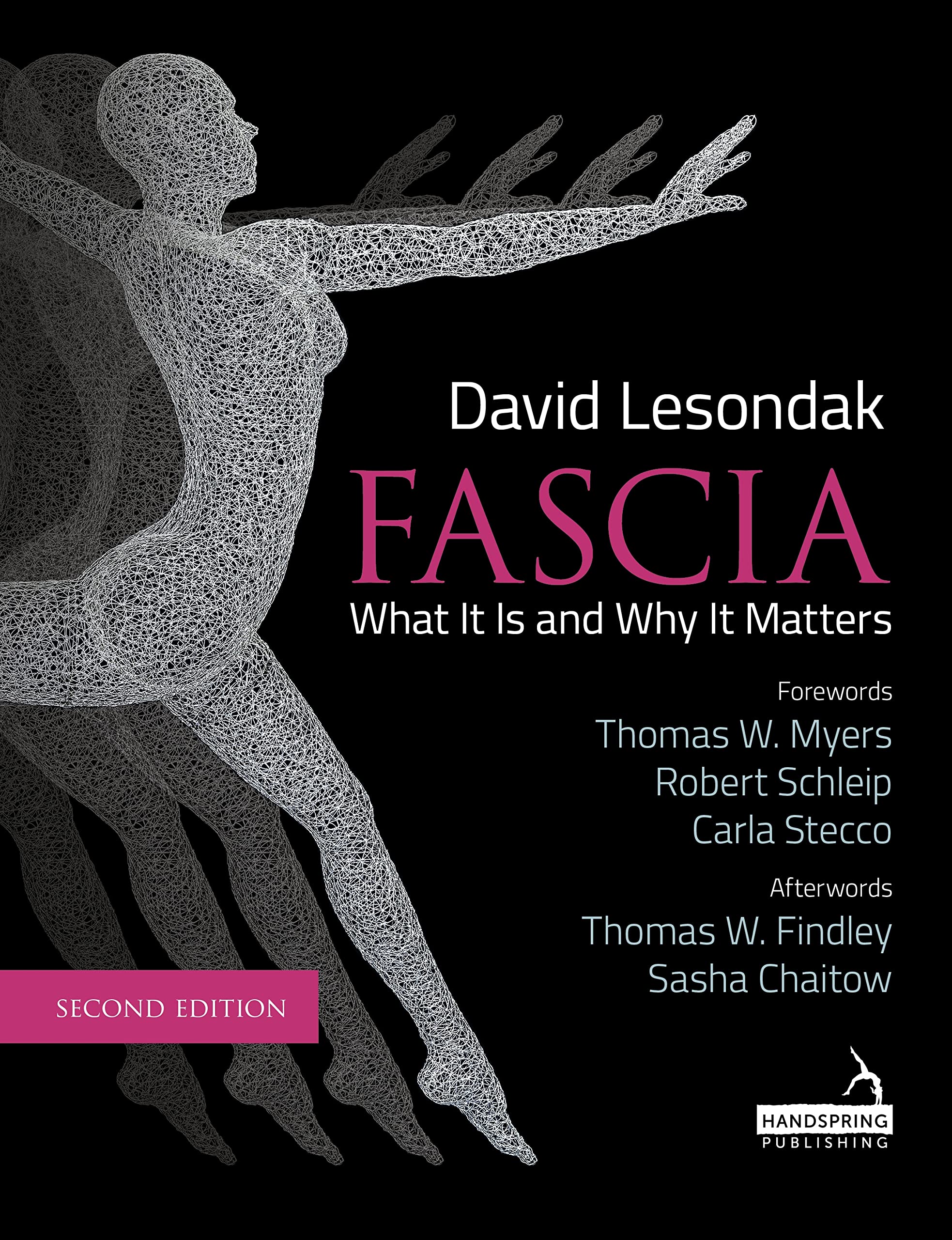
Fascia – What It Is, and Why It Matters, Second Edition
The second edition of What It Is and Why It Matters, the first being the "must-have" book for everyone wanting to learn more about fascia as a tissue and a system, maintains the high standard of the first book while expanding on everything that made it so popular.
By focusing first on the fundamentals of fascia as a tissue that surrounds, supports, and permeates all the muscle, bones, nerves, and organs, Lesondak takes the reader on a journey throughout their entire body from the perspective of the fascial system, making many stops along the way to make sure the reader understands what it is that's important and why it matters to the body.
From the new rules of biomechanics, biotensegrity, cellular processes, musculoskeletal issues, proprioception, neuroscience and cognition, somatic dysfunction, and restoration-Lesondak deftly weaves it all together with a deep appreciation for the history of science, fine storytelling sensibilities, and a sense of humor as well as a sense of wonder.
By focusing first on the fundamentals of fascia as a tissue that surrounds, supports, and permeates all the muscle, bones, nerves, and organs, Lesondak takes the reader on a journey throughout their entire body from the perspective of the fascial system, making many stops along the way to make sure the reader understands what it is that's important and why it matters to the body.
From the new rules of biomechanics, biotensegrity, cellular processes, musculoskeletal issues, proprioception, neuroscience and cognition, somatic dysfunction, and restoration-Lesondak deftly weaves it all together with a deep appreciation for the history of science, fine storytelling sensibilities, and a sense of humor as well as a sense of wonder.
- GenresHealthNonfictionFitness
201 pages, Kindle Edition
Published October 21, 2022
Ratings & Reviews
Friends & Following
Create a free account to discover what your friends think of this book!
Community Reviews
Displaying 1 - 13 of 13 reviews

October 24, 2019
I feel smarter
Most books like this have me feeling dumb, but Lesondak is a better writer. He's able to take difficult biology and explain it in a way the layperson can understand. I'd still recommend taking notes as you read this. There's a lot of material covered here.
This book covers our past and present understanding of fascia in the body, detailing how we managed to overlook it's usefulness until fairly recently. It even gives plenty of resources in near the end for further reading.
Most books like this have me feeling dumb, but Lesondak is a better writer. He's able to take difficult biology and explain it in a way the layperson can understand. I'd still recommend taking notes as you read this. There's a lot of material covered here.
This book covers our past and present understanding of fascia in the body, detailing how we managed to overlook it's usefulness until fairly recently. It even gives plenty of resources in near the end for further reading.

August 28, 2022
I honestly do not care which version is which, that is not important to me. What is important is that there is a comprehensive book about fascia! I have been a licensed massage therapist since 2014, and I cannot even tell you how important fascia is and how it directly relates to the contractility of muscles. Fascia is why your muscles have the ability to move. My favorite massage modality, that I also hold a certification in is called myofascial release. This modality is basically manipulating fascia so muscles can move.
I absolutely loved that this indulged the muscle nerd in me! I love anatomy and physiology! This was so fun to read and the author explains this well to the novice. I appreciate that Lesondak made learning about fascia fun. I definitely need to get this at publishing for my home library. I enjoyed it that much.
This book helps me in dual careers as veterinary assistant and as a licensed massage therapist. I hope to get my license someday as a registered vet tech and specialize in rehab or orthopedics.
Highly recommended for anyone in the medical or veterinary field. The principle of fascia in is animals too!
Thanks to NetGalley, David Lesondak and Jessica Kingsley Publishers Handspring Publishing for an ARC in exchange for an honest review.
Available: 9/21/22
I absolutely loved that this indulged the muscle nerd in me! I love anatomy and physiology! This was so fun to read and the author explains this well to the novice. I appreciate that Lesondak made learning about fascia fun. I definitely need to get this at publishing for my home library. I enjoyed it that much.
This book helps me in dual careers as veterinary assistant and as a licensed massage therapist. I hope to get my license someday as a registered vet tech and specialize in rehab or orthopedics.
Highly recommended for anyone in the medical or veterinary field. The principle of fascia in is animals too!
Thanks to NetGalley, David Lesondak and Jessica Kingsley Publishers Handspring Publishing for an ARC in exchange for an honest review.
Available: 9/21/22

February 7, 2021
The growth in interest in fascia in the yoga community has been huge. This is a readable introduction and was very helpful during my teacher training course

May 28, 2022
Lesondak is a true teacher. He takes a subject like the extra cellular matrix and makes it both fascinating and accessible. Highly recommend.

August 15, 2022
There isn't a place to review the 2nd edition, so I'm putting it here: "Fascia, 2nd edition" explains what fascia is, how it works, and different methods for treating fascia problems. The chapters covered: what fascia is, tensegrity, studying fascia anatomy, fascia and the nervous system, fascia-like structures in the brain, fascia and organs, recognizing a fascia problem, and various methods of treating fascia problems. That last chapter talked about different methods, what the method was like, and where to learn it. All throughout, there were pictures of fascia (or related things, like tensegrity models). The text wasn't highly technical but it's in-depth enough that it's probably most interesting to bodyworkers and other people with some medically training. While very interesting, clearly fascia needs a lot more study--and this book is meant to both inform and interest people in furthering this research.
I received an ebook review copy of this book from the publisher through NetGalley.
I received an ebook review copy of this book from the publisher through NetGalley.
December 3, 2025
A good overview of Fascia, how it is connected to other systems in our body, the difficulties that arise from chronically stressed or tense fascia and some suggestions on methodologies that could help to relieve this tension.
It gives some deeper scientific insight into the world of fascia while still being rather accessible for the layman.
It gives some deeper scientific insight into the world of fascia while still being rather accessible for the layman.

August 20, 2026
I learned so much from this book, and it was key to preparing my course on fascia and perimenopause. I would recommend a book like this for all medical, nursing, psychiatry, OT, PT, bodywork, or manual therapists. It should be a whole class in pre-med.
March 18, 2021
Informative

November 11, 2022
The most comprehensive text on Fascia I have found.
Though it reads like a textbook, the second edition of Fascia keeps us appraised of research pertaining to a previously speculative science. In order to fully understand fascia, the book delves into history as well as anecdotal examples. Having listened to David Lesondak speak, I would highly recommend supplementing this text with video- his passion really brings the material to life.
Learning about fascia has immeasurably changed my approach to bodywork. Whether you are a physical therapist, occupational, massage, trainer, chiropractor, orthopedic professional, etc. this is an excellent resource to have in your library.
[Thank you to NetGalley and Handspring Publishing for a copy of this read in exchange for an honest review.]
Though it reads like a textbook, the second edition of Fascia keeps us appraised of research pertaining to a previously speculative science. In order to fully understand fascia, the book delves into history as well as anecdotal examples. Having listened to David Lesondak speak, I would highly recommend supplementing this text with video- his passion really brings the material to life.
Learning about fascia has immeasurably changed my approach to bodywork. Whether you are a physical therapist, occupational, massage, trainer, chiropractor, orthopedic professional, etc. this is an excellent resource to have in your library.
[Thank you to NetGalley and Handspring Publishing for a copy of this read in exchange for an honest review.]
March 6, 2023
The comprehensive text on Fascia.
Though it reads like a textbook, the second edition of Fascia keeps us appraised of research pertaining to a previously speculative science. In order to fully understand fascia, the book delves into history as well as anecdotal examples. Having listened to David Lesondak speak, I would highly recommend supplementing this text with video- his passion really brings the material to life.
Learning about fascia has immeasurably changed my approach to bodywork. Whether you are a physical therapist, occupational, massage, trainer, chiropractor, orthopedic professional, etc. this is an excellent resource to have in your library.
[Thank you to NetGalley and Handspring Publishing for a copy of this read in exchange for an honest review.]
Though it reads like a textbook, the second edition of Fascia keeps us appraised of research pertaining to a previously speculative science. In order to fully understand fascia, the book delves into history as well as anecdotal examples. Having listened to David Lesondak speak, I would highly recommend supplementing this text with video- his passion really brings the material to life.
Learning about fascia has immeasurably changed my approach to bodywork. Whether you are a physical therapist, occupational, massage, trainer, chiropractor, orthopedic professional, etc. this is an excellent resource to have in your library.
[Thank you to NetGalley and Handspring Publishing for a copy of this read in exchange for an honest review.]
July 11, 2024
Fascial research is really "in" right now. Books on the subject abound, published studies are coming out all the time, there is a Fascial Research Institute attached to the University of Ulm in Ulm, Germany. Gil Hedley has created a cottage industry videoing facial dissections -- the list goes on and on. It's because of this that I knew I better read the 2nd edition. The book is terrific. In the relatively small space of a lavishly illustrated 180 pages, Lesondak covers the fascial water front. He somehow has created a book that is accessible to the public, useful for the clinician, and researched enough to satisfy the medical profession. I highly recommend you read it.

March 24, 2019
As I seem to say for all my yoga books, this may have been "read" but not finished. Having just finished my second yoga intensive with Carrie Gaynor on yoga from a fascial perspective, I find the details in this extremely well written book to be starting points for more reflection and yoga practice.

August 7, 2023
Pozycja co najmniej dla osób średniozaawansowanych w tematyce zdrowia i poprawy samopoczucia. Idealna dla chcących rozwijać się i kształcić osób zawodowo związanych ze zdrowiem i pracą z klientami, pacjentami. Dużo się dowiedziałam, dużo się nauczyłam i zdecydowanie wykorzystam ogrom referencji do innych publikacji w temacie powięzi w dalszym kształceniu.
Displaying 1 - 13 of 13 reviews