‘Entrancing … soulful and evocative’ ANIRUDH KANISETTI
Saturday, the 27th of February, 1627. The master artist Mansur, who works under the patronage of Mughal emperor Jahangir, must finish his painting of a dodo and prepare for an imminent journey to Kashmir when he is interrupted by a younger colleague, Bichitr. An innocuous remark from this visitor – first to Mansur and a little later to the portraitist Abu’l Hasan – has dire consequences as more characters at the imperial atelier, the library and the Women’s Quarter are drawn into a web of secrets, half-truths and petty rivalries.
At the heart of the story is a jewel-like verse book whose pages Mansur has illuminated and filled with lifelike butterflies. On reaching Verinag, the royal summer retreat in Kashmir, the painter must present the book to its author, the empress Nur Jahan, who had commissioned it as a keepsake for her husband, the emperor Jahangir.
A delay in the book reaching Mansur from the bindery adds to his apprehensions that its very existence is no longer a secret, coupled with dread that so precious an artefact might fall into the wrong hands. What must the painter confront before his masterwork is conveyed safely to Verinag?
The dodo—that dumpy, short-winged, ungainly bird now synonymous in the English language with being dead and gone—was first sighted and described by Europeans sometime in the early 1500s; over the following century, many painters depicted the bird. Most of the paintings are distorted, the dodo’s centre of gravity obviously awry.
An Indian, however, was responsible for what is probably the most accurate depiction of a dodo: Ustad Mansur, of Jahangir’s imperial atelier, painted the bird around 1623 CE. Jahangir, deeply interested in natural history, had agents stationed in Goa to check every ship that sailed in: they had instructions to acquire exotic creatures being brought to India, and to have these sent on to the Emperor. Who, of course, would not only add them to his menagerie, but have them painted by Mansur.
Thus Mansur, painting the dodo.
Which is how Vikramajit Ram’s Mansur: A Novel begins: with Mansur painting the dodo.
‘It stands in a wash of light green under a hint of watery sky, a tussock of darker grass in the foreground for scale. As in life, so in the painting, there’s a canny smile to its heavy hooked bill, a jaunty step to its ochre-grey feet.’
Mansur toils over the painting, while fretting over a very private assignment he has been working on these past months. From the room where Mansur works, the narrative moves out, to the other rooms of the imperial atelier. To where a talented young trainee draughtsman, Mirar, fascinated by his handsome tutor, Abul Hasan, finds himself torn between jealousy and ambition, between pride and devotion to his Beloved. To others: the master portraitist, Bichitr, eager to get ahead, frantic to be taken along to Kashmir as part of the Emperor’s entourage. Higher up in the echelons of the atelier and the library is Muktab Khan, the Keeper of Paintings; and in a world both distant as well as connected to the atelier are the two old ladies, Sahifeh Banu and Nadireh Banu, who dwell in the Women’s Quarters of the palace and whose Abyssinian page, Jamal, ferries mysterious packages between the ladies and Mansur…
The chapters of Mansur have titles that, even if not exactly those of paintings, could well be: ‘Flightless bird with heavy hooked bill’, is the first chapter; ‘A youth woos his Beloved with fine drawings’ the next, and so on. It’s an appropriate way to define this book, because Mansur’s core strength is its depiction of art, both Mansur’s and that of his contemporaries. Vikramajit Ram describes the paintings in loving detail, bringing out their nuances, working into their descriptions a knowledge of not just the way art is created, but how the creator of that art is reflected in the work too.
This aspect of art—how it is affected by the painter and other considerations—forms an important part of the story. The characters are all in some way involved with the creation of art, even if they are not artists themselves. Their motivations, their ambitions and rivalries play out against the backdrop of the atelier and the imperial family it serves.
The book, at a little over 150 pages, is slim, the story brief. The characters are many, flitting in and out of frames, often only briefly glimpsed before the scene shifts. Their dialogues, sometimes whimsical or witty, are occasionally obtuse. The combination of too many characters and too brief a book ends up being underwhelming: a reader may be left with a fleeting, half-formed impression of a story of greed, jealousy, power and ambition in the imperial atelier. Not an impactful, strong story, but one that seems to be perceived through a shifting veil: broad brushstrokes prevail here, rather than the finer details.
But Ram’s exquisite prose is a pleasure to read, and he does a fine job of transporting a reader into another space, another time.
Lovely story set in the Mughal atelier ... Gives a glimpse of how paintings and art flourished during Emperor Jehangir 's rule as the Emperor. While I have seen some of the paintings before , I didn't know the painters themselves . Highly recommended read to trigger more interest in the art form and to read veterans like BN Goswamy and other stalwarts who have written extensively on Indian art
I love the Mughal Era of India, it was rich in art, culture and cuisine. Mansur was a revered artist of the Mughal era and his essence comes to life in this beautiful book. We see the lives of the royal court through the eyes of an artist. The writing style was lyrical and ornate. The tone of the book was emphatic and straightforward. My favourite part of the book was the rich history of the bygone era that the author brought forth with skill.
The story focuses on Mansur, his current piece of art, his young student/ prodigy and his impending travel to Kashmir. As always there are elements of drama, deceit and treachery that spicen the book, if you are looking for a rich historical fiction based on Indian art, you must read this gem.
Here's a fantastic recommendation for all historical fiction lovers! Mansur is a fascinating and spellbinding novel that will take you back to the Mughal era and into the royal court of Jahangir. There is art, ambition, adventure, mystery, deception, and drama. I enjoyed reading it and found it highly entertaining!☺️
Mansur was a widely celebrated Mughal painter. He gained recognition during the reign of Jahangir. Bichitr, who was a younger colleague of Mansur, also aspired to achieve the precision of Mansur. A remark by him to Mansur started a cascade of events that eventually led to dire consequences. Mansur leaves for Kashmir on a mission to meet Nur Jahan and present a secret book to her.
But will he be able to do that? Will the book stay a secret for long?
We get to read about the various secrets, politics, and rivalries among the court members. I enjoyed reading about the intricate details of some renowned paintings and the intense court politics. Every single page is filled with vivid descriptions of either beautiful paintings or the lovely valleys of Kashmir or both. And there is as much thrill and adventure in this story as is the splendid beauty. It was interesting to read about the growth and passion of Abu'l Hassan. He was a creative and masterful painter who started his journey as a junior painter and soon rose in the ranks because of his exceptional talent.
But did he get along well with Mansur?
I found this to be an amazing page-turner! It has all the elements to keep one hooked till the end. I loved it and hope you love it too!☺️
‘He has no memory of the pain but of everything else.’
I relished this richly atmospheric, elegantly told tale of art and intrigue. Set in the court of Emperor Jahangir, Vikramajit Ram’s immersive novella pivots around the master painter Mansur, hailed as the ‘Rarity of the Present’, renowned for his exquisite renditions of flora and fauna. He has been commissioned to work on a secret project, and as he strives to maintain the secrecy of the special task entrusted to him, the reader is drawn into the intoxicating, vibrant world of the imperial court: its petty rivalries, its hidden desires, its potent jealousies, its intricate politics.
That “Mansur” ably evokes such an immersive, three-dimensional world despite its crisp brevity is a marvel. But most delightful are the tantalizing glimpses into what life might have been like for a seventeenth-century artist in the Mughal atelier: from the fascinating insights into an artist’s process to the deft descriptions of actual miniature paintings woven seamlessly into the story. (Part of the joy, for me, was to suddenly stumble across paintings I remember fondly from my days as a student of art history, like that of the squirrels in the chinar tree, which still renders me speechless.)
This book is based on the life story of Ustad Mansur, the master painter and artist in Emperor Jahangir's court during the Mughal Empire. He was one of the finer artists to paint animals and birds after closely observing them, and he even painted a few from his imagination. His portrait of the dodo is so famous that it's said that their eyes were painted with a precision that no one else ever managed to recreate. He is also said to have signed his paintings even during the seventeenth century, which reflect his confidence, position and power in the court.
The Empress Nurjahan also bestows him the responsibility of handing over a few souvenirs to the emperor himself after painting each page with a butterfly. From what history says, Mansur was fondly known as "Nadir-ul-Asr" by many, which means "Rarity of the Present". But during an era and in a place where hierarchy and rivalries existed, Mansur had become a victim of gossip and jealousy. It leads to a spiral of events that ends in a conspiracy against him that is webbed by his colleagues and junior artists. Will Mansur manage to evade them to excel and deliver the souvenir to his emperor?
Mostly biographical and partly fiction, this book sheds light on Ustad Mansur's grandeur talent, added with a hint of mystery. The descriptions of his paintings were vivid and fascinating. I wouldn't say it's one of the fastest reads just because it's less than 200 pages because the language is vibrant and intricate. You might find it slightly repelling if you do not enjoy elaborate, complex descriptions like in this book. But you could try reading them slower by ensuring attention to minor details that would make the reading experience pleasant. This book brought Mansur's picturesque tapestries to life with its detailing and narration.
The Mughal Empire ruled over India for almost two hundred years. Mughal Art, Culture and Architecture is still famous till date. They had a deep interest in paintings. Mughal Paintings flourished and was at its peak during the reign of Akbar, Jahangir and Shah Jahan.
Mansur by Vikramajit Ram is dedicated to the painting artists during the reign of Emperor Jahangir. It gives us the glimpse of the atelier where the famous artists worked to deliver their best.
Mansur, the master artist in the court of Emperor Jahangir has been titled as the 'Rarity of Present'. He has entrusted by the Empress to deliver a precious book of verses back to her in Verinag, the summer capital in Kashmir.
We find accounts of others famous painters too in this book. The school of paintings where young trainees were taught the art of painting. An account of library where all the paintings were kept after framing and bordering.
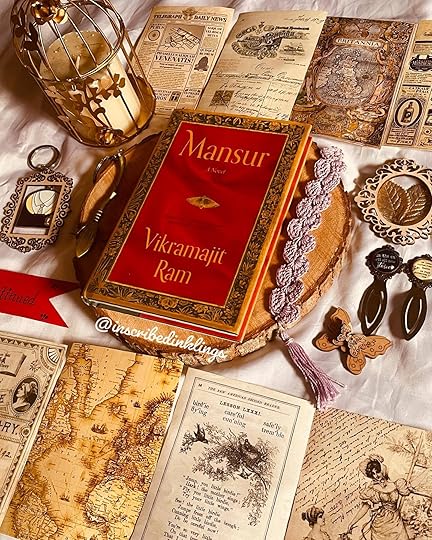
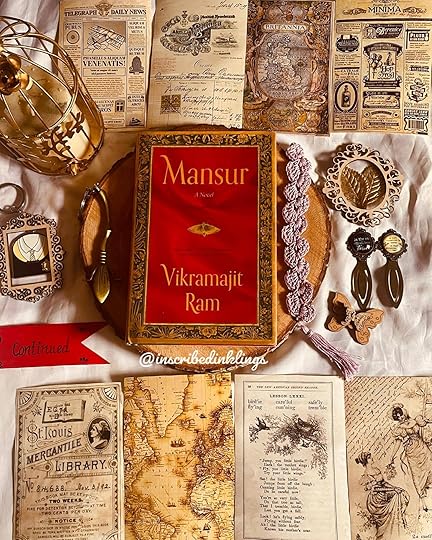
While reading I found myself drifted back in the Mughal era. The author has a realistic touch in his writings which envelops the readers in the background of the story. It was interesting and fun reading the story setup ages back. The book cover has been given a royal touch which is beautiful to behold. Suggesting this book to historical and art lovers.
Mansur, the brilliant artist bestowed with the title “Rarity of the Present” under the patronage of the Mughal Emperor Jahangir is commissioned by the Empress Nur Jahan to create a book of verses she intends to present to the Emperor. The accomplished artist specializes in creating magnificent art depicting natural flora and fauna but he is not the only accomplished artist at the Mughal atelier.
This simple sounding plot is a tale of intrigue, doused with politics at the atelier where competitive rivalry can stray too far. It cleverly captures the essence of the Mughal culture in the short span of the story. The focus on art and the etiquette of the time are succinct yet notably penned to carve a vivid landscape.
For me, this book was a treat for its entrancing writing and not the premise as it kept me longing for more.
Verdict: Looking for a quick but charmingly penned historical fiction? Read this.
A really beautiful novel, set in the time of Jahangir. The novel revolves around Mansur, also known by his title “Rarity of the Present” given to him for his expertise in painting flora and fauna.
The book gives us a rich (fictional) glimpse into the life of the artists who worked for the Emperor and their ambitions.
I learnt so much from this book about the art and culture of the Mughals.
The book was really enjoyable, but it gets 5 stars from me because of how unique it is. I have never read a book like this: Set in India, based on historical events, yet fictionalized, centred not around royalty but thise who are below them, and of course beautifully told.
It was a treat! Now I must see some of Mansur’s art. I wonder if the Dodo exists somewhere.
Though the Mughal rule spanned more than three centuries, the period from about 1580 to 1650 is referred to as the great age of Mughal art. Akbar laid the foundation of the Mughal School of Paintings and it was furthered by his two successors, Jahangir and Shah Jahan. These rulers patronized highly skilled painters like Dasvanth, Basavan, Ustad Mansur, Govardhan, Bichitr, Abul Hasan, Bishandas, etc., who produced masterpieces by integrating the elements of the indigenous Indian school of painting with the Safavid style of Persian painting, and it was then that the Mughal art reached its zenith.
Despite the splendour of Mughal paintings, there is dearth of fiction based on this rich art form, and the short read titled 𝐌𝐀𝐍𝐒𝐔𝐑 by Vikramajit Ram is verily a pleasing journey into this untraversed sphere.
Set during Jahangir's reign and centered around one of India's greatest painters, Ustad Mansur, the story provides an insight into the world and works of some celebrated Mughal painters of the seventeenth century. It takes us inside the imperial atelier—home to eminent painters like the eponymous Mansur, Abu'l Hasan and Bichitr, among others—resplendent with exotic portraits and canvases, where an illustrated miniature verse book, commissioned by Nur Jahan to Mansur as a token for Jahangir, is at the core of the story.
We enter the curtained spaces of notable paintings like Bichitr's allegory of Jahangir sitting on an hourglass throne, and witness Mansur's artistic finesse first hand as he conceives the famous coloured illustration of a dodo. Ram brings the painters' emotive forces to the fore—their latent desires and resentments find tangible expression through their art. While inside the atelier, he also exposes the chaos unfurled by petty rivalries, which further entangled departments like the women's quarters and the imperial library in a network of gossip and lies.
The author has woven his tale around the real subjects with such expertise that it is impossible to discern fiction from fact, he has fleshed out the characters extensively in an admirably succinct manner with special emphasis on the paintings of the bygone era. Never before did I pay attention to the Mughal paintings as closely as I do now, the book compels the readers to be heedful of this form of creative expression.
All good books enthrall you but just a handful of them have you entranced, and this novella certainly fits into the latter bracket for me. In a verse like narrative, the writer illustrates how substantial the events of a single day can be. His eloquence leaves a profound impact.
The rarity of the Present, the title was bestowed on Ustad Mansur by Emperor Jahangir for the great artist he was in the Mughal court. He, who brought to life flora and fauna on his canvas, has been brought to life in this novel by the author Vikramajit Ram. Through this novel and his prose-like writing, the author takes readers back into the Mughal era more than 400 years ago. One gets to read a descriptive account of several famous paintings of the Mughal era, the architectural description of Mughal palaces, the life of Mughal artists, internal rivalry among courtesans, the relationship among Mughal families, and much more.
The base of the story runs across the life and aspirations of various characters. Mansur, who is Rarity of Present and has been bestowed with the responsibility of painting a book written by Empress Noor Jahan for Emperor Jahangir. Abu'l Hasan, Rarity of Age, another distinguished artist of the Mughal court. Mirar, a young and ambitious artist training under Abu'l Hassan but is fuming because of the less than expected assessment of one of his artworks by his master Abu'l Hasan. Not just these, one comes across several other known and unknown characters of the Mughal era in different capacities.
What makes this book different is the concept and the writing style. A book on art and its artist in an equally artistic style. From the plot and story perspective, readers may crave for more. But one's craving for good writing will get satiated here. If you are an art lover, you may be able to appreciate the uniqueness of this novel. Others may skip.