This book was converted from its physical edition to the digital format by a community of volunteers. You may find it for free on the web. Purchase of the Kindle edition includes wireless delivery.
James Branch Cabell was an American author of fantasy fiction and belles lettres. Cabell was well regarded by his contemporaries, including H. L. Mencken, Edmund Wilson, and Sinclair Lewis. His works were considered escapist and fit well in the culture of the 1920s, when they were most popular. For Cabell, veracity was "the one unpardonable sin, not merely against art, but against human welfare."
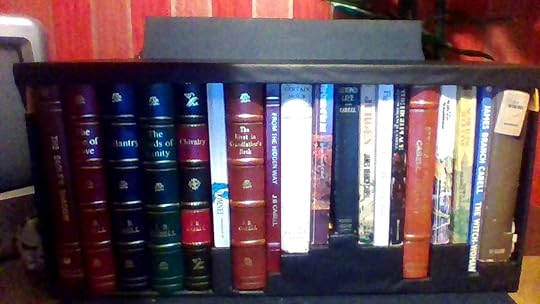
Second Read 3-Stars The start of my complete reread of the Biography of Manuel. Now in my owned hardcopies. The physical object I’m reading is a leatherbound print-on-demand with the text being a scan of the 1924 McBride edition. This is an interesting edition with lengthy introduction by an Edwin Bjorkman, which is pretty well rounded. It’s more of an intro to the entire biography rather than this particular book. It also includes the piece An Appendix: On Morals which mostly consists of letters from the New York Times of the period (1904). With a back and forth from various readers, very nice addition and entertaining from a modern perspective.
There are a couple of bits of untranslated latin (not unusual with Cabell). I found this handy site with notes and translations of his epigraphs, https://jamesbranchcabell.library.vcu... . I wrote in the translations in pen on my copy, the advantage of PoD. I don’t need to care what i do to you, your not a real book! Anyway, onward!
First read 2-Stars "is it not strange an all-wise Creator should have been at pains to fashion this brave world about us for little men and women such as we to lie and pilfer in? Was it worth while, think you, to arch the firmament above our rogueries, and light the ageless stars as candles to display our antics?
So this is pretty straightforward stuff. Its a comedy romance with plenty of misunderstandings, reminded me of some of the Shakespeare comedies.
None of which is stuff i actually like. However it is pretty well written and the author does everything with a wink in his eye. Apart from the comedy/romance the only theme if the problems of money but it isn’t dwelt on that much.
I’ve had worse reading experiences with Cabell, this is light and easy and quite compelling in the 3rd quarter. In the end though i’m not sure i’d recommend it too much and i’ve dropped my score due to comparing it to Cabells other books due to its simplicity.
"It was the mirth of a beaten woman, of a woman who has known the last extreme of shame and misery and has learned to laugh at it."
Please...
This is an overdrawn romance between very shallow young aristocrats penned 15 years before Cabell began to really hit his master stride. Full of the nonsensical waxing over the psychological pain and plight of people who never knew a hardship, and posing as a sophmoric lecture about the evils of American consumerism (the Eagle's shadow is the enslavement of the public to the almighty dollar, don't you know), the only modern readers this might appeal to are 15 year old girls with blue hair and a penchant for reading the "classics."
Here's another jem, written about a spoiled heiress who for ridiculous reasons thinks the man she loves wants to marry her for money. "Ah, poor little lady of Elfland! poor little Undine, with a soul wakened to suffering!" If this bit had been written in "Jurgen" or "The Silver Stallion," I would have known Cabell was making fun of the character, but there is no tongue and cheek here. Only cheek.
The only thing that makes this book part of a series is the character of Felix Kennaston, who becomes the key figure in the superior sequel, "The Cream of the Jest," the entry that begins to wrap up the thought-provoking but controversial end of the epic. But what puzzles me is how a writer of Cabell's forethought and sophistication believed it would be a good idea to later include "The Eagle's Shadow" into his Dom Manuel series at all. By the time he tried to cram this piece of adolescent hysterics down the throats of his 1920s audience, he should clearly have had enough self-awareness to know this work was immature and not up to standards he had set with many others of the Dom Manuel series.
If you study the series, you will notice that as it progresses there is very little "new" material, just reworked versions of his older stuff. On the surface, that's a clever marketing campaign to keep his writings in publication and in the public eye. And while many of his previously written material actually blends well shoehorned into this fantasy series, since much of his oeuvre has a common theme, he should have been more selective.
Cabell was very keen on being read by larger audiences years after death, and I think he considered his relatively limited fanclub to be due to the limitations of American fads and consumerist intellect. He even refers to Charles Dickens in this novel as "a novelist who is obsolete now because he 'wallows naked in the pathetic' and was frequently guilty of a very vulgar sort of humour that actually made people laugh, which, as we now know, is not the purpose of humour..." Cabell identified with writers who he felt were misunderstood by readers in the '20s, but I feel that with the reintroduction of this dud of a novel into the active repertory of what his fans were reading during the height of his popularity, Cabell himself was responsible for not being remembered in history as the fine artist he is.
James Branch Cabell’s first book, The Eagle's Shadow, was published in 1904. At the end of the 1920s, Cabell shoehorned it into the Biography of the Life of Manuel as Volume 15, with some edits—presumably to reference Dom Manuel or Jurgen. I read the original first edition, which contains no mention of these two characters from his later, great fantasy novels.
Felix Kennaston, who appears as a young poet in The Eagle's Shadow, will later star as a disillusioned middle‑aged author in The Cream of the Jest (1917), an alter ego for Cabell himself. John Charteris is mentioned in conversation in The Eagle's Shadow (p. 11)—the author from Beyond Life, The Cords of Vanity, and Straws and Prayer Books. Thus, these two characters have some continuity from Cabell’s very first novel.
The Eagle's Shadow was the first of Cabell’s three non‑fantasy novels in the Biography, the other two being The Cords of Vanity (1909) and The Rivet in Grandfather’s Neck (1915). In my first reading, I felt it was weak and pointless. I’ve recently been working my way through the Biography, rereading the books in order. I almost skipped The Eagle's Shadow this time, knowing its subject matter and its failings. I decided to give it one more try. My earlier impressions were reinforced, but I recognized some qualities that redeem the book somewhat.
Margaret Hugonin has inherited a fortune from the deceased Frederick R. Woods—unfairly, perhaps, because his nephew Billy Woods would normally expect to be the heir. The elder Woods, however, is upset with Billy for going off to Paris to become an artist. The action takes place at Frederick R. Woods’s estate, Selwoode, where Margaret, Billy, and several other young people—including Felix Kennaston—are gathered for a house party. Margaret and Billy are in love, though misunderstandings about their relationship and the inheritance have taken hold. Both Margaret and Billy have other potential love interests among the company. The scene is set for a social comedy of sorts.
The Eagle’s shadow refers to the malign influence of money and its ability to warp human relations. According to the deceased Uncle Frederick R. Woods, “…the Eagle meant that crude, incalculable power of wealth he gloried in” (p. 60); again, “…the Eagle—the symbol of the crude, incalculable power of wealth” (p. 138). Cabell returns frequently to the Eagle motif. He is telling us, I think, that this is what the book is about.
I have to admit that I enjoyed some of Cabell’s phrasing in The Eagle's Shadow. It foreshadows some of his best writing: “Let us be frank, Kathleen, and confess that life is but a trivial farce ignobly played in a very stately temple” (p. 180). In this book, Cabell’s detached, jaded, urbane philosophy is spoken by Felix Kennaston. Cabell also speaks as the omniscient observer of events. He comments again in this role on the malign influence money exerts on the personalities and relationships of the rich. Here is the omniscient author on the Eagle: “Even the shadow of the Eagle is a terrible thing—a shadow that, as Felix Kennaston has told you, chills faith and charity, and independence, and kindliness, and truth, and—alas—even common honesty” (p. 233).
So far, so good. Cabellian gems are scattered throughout the text, which I didn't take account of in my first reading of the book. The most interesting character is Felix Kennaston, for his spouting of jaded philosophy. On the other hand, it is a romantic comedy, and the lovers are caricatures: Billy is tall, dashing, handsome, and impeccably honourable; Margaret is astoundingly beautiful, with masses of golden blond hair—frequently referenced and described—but she is impetuous and impressionable.
Much of the book also reads like a series of in‑jokes for Cabell’s own social class. I grew weary of phrases like “trousered persons” and “petticoated persons” to refer to the genders. Nevertheless, the sexual politics of Cabell’s upper‑class, turn‑of‑the‑century American South are interesting. Viewing this social aspect of the book’s time and place through the lens of Margaret and Billy is another saving grace of The Eagle's Shadow.
The Eagle's Shadow certainly does not belong in a series with fantasy novels, but if you enjoy Cabell’s writing, it can be mined for its gems.