

What do you think?

The Collected Works #3
Feiffer: The Collected Works
In 1956, an unknown cartoonist named Jules Feiffer began drawing a weekly comic strip called Sick, Sick, Sick free of charge for a then-obscure weekly newspaper called the Village Voice. Within two years, Feiffer had become one of the most popular satirists of the period, appearing in several major newspapers in the U.S. and Great Britain, and with a best-selling book under his belt.
Feiffer: The Collected Works Vol. 3 contains the first two scintillating years of this strip (later re-dubbed simply Feiffer), shot mostly from the original art. But that's not all! This volume also includes "Boom," Feiffer's savage take on H-bomb testing, government duplicity, and public apathy. "The Deluge" takes a modern everyman, Harvey Noah, and gives him the daunting task of warning the world of impending flood by going through proper bureaucratic channels. "Kept" is the story of a small, ugly man who discovers the awful secret of successful seduction. In "Harold Swerg," the title character is the greatest athlete in the world; he upsets the nation when he refuses to win the Olympics because there's no challenge in it.
As a special bonus this book includes "Rollie," a never-before-printed 10-page story from that period, about a bass player whose playing sends everyone who hears it into orbit. This story, which languished in Feiffer's files for close to four decades, is a great lost treasure, and absolutely critical to any Feiffer fan!
This is the Feiffer work we've all been waiting for, the classic cartoons that assured him a place in the Pantheon of great American cartoonists and eventually won him a Pulitzer Prize.
Feiffer: The Collected Works Vol. 3 contains the first two scintillating years of this strip (later re-dubbed simply Feiffer), shot mostly from the original art. But that's not all! This volume also includes "Boom," Feiffer's savage take on H-bomb testing, government duplicity, and public apathy. "The Deluge" takes a modern everyman, Harvey Noah, and gives him the daunting task of warning the world of impending flood by going through proper bureaucratic channels. "Kept" is the story of a small, ugly man who discovers the awful secret of successful seduction. In "Harold Swerg," the title character is the greatest athlete in the world; he upsets the nation when he refuses to win the Olympics because there's no challenge in it.
As a special bonus this book includes "Rollie," a never-before-printed 10-page story from that period, about a bass player whose playing sends everyone who hears it into orbit. This story, which languished in Feiffer's files for close to four decades, is a great lost treasure, and absolutely critical to any Feiffer fan!
This is the Feiffer work we've all been waiting for, the classic cartoons that assured him a place in the Pantheon of great American cartoonists and eventually won him a Pulitzer Prize.
96 pages, Hardcover
First published January 1, 1956
About the author
Jules Feiffer
142 books196 followersJules Feiffer was an American cartoonist, playwright, screenwriter, and author whose work left a significant imprint on American satire and cultural commentary. Emerging from the postwar era of newspaper comics, he first gained recognition through his long-running comic strip published in The Village Voice, where his loose, expressive line drawings and psychologically sharp dialogue captured the anxieties, contradictions, and social performances of contemporary life. Feiffer used humor to critique politics, relationships, and everyday neuroses, developing a voice that felt conversational, self-aware, and deeply engaged with the shifting cultural moods of the United States. His graphic style, which often emphasized gesture and tone over detailed renderings, was equally distinctive, and helped expand the visual vocabulary of editorial and literary cartooning. Beyond his cartoons, Feiffer became an accomplished writer for stage and screen; his play Little Murders offered a darkly comic exploration of violence and alienation in urban America, while his screenplay for Mike Nichols’s film Carnal Knowledge drew widespread attention for its unflinching examination of intimacy and desire. Feiffer also wrote children’s books, including the popular The Phantom Tollbooth, for which he provided the illustrations that helped establish the book’s imaginative visual identity. He demonstrated an enduring commitment to making art accessible, engaging with students and general audiences alike through teaching and public appearances, and continued producing work across multiple genres throughout his life. His comics and writings were often autobiographical in spirit, even when fictionalized, providing commentary on his experiences growing up in New York and moving through decades of cultural change. Feiffer received numerous honors for his contributions to American arts, including major awards recognizing his innovation in cartooning, his influence on graphic storytelling, and his impact on theater and film. His later work included longer-form graphic novels and personal memoirs, reflecting on childhood, family, and the evolution of his artistic voice. Feiffer remained an active and inquisitive creator well into his later years, consistently exploring new creative forms and responding to contemporary political and social issues. His legacy is seen in the work of generations of cartoonists and writers who drew inspiration from his willingness to bring emotional depth, social critique, and literary ambition to comics and satire. Feiffer’s work stands as a testament to the power of humor to illuminate the complexities of human behavior and the cultural forces that shape everyday life.
Ratings & Reviews
Friends & Following
Create a free account to discover what your friends think of this book!
Community Reviews
Displaying 1 - 24 of 24 reviews

September 27, 2009
I’m too shocked for words. Practically. None of my goodread friends has read any Feiffer???! Unbelievable. Don’t you all know that this Pulitzer prize winning, Academy award winning cartoonist is the daddy of modern humour in the US? From Feiffer comes Trudeau, from Feiffer comes Seinfeld, it is that wide-ranging. It was Feiffer who took the neuroses he saw in society and turned them into ‘Sick, sick, sick’ the name of his cartoon strip. It was Feiffer who tried to show white liberal America what it was:
He saw the sexual ‘revolution’ as the vehicle for the continued sexual exploitation of woman…as indeed it was.
Interalia he makes an indirect observation about some of the major liberal US magazines attempts to interfere with the artist’s free expression. From Paul Morton’s interview with him:
I can only assume, my goodreads friends, that you must surely in your life sometime have seen Feiffer without even knowing: if not Carnal Knowledge then Little Murders starring Elliot Gould, Altman’s Popeye for which he wrote the screenplay or Kill Bill 2 where I gather Tarantino steals some of his thoughts on Superheroes.
His cartoons are timeless and insofar as liberal first world complacency (I don’t see that the US should shoulder all the guilt) needs to be relentlessly criticised, this applies even to his political cartoons. Still, it is his social observations that I have picked for your perusal here.
The cool people:
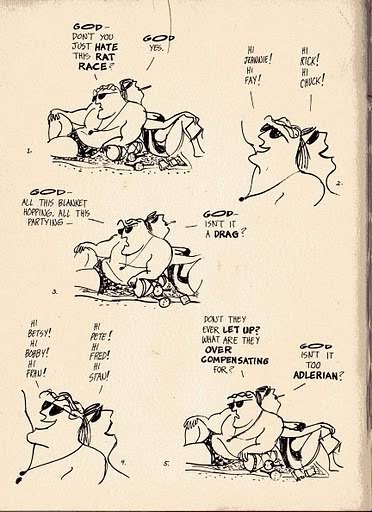
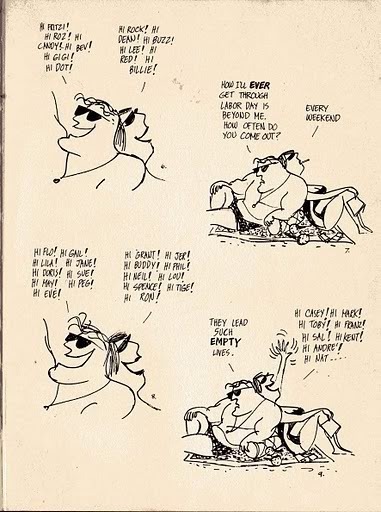
Conformity in rebellion:


Mother:


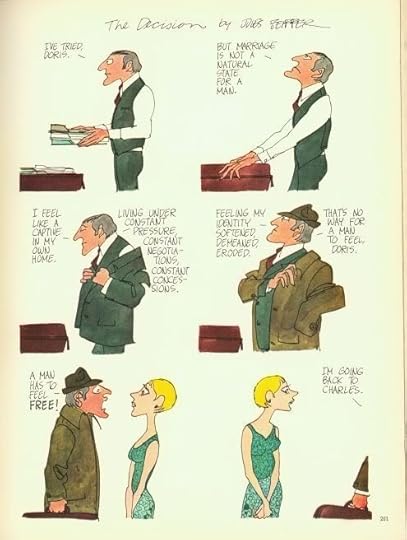
The illusion of freedom:
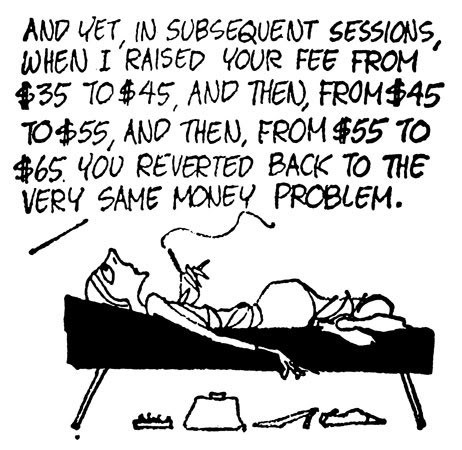
Therapy:
Oh and I love this:

You'll find his books for practically nothing at your local secondhand bookshop (that is, if you still have one....I can't speak for the Oxfam monster) as he is evidently completely unfashionable although timeless. A peculiar contradiction. Get one. PLEASE!!!!!
Baby boomers had a habit of falling in love with satirists a few years older than themselves who disliked the counter-culture. When Woody Allen poked fun at “Just Like a Woman” in Annie Hall his audience forgot they loved Bob Dylan for a few moments. Robert Crumb preferred quiet blues to rock n’ roll though he is most famous for his cover of Big Brother and the Holding Company’s Cheap Thrills. Jules Feiffer was of a similar make, but his satire went well beyond a dislike for Dylan. He was deeply critical of the sexual revolution well before it began in strips he wrote for the Village Voice in ’50s and, when it was well underway, in his screenplay for Mike Nichols’s Carnal Knowledge (1971). He spent more energy attacking his white liberal neighbors for their complacency during the civil rights movement than Southern bigots for their brutality. He was terrified of the bomb. Stanley Kubrick in Dr. Strangelove saved his cruelest jokes for George C. Scott’s psychopathic General Buck Turgidson or Peter Sellars’s neutered president. But Feiffer, in his comic story “Boom!” (1959), focused as much on a populace that was disturbingly complicit in ensuring its own nuclear annihilation as on the demons with power. (Paul Morton, bookslut)
He saw the sexual ‘revolution’ as the vehicle for the continued sexual exploitation of woman…as indeed it was.
Interalia he makes an indirect observation about some of the major liberal US magazines attempts to interfere with the artist’s free expression. From Paul Morton’s interview with him:
“The Lonely Machine” was published in Playboy. But you were so against everything that Hugh Hefner stood for in that magazine.
Well, apparently. But Hefner was terrific about it. [He didn’t:] try to shape me to the demands of his publication as every publication except for the Voice generally did. Whether you were working for Esquire or Harper’s or the Atlantic or the New Yorker they wanted you to be like them, with their sensibility. Hefner, when he sent me back notes, he sent me back richly-detailed notes, panel-by-panel breakdowns of what he liked and what he didn’t like. And it was never to change my point-of-view to his or to the magazine’s. But it was to make my argument stronger by strengthening what he thought was a weakness. And in many cases he was right.
I can only assume, my goodreads friends, that you must surely in your life sometime have seen Feiffer without even knowing: if not Carnal Knowledge then Little Murders starring Elliot Gould, Altman’s Popeye for which he wrote the screenplay or Kill Bill 2 where I gather Tarantino steals some of his thoughts on Superheroes.
His cartoons are timeless and insofar as liberal first world complacency (I don’t see that the US should shoulder all the guilt) needs to be relentlessly criticised, this applies even to his political cartoons. Still, it is his social observations that I have picked for your perusal here.
The cool people:
Conformity in rebellion:
Mother:
The illusion of freedom:
Therapy:
Oh and I love this:
You'll find his books for practically nothing at your local secondhand bookshop (that is, if you still have one....I can't speak for the Oxfam monster) as he is evidently completely unfashionable although timeless. A peculiar contradiction. Get one. PLEASE!!!!!
October 19, 2020
Reading these cartoons was like attending a dinner party and alternately conversing with or overhearing conversations between some truly amusing and obnoxious individuals. Feiffer is sharp, perceptive, and subtle. He does voice very well, and you feel like you've been dropped into snippets of very real conversation. He's not always going for the laugh. Frequently he's going for the head shake, either sad or exasperated.
As far as achievement and genius, I give five stars. Rating for personal enjoyment, I skew lower, since Feiffer does almost too good of a job. As good as this is, I'd be quite happy to not run into the obnoxious people he so well depicts again any time soon. The feeling that I just came from a rather draining dinner party seems very real.
I understand this is his earliest work. I'll definitely read some of the later ones too.
As far as achievement and genius, I give five stars. Rating for personal enjoyment, I skew lower, since Feiffer does almost too good of a job. As good as this is, I'd be quite happy to not run into the obnoxious people he so well depicts again any time soon. The feeling that I just came from a rather draining dinner party seems very real.
I understand this is his earliest work. I'll definitely read some of the later ones too.

January 29, 2024
Ho come l'impressione che Feiffer sia stato completamente dimenticato nel mondo della satira. Ha vinto un Pulitzer, lavorato in gioventù con Will Eisner, pubblicato vignette per riviste come il Village Voice, il New Yorker e Playboy, sceneggiato il film "Conoscenza carnale" (regia di Mike Nichols e con un cast pauroso) e persino il tristemente dimenticato "Popeye" di Altman. Non male come curriculum.
Ed invece nulla, ed è un peccato: satira sociale pungente, che scardina molte ipocrisie della società americana (soprattutto di area medio-borghese e wasp, direi) dell'epoca e che in parte sembra non essere affatto invecchiata.
Il tratto nervoso e stilizzato (ma mai raffazzonato, attenzione) potrebbe non piacere a chi cerca il bel disegno atutti i costi, ma è un problema loro, non mio.
A cura di Umberto Eco (sua l'anonima introduzione?) e Cathy Berberian, non nuovi a scorribande nel mondo del fumetto americano.
Ed invece nulla, ed è un peccato: satira sociale pungente, che scardina molte ipocrisie della società americana (soprattutto di area medio-borghese e wasp, direi) dell'epoca e che in parte sembra non essere affatto invecchiata.
Il tratto nervoso e stilizzato (ma mai raffazzonato, attenzione) potrebbe non piacere a chi cerca il bel disegno atutti i costi, ma è un problema loro, non mio.
A cura di Umberto Eco (sua l'anonima introduzione?) e Cathy Berberian, non nuovi a scorribande nel mondo del fumetto americano.
Read
January 23, 2025This guy right here

July 12, 2012
This is a dandy collection of early Feiffer cartoons. They tend to have fairly typical constructions, building to a punch line, but they deal with topics generally not common on the comics page at the time--neuroses, the bomb, policical hypocrisy, etc.; it's like Feiffer's a sort of a cross between a political cartoonist, satirist, and gag man, and it works pretty well. He has a fluid, expressive line somewhat reminiscent of Kurtzman's but with an arguably more subtle grasp of character.

June 13, 2019
Such high quality smartly written clever comics. I want to read more of his work because damn I loved this

May 1, 2018
This is a review of Sick, Sick, Sick and a praise of the Little Library free book box system across these United States. I was taking my son to a walk to the park one day, on the back we passed one of these and I rifled through it as I always do. I found this book and decided to give it a whirl.
It's fun. A bygone relic from the days when any respectable magazine of note would have on staff cartoonists to pepper their pages with dry assorted gags aimed at adults. Many comics in here I found incredibly funny because I got the joke (an early one about Oedipus at the analyst is gold) and many others I'm sure were lost on me due to the distance between now and the late 50s but it's also interesting to see how many things were similar back then just from a few comic strips. Everyone was still horny, corporations were still evil and Americans were still obsessed with status and material objects that convey status.
The reoccurring theme that sticks with me though is the sense of other and otherness. Many of the comics are centered around a feeling of alienation, not fitting in, whether it's because of a failure to meet the norms of the current zeitgeist (beats and "rebels" get a shellacking in here) or the feeling of being alienated for your own quirks and personality. It's obviously something that Feiffer himself has felt and it is often expressed through the lens of a child. A repeated comic is that of an 11 year old boy with no interest in or skills regarding baseball. This leads him to feel wholly excluded from his peer group and thus that he's wasted his life. It's a sad, funny little comic and it and many others regarding alienation have stuck with me.
Still, there are some problematic views of women and some other duds throughout so it's not a perfect book but considering how easy it is to read I wholly recommend it if you have even a slight interest in 20th century cartooning.
It's fun. A bygone relic from the days when any respectable magazine of note would have on staff cartoonists to pepper their pages with dry assorted gags aimed at adults. Many comics in here I found incredibly funny because I got the joke (an early one about Oedipus at the analyst is gold) and many others I'm sure were lost on me due to the distance between now and the late 50s but it's also interesting to see how many things were similar back then just from a few comic strips. Everyone was still horny, corporations were still evil and Americans were still obsessed with status and material objects that convey status.
The reoccurring theme that sticks with me though is the sense of other and otherness. Many of the comics are centered around a feeling of alienation, not fitting in, whether it's because of a failure to meet the norms of the current zeitgeist (beats and "rebels" get a shellacking in here) or the feeling of being alienated for your own quirks and personality. It's obviously something that Feiffer himself has felt and it is often expressed through the lens of a child. A repeated comic is that of an 11 year old boy with no interest in or skills regarding baseball. This leads him to feel wholly excluded from his peer group and thus that he's wasted his life. It's a sad, funny little comic and it and many others regarding alienation have stuck with me.
Still, there are some problematic views of women and some other duds throughout so it's not a perfect book but considering how easy it is to read I wholly recommend it if you have even a slight interest in 20th century cartooning.

September 30, 2024
Sick, Sick, Sick is the first collection of Jules Feiffer's comic strips, collecting many of the weekly strips drawn for The Village Voice over four decades. The strip was satirical commentary on New York life, with little in the way of recurring narratives or characters. Feiffer flexed this freedom into crafting innovative new gags with each strip, unburdened by structure, style or tone. This allowed for a lot of variability in the comics themselves which in turn makes some of the gags less funny than others, but the diversity in the strips was also a strong feature as very little about the lives of New Yorkers escaped Feiffer's penetrating gaze.
A rhythm is somewhat observable after going through enough of these strips. Feiffer's style is very much about the punchline, so the strips always begin with a simple premise that leads to a subversive turn midway through. Taken together, the collection does feel repetitive after some time but it's easy enough to see how there would be continuing popularity as a weekly strip read by a less committed reader. What is most impressive about the Sick, Sick, Sick strips are the insights into social views on sexuality and politics of the time, which Feiffer was more than happy to challenge. Daring for its time, a modern readership can use these as insight into the minds of New Yorkers from the late '50s onwards.
What was most appealing to me is Feiffer's looseness in his illustrative style. Scribbly and loose, Feiffer's linework emphasizes motion in a highly caricaturized fashion that is slick and appealing. The lack of panels also highlights the looseness of the strip, which works surprisingly well and adds to the liberated nature of the storytelling. There is a very classic look to the cartooning that adds a sentimental and timeless quality to the strips.
A rhythm is somewhat observable after going through enough of these strips. Feiffer's style is very much about the punchline, so the strips always begin with a simple premise that leads to a subversive turn midway through. Taken together, the collection does feel repetitive after some time but it's easy enough to see how there would be continuing popularity as a weekly strip read by a less committed reader. What is most impressive about the Sick, Sick, Sick strips are the insights into social views on sexuality and politics of the time, which Feiffer was more than happy to challenge. Daring for its time, a modern readership can use these as insight into the minds of New Yorkers from the late '50s onwards.
What was most appealing to me is Feiffer's looseness in his illustrative style. Scribbly and loose, Feiffer's linework emphasizes motion in a highly caricaturized fashion that is slick and appealing. The lack of panels also highlights the looseness of the strip, which works surprisingly well and adds to the liberated nature of the storytelling. There is a very classic look to the cartooning that adds a sentimental and timeless quality to the strips.

December 7, 2019
Boy howdy, is Feiffer: The Collected Works Volume Three: Sick, Sick, Sick
not
my brand of humor. I'm not entirely sure whether it's because I have exactly zero frame of reference for Greenwich Village in the Eisenhower era (most of the cartoons in this collection originally appeared in the Village Voice and were meant as satiric commentary on life in the Village), but I found Sick, Sick, Sick seriously discomfiting, grim even. Jules Feiffer's longer pieces (particularly "The Deluge" and "Boom!") worked rather better for me than the one-off comic strips, but even the longer pieces are almost unrelentingly, almost nihilistically dark. I suppose that on some level, Feiffer intended the satire in these comics as so dark and grim, and I very much understand, based on this collection, why he's considered a comics visionary, but irrespective, there's a certain datedness to Sick, Sick, Sick, as well as a bleakness that prevented me from really enjoying the collection—which is a shame, because my first introduction to Jules Feiffer was in his whimsical yet down-to-earth illustrations for Norton Juster's The Phantom Tollbooth. I remember that I first added Sick, Sick, Sick to my to-read list after seeing it in an endnote to Jeremy Dauber's excellent study Jewish Comedy: A Serious History, but for the life of me, after reading the book, I can't figure out why; I don't particularly find myself interested in pursuing any of Feiffer's other collections, and to some extent I'm disappointed by that, but nonetheless, I'm also not particularly interested in ennui as an emotion post-reading.

April 27, 2020
Of course this series came to a screeching halt- he's exhausting without a plot to dilute his whining to manageable when reading at once.
He must've been a great read back in the late 1950s slinging zingers at ya once a week and possibly would've worked daily (if he could've pulled it off)
but when it's all lined up on completely flat paper on a constant surface in reliable lighting it's TOO MUCH AT ONCE. You notice his full wraith of snooty with art that's so annoyingly HALF-ASSED (his skill isn't wasted scribbling?)
Obviously he mixes in brilliance on a percentage of weeks but this collection doesn't edit anything so you wince through quite a few.
Then you lose so many in translation if you weren't alive back then!
On the back cover they mentioned 12 projected volumes in planning but who ACTUALLY liked this one? Caaaamaan...
He must've been a great read back in the late 1950s slinging zingers at ya once a week and possibly would've worked daily (if he could've pulled it off)
but when it's all lined up on completely flat paper on a constant surface in reliable lighting it's TOO MUCH AT ONCE. You notice his full wraith of snooty with art that's so annoyingly HALF-ASSED (his skill isn't wasted scribbling?)
Obviously he mixes in brilliance on a percentage of weeks but this collection doesn't edit anything so you wince through quite a few.
Then you lose so many in translation if you weren't alive back then!
On the back cover they mentioned 12 projected volumes in planning but who ACTUALLY liked this one? Caaaamaan...

Read
May 7, 2024Some stuff still lands, some stuff...does not. Glad I read it, probably won't return to re-peruse it.

April 9, 2025
"It's lucky they never invited me to play. Otherwise I might never have noticed."

June 10, 2025
Funny, touching, trenchant, witty, lovely, cutting, sweet. Genius.
May 2, 2020
Copy considered for this review is a First edition, 1958, 13th Printing. I can't explain why I needed to buy this on eBay, as it's been reprinted recently, and I have many, if not all, or these cartoons reprinted in other editions. I just had to have it. It needed to be in my collection, as some kind of talisman to what Feiffer's work means to me. (Also, I must add that I only buy vintage books on eBay if I can find them cheap.)
When I was younger, I would spend untold hours in bookstores looking for volumes just like this, but never found this one. I held onto "Boy, Girl, Boy, Girl", "Passionella", "Hold Me!" and a few others, but couldn't find more. My search went dry. It's the 80's and 90's and I'm hunting down paperbacks of cartoons about the 50's, 60's, and 70's, all the relationship neuroses, corporate paranoias, rat race fears, nuclear bug-a-boos, and dances to spring. And autumn. I could relate to Feiffer's people.
The tag-line of this edition was not continued in further printings, and so was a surprise to me when I found this copy: "A guide to non-confident living."
One punchline best sums up Feiffer: "I wish I could be a non-conformist like all the others."
Years before I read that cartoon, in high school, I asked a button-making friend fire one off for me with the slogan "Non-Conformists Unite!" Some got it, some didn't.
If you see this book, buy it and enjoy the timelessness of Feiffer's revolutionary cartooning.
When I was younger, I would spend untold hours in bookstores looking for volumes just like this, but never found this one. I held onto "Boy, Girl, Boy, Girl", "Passionella", "Hold Me!" and a few others, but couldn't find more. My search went dry. It's the 80's and 90's and I'm hunting down paperbacks of cartoons about the 50's, 60's, and 70's, all the relationship neuroses, corporate paranoias, rat race fears, nuclear bug-a-boos, and dances to spring. And autumn. I could relate to Feiffer's people.
The tag-line of this edition was not continued in further printings, and so was a surprise to me when I found this copy: "A guide to non-confident living."
One punchline best sums up Feiffer: "I wish I could be a non-conformist like all the others."
Years before I read that cartoon, in high school, I asked a button-making friend fire one off for me with the slogan "Non-Conformists Unite!" Some got it, some didn't.
If you see this book, buy it and enjoy the timelessness of Feiffer's revolutionary cartooning.

November 21, 2019
Nevrosi a fumetti
"Qualche volta mi sento piccolo
Qualche volta mi sento più grande del normale
Qualche volta mi sento come schiacciato
E qualche volta mi sento un re
Qualche volta mi sento ottuso
E qualche volta mi sento acuto e brillante
Il più delle volte mi sento soltanto me stesso
E perciò bevo."
"Abbiamo tante cose in comune.
Ci piacciono le stesse commedie, la stessa musica, ci divertiamo un mondo.
Si esprime così bene, ha tanto calore, tanta comunicativa.
E' una lettrice sensibilissima. Qualche volta la sua acutezza mi sbalordisce.
E' l'avventura più bella che abbia mai avuto.
Mi chiedo perché non l'amo
Dev'essere per via del fisico."
"Qualche volta mi sento piccolo
Qualche volta mi sento più grande del normale
Qualche volta mi sento come schiacciato
E qualche volta mi sento un re
Qualche volta mi sento ottuso
E qualche volta mi sento acuto e brillante
Il più delle volte mi sento soltanto me stesso
E perciò bevo."
"Abbiamo tante cose in comune.
Ci piacciono le stesse commedie, la stessa musica, ci divertiamo un mondo.
Si esprime così bene, ha tanto calore, tanta comunicativa.
E' una lettrice sensibilissima. Qualche volta la sua acutezza mi sbalordisce.
E' l'avventura più bella che abbia mai avuto.
Mi chiedo perché non l'amo
Dev'essere per via del fisico."

March 27, 2013
At times he seems a total genius--and just working off in his own corner where no one else is. Like with the raspy "Boom"--you can almost picture guys thousands of years from now thinking he really had the pulse of the age. Leaning a bit heavy on the '50's New York thing--analysis, consumerism, neurosis as a way of life. It was kinda like if Bob Newhart had a comic strip.

February 2, 2014
Excellent if slightly dated look at city life in the late fifties by a legendary cartoonist. The artwork is sublime and the gags are the same; this is some intellectual humor rather that laugh-out-loud funny.

Want to Read
June 16, 2010Recommended very convincingly -- almost threateningly, in fact -- by NGE.

September 6, 2010
R O F L O L

August 5, 2011
Terribly sad and wonderfully funny all at once.
January 29, 2013
Absolutely recommended.

June 9, 2019
Simply brilliant! One of the finest cartooning books in my library.
December 10, 2020
cute, never gets old. "don't i read paperbacks? don't i have needs?"

April 21, 2017
Need to be reminded the context of when these were drawn and published. Wonderful work but some things just went over my head in the sense that having not lived in the 50s, some references are lost to me.
Displaying 1 - 24 of 24 reviews