In V. Sackville-West's novel, Challenge, readers are immersed in a captivating tale of love, betrayal, and redemption set in the English countryside. Sackville-West's vivid descriptions and engaging dialogue create a rich literary tapestry that transports the reader to a bygone era. The novel's exploration of class dynamics and social norms adds depth and complexity to the plot, making it a compelling read for those interested in British literature of the early 20th century. Victoria Mary Sackville-West, a renowned British author and poet, drew inspiration from her own experiences and observations of aristocratic society to craft the narrative of Challenge. Her keen insight into human nature and ability to capture the nuances of relationships shine through in her writing, creating a story that resonates with readers on a profound level. I highly recommend Challenge to readers who appreciate classic British literature and enjoy a thought-provoking read. Sackville-West's masterful storytelling and intricate character development make this novel a must-read for those looking to delve into the complexities of love, ambition, and society.
Novels of British writer Victoria Mary Sackville-West, known as Vita, include The Edwardians (1930) and All Passion Spent (1931).
This prolific English author, poet, and memoirist in the early 20th century lived not so privately. While married to the diplomat Harold Nicolson, she conducted a series of scandalous amorous liaisons with many women, including the brilliant Virginia Woolf. They had an open marriage. Both Sackville-West and her husband had same-sex relationships. Her exuberant aristocratic life was one of inordinate privilege and way ahead of her time. She frequently traveled to Europe in the company of one or the other of her lovers and often dressed as a man to be able to gain access to places where only the couples could go. Gardening, like writing, was a passion Vita cherished with the certainty of a vocation: she wrote books on the topic and constructed the gardens of the castle of Sissinghurst, one of England's most beautiful gardens at her home.
She published her first book Poems of East and West in 1917. She followed this with a novel, Heritage, in 1919. A second novel, The Heir (1922), dealt with her feelings about her family. Her next book, Knole and the Sackvilles (1922), covered her family history. The Edwardians (1930) and All Passion Spent (1931) are perhaps her best known novels today. In the latter, the elderly Lady Slane courageously embraces a long suppressed sense of freedom and whimsy after a lifetime of convention. In 1948 she was appointed a Companion of Honour for her services to literature. She continued to develop her garden at Sissinghurst Castle and for many years wrote a weekly gardening column for The Observer. In 1955 she was awarded the gold Veitch medal of the Royal Horticultural Society. In her last decade she published a further biography, Daughter of France (1959) and a final novel, No Signposts in the Sea (1961).
Vita Sackville-West aveva già debuttato con successo (poesie e un primo romanzo). Ma, pur convinta che questo Challenge fosse “maledettamente buono” preferì aspettare qualche anno prima di pubblicarlo, almeno cinque, e farlo uscire in USA e non in UK. Perché? Voleva evitare lo scandalo alla sua famiglia e agli amici. In quanto Sfida racconta la storia della sua amicizia divenuta amore per Violet, amica d’infanzia più piccola di due anni.
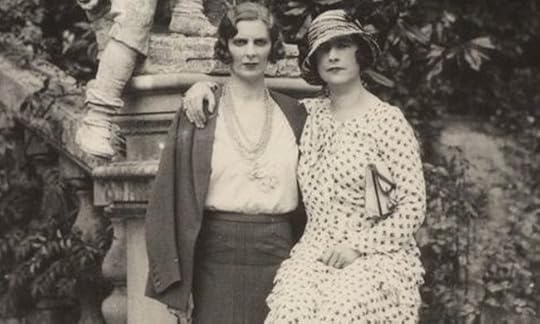
Vita e Violet.
Vita e Violet si conobbero quando la prima aveva dodici anni e la seconda dieci. Quattordici anni dopo quel primo incontro capirono che la loro amicizia includeva anche una forte attrazione fisica. La loro storia non durò a lungo, tre anni duranti i quali arse “vivida e rovinosa”.
Entrambe sposate, decisero di abbandonare tutti e tutto, trasferirsi in Francia e vivere il loro amore. Ma furono raggiunte dai rispettivi mariti che a fatica riuscirono a terminare la loro storia e farle tornare nell’ambito familiare.
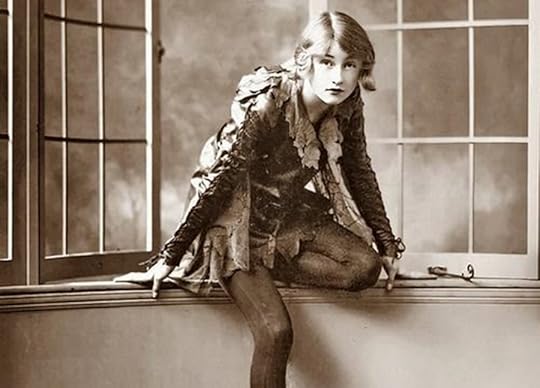
Violet da ragazza.
Amore breve, intenso, pieno di passione, e anche sofferenza, bruciato in un lasso di tempo ben più breve di quello necessario alla costruzione della loro storia. Il titolo è quanto di più dichiarato si possa immaginare, la ‘sfida’ fu al mondo intero. Ma prima di scegliere questo, Vita avrebbe anche optato per ‘Rebellion’, che non mi sarebbe parso da meno.
Scritto nel periodo del pieno amore con Violet durante i vagabondaggi francesi, convinse in pieno Violet che spingeva per la pubblicazione immediata. Ma Vita si lasciò fermare dalle pressioni familiari e soprattutto da quell'amica che le chiese: “Se Violet fosse morta, lo pubblicheresti?”. Vita leggeva a Violet ogni sera le pagine scritte durante il giorno, e Violet si permetteva di correggere: il testo finale è quindi fedele al sentimento di entrambe.
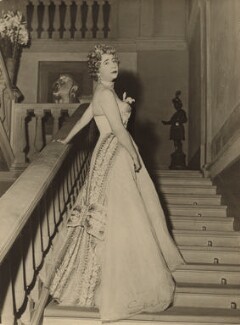
Un’altra immagine di Violet Trefusis nata Keppel, qui un po’ di anni dopo.
In queste pagine Violet diventa Eve e Vita diventa Julian, il quale Julian è probabilmente l’uomo che Vita avrebbe sempre voluto essere. L’azione è spostata più a sud della Francia, nel Mediterraneo e soprattutto in una Grecia alquanto immaginaria. Donne che precorrono i tempi. O forse, invece, donne che vivono appieno il loro tempo perché personaggi femminili con questo senso di indipendenza e libertà, con questo coraggio e determinazione di vivere fino in fondo le proprie scelte, per quanto fortemente osteggiati all’epoca, non erano insoliti, soprattutto nel mondo artistico.
Mi sono permesso di intitolare questo mio commento parafrasando l’assurdo titolo italiano di un altro romanzo di Sackville-West che ho letto, Il signore scostumato, che nell’originale è invece Easter Party.
I couldn't get into the style and the story. (I abandoned it just before meeting between the two main characters, I think).
It was my first try with Vita Sackville-West's book. I will try another of her, perhaps it was not a good choice for the first encounter with her prose.
Vita Sackvile-West is a wonderful writer; her letters, novels (that I’ve read), and autobiography are all fascinating and well written and, more impressively, feature her originality and her verve in abundance.
I knew the backstory of “Challenge” before I read it: it’s a fictionalized account of her and Violet’s affair which was quite scandalous by 1920’s standards. In life, both women left their husbands to be together; Vita wrote “Challenge” when she was with Violet, who edited the book for her.
I see traces of Vita in the fictional Julian here, and I recognize Violet in Eve; some of the things her character says seems right out of Violet’s letters to Vita.
Yet “Challenge” manages to be achieve the distinction of being the only thing I’ve ever encountered of Vita which is dull. The book is just not that interesting, which is a shame as the real story of Vita and Violet is bold, provocative, heartbreaking, and unique. “Challenge” is none of these things. Vita’s non-fiction account of this relationship, included in “Portrait of a Marriage,” is a far more compelling version than this novel. This is definitely a case of the truth being more strange- and riveting- than fiction.
genuinely felt my heart break at the end of this. i know the place from which it was written. a complex and nuanced and honest insight into how it feels to be in love, and for things not to workout. this will stay w me for a while: heartsore
Intended as ‘a romantic adventure story’, Challenge was Vita Sackville-West’s second work of fiction and was completed in 1920. It follows her first novel, Heritage, which had ‘met with unusual acclaim’ according to her son. Due to personal turmoil – the author’s affair with Violet Trefusis reaching its ‘peak’ – however, Challenge was not published in the United Kingdom until 1974, ‘for fear of the scandal it would cause’. It has recently been reprinted by Virago.
The novel itself is semi-autobiographical. Echoes of both Violet and Vita are realised in the characters of Eve and Julian respectively. Challenge, according to Nigel Nicolson, was essentially Sackville-West’s ‘declaration of defiance… She wished to publish it as a memorial to what she had endured, as her statement of what love could and should be’.
The novel takes place upon a fictional Greek island named Herakleion, which is peopled by a ‘diplomatic, indigenous, and cosmopolitan society’. It is ‘a little place’ where ‘one forgets that one is not at the centre of the world’. Challenge opens with a character named Madame Lafarge and her daughter Julie, neither of whom are central characters. Instead, Sackville-West has used them to give an overview of the historical and political background to ‘the Islands’.
Julian Davenport and his father, William, are soon introduced. Despite his current studies at Oxford University, Julian was raised on the island and likes to think he knows the ins and outs of the society around him. He is a very privileged young man, just nineteen years old when the novel begins and ‘no longer permitted to be a boy’. The Davenport family ‘for three generations had been the wealthiest in the little state’. A rather old-fashioned uncle of Julian’s tells him rather patronisingly: ‘You don’t belong there, boy… You’re English. Bend the riches of that country to your own purpose… Impose yourself. Make ‘em adopt your methods. That’s the strength of English colonisation’.
This edition includes an introduction by author Stella Duffy, as well as the original foreword written by Sackville-West’s son, Nigel Nicolson, which was first added to the book in 1974. Duffy believes that ‘in many ways, Sackville-West has written a classic Greek drama’. In her introduction, she also states that she sees the main protagonists in the following way: ‘Eve as all-knowing, all-entrancing femme and Julian as passionate, political butch’. Julian believes Eve to be ‘spoilt, exquisite, witty… detached from such practical considerations as punctuality, convenience, [and] reliability’, whilst Eve concurrently views Julian with the utmost disinterest.
The third person omniscient narrative is split into three different sections, one of which follows Julian and another, Eve. The storyline itself is weighted down by political occurrences and social beliefs, and is also rather heavy with regard to the historical context. The account of the love which occurs between Julian and Eve is built up rather too gradually, and their tale is often sadly overshadowed by the context in which it takes place.
Sackville-West’s prose is rich and descriptive from the outset, and she is certainly at her best when describing the lush scenery of the island, which becomes a character in itself. Her character descriptions are inventive – Julian’s ‘black wavy hair grew straight back, smoothed to the polish of a black greyhound’, Madame Lafarge’s bust is ‘generously furnished’, her husband is ‘majestically bearded’ and another man has a ‘wrinkled saffron face’.
Despite, or perhaps due to, the prose style, however, the novel is rather difficult to get into. Some of the conversations throughout seem a little disjointed, particularly when important comments are made by one character and ignored by another.
To conclude, Challenge is unfortunately a rather disappointing novel. Sackville-West is at her best when writing about England with its vast expanses of countryside and grand estates, and not of a country which she has never visited. There is not the same sense of wonder or similar dazzling prose which fills novels such as All Passion Spent and Family History. It is a real shame, but Challenge seems to be lacking in something fundamental.
It was slow for me to get into, with all the fictional politics set up, but Jesus. Once it gets going. I’ve never read something so spot on about evil all consuming infatuation. I’m in love with Eve I think, and filled with guilt because of it. So clearly written by a woman about a woman. So intense and so doomed. The relationships between characters was so well written. The hypocrisy the whole way through. True the politics of the fictional Greek island was boring, but worth it for the angst. And the clothes imagery???? Stunning. Like I could feel the silk. Ugh!
Could not get into this at all. Pretentious writing and nothing that grabbed my interest over the first 100 pages, so I gave up. Shame as I really enjoyed The Edwardians and All Passion Spent.
Perhaps not Sackville-West's best novel, but still intriguing nonetheless. I found the setting and politics somewhat bemusing, but I'm not sure how much that matters, as I think the islands represent what? - ideals generally? This book seems to be an attempt to depict the interplay of a love that transgresses the accepted societal codes of behaviour in relation to the political struggles for change and a better world. The novel is also critical of British colonialism.
Eve ultimately seems unable to thrive in the world as it is, with its inequalities, restrictions on human relationships and turmoil, yet she does not strive to oppose them. Her jealousy is ultimately a fatal flaw. The character of Kato seems to reference Sackville-West's own ancestral link with Pepita de Oliva, her grandmother, who was a Romani Spanish dancer - her effect upon Julian is 'that he felt himself again completely a citizen of Herakleion; that he felt himself, in fact, closer than ever before to the beating heart of intrigue and aspiration' (chapter III)
For me, the best bits of this novel were an arresting response of one of the main characters to a death and the descriptions of Eve, which have spark and vitality in them.
I thought the references to drowning were poignant in the light of Sackville-West's lover, Virginia Woolf's death in 1941.
The main problem with Challenge – is that apart from one of two rare moments of interest, it is unremittingly dull. Vita Sackville West is definitely at her best writing about the English society she was a part of. While Challenge does have an autobiographical element – in the relationship between the two central characters – I just felt there was less of Vita in the novel than I had expected. Vita did however write herself into this novel in the character of Julian – while Violet Trefusis; the woman with whom she had a relationship, and eloped to France with, is reproduced in the character of Eve. The descriptions of Eve in the novel – sounds very Violet Trefusis like. Challenge – the title apparently coming from the challenge it is to dare to love – is set on a fictional Greek Island, Herakleion. Herakleion is inhabited by an odd mixture of people, governed by a mix of indigenous people, and a cosmopolitan group of diplomats. One of the main families on Herakleion are the Davenants, Julian the son of one brother, Eve the daughter of the other.
Well, that will teach me to read the foreword. The book mirrors the passion between Vita Sackville West and her childhood friend Violet Keppel, so I was waiting for passion and scandal. Which happens mostly in the last 100 pgs. Actually the last 20 are really intense. I can't help thinking that Eve, the heroin, is a pain. She is so jealous she is even jealous of her lover's ideals. He should only think of her. But it was a bit hard for me to read, the style is a bit old fashioned and the print very small.
I keep thinking someday I'll find another one of Vita's novels I'll actually like (other than All Passion Spent). This one, alas, was not it -- the lovely descriptive prose didn't make up for the unlikely plot and unlikeable characters.
I didn't appreciate this book very much. Perhaps I was too influenced by the fact that everywhere this novel is spoken of as the story of the love affair between Vita Sackwille-West and Violet Trefusis. In reality, in the novel the love affair, heterosexual, is very marginal and the setting and the political and diplomatic history of an invented island in Greece take over everything else in the plot. I found everything rather boring: the setting, the series of diplomats who are the main group of characters, the two main characters, the story of the rebellion of the invented island of Aphros. I also don't understand how this novel could cause a scandal in the twenties (it is said that this is the reason why it was not published until 1974).
Nick Carraway says of Daisy and Tom Buchanan that:"They smashed up things and creatures and then retreated back into their money or their vast carelessness..". The two main characters in this story wallow in a sense of entitlement : one a naive idealist the other (and more loathsome) vain, selfish and jealous. Like Daisy and Tom no thought for the lives that their self possession destroyed only their own self pity.
J'ai eu du mal à continuer la lecture au début mais à partir de la 2e partie les évènements s'accélèrent et les péripéties ont ravivé mon intérêt. Les dialogues sont très bien écrits. La tension, les disputes, les jeux de séduction entre Julian et Ève sont délicieux. La 3e partie est brillante, peut-être un peu précipitée, mais si tragique et belle. C'est un vrai drame grec.
Vita Sackville-West was apparently too much under the influence of her erratic affair with her intense (eve ) to realize that her novel is not as good as she thinks ... the fantastic background and politics and the disguised love affair itself are not interesting or even cohesive .
She is a good storyteller and a better writer than Virginia Woolf. It is a love story set in Greece with the character of Julian patterned on Lord Byron.
Finished reading: Challenge / Vita Sackville-West ... 19 September 2015 ISBN: 9781844087655 Copyright 1924; V.S-W's second novel.
In his Foreward of 1974 (the year the novel was first published in Britain), Nigel Nicolson, son of V.S-W, is quite clear that the novel is about the affair of V.S-W and Violet Trefusis, with Julian modelled somewhat on V.S-W and Eve more closely on Violet. The setting, of course, is quite different, in Herakleion, a fictional country near Greece, whose off-shore islanders, with more of an Italian history, wish to secede.
The writing is beautiful, the basic plot interesting. But the characters Julian and Eve ..... Julian has his ideals to support the islanders but otherwise they are two self-centred individuals, to the point of self-obsession in the case of Eve. The only reason I kept reading was to find out what happened to the islanders because if Julian or especially the vile Eve crossed your path you wouldn't give them time of day. The vast majority of the book was about Julian and Eve and their relationship. All the action of the revolution was limited to the very end, and even then, in Eve's mind, it was all about Eve.
If you want to read beautiful prose, find another example. Life is too short, books too many, to waste time on this. Very glad I bought it from a bargain table and didn't pay full price!