

What do you think?

If the River is Hidden
'If the River is Hidden' charts the journey of two writers from the source to the mouth of the Bann, Northern Ireland’s longest river. Through a dialogue of prose and poetry the history, landscape and divisions that have come to define the North are explored and challenged. With backgrounds from each side of the sectarian divide, theirs is a journey of uncovering a sense of place and of searching for meaning; a reshaping of the authors' own memories, experiences and expectations. For like the river, it is not just what is visible, but what is hidden, that comes to define us.
128 pages, Paperback
Published November 24, 2022
Ratings & Reviews
Friends & Following
Create a free account to discover what your friends think of this book!
Community Reviews
Displaying 1 - 9 of 9 reviews
May 22, 2023
A River Runs Through Northern Ireland
Review of the époque press paperback edition (November 24, 2022).
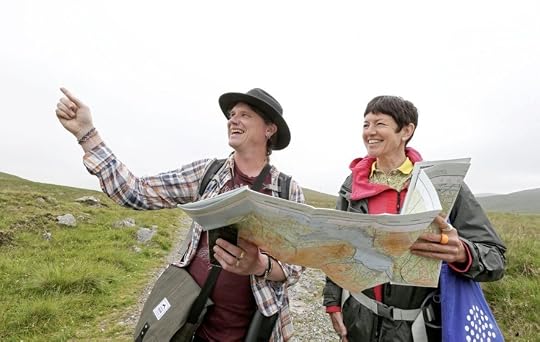
The co-authors plotting their walking trail on the River Bann. Photograph by Hugh Russell for the Irish News (link below).
If the River is Hidden records a dual memoir in prose and poetry by writers Cherry Smyth and Craig Jordan-Baker of an 8-day trek which they undertook in a journey of discovery of their Northern Irish heritage. Poet and documentarian Smyth left Northern Ireland over 40 years ago (during the Troubles) and has lived and worked out of London ever since. Novelist and educator Jordan-Baker had a grandfather from Northern Ireland who had emigrated as well. I enjoyed Jordan-Baker's novel The Nacullians (2020) several years ago, also through the Republic of Consciousness Book of the Month Club.
The River Bann (the name is derived from the Irish An Bhanna, the Goddess) traverses Northern Ireland from its source in the south-east to its mouth in the north-west and is 89 kilometres long (129 if you count the lake Lough Neagh which splits the journey. The authors crossed the lake in an eel-boat.
This was a lyrical journey where the prose and poetry merged seamlessly to tell the story of both the journey and authors' own pasts and those of their families. Presumably Smyth wrote the poetry and Jordan-Baker the prose, but at times it is certainly Smyth speaking during the prose segments so there is some blurring of the borders.
I enjoyed the book for both its blending of genres and for its method of discovering one's heritage by a physical journey through its landscape.
I read If the River is Hidden as the February 2023 selection from the Republic of Consciousness Book of the Month (BotM) club. Subscriptions to the BotM support the annual Republic of Consciousness Prize for small independent publishers.
Soundtrack
époque press commissioned a musical composition by flautist Eimear McGeown to accompany If the River is Hidden which you can listen to here.
Trivia and Links
The co-authors were interviewed by the Irish News during their journey and the article with several photographs by Hugh Russell can be seen here by Claire Simpson, Irish News, July 5, 2021.
Read more about the River Bann on Wikipedia here.
Review of the époque press paperback edition (November 24, 2022).
He tells her he wants to stick to using physical maps, to enjoy the working out of the path and the working round of the river. To embrace the uncertainty inherent in not having your position geolocated by dozens of satellites in near-earth orbit. Uncertainty, it seems to them both, is key. For why go on a journey of discovery if you both know exactly where you are, know exactly which degrees of longitute and latitude will constitute where you end up?
The co-authors plotting their walking trail on the River Bann. Photograph by Hugh Russell for the Irish News (link below).
If the River is Hidden records a dual memoir in prose and poetry by writers Cherry Smyth and Craig Jordan-Baker of an 8-day trek which they undertook in a journey of discovery of their Northern Irish heritage. Poet and documentarian Smyth left Northern Ireland over 40 years ago (during the Troubles) and has lived and worked out of London ever since. Novelist and educator Jordan-Baker had a grandfather from Northern Ireland who had emigrated as well. I enjoyed Jordan-Baker's novel The Nacullians (2020) several years ago, also through the Republic of Consciousness Book of the Month Club.
The River Bann (the name is derived from the Irish An Bhanna, the Goddess) traverses Northern Ireland from its source in the south-east to its mouth in the north-west and is 89 kilometres long (129 if you count the lake Lough Neagh which splits the journey. The authors crossed the lake in an eel-boat.
This was a lyrical journey where the prose and poetry merged seamlessly to tell the story of both the journey and authors' own pasts and those of their families. Presumably Smyth wrote the poetry and Jordan-Baker the prose, but at times it is certainly Smyth speaking during the prose segments so there is some blurring of the borders.
I enjoyed the book for both its blending of genres and for its method of discovering one's heritage by a physical journey through its landscape.
I read If the River is Hidden as the February 2023 selection from the Republic of Consciousness Book of the Month (BotM) club. Subscriptions to the BotM support the annual Republic of Consciousness Prize for small independent publishers.
Soundtrack
époque press commissioned a musical composition by flautist Eimear McGeown to accompany If the River is Hidden which you can listen to here.
Trivia and Links
The co-authors were interviewed by the Irish News during their journey and the article with several photographs by Hugh Russell can be seen here by Claire Simpson, Irish News, July 5, 2021.
Read more about the River Bann on Wikipedia here.

March 3, 2023
Is it the same thing that convinced Craig to take a journey through a homeland he can’t quite claim and I can’t quite renounce?
The February Republic of Consciousness Book of the Month.
If the River is Hidden is co-authored by poet Cherry Smyth and novelist Craig Jordan-Baker, author of the wonderfully quirky The Nacullians, published, as with this book, by époque press "an independent publisher based between Brighton, Dublin and New York. Established to promote and represent the very best in new literary talent."
This is however a non-fiction book, although with a distinct literary style, and a very different feel to The Nacullians. Smyth, Antrim born but who moved to London in the 1980s, and Jordan-Baker, brought up in Brighton, but with an Irish grandfather, embark on a quest to walk along the River Bann:
It was on the day after the summer solstice that they set out to walk the eighty-three miles from the source of the Bann to its mouth. This is the way that they went:
North and northeast from Deer's Meadow, the nebulous source of the river.
Through Katesbridge, a frost hollow where cool air creeps down, the coldest place in Ireland.
Through Banbridge town in the County Down, where the river snakes through Solitude Park and the bunting red, white and blue flickers true.
By Portadown, where a new emotion was found.
Up towards Bannfoot, where the river's upper course washes into Lough Neagh.
And then over Lough Neagh, where a silent landscape sits underwater.
Through Toome, where brickworks gouged clay from the Bann, and where the Tricolour flies.
And past Portglenone, where the Bann is broad and black.
Through Bendooragh, where they can remember little.
And to Portstewart, home of the mouth.
These were the places they were to pass on their way to the Atlantic. These were the names that staged their pilgrimage. These were the days that shortened their path.
The lyrical narration of their walk alternates between Jordan-Baker's prose and Smyth's poetry/broken prose, with a prologue and epilogue written in the third person (with them as 'he' and 'she'). The publisher's website also provides a composition by flautist Eimear McGeown, specially commissioned to accompany the novel.
The descriptions of the landscape are combined with an exploration of community, belonging and sense of place, with the sectarian divides of the Troubles a frequent companion.
Cherry becomes attuned to the different kinds of muck and shite that dance about the air in great sultry wafts. 'Smells like pig; she says of the airslurry around a concrete shed near Gilford. 'Ah, that's cow,' she will note, as a breeze blows down off the high fields of Bendooragh.
I wonder about a cartographic possibility. A mid-Ulster map of smells, cut through with tones of brown and tan, flexing over the landscape. As well as borders drawn by county and constituency, and borders etched by river and mountain, there would also be borders of the air: County Muck, Steve Slurry, West Nosefast. These places would never settle and everyone would have to accept they could not hold down the provinces of the air.
Impressively written if not my normal literary fare - 4 stars for merit although closer to 3 for personal taste.
The February Republic of Consciousness Book of the Month.
If the River is Hidden is co-authored by poet Cherry Smyth and novelist Craig Jordan-Baker, author of the wonderfully quirky The Nacullians, published, as with this book, by époque press "an independent publisher based between Brighton, Dublin and New York. Established to promote and represent the very best in new literary talent."
This is however a non-fiction book, although with a distinct literary style, and a very different feel to The Nacullians. Smyth, Antrim born but who moved to London in the 1980s, and Jordan-Baker, brought up in Brighton, but with an Irish grandfather, embark on a quest to walk along the River Bann:
It was on the day after the summer solstice that they set out to walk the eighty-three miles from the source of the Bann to its mouth. This is the way that they went:
North and northeast from Deer's Meadow, the nebulous source of the river.
Through Katesbridge, a frost hollow where cool air creeps down, the coldest place in Ireland.
Through Banbridge town in the County Down, where the river snakes through Solitude Park and the bunting red, white and blue flickers true.
By Portadown, where a new emotion was found.
Up towards Bannfoot, where the river's upper course washes into Lough Neagh.
And then over Lough Neagh, where a silent landscape sits underwater.
Through Toome, where brickworks gouged clay from the Bann, and where the Tricolour flies.
And past Portglenone, where the Bann is broad and black.
Through Bendooragh, where they can remember little.
And to Portstewart, home of the mouth.
These were the places they were to pass on their way to the Atlantic. These were the names that staged their pilgrimage. These were the days that shortened their path.
The lyrical narration of their walk alternates between Jordan-Baker's prose and Smyth's poetry/broken prose, with a prologue and epilogue written in the third person (with them as 'he' and 'she'). The publisher's website also provides a composition by flautist Eimear McGeown, specially commissioned to accompany the novel.
The descriptions of the landscape are combined with an exploration of community, belonging and sense of place, with the sectarian divides of the Troubles a frequent companion.
Cherry becomes attuned to the different kinds of muck and shite that dance about the air in great sultry wafts. 'Smells like pig; she says of the airslurry around a concrete shed near Gilford. 'Ah, that's cow,' she will note, as a breeze blows down off the high fields of Bendooragh.
I wonder about a cartographic possibility. A mid-Ulster map of smells, cut through with tones of brown and tan, flexing over the landscape. As well as borders drawn by county and constituency, and borders etched by river and mountain, there would also be borders of the air: County Muck, Steve Slurry, West Nosefast. These places would never settle and everyone would have to accept they could not hold down the provinces of the air.
Impressively written if not my normal literary fare - 4 stars for merit although closer to 3 for personal taste.

December 31, 2022
I have got to find the river
Bergamot and vetiver
Run through my head and fall away
Leave the road and memorize
This life that pass before my eyes
And nothing is going my way
While I was reading If the River is Hidden, this quote from R.E.M.’s song Find the River kept going round my head. Given the book’s ‘plot’ I think it’s apt.
The journey is an important feature in literature as the act of travelling provides a from of enlightenment from The Odyssey to The Road the act of a pilgrimage in order to realise oneself is topic which is equally poignant and interesting. If the River is Hidden fulfils these points delightfully.
Cherry Smyth and Craig Jordan-Baker are on a quest to follow the River Bann, which is the longest river in Northern Ireland. The historical influence of this river cannot be overlooked: not only does it flow into both catholic and protestant areas of Northern Ireland, thus forming a dividing line. It also has other uses ranging from scenic spot to industrial use. It’s not an easy one to follow as there are some obstacles.
By following the river both Cherry Smyth and Craig Jordan-Baker are breaking those divides and traversing into different lands. I also saw this journey as one to rediscover one’s roots as there are quite a few passage which have a nostalgic feel to them. Like how the river has an identity, both authors are searching for one as well. As the authors continue with their trip, it becomes clear that they metaphorically become one with the river and coupled with the voyages into the past, life is given some sort of meaning.
It’s worth noting that Craig Jordan-Baker has also written the novel The Nacullians which is also based in the North, however whereas that book was about the grittier, industrial side, here we have a pastoral side as both authors co-write their views as they navigate through nature.
The writing is sparse but that does not mean it is devoid of beauty. Like all good travelogues it is a snapshot of a time and place and involves the reader in the process.
If the River is Hidden is published by époque, who are no stranger to incorporating nature in their books but rather than brutal farmlands , the language of trees or the habits of Indonesian fauna , this is a more personal account with an added historical angle, which makes it a bit different. I found the book interesting and thought provoking and a sign that époque are not afraid to experiment and take their books to different territories.
Bergamot and vetiver
Run through my head and fall away
Leave the road and memorize
This life that pass before my eyes
And nothing is going my way
While I was reading If the River is Hidden, this quote from R.E.M.’s song Find the River kept going round my head. Given the book’s ‘plot’ I think it’s apt.
The journey is an important feature in literature as the act of travelling provides a from of enlightenment from The Odyssey to The Road the act of a pilgrimage in order to realise oneself is topic which is equally poignant and interesting. If the River is Hidden fulfils these points delightfully.
Cherry Smyth and Craig Jordan-Baker are on a quest to follow the River Bann, which is the longest river in Northern Ireland. The historical influence of this river cannot be overlooked: not only does it flow into both catholic and protestant areas of Northern Ireland, thus forming a dividing line. It also has other uses ranging from scenic spot to industrial use. It’s not an easy one to follow as there are some obstacles.
By following the river both Cherry Smyth and Craig Jordan-Baker are breaking those divides and traversing into different lands. I also saw this journey as one to rediscover one’s roots as there are quite a few passage which have a nostalgic feel to them. Like how the river has an identity, both authors are searching for one as well. As the authors continue with their trip, it becomes clear that they metaphorically become one with the river and coupled with the voyages into the past, life is given some sort of meaning.
It’s worth noting that Craig Jordan-Baker has also written the novel The Nacullians which is also based in the North, however whereas that book was about the grittier, industrial side, here we have a pastoral side as both authors co-write their views as they navigate through nature.
The writing is sparse but that does not mean it is devoid of beauty. Like all good travelogues it is a snapshot of a time and place and involves the reader in the process.
If the River is Hidden is published by époque, who are no stranger to incorporating nature in their books but rather than brutal farmlands , the language of trees or the habits of Indonesian fauna , this is a more personal account with an added historical angle, which makes it a bit different. I found the book interesting and thought provoking and a sign that époque are not afraid to experiment and take their books to different territories.

April 3, 2023
“The road removes us.
The river invites us back
to time’s deep body.”
Make it a mini-string in my reading now of books showing us the wandering mind, displaying the associations and memories it dredges up from that bottomless disembodied consciousness that flows, rises, and dips within us, somehow contained within the banks of our lobes, in dialogue with external stimuli.
Two Sherpas did so through fiction; If the River is Hidden does so through travelogue and poetry. While this is a physical journey for the authors along the course of the River Bann, in the written word it is a mental journey that rewards a willingness to relax into language and follow the wandering course that presents itself.
Reportage and pedestrian facts are disempowered. Of Portadown, generally known for being the site of the most contentious of the yearly Orange Order provocations, it is merely written that “there’s something here that feels different. It feels, well, Portadown.” Not enlightening from an information-seeking point of view, but redress is offered in the poetic line that Portadown is not dissimilar to other towns “where ugliness and utility share the same toothbrush.”
Poetry and prose are throughout intermingled to produce a lyrical account of the landscape (generally stinking of animal shit) and the mental activity sparked in the two writers, answering affirmatively the question “Can this be an Irish poem?” It is so when in conversation with The Táin: From the Irish Epic Táin Bó Cúailnge, noting that “the Pangs of Ulster are different today”, and in noting the mental states of one’s companion, how “he hums the dark hedges inside himself.”
Approaching this work from the proper point of view is important; knowing little about it when I received it as part of my Republic of Consciousness monthly subscription, spurred to read it fairly immediately by my inordinate lifelong interest in the north of Ireland/Northern Ireland, I did not at first and needed to reorient. Having done so, it is a delightful way to pass a bit of time.
The river invites us back
to time’s deep body.”
Make it a mini-string in my reading now of books showing us the wandering mind, displaying the associations and memories it dredges up from that bottomless disembodied consciousness that flows, rises, and dips within us, somehow contained within the banks of our lobes, in dialogue with external stimuli.
Two Sherpas did so through fiction; If the River is Hidden does so through travelogue and poetry. While this is a physical journey for the authors along the course of the River Bann, in the written word it is a mental journey that rewards a willingness to relax into language and follow the wandering course that presents itself.
Reportage and pedestrian facts are disempowered. Of Portadown, generally known for being the site of the most contentious of the yearly Orange Order provocations, it is merely written that “there’s something here that feels different. It feels, well, Portadown.” Not enlightening from an information-seeking point of view, but redress is offered in the poetic line that Portadown is not dissimilar to other towns “where ugliness and utility share the same toothbrush.”
Poetry and prose are throughout intermingled to produce a lyrical account of the landscape (generally stinking of animal shit) and the mental activity sparked in the two writers, answering affirmatively the question “Can this be an Irish poem?” It is so when in conversation with The Táin: From the Irish Epic Táin Bó Cúailnge, noting that “the Pangs of Ulster are different today”, and in noting the mental states of one’s companion, how “he hums the dark hedges inside himself.”
Approaching this work from the proper point of view is important; knowing little about it when I received it as part of my Republic of Consciousness monthly subscription, spurred to read it fairly immediately by my inordinate lifelong interest in the north of Ireland/Northern Ireland, I did not at first and needed to reorient. Having done so, it is a delightful way to pass a bit of time.

January 10, 2024
A beautiful read and I highly recommend listening to the audiobook as well!
November 8, 2025
I would say it wasn’t perfect… but it was damn inspiring. A book that makes me want to not only replicate the premise (to walk a river!!!) but read it again; this is a book that’s found its place in the heart of a headless beast - E. A.. So insightful. Although it could have been more ecological like The Flow or gone more atavistic like Some of Us Just Fall, it percolates and flourishes in the way (like Dalloway or The Road (salmon are an enduring metaphor)) that characters blend into one. You decide when someone is someone else and so we question boundaries, identity and story in every word. Its a highly engaging torrent that peters into a rivulet and lets you think. Although maybe you could argue underneath is a torrent held back.
March 29, 2023
I was reading the book chapter by chapter to savour it.
Slow reading is a different kind of pleasure for some books
than in-one-go. I’m sure, I’l read it all again anyway.
It’s exceptionally well written, Cherry's especially but Graig’s too in a different way.
Smyth's command of language is superb.
And her sharpness:
“If the river is hidden, so is what enters it.”
“Don’t live in a body if you can’t face getting old.”
“…the hundred Protestants thrown into the river,
shot till they stilted…”
“We’re learning where Irish and English meet…
at the metal edge of the tongue’s border.”
And so much more.
Graig Jordan-Baker’s voice soft, tender, human is very engaging. That boy has soul.
Overall, I connected more with the personal and/or political
aspects of both their writings rather than the parts referring to the land.
(I did wonder though how those parts would resonate for me if the names were Argos Orestiko, Kastoria, Aliakmonas river etc)
Warmest congratulations to both, a very original project!
Slow reading is a different kind of pleasure for some books
than in-one-go. I’m sure, I’l read it all again anyway.
It’s exceptionally well written, Cherry's especially but Graig’s too in a different way.
Smyth's command of language is superb.
And her sharpness:
“If the river is hidden, so is what enters it.”
“Don’t live in a body if you can’t face getting old.”
“…the hundred Protestants thrown into the river,
shot till they stilted…”
“We’re learning where Irish and English meet…
at the metal edge of the tongue’s border.”
And so much more.
Graig Jordan-Baker’s voice soft, tender, human is very engaging. That boy has soul.
Overall, I connected more with the personal and/or political
aspects of both their writings rather than the parts referring to the land.
(I did wonder though how those parts would resonate for me if the names were Argos Orestiko, Kastoria, Aliakmonas river etc)
Warmest congratulations to both, a very original project!

February 11, 2024
“To say that the river is just a river or that that piece of land is just land seeks reduction: just a pile of rock, an old tree, a hill, a flag, a colour, a date. In a place like this, a place with a history of violence, it’s obvious we would wish for ‘just.’”
Two writers walk down the Bann, Ireland’s longest river, from source to mouth. They write poetry and prose about the journey, the land, its history and its conflict.
A beautiful, evocative story, to be read in mouthfuls; it’s too dense, too rich, to swallow in one gulp. In between bites I brush the softly purring cat, digesting what I’ve read. It’s a tale of acceptance of the sad history of the land, of the river. The writers are from two traditions, ancient and recent enemies, the orange and the green, but united in celebration of the journey. A good book.
Two writers walk down the Bann, Ireland’s longest river, from source to mouth. They write poetry and prose about the journey, the land, its history and its conflict.
A beautiful, evocative story, to be read in mouthfuls; it’s too dense, too rich, to swallow in one gulp. In between bites I brush the softly purring cat, digesting what I’ve read. It’s a tale of acceptance of the sad history of the land, of the river. The writers are from two traditions, ancient and recent enemies, the orange and the green, but united in celebration of the journey. A good book.

May 15, 2023
With water being naturally reflective, the journey that Craig Jordan-Baker and Cherry Smyth took along the Bann served as the perfect impetus for an exploration of place and identity.
Displaying 1 - 9 of 9 reviews