Jump to ratings and reviews
Rate this book

First Impressions: A Novel of Old Books, Unexpected Love, and Jane Austen

Rate this book
A thrilling literary mystery co-starring Jane Austen from the New York Times bestselling author of The Bookman’s Tale

Charlie Lovett first delighted readers with his New York Times bestselling debut, The Bookman’s Tale. Now, Lovett weaves another brilliantly imagined mystery featuring one of English literature’s most popular and beloved authors: Jane Austen.

Book lover and Austen enthusiast Sophie Collingwood has recently taken a job at an antiquarian bookshop in London when two different customers request a copy of the same obscure book: the second edition of Little Book of Allegories by Richard Mansfield.  Their queries draw Sophie into a mystery that will cast doubt on the true authorship of Pride and Prejudice—and ultimately threaten Sophie’s life.

In a dual narrative that alternates between Sophie’s quest to uncover the truth—while choosing between two suitors—and a young Jane Austen’s touching friendship with the aging cleric Richard Mansfield, Lovett weaves a romantic, suspenseful, and utterly compelling novel about love in all its forms and the joys of a life lived in books.

308 pages, Hardcover

First published October 16, 2014

257 people are currently reading
9067 people want to read

About the author

Charlie Lovett

29 books1,069 followers
I was born in Winston-Salem, NC and grew up as the child of an English professor. We spent our summers in the rural North Carolina mountains, so I felt an early affinity for the countryside. I was educated at Summit School, Woodberry Forest School (VA), and Davidson College (NC) and in 1984 went into the antiquarian book business with my first wife, Stephanie. About the same time I began to seriously collect books and other materials relating to Lewis Carroll, author of Alice’s Adventures in Wonderland.

When I left the book business in the early 90s, I continued to be a book collector, and now have a large (and growing) collection of rare (and not so rare) books and artifacts connected to Lewis Carroll and his world.

In 1997 I received my MFA in Writing from Vermont College (now Vermont College of Fine Arts). During my work on this degree I researched and wrote Love, Ruth, a book about my mother, Ruth Candler Lovett, who died when I was two years old. Maya Angelou called the book “tender, sensitive, and true.”

After completing my MFA, I traveled with my wife, Janice, and daughter, Jordan, to England where we lived for six months in Kingham, Oxfordshire. We immersed ourselves in the culture and made lifelong friends. Ten years later, we purchased the cottage we had rented in 1997 and renovated it. My wife and I now spend about 6–8 weeks a year in Kingham, and have traveled extensively throughout the UK.

In 2001, my wife was hired to oversee the third grade drama program at Summit School. Bemoaning the dearth of good material, she asked if I would write a play. Thus began my career as a children’s playwright. For eleven years, as Writer-in-Residence, I wrote plays for third graders and for eighth and ninth graders. Nineteen of my plays have been published and have proved extremely popular and have seen over 3500 productions in all fifty states and more than 20 foreign countries.

During all my years as a writer, I have worked on writing fiction. I wrote my first novel-length manuscript in the early 1990s and, with luck, it will never see the light of day, but it did prove to me that I could write a book-length work of fiction. In 2008, my novel The Program, about an evil weight loss clinic, was published by the micro-press Pearlsong Press, which later published my YA novel The Fat Lady Sings.

But my big break-through as a writer came when I put together two of my passions—rare books and the English countryside—to write The Bookman’s Tale. It was a New York Times bestseller, a Barnes and Noble Recommends selection, and has been translated into several foreign languages. Parade Magazine called the book “[A] delightful tale of love and bibliophilia.”

My next novel, First Impressions, is another literary adventure, this one starring Jane Austen. People Magazine called it “a delightful novel that weaves together a modern love story and a literary mystery involving Jane Austen.”

2015 was a busy year for me, being the 150th anniversary of the publication of Alice’s Adventures in Wonderland. I curated a major exhibition called Alice Live! at the New York Public Library for Performing Arts at Lincoln Center. I spoke at the international gathering of Carroll enthusiasts in New York and wrote the introduction to the new Penguin Books edition of Alice. 2016 also saw the publication of my Christmas book, The Further Adventures of Ebenezer Scrooge, which USA Today called “[a] clever, merry, and, yes, convincingly Dickensian reimagining of this Victorian tale.”

My new novel, The Lost Book of the Grail, will be published on February 28, 2017. Set in an English cathedral library, and reaching through centuries of English history, it tells the story of bibliophile and Holy Grail enthusiast Arthur Prescott as he works to uncover a centuries-old secret about the cathedral’s history.

None of this could have happened without the support and love of my wonderful wife, Janice, and my fabulous children, Jimmy and Jordan.

Ratings & Reviews

What do you think?
Rate this book

Friends & Following

Create a free account to discover what your friends think of this book!

Community Reviews

5 stars
1,288 (19%)
4 stars
2,618 (39%)
3 stars
1,985 (29%)
2 stars
629 (9%)
1 star
136 (2%)
Displaying 1 - 30 of 1,278 reviews
Profile Image for Diane.
1,117 reviews3,198 followers
January 25, 2015
This novel is ridiculous. The writing could be cliched and cringe-worthy, and I came close to abandoning the book several times. If the story had not involved Jane Austen I would not have finished it.

Despite these irritations, there were a few things I liked about "First Impressions." It opens in 1796 in Hampshire, with Jane Austen meeting Richard Mansfield, an elderly clergyman. Eventually the two become good friends, sharing ideas about books and literature. We see the fictional version of Jane becoming more confident as a writer, and sharing early drafts of her novels with Mr. Mansfield. Lovett invents numerous letters, taken from the text of Austen's real novels, and even though I thought it was twee, some fans might get a kick out of this.

Meanwhile, the story also follows Sophie Collingwood, who is a modern-day bibliophile in London. The novel alternates chapters between Jane's life and Sophie's, and Sophie gets caught up in a mystery about something Mansfield wrote back in 1796. Sophie goes on a hunt to prove that Jane Austen wasn't a plagiarist, and this melodramatic mystery quickly became absurd.

What I did like were the bookish aspects of the novel. Sophie was close with an uncle who is also a bibliophile, and the two had long conversations about their love of literature. Sophie also starts dating a guy who collects 18th and 19th century books, and another guy who shares her passion for Jane Austen's works.

What I did not like was the trite writing and two-dimensional characters. I almost hurt myself doing exaggerated eye rolls while reading. Here are a few examples:

* Sophie describes one of her fellas as a "drop-dead gorgeous, charming, intelligent man." BLECH.

* During the ridiculous hunt for clues, Sophie comes to a locked door, kicks it open and says something like, "Good thing I took those kickboxing lessons." OH MY GOD. DID YOU SERIOUSLY WRITE THAT?

* During the final showdown with the villain, there is a pause in the action so the bad guy can explain his evil plan. Lovett wrote that he was "leaning against the fireplace, seeming to enjoy prolonging his moment of triumph." DO YOU SEE WHAT I MEAN, PEOPLE? THIS NOVEL IS SO CORNY IT'S ANNOYING.

The book is filled with references to Austen's writing, but I cannot in good conscience recommend it to my fellow Janeites. I was disappointed because I had been excited to read this book involving Jane Austen as a character. However, I think this will be one of those silly stories that I shall forget as soon as I return it to the library.
Profile Image for Phrynne.
4,030 reviews2,726 followers
November 3, 2015
I would have liked this more if Sophie had not been such a complete idiot! Really she was a very unlikeable and even moronic main character. The rest was good. I liked the idea of Jane finding inspiration for her novels from a friend and I really enjoyed all the references to books and libraries. In fact all the chapters about Jane were interesting but then we were inflicted with the terrible Sophie which pretty much ruined it for me. Not a bad book but not a very good one either.
Profile Image for Susan.
1,060 reviews198 followers
September 25, 2014
If you are a bibliophile you will enjoy this book. As you enter the world of second hand books with that old, musty, moldy smell in the search of a rare Jane Austen draft of "Pride and Prejudice", you are immediately caught up in a rarefied atmosphere where books matter. The story is told in two parts. One is a twenty something Jane Austen and her friendship with a 80 year old curate, Richard Mansfield. The other part is told by modern day Sophie Collingwood who is hot on the trail of Jane Austen's first draft of P &P called "First Impressions".

The story of Jane and Mansfield is quite interesting even though it's fictional. It tells of Jane's early struggles in creating her literary masterpieces.

Sophie grows up in a family with a fine library that no one is allowed to use. It's kept locked up and no one is allowed to enter except once a year when Sophie's uncle comes and picks a book for his private collection. I can not imagine a worse situation than having a wonderful library you can't use. It almost makes me cry just thinking about it. Sophie has a wonderful relationship with this uncle. When he dies he leaves his house and library to her. Unfortunately the library is sold to pay the estate's bills. Poor Sophie! Two libraries and no access to either.

There is a mystery involving the authorship of an Austen novel but that is really beside the point. This book was designed just to enjoy the love of books. The discussions of the earlier printing of books and typefaces was fascinating. The creative process was quite revealing. What made the book for me was just the joy of books and how much they mean to people. I highly recommend it to people who just revel in their enjoyment of books.
Profile Image for Hannah • So Obsessed With.
1,544 reviews373 followers
October 16, 2014
Note: I stopped reading First Impressions at 20%.
Contains spoiler-y comments on the beginning of the book.

First Impressions was one of my most anticipated fall releases. As a HUGE Jane Austen fan, I wanted to read it as soon as I saw that it was "a novel of old books, unexpected love, and Jane Austen." It sounds like everything I love, and I was thrilled when I got a copy on NetGalley. As much as I love Austen's work, I also enjoy spin-offs and variations. I'm not an Austen purist - I'm totally open to new interpretations! So, I'm typically not bothered by an author taking some liberties. Unfortunately, I was unable to finish this book... and I think it's because I'm almost too familiar with Jane Austen and her life.

First Impressions alternates between two time periods: present day and Jane Austen's time (1790s-1817). In the portions set during Austen's time near the beginning of the book, Austen is in her twenties. She meets an older man named Mr. Mansfield (he's in his eighties), and they establish a friendship. At this point, she hasn't written a full book yet but is working on an epistolary novel that will eventually become Sense & Sensibility. Mansfield, just to note, is an entirely fictional character. He did not actually exist, so the "historical" portions are really an invented version of history (not a fictionalized version of Austen's actual life). I was expecting the Austen portions to be more realistic, which definitely threw me off from the start.

Mansfield and Austen have long conversations about books and spend lots of time together (presumably alone). During those chats, she reads him samples of her writing. She goes away at one point, and they continue their friendship by correspondence. Not only do I find it a little unbelievable that Jane would be spending that much time alone with a man (regardless of his age), but I find it even more of a stretch to believe that she would be writing him letters. Men and women could spend time alone together during that time period, but the rules for correspondence were much stricter. If letters were being exchanged by people of the opposite sex, it was typically a sign that they were engaged. And if they weren't, it was a breach of propriety (just look at Marianne and Willoughby). I have no idea if the age gap would make it less improper for Austen and Mansfield to correspond, but at that point I was questioning everything that I was reading. It just didn't feel like it fit within the time period! Then, Jane begins to discover that she loves him. But it's not as a lover or a parent? I don't even know.

It was not, she knew, the ache of a lover [...] but she found that she could no longer think of him merely as a friend or companion. (11%)


It's well known that Jane never married, but there has been a lot of speculation as to whether or not she ever had a romantic relationship. Obviously, this book is a work of fiction. But I wanted it to at least present a version that felt a little bit plausible! But Jane falling for someone who could be her grandfather? Ugh. It's particularly annoying since, prior to that, there are a number of comments suggesting there was no possibility for romance.

However, that's not what I hated about the book. I can accept the somewhat questionable development of their friendship and the unwelcome introduction of romantic feelings. But what I could not abide were the contents of their conversations. Let me explain. As Jane begins reading her writing aloud to Mr. Mansfield, he offers her suggestions for improvement. Prior to the conversation below, he has just told her how she could improve the character of Sir John Middleton in Sense & Sensibility. Then, they have this exchange:

"It is, I think," said Mr. Mansfield, "the sign of a well-crafted novel when the minor characters are as fully realized as the hero and heroine."

"Wisely spoken, Mr. Mansfield. And I am certainly guilty of giving less life to those whose time upon the page of my novel is but brief. It is a fault I shall endeavor to correct." (6%)


WHAT?! This was very early on in the book, and I was immediately pissed. To have Jane Austen say that she isn't good at writing secondary characters... Are you kidding me?! Jane Austen wrote extensively as a teenager - long before she wrote her first full-length novel. Many of her short stories can still be read today, and anyone who has taken two seconds to read them would see that Austen's wit and keen eye for characters was already on display. They aren't as polished as her later works, but her talent is still evident.

I found the implication that Jane Austen needed the help of an eighty-year-old man to improve and instruct her on writing to be insulting and absolutely ridiculous. Jane Austen is my homegirl, and I will not stand by and see her treated thus. At one point, Mr. Mansfield offers this oh-so-helpful advice on Willoughby:

"I only feel that when Mr. Willoughyby first comes into the lives of the Dashwoods, one already gets the sense that he is a scoundrel. The shock of Miss Marianne's rejection would be so much more powerful if we had no reason to suspect Willoughby of duplicity until his true character is revealed."

"So Willoughby should come onto the stage as more of a hero?"

"Exactly. That is precisely how I should put it. I do hope you do not think me impertinent to say so." (11%)
GET REAL. At that point, I was rolling my eyes and feeling stabby. There's no way I could continue to read a book that implied (even if fictionally) that Jane Austen's books were good because this old man helped her make them that way or that some of the best parts were things that he told her to do. It's a stupid premise, and I hated it! Maybe it was supposed to show that Jane finally met someone who was her intellectual match. Unfortunately, it didn't read that way to me. It basically came across like this totally annoying and fictional old man is how Jane Austen became an incredible writer. NOPE NOPE NOPE.

I'm pretty sure that, if I had continued, one of the "mysteries" concerned the authorship of one of Austen's books and the question of whether or not she had plagiarized Mr. Mansfield. I'm sorry, y'all, but I don't have the patience for that kind of nonsense. In my world, that's basically blasphemy. We DO NOT speak so of Austen.

The portions set in the present day were annoying, but a little less so because I obviously didn't care about that heroine (Sophie) outside the context of the novel. However, I did find a number of things totally ridiculous in the modern portion, too. For example, Sophie's beloved uncle dies (from falling down the stairs while reading a book?!), and she immediately recalls a conversation where he told her to never read and walk. She then becomes absolutely convinced that he was murdered. What? It was so out of nowhere that I was flipping back a few pages to see if I had missed something, anything, that would have implied there was foul play and supported Sophie's radical leap to murder. When I realized I'd read everything correctly, I knew I was done.

I never write DNF reviews because I don't want to "review" a book that I didn't finished reading. However, I typically stop reading a book because I'm not hooked on it - not because I actively dislike what I'm reading. Since I had very specific reasons for my DNF and had a lot to say about it, I decided to share my thoughts. However, I can't speak to the novel as a whole because I don't know how it ends. However, as an Austen fan, I thought it was awful. I wanted to punch Mr. Mansfield and toss the book across the room... Maybe the book will pull a Mr. Darcy and improve upon further acquaintance. Unfortunately, I found it barely "tolerable, and not [good] enough to tempt me" to finish and find out. I'm sorry First Impressions, but "you are wasting your time with me.''
Profile Image for Sara the Librarian.
844 reviews805 followers
January 31, 2016
It is a truth universally acknowledged that I came very close to running my car into a telephone pole more than once while listening to this atrocious book just to make it stop.

One of my favorite things about my job is the wonderful uninterrupted time my commute gives me to listen to audio books. This is a pleasure I have not been afforded in many years so I tend to be super choosy about what makes its way into my CD player. As a genuine fan of Charlie Lovett's The Bookman’s Tale a literary mystery tailor made for hard core Shakespeare nuts and any lover of antiquarian books I had every reason to believe First Impressions: A Novel of Old Books, Unexpected Love, and Jane Austen would be a similar delightful foray into the world of another author I love, Ms. Jane Austen.

Let's just say it got to the point with this particular audio book that I just couldn't let it beat me and listened right to the bitter end despite every fiber of my being screaming "TURN IT OFF!!!!"

Seriously I was actually yelling at the CD player by the end.

Let me introduce you to Sophie Collingwood. She is an idiot. Why you ask? Well, Sophie Collingwood loves books. Nothing wrong with that you say! Certainly not, I reply. The problem is that is the only thing Sophie Collingwood cares about. The only thing in the entire world, according to Sophie, worth any attention, love, or more than ten seconds of her time is books. Your worth as a human being is defined, according to Sophie, by how much you love books. If you do not agree with this Sophie will kill you. No seriously. She'll totally kill you. Unless she finds a new book then she'll get distracted and you can run away.

Sophie is devoted to her uncle Bertram another bibliophile who, like Sophie, literally does nothing other than read and purchase books. I think he may have a job as an accountant somewhere but that's only so he can get money to buy more books. Lovett mentions this all of one time so I could be wrong.

Then Sophie meets Eric who is the single most horrendous love interest ever. In the span of two days Eric does the following;

1.) Calls Sophie an idiot for liking the romantic aspects of Jane Austen's writing.
2.) Stalks her to her parents house.
3.) Insults her father to his face repeatedly within ten minutes of meeting him.
4.) Strong arms Sophie into kissing him after promising he's not interested in getting her into bed.

Of course none of these things are deal breakers because its totally charming when a guy stalks you, insults you and your family repeatedly and lies from the moment he opens his mouth. Also he's "taking a year off" to travel the world and read "great literature" in its country of origin. For someone who would clearly eat, wear, and sleep on books if she could this is the height of romance.

Then dear old uncle Bertram dies and leaves Sophie his amazing collection of dusty books along with his apartment. This is actually great since Sophie just graduated from Oxford (where I have no idea what in the hell she studied because it is never, ever mentioned) and she doesn't have a job or any idea what to do with her life. She is horrified to discover upon her arrival at the apartment that her father has had to sell uncle Bertram's collection to pay off his apparently outstandingly huge debts at the risk of losing the apartment.

Sophie's response to this is to tell her father that if he'd really loved his brother he would have sold the apartment instead.

Let that sink in.

Her poor father has just lost his brother. We learn that he spends all his time and effort on trying to maintain the family legacy, an estate left to him by his father, and receives no help from anyone including his own younger brother who's only interest is the family library which he will not allow Sophie's dad to sell because BOOKKKKKKSSSSSSSSSSSSSSSSSSSSS!!!!!!!!!!!!!!!!! His daughter thinks he's a jerk and spends all of her time with her uncle and then when he dies tells him he didn't really love said brother because he sold his books so his jobless daughter would have somewhere to live.

This is to me the defining moment in the book wherein we realize just how horrible of human being Sophie really is.

Fortunately Sophie lands a job as a clerk in a used bookstore which is apparently all you need to pay for an apartment in London these days. But she's barely gotten started when not one but two different clients call seeking the same second edition of an obscure work of allegorical stories written by a long dead curate. One client threatens her with bodily harm if she doesn't find the book and the other, a handsome guy named Winston, becomes Sophies boy toy since Eric is now in Paris on his reading vacation.

Before too long Sophie is embroiled in a hunt for the elusive author of the allegories, Richard Mansfield, who appears to have had a very intimate connection with none other than Jane Austen and as she researches she discovers to her horror that it may have been Richard Mansfield who was responsible for Jane's most famous work Pride and Prejudice.

Proving that Jane Austen did in fact write Pride and Prejudice on her own becomes the entire focus of Sophie's life. Nothing, I repeat, nothing is as important as proving this. Her entire life revolves around proving that Jane Austen is not a plagarizing hack.

All kidding aside it does sound like a cool story right? Its bound to be exciting and tense as she works to discover the truth isn't it? Its totally not. Lovett's detestable characters are not helped out at all by his writing which consists mainly of repeating himself over, and over, and over, and over. Scenes go something like this;

"Sophie had no idea what she would do if it turned out Jane hadn't really written Pride and Prejudice. Would she reveal this information to the world? What would she do? Would she keep it to herself? She felt so strongly that Jane had written Pride and Prejudice. But what if she hadn't? What did it all mean? Had Jane really written Pride and Prejudice? And if she hadn't what would Sophie do!?"

For every step forward in the plot we take twenty backwards into Sophie's brain while she wonders over and over and over and over who's telling the truth, who's lying, what she'll do to save Jane's honor blah, blah, blah, blah.......AGGHHHHHH!!!!!

This book goes on and on and on while Sophie does absolutely everything she can think of to learn the truth. And I do mean everything. She commits several acts of theft, breaking and entering, grand larceny, trespassing, put people's lives in danger, and she lies to everyone and all of this is okay because she just loves books and Jane Austen soooooooo much you guyyyyysssss!!!!!!!!!!!! And also BOOOOKKKKKKKKKSSSSSSSSSSSSSS!!!!!!!!!!!

Paradoxically she gets incredibly angry with anyone who does the exact same things to her. Just in case we didn't find her annoying enough I guess.

The only reason this book even has two stars is because of the one thing Lovett does right in this atrocity.

Horrid Sophie and her stupid friends and crappy story are intertwined with a fictional flashback account of Jane's relationship with Richard Mansfield, an 80 year old curate who she meets one day while out walking. The two begin a passionate friendship (Lovett goes out of his way to repeat that she is NOT in love with him) born of their mutual love of literature and writing. The chapters devoted to their story are honestly wonderful, written very much in Jane Austen's style.

I would have happily read an entire book about the two of them provided Lovett acknowledged the notion that Jane Austen might very well have fallen in love with a man, regardless of his age, who shared her unique view of the world and her passion for literature.

Instead I had to suffer through Sophie's endless internal monologues about how unique she is because she likes to read and how no one understands the value of books and who should she choose Eric or Winston interspersed with Lovett bending himself into a pretzel to remind me that Jane loves Mr. Mansfield but she doesn't LOVE love him.

This was an incredibly maddening read because Lovett can write a good story with lovely characters so I don't know what the hell was going on when he wrote this horror show.

Nothing is helped by the wackadoo narration provided by Jane Entwhistle who has a lovely name but a voice that sounds like your 125 year old grandmother dealing with a serious head cold and therefore isn't exactly appropriate for a dashing young American Eric who sounds a bit like Buffalo Bill from "Silence of the Lambs" or handsome, mysterious Winston who sounds like an 85 year old man. Her general narration is fine if somewhat distracting since her voice is so damn cutesy and gravelly it made me grit my teeth but both love interests sound positively creepy the way she does them. About the only character who comes out right is Mr. Mansfield since he is, in fact, an 80 year old man.

For gods sake go read actual Jane Austen if you need a regency fix. Hell go cut your toenails but for the love of all things holy don't read this.

Profile Image for Carolyn.
2,746 reviews747 followers
January 3, 2015
This is a slightly different take on the Jane Austen story. Alternate chapters tell the hypothetical story of Jane's friendship with an elderly pastor and his influence on her as a young writer and a modern day mystery surrounding an old book.

The modern story is old through the eyes of Sophie Collingwood, Oxford scholar and book lover who becomes embroiled in the mystery when she starts work in an antiquarian bookshop. Woven into the mystery is the unexpected death of Sophie's beloved Uncle Bertram who introduced her to a love of books and writing. Sophie must also deal with two handsome suitors who may or may not be after more than her affection. Jane's story stays close to what historians know of her life. Well written and engrossing the mystery unfolds slowly to culminate in a suspenseful conclusion.

The story is all about first impressions - Jane's and Sophie's and how we should be careful to not leap to conclusions prematurely. Much of the story is set in bookshops and libraries and gives an insight into the world of antiquarian books. I liked this quote by Sophie's Uncle Bertram on the beauty of collecting rare books:

"If you mail a rare stamp it becomes worthless. If you drink a rare bottle of wine, you're left with some recycling. But if you read a rare book it's still there, it's still valuable, and it's achieved the full measure of it's being. A book is to read, whether it's worth five pounds or five thousand pounds"

Definitely one of the best of the current batch of Jane Austen spin-offs. 4.5★
Profile Image for Holly in Bookland.
1,347 reviews619 followers
November 3, 2014
I adored this book. I simply didn't want to put it down. I could identify with the main protagonist, Sophie, with her love of books and Jane Austen. I think this is a book that any bibliophile would appreciate. Especially when Sophie and her Uncle Bertram talked of their love and appreciation of reading and books in general. I liked that there was a little mystery involved, too. Even though Sophie did make some stupid mistakes, I was still rooting for her. And, of course, the thought that Jane Austen plagiarized Pride & Prejudice sent me all up in arms! That's a sign of a good book, when you know for a fact certain truths but still can get your emotions flared with fiction.

My favorite quote says it all, "A good book is like a good friend. It will stay with you for the rest of your life. When you first get to know it, it will give you excitement and adventure, and years later it will provide you with comfort and familiarity. And best of all, you can share it with your children or your grandchildren or anyone you love enough to let into its secrets."

First Impressions charmed me, engaged me, fulfilled my love for Jane Austen, and made me love another book.
Profile Image for Sina & Ilona Glimmerfee.
1,057 reviews118 followers
February 6, 2017
Sophie Collingwood liebt, dank ihres Onkels Bertram, Bücher über alles und ganz besonders die Geschichten von Jane Austen. Ihre Welt bricht durch einen Unglücksfall in Scherben. Sie fängt in einem Antiquariat an zu arbeiten, in dem zwei Kunden plötzlich ein starkes Interesse an dem Werk 'Ein kleines Buch allegorischer Geschichten' von 1796 zeigen. Das kann kein Zufall sein. Eine gefährliche Geschichte um Jane Austen, den Geistlichen Richard Mansfield und die Liebe zu Büchern beginnt.

Das Buch springt zwischen Jane Austen und Sophie Collingwood. Jane Austen tauscht sich über ihr Schreiben mit Richard Mansfield aus und der Leser begleitet die Entstehung ihrer Werke. Sophie lebt in der heutigen Zeit und riskiert Kopf und Kragen um die Geheimnisse, die sich vor ihr auftun, zu entschlüsseln. Ein interessantes Konzept, dass ich gerne gelesen habe und vielleicht begegnen mir in Zukunft noch andere Bücher des Autoren.
Profile Image for Heidi (can’t retire soon enough).
1,379 reviews273 followers
October 20, 2021
Best (by a mile) of the three Austen-inspired books I've read this month.

The strength of this book lies in the 1796-97 chapters. So perfectly woven they feel as if it all could have happened, exactly as written.

Unfortunately, the modern chapters aren't nearly as strong as the novel winds its way to its slightly slap dashed ending. In the beginning, those chapters carried me along as easily as the Austen-centric chapters, but later, I must sadly admit, those chapters fell apart for me. I blame it on a shaky love triangle that was missing some character fleshing, proper pacing and included a silly twist you could see coming, and so should have our very smart heroine, a mile away.

Still, a wonderful way to spend a few hours, feeling ever so briefly, a little closer to Miss Austen and her brilliance.
Profile Image for Marianne.
4,403 reviews341 followers
November 3, 2015
“A good book is like a good friend. It will stay with you for the rest of your life. When you first get to know it, it will give you excitement and adventure, and years later it will provide you with comfort and familiarity. And best of all, you can share it with your children or your grandchildren or anyone you love enough to let into its secrets.”

First Impressions is the fourth novel by American writer, teacher and playwright, Charlie Lovett. After Sophie Collingwood’s beloved Uncle Bertram dies, and his treasured book collection is sold off, she eventually consoles herself by working for his favourite bookseller, Augustus Boxhill at Antiquarian Books in London. Quite soon after she starts there, she is presented with a request to source a rare second edition of an obscure little book of allegories written by Reverend Richard Mansfield in 1796. But what is most intriguing is that two different customers ask for the book in fairly quick succession.

And, distracting her from her search, two things: the memory of a moonlight kiss from a rather cheeky American, and the nagging feeling that her Uncle’s death was not accidental. The present day narrative alternates with chapters that describe moments in the real and imagined life of Jane Austen as she was about to embark on her second novel, tentatively titled First Impressions; and events in the lives of Richard Mansfield and of a certain eighteenth century printer, Gilbert Monkhouse.

Lovett has extensive experience with book collectors, collections and all manner of libraries, and his expertise in antiquarian bookshops and rare editions is apparent on every page. He imparts a wealth of knowledge, about books, about printing and about Jane Austen, and presents it in an easily digestible manner. There are some parallels between the two timelines: an older mentor who dies; the haunting sight of empty bookshelves; and meetings during a waterside stroll. Lovett skilfully blends fact with fiction and the “what if” scenario on which the plot hangs generates more than enough mystery to make this a real page-turner with an exciting climax.

Lovett creates a marvellous cast of characters, some of whom will certainly have the reader wondering about their honesty and their motivations. Contrary to her usual behaviour, Sophie finds herself shoplifting a very expensive book, stealing from a library, and breaking into a house, but her reverence at holding a first edition of Pride and Prejudice assures the reader of her pure intentions. Lovett paints Austen as an intelligent, thoughtful young woman with remarkable moral strength and a delightful sense of humour.

Those die-hard fans of Austen who recoil at the mere mention of Austen and plagiarism in the same sentence should take heed of a remark Bertram makes to Sophie: ”But the truth and a good story are not always the same thing, now, are they?” The cover of the Text Publishing edition is particularly evocative, and this excellent literary mystery will have readers seeking out more work by this fine author.
Profile Image for Jill H..
1,637 reviews100 followers
February 21, 2018
I love reading books, I love collecting and owning books, and am a fan of Jane Austen. That indicates that this book should be at least a 4 star read. But it was not to be. Much has been said by other reviewers with whom I agree so I need not repeat it except to add a few comments.

The sections in which Miss Austen is conversing with her aged friend about her writing are a plus as they do capture the style of conversation of the time, stilted and polite. But I am hardly convinced that an 80 year old man who had written a perfectly dull book of his own would have much to teach a brilliant and creative young woman who would become one of the classic authors of all time. It is just not believable even though it is fiction.

In the modern day portions of the book, Sophie, who is an Oxford educated bibliophile, is a total idiot who puts herself in a situation that the reader saw coming from the beginning. And then she finds herself tied to a chair in a burning building!!! Really??

This book was not my cup of tea although there were sections that were well written. I wanted to like it since I have enjoyed the author's other works but it was a disappointment.
Profile Image for Kirsti.
2,497 reviews104 followers
March 5, 2015
The best, and only good part, of this novel is that it mentions other books. Books I probably should have read instead of this one! While I won't go outright and say I hated it, there were many times I wished to throw it out of a window, preferably a few stories up. As a book lover, just like the characters here, that sounds almost like blasphemy!

First, there are two stories told here that intertwine. One is the story of Jane Austen and the secret love she held for an 80 year old clergyman. The other is of Sophie, and her love of Jane Austen and trying to work out if Jane Austen was a plagiarist. Sophie fumbles her way around solving the mystery, while Jane Austen gets advice and has her novels built into the form we all know today by the fictional Mr Mansfield. I kind of felt sore on this point. Jane Austen, needing the help of an older man to produce her brilliant books? He names them, crafts lines, it was just too much to bear!

Then the whole modern era tale. Why Sophie, why? I had one status update for this book, because I was incredulous that she was already kissing the love interest after 40 pages and two conversations. If someone tried to kiss me on the second conversation, no matter how 'good' they were, all they'd get back was a punch in the nose. But then it didn't matter, because we ended up with a Pride and Prejudice style love triangle, except Sophie (and this is a spoiler, just a warning!) sleeps with the bad guy while ignoring the 'good' one. Really? Couldn't we have done without the romance and sex entirely and just focused on the mystery plot line? We might have reached the dramatic conclusion a lot sooner, where Sophie asks her new found love (on the third conversation) to kiss her again after he confesses he's falling in love with her. Gah.

So yeah, not really my cup of tea. I spent $30 on it too, more fool me. Only reason it gets two stars is for all the OTHER books mentioned!
Profile Image for Cinta.
Author 101 books101 followers
October 12, 2014
I got an ARC of this book via the First to Read program by Penguin Books. This is my most honest review.

I just finished reading this book and I can only say, "Thank you, Universe, for ending this torture!" I love Jane Austen, I love her books, and I always try to read all kinds of books based on her novels. But this book just made me angry. And not only because it was implied in the book that Jane Austen could have been a plagiarist. The writing could have been better, and the story taking place in modern day was plain ridiculous.

Sophie Collingwood is a bibliophile who finds herself involved in a mystery regarding a lost copy of a second edition of a book written by an author called Richard Mansfield. This wouldn't have been so mysterious if Jane Austen's possible plagiarism, a threatening man who would do anything to find that book, and a murder weren't also involved in the looking for this book. We learn from what happens to her at the same time that we see glimpses of Jane Austen's friendship with Reverend Richard Mansfield.

I find the idea of Jane Austen needing someone to prompt her to write extremely unlikely and ridiculous. Her friendship and love for the aging reverend is a bit odd too, but anyway, this is fiction, right? However, even fiction has to follow certain rules, and they were all broken in the modern-day part of this book. There is only a certain number of coincidences that can happen in someone's life at a time, and Sophie's life is so filled with coincidences and convenient events that it is totally unbelievable. I couldn't stop rolling my eyes while reading this book. Certainly, I don't hear that a member of my family has died and the first thing that comes to my mind is, "They have been murdered!" The paranoia of this character doesn't stop there, and her behavior towards the different people she meets along the way is a bit hard to believe too.

All in all, this is not the kind of story I was expecting, proving once more that First Impressions can be misleading. I won't read more from this author.
Profile Image for The Lit Bitch.
1,272 reviews402 followers
November 24, 2014
Earlier this year I read another book by Lovett, The Bookman’s Tale, and was turned on to a new sub genre for me….literary thrillers. And that’s what this book was written for…..bibliophiles.

The suggestion that Pride and Prejudice could have been plagiarized is compelling and seductive, not to mention controversial. Lovett makes no claims that this book is historically accurate, but he approaches it in a way that is more suggestive….more of a ‘what if’.

I think you have to approach this novel with an open mind. It’s historical fiction….sure there are real life people cast as characters but it’s not meant to be a historically accurate novel. Jane Austen is meant to be a ‘fictional’ character in this book so if you look at it that way and just enjoy the story without reading too much into it….then I think you will love this novel.

This book has a lot for book lovers to swoon over. What book lover doesn’t dream of going to work in a rare bookstore and having all that rich literary history at their finger tips? I for one was like where do I sign up for this dream job? And then to be thrust into this literary mystery…..swoon swoon and more swooning!

One of the things that stood out to me in this novel was, again, Lovett’s extensive experience with book collectors and antiquarian bookshops. This is clearly an industry that he has extensive knowledge about.

As with his previous novel that I read….I would recommend this book based on the antiquarian book knowledge alone! It’s so extensive and all encompassing but presented in an understandable fashion that readers will be completely bewitched!

Bottom line if you love old books, rare antiquarian bookstores, mystery, a little romance, and Jane Austen then you will enjoy this book.

See my full review here
Profile Image for Laura.
884 reviews335 followers
May 29, 2018
I primarily listened to this book over a few weeks when I was falling asleep at night or during insomnia periods. It was really good for this so I guess that should have warned me haha.

This is a dual storyline novel in which the main character in the past is Jane Austen and the m/c in the present is a British girl who loves Jane Austen and books in general. There is a little love story off to the side, which I usually love. And it's mostly a book about books, so I thought it would be all good.

For the first third at least, I was really loving the book, but the present day storyline in the second half became a little much. For me, Sophie's actions stretched believability both as to the two male m/c's and as to her actions regarding her sister toward the very end of the book. That sounds awkward but I don't want to spoil anything.

Anyway. I think if the Jane Austen storyline had been more fully fleshed out, it probably could have stood on its own and been a much stronger read.

A note on the audio: It was well done, but why why why, esp in a book like this, when a story is based on real life, isn't the author's note part of the audiobook? It explains how much of this was pure fiction and how much was reality and it is important to know because the Austen storyline was very believable and beautifully written.
Profile Image for Christina (A Reader of Fictions).
4,574 reviews1,757 followers
April 6, 2015
.5 stars

For more reviews, gifs, Cover Snark and more, visit A Reader of Fictions.

The course of Austen fanaticism never did run smooth. Charlie Lovett wrote The Bookman’s Tale, which I’ve not yet read, and which is, by most accounts, quite a good novel. The fact that he was writing an Austen-inspired novel called First Impressions could not fail to miss my notice, and I could not possibly fail to read it. Surely, this novel would be legit, a true celebration of Jane Austen, clever and well-written. Instead, First Impressions is a terrible mystery, a worse romance, and somewhat insulting to Jane Austen.

First Impressions alternates between a fictionalized history of Jane Austen and a modern contemporary romance/mystery of Sophie, a fan of Jane Austen’s work and bibliophile. In theory, I am so down for this; in actuality, I spent a lot of time rolling my eyes and wanting to punch the book, which I couldn’t really do since it was digital. The switching between the two time periods to interweave the happenings of the past with the mystery of the present is a technique that can be used to great affect, as is the case in The Dream of Scipio by Iain Pears, but Lovett’s feels very artificial, as he holds back information in the historical timeline to maintain the mystery in the contemporary one.


First Impressions seems to think that it’s Pride & Prejudice, happily declaring that Jane’s major fault is prejudice. In her case, she immediately makes up stories about everyone she meets, including clergyman Richard Mansfield, who she thought would be macabre old man, but turned out to be lively and a lover of literature. The modern timeline includes a romance begun with hatred (for five seconds) and a Wickham figure named Winston. Sophie misjudges Eric Hall, the American she initially heard mocking Austen fangirls in a bar. There is, however, nothing of Pride & Prejudice in it; these attempts fail utterly.

The novel also aims for some Northanger Abbey, and there it succeeds. Unfortunately, it’s Northanger Abbey taken seriously, without the elements of satire that make the intentionally ridiculous mystery so much fun. Without that, First Impressions has a rather dimwitted heroine who tries to solve an actual murder mystery. Add in the unending patriarchy of Mansfield Park, and you’ve pretty much got First Impressions.

The historical timeline has one major problem. The mystery plot imagines that Jane Austen may have been a plagiarist. Though this does not end up being the case, thank goodness, Lovett still imagines Jane as indebted to Richard Mansfield for her success. He’s the one who tells her to turn Elinor & Marianne into a narrative novel, and who suggests changing the title. Mansfield also comes up with the ideas for both First Impressions and Northanger Abbey. Later in the novel, she would have given up on writing, but for a promise to Mr. Mansfield, and she later names her most boring book for him in a move nobody saw coming.


This deeply offends me. Even though Mansfield was not the author of an original version of Pride & Prejudice that was printed with his book of allegorical stories, Lovett imagines him influential in Austen’s career. Few enough women were able to have writing careers in that time, and he wants to envision her as unable to be such a talented writer without the help of a man? I don’t fucking think so. Not to mention that Austen praises Mansfield’s allegories, even though Sophie Collingwood read them and they were horrid; Jane had better taste than that I’m sure.


This brings us to the second major problem in First Impressions: the romance. In First Impressions, Charlie Lovett has written some of the most awkward and terrible romance I’ve ever encountered. Creepiest to me were the attempts to write about other forms of love that really didn’t come across as intended.

It was not, she knew, the ache of a lover […] but she found that she could no longer think of him merely as a friend or companion.


The above quote is about Jane’s feelings for Mr. Mansfield, who is, incidentally, somewhere from 80 to 90 years old, while Jane was about 20. Previously, she’d talked about how their age difference made them better friends, since there was no question of a romantic relationship. Lovett clearly means for this to come across as a platonic love of the mind, but it doesn’t. She has this massive revelation about her love for Mr. Mansfield, which just is not a thing people have about friends. Jane also wants to confess her love to him, which again is not something I’ve ever done with a friend. It was so weird and creepy.

[Uncle Bertram] had been the one who introduced her to that world, and because of that he had been—well, she had never really named it before, but he had been, in a certain way, the love of her life.
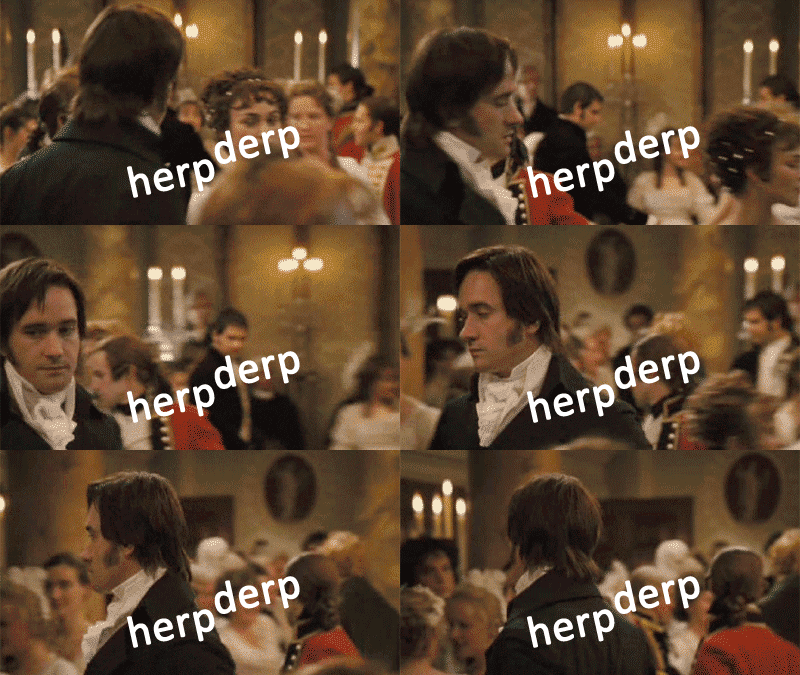
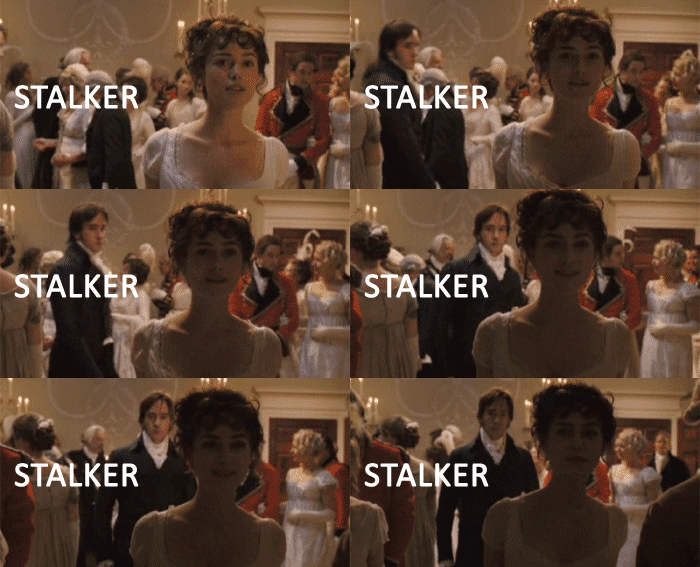
In the modern timeline, Sophie Collingwood was very close with her Uncle Bertram. He is the one who taught her to love reading and book collecting. That does not, however, make the use of the phrase “love of her life” remotely okay. The english language desperately needs more words to cover varieties of love; we are very imprecise, and it can be hard to tell which sort of love is meant. However, the phrase “love of my life” is universally acknowledged to be about romantic love and should never ever be applied to uncles, no matter how you qualify it. That “in a certain way” doesn’t make anything better.


The intended romance is no better. About the only thing that I like is that Sophie Collingwood has some really hot casual sex without any sort of shame or shaming from others. She does this with Winston, who is the first of two men to ask for the second edition of Richard Mansfield’s allegories at the rare book shop where she works. When she eventually figures out that the printer of Mansfield’s book was her ancestor and that’s why she would be the only one to find it, she never once questions the motivations of the sexy Winston. She continues to search with him and sex with him. Even when he steals her car and the second edition, she still doesn’t think he’s a bad guy. THIS is why I accuse Sophie of being a dimwit and the mystery of being horrible. Like, ooooh, I wonder who the bad guy could possibly be, especially since the obvious love interest warned her away from him.


Then there’s the actual romance of the book. Eric Hall was visiting Oxford, and insulted Austen fangirls at a bar. Sophie overheard and was deeply insulted. They bump into each other on a walk, and he reveals his deep love of Austen’s writing, so they become friends over the course of that day. He invites her on an Austen-related outing the next day, but she says she has to attend a sculpture party at her family’s home. He shows up at the party, having researched and found her.


Then they kiss once, and he leaves for France, the end of his trip in England having arrived. From France, he sends her a second edition French Austen novel worth thousands of pounds and writes that he can’t stop thinking about her. Finally, he writes that he’s coming back for her, and he once again happens to find her (aka stalks her). During the course of the book, they interact in FOUR SCENES, including the final one where he saves her from Winston and reveals he was a good guy all along and also that he loves her. FOUR SCENES, PEOPLE. In the epilogue, they’re married. Even Austen’s heroes and heroines got to know each other more intimately before falling in love, and courting was much harder back then, for fuck’s sake.

If you, like me, are an Austen fangirl and have trouble resisting any spinoff or retelling, RESIST. First Impressions is not worth your time or money. Reread Northanger Abbey instead.

883 reviews51 followers
September 20, 2014
I do count myself as an admirer of the works of Jane Austen, but that doesn't mean I can't accept variations or interpretations or extensions of her novels as long as they make common sense and are well done. So on the question of common sense, why did Sophie Collingwood's thoughts immediately turn to murder when a death occurred? Not one sniff of supposition, not one shred of evidence, never a question from anyone in authority, but Sophie immediately knew. I got plenty of eye-rolling exercise with this novel and, in case you are wondering, that isn't good. (A character named Mr. Boxhill? Really?) Sophie has a regrettable tendency to faint and act in ways that would make me automatically avoid her in real life. I also found it very hard to accept the premise that Austen needed the help of an eighty year old retired clergyman to whip one of her novels into shape, adapt another from an idea Mr. Mansfield had and prod her into the writing of a book he suggested the subject and title for, Northanger Abbey.

This novel alternates chapters between the present day and 1796 - 1817. It is not difficult to keep track of where you are in time because the manner of speech is naturally so different in the two time periods. The author uses the known history of Jane Austen to make her story in this novel fit in with the writing which will figure so large in the criminal activities taking place in the modern times related to those same writings. I'm sure researchers and writers are always looking for any lost Austen manuscript which will rock the literary world. In this case it was supposed to be a short story with disputed authorship which had never been found before. Except by one person, of course, who never revealed that it existed. Was Jane Austen a plagiarist? If so, does the world need to know?

I wish I could say I enjoyed the book, but I only read through to the end to see how the author would try to resolve all the problems of proving authorship of the story. Sophie was not a character who inspired sympathy or kind regard in me and having the author take the easy way out of challenging situations by having her steal books and literary material certainly did not help me enjoy the book. Jane Austen in love? Well, don't get your hopes up.
Profile Image for midnightfaerie.
2,269 reviews130 followers
June 10, 2016
While not necessarily a classic, what this book did for me is open me up to the world of original source material and book knowledge. What I mean by that is this: What makes a book valuable? How can you tell the different between first and second editions? If it’s expensive does that necessarily mean it’s valuable? And in doing research, is it that much more accurate to have the original documents than rely on a book that is second hand information that’s been filtered through another author’s opinion? And where is this original source material? Are there libraries around where I live? Can just anyone use it? Or do you have to be in something like a special club? And how much sifting through useless information before you find something important? And how do you know it’s important? And most importantly, how does it feel to know you’re holding an original document that has somehow changed history?

Charlie Lovett explores all these questions in his book, First Impressions: A Novel of Old Books, Unexpected Love, and Jane Austen. He does this through Sofie, our main character who has been instilled the love of books by her uncle since she was a child. Sofie uncovers what might be the greatest scandal in all of literature – a mystery surrounding her beloved favorite author, Jane Austen.

Lovett goes into great detail on antique books, original source material, and differing editions of books. He captures the excitement of Sofie finding clues through old documents so well, the reader can’t help but want to be there, touching the piece of paper that Jane Austen herself once held.

This is a book about books that has adequately described the excitement that ensues from sifting through dusty old papers, so much so, I now endeavor to learn more about original source material and how I can get my hands on it. Anyone with a love for books and mystery will appreciate this novel. And while the love story seems like an afterthought to the book, the depiction of the 18th century and its inhabitants and literary pursuits are alone well worth the reading of this novel. I couldn’t put it down.
Profile Image for Sheri Horton.
173 reviews
August 26, 2014
I was so excited when I won an ARC of this book, as I loved his prior book, The Bookman's Tale, so much. This one is even better, combining my passions for book collecting, mysteries and Jane Austen all in one. I couldn't put it down, and once finished felt so much joy that I had read this and so much sadness I had finished it. It is one that will stay with me for a long while. I may just sit here and hold it for a time......
Profile Image for primeballerina.
286 reviews63 followers
August 24, 2016
Der Buchtitel „Jane Austens Geheimnis“ von Charlie Lovett hat alleine durch den Titel und die Buchbeschreibung meine Aufmerksamkeit gewonnen – denn Jane Austen und Bücher, das kann nur eine gute Geschichte werden.

Sophie Collingwood ist nämlich eine passionierte Buchsammlerin und Jane-Austen-Liebhaberin. Ihre Leidenschaft für Bücher und ihre Geschichte hat sie von ihrem Onkel geerbt, welcher sie bereits in frühen Jahren in die Welt der Bücher eingeführt hat. Als ihr Onkel unversehens stirbt, zieht sie nach London in seine Wohnung und tritt eine Stelle in einem Antiquariat an.

Dort erreichen sie kurz hintereinander gleich zwei Kundenanfragen für ein Buch, welches weder bekannt noch außergewöhnlich zu sein scheint und welches scheinbar nirgendwo aufzufinden ist. Doch Sophie entdeckt nach und nach die Geheimnisse dahinter auf – und findet sich plötzlich in einem nicht ganz ungefährlichen Abenteuer wieder.

»Es ist eine allgemein anerkannte Wahrheit, dass ein Junggeselle im Besitz eines schönen Vermögens nichts dringender braucht als eine Frau.« – Seite 192

Obigen Satz dürften auch diejenigen kennen, die nicht unbedingt großartige Liebhaber von Jane Austen sind – der Anfangssatz von „Stolz & Vorurteil“ dürfte jeder schon einmal irgendwo gelesen oder gehört haben. Und die Geschichte hinter „Jane Austens Geheimnis“ dreht sich – wie der Titel vermuten lässt – tatsächlich ganz um die Schriftstellerin und ihre Bücher. Insbesondere auf eben „Stolz & Vorurteil“ wird hier der Fokus gelegt und die Entstehung dieser Geschichte.

Dabei vermischt der Autor wahre Fakten mit Fiktion und kreiert so eine umfassende und interessante Geschichte. Denn neben dem eigentlichen Handlungsstrang um Sophie Collingwood darf man als Leser auch für kurze Augenblicke in das Jahr 1796 abtauchen und Jane Austen selbst bei ihrer schriftstellerischen Entwicklung begleiten. Hier hat Lovett die fiktive Figur des Richard Mansfield geschaffen, einen engen Freund von Austen, welcher sie beim Schreiben mit allerlei Ratschlägen und ermunternden Worten unterstützt hat.

»Ein gutes Buch ist wie ein guter Freund. Es wird dich für den Rest deines Lebens begleiten. Am Anfang wird es spannend und abenteuerlich sein, und Jahre später wird es zu etwas Tröstlichem, Vertrautem werden. – Seite 45

Der Originaltitel dieses Romans, „First Impressions“, bezieht sich auf den eben ersten Entwurf von dem späteren Roman „Stolz & Vorurteil“, der den Titel „Erste Eindrücke“ trug. Damit beschäftigt sich auch die eigentliche Protagonistin, Sophie Collingwood, die man höchstwahrscheinlich gleich von der ersten Seite an sympathisch finden wird, wenn man eben selbst – wie auch ich – solch eine Buchliebhaberin ist. Sophies Liebe und Verbundenheit zu ihrem Onkel ist auf jeder einzelnen Seite spürbar und alleine deswegen lohnt es sich, diese Geschichte zu lesen. Allerdings ist Sophies Geschichte auch mit einer Prise Romantik bedacht worden, die ich zwar anfangs mochte, doch mit den zunehmenden Verwirrungen um gewisse Männer wurden mir Sophies Verhaltensweisen etwas suspekter, was mich ehrlicherweise etwas gestört hat, obwohl es im Grunde nicht groß Auswirkung auf die eigentliche Handlung hat – die mir eben sehr gut gefallen hat.

Doch so sehr ich Sophies kleines Abenteuer mochte, muss ich zugeben, dass es mir vor allem die Geschichte rund um Jane Austen angetan hat. Auch wenn sich Lovett einige Dinge hier ausgedacht hat und nicht alles der Wahrheit entspricht, so fand ich diese Geschichte trotzdem recht glaubhaft und interessant. Neben den vielen Bezügen zu „Stolz & Vorurteil“ findet man nämlich auch viel zu Austens anderen Romanen, vor allem zu „Verstand und Gefühl“ sowie „Northanger Abbey“. Da diese ausgerechnet zu meinen liebsten Austen-Romanen gehören, war dies natürlich umso schöner. Wie gut und glaubhaft Lovett Fakten und Fiktion miteinander vermischt hat, hat mir unglaublich gut gefallen. Und ich muss zugeben, dass ich tatsächlich überrascht war, dass solch ein Buch aus der Feder eines Autors stammt, würde man doch meinen, dass es meist Frauen sind, die Austens Bücher so sehr lieben. Doch Charlie Lovett ist selbst ein Buchliebhaber und Antiquar, was eben diesen Roman erklärt und auch die Tatsache, dass seine Liebe zu Büchern auch so gut beim Leser ankommt.

Wer sich auch nur ein wenig für Jane Austen und ihre Werke interessiert oder ihre weltberühmten Romane gelesen hat, der wird von „Jane Austens Geheimnis“ begeistert sein. Ein Buch von einem Buchliebhaber für Buchliebhaber und eine ganz klare Leseempfehlung.
Profile Image for David Eppenstein.
789 reviews197 followers
August 18, 2017
I have never read anything by Jane Austen. That hasn't been by conscious choice, it's just something that has never occurred to me to do. I have seen bits and pieces of movies based on her books but never watched one beginning to end. What little I have picked up or seen regarding Austen's work was enough to tell me that I probably wouldn't be interested in her writing. So why read a book that is based upon Jane Austen's work? Because the author has written two other books whose plots have been based upon books and I found both of those works to be highly enjoyable. If the other two were good then shouldn't this one be just as entertaining?

The story is told in two timelines. The first involves Jane Austen and her relationship with a retired cleric, Richard Mansfield. The second timeline occurs in the present and involves an Oxford grad student named Sophie Collingwood that has just completed her studies and is now looking for a job. Sophie is the heroine of the story and a bibliophile thanks to the influence of her Uncle Bertram. I did not think the plot as well conceived as those of the other two books I've read by this author but it was still good. However, I imagine Jane Austen fans will probably consider this book to be something of a sacrilege. If that be the case I would point out that the author makes several mentions of Austen's book "Northanger Abbey" being meant as a satire of the then current popularity of gothic novels. I could be wrong but this book might just be the author's attempt to satirize Austen fans as Jane did gothic novel fans in her day. Again, I have not read any Austen at all but I suspect the characters and their relationships does seem to be similar to what I know of Austen's work. So maybe the author is having a little fun at the expense of Austen fans, I will leave that for each of you to decide for yourselves.

The plot unfolds after Sophie takes a job with an antiquarian book dealer following the death of her beloved uncle that she finds suspicious. In the course of her new job she receives an assignment to track down a specific book by Richard Mansfield. The importance of this book is that it may prove that "Pride and Prejudice" was plagiarized by Austen and was actually the work of Rev. Mansfield. The search for this book takes Sophie on a journey through literary history and history of her own family and the lives of two suitors that she encounters along the way. This is not great literature, this book is just fun, a quick read, and entertaining. It is just the sort of lighthearted book to provide a reader with a change of pace from heavier reading which is why I picked it up. Give it try.
Profile Image for Annette.
956 reviews610 followers
November 27, 2017
This book weaves two stories of past and present. The past is about the friendship between Jane Austen and a clergyman, who is her best constructive critic and supporter of her work. The present is about a young British woman whose love for books was instilled in her by her uncle.

Both stories have a great sense of humor and the appropriate language for the time period.

The result is an engrossing tale wrapped around the love of writing, reading and collecting old books.

There were some moments in the present story that one could question if that was believable. Also, the claim that Jane Austin might have been a plagiarist was a stretch and I can see how some fans of Jane Austin might be offended by this. Nevertheless, I enjoyed this book.

Overall, this is a quick and easy read. There is something endearing about this story. I’ve always loved books and Jane Austin, but now I appreciate them even more.

@Facebook: Best Historical Fiction
Profile Image for Diane Challenor.
355 reviews80 followers
January 8, 2015
My first impression of Charlie Lovett’s “First Impressions” was positive and that impression played out well throughout the book. I wasn’t disappointed. It’s a book about books, one of my favorite genres. The story switches chapter by chapter between Jane Austen’s world and the life of a present day character, Sophie Collingwood. It’s easy to read and flows at a good pace, not too fast and not too slow.

It wasn’t long after my reading was underway that the cynic in me undermined several of the characters. I identified a couple of the characters as ingratiating predators; I wasn’t sure whether or not the author intended me to think so. On the positive side, I connected closely with Jane Austen’s fictional friendship embracing the elderly Reverend Mansfield. Mistakenly I was wary of Sophie’s Uncle Bertram. In this day and age, a single middle aged unmarried man, given free access to a child is questionable. I think I should stop watching the News, it’s taken away so much of my trust in the world. Is it that I can no longer look at the world with rose colored glasses or am I just cautious. With my first impressions firmly embedded, I read onward and discovered that I had to suspend belief and go with the story-line.

It’s a melodrama of the best kind.

If you are a lover of Jane Austen’s life and work, this story will very likely fascinate. My experience with this book was a little different because Jane Austen’s novels don’t appeal to me, I’m not keen on domestic dramas, real or imagined. I hate unnecessary fuss and bother, Jane Austen’s stories are anchored in them. I’d prefer a well written mystery with a reason for being, something I can learn from and be surprised by, but not driven to misery in the process. Don’t let me mislead you about my knowledge of Jane Austen’s stories, I’ve never read anything by her, my lack of intimate knowledge of Ms Austen’s stories may obscure an accurate understanding of her work, however this ignorance did not diminish my enjoyment of Charlie Lovett’s mystery.

The story is plot driven and a fun mystery that keeps you turning the pages. Along the way the book beautifully describes the love of the mind by pairing Jane Austen’s character and the present day heroine, Sophie, with their elderly mentors. Both heroines are separated by time and both are guided and encouraged by these well educated gentlemen. I highlighted many passages that I felt were profound insights into love, not of the romatic kind, but the love of an individual’s mind and spirit.

I was torn between giving it a three or four star rating due to it’s “light” reading nature. The last few chapters reminded me of a silent movie where the audience boo the villain and cheer on the hero, and feel despair for the heroine who is tied up and about to be seriously damaged. In the end I gave it four stars because I enjoyed the book very much and couldn’t put it down. Although the plot became a bit far fetched I was able to accept and enjoy the story.

It was a fun light read, it deserves four stars for the enjoyment it gave me.
198 reviews5 followers
September 3, 2014
Copy provided by GoodReads First Reads program.

This was the perfect book to snuggle under the covers with for the entire afternoon. I got up only to replenish my tea and to make a bit of risotto. The risotto and tea made it back in to bed with me so I could continue reading in ultimate comfort.

I think that First Impressions is a love letter to devoted bibliophiles. You get a mystery of a literary nature, love, and of course, the dream of almost any book reader: the inheritance a flat in London and a magical job at a used book store.

Charlie Lovett has written a charming novel about a girl who loves Jane Austen and a mystery that falls into her lap. It is not a challenging read, but one that you enjoy on a train ride or in a coffee shop on a cloudy day. It is a wonderful autumn read.

You do not need to be a Jane Austen enthusiast to enjoy First Impressions, but it does help to be very interested in books and old things. It reminded me of the pleasure of getting a letter in the mail and I will perhaps write one just for the fun of it. Or, I will start selling old books and hope for a mystery.

Profile Image for Christine.
346 reviews
February 9, 2017
I wanted to love this book, but alas, I found I did not. I was entertained and amused by the chapters which took place in Jane Austen's period but the further I progressed in the book the more I grew to dislike Sophie and the entire modern day plot line. I did not think I would find a character with such terrible judgment and poor choice of actions and associates in this book. As a result, I had to take an average of what I would have ranked the Jane chapters v the Sophie chapters.
Profile Image for QNPoohBear.
3,580 reviews1,562 followers
November 23, 2014
3.75 stars

This dual narrative novel tackles Jane Austen's life, the history of printing and publishing, modern romance and intrigue. In 1796 in Hampshire, a clergyman's daughter named Jane Austen happens across a rumpled old man sitting on a stile hunched over reading. Her first impression is that he is a comical figure to be put in a novel she may write one day. His first impression is that she is a rather dull and impetuous young lady. Happily their first impressions are wrong and they soon discover they have a lot in common. They both love to read novels and Mr. Mansfield is also a writer. He has written one book of dull allegorical tales for children but he knows what it takes to be a great writer and he sees it in Miss Austen. The pair soon become close as Mr. Mansfield advises Jane on her writing and provides life advice as they share long walks and cups of tea. Jane trusts him with her darkest secret and Mr. Mansfield comes up with a plan to atone for Jane's feelings of guilt. This plan may alter the course of literary history forever. In present day Oxfordshire, Sophie Collingswood has just completed her Masters' Degree in nineteenth century literature and is wondering what to do next. She's looking forward to some advice from her beloved, bibliophile Uncle Bertram. When she encounters Eric Hall, a brash American who mocked her favorite author (Jane Austen, of course), she's prepared to dismiss him, but as Jane Austen knew well, first impressions may not be entirely correct. Sophie's world is shattered when her uncle dies. She takes comfort in the fact he left her his extensive library, but she is shocked to learn his books were sold to pay his debts. She's determined to get them back one way or another. Her search leads to her a rare book dealer who gives her a job. On the day she's hired, a hunky young man comes in the store to chat her up. He's searching for the second edition of Mansfield's book. When it becomes clear Sophie can't find it right away, he's content to be with her. Then another customer calls looking for the exact same book and he is not so friendly. He threatens Sophie and makes her fear her uncle's death was not as innocent as it seemed. Why are they searching for this particular book? When she finds it, she receives the shock of a lifetime and discovers her favorite author may have plagiarized her most famous novel. Sophie sets out to clear the name of her beloved Jane Austen no matter what; then she can figure out her love life and what she wants to do with the rest of her life.

This is a thrilling book with lots going on. A summary can only scratch the surface. I loved the bookishness of the contemporary plot. Rare books, libraries and history centers are my true love so the setting of the novel appeals to my nerdy heart. The biggest strength of the novel is Jane Austen's plot. I feel the author was true to what we know of her. I truly appreciated the love story. It's a nice change to read a love story that isn't romantic or familial. I hope Jane did have someone like that in her life. We know she was close with Madame LeFroy, but I liked how Mr. Mansfield mentored her and helped shape her writing. The description of life in 18th century Hampshire was excellent. The author didn't try too hard to make Jane's novels inspired by real life. There are some places and incidents that influence her writing but in a natural way. It didn't feel forced the way most novels about Jane's life do. The story almost made me teary eyed towards the end.

Sophie is a great heroine. She's very real. She's not perfect. She's been hurt, she's made mistakes and she's aware of her faults. She's insecure outside of the world of academia and trying to figure out how to be a grown-up. I can really relate to that, being in the same place in my life. She's tenacious, and though I don't approve of some of her methods, I can see me doing many of the same things. I found her relationships interesting. The Mr. Darcy love interest was so swoony - I fell in love with him and the Willoughby suitor was just too obvious to be believable. I found Sophie far more believable and well-written than the contemporary male characters. The men were very two-dimensional and not fleshed out enough. I wanted a bit more character development for one of the two boyfriends. Sophie does shag a man but nothing is really described but how it made her feel. It's mentioned a few times and there's a tiny bit of skin in a second shagging scene, but nothing is described in detail so I rate this as a clean read but not kisses only.

The weak parts of the novel made me bump it down from 4 stars. First, it was obvious which one of Sophie's boyfriends was Mr. Darcy and which was Willoughby. She should know that by now. She chose to ignore what her beloved Jane teaches her readers. The villain was also rather cartoonish. Another thing I didn't like were the obvious inaccuracies about book collecting, rare book shops and libraries. Not only were there inaccuracies, I didn't approve of Sophie's methods of obtaining what she wanted. As a librarian, she should know better. The story also relies too much on coincidences. I also found sections on the history of printing that were from the point-of-view of the printer very boring and unnecessary.

Even with all the faults, I found the mystery so compelling that I had to keep turning the pages to find out how Sophie solved the mystery. It's a real page turner. I also liked the parallel between Sophie's relationship with her Uncle Bertram and Jane's relationship with Rev. Mansfield. I loved reading the (imagined by Lovett) first draft of First Impressions. It was pretty poorly written and if it had remained as such, no one would be reading it today. It really showed what a skilled writer Jane was.

This review is based on my first impression. I need to read it again to see if my opinion changes. I highly recommend it to Janeites, bibliophiles and fans of "chick lit."
Profile Image for Cynthia Egbert.
2,670 reviews39 followers
July 18, 2020
I wish I could give this one 3. 5 stars. It is not quite a four star read but I did love it. I realize that many do not care for this one but since I am considered "juvenile" in my relationship with the works of Jane Austen perhaps it is not a surprise that I enjoyed this one. That being said, the idiotic heroine, Sophie, rivals Lydia Bennet for being the most stupid woman in literature when it comes to romance and that is grating but the story still swept me along, both stories actually, since this novel swaps back and forth from Jane Austen's life to modern day.

There are two quotes that I want to remember:

"Choose carefully. A good book is like a good friend. It will stay with you for the rest of your life. When you first get to know it, it will give you excitement and adventure, and years later it will provide you with comfort and familiarity. And best of all, you can share it with your children or your grandchildren or anyone you love enough to let into its secrets."

"You know that every book tells a story, but every one of those bits of paper tells a story, too. I never kept a diary, you see. My books and my bookmarks are my diary."
Displaying 1 - 30 of 1,278 reviews

Can't find what you're looking for?

Get help and learn more about the design.