

What do you think?

Soul Picnic: The Music and Passion of Laura Nyro
Soul The Music and Passion of Laura Nyro is a biography of the pioneering singer-songwriter whose recordings and high-drama performances were both beloved and inspiring in the 1960s and '70s. With her groundbreaking honest and passionate lyrics, her unusual and innovative rhythms and melody, Nyro's influence is still felt by singers and songwriters today.
Beginning with her childhood and teen years in the Bronx, and ending with her untimely death from ovarian cancer in 1997, Soul Picnic details how Nyro was "discovered" as a prodigious eighteen-year-old songwriter, had her songs covered with great success by other singers (most famously, the Fifth Dimension, Blood, Sweat & Tears, Three Dog Night, and Barbra Streisand), and created her own remarkable albums, such as Eli and the Thirteen Confession and New York Tendaberry. It also tells how a young David Geffen, as her agent and then manager, helped boost her career, but how she ultimately rejected both Geffen and the glare of stardom for a quieter rural life. Nyro was a very private person, and Michele Kort has uncovered aspects of her life offstage never previously revealed, including a romance with famed rock musician Jackson Browne and the love affair that led to the birth of her son, Gil. It also fleshes out her long, loving relationship with painter Maria Desiderio.
Kort features Laura Nyro's music, the making of each of her albums, the musical influences that informed her work, and the important legacy she has left behind. She interviewed nearly all of the producers and arrangers Nyro worked with, and many of the musicians who played on her albums. The book also includes a discography of both Nyro's recordings and many covers of her songs by well-known artists.
With passion and style, acclaimed journalist Michele Kort has seamlessly joined thorough research with oral history in this beautifully rendered biography of an important, often-overlooked music icon.
Beginning with her childhood and teen years in the Bronx, and ending with her untimely death from ovarian cancer in 1997, Soul Picnic details how Nyro was "discovered" as a prodigious eighteen-year-old songwriter, had her songs covered with great success by other singers (most famously, the Fifth Dimension, Blood, Sweat & Tears, Three Dog Night, and Barbra Streisand), and created her own remarkable albums, such as Eli and the Thirteen Confession and New York Tendaberry. It also tells how a young David Geffen, as her agent and then manager, helped boost her career, but how she ultimately rejected both Geffen and the glare of stardom for a quieter rural life. Nyro was a very private person, and Michele Kort has uncovered aspects of her life offstage never previously revealed, including a romance with famed rock musician Jackson Browne and the love affair that led to the birth of her son, Gil. It also fleshes out her long, loving relationship with painter Maria Desiderio.
Kort features Laura Nyro's music, the making of each of her albums, the musical influences that informed her work, and the important legacy she has left behind. She interviewed nearly all of the producers and arrangers Nyro worked with, and many of the musicians who played on her albums. The book also includes a discography of both Nyro's recordings and many covers of her songs by well-known artists.
With passion and style, acclaimed journalist Michele Kort has seamlessly joined thorough research with oral history in this beautifully rendered biography of an important, often-overlooked music icon.
352 pages, Hardcover
First published April 3, 2002
Ratings & Reviews
Friends & Following
Create a free account to discover what your friends think of this book!
Community Reviews
Displaying 1 - 30 of 36 reviews
January 20, 2009
Make no mistake this comment is both a rave and a query.
Michele Kort's book is more than a loving tribute, it is an excellent biography. But, I am unsure about Ms Kort's claim that Laura came to her bi-sexuality in her mid 30's?
There is overwhelming evidence, albeit circumstantial, that from 1967 on, Laura was involved with at least one woman, her eventual life partner, Maria Desiderio.
Kort in SOUL PICNIC corroborates that "back in the day" Laura was doing drugs (pot & LSD), was sexually active, and was an awesome talent in jazz, folk, R&B, soul & doo-wop. Michele Kort's research confirmed that Laura "...may..." have been leading the intense 60s lifestyle of drugs, sex and rock 'n roll.
As to Laura's bisexuality, Pete Johnson in his June 1968 review of ELI AND THE THIRTEENTH CONFESSION in COAST FM & FINE ARTS (page 50) commented about the song "Emily." "There is a momentary shock at hearing a woman romancing another woman..." On April 25, 1997, seventeen days after Laura's death, Alanna Nash in her comment on E.W.COM, Passion Player celebrated "Emmie" as "pop's first lesbian love song." Also in ELI is the song "Timer." Any doubt as to the lover being a woman was dispelled by Laura's redacted version of "Timer" performed on May 30, 1971 in live concert at the Fillmore East. It becomes apparent when viewed in the context of the song "American Dove" which was Laura's love song to her fiancé, a decorated Vietnam war veteran. Both songs were released on SPREAD YOUR WINGS AND FLY. As originally released on ELI, "Timer" is a same-sex musing, with this denouement; "If you love me true - I'll spend my life with you - you and Timer." And, again in ELI, what about the silhouetted picture of Laura and the much younger woman on the album's back dust jacket? It is worth 1,000 confessions. Renderings of the image are an easy find on-line. In 1971, Laura released the album GONNA TAKE A MIRACLE. Her adapted version of the song "Desiree" remains one of the most undisguised expressions of love by one woman singing to another woman. A remarkable coincidence is that both the names Desiree and Desiderio mean desire.
Both, Michele Kort confirmed through Lee Housekeeper (page 106) and Bob Sarlin, in his book TURN IT UP (page 131) witnessed that Laura's "hard core fans" were "dominated by thirteen- to sixteen-year-old girls..." This age range coincides exactly with Maria's age between June 1967 and June 1971. "So...let the wind blow Timer, I like her song and if the song goes minor - I won't mind. Laura 'n Maria '67 "carved in a heart on berry tree."
If the Kort work has any flaw, it comes in the author being too readily willing to accept the 1980's as Laura's coming out.
Ultimately, what lead me to the 5 stars was Michele's sensitivity in preserving some mystery about Laura's life. It was her thoroughness, tempered by her sensitivity that left things to be discovered. I am still gleaning facts and incites from the book.
Among Michele's last words on the subject was a phrase that has become my mantra; "If you want to know her...go to the music." Get this book; buy or download and listen to "Désiree." Listen to "American Dove" and then compare both versions of "Timer."
Your reply to Ralph A. Bruno's post:
Guidelines
Reply to this post | Permalink
Michele Kort's book is more than a loving tribute, it is an excellent biography. But, I am unsure about Ms Kort's claim that Laura came to her bi-sexuality in her mid 30's?
There is overwhelming evidence, albeit circumstantial, that from 1967 on, Laura was involved with at least one woman, her eventual life partner, Maria Desiderio.
Kort in SOUL PICNIC corroborates that "back in the day" Laura was doing drugs (pot & LSD), was sexually active, and was an awesome talent in jazz, folk, R&B, soul & doo-wop. Michele Kort's research confirmed that Laura "...may..." have been leading the intense 60s lifestyle of drugs, sex and rock 'n roll.
As to Laura's bisexuality, Pete Johnson in his June 1968 review of ELI AND THE THIRTEENTH CONFESSION in COAST FM & FINE ARTS (page 50) commented about the song "Emily." "There is a momentary shock at hearing a woman romancing another woman..." On April 25, 1997, seventeen days after Laura's death, Alanna Nash in her comment on E.W.COM, Passion Player celebrated "Emmie" as "pop's first lesbian love song." Also in ELI is the song "Timer." Any doubt as to the lover being a woman was dispelled by Laura's redacted version of "Timer" performed on May 30, 1971 in live concert at the Fillmore East. It becomes apparent when viewed in the context of the song "American Dove" which was Laura's love song to her fiancé, a decorated Vietnam war veteran. Both songs were released on SPREAD YOUR WINGS AND FLY. As originally released on ELI, "Timer" is a same-sex musing, with this denouement; "If you love me true - I'll spend my life with you - you and Timer." And, again in ELI, what about the silhouetted picture of Laura and the much younger woman on the album's back dust jacket? It is worth 1,000 confessions. Renderings of the image are an easy find on-line. In 1971, Laura released the album GONNA TAKE A MIRACLE. Her adapted version of the song "Desiree" remains one of the most undisguised expressions of love by one woman singing to another woman. A remarkable coincidence is that both the names Desiree and Desiderio mean desire.
Both, Michele Kort confirmed through Lee Housekeeper (page 106) and Bob Sarlin, in his book TURN IT UP (page 131) witnessed that Laura's "hard core fans" were "dominated by thirteen- to sixteen-year-old girls..." This age range coincides exactly with Maria's age between June 1967 and June 1971. "So...let the wind blow Timer, I like her song and if the song goes minor - I won't mind. Laura 'n Maria '67 "carved in a heart on berry tree."
If the Kort work has any flaw, it comes in the author being too readily willing to accept the 1980's as Laura's coming out.
Ultimately, what lead me to the 5 stars was Michele's sensitivity in preserving some mystery about Laura's life. It was her thoroughness, tempered by her sensitivity that left things to be discovered. I am still gleaning facts and incites from the book.
Among Michele's last words on the subject was a phrase that has become my mantra; "If you want to know her...go to the music." Get this book; buy or download and listen to "Désiree." Listen to "American Dove" and then compare both versions of "Timer."
Your reply to Ralph A. Bruno's post:
Guidelines
Reply to this post | Permalink

November 4, 2015
Reading this book finally gave me that special "secret key" into a world no one was privy to until now. Laura Nyro's mysterious persona was always very compelling. She was someone you never could get too much of, because there never was much we were allowed to know. So, those of us who fell in love with her amazing music always were forced to read into the lyrics, to wonder, to get lost in a trance while listening as we saw visions of New York streets and imagined the people and scenes in her songs. I was 16 years old the first time I escaped into Laura's music, and that was decades ago. My reaction as I listened to each song, was that I was stunned. The songs were stunning. Her voice: stunning. It was that melding of jazz, gospel, Broadway and how every note she played on the piano was intentionally placed and significant. And how her voice captured all the raw emotion of real New York life. She made me yearn to go there, to feel what she felt, to see what she saw.
She was the pioneer, a woman whose creative abilities were, in my opinion, up until that time, unsurpassed by anyone, male or female. That's why the book is such a treasure. It unlocks so many of the mysteries that many of us had resigned ourselves to never know. Unlike the other reviewer, I relished the details of the recording sessions and everything else, every other detail about Laura's life, personality, art. At the risk of sounding snobbish, I suppose you have to be the following to truly appreciate what is offered here: 1) an absolute die-hard Laura Nyro follower and fan from the 70s, and 2) probably a songwriter and musician yourself in order to understand what it takes to create the kind of work she created. (I am both).
I suppose to sum it up it just felt really great to finally have the real Laura, unshrouded and revealed to us. The great thing is that--it was refreshing to know that she really was just a regular girl, not someone who particularly wanted or even warranted that dark aura, just someone who had a real life and didn't go for the showbiz thing very much. And, even better: someone very wonderful in her personal life as far as her generosity and kindness--and full of laughter, humor, delight, and loving friendships. I took away the details of a woman who had an unparalleled musical gift, many friends, a happy relationship, loved her child, and had a generally beautiful life. After all these years, and with her death, it is nice to know that she could have just been one of us. I guess you might say this book gave me some "closure". And, I felt happier as a result of reading AND re-reading it, for its endearing, real-life stories about this lovely human being.
She was the pioneer, a woman whose creative abilities were, in my opinion, up until that time, unsurpassed by anyone, male or female. That's why the book is such a treasure. It unlocks so many of the mysteries that many of us had resigned ourselves to never know. Unlike the other reviewer, I relished the details of the recording sessions and everything else, every other detail about Laura's life, personality, art. At the risk of sounding snobbish, I suppose you have to be the following to truly appreciate what is offered here: 1) an absolute die-hard Laura Nyro follower and fan from the 70s, and 2) probably a songwriter and musician yourself in order to understand what it takes to create the kind of work she created. (I am both).
I suppose to sum it up it just felt really great to finally have the real Laura, unshrouded and revealed to us. The great thing is that--it was refreshing to know that she really was just a regular girl, not someone who particularly wanted or even warranted that dark aura, just someone who had a real life and didn't go for the showbiz thing very much. And, even better: someone very wonderful in her personal life as far as her generosity and kindness--and full of laughter, humor, delight, and loving friendships. I took away the details of a woman who had an unparalleled musical gift, many friends, a happy relationship, loved her child, and had a generally beautiful life. After all these years, and with her death, it is nice to know that she could have just been one of us. I guess you might say this book gave me some "closure". And, I felt happier as a result of reading AND re-reading it, for its endearing, real-life stories about this lovely human being.

December 2, 2012
This is a loving tribute to the life and work of Laura Nyro, one of the relatively unheralded geniuses of pop music. The problem with a book-length story about Nyro thought is that her life was, well, not all that interesting after the early 70's. She shunned stardom, or rather the steps deemed necessary by the recording business to achieve it, and so her fame continued to dim after her halcyon days of 1966-1972, roughly, until her death from ovarian cancer at age 49 in 1997. She lived, she loved, she continued to make music and write songs that were beautifully complex and idiosyncratic, she gave birth to a son. She is however oddly unknown compared to other women singer songwriters of the same generation like Joni Mitchell, Carole King, and Carly Simon, despite her influence, owning mostly to her lack of any chart-topping singles that weren't songs of hers covered by others. She was finally inducted into the Rock and Roll Hall of Fame this year, but she remains a musician's musician and cult hero. The book concludes with a fitting admonition to the reader to go to her music to really know Laura's soul, but that leaves the question of why a book of more than 250 pages about her? I did learn some interesting tidbits about her life, and she comes off as a person who knew herself well and insisted on living her life and producing her art her way. She was an arch-hippie to the end, and all of that is commendable in my book, but not compelling reading after all. Still, I liked the book, except that the photographs are often too dark to decipher, most notably and sadly the one of her with Miles Davis, but I am a fan, and was surprised that I didn't like it more.

March 8, 2013
I LOVED this book. Am amazing story with the perfect amount of detail. Not only do you get to know Laura and her life story, but you get a rundown of how her life impacted every album and every song down to the last studio musician who played on them. It also brings you right into the business and the people who started the singer/songwriter genre and how they were inspired by LR.
Excellent read.
Excellent read.

February 21, 2026
Rather disappointing book about Laura Nyro, artist and woman. Sadly, the information presented was uninspiring and I found myself skipping a lot of pages due to boredom.

May 9, 2010
This novel documents the life of one of the first great female singer-songwriters, Laura Nyro. Her music was unprecedented and often criticized by the music critics. However, up until her untimely death, Nyro remained true to herself and her fans when it came to her music. Nyro has inspired many, including Joni Mitchell, and continues to inspire many musicians today with her timeless sound.

March 29, 2026
Beautifully researched and written another loss to the music world RIP

November 2, 2011
Although Laura Nyro has been on my radar for over two years, I only recently downloaded one of her albums.
That album was New York Tendaberry and, let's put it this way: if I had it on vinyl, it would never leave my turntable
My almost 13-year-old brother who hangs around me a lot, detests her; he identifies her as "the woman who wails." And, while it's a bit of an exaggeration, he's right - she's a wailer! But that's what I love about her: how she sings her heart out. I have a great admiration for singers who convey a lot of power and emotion in their singing. As someone who expresses herself through the medium of singing/songwriting, I would love and strive to have that sort of emotional strength in my voice, and even lyrics. I don't, though. Or at least, I feel like I don't. Sure, nice adjectives have been used to describe my voice, but something in me wants to have a rough, emotive voice like, say, Janis Joplin.So I'm going to take up drugs and alcohol and see where that gets me.
Anyway, I tell my entirely too-judgmental brother that Laura is an acquired taste, and I suppose she is. For a while, even I was ambivalent about whether I liked her or not. But I kept an open mind and now I'm basically in love with her. So there you go!
All this to say, this biography was mahvelous; an excellent look on Laura's life and her groundbreaking musical influences. This book has further fueled my passion for all things Laura Nyro; I am resisting the urge to go out and buy her entire discography.
My favourite photograph in the book of the lovely Laura:
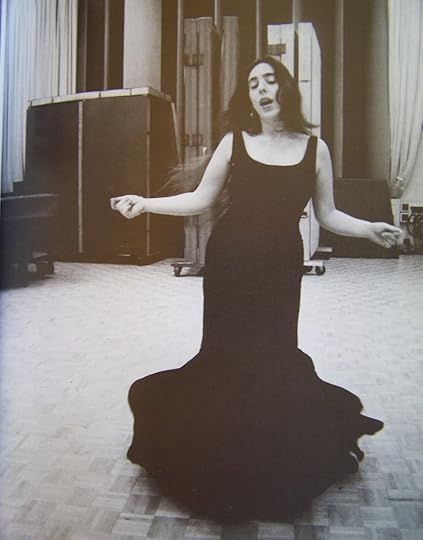
[Caption: Nyro taking a dance break during New York Tendaberry recording sessions, 1969. (Photo by Stephen Paley, courtesy of Michael Ochs Archives)]
That album was New York Tendaberry and, let's put it this way: if I had it on vinyl, it would never leave my turntable
My almost 13-year-old brother who hangs around me a lot, detests her; he identifies her as "the woman who wails." And, while it's a bit of an exaggeration, he's right - she's a wailer! But that's what I love about her: how she sings her heart out. I have a great admiration for singers who convey a lot of power and emotion in their singing. As someone who expresses herself through the medium of singing/songwriting, I would love and strive to have that sort of emotional strength in my voice, and even lyrics. I don't, though. Or at least, I feel like I don't. Sure, nice adjectives have been used to describe my voice, but something in me wants to have a rough, emotive voice like, say, Janis Joplin.
Anyway, I tell my entirely too-judgmental brother that Laura is an acquired taste, and I suppose she is. For a while, even I was ambivalent about whether I liked her or not. But I kept an open mind and now I'm basically in love with her. So there you go!
All this to say, this biography was mahvelous; an excellent look on Laura's life and her groundbreaking musical influences. This book has further fueled my passion for all things Laura Nyro; I am resisting the urge to go out and buy her entire discography.
My favourite photograph in the book of the lovely Laura:
[Caption: Nyro taking a dance break during New York Tendaberry recording sessions, 1969. (Photo by Stephen Paley, courtesy of Michael Ochs Archives)]

January 8, 2008
I never really got Laura Nyro, even though I knew some of her hits like 5th Dimension's "Wedding Bell Blues" Blood, Sweat and Tears's "Eli's Coming" and of course, Barbra Streisand's "Stoney End".
So, when I saw this book in a used bookstore, I picked it up for my post-surgical vacation (gallbladder safely removed, thank you for your concern), because I thought I could get a lot about the 1970s from her life, more than any interest in reading about her.
Well, I really liked her. I had no idea of the devotion of her friends and family, the musicians she worked with and her fans.
Laura always lived in a world of art and music, whether living on a houseboat in India, in Japan, in New Orleans, Connecticut, Massachusetts, New York, Ithaca, or wherever she felt like hanging out.
She is constantly described by those who knew her as funny, warm, campy, lively and certainly comes across as someone who enjoyed her life.
I even put the book down for a bit before getting to the last 3-4 years of her life, as it was bumming me out to leave this charming, kooky woman. Since finishing it, I keep her on a regular playlist and now hear her influence in so many other artists work.
So, when I saw this book in a used bookstore, I picked it up for my post-surgical vacation (gallbladder safely removed, thank you for your concern), because I thought I could get a lot about the 1970s from her life, more than any interest in reading about her.
Well, I really liked her. I had no idea of the devotion of her friends and family, the musicians she worked with and her fans.
Laura always lived in a world of art and music, whether living on a houseboat in India, in Japan, in New Orleans, Connecticut, Massachusetts, New York, Ithaca, or wherever she felt like hanging out.
She is constantly described by those who knew her as funny, warm, campy, lively and certainly comes across as someone who enjoyed her life.
I even put the book down for a bit before getting to the last 3-4 years of her life, as it was bumming me out to leave this charming, kooky woman. Since finishing it, I keep her on a regular playlist and now hear her influence in so many other artists work.

January 18, 2018
I loved this book because I love Laura Nyro. She was such an amazing artist who followed her own passion. I found the info about her relationships with other singers to be fascinating. She was able to produce a wonderful repertoire of songs and had a unique style of her own. The book was great. However, I did find it to be a bit long. Definitely a good read if you're into the artist.
April 22, 2026
I savored this book as I am a lifelong fan obsessed with Laura Nyro. The author's reporting was excellent. I was amazed at how much information Ms. Kort was able to gather. This is a must-read for Nyro fans.
June 13, 2023
A well-written biography of a fascinating, endlessly talented, enigmatic person. It is based mostly upon interviews with friends and people who worked with her. A must for people who loved Laura Nyro's music and are curious about her personality and her life.
March 11, 2010
A rather workmanlike biography of the great singer/songwriter, but to date the only one we have. I would recommend it to fans of Laura.
April 16, 2022
great read about the talented Laura Nyro
Fantastic read about a very talented artist who led the way for many current woman musicians. Highly remember this book!
Fantastic read about a very talented artist who led the way for many current woman musicians. Highly remember this book!
May 18, 2023
Awesome piece of work! Great research. Well done!

January 10, 2025
Inspiring and also so sad. Very well researched and written.
May 14, 2023
A detailed look at Laura Nyro and her work which is still largely ignored by the mainstream music world. I wish Kort had included the lyrics to her songs. Telling us how poetic her songs are, mentioning a line or three, doesn't work for me. Sure, the lyrics are available online, but it would be nice to have within the book.
I enjoyed the book since it made be go back and listen/re-listen to Nyro's work and I enjoyed reading about her life and approach to the music business. I found the song by song description of each album tedious. And I thought it irrelevant to read what stars came out to hear her performances.
In the last chapter Kort writes:
"Unfortunately, Nyro's 'enduring originality' continues to be overlooked in places where she should be part of the canon.
She's neither a member of the Rock and Roll Hall of Fame nor the Songwriters Hall of Fame (although Desmond Child has vigorously lobbied the latter for her inclusion). She was also ignored at Lilith Fair, the women's music festival whose first incarnation occurred the summer after her death. By all rights the festival should have been dedicated to Nyro, but her name wasn't even mentioned, though her legacy was every present in the poetic songs of Paula Cole, Jewel, and Lilith Fair's founder, Sarah McLachlan."
It's a somewhat odd lament given Kort writes repeatedly about how Nyro eschewed fame or even notoriety - she wasn't interested in creating hits, she was interested in creating her music her way- she denied interviews repeatedly whether for newspapers, magazines, radio, or tv. That female songwriters and performers like Sarah McLachlan either don't know of or don't feel influenced by her shouldn't be surprising. If McLachlan didn't grow up listening to Nyro, why would she dedicate Lilith Fair to her? That doesn't mean McLachlan isn't a beneficiary of the ceilings Nyro broke through. It simply means she was more directly influenced by others, some of whom perhaps were influenced by Nyro.
There was one mistake in the book that perhaps is of interest to nobody but me. Kort writes:
"Tim Hardin...had been incorporating jaz players into his musical mix since the mid-1960s, even playing at Woodstock in 1969 backed by the jazz group Oregon."
Hardin was not backed by Oregon, which formed in 1970 after Woodstock. Hardin was backed by a group of musicians that included two of the original four members of Oregon, Ralph Towner (guitar) and Glen Moore (bass). But Oregon did not back Hardin.
I enjoyed the book since it made be go back and listen/re-listen to Nyro's work and I enjoyed reading about her life and approach to the music business. I found the song by song description of each album tedious. And I thought it irrelevant to read what stars came out to hear her performances.
In the last chapter Kort writes:
"Unfortunately, Nyro's 'enduring originality' continues to be overlooked in places where she should be part of the canon.
She's neither a member of the Rock and Roll Hall of Fame nor the Songwriters Hall of Fame (although Desmond Child has vigorously lobbied the latter for her inclusion). She was also ignored at Lilith Fair, the women's music festival whose first incarnation occurred the summer after her death. By all rights the festival should have been dedicated to Nyro, but her name wasn't even mentioned, though her legacy was every present in the poetic songs of Paula Cole, Jewel, and Lilith Fair's founder, Sarah McLachlan."
It's a somewhat odd lament given Kort writes repeatedly about how Nyro eschewed fame or even notoriety - she wasn't interested in creating hits, she was interested in creating her music her way- she denied interviews repeatedly whether for newspapers, magazines, radio, or tv. That female songwriters and performers like Sarah McLachlan either don't know of or don't feel influenced by her shouldn't be surprising. If McLachlan didn't grow up listening to Nyro, why would she dedicate Lilith Fair to her? That doesn't mean McLachlan isn't a beneficiary of the ceilings Nyro broke through. It simply means she was more directly influenced by others, some of whom perhaps were influenced by Nyro.
There was one mistake in the book that perhaps is of interest to nobody but me. Kort writes:
"Tim Hardin...had been incorporating jaz players into his musical mix since the mid-1960s, even playing at Woodstock in 1969 backed by the jazz group Oregon."
Hardin was not backed by Oregon, which formed in 1970 after Woodstock. Hardin was backed by a group of musicians that included two of the original four members of Oregon, Ralph Towner (guitar) and Glen Moore (bass). But Oregon did not back Hardin.

May 6, 2023
When I mention Laura Nyro (1947-1997), the composer/singer/pianist who was compared to Joni Mitchell, some people react enthusiastically, but some fail to recall her until I mention some of her songs, like "And When I Die", "Eli's Comin'", "Stoned Soul Picnic", or "Wedding Bell Blues", all huge hits in the late 60s/early 70s as covers by artists like Blood Sweat and Tears, Three Dog Night, and The Fifth Dimension. Barbra Streisand, whose highly successful 1971 "Stoney End" album updated her image and appealed to younger generations looking for contemporary music, also included Nyro's "Time and Love". Nyro released multiple albums of her own, including "Eli and the Thirteenth Confession" and "New York Tendabury". In 2014, Billy Childs and Allison Kraus revisited Nyro's work with "Map to the Treasure: Reimagining Laura Nyro", with help from Chris Botti, Renée Fleming, and Yo-Yo Ma, among others.
Nyro was born in The Bronx, New York. Her father was also a musician. She began her idiosyncratic career when she was still a teenager, but in time became something of a legend, as a friend and protégé of then talent agent David Geffen, who was a huge force in popular music before he moved on to film production. She died of uterine cancer at forty-nine, which had also claimed her grandmother and mother.
Michele Kort's book is a well-researched biography of Nyro, and celebrates not just her legacy, but the music scene of the era when her career began, and brings it back to life. It was wonderful to imagine her performances at sadly now-defunct clubs like New York's The Bottom Line, where I went often. Just a little more careful editing would have made it a five-star effort, but it is truly compelling reading for fans of both Nyro and those interested in the singer/songwriter movement, and the music of the 60s and 70s that lives in many of our memories.
Nyro was born in The Bronx, New York. Her father was also a musician. She began her idiosyncratic career when she was still a teenager, but in time became something of a legend, as a friend and protégé of then talent agent David Geffen, who was a huge force in popular music before he moved on to film production. She died of uterine cancer at forty-nine, which had also claimed her grandmother and mother.
Michele Kort's book is a well-researched biography of Nyro, and celebrates not just her legacy, but the music scene of the era when her career began, and brings it back to life. It was wonderful to imagine her performances at sadly now-defunct clubs like New York's The Bottom Line, where I went often. Just a little more careful editing would have made it a five-star effort, but it is truly compelling reading for fans of both Nyro and those interested in the singer/songwriter movement, and the music of the 60s and 70s that lives in many of our memories.

January 4, 2025
Soul Picnic is over 20 years old and likely to be the only biography of Laura Nyro we’ll get, as she is still an underrated figure in the world of popular music. A number of her earlier songs were hits for other artists, but her own records were never huge sellers. Most of her reputation rests on her first five releases, though she never made a bad album. More Than a New Discovery is an astonishingly stellar debut, all original songs from a teenage wunderkind; Eli and the Thirteenth Confession is a real tour-de-force, accessible and innovative; New York Tendaberry and Christmas and the Beads of Sweat are more challenging and idiosyncratic, but they reward active listening; Gonna Take a Miracle is an all-covers album with gorgeous work by Laura and the group Labelle. It’s nice to have more context for the world she came from and the experiences that changed her in this biography.
May 23, 2020
I have to say right up front that I love Laura Nyro and was very interested at the prospect of a well done biography. Unfortunately, this book contains about a Wikipedia article's amount of biographical information spread over the course of the book, and mostly consists of fan girl post-modern critique deep dives into the possible meanings of nearly every lyric Nyro ever wrote. I found myself skipping page after page after page, until I got past the author's personal interpretations of lyrics and back to a little bit of biographical data. And there is no critical distance or evaluation of Laura Nyro here, just pure adulation of everything she ever wrote, said or did. Incredibly disappointing book.

June 24, 2018
Laura Nyro was an amazing performer and song writer who died much too young. This biography is a bit over the top but gives a clear portrait of her as an uncompromising artist who cared about the music and not the music business. Lots of singers and songwriters have credited her as an inspiration including Joni Mitchell. This biography though intends to be comprehensive and discusses each album, each song and the critical reaction to each one chapter by chapter. It opened my eyes to how central she was to pop music in the late 60s, early 70s. I hope it encourages more young people to discover her music.

October 9, 2024
A pretty good overview of perhaps the most creative, original and talented female singer-songwriter of the late 60’s-early 80’s. If you look up the words pure artist you’ll find a picture of the Bronx-born Nyro, who NEVER EVER sold out in the slightest for fame or fortune. She, like Joni Mitchell, made up her own chords, changed tempos multiple times in her songs and created a genre-less type of music that some loved, some hated, but everyone respected. Bob Dylan and David Geffen were among her biggest fans, and the Fifth Dimension, Blood Sweat & Tears and Barbra Streisand (along with many others) had huge success with songs she wrote.
I enjoyed learning about Nyro’s free-wheeling lifestyle, the musicians who recorded with her, her romances, her feminism and activism, and the backstories on her albums. She was a very interesting person. I’d have loved to have been in her orbit.
I enjoyed learning about Nyro’s free-wheeling lifestyle, the musicians who recorded with her, her romances, her feminism and activism, and the backstories on her albums. She was a very interesting person. I’d have loved to have been in her orbit.
December 2, 2021
It's a pretty good, dutiful biography. It's pretty interesting to follow Laura into her more disconnected, post-Geffen life for a while, but it does flag. Hard not to love Laura Nyro. Wish she'd stayed in New York.

May 17, 2022
well researched and well written bio of an amazing artist.
January 25, 2018
If you want to know everything about Laura Nyro, this book is for you.
April 20, 2024
A super thoughtful biography of a singular talent. Michele Kort does a wonderful job at taking the reader through the life of Laura Nyro. The moments early in her career are particularly interesting, especially the behind the scenes information about the making of Eli & The Thirteenth Confession.
August 3, 2021
This a must-read for any fan of Laura, mostly because it is the only full-length biography of her available. Secondly, because Michele Kort did such an amazing job of telling Laura's story from birth to death. Kort, being a journalist, did extensive research. She seems to have read everything published on Laura, and then interviewed as many people as possible who knew her. Whether by choice or necessity, there is very little said about Laura's partner of 17 years, Maria. This is possibly because Maria was even more private than Laura, and thus there is little known about her. Michele Kort was not a musician, so there is not much analysis of Laura's creative use of harmony and chord substitutions, her unusual rhythmic devices, her radical employment of extreme dynamics and silence, her unconventional song forms, and fluid concepts of tempo. Hopefully, that kind of work is yet to be done by someone else.
However, Kort shows how someone with a talent as unprecedented as Laura's grew up and was nurtured in a music industry that recognized her genius, even if they didn't know what to do with her. Of course, Laura's story is closely entwined with that of David Geffen's, who tirelessly promoted her in a way no one else seemed equipped to do.
The book loses some steam a bit after her divorce and the birth of her son, because at that time Laura severely reduced her recording and performing to only when she felt the desire. Plus, during that time, she turned down all the offers to write music for movies, and do TV appearances; opportunities that would have raised her profile considerably.
We're very lucky Michele Kort wrote the definitive book on Laura because, even as Laura's legend seems to grow for some, her cult of actual fans may slowly be diminishing, and those of us hungry for information on her life will most likely have only this one book to help get us by.
However, Kort shows how someone with a talent as unprecedented as Laura's grew up and was nurtured in a music industry that recognized her genius, even if they didn't know what to do with her. Of course, Laura's story is closely entwined with that of David Geffen's, who tirelessly promoted her in a way no one else seemed equipped to do.
The book loses some steam a bit after her divorce and the birth of her son, because at that time Laura severely reduced her recording and performing to only when she felt the desire. Plus, during that time, she turned down all the offers to write music for movies, and do TV appearances; opportunities that would have raised her profile considerably.
We're very lucky Michele Kort wrote the definitive book on Laura because, even as Laura's legend seems to grow for some, her cult of actual fans may slowly be diminishing, and those of us hungry for information on her life will most likely have only this one book to help get us by.

June 20, 2016
I read this book a few years ago, but I just re-read it and like it even more.
Laura Nyro's music had a formative influence on me since the mid-60s when she released her first album, and I consider her and Joni Mitchell to be equally responsible for my tastes in music and songwriting.
This book is tirelessly researched with many, many interviews with musicians and other music professionals (as well as friends and loved ones; many of these categories intersect) that give a good picture of her creative, loving, passionate, kind, and quirky approach to her music and in fact, her life.
What comes through strongest is the fact that she had a definite yet intuitive of idea of how she wanted her work recorded and she managed to persist in her preferences against record executives, producers and other decision-makers in the record business. This in itself was a significant achievement, given the fact that her affect was somewhat spacey and she believed in treating people with fairness and compassion. But in protecting her music, she was fearless and formidable.
The second thing that comes through (and all her fans already know this) was how absolutely beautiful and transformative her singing was. She was a truly inspired artist and she had the gift of passion that let her deliver her vision to her listeners.
I think that Bette Midler's speech inducting her into the Rock and Roll Hall of Fame said it all (you can look it up on YouTube.)
Reading this biography was inspiring and comforting. There are so many biographies of male rock and rollers that just document how they got drunk and addled, misbehaved, threw tantrums, etc, with a bit of their musical performances thrown in. This book is so different. It is the story of a truly fine human being who retained her passion for writing and performing music her entire life. We should all be so lucky.
Laura Nyro's music had a formative influence on me since the mid-60s when she released her first album, and I consider her and Joni Mitchell to be equally responsible for my tastes in music and songwriting.
This book is tirelessly researched with many, many interviews with musicians and other music professionals (as well as friends and loved ones; many of these categories intersect) that give a good picture of her creative, loving, passionate, kind, and quirky approach to her music and in fact, her life.
What comes through strongest is the fact that she had a definite yet intuitive of idea of how she wanted her work recorded and she managed to persist in her preferences against record executives, producers and other decision-makers in the record business. This in itself was a significant achievement, given the fact that her affect was somewhat spacey and she believed in treating people with fairness and compassion. But in protecting her music, she was fearless and formidable.
The second thing that comes through (and all her fans already know this) was how absolutely beautiful and transformative her singing was. She was a truly inspired artist and she had the gift of passion that let her deliver her vision to her listeners.
I think that Bette Midler's speech inducting her into the Rock and Roll Hall of Fame said it all (you can look it up on YouTube.)
Reading this biography was inspiring and comforting. There are so many biographies of male rock and rollers that just document how they got drunk and addled, misbehaved, threw tantrums, etc, with a bit of their musical performances thrown in. This book is so different. It is the story of a truly fine human being who retained her passion for writing and performing music her entire life. We should all be so lucky.

May 3, 2024
Pros: you def 100% understand the time period she was living in and affecting. I loved hearing about all the songs that she loved to sing, all the tuna fish sandwiches she offered to people, all the ppl who worked with her, all the ppl who hated working with her!
Cons: it was very very very dry and a slave to the sources. I thought the book could have been shorter by a third.
I remain appreciative that this biography exists--I stumbled upon Laura Nyro when I was on a big 5th Dimension kick and was so floored that these songs I had attributed to the singers were actually Laura creations. I know a ton more about her because of SOUL PICNIC.
Cons: it was very very very dry and a slave to the sources. I thought the book could have been shorter by a third.
I remain appreciative that this biography exists--I stumbled upon Laura Nyro when I was on a big 5th Dimension kick and was so floored that these songs I had attributed to the singers were actually Laura creations. I know a ton more about her because of SOUL PICNIC.
January 18, 2011
What this mysterious woman was able to do with just a handful of very nicely voiced chords amazes me. I believe her lack of knowledge in terms of music theory worked greatly to her advantage; she wasn't aware of any rules and therefore wasn't restricted by any. She did it differently.
I enjoyed the book very much, but I have to be honest, I find some folks preoccupation with the details of her bisexuality a bit annoying and shallow. I mean, of what importance is it really? But that's just me.
I enjoyed the book very much, but I have to be honest, I find some folks preoccupation with the details of her bisexuality a bit annoying and shallow. I mean, of what importance is it really? But that's just me.
Displaying 1 - 30 of 36 reviews