This account of the Gallipoli campaign of 1915 brings an epic tragedy to life. As well as taking the reader into the trenches to witness the fear, courage and humour of the soldiers who fought there, describing their experiences, whether Australian, British, New Zealand, French or Turkish, it examines those who led them: the generals and politicians - some brilliant, some ruthless, some hopelessly incompetent - who held the lives of tens of thousands of young men in their hands. From the grand military and political strategies to the squalor of the front line, it is a haunting insight into the realities of war. The struggle for the Gallipoli Peninsula was dominated by the terrain as much as by men and steel, and here the battlefields come alive as the author guides the reader through them, evoking the landscape. Using an intimate knowledge of Gallipoli itself (his researches also took him to the UK, France, Australia and New Zealand), together with storytelling and scholarship, Les Carlyon has written an immediate account of one of modern history's defining moments.
Les Carlyon was born in northern Victoria in 1942. He has been editor of the Age, Melbourne, and editor-in-chief of the Herald and Weekly Times group. He has twice won the Walkley Award. His Gallipoli was published in 2001 to enormous critical and commercial success in Australia, New Zealand and Great Britain, and is now widely regarded as the definitive history of that campaign. Gallipoli won the Queensland Premier's Literary Award for Best History Book and the Australian Publishers' Association Readers' Choice Award. He died in March 2019.
This is a terrific synthesis and masterful narrative of a debacle of a high order in the early part of World War 1. Over about a year’s time, starting with naval actions in February 2015 and massive amphibious landings at the end of April, the Gallipoli campaign incurred about 350,000 battle casualties among both the Allied and Ottoman Turkish troops. The Allied forces, which included a large contingent of Australian and New Zealand soldiers (ANZAC), never succeeded in advancing more than a couple of thousand yards up the cliffs and hills of the rough, arid lands at the southern portions of the peninsula overlooking the Dardanelles. The Turks retained the high ground throughout, and a stalemate of trench warfare developed. The typical futile charges of ranks of men with rifles and bayonets against machine guns resembles the same depressing situation as the Western Front, with the same tragic outcome of mass slaughter wrought by 19th century tactics against modern weapons.
Maybe you have seen Peter Weir’s wonderful movie “Gallipoli” and were moved like me with how so many naïve young Australians were readily recruited and cruelly thrown into this slaughterhouse. Or maybe you tear up like me when you chance to hear the song “Waltzing Matilda”, with its elegiac sense of loss of the innocent boys and despair over grievous wounds among returnees never to waltz again. In this centennial period after the Great War, I feel the need to dig deeper on the themes and human stories behind this useless war. To honor heroes and vilify villains, and to seek lessons and flaws in human nature that led us astray. The author Carylon fulfills these goals with great expertise of research and writing talent.
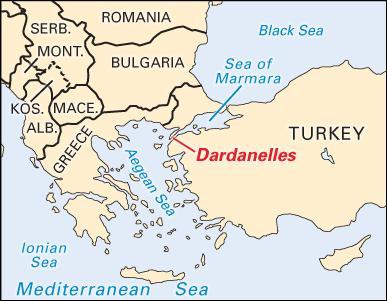
The British and French navies were tasked to force the Dardanelles passage from the Mediterranean to Constantinople and thereby secure a route from the Black Sea for their ally Russia to effectively join their desperate standoff with the German and Austro-Hungarian empires in Europe. From my perspective, a surprise naval strike combined with minesweeping operations this was a great idea of Churchill in his Admiralty cabinet post. But it was executed too slowly, giving the Turks enough time to beef up their artillery at the many small forts along the passage and bring in mobile howitzers. Carylon puts the failure in plain terms:
…the battle for the Dardanelles …is about a riddle worthy of Catch 22. …And the riddle goes like this: the navy couldn’t get close enough to destroy the forts and batteries until the mines had been cleared; the mines couldn’t be cleared because the forts and batteries kept firing on the minesweepers.
So much pressure fell on the admiral in charge that in March he gambled a massive attack by his armada to give the minesweepers a chance to do their work, with an outcome of three battleships sunk and three other warships seriously damaged. If they had only persisted, they might have broken through, as the Turks were almost out of artillery shells and had no more mines in reserve. But instead fate was sealed with a crash plan put in motion by the War Council and Field Marshall Kitchener in London for landing army forces on the peninsula to take the peninsula and silence the artillery cover of the waterway. General Ian Hamilton was dispatched to assume supreme command of the joint forces, without any staff, a clear plan, or even decent maps. Pulling off the landing of nearly 80,000 troops at night by the end of April was quite an accomplishment. But chaos, confusion, and critical mistakes abounded every step of the way.
The first mistake was that Turks and the German supervisors of the Ottoman forces knew of the plans from leaks associated with the assembly of Allied forces in Alexandria and Lemnos. The site of the British landings at the tip of the peninsula (Cape Helles) was well defended, whereas that for the ANZAC forces further up the western side of Gallipoli was mistakenly made at an unpropitious beach surrounded by steep hills but easily defended by the small force at hand. Kemal Mustafa (the future Attaturk) and his German commander Liman von Sanders brilliantly marshalled their limited and poorly equipped troops and artillery to restrain the advance of the Allies and keep them off the commanding ridges. As time went on, each step the Allies made in garnering more troop deployments out of Kitchner was met with more Turkish troops and infusions of German armaments.
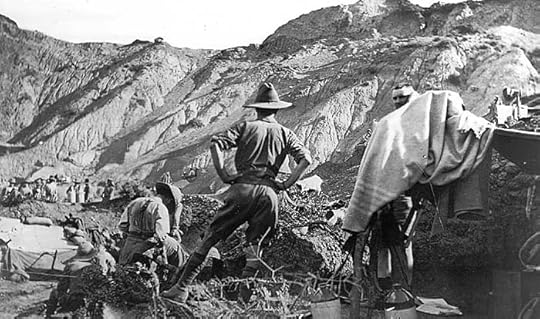
Rough country facing the Anzacs after their mistargeted landing via towed barges on the night of Apr. 25, 1915.
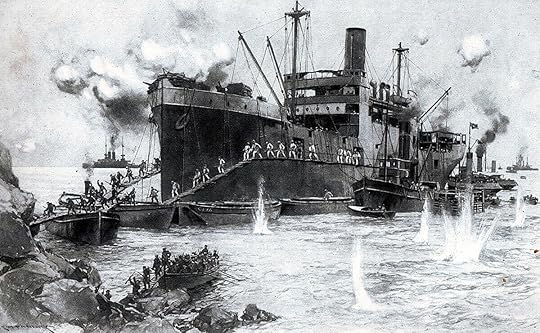
Illustration of “hot landing” for British troops landing at “V Beach” at Cape Helles, achieved by running the collier troopship “River Clyde" aground.
Just from looking at the geography and the maps, we can see that the Allies’ ignorance of the geography was a big barrier to the dream of sweeping overland up the long peninsula, especially since the Turks harnessed that knowledge skillfully and were obviously highly motivated to defend their homeland from invasion. In hindsight, we want to ask why the War Council recognize the stalemate for what is was and pull out after the first month. It turns out they weren’t getting a full picture from Hamilton. He suffered from perpetual optimism, and thus failed to convey in his reports to London the dire situation the expeditionary forces were in and the extent of casualties being sustained in reality. Carylon finds him blameworthy for not pressing hard enough for Kitchener to supply the hundreds of thousands of troops that were really needed and consequently ended up getting inadequate allotments in phases. The author digs deep to arrive at a trove of paradoxes in the character of Hamilton and reaches some compelling conclusions on how they likely contributed to his costly failures in leadership. I tuck some choice passages from the author on the man:
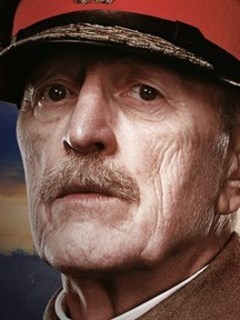
General Ian Hamilton, commander of the Allied forces at Gallipoli. At age 62, he has had 42 years military experience for the British Empire, on top of being a gentleman, a poet, and a friend of Churchill. His failures were rewarded by sacking in October, before the withdrawal of all forces in January 1916. He seems to have been too kind in his leadership and too lenient in letting blundering by his subordinate commanders continue into disasters.
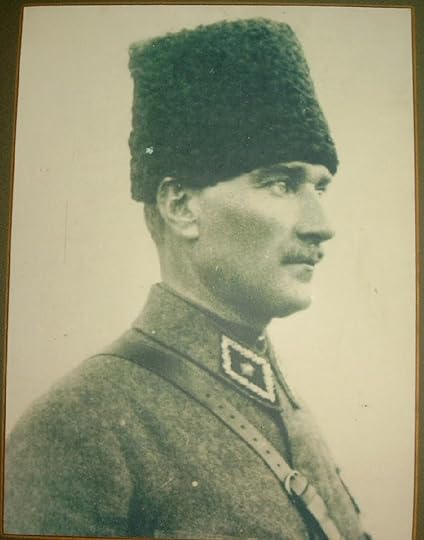
Mustafa Kemal, the inspiring and diligent military captain of the Turks at Anzac in Gallipoli and later commander of the critical 19th division. He was a member of the revolutionary cabal which took over control of the Ottoman Empire in 1908 (Committee of Union and Progress) He later leveraged his success in war to become the first president of the Republic of Turkey in 1923, serving until his assassination in 1938.
Otto Liman von Sanders, the crafty and cantankerous Prussian commander of the Ottoman 5th Army in the war. He bonded well with Kemal and made a smart move in promoting him to divisional command.
The stories of the leaders are well balanced with vignettes revealed from the diaries and journals of the soldiers in the field. After a period of demonizing their opponents and take-no-prisoners attitudes, they soon came to respect their enemies. Both suffered terribly from shortages of water for drinking and cleaning and rampant disease like typhoid and dysentery. On both sides the casualties from disease approached 200,000. As in the trench warfare in Europe, rotting bodies piled up in a no-man’s land or walls of the trenches. The evacuation of the Allied wounded from the hillside battle lines was a nightmare, and long waits on the beaches for boats was extended by a long transport to British colonial hospitals. Donkeys played a big role in this campaign. Accounts of the impact of these factors include many acts of heroism in dealing with the travail, often under constant sniping fire.
From the start, the censored journalism that came out of the war leaned to propaganda. Many of the stories came from the well connected and aristocratic reporter Ellis Ashmead-Burnett. His account of the first days of fighting for the Australian papers puts a mythic, romantic gloss on the fighting:
I have never seen anything like these wounded Australians in war before. Though many were shot to bits, without hope of recovery, their cheers resounded throughout the night …They were happy because they knew they had been tried for the first time and not found wanting…These raw colonial troops, in these desperate hours, proved worthy to fight side by side with the heroes of Mons, the Aisne, Ypres and Neuve Chapelle. …The scene at the height of the engagement was somber, magnificent and unique.
Another important journalist on site for the duration of the campaign, Charles Bean, aimed for accuracy as the official Australian historian. His history completed after the war is a resource Carylon frequently touches base with, yet finds it overall too simplistic and biased in some ways:
Bean wrote that the war was like a crusade to Australians. This was certainly the way the story played in newspapers. Germany was imposing its brutal culture on the world; the Kaiser was the anti-Christ; Belgium and Serbia were victims; democracy needed to be ‘saved.’ …Yes, the Prussian mindset was ugly. Yes, the Kaiser was a reactionary and not very bright, clinging to the divine right of kings while Britain and France worked at what Bean called ‘human progress.’ Yes, Germans committed atrocities across Belgium and behaved like Philistines, wrecking libraries and cathedrals. They, more than any nation, were responsible for the world war starting. Yet it was not so simple as Bean and others saw it in 1914. The Romanovs of Russia, allies of Britain and France, were more reactionary than Kaiser Bill. Belgium indeed knew all about atrocities: it had been committing them in the Congo for decades. Even British democracy was a selective thing. It did not play in Bombay or Dublin (or among Australia’s Aborigines) the same way it did in London or Sydney.
Carylon is particularly pissed at how the journalists, historians, and memoirs of the generals whitewashed some of the terrible faults of certain divisional and regimental commanders in the August escalation of the battle. Ian Hamilton had to take responsibility for the failure of the overall operation and plan, as outlined here:
Whenever one reflects on the Gallipoli campaign, there is the temptation to judge the men and events of 1915 by the values and knowledge of today. To do so is not only unfair; it is an obstacle to understanding. …Had Pilate known what he was starting, he would surely have given Jesus a suspended sentence. That acknowledged, one has to say that the plans for the August offensive …were too complex. …Too many events were contingent on each other. It was like an exotic bet on a series of horse races. If the first leg got up, the second leg was alive; if the third leg didn’t get up, the whole bet was lost. There were to be three new fronts, two on the left of Anzac and one at Sulva, plus diversions at Anzac and Helles. One hundred thousand Allied troops would be in action on five fronts. …The scheme was so fussy and over-cooked that misunderstandings persist about what it was supposed to do. The capture of the Sari Bair heights from Anzac, directed by General Godley, was the main event; the landing at Suvla under Stopford was the sideshow, if a big one. … Suvla would give Hamilton a new base, free from shelling. He could drive southeast from here, into the Sari Bair range and the Turkish flank. This was the crucial point. Owning the Suvla beachfront was no prize. The troops at Suvla only mattered when they moved to threatened something.
Doddering old General Stopford of the administrative only experience had seniority for a battlefield position that put him in charge of the new landing at Suvla Bay. The landings went off well, but he failed to pursue the easy mission to secure the high ground beyond the beaches, allowing strong Turkish forces to take up a commanding position during the night. He was later sacked for the ensuing costly defeats on that objective. Carylon feels that Stopford is used as a scapegoat for the even more egregious actions above Anzac beach during the August initiative. It was there that General Godley was tasked by overall ANZAC commander Birdwood to take the hill Baby 700 through the narrow valley called the Nek, who handed the task to General Hughes who in turn left it up to a Colonel Antill. Carylon paints him as a martinet and bully who in the Boer War “had the whiff of Custer: he liked to gallop at enemy guns”. Despite the planned condition of a diverting attack by New Zealanders from the Turk’s rear being absent, he the attack proceed with “grit and determination” and his subordinates carried out wave after wave of bayonet attacks though the Nek, each mown down by converging machine gun fire like wheat. That is the powerful scene we see at the end of the Weir movie. Rather than knowingly directing a certain suicidal attack like the movie suggests, Carylon sees it as more like a robotic neglect assuming the proportions of murder:
Antill behaved like he always did, like a bull strung up in barbed wire. Antill gave orders without finding out what was happening. He could easily have justified calling the attack off; the failure of the first line proved the objective was unattainable.
This disaster was subject to widespread neglect in coverage: The incident at the Nek was like incest: no one in the family much wanted to talk about it. Everyone in authority felt guilt that such a thing could happen. They became a mutual protection society and offered the occasional alibi.
Hamilton gives the slaughter there no mention in his 700-page memoir. In Godley’s autobiography (“a book of surprising shallowness”), he wrote of how the attack succeeded in “drawing the enemy’s reserves away from the main attack” (Suvla), which is “the rhetoric one falls back on to dress up defeat as victory”. Antill’s account was similar in noting the attack would have been of value if Suvla forces had done their job.
After the failure of the August attacks, Ashmead-Burdett broke the chain of communications and voiced his despairing opinions about the futility of the whole campaign in a letter he wanted to convey to PM Asquith. He was particularly concerned about the prospects of winter killing so many from cold and flooding of the trenches. He declaimed the August offensive as “the most ghastly and costly fiasco in our history since the battle of Bannockburn …the muddles and mismanagement beat anything that has ever occurred in our military history …”. He asked budding Australian journalist Keith Murdoch (Rupert’s father) to deliver the letter. Instead he wrote his own letter with similar points, ostensibly for his own PM, but which was passed by Lloyd-George to Asquith, who surprisingly made it public as an “official document.” Murdoch published stories calling for Hamilton’s dismissal. And soon that came to pass. He also had particular venom for the upper class managers of the campaign:
The conceit and self-complacency of the red feather men are equaled only by their incapacity. Along the line of communications, and especially at Mudros, are countless high officers and conceited young cubs who are plainly only playing at war. What can you expect of men who have never worked seriously, who have lived for their appearance and for social distinction and self-satisfaction, and who are now called upon to conduct a gigantic war?
It has often been said that the contribution of Australia and New Zealand to the war made them feel for the first time like worthy players on the world’s stage. Carylon feels they were ill used and their sacrifices a great shame. Carylon digs deeper on why Australia would sacrifice so much for Britain, and concludes simply that “Australians saw themselves as transplanted Britons. A war against England was a war against them”.
Carylon finds a sad irony in so many Anzacs travel to the remote battlefields of Gallipoli and visit the scattered gravesites in the stony wastelands where so many are buried, often in mass graves. Many survivors found themselves in continuing perplexity over why they felt so alive in their time here despite or somehow because of being so close to death nearly every day. At a ceasefire to allow retrieval of the dead, a Turkish officer told a Brit one of this paradox they shared: At this spectacle, even the most gentle must feel savage, and the most savage must weep.
Les Carlyon's new book (published in 2001 in Australia) covering the Allied campaign against Turkey in the Dardanelles is one of those books that you find hard to put down once you start. In over 540 pages of narrative we get to hear the soldiers speak of their terrible trials and tribulations fighting in a harsh environment against a formidable enemy.
The book's main focus is upon the Australian involvement but the author does not neglect the role of the other Allied contingents, soldiers and sailors of the British and French Empires. Nor does his forget the enemy, 'Johnny Turk', who many Australian soldiers later came to respect regardless of the horrific fighting that they had endured.
I suppose many people will ask why Australia continues to make such a fuss over Gallipoli. When you take into consideration that the Australia of 1914 sent out of its small population over 332,000 men to serve overseas and of those 215,000 or more became casualties, (of which 60,000 died). A casualty rate of 65 per cent. Taking those figures into consideration you get an idea of why WW1 and particular Gallipoli means so much to many Australians.
The book is well told and the author uses numerous first-hand accounts of the soldiers, from both sides, who fought during this campaign. The narrative is engrossing, full of interesting facts and stories and just pulls you along further and deeper towards an ending we all know but made more alive and new by the author's style of writing.
I don't think that this book will offer any serious readers of this campaign anything new or startling, but I think that anyone who has a passion for Gallipoli will find this a well told account and close to being the definitive book on the subject. Many aspects of the book, particularly the stories of the blunders made by the Allied High Command still make me shake my head even though I have read it all before.
"We mounted over a plateau and down through gullies filled with thyme, where there lay about 4000 Turkish dead. It was indescribable. One was grateful for the rain and the grey sky. A Turkish Red Crescent man came and gave me some antiseptic wool with scent on it... The Turkish captain with me said: "At this spectacle even the most gentle must feel savage, and the most savage must weep' ... I talked to the Turks, one of whom pointed to the graves. 'That's politics,' he said. Then he pointed to the dead bodies and said: 'That's diplomacy. God pity all us poor soldiers.'" - Captain Aubrey Herbert, ANZAC, May 1915 (taken from the inside dust-jacket of the book).
On the seafront at South Shields is a little stone monument. It commemorates the men of the British and ANZAC forces that fought at Gallipoli, and it looks out over the beach, the harbour and the North Sea. Further into town is a statue of a man in battledress, without web gear, with a donkey. It's beloved of the seagulls, and every April and May it sprouts poppy wreaths from strange, far away places.
That's why I came to this book. It's very focussed on the Australian and New Zealand experience of Gallipoli, but that's ok, because it's written by an Australian and everyone's entitled to their own take on the experience, and the book is even handed in the extreme. Mr Carlyon doesn't mind calling a spade a spade, and incompetency wore all manner of unit patches.
The book reads, to me, like a conversation with a mate down the pub ("You'll never guess where I ended up on holiday...") The peninsular obviously means something important, because it's described in such vibrant, colourful detail and the reverence in each description of the battlefields as they are today is obvious. The research is wonderful, but the real standout parts for me are the author's musings... the nature of legends and the random nature of who is picked out for rememberance being standout parts of the book for me, as was the enduring nature of the men who fought in such awful places... certainly no place to hold a war.
So I would recommend this to anyone with an interest in World War One, or Australian history. This one will stay with you for a long time.
I devoured this book. An odd choice for a pacifist to curl up with, I suppose, but it's a well written and clear-eyed account of the fascinating, heart-breaking Dardanelles campaign.
Gallipoli looms mythically in the Australian consciousness, and Carlyon is an Australian writer - but he aims to tell it how it was, as much as he can. It wasn't only the British leadership who bungled; it wasn't only the Australian and New Zealand troops who were heroic and cheerfully stoic. Carlyon takes a wide view of this episode that was indeed part of a 'world war', and considers not only the Anzacs and the British, but also the Irish, French, Gurkhas, Turks and Germans. The focus is on the Australian experience, but that's not the whole story, and Carlyon deals as fairly as he might with everyone involved.
It's hard to know what more to say. As Carlyon himself concludes, "Gallipoli ... is a tale of all that is fine and all that is foolish in the human condition." It's epically frustrating to read of the useless sacrifice of life and health throughout the campaign, in many instances when the leadership involved surely should have known better. If they didn't know better at first, that might be understandable, as the nature of war was changing apace - but it seemed they were very slow to learn as well, and that is harder to forgive. But then - but then! - months of tragic waste is followed up by a perfectly planned and executed withdrawal of troops, in which there were two minor injuries and no deaths (amongst the Allies). The Turks had guessed it would occur, but didn't even realise it was happening - until the bombs and mines left behind were triggered. Not a gentlemanly way to say farewell, perhaps, but then individuals left behind their food for the Turks as well. If the Allies' offensive campaign had been conducted as efficiently and carefully as the evacuation, then the story would have played out very differently indeed.
Well. Enough from me. If you only ever read one book on Gallipoli, I suspect this would be a very good choice.
I'm no expert on the Great War, but if Carlyon's account is anything to go by, Gallipoli was the pinnacle (or nadir) of a pointless war, fought incompetently. The campaign was an ill concieved idea of Winston Churchill's, championed by Kitchener and catastrophically pursued by the various generals appointed to carry it out.
For those who may not be familiar, the Gallipoli campaign was basically the invasion of Turkey (via the Dardanelles) by the Allied forces in 1915, aiming to open up a second front against Germany. The invasion stalled on three beachheads almost immediately, due largely to shockingly bad leadership at most levels and never achieved even its initial objectives. In all, over the eight months of fighting, it generated some 130,000 deaths and 240,000 casualties on both sides.
I used to be able to read books like this (large, in depth military histories) with little problem, but my tastes have changed over the years and I now find them a lot harder to wade through. I was initially worried about this one as it seemed to be exclusively about the ANZAC experience of the campaign (reasonable enough as it was written by an Australian for the Australian market) but, after a few chapters, it became clear that it was a less partial and, while the ANZAC story still takes precedence, the book covers the British campaign and the Turkish defence as well. I was surprised to discover that the French had a significant presence on the Gallipoli penninsula although they get rather less coverage in the book.
This turns out to be an absorbing and fairly easy-to-read history of the campaign. It isn't perfect and I found the telling of the story to be fractured, confused and in some places downright illogical. However, I am beginning to think that part of the problem is that the battle was itself shambolic in its conception, planning and execution: so, if you're looking for an explanation of the motivation for the campaign, the strategic aims or even a coherent plot to the story ... well, there was none! The book pulls no punches in exposing the poor planning and weak or brutal generalship. By contrast, it highlights the suffering and martyrdom of the thousands of soldiers on both sides of the line: lions led by donkeys, indeed. It also dispels the myth that Gallipoli was a largely Australian battle and that the Diggers suffered at the hands of incompetent British generals. More British (indeed, more French) soldiers lost their lives than did ANZACs and there were a healthy dose of blundering Aussie generals too.
Carlyon's personal feelings come through strongly in the writing which gives the book a human, readable flavour and his description of the slaughter of the Australian Light Horse at The Nek has to be one of the most horrifying yet poignant and moving passages that I have ever read. In some cases, his feelings sometimes get the better of him and sarcasm drips from the page, generally when he describes the behaviour of the British and Australian "leaders". Read his "stream of consciousness" description of Stopford's behaviour during the Suvla landings, Godley at The Nek or this one about the brutal and unimaginitive British General, Aylmer Hunter-Weston.
"Just about everything Hunter-Weston had done at Helles had failed. Which would explain why ... he was promoted to lieutenant-general and made a corps commander. Had he managed to take Achi Baba, he possibly would have been made Archbisop of Canterbury."
True, perhaps, but not entirely appropriate for a serious historical account?
My main gripe is the lack of decent maps. There are a few scattered through the book, a large scale one of the Mediterranean theatre and several fine scale maps of individual battles or skirmishes, but none that clearly shows how the two sides were arranged against one another.
Such minor complaints aside, after working at this for a couple of chapters, I eventually found my feet and began to enjoy the story and I can recommend this as a fine account. There may be better historical treatments elsewhere, but for readability this is certainly well worth a go.
At 4:30am on April 25 the first troops landed at Gallipoli, a place that has passed into Australian legend. However the campaign turned into a debacle - one which started when the troops landed at the wrong beach. The author of the Gallipoli scheme was Churchill. His "excess of imagination" together with the "fatal power of a young enthusiasm" saw Gallipoli as "something that would put him in the history books". Carlyon captures in a very readable way, the details of the logistics and terrain as well as the battlefield and the politics. The reality of war comes home with Carlyon's anecdotes of the people who fought there - both Allied and Turkish. At 543 pages Gallipoli is long and would have benefited from a heavier editorial hand. It's 130 pages and seven chapters before the troops have even landed. Not all of this adds to the reader's understanding of the campaign. However Carlyon's Gallipoli will reward those seeking an insight into a part of Australia's history.
Took me about a long time to read as so much to absorb but felt the book was a real eye opener to the Gallipoli campaign, and a harrowing account of the soldiers' experience.
I picked this book up on a whim, I was bored and I had a weekend to myself and I needed something to do. Its a subject I only really knew through the Mel Gibson movie from the early 80s and a few mentions in articles and such over the years, i had gleaned from these few sources that it was a disaster of epic proportions but was generally clueless. After reading Carlyon's well written well researched no punches pulled account I was dramatically moved by the horrors of war and I honestly thought I was immune. Its clear Gallipoli means something deep to the author and it comes across in the book. I enjoyed this book thoroughly and I was genuinely sad when I turned the last page as a great experience was over, I dont have much to say except that i wholeheartedly recommend it, not just to war buffs but to people who are interested in heroism on both sides and just what humans can endure under appalling conditions
To me in these difficult, unproductive time of my mid thirties, when again I fell in love and away at the same time. I can say for now that this book is as good as any other great book that says all truth about past, to the very same reader who can live through that, though book, not these causes of that dramatic moment in our history. and become bather person.
For me definitely to read again
There is always a chance that I will read them with her, growing between ourselves the very same interests we already share. I even don't know if I'm not missing opportunity to train with her physical exercises and all the talks we could have out of books we have. Missing being with her like missing intellect.
After recently walking the battlefields on the Gallipoli Peninsula, this book had great personal significance to me. I visited every Australian grave that was marked there and stood in the presence of the thousands that weren't. This account focussed the deep sadness and the great anger that dominated my heart and soul as I stood before those graves. The courage and determination that were demonstrated in that place by men who were essentially inexperienced as soldiers deserve our undying admiration. That however should never drift into sentimental nationalism, nor the jingoism and politically motivated nonsense that is being drummed up now by our politicians around these events. They do that for their own purposes as they whittle away the benefits of their veteran' so recently returned from the latest bunch of debacles our erstwhile leaders commit them to.
What we must remember, as well as the heroism and tenacity these men displayed minute by minute, hour by hour in the face of hopeless and what should have been overwhelming circumstances, is the conduct of their leadership. The arrogance and ineptitude that was the British High Command was personified by a dithering Hamilton who commanded the whole campaign, Kitchener who appointed him, Stopford who was simply a coward and Hunter Weston who was just a mindless butcher. Needless to say none got their come uppences for their abject failure to provide any leadership, but were either mildly rebuked or indeed rewarded with higher commands....and let's not forget Churchill, who conceived the whole debacle and who despite his later role in WW2 was always a man more concerned with his own place in history than anything else, particularly the lives of young men. He was in this instance, as always ruthless in his pusuit of his personal glory.
Let s not either, forget the response of our Australian politicians who true to the form of those who followed them, wanted to push the whole tragedy under the carpet lest it interrupt their plans to funnel yet more lives into the maw of the western front in support of their precious ideals of empire. It was Hughes, little turncoat backstbbing prick that he was, who promoted the idea of "crucible that birthed a nation". That served his political purposes. Of course his politics was the same as Menzies who did him proud leading us into WW2 and making the decisions he did in support of England, content top leave Australia's defences against the Japanese denuded as a result. Had they invaded no doubt he would have fled. Not much personal courage there either.
I did learn something I did not know however, and that was something of significance; the role of the Kiwis at Chunuk Bair. As courageous an action as any feat of arms in history before or after. Particularly the role of their commander Lt Col Malone, a great soldier beloved of his men who was killed during the assault and never recognised for his magnificent effort. Not part of the "club" that the high command belonged to, not averse to refusing a stupid oreder and fighting for his troops in the face of abysmal stupidity of higher commanders, who were never able to take advantage of any of the opportunities bought so dearly with blood; the blood often of our countrymen. Were I to become the Prime Minister of New zealand I would move to award the VC to Malone posthumously,on the 100th anniversay of that great action of capturing those heights, even if for such a painfully short time.
Every Australian and New Zealand high school student should be led through this book so that at least there could be no illusions about what we commemorate every April 25th.
On the 8th of August 1915 my Great Grandfather John Brotchie was fighting his way up the Damakjelik Spur on Gallipoli. He was there as a volunteer fighter, part of the 14th Battalion force under the command of Colonel John Monash. Due to poor direction from Monash and his British superiors, the 14th Battalion became lost and isolated in brush scrub just before dawn. When the sun came up on the Battalion was out of position and fired upon heavily by Turkish forces entrenched on the high-ground at Alai Tepe. An excerpt from my Great Grandfather's effort to find cover from the Turkish guns appears on page 431 of this book. To put it bluntly, its sounds like absolute hell.
Les Carlyon's epic is an extremely honest account of the utter calamity that the Gallipoli campaign was for the British Empire. It exposes not only the brutality of the war waged on the peninsula including during the August offensive, it also details how ineffective the leadership of the British commanders was and why.
But more importantly, perhaps, the book isn't afraid to delve into the reasons why the butchery that occurred over those 8 months and cost nearly 503,000 lives for no apparent benefit to any of the main belligerents, has become such an important part of the Australian identity and psyche for an entire century.
Whilst I had a personal reason for wanting to understand the ANZAC history to reflect on how it affects my Australian sense of identity, I encourage every Australian to read this book themselves to demystify the legend that has become embodied in the term ANZAC. The reality, when one reads it, is that the horrors of this campaign are a far stretch from civil pageantry which commemorates it today.
To all those who say Lest We Forget on ANZAC Day and wish to understand what we indeed shouldn't forget, this book is an absolute must.
A fabulous story written by a historian who could write. After seeing P Weir’s film I was under the impression that what was most shocking was how the English officers used the ANZAC troups as cannon fodder. Actually they also used their own for that purpose. What is shocking is how incompetent they were. They had a total disregard for the life of their guys and basked themselves in a clubish atmosphere where all that counted was to fight “gallantly”. The politicians were hardly better but that is to be expected. 150,000 allied casualties (250,000 Turkish) for a beach front that was a few miles wide and only a few hundred yards deep!
Another conflict that shaped our world nearly a century ago. Interesting to learn of the decision processes of the time in England and Australia and the growth of young Winston Churchill. Interesting though it was, this was kind of a long, slow read.
World War I is known for the massive assaults where hundreds of thousands of men faced off against each other in deeply entrenched positions. Battles were generally exercises in masses of men charging across open territory trying to dislodge and defeat men with machine guns. Tens of thousands died on both sides in a single battle and on the western front, the front line rarely moved more than a mile or two. Most attacks were prefaced by massive artillery bombardments that sometimes lasted for days. The Allied attack on the Turkish territory on the west side of the Dardanelles straight was a sideshow front relative to the battles that took place on the eastern and western fronts. Yet, it did have the potential for the highest reward for the risk of any of the other fronts. For if the Allies would have been able to take control of European territory of the Ottoman Empire, the Turks would have likely sued for peace. With the Ottoman Empire out of the war, Russia and the Allies would have been able to move freely through the straits and the Black Sea. Badly needed military equipment and supplies could then have been transported to Russia. Therefore, Winston Churchill was probably right in his insistence that the Allies carry out the attack that is now known as the Gallipoli campaign. However, in a war known for the simple-minded incompetence of the commanders, this battle was probably the most poorly led and executed of the entire war. It ended with an ignominious withdrawal by the Allied forces. As Carlyon states, the attacking forces largely didn’t know anything about the terrain, climate or morale of the opposing Turkish forces. They carried out the invasion lacking vital munitions, food, water and medical people and equipment. Despite the obvious lessons for the need for artillery support to destroy defensive positions, the attackers had only a minimum amount of artillery. They also suffered from the arrogance of believing that when they arrived the Turkish forces would simply retreat in terror, leading to an easy victory. This book is the definitive description of this battle, how it was conceived, conducted and finally abandoned with heavy loss. Carlyon also describes the morale and motivation of the troops of the Australian and New Zealand contingents. While independent, at the time the British ties were still strong, and these men willingly enlisted to fight and die in one of the most pointless fronts of the war. It is easy to come away from reading this book surprised that Winson Churchill was able to eventually rise from the ashes of this debacle.
Gallipoli, by Les Carlyon, describes the horrible battle from the perspective of the Australians. However, the author also includes some perspectives from some of the other allied powers fighting in the battle. The story begins with the opening battle at the Dardanelles all the way through to the evacuation of the allied troops after horrible deadlock and attrition. The author describes the battle with such vivid tones that send your mind to wild images of the harsh struggles that the men experienced. Carlyon uses exceptional literature when describing the tone of the battle and the aftermath. The way he puts you in the place of the naval officers, the French, the British, and the Australians are very moving. The struggles that these men went through were so horrifying that most find it hard to write about. Carlyon uses a lot of symbolism throughout the book that helps give you a solid idea of the suffering that these men went through.
Les Carlyon clearly wrote this for a certain market, that being the Australian Father’s Day Gift market, and he panders to his market well. Consequently there are little anti-British jibes throughout that would confuse any reader without a sense of irony (so there’s the US market gone). He alternates between the politics of the British government and military High Command and anecdotes of life in the trenches that will make you laugh, cry, be outraged and feel a little bit sick in a regular rotation. A constant theme of the book is that the terrain at Gallipoli is incomprehensible and although they do their best with the maps to explain what happened it is still confusing. One comprehensive map that displayed all the topographical features that were mentioned in the text would have assisted enormously.
A lucid account of Gallipoli campaign, which was to result in taking Constantinople from German allies Turks and handing it over British allies - Russians. Thought out by Churchill and Kitchener lasted eight months and ended up with over half a million casualties, including over one hundred thousand of them killed. A story of heroism of the trench soldiers and officers and incompetence of the senior officers leading from the distance of their ships or neighbouring islands, without any knowledge of terrain and abilities of their opponents. The author covers both the strategy and implementation of this wasted effort that ended up in evacuation of British and French forces at the end of 1915 and early 1916. Highly recommended.
What an impressive book — engaging, intriguing and excellently researched. Carlyon clearly had a point of view he wished to express when he wrote this book — anger at the appalling loss of life through ridiculous leadership of the British (including Australians and New Zealand commanders at times). BUT he is angry in context. He tries to understand WHY the British leadership was so poor and this is the book's strength. He is writing eighty years after the events but examines what occurred with humanity and does not take the easy way out by just saying all the British leadership were bunglers because they were by definition. This is a gripping book and deserves the accolades it has received.
I really enjoyed this book. Carlyon writes as a journalist, so it is less formal than a history and full of personal opinions, sarcasm and smart arse remarks - very Australian in style! Carlyon draws mostly on diaries, letters and memoirs from the participants. He covers the campaign from all perspectives. He highlights the stuff ups and he is unsparing in his criticisms of most of the generals. However, he lets them off in a sense by attributing their failure mostly to a lack of understanding of the nature of warfare in the 20th century. Overall a great book which gave me a much deeper understanding of ANZAC and its role in Australian society.
An outstanding book on a number of different levels. I was in awe of his research and even his endnotes and bibliography were staggering. I don't know how you would even start to write a book on this subject but it is essential reading for anybody even slightly interested in Australian History. The folly of war is at the centre of the book and the exploration of the Australian identity and culture due to what happened at Gallipoli is fascinating. It is a very long book with a lot of detail but it is well worth the time and effort to read.
This is a very detailed coverage of the Gallipoli campaign from an Australian (and New Zealand) perspective. The author uses irony widely and I found myself laughing from time to time. Overall though, I found the book plodded. I was also irritated by the author's continual use of Brigadier General. There is no such rank in the the British or Commonwealth Armies. This is an American rank. To me this reduced the credibility of the work.
A very dramatic book telling in detail the History of the WW 1 Battles for the Dardanelles area . It is replete with mistakes by all sides in Particular the British and their born to rule attitude. The Australians were sacrificed along with the New Zealanders and Turks and French. Australia would be a different country with all the men lost to disaster.
Having never read any book re Gallipoli previously I found this book interesting and equally terrifying. It’s hard to say you enjoy a book that focuses on wholesale incompetence that leads to so many deaths.
The bravery of the many who died should not be forgotten but the senseless waste of life, highlighted throughout, by the great descriptive writing emphasises the futility of this battle.
Such a great book. So well researched and told by Carlyon. Conveys the feelings of adventure, patriotism (sometimes blind), terror and surprise. Some decisions made are unbelievable yet the courage that followed leaves you amazed. Comprehensive.