Award-winning civil rights historian Ray Arsenault describes the dramatic story behind Marian Anderson's concert at the Lincoln Memorial―an early milestone in civil rights history―on the seventieth anniversary of her performance.
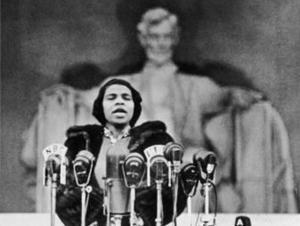
On Easter Sunday 1939, the brilliant vocalist Marian Anderson sang before a throng of seventy-five thousand at the Lincoln Memorial in Washington―an electrifying moment and an underappreciated milestone in civil rights history. Though she was at the peak of a dazzling career, Anderson had been barred from performing at the Daughters of the American Revolution's Constitution Hall because she was black. When Eleanor Roosevelt resigned from the DAR over the incident and took up Anderson's cause, however, it became a national issue. Like a female Jackie Robinson―but several years before his breakthrough―Anderson rose to a pressure-filled and politically charged occasion with dignity and courage, and struck a vital blow for civil rights.
In the 1963 March on Washington, Martin Luther King would follow, literally, in Anderson's footsteps. T his tightly focused, richly textured narrative by acclaimed historian Raymond Arsenault captures the struggle for racial equality in 1930s America, the quiet heroism of Marian Anderson, and a moment that inspired blacks and whites alike.
Marian Anderson, the celebrated contralto of the twentieth century was a pioneer in the Civil Rights movement and best known for her historic concert on Easter Sunday, April 9, 1939, in front of the Lincoln Memorial. Anderson, an NAACP Spingarn Medal recipient, had hoped to hold her concert at the DAR's Constitution Hall in Washington, DC but was denied by the women's organization due to her race. In 1939, the southern United States was still very segregated and held to Jim Crow laws. The focus of Arsenault's book is the history of the events leading up to the concert, the DAR's controversial decision, and the subsequent fallout.
Throughout her life, Marian Anderson stood proudly and conducted herself as a strong, yet humble woman. Her actions and reactions to the discrimination she faced throughout her career, particularly with the DAR's decision showed that she was worthy of the many accolades she received during her lifetime. Arsenault does an excellent job of covering Anderson's history while zoning in on the specifics of the concert that seemed to be a defining moment for Anderson and the Civil Rights movement pre-WWII. Part biography, part micro-history of that historic event, The Sound of Freedom is a must read. It gives the reader a different perspective of the Civil Rights movement through a specific event while celebrating the life of the iconic singer.
Marian Anderson - April 9, 1939 - The Lincoln Memorial Concert
I had opened this book thinking it would tell of an epic moment in civil rights history: the 1939 Lincoln Memorial concert by Marian Anderson. The book is much more than that. To understand how Marian Anderson got to that point, the author has given us a book of her life and times. We learn how a woman with limited access to formal education managed to find the music training to become not the finest African-American singer of her day but the most celebrated American concert singer of her day, period - and, since her repertoire included classical and opera music, becoming fluent in four other languages as well, and all this as the Depression set in.
Toscanini told her, after a brilliant concert in Austria, that her voice was one that came along only once in a hundred years. It's scary to think that that voice and that talent might not have come to fulfillment. As a Houston reviewer would write in 1938 of yet another standing ovation, "And there, you thought, but for the Grace of God, stood somebody's negro cook." And, as the author has made us understand, it such a compelling talent that, when she came to Washington in 1939, that the confrontation arises. She commanded audiences and critical acclaim, and it was for that reason that Constitution Hall seemed a worthy venue.
The author also provides, without digressing too far from Marian Anderson's story, considerable background on American music, culture, and society - and America's corrosive Jim Crow culture, particularly in Washington. It's startling to learn that not only was Constitution Hall off-limits, thanks to the DAR's white-performers-only policy, but no suitable venue was open to Marian Anderson - including, thanks to the Washington school board - the theater at Central High School. This for an artist who had performed at the White House, three years before. No respectable Washington hotel would admit her, either, and we find that she stayed at a private home.
The book's climax, of course, is the Easter 1939 concert, for which Eleanor Roosevelt, and Harold Ickes, among others, would substitute the Lincoln Memorial for Constitution Hall. This was the first time a major cultural and historic event took place there, outdoors, to an enormous crowd. That place has seen much more such events since then, notably the 1963 March with Martin Luther King, and a pre-inaugural 2009 celebration for Barack Obama. We're accustomed to that now. But she was there first, and in an event that was something of a thunderclap in the American experience. The book does not neglect the impact that event had, in its time and since.
I had a resolution to expand my reading to new genres. I've typically struggled to finish non-fiction books, but this was amazing. I learned so much about this graceful woman and how she quietly helped move the color bar in the United States, well before the Civil Rights movement of the 60's. She was a quiet groundbreaker.
I recently had the pleasure of hearing Ray Arsenault talk about Marian Anderson's remarkable life, which inspired me to read this book. He said that a student once asked him who Anderson was and he replied that she was the classical music version of Jackie Robinson, To which the student responded, "who's Jackie Robinson?" That is why we need books like this one and movies like Hidden Figures and 42.
Marian Anderson was not the first black singer to succeed in classical music, but she was among the first and was extraordinarily successful, an international star. Further she helped change the conversation about race in America. When the Daughters of the American Revolution banned her from Constitution Hall because she was black, her supporters organized what became the first concert at the Lincoln Memorial, in 1939. "Through the Marian Anderson protest concert we made our triumphant entry into the democratic spirit of American life," wrote Mary McLeod Bethune.
Anderson was for many years among the most admired women in America, received countless awards, became the first black singer at the Metropolitan Opera and was a U.S. Delegate to the United Nations. Pretty amazing for a poor girl from a Philadelphia.
Arsenault wrote: "Attending an Anderson concert could be mystifying, not only in the emotional intensity of her voice, but also in disrupting and contradicting a lifetime of racial socialization." If you read this book, be sure to go to YouTube and listen to some of the recordings.
In 1939, Marion Anderson had been refused the right to perform at the Daughters of the American Revolution's Constitution Hall. Although she had sung at the White House, sung for heads of state and royalty across Europe, and had an extensive following, of black and white Americans, she was denied because she was black. Eleanor Roosevelt resigned from the DAR and became one of her strongest supporters and Marion Anderson rose to this personal challenge with quiet dignity and great poise. On Easter Sunday in 1939, she sang on the National Mall, the Lincoln Memorial behind her before an audience of 75,000 people. (If she had sung at Constitution Hall, the audience would have been about 4,000). Almost 25 years later, Martin Luther King would walk in Anderson's footsteps on the Mall.
Historian Raymond Arsenault provides a detailed look at racial tensions in the 1930s and decades of Marion Anderson's efforts for change.
"There is hope for America. Our country and people have every reason to be generous and good . . . All the changes may not come in my time; they may even b left for another world. But I have seen enough changes to believe that they will occur in this one." 1956
This was a terrific book about an important story. Well and thoroughly researched (with almost half of the book given over to footnotes and a bibliography), the author tells the compelling story of famed contralto Marian Anderson, who was banned by the DAR from singing at Constitution Hall in DC in 1939. With the help of first lady Eleanor Roosevelt, Anderson performed instead at the Lincoln Memorial, drawing a crowd that was memorable both for its unprecedented size and for its unsegregated audience. While Arsenault sometimes waxes a bit too poetic about Anderson and the concert, the chapter describing the event is worth the whole book, capturing the moment that was singular for its artistry and for its historic importance to the Civil Rights movement. I supplemented with some YouTube clips of the event, but the book does an even better job of capturing that unique moment and the remarkable woman who became an icon of America's democratic ideals in practice.
This was a very well researched interesting book. I will admit before I listened to a podcast about Marian Anderson I didn't know very much about her. Afterwards I wanted to learn more so I looked up the available books on her and this one caught my eye. The author wrote an engaging well written story about an amazing woman and he did a great job of putting her story in context of the times in which it occurred. I highly recommend it!
It was great to learn about this icon. Some of the facts about her life, I really did not know. But I admire her stance, her resilience. Being a singer, this was a good read for me as well. I like dit a lot.
This book is a biography of an event, Marian Anderson's landmark 1939 concert at the Lincoln Memorial. The concert was the first large public event held at the Lincoln Memorial, and the choice of location was precipitated by the Daughters of the American Revolution and their racially motivated refusal to let Anderson perform in their Constitution hall, despite the fact that Anderson was one of the most popular and renowned classical singers of the day. Arsenault also provides us with the rest of Anderson's life story as well as an examination of the ways in which the musical world was segregated in the 1930s as background for the 1939 concert. The Sound of Freedom was extremely interesting. I did not know much about the 1939 concert before, and Arsenault does a great job of portraying the way art and politics converged around it. Arsenault does not mince words or pull punches when discussing the racist policies and practices of pre-war America, which gives the events leading up to the Lincoln Memorial performance more resonance and meaning.
I had opened this book thinking it would tell of an epic moment in civil rights history: the 1939 Lincoln Memorial concert by Marian Anderson. The book is much more than that. To understand how Marian Anderson got to that point, the author has given us a book of her life and times. We learn how a woman with limited access to formal education managed to find the music training to become not the finest African-American singer of her day but the most celebrated American concert singer of her day, period - and, since her repertoire included classical and opera music, becoming fluent in four other languages as well, and all this as the Depression set in.
Toscanini told her, after a brilliant concert in Austria, that her voice was one that came along only once in a hundred years. It's scary to think that that voice and that talent might not have come to fulfillment. As a Houston reviewer would write in 1938 of yet another standing ovation, "And there, you thought, but for the Grace of God, stood somebody's negro cook." And, as the author has made us understand, it such a compelling talent that, when she came to Washington in 1939, that the confrontation arises. She commanded audiences and critical acclaim, and it was for that reason that Constitution Hall seemed a worthy venue.
The author also provides, without digressing too far from Marian Anderson's story, considerable background on American music, culture, and society - and America's corrosive Jim Crow culture, particularly in Washington. It's startling to learn that not only was Constitution Hall off-limits, thanks to the DAR's white-performers-only policy, but no suitable venue was open to Marian Anderson - including, thanks to the Washington school board - the theater at Central High School. This for an artist who had performed at the White House, three years before. No respectable Washington hotel would admit her, either, and we find that she stayed at a private home.
The book's climax, of course, is the Easter 1939 concert, for which Eleanor Roosevelt, and Harold Ickes, among others, would substitute the Lincoln Memorial for Constitution Hall. This was the first time a major cultural and historic event took place there, outdoors, to an enormous crowd. That place has seen much more such events since then, notably the 1963 March with Martin Luther King, and of course the celebration for Barack Obama. We're accustomed to that now. But she was there first, and in an event that was something of a thunderclap in the American experience. The book does not neglect the impact that event had, in its time and since.
This book is about one of the great moments in the history of the Civil Rights movement and in the history of the United States, but there’s even more to this fine work of history. This year marks the seventieth anniversary of Marian Anderson’s landmark concert at Lincoln Memorial. While the focus of the book is on that event, Arsenault also provides a biographical portrait of Anderson’s life up to the time of the concert, as well as a social and cultural portrait of the times that shaped her and led to her historic performance in the shadow of the Great Emancipator.
I was familiar with the bare bones of this story—that Anderson, despite her international renown as a singer, had been denied the opportunity to sing at Constitution Hall, the District of Columbia venue owned and operated by the Daughters of the American Revolution. The DAR refused to back down in the face of heavy criticism for the decision and asserted that it was merely following local custom in Washington, which was a segregated city at the time.
Thanks to the actions of First Lady Eleanor Roosevelt and a host of other distinguished Americans, Anderson was instead given the opportunity to perform at the Lincoln Memorial on Easter Sunday, 1939. The event, which drew a crowd of 75,000 and was heard by millions on a coast-to-coast radio broadcast, was more than an artistic triumph—it was a victory for human freedom.
Although this is a scholarly, well researched work, Arsenault’s narrative does an outstanding job of capturing the electrifying spirit of that transcendent moment. The subtitle of this book includes the phrase “the Concert that Changed America.” Assertions of this nature seem to be all too common in book titles these days. But in this case, it’s not hyperbole; it’s fact.
After reading this meticulously researched book one does gain a better understanding of the Civil Rights movement and how one person can make a difference.
I think everyone has heard of the 1939 Lincoln Memorial concert but not the how or why. This book focuses on this seminal event and how it changed Marian Anderson's career and perhaps how it jump started the Civil Rights movement. The DAR refused to allow Marian to sing at Constitution Hall stating a previous engagement. Thus began the fight which led to the Lincoln Memorial Concert and Marian Anderson forever associated with Lincoln. This concert also sent her career into a whole new level.
This chronicles her life, her struggles and her rise to stardom. it also chronicles how one person can make a difference (with the help of others). She became a point of racial equality and racial struggles.
You can hear Marian Anderson on You Tube, there ia snippet from the 1939 concert. I do encourage you to read this book.
This book is an interesting read centered about the 1939 concert the great singer Marian Anderson performed at the Lincoln Memorial after the Jim Crow laws and customs of the times kept her from performing at a concert hall.
The book actually encompasses her entire life, however, and shows her as an artist whose contributions to the cause of civil rights mostly came from her devotion to her art. Determined to showcase her artistry to as wide an audience as possible, she ended up breaking down the barriers of segregation in many venues in city after city across the country.
February's bookclub book. This book taught me alot that I didn't know about people who paved the way for the Civil Rights Movement. I enjoyed reading about Marian Anderson and her impact on the United States and the world.
Well written, thoroughly researched (notes and index are almost 100 pages). Does a great job of painting the picture of who Marian Anderson was and why it matters. Great piece of history that this book handles well.