

What do you think?

Radiant Days
It is 1978. Merle is in her first year at the Corcoran School of Art, catapulted from her impoverished Appalachian upbringing into a sophisticated, dissipated art scene.
It is also 1870. The teenage poet Arthur Rimbaud is on the verge of breaking through to the images and voice that will make his name.
The meshed power of words and art thins the boundaries between the present and the past—and allows these two troubled, brilliant artists to enter each other’s worlds.
It is also 1870. The teenage poet Arthur Rimbaud is on the verge of breaking through to the images and voice that will make his name.
The meshed power of words and art thins the boundaries between the present and the past—and allows these two troubled, brilliant artists to enter each other’s worlds.
272 pages, Hardcover
First published April 1, 2012
About the author
Elizabeth Hand
190 books1,369 followersA New York Times notable and multiple award– winning author, Elizabeth Hand has written seven novels, including the cult classic Waking the Moon, and short-story collections. She is a longtime contributor to numerous publications, including the Washington Post Book World and the Village Voice Literary Supplement. She and her two children divide their time between the coast of Maine and North London.
Ratings & Reviews
Friends & Following
Create a free account to discover what your friends think of this book!
Community Reviews
Displaying 1 - 30 of 77 reviews

November 30, 2011
Despite my well-documented love for Elizabeth Hand, it took quite a while to warm up to this — something about the disparate worlds of Merle and Arthur, separated by a century and an ocean, and the knowledge that a clever timeslip would bring them together. Still, they're compelling: creators, fighters, sullen and strong-jawed and willfully unwilling to do anything but what suits them. I missed the (drunken) boat on Rimbaud's poetry in the sense that I think he's best met at an age of passionate defiance, and I was too wrapped up in language games and William James and the musicality of Attic Greek at twenty-one to give myself up to his writing. And it, he, requires submission. Here, though, translated by Hand in a voice that matches the character she's developed perfectly, he gleams with visionary emotion. Merle's very physical response to her lover's body, not as an object of sexual desire but an inspiring form that demands creativity, color, vision, provides the perfect counterpoint. When they meet, it is at once easy and combative. This felt right, the kind of irresistible inevitability that confidently asserts just how real the characters have become to the person writing them — and, therefore, to her readers.
Less successful was the time travel conceit, despite some exquisite descriptive language: still, how strange to wish it was more metaphorical. I wanted this fiery dream of an adventure to echo the Art to which our protagonists are so dedicated, Art that's capitalized regardless of its place in a sentence or question or life, uncompromising and brilliant as Merle's distinctive tag. Art that knows it's Art, even when you doubt the beauty or validity of little scratches on D.C.'s concrete underbelly.
For me, the star of this book was the mythic vagrant who linked Radiant Days most clearly to Hand's other works with his impossibility, beginning with a flickering blue light and ending with a coy reference to the Divine, that insanely otherworldly sacred space-filled university of Waking the Moon. Ted embodies potential, endless, inspired, inspiring, squandered, all at once. He's the sort of man who can write a song that rocks every listener to their cores. And my god he is wise:
Merle matches Ted's harsh honesty when he advises her never to waste her energy on looking back.
If there exists a more compelling argument for giving form to the visions unique to each of us, I haven't encountered it. With Radiant Days Hand has written another startling, inspiring paean to creativity, Mortal Love's moody teenage sibling, dark and dirty and intensely committed to the potential every one of us should be brave enough to bring to life.
Less successful was the time travel conceit, despite some exquisite descriptive language: still, how strange to wish it was more metaphorical. I wanted this fiery dream of an adventure to echo the Art to which our protagonists are so dedicated, Art that's capitalized regardless of its place in a sentence or question or life, uncompromising and brilliant as Merle's distinctive tag. Art that knows it's Art, even when you doubt the beauty or validity of little scratches on D.C.'s concrete underbelly.
For me, the star of this book was the mythic vagrant who linked Radiant Days most clearly to Hand's other works with his impossibility, beginning with a flickering blue light and ending with a coy reference to the Divine, that insanely otherworldly sacred space-filled university of Waking the Moon. Ted embodies potential, endless, inspired, inspiring, squandered, all at once. He's the sort of man who can write a song that rocks every listener to their cores. And my god he is wise:
"Screw that, Little Fly. You lost everything? Big fucking deal. Boo hoo. You said you were an artist, right? Well, this is where it starts to get interesting."
"But I don't have any paint. And my sketchbooks — all my drawings, my brushes, my charcoal pencils —"
"You don't need that stuff. I've seen your tags. You need another aerosol can? Steal it. Wouldn't be the first time, I bet. Steal everything you need. If you're good enough — if you're great — they'll forgive you. And if you're not good enough?" His eyes narrowed. "In that case, Little Fly, nobody cares."
Merle matches Ted's harsh honesty when he advises her never to waste her energy on looking back.
"What about you?" I asked, not meeting his eyes. "You and your band — you were supposed to be so great. But you stopped."
"Yeah, well, them's the breaks. I stuck it out for a long time. Too long, probably. And I let other stuff get in the way. You want to know something, Little Fly?" Ted touched my wrist, and then the piece of charcoal in my hand. "None of this lasts. None of us lasts. But that" — he pointed at the empty sheet of paper — "that's what matters. That's what'll be around after you're gone. Not you or Arthur; only the stuff you leave behind." He fumbled a cigarette from a battered pack and held it to his fingertips. A blue flare; he took a drag and exhaled. "Your paintings. His poems. That's what's left."
"I stared at the cigarette. "Jesus, how the hell do you do that? Is it — is it some kind of magic?"
I thought he'd laugh. Instead, he shook his head and said, "Magic isn't something you do, Little Fly. Magic is something you make. Now get to it."
If there exists a more compelling argument for giving form to the visions unique to each of us, I haven't encountered it. With Radiant Days Hand has written another startling, inspiring paean to creativity, Mortal Love's moody teenage sibling, dark and dirty and intensely committed to the potential every one of us should be brave enough to bring to life.

January 14, 2013
GENESIS OF GENIUS
Radiant Days by Elizabeth Hand
A Review by Richard Cambridge
1 July 2012
Where do paintings come from? How do poems get made?
Elizabeth Hand’s excavation of the creative process in two precocious teenage artists, painter Merle Tappitt of 1970s Washington, D.C., and poet Arthur Rimbaud of 1870s Charleville, France whose work is one of the cornerstones for 20th century art, music, and literature, is a deeply layered and beautifully crafted novel.
Billed as YA fantasy, it is also historical fiction, magical realism, mythopoetic, mystery and romance, gutsy and gritty noir, queer lit, and smartly literate, but above all, storytelling at its best.
The book opens in 1978 Washington, D.C. with Merle’s first person account of being seduced by Clea, her instructor at the Corcoran School of Art where she has won a scholarship. Clea envys Merle’s raw, original talent, scarfs Merle’s portraits of her in exchange for picking up the tab for food, whisky, cigarettes, and art supplies, and introducing Merle to the avant-garde scene of D.C. and New York. Merle’s artistic skill extends beyond canvas and paper to the city’s walls and she develops into an accomplished graffiti artist with her signature tag— “…Day-Glo yellow waves, a fiery eye rising from a golden sea— RADIANT DAYS.”
In the next chapter we’re in Charleville, France in 1870 where Arthur has run away from home to Paris on the eve of the Franco-Prussian war, and is tossed in prison for not having enough train fare. His closest friend and former teacher, Georges Izambard, bails him out, and he returns home, only to run away again, this time to Brussels. On the way he meets a tramp fishing for carp by moonlight. A very unusual tramp who lights his pipe from blue flame sparked by rubbing his fingertips together. Arthur tells him proudly, “I’m a writer.” “That’s good,” says the tramp. “Writers need lots of practice at starving.” He tells Arthur where he can find a lockhouse, shelter for the night.
Hand braids the story in alternating first person (Merle) / third person-intimate (Arthur) chapters creating in the reader a frisson of anticipation: we know they will meet. The delight is in wondering just how the author will pull this off. Though nearly a hundred years separate them, they are being drawn closer together in actual calendar days.
Back in D.C. things get interesting for Merle. She’s bounced from school, Clea kicks her to the curb, some local kids steal her portfolio, and she nearly gets caught tagging by the police. Merle flees to the banks of the Potomac where she encounters an old man fishing. He, too, has a bucket with a carp flashing in it. When she asks him for a cigarette, he lights it from a “gas-blue flame” sparked from his fingertip. “How’d you do that?” asks Merle. “Get to be my age, you learn some shit,” he says.
No doubt about it: it’s the same dude. In Merle’s timeline he has a name: Ted Klampfert, guitarist for the legendary band, the Deadly Rays. The “the biggest, most brilliant burn-out who ever staggered along the streets of D.C., or anywhere—” a friend had told her. Or is this beautiful loser something more?
Green Man, Fisher King, Oracle, Demiurge, latter day Orphic Muse— he is all of these, and more. He is Wise Mentor/Midwife assisting Merle as she gives birth to her true creative self. He gives her the key— an ornate skeleton key fashioned from a fishbone— to a lockhouse along the D.C. canal. “G’wan, Little Fly! And don’t lose that— it’s the only one,” Ted tells her. The police are in hot pursuit.
She finds the lockhouse, and once inside, the darkness resembles a cave. In a creative frenzy she throws herself into her art like a dervish, painting on the wall “as though this might be the last time I’d ever have the chance…the room illuminated by a strange fitful light that seemed to pulse from the words RADIANT DAYS, yellow and onyx and crimson.”
When she’s done she absently thrusts a hand in her pocket, piercing her thumb on the prong of the fishbone key. She doesn’t dwell on the pain; she transmutes it into art:
“Blood welled from the puncture wound. I turned and pressed my hand against the wall, covering the image of the sun rising from the waves. When I withdrew my hand, a red smear like the imprint of a kiss bloomed across the sun’s eye.”
The final stroke on the mural is her blood, and this is significant.
In the medieval guilds of France a master would take on an apprentice, but the sign as to whether or not the apprentice would become not just a skilled artisan, but a true artist in the chosen craft, would not be a test, but an accident, say, the slip of the joiner’s saw cutting the hand: the moment when the trade entered the flesh! This wounding— the Old French word for blessing— was the sign: the craft had entered the bloodstream of the apprentice; the craft would become whole in the flesh: the youth would mature in the chosen trade, and bring honor to the guild.
Exhausted, Merle falls asleep on the cold slate of the lockhouse floor. She awakes just before midnight, and someone is in the room with her. It’s Arthur, somehow transported from the lockhouse near Charleroi. After an awkward confrontation they find a commonality: it seems the same tramp directed them to the lockhouse. They step out into the night, find Ted, and confront him. He initially evades their questions, but finally yields.
“‘Have you ever noticed how minutes or hours seem to speed up sometimes, but other times go really slow? Ever think that maybe it doesn’t just seem that way? [...] That’s because Time is a river, and you can travel back and forth in it. But only sometimes, and only if you’re in the right place.”
‘Like the lockhouse?’ I [Merle] said.”
During this one fateful night, “like a dozen nights, all run together,” they explore the glitter and underbelly of the city, sparking and nurturing each other in a kind of creative synergy that awakens in both of them a new way of seeing. When Arthur reads her one of his poems, “Romance,” Merle
“…felt as though a veil had been torn away revealing a landscape at once familiar and unknown. I closed my eyes, and for the first time realized how a poem might be like a painting, each word a brushstroke, a color or flash of motion: words combined the way I mix pigments, or slashed a sun across a wall in arcs of neon yellow.”
In a ritual sealed with their blood they become not lovers, but muse mates, clasping hands “filigreed with blood” after Arthur has punctured them with the fishbone key. Their children will be artistic and poetic creations.
Further on they slip back to Arthur’s time, where anarchy reigns in the streets during the Franco-Prussian war. They witness a mob murdering a policeman, and Merle is both horrified and fascinated:
“Yet I couldn’t look away. It was as though two Merles stood there, side by side: the one that numbly observed the man’s torment and the one that recorded every detail of it, noting the play of light an shadow across the man’s face, the crosshatch of hemp fibers and blotched flesh.”
Merle manages to slip back to the future where she takes the essence of her magical radiant days with Arthur to flesh out her artistic aesthetic. But not before one final appearance of Arthur…
Radiant Days is layered with Rimbaud’s poems and letters (beautifully translated by Hand) like so many illuminations leaved in a book. They are ingeniously woven into the narrative from the fabric of his life, and if they shimmer with beauty, Hand doesn’t flinch to show us the source of poetic inspiration—the “foul rag and bone shop of the heart” that Yeats coined in the closing line of “The Circus Animals Desertion.”
Reading is an act of mental construction. How difficult or easy it is for us to see the movie of the story playing upon our mental retina can determine how pleasurable the experience is. This is the challenge of all verbal artists.
In one of the most beautiful passages of the book Ted offers Merle shelter for the night on his floating wreck of a canal boat. When he picks up his guitar and plays “a wordless song that reminded me of something from long ago, a wash of yearning… ”, she sees not the man and his guitar, “just a play of light and shadow,” and begins to draw, not so much him, but the negative space around him. Our mental construction of this image is effortless. Ted rises from the page like a hologram before the view screen of our mental retina. Here is the rendering, in chiaroscuro:
“I stared at the sheet in front of me, and began to move the charcoal across it. The page dissolved into light and shadow, black hollows and empty space; a crosshatch of fine lines around his eyes and beneath his chin, a darker wedge where the guitar touched his chest; more empty space where the lantern light rippled across broken fingernails and guitar strings. I smudged edges with my fingertips, and leaned down to blow away charcoal dust like ash.”
I experienced the intimacy of this passage so sharply it was as if Merle held up the dusted-off sketch to me, not Ted to see. When Ted says simply, “It’s beautiful,” and Merle responds, “I know,” there is not a hint of false pride or bravado, just calm self-realization of the truth: she has come into her own as a creative artist.
And then, there’s Hand’s exquisite use of color words— unmatched, in my view. Here’s one example, but the full pallet of senses rippling with synethesia comes into play as well.
“Overhead a moon nearly full shone in a sky the deep lacquered blue of an apothecary jar. Owls hooted in the woods. He heard a nightjar’s twanging cry, the sharp bark of a fox. The air smelled of distant woodsmoke, crushed acorns, and wild grapes. Above the canal, skeins of mist gleamed like milk in the moonlight.”
There are, quite literally, hundreds of these gems. Radiant Days is a virtual mosaic of color. In the spring of 2005 I had the great fortune of standing inside the 13th century cathedral of Sainte-Chapelle in Paris, suffused with light pouring through towering stained glass windows. The experience of Radiant Days was similar. Language this lovingly crafted is rare: reading this book is a physical pleasure.
Five stars— make that a new constellation.
Radiant Days by Elizabeth Hand
A Review by Richard Cambridge
1 July 2012
Where do paintings come from? How do poems get made?
Elizabeth Hand’s excavation of the creative process in two precocious teenage artists, painter Merle Tappitt of 1970s Washington, D.C., and poet Arthur Rimbaud of 1870s Charleville, France whose work is one of the cornerstones for 20th century art, music, and literature, is a deeply layered and beautifully crafted novel.
Billed as YA fantasy, it is also historical fiction, magical realism, mythopoetic, mystery and romance, gutsy and gritty noir, queer lit, and smartly literate, but above all, storytelling at its best.
The book opens in 1978 Washington, D.C. with Merle’s first person account of being seduced by Clea, her instructor at the Corcoran School of Art where she has won a scholarship. Clea envys Merle’s raw, original talent, scarfs Merle’s portraits of her in exchange for picking up the tab for food, whisky, cigarettes, and art supplies, and introducing Merle to the avant-garde scene of D.C. and New York. Merle’s artistic skill extends beyond canvas and paper to the city’s walls and she develops into an accomplished graffiti artist with her signature tag— “…Day-Glo yellow waves, a fiery eye rising from a golden sea— RADIANT DAYS.”
In the next chapter we’re in Charleville, France in 1870 where Arthur has run away from home to Paris on the eve of the Franco-Prussian war, and is tossed in prison for not having enough train fare. His closest friend and former teacher, Georges Izambard, bails him out, and he returns home, only to run away again, this time to Brussels. On the way he meets a tramp fishing for carp by moonlight. A very unusual tramp who lights his pipe from blue flame sparked by rubbing his fingertips together. Arthur tells him proudly, “I’m a writer.” “That’s good,” says the tramp. “Writers need lots of practice at starving.” He tells Arthur where he can find a lockhouse, shelter for the night.
Hand braids the story in alternating first person (Merle) / third person-intimate (Arthur) chapters creating in the reader a frisson of anticipation: we know they will meet. The delight is in wondering just how the author will pull this off. Though nearly a hundred years separate them, they are being drawn closer together in actual calendar days.
Back in D.C. things get interesting for Merle. She’s bounced from school, Clea kicks her to the curb, some local kids steal her portfolio, and she nearly gets caught tagging by the police. Merle flees to the banks of the Potomac where she encounters an old man fishing. He, too, has a bucket with a carp flashing in it. When she asks him for a cigarette, he lights it from a “gas-blue flame” sparked from his fingertip. “How’d you do that?” asks Merle. “Get to be my age, you learn some shit,” he says.
No doubt about it: it’s the same dude. In Merle’s timeline he has a name: Ted Klampfert, guitarist for the legendary band, the Deadly Rays. The “the biggest, most brilliant burn-out who ever staggered along the streets of D.C., or anywhere—” a friend had told her. Or is this beautiful loser something more?
Green Man, Fisher King, Oracle, Demiurge, latter day Orphic Muse— he is all of these, and more. He is Wise Mentor/Midwife assisting Merle as she gives birth to her true creative self. He gives her the key— an ornate skeleton key fashioned from a fishbone— to a lockhouse along the D.C. canal. “G’wan, Little Fly! And don’t lose that— it’s the only one,” Ted tells her. The police are in hot pursuit.
She finds the lockhouse, and once inside, the darkness resembles a cave. In a creative frenzy she throws herself into her art like a dervish, painting on the wall “as though this might be the last time I’d ever have the chance…the room illuminated by a strange fitful light that seemed to pulse from the words RADIANT DAYS, yellow and onyx and crimson.”
When she’s done she absently thrusts a hand in her pocket, piercing her thumb on the prong of the fishbone key. She doesn’t dwell on the pain; she transmutes it into art:
“Blood welled from the puncture wound. I turned and pressed my hand against the wall, covering the image of the sun rising from the waves. When I withdrew my hand, a red smear like the imprint of a kiss bloomed across the sun’s eye.”
The final stroke on the mural is her blood, and this is significant.
In the medieval guilds of France a master would take on an apprentice, but the sign as to whether or not the apprentice would become not just a skilled artisan, but a true artist in the chosen craft, would not be a test, but an accident, say, the slip of the joiner’s saw cutting the hand: the moment when the trade entered the flesh! This wounding— the Old French word for blessing— was the sign: the craft had entered the bloodstream of the apprentice; the craft would become whole in the flesh: the youth would mature in the chosen trade, and bring honor to the guild.
Exhausted, Merle falls asleep on the cold slate of the lockhouse floor. She awakes just before midnight, and someone is in the room with her. It’s Arthur, somehow transported from the lockhouse near Charleroi. After an awkward confrontation they find a commonality: it seems the same tramp directed them to the lockhouse. They step out into the night, find Ted, and confront him. He initially evades their questions, but finally yields.
“‘Have you ever noticed how minutes or hours seem to speed up sometimes, but other times go really slow? Ever think that maybe it doesn’t just seem that way? [...] That’s because Time is a river, and you can travel back and forth in it. But only sometimes, and only if you’re in the right place.”
‘Like the lockhouse?’ I [Merle] said.”
During this one fateful night, “like a dozen nights, all run together,” they explore the glitter and underbelly of the city, sparking and nurturing each other in a kind of creative synergy that awakens in both of them a new way of seeing. When Arthur reads her one of his poems, “Romance,” Merle
“…felt as though a veil had been torn away revealing a landscape at once familiar and unknown. I closed my eyes, and for the first time realized how a poem might be like a painting, each word a brushstroke, a color or flash of motion: words combined the way I mix pigments, or slashed a sun across a wall in arcs of neon yellow.”
In a ritual sealed with their blood they become not lovers, but muse mates, clasping hands “filigreed with blood” after Arthur has punctured them with the fishbone key. Their children will be artistic and poetic creations.
Further on they slip back to Arthur’s time, where anarchy reigns in the streets during the Franco-Prussian war. They witness a mob murdering a policeman, and Merle is both horrified and fascinated:
“Yet I couldn’t look away. It was as though two Merles stood there, side by side: the one that numbly observed the man’s torment and the one that recorded every detail of it, noting the play of light an shadow across the man’s face, the crosshatch of hemp fibers and blotched flesh.”
Merle manages to slip back to the future where she takes the essence of her magical radiant days with Arthur to flesh out her artistic aesthetic. But not before one final appearance of Arthur…
Radiant Days is layered with Rimbaud’s poems and letters (beautifully translated by Hand) like so many illuminations leaved in a book. They are ingeniously woven into the narrative from the fabric of his life, and if they shimmer with beauty, Hand doesn’t flinch to show us the source of poetic inspiration—the “foul rag and bone shop of the heart” that Yeats coined in the closing line of “The Circus Animals Desertion.”
Reading is an act of mental construction. How difficult or easy it is for us to see the movie of the story playing upon our mental retina can determine how pleasurable the experience is. This is the challenge of all verbal artists.
In one of the most beautiful passages of the book Ted offers Merle shelter for the night on his floating wreck of a canal boat. When he picks up his guitar and plays “a wordless song that reminded me of something from long ago, a wash of yearning… ”, she sees not the man and his guitar, “just a play of light and shadow,” and begins to draw, not so much him, but the negative space around him. Our mental construction of this image is effortless. Ted rises from the page like a hologram before the view screen of our mental retina. Here is the rendering, in chiaroscuro:
“I stared at the sheet in front of me, and began to move the charcoal across it. The page dissolved into light and shadow, black hollows and empty space; a crosshatch of fine lines around his eyes and beneath his chin, a darker wedge where the guitar touched his chest; more empty space where the lantern light rippled across broken fingernails and guitar strings. I smudged edges with my fingertips, and leaned down to blow away charcoal dust like ash.”
I experienced the intimacy of this passage so sharply it was as if Merle held up the dusted-off sketch to me, not Ted to see. When Ted says simply, “It’s beautiful,” and Merle responds, “I know,” there is not a hint of false pride or bravado, just calm self-realization of the truth: she has come into her own as a creative artist.
And then, there’s Hand’s exquisite use of color words— unmatched, in my view. Here’s one example, but the full pallet of senses rippling with synethesia comes into play as well.
“Overhead a moon nearly full shone in a sky the deep lacquered blue of an apothecary jar. Owls hooted in the woods. He heard a nightjar’s twanging cry, the sharp bark of a fox. The air smelled of distant woodsmoke, crushed acorns, and wild grapes. Above the canal, skeins of mist gleamed like milk in the moonlight.”
There are, quite literally, hundreds of these gems. Radiant Days is a virtual mosaic of color. In the spring of 2005 I had the great fortune of standing inside the 13th century cathedral of Sainte-Chapelle in Paris, suffused with light pouring through towering stained glass windows. The experience of Radiant Days was similar. Language this lovingly crafted is rare: reading this book is a physical pleasure.
Five stars— make that a new constellation.

April 27, 2012
Radiant Days begins in 1978 following Merle Tappitt, fled from an abusive redneck childhood for the only slightly greater comfort of art school. She explores her own artistic impulses and means, and makes a few friends among fellow students, as well as one female teacher who takes a special personal interest. Stimulated by the nascent scenes of punk rock music and graffiti art, Merle herself takes up graffiti, inspired by the work of "SAMO" (a real-world tag which belonged to Jean-Michel Basquiat before he became an art world superstar). Her signature tag gives the book its title.
Before we get too far into the story of Merle, the story switches to 1870 and the point of view of a teenage Arthur Rimbaud, likewise going through parent-related difficulties and struggling to find his muse. Although Merle Tappitt and Arthur Rimbaud are separated by an ocean and more than a century, they inexplicably meet, after each has an encounter with a mysterious old fisherman. Rimbaud speaks French and Merle English, yet they understand each other without trouble, cross briefly into each other's worlds and apart again.
I love the depiction of the lives of young, rough-edged creative people. As in her Cass Neary novels (Generation Loss and Available Dark), Hand portrays the gritty, often unglamorous daily life and struggles of the creative person in a way that seems true, equal parts grim and inspiring.
Something Elizabeth Hand does better than anyone is show the way impressionable creative types juggle influence and inspiration. A painter might be influenced by music or poetry, might try their hand at charcoal portraits, join a band, or spend a year doing graffiti art. That's the way real artists find their way, develop a personal style or voice, yet it's rare to see this path to artistic selfhood portrayed in fictionalized lives of artists. The struggle toward creative self-expression is messy, non-linear, full of self-defeating detours and periods of fallowness and frustration. Radiant Days captures the young artist's struggle for clarity, for insight and direction.
Though Radiant Days is marketed toward the "Young Adult" category of reader (and I'm much older than that), I enjoyed it for Hand's clear, expressive writing and the honest way she depicted the struggle of the artist, using both the fictional Merle Tappitt and the drawn-from-life Arthur Rimbaud.
Before we get too far into the story of Merle, the story switches to 1870 and the point of view of a teenage Arthur Rimbaud, likewise going through parent-related difficulties and struggling to find his muse. Although Merle Tappitt and Arthur Rimbaud are separated by an ocean and more than a century, they inexplicably meet, after each has an encounter with a mysterious old fisherman. Rimbaud speaks French and Merle English, yet they understand each other without trouble, cross briefly into each other's worlds and apart again.
I love the depiction of the lives of young, rough-edged creative people. As in her Cass Neary novels (Generation Loss and Available Dark), Hand portrays the gritty, often unglamorous daily life and struggles of the creative person in a way that seems true, equal parts grim and inspiring.
Something Elizabeth Hand does better than anyone is show the way impressionable creative types juggle influence and inspiration. A painter might be influenced by music or poetry, might try their hand at charcoal portraits, join a band, or spend a year doing graffiti art. That's the way real artists find their way, develop a personal style or voice, yet it's rare to see this path to artistic selfhood portrayed in fictionalized lives of artists. The struggle toward creative self-expression is messy, non-linear, full of self-defeating detours and periods of fallowness and frustration. Radiant Days captures the young artist's struggle for clarity, for insight and direction.
Though Radiant Days is marketed toward the "Young Adult" category of reader (and I'm much older than that), I enjoyed it for Hand's clear, expressive writing and the honest way she depicted the struggle of the artist, using both the fictional Merle Tappitt and the drawn-from-life Arthur Rimbaud.

January 10, 2012
I like the idea of this novel more than I enjoyed reading it. The pacing was off. The tension attenuated. Hand was in need of a MacGuffin or something. I did enjoy reading it and there are some truly great parts, but I love the idea of it more. Two troubled teens, French poet Rimbaud and aspiring graffiti primitivist Merle, share a night of authentic art moments, chilling, and stealing to eat in Washington, DC. Really this is the story of three artists because there is also Ted the homeless man who was in a band that should have been “the American Rolling Stones” and who tricks them across time and acts as a spirit guide who wants to talk about the realness of art, not the particularities of time travel. The end visitations where R+M make brief meaningful connections like two cool cats nodding to each other across the crowded sidewalks of time was a bit much. Were they afraid to mess up history? I thought they should at least try it. Merle continues to live her life the way she has been, vindicated. The decadence was lovely especially for ya. I wanted a return of Clea and a slightly less serious plot. I wish ya poet time travel books were a genre. I wish Hand had stretched their stories together more and particularly developed more Rimbaud. I do not care about historical accuracy, I just want to milk the improbability of the situation. Maybe it would be beyond the boundary of ya awesome as it would be, but the untapped Verlaine/post-poetry eras of Rimbaud's life begged to be tied in.
This entire review has been hidden because of spoilers.

November 13, 2011
This one started out slow, and it was difficult to get into. In the end, though, it was worth the wait. There's a touch of magic to bring it all together, but the rest of the world is normal. The characters are incredible. Basically, the book woke up an artistic part of me I had kind of forgotten about. It's beautiful.

March 1, 2019
A radiant read! Those of us who read biographies and follow inspiring artists (be it authors, painters, musicians...) know how much of an impact a long-dead person can make, what inspiration they can still be to us. Well, imagine that instead of reading biographies and all that, there was a magic that could connect you to this person and let your muse time-travel to you or vice versa.

November 16, 2011
Alternating between Mere's 1st person narrative in the late 1970's and Arthur's 3rd person narrative of the 1870, RADIANT DAYS brings two very unique artists together for brief amounts of time. Time itself is an interesting concept in this story, as each character slides into the other's world with a little help from Ted (who is awesome). Hand's story serves as more than just a glimpse into these characters lives - the deeper and thoughtful aspects make this story worthwhile. But, it almost seems a bit too ambitious for such a short novel. Arthur receives a significant less amount of page-time than Merle did, so it was difficult to get to know his character. In the end, I liked this story and the way the art inside was described, but the overall story and main characters didn't intrigue me as much as I hoped.

May 15, 2012
Normally I adore what Elizabeth Hand writes, so I was a little sad that I didn't like this more than I did. It wasn't bad, but it felt like it should've been longer somehow. It did make me think of Mortal Love, which I liked a good deal, but it was kind of lesser version of it. Perhaps because it's really more YA something didn't work for me in it. I'm not sure. The idea was cool, the writing beautiful, it just didn't have the deep connection I like from her other work.

May 10, 2012
4.5. Hallucinatory.
"She's got everything she needs, she's an artist, she don't look back."

April 9, 2020
When I read the description of Elizabeth Hand’s Radiant Days, I knew I had to read the novel. She is a writer of works that defy categories, push boundaries, and are invariably interesting. This is a novel about creativity and the coming of age of an artist and a poet. It’s also a time slip novel. The chapters alternate between two places and two different time periods—Washington DC in 1977 and Charleville, France in 1870. In Washington DC in 1970, 18-year-old college art student Merle Tappitt, after leaving her Appalachian home, struggles to find her way as an artist and a young woman in a very different environment and with little money. Her chapters alternate with those of the legendary poet Arthur Rimbaud at age 16 as he struggles to break free of home and find his poetic voice in a country emerging from the hardships of a war. Both young artists are surrounded by gritty worlds and the hardships of poverty but are also driven by the desire to create and make their mark. Through a mystical time slip they meet and briefly experience each other’s worlds. The novel won’t be everybody’s cup of tea, but I’m glad I stumbled across it. I admire Elizabeth Hand’s willingness to take risks and write something so unique.

July 31, 2025
Elizabeth Hand loves artists. Many, if not most of her books, are about people who create some form of art. In this book, there are two types of artists: Merle, who is a painter in 1978, and Arthur Rimbaud, the French poet from the 1870s. Of course, a mysterious figure (who is a musician) brings them together through time, although their time together is brief.
Much of the book is set in one day, a day where Merle loses almost everything: job, school, housing, and her drawings and supplies. But she meets Arthur, and doesn't understand where he comes from. But she immediately recognizes him as a fellow creative.
Hand is so good at sketching a scene and making you feel you're in it. There's a lot of sensual information – I don't mean sexy (although there's some of that), I mean sensual, as in smell, sight, sound, touch. Her heightened sensibilities of a scene add to the feeling that we are dealing with people who perceive the world differently. It's very effective.
There's a blurb on the jacket that refers to this book as a “follow up” to her novella “Illyria”. It's not really, any more than it's a follow up to her other books about creative people. But it's still vintage Hand, and that's something to look forward to.
Much of the book is set in one day, a day where Merle loses almost everything: job, school, housing, and her drawings and supplies. But she meets Arthur, and doesn't understand where he comes from. But she immediately recognizes him as a fellow creative.
Hand is so good at sketching a scene and making you feel you're in it. There's a lot of sensual information – I don't mean sexy (although there's some of that), I mean sensual, as in smell, sight, sound, touch. Her heightened sensibilities of a scene add to the feeling that we are dealing with people who perceive the world differently. It's very effective.
There's a blurb on the jacket that refers to this book as a “follow up” to her novella “Illyria”. It's not really, any more than it's a follow up to her other books about creative people. But it's still vintage Hand, and that's something to look forward to.

June 24, 2018
I don't know if I've come across an author who writes about the mysterious beauty of art--and infuses everyday life with magic--quite as effectively or uniquely as Elizabeth Hand. Blending fantasy and history with the dual narratives of two artists mirrored across time--Hand has created a remarkable story of tarnished ambition and the inexplicable bonds of art and beauty--as she examines the human desire to be known and to create something able to outlast our own fragile lives.

September 28, 2018
Thoroughly queer book with delightful poetry. This is the style of Hand's writing that I especially love, very like "Waking the Moon" and "Black Light" (more the former than the latter). The mythology woven in, both subtly and not, is especially excellent.
The jumps between times appear to be without logic, which can be a bit jarring (and what largely earns it the 4 stars instead of 5). I wanted it to be longer, but loved the ending nonetheless.
The jumps between times appear to be without logic, which can be a bit jarring (and what largely earns it the 4 stars instead of 5). I wanted it to be longer, but loved the ending nonetheless.
May 7, 2017
This book made me feel 95. These characters are so unlikable that I just kept thinking, "get a job, you hippies."

December 3, 2023
This was just a very flat read, just sorta nothing.

March 24, 2022
At first I was taken somewhat aback at the lack of the inky black darkness of her Cass Neary novels. It was so well done that I didn't realize it was YA until I looked it up.
It's a, well, radiant story about the importance of creativity for both individual souls, and that of the world itself. It took just a wee bit more time to get where it was going, ended on a moving crescendo.
It's a, well, radiant story about the importance of creativity for both individual souls, and that of the world itself. It took just a wee bit more time to get where it was going, ended on a moving crescendo.

May 3, 2016
When I first saw the summary after randomly browsing the YA section at the library, I was oddly reminded of that one movie (I think it's Keanu Reeves and someone else) where they're both staying at that one house but in different years and they're somehow able to write letters to each other. Which, mind you, I actually haven't seen, but that's what I was reminded of, just based on the trailer...and honestly, this book was so, so confusing.
Arthur's timeline seemed a lot more confusing than Merle's- although I will say that there were points where Merle's timeline was sort of confusing, mostly where Arthur was concerned. It didn't help that Hand randomly switched perspectives and time periods, and it was hard to be fully into a book where things just randomly jump around. The Orpheus myth at the end of the book didn't make sense, since it was randomly thrown in, and I didn't get why it was even mentioned, since it wasn't important, or even mentioned, up to that point.
Even though Merle ends up being inspired by Arthur's poetry, and he somehow manages to see her work in a gallery, there doesn't seem to be a big connection between them. I really thought there would be more between them, and when they do travel in time, they don't particularly care about talking to each other.
It's also a little bit new-age-y, which probably wouldn't have bothered me in most cases, but it seemed a little weird and over-done in this book. And honestly, the artist aspect didn't have much impact for me, and it seemed to take a backseat to the aimlessness this book seemed to have.
I'm also not sure why this was shelved in the YA section, because even though Arthur and Merle are teens in this book, something about this book seemed like it was meant for an older audience, not YA audience. In general, the overall feel I get from this book is old, and it really does feel like it was written long before 2012...that seems too recent of a publication date, at least for me.
I didn't really care for Merle, who gets this scholarship (I think), only to drop out of school. It seems like such a waste, especially for someone who wanted to get away from her family and the rural area she grew up in. We do get to know more about her than Arthur- possibly because he was a published poet in real life. Merle's timeline seemed much more fleshed out than Arthur's, and I kind of wanted a little bit more of Arthur.
My Rating: 2 stars. I think I liked the idea of the story more than the story itself. Overall, Radiant Days was just okay.
Arthur's timeline seemed a lot more confusing than Merle's- although I will say that there were points where Merle's timeline was sort of confusing, mostly where Arthur was concerned. It didn't help that Hand randomly switched perspectives and time periods, and it was hard to be fully into a book where things just randomly jump around. The Orpheus myth at the end of the book didn't make sense, since it was randomly thrown in, and I didn't get why it was even mentioned, since it wasn't important, or even mentioned, up to that point.
Even though Merle ends up being inspired by Arthur's poetry, and he somehow manages to see her work in a gallery, there doesn't seem to be a big connection between them. I really thought there would be more between them, and when they do travel in time, they don't particularly care about talking to each other.
It's also a little bit new-age-y, which probably wouldn't have bothered me in most cases, but it seemed a little weird and over-done in this book. And honestly, the artist aspect didn't have much impact for me, and it seemed to take a backseat to the aimlessness this book seemed to have.
I'm also not sure why this was shelved in the YA section, because even though Arthur and Merle are teens in this book, something about this book seemed like it was meant for an older audience, not YA audience. In general, the overall feel I get from this book is old, and it really does feel like it was written long before 2012...that seems too recent of a publication date, at least for me.
I didn't really care for Merle, who gets this scholarship (I think), only to drop out of school. It seems like such a waste, especially for someone who wanted to get away from her family and the rural area she grew up in. We do get to know more about her than Arthur- possibly because he was a published poet in real life. Merle's timeline seemed much more fleshed out than Arthur's, and I kind of wanted a little bit more of Arthur.
My Rating: 2 stars. I think I liked the idea of the story more than the story itself. Overall, Radiant Days was just okay.

May 6, 2012
“You can’t look back, Little Fly.”
Are the words Ted the Tramp says repeatedly to our teenage protagonist Merle in Elizabeth Hand’s latest book, a foray into YA lit called Radiant Days.
In it, college wash-out Merle reels through the various happenstances anyone who went to art school would be familiar with, whether they graduated or not.
The lucky thing for Merle is, not only does she have various sign-posts to help her on her odyssey in the personages of Clea her older teacher/lover, and Ted, an aged rock legend turned street person, but also Arthur Rimbaud as a time-displaced focal-point.
To start, Merle, a backwoods Virginia type of girl, has no real notion of how lucky she is as this cast of characters drift in and out of her story, but as her narrative unfolds, realization and awareness begins to dawn on her, mostly through Ted’s street music and later hearing and reading Arthur’s poetry.
All artists are driven to create, by whatever internal spark they have. Often it comes from a need to change or impose their will on what often seems an unyielding environment, which Hand brings to life in her unapologetically lyrical prose. As Merle discovers more about who she is and more importantly why she creates, the theme Radiant Days in her graffiti tags becomes clearer and clearer.
For fun along the way, Merle shifts between her present world and Rimbaud’s harsher reality of 1870’s France as well. Realization dawns on her, as usual, at a cost.
“Art is the expression of enormous preference.” says Wyndham Lewis, and that is what we get here. Hand gives us a fantasy of wish-fulfillment featuring tropes of urban fantasy mixed with classical mythology along with the flights of time travel, served up in her own lexicon which will have her less familiar readers running (one hopes) for a Thesaurus or Wikipedia.
First time readers are in for a resplendent banquet of literary proportions and long time readers should revel in her neoteric wordscapes. If nothing else it may make you long for your college (or if you were super lucky- art school) days. Right now I’ve got a real hankering for a sandwich at Primanti Bros. Anyone in Pittsburgh wanna hook me up?
Are the words Ted the Tramp says repeatedly to our teenage protagonist Merle in Elizabeth Hand’s latest book, a foray into YA lit called Radiant Days.
In it, college wash-out Merle reels through the various happenstances anyone who went to art school would be familiar with, whether they graduated or not.
The lucky thing for Merle is, not only does she have various sign-posts to help her on her odyssey in the personages of Clea her older teacher/lover, and Ted, an aged rock legend turned street person, but also Arthur Rimbaud as a time-displaced focal-point.
To start, Merle, a backwoods Virginia type of girl, has no real notion of how lucky she is as this cast of characters drift in and out of her story, but as her narrative unfolds, realization and awareness begins to dawn on her, mostly through Ted’s street music and later hearing and reading Arthur’s poetry.
All artists are driven to create, by whatever internal spark they have. Often it comes from a need to change or impose their will on what often seems an unyielding environment, which Hand brings to life in her unapologetically lyrical prose. As Merle discovers more about who she is and more importantly why she creates, the theme Radiant Days in her graffiti tags becomes clearer and clearer.
For fun along the way, Merle shifts between her present world and Rimbaud’s harsher reality of 1870’s France as well. Realization dawns on her, as usual, at a cost.
“Art is the expression of enormous preference.” says Wyndham Lewis, and that is what we get here. Hand gives us a fantasy of wish-fulfillment featuring tropes of urban fantasy mixed with classical mythology along with the flights of time travel, served up in her own lexicon which will have her less familiar readers running (one hopes) for a Thesaurus or Wikipedia.
First time readers are in for a resplendent banquet of literary proportions and long time readers should revel in her neoteric wordscapes. If nothing else it may make you long for your college (or if you were super lucky- art school) days. Right now I’ve got a real hankering for a sandwich at Primanti Bros. Anyone in Pittsburgh wanna hook me up?

May 27, 2012
Although this book contains many powerful passages and picked up speed once I reached the first half, it started off quite slowly for me, possibly because it was hard for me to like Merle, one of the book's main characters. She's in her first year of art school in Washington, DC, living life on the edge, barely surviving, and eventually drawn into an affair with her teacher. I wanted to see her honing her craft and learning art techniques amid all the painting at home and the tagging on the city's streets as Radiant Days. Her part of the story is set in 1978, and I found it rather absurd that so few could recognize the originality of the art she was creating. On one special night, she encounters poet Arthur Rimbaud along the banks of the Potomac, and that encounter changes everything for both of them. Rimbaud's story mostly occurs in 1870 as he continuously runs away from home and works on his poetry, some of which seems to refer to Merle. Merle's work, in turn, draws inspiration from their shared moments. The author moves her characters from one time and place to another seamlessly, and she captures their worlds vividly. Her depiction of Rimbaud seems more authentic than Merle, who never really showed much of her Appalachian roots. Because of the artistic and musical connections among the two and Ted, the brilliant homeless musician, I kept thinking of a more sophisticated Nick and Norah's Infinite Playlist as I read this one. Older teen readers fascinated with the punk movement and the avant-garde are likely to be drawn to this book as they imagine the possibilities of time travel and inspiration from unexpected sources. For me, it ended up being an interesting read with a cool premise that ultimately left something lacking.

March 13, 2013
This was billed as a follow up to her novel, Illyria, but really the two books share only an obsession with artistry and passion.
This one wasn't as enjoyable for me as the Illyria. Possibly because I felt detached somewhat from the two main characters as we followed both their stories in separate time streams; not a problem with Illyria because we stayed in one POV.
Merle and Arthur are both consumed by their artistic visions, sometimes to a degree that negatively impacts their living arrangements.
Merle is a artist in the modern world, not content to follow the traditional art school path. Arthur is THE famous Arthur Rimbaud, a poet during the Franco-Prussian war in Paris.
A meeting with a tramp/famous band ex-member sets up a series of meetings between the two.
For full-throttle enjoyment of Rimbaud's poetry, vivid descriptions of Merle's painting visions, and a touch of history to boot, this book is in the 4 star range. However, I had to set aside my discontent with wanting to connect more fully with Merle and her life decisions, seeming apathy, and obsession instead of true connection with her romantic interest. This is not a love story, unless you consider it a love story with artistry--which Merle and Arthur both have--and the outcome of Merle's and Arthur's encounters have less a transformative effect than I would have liked to have seen (but that's personal taste.)
Still, it's an Elizabeth Hand book, and they are never a waste of time to read; the language is gorgeous, the themes transcendent.
This Book's Snack Rating: BBQ Lays for somewhat thin (for me) characters with the spicy flavor of passion, art, and 19th Century France
This one wasn't as enjoyable for me as the Illyria. Possibly because I felt detached somewhat from the two main characters as we followed both their stories in separate time streams; not a problem with Illyria because we stayed in one POV.
Merle and Arthur are both consumed by their artistic visions, sometimes to a degree that negatively impacts their living arrangements.
Merle is a artist in the modern world, not content to follow the traditional art school path. Arthur is THE famous Arthur Rimbaud, a poet during the Franco-Prussian war in Paris.
A meeting with a tramp/famous band ex-member sets up a series of meetings between the two.
For full-throttle enjoyment of Rimbaud's poetry, vivid descriptions of Merle's painting visions, and a touch of history to boot, this book is in the 4 star range. However, I had to set aside my discontent with wanting to connect more fully with Merle and her life decisions, seeming apathy, and obsession instead of true connection with her romantic interest. This is not a love story, unless you consider it a love story with artistry--which Merle and Arthur both have--and the outcome of Merle's and Arthur's encounters have less a transformative effect than I would have liked to have seen (but that's personal taste.)
Still, it's an Elizabeth Hand book, and they are never a waste of time to read; the language is gorgeous, the themes transcendent.
This Book's Snack Rating: BBQ Lays for somewhat thin (for me) characters with the spicy flavor of passion, art, and 19th Century France

January 10, 2014
Ooo! Another time traveling novel. That's how you can be in 1870 and 1978 in one novel.
Radiant days stars Arthur Rimbaud, who is actually a real person and a poet. His character is based on the real guy, if you didn't know. Anyway, Radiant Days is a pretty good book, with remarkable words and phrases. I like its little lessons even though it's not very obvious.
The plot gets really annoying quickly. This time, it's good that the POVs are from different perspective. Like Arthur's is told from...first or third person. I can't remember. But Merle is written in another way. Most likely Arthur's told from third person since Merle (probably is Elizabeth Hand in her imagination) is current times. Anyway, the plot skips back and forth from the past to near modern times. It gets kind of annoying when you jump back and forth between chapters. Sometimes I wish there's a set time for each part of the book.
The writing of Radiant Days is good, but that's not very...important.
The characters, on the other hand, were a bit confusing. Arthur was okay, actually, because he was a poet with a bunch of problems and hardships, along with his mother. But it's Merle, who is confusing. I just don't get her character. She jumps way too much for me. I do like her headstrong personality, but she's broken and kind of weak inside. But that's the point of the story. To be weak in the beginning, and be better in the end.
Anything else?
Well, I do love the man behind all of the time traveling. He said that time was a river, which runs in both directions. A very nice touch, with a lot of mystery and intrigue weaved in.
Rating: Three out of Five
-ofpaperandwords.blogspot.com
Radiant days stars Arthur Rimbaud, who is actually a real person and a poet. His character is based on the real guy, if you didn't know. Anyway, Radiant Days is a pretty good book, with remarkable words and phrases. I like its little lessons even though it's not very obvious.
The plot gets really annoying quickly. This time, it's good that the POVs are from different perspective. Like Arthur's is told from...first or third person. I can't remember. But Merle is written in another way. Most likely Arthur's told from third person since Merle (probably is Elizabeth Hand in her imagination) is current times. Anyway, the plot skips back and forth from the past to near modern times. It gets kind of annoying when you jump back and forth between chapters. Sometimes I wish there's a set time for each part of the book.
The writing of Radiant Days is good, but that's not very...important.
The characters, on the other hand, were a bit confusing. Arthur was okay, actually, because he was a poet with a bunch of problems and hardships, along with his mother. But it's Merle, who is confusing. I just don't get her character. She jumps way too much for me. I do like her headstrong personality, but she's broken and kind of weak inside. But that's the point of the story. To be weak in the beginning, and be better in the end.
Anything else?
Well, I do love the man behind all of the time traveling. He said that time was a river, which runs in both directions. A very nice touch, with a lot of mystery and intrigue weaved in.
Rating: Three out of Five
-ofpaperandwords.blogspot.com

January 28, 2012
This short, YA-ish* novel was quite lovely. It's about Merle, a young artist living in DC in 1978, and Arthur Rimbaud, young poet in France in 1870. Merle flunks out of art school and hits rock bottom one night, ending up homeless and robbed of her sketchbooks and supplies. She is befriended by Ted, a homeless musician who is something of a local legend, and Merle's interactions with him seem to be the catalyst for a kind of rift in time that allows her to meet Arthur. These experiences help Merle climb back up and eventually become a very successful artist. They also help provide inspiration and drive to Arthur.
While not as good as Waking the Moon, Radiant Days has a lot of the same wonderful qualities: vivid characters, a sharp sense of time and place, and a luminous, mythic approach to magical realism/modern fantasy. It's a lovely examination of the different ways art can be redemptive to both the artist and the audience, and the ways it can bridge time and space to create relationships that wouldn't otherwise be possible. I loved the character of Ted - he was so clearly inspired by Tom Waits' persona by way of Orpheus. Also, Merle really reminded me of a friend.
(I received this book for free through a Goodreads giveaway.)
*It's being marketed as YA, and it is completely appropriate for teens. Yet I would hesitate to label it that completely because the themes, subject matter, and general atmosphere of the book definitely transcend such categorizations.
While not as good as Waking the Moon, Radiant Days has a lot of the same wonderful qualities: vivid characters, a sharp sense of time and place, and a luminous, mythic approach to magical realism/modern fantasy. It's a lovely examination of the different ways art can be redemptive to both the artist and the audience, and the ways it can bridge time and space to create relationships that wouldn't otherwise be possible. I loved the character of Ted - he was so clearly inspired by Tom Waits' persona by way of Orpheus. Also, Merle really reminded me of a friend.
(I received this book for free through a Goodreads giveaway.)
*It's being marketed as YA, and it is completely appropriate for teens. Yet I would hesitate to label it that completely because the themes, subject matter, and general atmosphere of the book definitely transcend such categorizations.

December 9, 2014
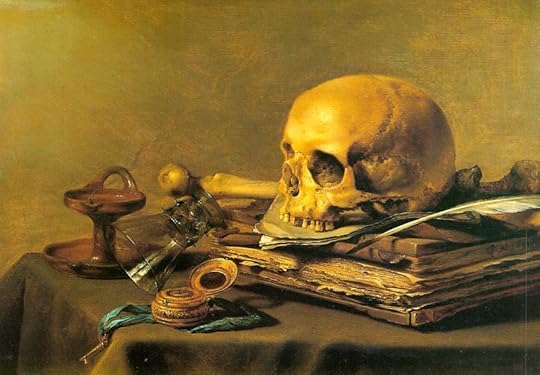
Vanitas by Philippe Champaign
This painting is orderly. It portrays a universe obeying laws of gravity, proportion, and perspective. Recognizable symbols articulate the ideas of the beauty and transience of life.
Merle and Arthur, our leads, despise this sort of art. What they create is instead visceral, bright, and hallucinatory; their worlds are heavily warped by emotion. All that matters is that they are there, in the moment, creating.
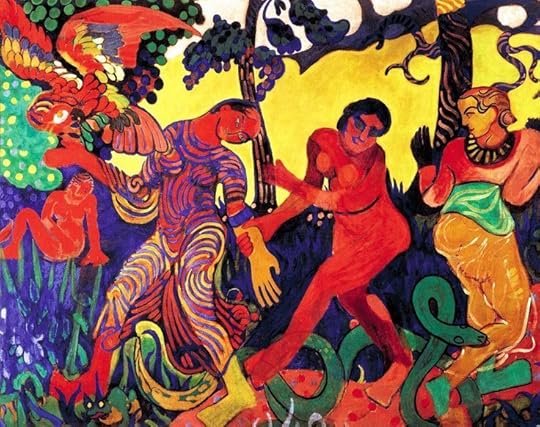
The Dance by Andre Derain
“[Poetry] was a form of incantation, a means of welding the world inside his head to the one that surrounded him, words the fiery chain that bound it all together.”
Though these two artists have a chasm of time and language separating them, their shared passion brings them together. In two night-long meetings, they explore each other’s worlds and find their voices. It is a shimmering and impacting story of awakening.
I think the duo would scoff at me, trying to dissect their experience - these are not graphable things. They are things to feel. Why analyze the great mystery of human emotion when you can let it sweep, like a hurricane, through you? Either way, RADIANT DAYS is a radiant book, brimful with raw emotion and intense writing.

January 4, 2014
I received this book from a friend for a recent birthday. She told me it was YA fiction and I often like YA fiction (have been surprised at the quality of writing in this genre in recent years) so I was appreciative and curious.
This book is a hard one to classify however it does seem to fall in the "fantasy" realm while at the same time much of what is portrayed is in a realistic manner (in other words the fantasy element of it does not form the entire basis of the narrative -- it is more of a device at a few points in the story, in my opinion).
The novel alternates its narrative between a young art student, Merle, living in Washington, DC in the late 1970s and the poet, Arthur Rimbaud, living 100 years earlier in France. Both of these characters are adolescents estranged from their families -- each of them has strong unique artistic talents and their talent form a strong backdrop to their lives. The struggles of their lives as they try to cope with relationships as well as finding their way in the world makes for a good read. How Merle's and Arthur's lives intersect is where the novel takes a turn yet it isn't so over the top that the reader finds this element jarring.
There is another character, Ted, who emerges later in the story who becomes a strong part of the narrative as well. This I found interesting as it brought in the element of the mentor whose wisdom and spirit is mysterious and sad at the same time.
This book is a hard one to classify however it does seem to fall in the "fantasy" realm while at the same time much of what is portrayed is in a realistic manner (in other words the fantasy element of it does not form the entire basis of the narrative -- it is more of a device at a few points in the story, in my opinion).
The novel alternates its narrative between a young art student, Merle, living in Washington, DC in the late 1970s and the poet, Arthur Rimbaud, living 100 years earlier in France. Both of these characters are adolescents estranged from their families -- each of them has strong unique artistic talents and their talent form a strong backdrop to their lives. The struggles of their lives as they try to cope with relationships as well as finding their way in the world makes for a good read. How Merle's and Arthur's lives intersect is where the novel takes a turn yet it isn't so over the top that the reader finds this element jarring.
There is another character, Ted, who emerges later in the story who becomes a strong part of the narrative as well. This I found interesting as it brought in the element of the mentor whose wisdom and spirit is mysterious and sad at the same time.
January 14, 2014
I posted on Illyria not too long ago, but had to add a little bit more from Elizabeth Hand's newest, Radiant Days. Her language is a joy to read, tantalizing senses, imagination and that romanticism that stirs inside us when we read Shakespeare. Each word accompanies the others on the page in a dance that takes several reads to fully appreciate. Here are just a few of those moments:
"As if someone else, something else, moved there unseen"
"In love as in theatre, I had never had any magic"
"True, I never flamed out, and I never shone the way my cousin had, not even for a moment"
"Carpets in their muted colors, unfurling across wooden floors, white lace curtains in the windows, wisteria blooming on the porch outside and the echo of footsteps on the stairs above"
"when the entire house seemed knit around me"
"Stars seemed to stir in the wind"
"I didn't want to touch that painting, I wanted to be in it"
"Dieu me conduisse"
Her character may not have had any magic, but Ms. Hand's words are soaked in that stuff that turns zephyrs of wind and clouds into ancient creatures that gave birth to our legends and stories of times long gone and places we may never find.
A sincere thanks! That was an amazing read!
"As if someone else, something else, moved there unseen"
"In love as in theatre, I had never had any magic"
"True, I never flamed out, and I never shone the way my cousin had, not even for a moment"
"Carpets in their muted colors, unfurling across wooden floors, white lace curtains in the windows, wisteria blooming on the porch outside and the echo of footsteps on the stairs above"
"when the entire house seemed knit around me"
"Stars seemed to stir in the wind"
"I didn't want to touch that painting, I wanted to be in it"
"Dieu me conduisse"
Her character may not have had any magic, but Ms. Hand's words are soaked in that stuff that turns zephyrs of wind and clouds into ancient creatures that gave birth to our legends and stories of times long gone and places we may never find.
A sincere thanks! That was an amazing read!
June 20, 2020
"I can't thank you enough for everything you did for me, I feel it more today than ever. I'll make it up for you someday. I'll do something even if I die trying- I swear. I have so much to say."
4.5/5
I hate historical fiction. It sucks. It over glorifies stuff and sometimes it's very biased and hurtful. Of that you can surmise that I didn't know this book was historical fiction when I picked it up the first time around.
I don't remember why I didn't finish it. I chose it because it was narrated by Cassandra Campbell and it had a pretty cover. It was kind of fun the first time.
Going through with it I felt so much stuff. I imagined wandering the streets -can't do much wandering now, COVID and all- and writing pretty stuff. I imagined meeting someone and talking to them, and I was equally afraid and content.
I loved Rimbaud, the fictional one, at least. I'm planning on getting to know the real one. I had a classics crush on Lewis Carroll. I remember seeing a photo of him and feeling something. I felt connected to him and I obsessed over his life story. I'm still afraid to read Alice, but I really really want to.
So anyway, this book is amazing. Please do read it.

March 10, 2015
My first time I reading of Radiant Days was a library copy, and it unfolded as one of my disturbing reading experiences. Graffiti was written in the margin, appropriate to the subject matter and the story's invitation to participate in an edgy leap away from the constrictions of society and toward the soft borders of genuine art. It wasn't that. It wasn't that at all, in any way. The graffiti were simple frowny faces, drawn on the pages in which Merle is together with Clea, her first lover. To me, it was shocking, as though someone with a sturdy, condemnatory spirit were standing over my shoulder while I read, telling me how to respond to what I read.
In general, though, I approve of graffiti that isn't simply tagging or other mindless assertions. I consider the graffiti in the library book to be mindless, blithering, not worth expressing.
Needless to say, I acquired my own copy of the book. I didn't know that the reader must beware other, uninvited readers, or commentators--I doubt much reading was going on with the frowny face scrawler.
In general, though, I approve of graffiti that isn't simply tagging or other mindless assertions. I consider the graffiti in the library book to be mindless, blithering, not worth expressing.
Needless to say, I acquired my own copy of the book. I didn't know that the reader must beware other, uninvited readers, or commentators--I doubt much reading was going on with the frowny face scrawler.
This entire review has been hidden because of spoilers.

December 17, 2012
3 1/2, perhaps. Sort of a time slip, sort of a paean to art and the "artistic vision," I ended up liking this a bit more than I expected. There are definite things to appreciate here - I feel like Hand's portrayal of the 70s-era art scene in NY/DC was particularly strong and could've happily read more about it. Plus, I'd be a terrible Replacements fan if I didn't appreciate some of the more infamous bits of their mythos popping up here, along with (disguised, though it is) of Bob Stinson as a weird sort of guardian angel and time traveller.
Being sort of picky, though, I found Merle's scenes - and her world - so much more vividly realized than Rimbaud's. And I don't think I got as strong a sense of him, as a character, as I would've liked. That's maybe inevitable, since Hand gets to create Merle from the ground up and with Arthur she's working within the confines of history (to a degree). At times, though, it feels very pronounced.
Being sort of picky, though, I found Merle's scenes - and her world - so much more vividly realized than Rimbaud's. And I don't think I got as strong a sense of him, as a character, as I would've liked. That's maybe inevitable, since Hand gets to create Merle from the ground up and with Arthur she's working within the confines of history (to a degree). At times, though, it feels very pronounced.

August 31, 2013
This is an intersecting dual time novel. In 1978, Merle is attending art school in New York, an experience far different than her rural upbringing. In the 1870’s, the poet Arthur Rimbaud is on the cusp of his poetic powers. Merle does not fit in with her fellow students, but strikes up a relationship with one of her teachers. She becomes intrigued by graffiti art and the underground grittiness of New York and begins to place her own tag of “Radiant Days” around the city. On the other side of the ocean in his own time, Arthur is struggling to get out from the influence of his mother and make his way in the world. In curious circumstances, and at different times, an encounter with a fisherman causes each to visit the other’s world/time and make a deep and curious connection, each eventually providing inspiration for the other. As in her other works, the author does not hold back from the dark and tough side of life, providing realistic and poignant descriptions.

June 3, 2012
Pairing magic realism with historical fiction, this lyrical and multi-layered title conveys the passion that drives artists to make things that last. A homeless guitarist who fishes by the light of the moon gives a 1970s graffiti artist a key that allows her to spend one night with her kindred spirit, Arthur Rimbaud, the 1870s teenage poet whose work continues to inspire musicians and other creative souls.
Original translations of Rimbaud's poetry appear throughout and a bibliography of resources about his life and times is included.
I was surprised that Merle's sunburst tag wasn't featured on the cover - but that leaves things wide open for readers to create their own versions of Radiant Days' graffiti - maybe during sidewalk chalk graffiti art library programs or in an interactive online gallery for fans of the book.
Original translations of Rimbaud's poetry appear throughout and a bibliography of resources about his life and times is included.
I was surprised that Merle's sunburst tag wasn't featured on the cover - but that leaves things wide open for readers to create their own versions of Radiant Days' graffiti - maybe during sidewalk chalk graffiti art library programs or in an interactive online gallery for fans of the book.
Displaying 1 - 30 of 77 reviews